

We use cookies to ensure our website works properly and to personalise your experience. Cookies policy
College of Pharmaceutical Sciences, Puri
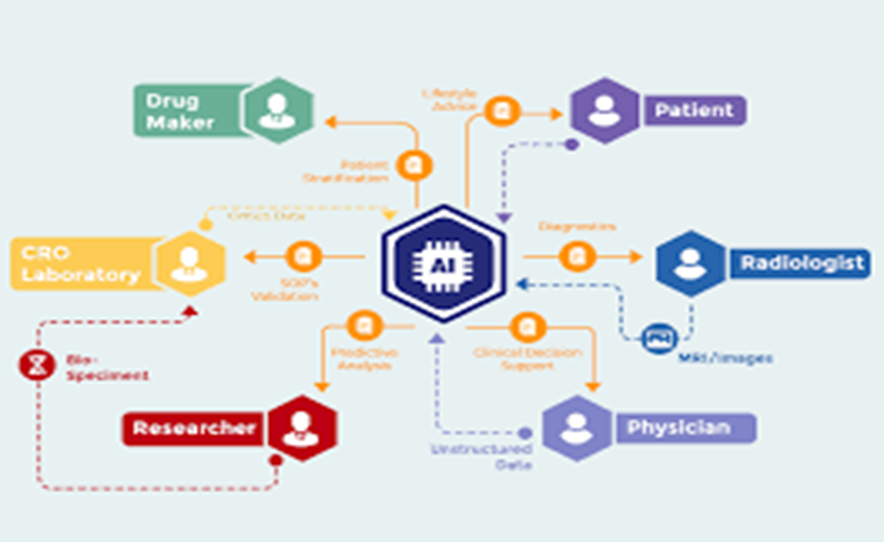
Artificial intelligence (AI) is a field of study within computer science focused on developing intelligent systems and algorithms that can perform tasks and make decisions in ways that mimic human cognitive processes. There are various branches includes in artificial intelligence i.e. Knowledge Engineering, Robotics, Machines Learning, Natural Language Processing. Various pharmaceutical industries using AI in manufacturing sector like roche, Pfizer, GlaxoSmithKline etc. AI used in pharmacy sector to became store the data and work become faster.AI used research and development, treatment of disease, manufacturing industry.
Artificial intelligence (AI) is a field of study within computer science focused on developing intelligent systems and algorithms that can perform tasks and make decisions in ways that mimic human cognitive processes. This includes the creation of sophisticated computer programs capable of learning from data and adapting their behavior to achieve results analogous to human attention and reasoning 1.Artificial intelligence (AI) encompasses the simulation of human cognitive processes by computational systems. This simulation involves several key components: the acquisition of data, the formulation of rules for processing and utilizing this data, the derivation of conclusions either approximate or definitive and the capacity for self-correction and iterative refinement 2.Artificial intelligence (AI) is acknowledged as playing a critical supportive role in efforts to combat and control viral infections, with the potential to significantly expedite the discovery and development of solutions within the biotechnology sector 3.Artificial intelligence (AI) solutions are progressively integrated into the processes of data collection, analysis, and utilization. AI facilitates the efficient management of large volumes of data, with automation playing a pivotal role in enhancing effectiveness and efficiency 4.Pharmacists are positioned to enhance patient outcomes by optimizing medication use, thereby improving overall health and reducing healthcare costs. Moreover, the integration of artificial intelligence (AI) tools into pharmacy practice is anticipated to broaden opportunities for interdisciplinary collaboration with other healthcare professionals 5.Advancements in artificial intelligence (AI) technology can be categorized into two principal domains. The first category encompasses traditional computing methodologies, including expert systems, which are designed to replicate human expertise and generate conclusions based on pre-defined knowledge structures 6.It is projected that artificial intelligence (AI) technologies have considerable potential to revolutionize various dimensions of pharmacy practice, encompassing the drug supply chain, safety measures, medication management systems, and patient care processes 7.Through ai tasks that ordinarily require human inteligence, including sensing, thinking, learning, decision making are performed by machines 8.
History
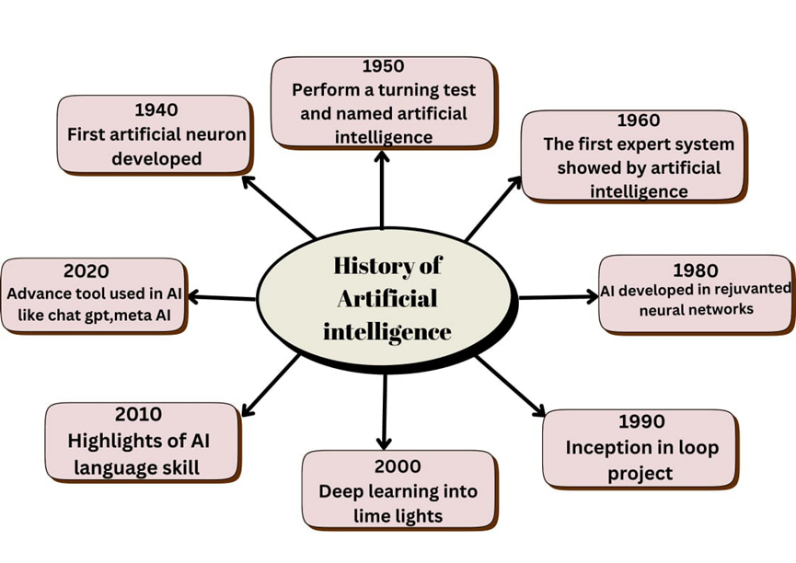
The history of artificial intelligence spans several decades with roots in computer science , mathematics and psychology. The term artificial intelligence was coined by John McCarthy. Rule based systems, problem solving and machine learning were explored.AI research focused on representing knowledge and building expert systems that mimicked human decision making. Funding and interest declined due to limitations and criticism of AIs potential. Advance in machine learning, neural networks and data analysis revived AI research. The availability of large datasets and computational power enabled significant break throughs in deep learning, leading to applications like image recognition, natural language processing and autonomous vehicles 9-12.
Branches of artificial intelligence:
Types
There are various type of artificial intelligence I.e.
Type -1 AI is further divided in to 3 types I.e.
Type -2 AI is again divided into 4 types I.e.
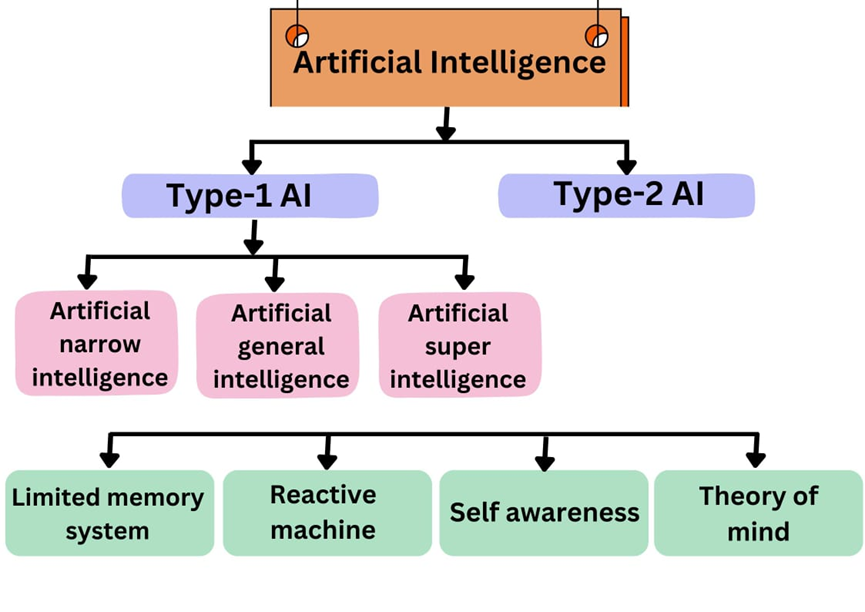
Schematic Diagram of Classification of Artificial Intelligence
Artificial Narrow Intelligence:
This system is also called weak AI. This system is engineered and trained to execute a specific, narrowly defined function, such as facial recognition, autonomous driving, chess playing, or traffic light management. For example, virtual personal assistants like Apple's Siri and social media tagging systems are designed for these specialized tasks 15.Precise functions are executed by artificial narrow intelligence systems with in a limited scope and capabilities beyond their designated function are not exhibited. These systems abilities remain restricted compared to human-to-human inteligence16 .Artificial narrow intelligence is designed for specific tasks and cannot be applied to other domains with un familiar environments beyond its training data 17.
Artificial General Intelligence
This is also referred to as Human-Level AI. It aims to replicate human cognitive abilities, allowing it to tackle new and unfamiliar tasks by finding solutions on its own. AGI (Artificial General Intelligence) is capable of performing any task that a human can do. The concept of artificial general intelligence is not bound to particular human traits. Certain properties of human intelligence may be universal among powerful AGIs but these have not been clearly identified given the current limited understanding of general intelligence 18 .
Artificial super intelligence
The term "brainpower" refers to cognitive capabilities, which can encompass a broad range of intellectual activities such as drawing, mathematics, space exploration, and more. This concept spans a spectrum from computational systems that are marginally more adept than human cognition to those that exhibit intelligence levels up to a trillion times greater than that of humans. This range includes everything from systems with computational capacities slightly exceeding human intelligence to those with exponentially superior cognitive abilities across various domains, including both scientific and artistic fields 19.
Limited based system
The system features a limited memory architecture that utilizes historical data to tackle diverse problems. In the realm of autonomous vehicles, this architecture excels at decision-making by referencing previously recorded observations to guide future actions. However, these observations are not stored permanently, meaning that the system does not retain all historical data indefinitely.
Reactive machine
This category encompasses systems designed for specific, single-purpose applications and is characterized by the absence of a memory system, which precludes the ability to leverage past experiences. These are known as reactive machines. A prominent example of such systems is IBM’s chess program, which is capable of recognizing chessboard pieces and making predictions based solely on the current state of the board, without integrating historical data.
Theory of mind
The "Theory of Mind" suggests that human decision-making is shaped by individual thoughts, intentions, and desires. Currently, there is no AI system that embodies this level of cognitive understanding, as such systems do not yet exist.
Self-awareness
It exhibits self-awareness, including a form of self-consciousness.
Technology used in artificial intelligence
AI is instrumental at multiple stages, spanning from drug discovery to product management.AI systems should integrate various technologies, including neural networks, advanced drug screening and design techniques, and Quantitative Structure-Activity Relationship (QSAR) technology for comprehensive data analysis. In pharmaceutical manufacturing, AI facilitates automated and personalized production processes, enhances error detection, and ensures rigorous quality control 20.
List of various pharma industry using artificial intelligence 21-23
|
Sr. No. |
Industry name |
Artificial intelligence |
|
1 |
Astellas pharma |
Biovista |
|
2 |
Bayer pharma |
Xbird |
|
3 |
Roche |
Bina |
|
4 |
Abbvie |
Aicure |
|
5 |
GlaxoSmithKline |
Exscientia |
|
6 |
Pfizer |
Xtalpi |
Different Barriers of artificial intelligence in pharmacy
AI technology may encounter multiple obstacles that hinder its adoption, performance and advancement. The implementation of AI technology in the field of pharmacy may be obstructed by a lack of awareness and comprehension regarding its applications 24.Pharmacists may exhibit resistance to change and reluctance to adopt AI technology due to apprehensions about potential job displacement. This resistance is likely rooted in insufficient awareness of the potential benefits that AI can provide to pharmacy practice 25. In the context of barriers to effective AI implementation in pharmacy settings, the absence of adequate AI infrastructure, particularly in resource-constrained environments, can considerably restrict the adoption of AI technologies.
Application of artificial intelligence
Artificial Intelligence in telepsychology:
The biological nervous system provides the foundational principles for the design and operation of artificial neural networks (ANNs).A network of interconnected computer processors, analogous to biological neurons, performs parallel data processing. The first artificial neuron utilized a binary threshold activation function. The multilayer feedforward perceptron, consisting of distinct input, hidden, and output layers, emerged as a widely adopted model in neural network architecture.
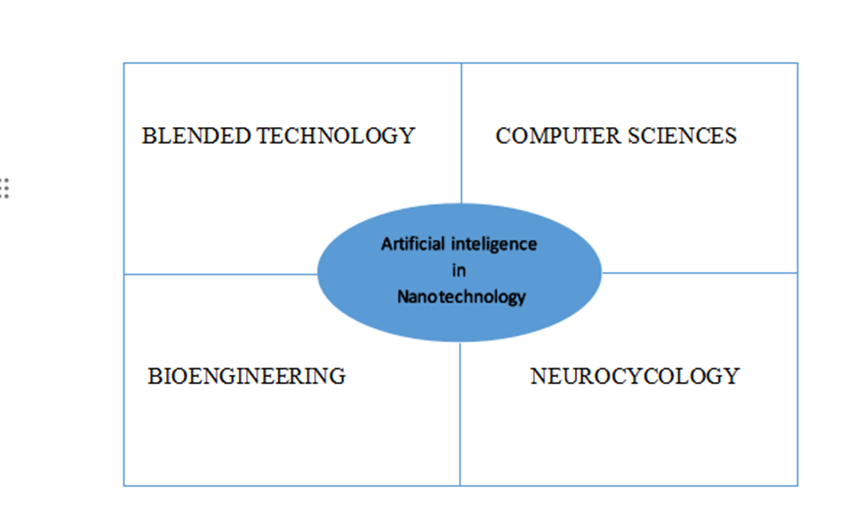
Artificial intelligence in nanotechnology:
The increasing production times, elevated costs, and decreased productivity associated with current molecular commodities have underscored the growing significance of artificial intelligence in the pharmaceutical industry, particularly in the domains of pharmaceutics and drug delivery 21. Nanoparticles play a crucial role in drug delivery systems, and artificial intelligence algorithms assist researchers in designing and optimizing these nanoparticles for targeted applications26.
Artificial intelligence in Research and Development:
Pharmaceutical companies worldwide are progressively integrating advanced machine learning (ML) algorithms and artificial intelligence (AI)-based tools to enhance the drug discovery process. These state-of-the-art technologies are adept at detecting complex patterns within large, multifaceted datasets, thereby facilitating the resolution of challenges associated with the complexity of biological networks 27.
Artificial intelligence in Disease prevention:
Pharmaceutical companies have the opportunity to harness artificial intelligence (AI) for the development of therapeutic interventions for both common diseases, such as Alzheimer's and Parkinson's, as well as for rare diseases. However, the pharmaceutical industry has traditionally concentrated less on rare diseases, largely due to the limited return on investment (ROI) relative to the considerable time and financial resources required to develop and commercialize treatments for these conditions 28.
Challenges faced in AI:
CONCLUSION:
Artificial intelligence (AI) is designed to augment human capabilities, enhance operational efficiency, and tackle complex challenges across diverse sectors, including healthcare, education, business, and environmental sustainability. Artificial intelligence (AI) is poised to catalyze a transformative shift in human history. By augmenting human cognitive capabilities, AI has the potential to drive significant advancements in human civilization, provided that its deployment is carefully managed to ensure it remains beneficial to society.
REFERENCES


Anup Kumar Patra, Basanta Kumar Behera, Artificial Intelligence: Implemented in Pharmacy Sector, Int. J. of Pharm. Sci., 2025, Vol 3, Issue 10, 2820-2827. https://doi.org/10.5281/zenodo.17452154
 10.5281/zenodo.17452154