

We use cookies to ensure our website works properly and to personalise your experience. Cookies policy
Department of Pharmacy Practice, Srinivas College of Pharmacy, Mangalore Karnataka -574143
Caffeine is a popular commodity among students. Over the past ten years, caffeine consumption has substantially increased resulting in numerous side effects that are worrying in the longer run. The purpose of this study was to determine; the overall aspects of Caffeine consumption in students, to assess the students’ awareness on potential health hazards of excessive caffeine consumption, to analyze the reason behind it and its early addiction. An online survey was conducted using a pre-validated questionnaire with a total of 110 participants for the study, in the community. The collected data was analyzed using Microsoft Excel and Google spread sheets. 94.6% of the total participants have reported to consume caffeine wherein, Coffee (45%) and tea (32.3%) were the most consumed caffeinated products. Many students have claimed to acquire improved focus, with heightened memory prowess, under caffeine consumption- although significant number of participants experienced sleep disturbance and insufficiency. The students experienced alertness, alongside excitement and random headaches whilst 31.1% of the participants reported of feeling agitated and unable to initiate tasks in the absence of Caffeine. The participants consumed caffeine at amounts that might have had negative impacts on their health and due to their lack of knowledge, seemed to have been unaware of the amount of caffeine they were ingesting. Young adults at large have been found over consuming Caffeine on a daily basis; necessitating Public Health sector intervention to steer clear of side effects like caffeine withdrawal and addiction.
Caffeine is one of the most widely used commodities because of its extensive presence in many of the commonly consumed beverages such as tea, coffee, cocoa, energy drinks, cola.[1] Over the past decade, there has been a steady rise in caffeine production along its consumption. In 2017–2018, the global production of coffee beans from over 60 countries achieved approximately 9513 million tons, amassing US$ 200 billion annually. [2] In 2023–2024, the consumption of coffee beans was over 177 million 60-kg packages, a striking rise as compared to the previous years. [3] Globally, the demand for caffeine and its commodities in the market now is estimated to be more than $10billion and is expected to further rise with the current trend of energy drinks that has been swiftly taking over the beverage industry. [4] As it is much readily accessible to the general public as consumable beverages, drinks and OTC drugs, its effects on a broader scale are often overlooked. Caffeine at smaller dose does indeed help to enhance the brain activity and alertness, but higher doses have been found to cause severe psychological and physiological adverse effects accompanied with withdrawal symptoms in the long run. Caffeine dependence is now incredibly prevalent amongst teens and young adults, exerting its influence on academic performance along with its unintentional abuse and addiction. A key safety concern involving the consumption of caffeinated energy drinks concurrently with alcohol, shows the stimulant effect of caffeine conceals the signs of acute intoxication, thereby impairing coherent judgement. [5] Regardless, consuming caffeine on its own or in combination with other stimulants is associated with high risk-taking behavior, although it is difficult to determine in the study if the students are merely attracted to the stimulants or are blatantly displaying the side effects of caffeine addiction. Caffeine alongside Stimulants is known to impact health; exacerbate heart conditions, epilepsies, sleep and mental disorders, including risk behaviors that of which are positively co-related. [6] Public health regulators and the global figures of caffeine consumption, demand for proper regulations overseeing its distribution. Despite claims of public safety from the larger industries, the underlying harm in caffeinated beverages and products remains a subject of serious debate.
OBJECTIVES
METHODOLOGY
Study type: The study was conducted through online survey using structured questionnaires to assess the knowledge, attitude practices towards the effects of caffeine among students. The questionnaire was created, designed and disseminated using Google forms platform. Online questionnaire was posted through social media outlets. Participants were encouraged to fill out the form and assist in sharing the questionnaire with their family members, friends and relatives. Moreover, participants were limited to one response to avoid duplicated or exaggerated data.
Study site: The study was based on an online survey which was conducted among the Community
Sample size: The study enrolled people during the time schedule allotted for the project including other circumstances.
Study Duration: The study was conducted for duration of one month.
Inclusion criteria: willing individuals of either sex within the age group of 18-25
Exclusion criteria: population of either sex below the age of 18 and above 25
Data source: An online survey was conducted with the help of an questionnaire in order to collect data from the student population of an age group of 18 to 25 to evaluate their daily caffeine consumption. Articles were collected from online sources such as PUBMED, FDA, NCBI, GOOGLESCHOLAR and questionnaires were prepared using these articles. The data obtained from this survey was analyzed, assessed and interpreted.
RESULT
The present study was aimed to determine the overall aspects of Caffeine consumption among students. An online survey was conducted using a pre-validated questionnaire where a total of 105 participants participated for the study. 94.6% of the total participants have reported to consume caffeine. The Socio-Demographic details (Table 1) show that 53% were in the age range of 18-21 years and 43% were in the age range of 25 years of age. 69% comprised of Female participants whilst 31% were of the total male participants. Majority of the participants, 73.9% were University students & 21.7% college students.
Table: 1 Socio-Demographic Details of The Participants (N=110)
|
Characteristics |
Percentage |
|
Age 18-21yrs 22-25yrs |
53.3% 43% |
|
Gender Female Male |
69% 31% |
|
Educational Status University College |
73.9% 21.7% |
To analyze the impact of caffeine on young adults, consumption frequency of these beverages in the last 30days was enquired, of which nearly 72% reported of caffeine consumption on a daily basis while the rest 13% claimed to have casually consumed atleast one of the caffeinated products during the time. The preferred choice of caffeine was found out to be coffee 45%, followed by tea 32% and then energy drinks 23%. (Fig. No2)

Fig.No2: Preferred choice of caffeine
The regularity of caffeine consumption (Table 2) depicted , 46.7% of the participants consumed caffeine daily and 39.2% were frequent consumers, with a routine use from >5years (77%), 5years(11%) and 2years or less(12%).(Fig.No3) This data helps to visualize the passage of time where casual consumption gradually morphs into addiction; wherein many students who reported to have had consumed caffeinated beverages daily have also been consuming it for longer than 5years.
Table: 2 Regularity of Caffeine Consumption
|
Characteristic |
Percentage |
|
Regularity: Daily Frequently |
46.7% 39.2% |
|
Duration: >5years 5years 2years or less |
77% 11% 12% |

Fig.no:3 Regularity of caffeine Consumption
Analyzing the quantity as given 250ml per serving, 39% have 2 servings, 26% of the participants have 3 servings and 15% have 5 servings (Fig.No4), at the morning interval of 37.4% and at evenings with a 42%, being the most preferred time. (Fig.No5)
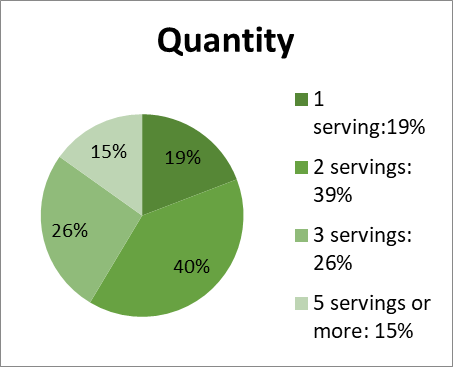
Fig.no:4 Quantity of caffeine (250ml/serving)
Fig.no:5 Favored interval
The participant’s reason for their energy drink consumption varied widely; to improve focus at work, accelerate memory potentiality, improved athletic performance and taste among many others (Table 3).
Table 3: student’s motivation to consume energy drinks
|
Motivation for students |
Students who identify (%) |
|
Improve focus at work |
65 |
|
Accelerate memory potentiality |
61 |
|
Taste |
52 |
|
Improved athletic performance |
41 |
|
Improved academic performance |
36 |
|
Insufficient sleep |
17 |
|
Enhanced energy |
15 |
The effects of caffeine consumption were analyzed in detail; 31.1% of the participants who were routinely consuming caffeine, were found to feel agitated and unable to carry their tasks in its absence. According to the study, the majority confirmed consumption of caffeine before bed interfered with their sleep pattern and only 35.9% experienced an improvement in academic performance with 32.6% resorting to an elevated level of caffeine especially during the exam periods. The respondents were assessed for characteristic reaction to caffeine consumption (Table 4); on which they were found to experience headache (43%), excitement (55.7%), exceptional alertness (64.2%) at large. (Fig.No6)
Table 4: Characteristic effect of caffeine and its influence
|
Characteristic |
Percentage |
|
Effect of caffeine |
|
|
Agitation |
31.1% |
|
Headache |
43% |
|
Excitement |
55.7% |
|
Alertness |
64.2% |
|
Increased anxiety |
41.9% |
|
Drowsiness |
32.8% |
|
Influence |
|
|
Media |
36.5% |
|
Direct shop |
32.2% |
|
Through people |
28.8% |
|
Taste of the product |
46.5% |
|
Particular company brand |
25.8% |
|
Influence from an individual |
13.8% |
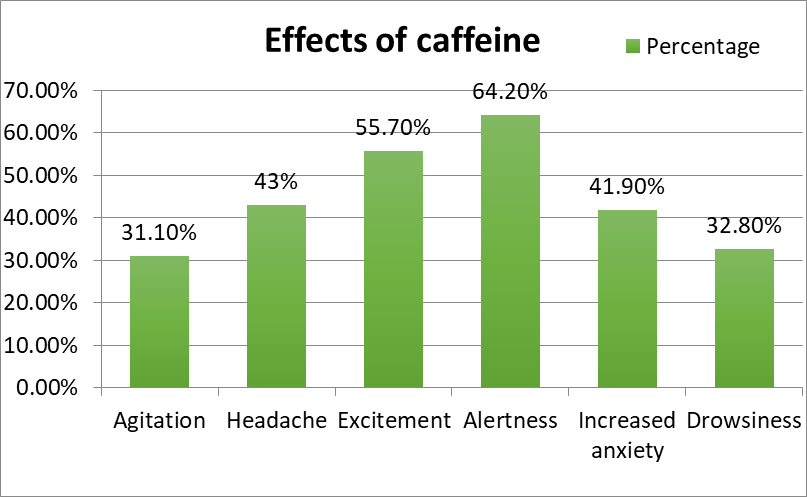
Fig.No6: Effects of Caffeine
Amongst the students, Media (36.5%) influence played a major role leading to the discovery of various caffeinated products, followed by direct shopping (32.1%) and through recommendation by other people (28.8%) The taste of the product (46.5%) remained subjective to the preference of caffeine, followed by the particular company brand (25.8%) and a reliable influence of a celebrity/individual (13.8%) featured along with it. This helps pinpoint the mode of production and distribution of caffeinated products to reach its target audience. (Fig.No7)
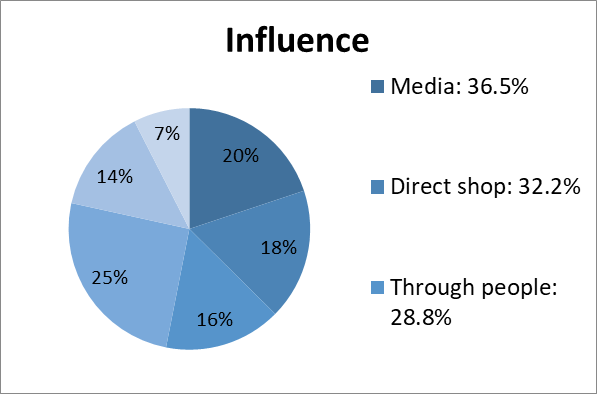
Fig.no7: Influence for consumption
DISCUSSION:
A great deal of population consumes caffeine on a regular basis in varying amounts, which now warrants concerns from the scientific community regarding the harmful impacts of Caffeine on human health. Attributed to its CNS stimulant effects, caffeine is found to have a number of significant problems with gradually increasing dependence that has a bearing on one's physical, psychological, academic, and social well-being. Journal of Psychiatric research reveals that enhanced performance appeared to be an appropriate candidate for an a priori caffeine use motivation scale. For many subjects, caffeine’s effects reflect its stimulant properties, in which these effects included enhanced psychomotor performance, alertness, and relief of fatigue. [6] This study showed that majority of the respondents were consuming caffeine at a fairly high amount (i.e. >350ml). This degree of caffeine consumption is typically linked to withdrawal symptoms and indicators of caffeine intoxication if discontinued. Due to their lack of attention to detail and misunderstanding of the numerous names caffeine can be labeled under on product labels, prompted to surmise that the participants may not have been reading the caffeine information on the labels and hence were unaware of the entire amount of caffeine they were ingesting. The participants were also found to believe that caffeine consumption before bed does not hinder their sleep cycle, while this is drastically a misconception with regards of various studies that have proven, caffeine to be leading cause for insomnia and impaired sleep under Health and Science [1] which is ultimately attributed to the participant’s lack of knowledge of the effects of Caffeine outside its recommended dose. Aside headache (65%) and excitement (52%) the respondents who participated in this study did not show any other significant side effects unlike a study based in US, according to Clinical Nutrition the college students that were surveyed, many reported using caffeine-containing products induced anxiety, stress, hyperactivity, headache and fatigue. [7]
FUTURE PROSPECTIVES
Proper awareness and inclusion of adversities of caffeine consumption overseen by Public Health sectors to eventually incorporate it into basic education targeting young audience, may significantly reduce the harmful effects.
CONCLUSION
The present study concludes that, students at large have been found to overuse Caffeine, out of its recommended dose. This has been mainly attributed, to the participant’s lack of knowledge on the effects of caffeine both psychologically and physiologically. Hence, there is a need for awareness programs regarding the use and misuse of caffeine, focusing on its long-term effects and the eventual addiction to it. The consumption, sale and manufacturing of caffeinated products being on a steady rise and the minimal information on the labeling, as opposed to Caffeine less often being referred to as a stimulant ‘drug’ serves as one of the main factors to this problem. Unrestricted sale and legal availability of caffeine to minors, ploughs a path to long term negative effects and hence need to be strictly monitored by the adults. As for the young adults, health risks are prominent with continuous caffeine consumption on account of which, Health education and the Government should impose regulatory measures on sale, advertisement, maximum caffeine content, health consequences and safety limits of caffeine containing products, alongside providing information and awareness so that it will be easier to recognize and steer clear of side effects like caffeine withdrawal and addiction.
ACKNOWLEDGEMENTS
I would like to extend my gratitude to the Principal, Dr A R Shabaraya, for guiding me throughout. I would also like to thank my friends for their invaluable support to carry out his research work.
REFERENCES


Jessica Maryiola Fernandes*, A. R. Shabaraya, Effects of Caffeine Consumption Among Students; A Community Based Study, Int. J. of Pharm. Sci., 2025, Vol 3, Issue 12, 209-216. https://doi.org/10.5281/zenodo.17785073
 10.5281/zenodo.17785073