
Professor, Crescent college of pharmaceutical sciences, Kannur, Kerala, India
Hair styling products are commonly used to improve appearance, but long-term use of synthetic products may cause scalp irritation and hair damage. This study focused on the formulation and evaluation of a herbal hair wax stick containing natural ingredients that provide both styling and hair care benefits. Ethanolic extracts of Tulsi (Ocimum tenuiflorum), Amla (Phyllanthus emblica), and Bhringraj (Eclipta prostrata) were incorporated into a wax base prepared using beeswax, cetostearyl alcohol, soft paraffin, and natural oils. Three formulations (F1, F2, and F3) were prepared and evaluated for physical properties such as color, odor, pH, spreadability, washability, and stability. Phytochemical analysis confirmed the presence of beneficial compounds like flavonoids and phenolics. The formulations were also tested for antimicrobial activity against Escherichia coli and antioxidant activity using the DPPH method. Among them, F3 showed the best overall performance with suitable pH, good spreadability, and higher antimicrobial and antioxidant activity. The study concludes that the herbal hair wax stick is safe, stable, and effective, and can be a natural alternative to synthetic hair styling products.
Cosmetics are products used to clean, beautify, and improve the appearance of the human body, and their use dates back to ancient times. The word cosmetics comes from the Greek term kosmeticos, meaning “to adorn.” Over time, cosmetics have developed from traditional preparations into scientifically regulated products as defined under the Drugs and Cosmetics Act, 1940. Although modern cosmetics are usually tested for safety, concerns about synthetic chemicals and their possible side effects have increased interest in natural and herbal products. As a result, herbal cosmetic formulations are becoming more popular because they are considered safer and offer additional health benefits. Hair wax sticks are one such product, widely used for styling as they provide hold, texture, and shine while helping to maintain healthy hair. This study focuses on the development of an Herbal Hair Wax Stick using natural ingredients like Amla, Tulsi, and Bhringraj, which are known for nourishing the scalp, strengthening hair, and providing antioxidant benefits. The formulation aims to give effective styling along with hair care benefits, making it a safer and more eco-friendly alternative to chemical-based hair waxes.
Hair wax is a commonly used cosmetic product for styling and shaping hair, providing hold, manageability, and shine or texture to hair fibre. It is a versatile shaping product that conditions the hairstyle while enhancing density, shine, smoothness, and organization. Hair wax is a solid substance with properties similar to hair gel, but its waxy texture prevents hair from hardening, keeping it supple and bouncy throughout the day. When applied correctly, its nourishing properties help prevent dryness, improve the appearance of damaged hair, and reduce hair breakage.
ADVANTAGES OF HERBAL HAIR WAX
Herbal hair wax offers several notable advantages due to its use of natural and plant-based ingredients such as beeswax, Amla, Tulsi, Bhringraj etc. these ingredients nourish the scalp and hair while providing medium hold for styling, making herbal hair wax a healthier alternative to synthetic styling products.
Unlike chemical-based waxes, herbal variants are free from parabens, sulphates, and artificial fragrances, thereby reducing the risk of irritation, allergic reactions, and long-term damage to hair.
They also offer added benefits such as moisturizing dry hair, preventing dandruff, and strengthening the hair shaft.
This formulation is eco-friendly and biodegradable, appealing to environmentally conscious users.
PLANT DESCRIPTION OF OCIMUM TENUIFLORUM
Tulsi (Ocimum tenuiflorum) is a revered aromatic herb significant in both Ayurvedic medicine and Hindu tradition, particularly within Vaishnavism. It is obtained from the leaves of plant Ocimum tenuiflorum of the family Lameaceae. Morphologically, the plant is characterized by its simple, ovate leaves arranged in an opposite pattern, featuring serrated margins and a reticulate venation system. The leaves, which typically measure 2-4 cm in length, possess a slightly hairy (pubescent) surface and a delicate texture. They are known for a distinctive clove-like aroma due to the presence of eugenol, paired with a pungent, slightly bitter taste. While fresh leaves range from the bright green of Rama Tulsi to the purplish hues of Krishna Tulsi, they consistently transition to a duller brownish-green once dried.
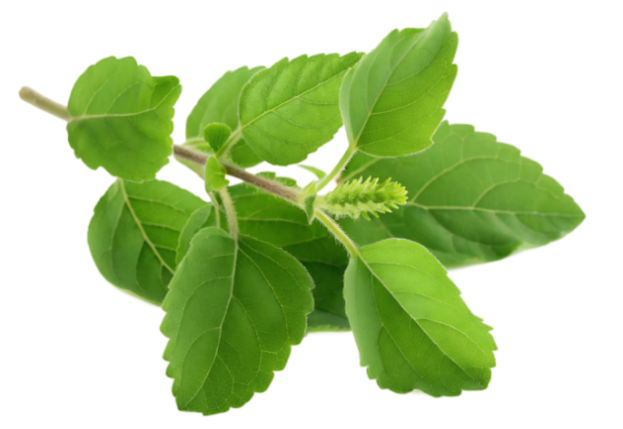
Fig 1: Tulsi
CHEMICAL CONSTITUENTS
Tulsi contains about 0.1-1%volatile oil rich in eugenol, methyl eugenol, camphor, linalool, and caryophyllene, which gives its characteristic aroma and antiseptic properties. It also contains flavonoids like orientin, vicenin, and luteolin, and phenolic compounds such as rosmarinic acid, responsible for antioxidant and anti- inflammatory actions. Other constituents include triterpenoids (ursolic acid, oleanolic acid), tannins, saponins, and vitamin C, which contribute to its adaptogenic, antimicrobial, and hepatoprotective effects.
USES
Tulsi serves as a powerful natural remedy for hair care, primarily due to its potent antifungal and anti-inflammatory properties which effectively treat dandruff and soothe an itchy, irritated scalp. By improving blood circulation to the scalp, it strengthens hair roots to reduce fall and stimulates healthy growth while helping to prevent premature greying.
PLANT DESCRIPTION OF PHYLLANTHUS EMBLICA
Amla is obtained from the fruit of the plant Phyllanthus emblica of the family phyllanthaceae. The odour is strong musky odor, and the taste is primarily sour, astringent, and bitter, often followed by a surprising sweet aftertaste. The flowers are greenish–yellow, and the fruit is light greenish–yellow, quite smooth and hard on appearance, with six vertical stripes or furrows. The fruit is up to 26 millimeters in size and is nearly spherical in shape.
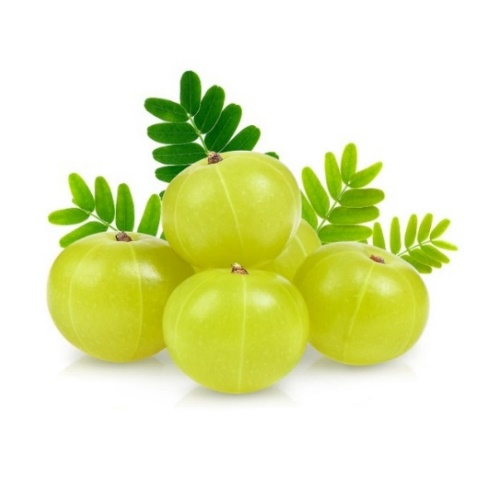
Fig 2: Amla
CHEMICAL CONSTITUENTS
The fruits contain high amounts of ascorbic acid (vitamin C) and have a bitter taste that may derive from a high density of ellagitannins such as emblicanin A (37%), emblicanin B (33%), punigluconin (12%), and pedunculagin (14%). Amla also contains punicafolin, phyllanemblinin A, phyllanemblinin, and other polyphenols such as flavonoids, kaempferol, ellagic acid, and gallic acid.
USES
Amla contains one of the highest concentrations of vitamin C among all fruits, a potent antioxidant that combats free radicals, thereby preventing oxidative stress and premature aging. Rich in vitamin C, antioxidants, and essential nutrients, amla strengthens hair roots, prevents hair fall, and promotes thicker, shinier, and healthier hair.
PLANT DESCRIPTION OF ECLIPTA PROSTRATA
Bhringraj is obtained from the leaves of eclipta prostrata belonging to the family Asteraceae. The odour is characteristic and slight aromatic, with a pungent taste. Each leaf is narrow long and shaped like a lance, rough to touch with tiny hairs seen on the surface. Leaves are 1–4 inches long and 0.5–1 inch wide, and the leaves of Bhringraj are opposite, meaning they grow in pairs facing each other on the stem.
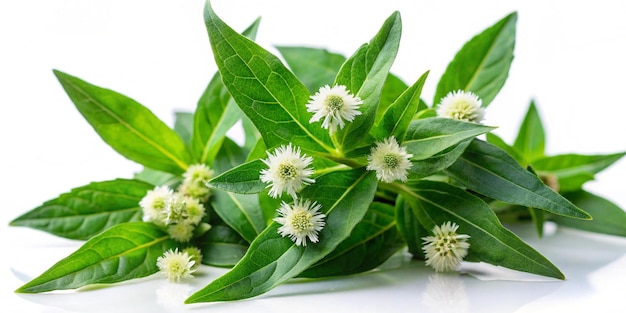
Fig 3: Bhringraj
CHEMICAL CONSTITUENTS
The main chemical constituents of the plant are wedelolactone and Dimethyl wedelolactone; other constituents include ecliptal, ß-amyrin, luteolin-7-O-glucoside, stigmasterol, heptacosanol, hentriacontanol, Ecliptic, Des-methyl wedelolactone, and sixteen polyacetylenic thiophenes.
Top of Form
Bottom of Form
USES
Benefits for hair include prevention of premature greying and providing the necessary nourishment required for hair growth.
MATERIALS AND METHOD
The leaves of Ocimum tenuiflorum (tulsi), fruits of Phyllanthus emblica (amla) and the leaves of Eclipta prostrata (Bhringraj) were collected locally.
EXTRACTION OF OCIMUM TENUIFLORUM
The Tulsi leaves were collected and washed, separated, dried in a hot air oven for 4 hours at 500 C, collected and powdered. Five grams of powdered leaves were taken in a beaker, 20 ml of ethanol were added, and it was kept for maceration for about 2 weeks with shaking. After maceration, the extract was filtered through Whatmann filter paper and the filtrate was taken.
EXTRACTION OF PHYLLANTHUS EMBLICA
The amla fruit were collected, washed, cut into small slices, and kept in a hot air oven for 6–8 hours at 600 C. After drying, they were powdered;
5 g of Amla powder was taken in a beaker, 20 ml of ethanol was added to soak, and it was kept for maceration for about 2 weeks with shaking. After maceration, the extract was filtered through Whatmann filter paper and the filtrate was collected.
EXTRACTION OF ECLIPTA PROSTRATA
The Bhringraj leaves were collected, washed, and dried in a hot air oven for 4 hours at 500 C, then powdered. Five grams of Bhringraj powder were taken in a beaker, 20 ml of ethanol were added, and it was kept for maceration for about 2 weeks with shaking. After maceration, the extract was filtered through Whatmann filter paper and the filtrate was collected.
FORMULATION OF HERBAL HAIR WAX STICK
Accurately weigh beeswax, cetostearyl alcohol, solid paraffin, and cocoa butter, transfer them to a china dish, and melt gently on a water bath. Add the previously mixed coconut oil and castor oil to the molten mass with continuous stirring and allow it to cool slightly. Add the required volume of ethanolic extracts of amla, bhringraj, and tulsi, stir until a uniform and homogenous mass is obtained, remelt, if necessary, pour into suitable molds, and allow it to solidify completely.
Table 1: Formulation of herbal hair wax stick
|
INGREDIENTS |
F1 |
F2 |
F3 |
|
Beeswax |
3g |
3g |
3g |
|
Cetostearyl alcohol |
0.5g |
0.5g |
0.5g |
|
Soft paraffin |
2g |
2g |
2g |
|
Tragacanth |
0.5g |
0.5g |
0.5g |
|
Castor oil |
1ml |
1ml |
1ml |
|
Coconut oil |
2ml |
2ml |
2ml |
|
Cocoa butter |
1g |
1g |
1g |
|
Bhringraj extract |
1ml |
2ml |
3ml |
|
Amla extract |
1ml |
2ml |
3ml |
|
Neem extract |
1ml |
2ml |
3ml |
EVALUATION PARAMETERS OF HERBAL HAIR WAX STICK
Physical parameters: The color of the formulation was checked manually and observed, and the odor was evaluated by applying the preparation on hand and feeling the fragrance.
Determination of pH: The pH was determined using a digital pH meter after 1 g of the formulation was dissolved in 100 ml of newly prepared distilled water for 2 hours, to ensure the pH of the produced hair wax stick is similar to the pH of the hair after 24 hours of use, and the results were recorded.
Spreadability: Spreadability was determined using two slides, with the sample placed between them, 100 g weight applied to spread as a thin layer, followed by 20 g weight on the upper slide, and calculated using the formula S = M·L / T.
Solubility testing: Solubility testing involved assessing solubility in water, ethanol, petroleum ether, acetone, and chloroform by immersing the hair dye stick, observing changes, and noting the results.
Antimicrobial study: The antimicrobial efficiency of the formulation was studied using gram negative Escherichia coli by agar well diffusion test. Sterilized glassware and nutrient agar medium were used, plates were inoculated, wells of 6 mm diameter were filled with the formulation, incubated for 24 hrs at 37°C, and examined for inhibition of bacterial growth.
Antioxidant activity: Six different concentrations of ethanolic extracts (10, 20, 40, 60, 80, and 100 μg/ml) were prepared by serial dilution from a stock solution of 1 mg/ml. Standard ascorbic acid was used, and different concentrations (20, 40, 60, 80, and 100 μg/ml) were prepared similarly from a 1 mg/ml stock solution by serial dilution.
RESULT AND DISCUSSION
PHYTOCHEMICAL SCREENING OF THE EXTRACTS
The phytochemical screening of the ethanolic extracts is summarized in the table
Chemical test for Bhringraj
Table 2: Chemical test for Bhringraj
|
SL NO |
CONSTITUENT |
TEST |
RESULT |
|
1 |
Alkaloids |
Mayer’s test |
+ |
|
Wagner’s test |
- |
||
|
Hager’s test |
+ |
||
|
2 |
Flavonoids |
Shinoda test |
+ |
|
3 |
Triterpenoids |
Liebermann Burchard test |
+ |
Chemical test for amla
Table 3: Chemical test for amla
|
SL NO |
CONSTITUENT |
TEST |
RESULT |
|
1 |
Tannins |
Ferric chloride test |
+ |
|
2 |
Phenolic compound |
Lead acetate test |
+ |
|
3 |
Flavonoids |
Shinoda test |
+ |
Chemical test for Tulsi
Table 4: Chemical test for Tulsi
|
SL NO |
CONSTITUENT |
TEST |
RESULT |
|
1 |
Phenol |
Ferric chloride test |
+ |
|
2 |
Saponin |
Foam test |
+ |
|
3 |
Tannins |
Braemer’s test |
- |
|
4 |
Flavonoids |
Alkaline reagent test |
+ |
EVALUATION PARAMETER
Physical appearance
Table 5: Physical appearance of the formulation
|
SL NO |
PHYSICAL PARAMETER |
F1 |
F2 |
F3 |
|
1 |
COLOUR |
Green |
Green |
Dark green |
|
2 |
ODOUR |
characteristic |
characteristic |
characteristic |
Determination of pH
Table 6: pH of the formulation
|
SL NO |
PARAMETER |
F1 |
F2 |
F3 |
|
1 |
pH |
5.1 |
5.2 |
5.3 |
Spreadability
Table 7: Spreadability of the formulation
|
SL NO |
PARAMETER |
F1 |
F2 |
F3 |
|
1 |
Spreadability(g/cm/sec) |
3.1 |
3.25 |
3.3 |
Solubility
Table 8: Solubility of the formulation
|
SL NO |
PARAMETER |
F1 |
F2 |
F3 |
|
1 |
Water |
Insoluble |
Insoluble |
Insoluble |
|
2 |
Ethanol |
Soluble |
Soluble |
Soluble |
|
3 |
Petroleum ether |
Soluble |
Soluble |
Soluble |
|
4 |
Acetone |
Soluble |
Soluble |
soluble |
|
5 |
chloroform |
Insoluble |
Insoluble |
Insoluble |
Antimicrobial activity
Table 9: Determination of antimicrobial activity
|
FORMULATION |
ZONE OF INHIBITION (mm) |
|
F1 |
7 |
|
F2 |
8 |
|
F3 |
10 |
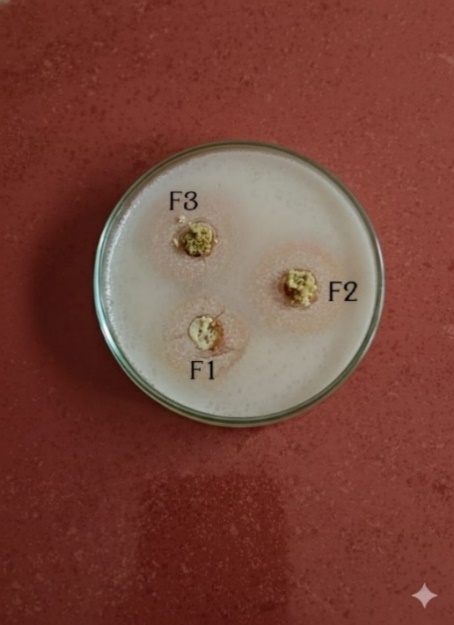
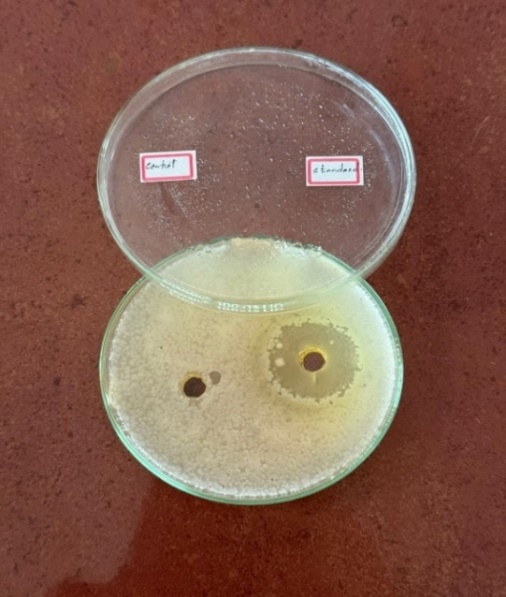
Figure 4: Antimicrobial study
DISCUSSION
Superior performance in terms of physical appearance, viscosity, spreadability, antimicrobial activity, and antioxidant potential due to its higher concentration of herbal extracts. The study confirms that the formulated herbal hair wax stick is stable, safe, and effective, offering both cosmetic styling benefits and therapeutic advantages. The use of natural ingredients makes it a promising alternative to synthetic hair styling products, with added benefits of scalp nourishment, hair strengthening, and protection
against oxidative and microbial damage.
Among the three formulations, F3 showed
CONCLUSION
The present work aimed to formulate and evaluate a herbal hair wax stick using natural plant extracts of Ocimum tenuiflorum, Phyllanthus emblica, and Eclipta prostrata having scalp nourishing properties. Three formulations F1, F2, and F3 were developed using various
concentrations of extracts, among which F3 showed superior performance in terms of texture,
appearance, pH, compatibility with hair, spreadability, stability, and safety for application. The prepared herbal hair wax stick demonstrated favourable spreadability, ease of application, characteristic odour and colour, physical stability, and formed a protective layer on the scalp to help remove debris and promote hair growth. Overall, the study concludes that the herbal hair wax stick formulated with Amla, Tulsi, and Bhringraj is safe, effective, stable, therapeutically beneficial, and offers a natural, cost-effective alternative to commercial hair care products.
REFERENCE


Dhanya V. O., Aysha sherin, Fathimathul Fida P. K., Akshay P., Development of herbal hair wax stick with scalp nourishing extract, Int. J. of Pharm. Sci., 2026, Vol 4, Issue 1, 2190-2197. https://doi.org/10.5281/zenodo.18333275
 10.5281/zenodo.18333275
