

We use cookies to ensure our website works properly and to personalise your experience. Cookies policy
Mount Zion College of Pharmaceutical Sciences and Research, Adoor.
Nowadays, there is an increasing demand for herbal cosmetic formulations owing to their safety, effectiveness, and minimal adverse effects. Face scrub gels play an important role in skin care by removing dead skin cells, improving skin texture, and enhancing complexion. The present study was aimed at the formulation and evaluation of a herbal face scrub gel using orange peel powder as a natural exfoliating agent. The formulations was prepared using orange peel powder, turmeric powder, poppy seed, and rose water along with suitable excipients such as Carbopol 940, phenoxy ethanol, triethanolamine, sodium lauryl sulphate, and distilled water. The prepared formulation was evaluated for various parameters including appearance, pH, spreadability, viscosity, extrudability, washability, grittiness, irritability, and stability. The results revealed that the formulation(F2) possessed acceptable physicochemical properties, good spreadability, suitable pH, and was non-irritant to the skin. Stability studies confirmed that the formulation remained stable throughout the study period. Hence, the developed herbal face scrub gel was found to be safe, effective, and suitable for cosmetic application.
Cosmetics have been an integral part of human civilization since ancient times, serving purposes related to personal hygiene, beautification, and protection of the skin. The word cosmetic originates from the Greek term “kosmetikos,” which means to adorn or arrange. Cosmetics are defined as substances or preparations intended to be applied to the external parts of the human body, such as the skin, hair, nails, lips, and teeth, with the primary objectives of cleansing, perfuming, protecting, altering appearance, and maintaining these parts in good condition.The skin is the largest organ of the human body and performs essential physiological functions including protection against environmental factors, regulation of body temperature, sensory perception, and immune defence. Maintaining healthy skin is crucial for overall well-being, as damaged or poorly maintained skin can lead to conditions such as dryness, irritation, infection, pigmentation disorders and premature aging. Skin characteristics vary among individuals and are generally classified into normal, dry, oily, combination and sensitive skin types, each requiring specific cosmetic care and formulations. In recent years, there has been increasing concern regarding the safety of synthetic chemicals commonly used in cosmetic products. Prolonged use of certain chemical ingredients has been associated with adverse skin reactions, including irritation, allergic responses and other dermatological problems. As a result, there is a growing demand for cosmetic formulations based on natural ingredients, which are considered safer, biodegradable and more compatible with the skin [1].Among various skincare products, exfoliating agents play a vital role in removing dead skin cells, promoting skin renewal, improving texture, and enhancing the penetration of other cosmetic products. Face scrubs are widely used exfoliating formulations that help cleanse the skin, unclog pores, stimulate blood circulation, and impart a smooth and radiant appearance. Therefore, the development and evaluation of an effective and safe face scrub using natural ingredients has gained significant importance in modern cosmetic research.
Face scrubs are widely used cosmetic products in skincare and beauty treatments because they help in exfoliating the facial skin. Herbal face scrubs work as mild exfoliating agents that improve skin smoothness and promote an even skin tone.
Gels are semi-solid dosage forms and are one of the most commonly used preparations due to their multiple benefits. Scrub gels effectively remove dead skin cells, leaving the skin clean, refreshed, and radiant.An ideal herbal scrub gel should supply essential nutrients to the skin and enhance facial brightness. In addition, these scrub gels help stimulate blood circulation in the facial area, which supports the nourishment of new skin cells and helps maintain healthy, glowing skin [2].
Benefits of orange peel face scrub
1. Skin Brightening: Orange peel contains citric acid and vitamin C, which help reduce pigmentation and improve overall skin tone.
2. Moisturizing Effect: Natural oils in orange peel help retain skin moisture and prevent dryness.
3. Anti-inflammatory Action: Orange peel has anti-inflammatory properties that help reduce skin irritation and redness.
4. Exfoliating Effect: The mild acidic nature of orange peel helps to remove dead skin cells, promoting smooth and healthy skin.
5. Antioxidant Property: Antioxidants present in orange peel protect the skin from oxidative damage and delay premature ageing [3].
MATERIALS AND METHODS
HERBAL INGREDIENTS
1.Turmeric powder

Figure No:1 Turmeric powder
Synonym: Haldi, Haridra, Curcumin.
Biological source: Turmeric consist of dried as well as fresh rhizomes of the plant Curcuma longa.
Family: Zingiberaceae.
Description: Colour- Brilliant yellow.
Odor- mildly aromatic.
Taste- Pleasantly bitter and earthy.
Constituents: Non-volatile curcuminoids and the volatile oil Curcuminoids contain, curcumin, demethoxycurcumin, bisdemethoxycurcumin.
Uses: Anti-septic.
Traditionally used for disorders of skin.
Anti-inflammatory.
Anti-bacterial.
Fights free radical damages [4].
3.Rose water
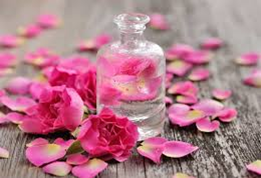
Figure No: 2 Rose water
Synonym: Gulab Jal, Rose Hydroso.
Biological Source: Rose water is obtained from the fresh petals of Rosa damascena (Damask rose), Rosa centifolia (Cabbage rose), or Rosa gallica (French rose) through steam distillation or hydrodistillation.
Family: Rosaceae
Constituents: The major constituents of rose water are citronellol, geraniol, nerol, phenyl ethyl alcohol, eugenol, farnesol, and small amounts of linalool and nonadecane. These compounds contribute to its aroma and therapeutic effects.
Description: The rose plant is a perennial shrub native to Central Asia and the Middle East, now cultivated widely across the world for ornamental, cosmetic, and medicinal purposes. It bears fragrant flowers that range in colour from pale pink to deep red. The petals are the main part used for extracting rose oil and rose water.
Uses: It is widely used due to its soothing, hydrating, anti-inflammatory properties.
It helps to maintain skin pH, control excess oil, and refresh the skin.
It acts as a natural toner and cleanser [5].
3.Poppy seed

Figure No: 3 Poppy seed
Synonym : Khash khash, Post dana, Papaver somniferum.
Biological source: Poppy seed is obtained from the dried ripe fruits (capsules) of Papaver somniferum, belonging to the family Papaveraceae.
Family: Papaveraceae.
Description: Colour – Greyish white to bluish black.
Odor – Mild, nutty aroma.
Taste – Sweet and nutty.
Constituents: Poppy seeds contain fixed oil (30–50%), proteins, carbohydrates, and minerals
such as calcium, iron, and phosphorus.
Uses: Used as a natural emollient and skin conditioner in cosmetic and pharmaceutical formulation
It helps to moisturize dry skin, reduce irritation, and promote a soft and smooth texture.
A natural, gentle exfoliant that helps to removes dea skin cells [6].
4.Orange peel powder

Figure No: 4 Orange peel powder
Synonym: Citrus peel, Naranga churna, Orange rind powder.
Biological source: It is obtained from the dried outer peel of the ripe fruit of Citrus sinensis.
Family: Rutaceae.
Description : Colour – Light orange to brownish-orange.
Odor – Characteristic citrus fragrance.
Taste – Bitter and slightly tangy.
Constituents : Contains flavonoids (hesperidin, naringin), vitamin C (ascorbic acid), citric acid, calcium, and essential oils such as limonene and linalool.
Uses: Helps in skin brightening.
Acts as a natural exfoliant.
Reduces acne and pigmentation.
Controls excess oil and promotes glowing skin
It possess antioxidant and cleansing properties [7].
EXCIPIENTS
Table 1: Excipients used and its functional category
|
Excipients |
Functional category |
|
Carbapol 940 |
Viscosity enhancer, binder, thickener. |
|
Phenoxy ethanol |
Preservative, stabilizer. |
|
Triethanolamine |
Alkalizing agent, emulsifying agent. |
|
Sodium lauryl sulphate (SLS) |
Surfactant, foaming agent. |
|
Distilled water |
Enhanced hydration, improved absorption of active ingredient. |
FORMULATION
Table 2: List of ingredients used in face scrub gel
|
SI.No |
Ingredients |
Quantity (gm) |
||
|
F1 |
F2 |
F3 |
||
|
1 |
Orange peel powder |
1.02 |
1.05 |
1.00 |
|
2 |
Turmeric powder |
0.09 |
0.09 |
0.09 |
|
3 |
Poppy seed |
0.78 |
0.45 |
0.25 |
|
4 |
Rose water |
5 |
5 |
5 |
|
5 |
Carbapol 940 |
0.6 |
0.3 |
0.45 |
|
6 |
Phenoxy ethanol |
0.3 |
0.3 |
0.3 |
|
7 |
Triethanolamine |
0.7 |
0.15 |
0.1 |
|
8 |
Sodium lauryl sulphate |
0.15 |
0.15 |
0.15 |
|
9 |
Distilled water |
q.s |
q.s |
q.s |
METHODOLOGY
Accurately weigh all ingredients as per the formulation (gelling agent, herbal scrub powder, surfactant, preservatives, etc.).
Take the required quantity of distilled water in a beaker. Slowly sprinkle the gelling agent (carbapol) into the water with continuous stirring. Allow it to hydrate (20 min) completely until a clear or uniform gel is formed.
Add finely powdered herbal exfoliating agent ( orange peel powder) slowly into the gel. Stir gently to ensure uniform distribution of scrub particles.
Add preservative, fragrance, and other additives and mix thoroughly.
Check the pH of the gel using a pH meter or pH paper. Adjust the pH to skin-friendly range (4.5–6.5) using suitable agents (e.g., triethanolamine).
Stir the formulation slowly to obtain a smooth, homogeneous scrub gel without air bubbles.
Transfer the prepared herbal face scrub gel into a clean, labelled container.Store at room temperature for further evaluation studies [8].
Evaluation Parameter
Visual observation was done to evaluate colour, odour, and consistency of the prepared scrub gel.
The pH of gel was determined using digital pH meter. 2 gm gel was stirred in distilled water till a uniform suspension is formed. The volume was made up to 40 ml and pH of the solution was measured.
Small portion of the prepared gel was applied on the skin and kept for few hours to check the irritation of the skin
Small amount of the gel was placed on the glass slide and another glass slide was placed on the gel. A wooden weight was placed on it. The time required for the gel to spread and the area was measured. The amount and the area of gel on the glass slide represents the efficiency of spreadability.
The viscosity of gel was measured using Brookfield viscometer.
Little quantity of gel was spread on the skin and was washed with water to check whether formulated gel was easily washable.
The presence of gritty particles which provides exfoliating effect was checked by applying on the skin.
Small amount of gel was shaken with water in a graduated measuring cylinder and the foam was measured.
It indicates that the face scrub formulation is stable and maintain its quality during storage. This confirms that compatibility of ingredients and the effectiveness of the formulation process[9].
RESULTS AND DISCUSSION
Table 3: Result and evaluation parameters of face scrub gel
|
SI.No |
Parameters |
F1 |
F2 |
F3 |
|
1 |
Colour |
Yellowish brown |
Yellowish brown |
Yellowish brown |
|
2 |
Odour |
Pleasant |
Pleasant |
Pleasant |
|
3 |
Texture |
Smooth |
Smooth |
Smooth |
|
4 |
pH |
2.5 |
5.8 |
3.9 |
|
5 |
Irritability |
No irritation |
No irritation |
No irritation |
|
6 |
Spreadability |
5.2 |
5.5 |
6.7 |
|
7 |
Viscosity |
10720 |
12230 |
8630 |
|
8 |
Washability |
Easily washable |
Easily washable |
Easily washable |
|
9 |
Grittiness |
Yes |
Yes |
Yes |
|
10 |
Foamability |
Moderate foam |
Moderate foam |
Moderate foam |
|
11 |
Stability test |
No change |
No change |
No change |
Formulation F1, F2, F3 was tested for evaluation parameters such as colour, odour, texture, pH, irritability, Spreadability, Viscosity, Washability, Grittiness, Foamability, Stability test. The formulation F2 was found to be very effective as compared to the F1 and F3. The colour of the product was observed to be yellowish brown with no indication of an unpleasant smell. Moderate foam was produced. The consistency of the product was satisfactory for skin application. The texture of the product was good and satisfactory with small gritty particles. The scrub was also washable with regular water, and the pH of the product was determined to be 5.5 indicating its suitability for the skin. The formulation can be applied for all skin types.
CONCLUSION
The present study focuses on the formulation and evaluation of a herbal face scrub gel using orange peel powder as a natural exfoliating agent. Orange peel contains antioxidants and bioactive compounds that help in removing dead skin cells and improving skin appearance. Three formulations (F1, F2, and F3) were prepared using different concentrations of orange peel powder.All formulations were evaluated for physicochemical parameters such as appearance, pH, spreadability, homogeneity, washability, and skin irritation. The results indicated that all formulations were within acceptable limits. Among them, F2 showed better pH, good spreadability, smooth texture, effective exfoliating property, and no skin irritation, making it the optimized formulation.Thus, the formulated herbal face scrub gel using orange peel powder is safe, effective, and suitable for regular use.
REFERENCES


Vaishnavi V.*, Sufana Siyad, Amaniya Ayoob, Amina R., Alpha C. Aniyankunj, Annie baby, Formulation and Evaluation of Face Scrub Gel Using Orange Peel, Int. J. of Pharm. Sci., 2026, Vol 4, Issue 2, 1106-1112. https://doi.org/10.5281/zenodo.18513861
 10.5281/zenodo.18513861