
Kamla Nehru College of Pharmacy, Butibori, Nagpur, Maharashtra, India 441108.
The primary goal of the current study was to create and assess a herbal powder hand wash with Arjuna bark as the main active component. The formulation was created to retain skin hydration while offering efficient washing with few adverse effects. Additional herbal ingredients like Ashoka bark, Reetha, Aloe vera, and lemon were added along with appropriate excipients to improve the overall cleansing and skin-conditioning qualities. Based on initial testing, three formulations (F1, F2, and F3) were created and refined. Key characteristics such as color, odor, pH, viscosity, particle size, soap index, antibacterial activity, and potential for skin irritation were assessed for each formulation and finally F3 batch was selected. The outcomes demonstrated the created herbal powder hand wash's acceptability as a natural and skin-friendly washing solution by confirming that it satisfied the required physicochemical and functional qualities.
Everyone agrees that one of the best and most affordable ways to stop the spread of infectious diseases brought on by bacteria, viruses, and fungi is to practice good hand hygiene. Frequent and appropriate hand washing considerably lowers microbial contamination, which in turn lowers the risk of communicable illnesses in both community and medical settings.1 Despite their widespread usage, synthetic soaps and detergents can cause skin dryness, irritation, lipid barrier disruption, and allergic reactions because they contain harsh surfactants, preservatives, and artificial smells.2 This has stimulated a growing shift toward natural, plant-based hand hygiene products that are perceived as safer, more biocompatible, and environmentally sustainable.3
The rich phytochemical profiles, natural antibacterial activity, and skin-protective qualities of herbal preparations have drawn a lot of attention in recent years.4 Herbal ingredients include natural surfactants, antioxidants, tannins, flavonoids, and emollients that can simultaneously wash, protect, and nourish the skin, in contrast to synthetic cleansing agents.? Consequently, herbal hand wash products have become attractive substitutes that minimize adverse effects while preserving good cleanliness.
Ayurveda has long regarded Terminalia arjuna (Arjuna bark), a member of the Combretaceae family, among other medicinal plants, especially for its wound-healing and cardioprotective qualities.? Many of the polyphenols, tannins, flavonoids, triterpenoids, and glycosides found in the bark have strong antibacterial, antifungal, antioxidant, and anti-inflammatory properties.? Arjuna bark is a desirable option for inclusion in herbal cleansing preparations due to these pharmacological characteristics. Its antibacterial properties assist lower the microbial load in a hand wash system, while its anti-inflammatory and antioxidant properties help preserve the integrity of the skin and reduce discomfort.
Herbal medicines frequently contain Sapindus mukorossi (Reetha) to improve cleaning effectiveness and give natural surfactancy. Saponins, which are naturally occurring triterpenoid glycosides that can efficiently produce foam and remove oils and grime without harming the skin's barrier, are abundant in reetha fruits.? Reetha-based surfactants have been extensively investigated as substitutes for traditional synthetic detergents in cosmetic and hygiene formulations due to their mildness and biodegradability.
Complementary advantages are provided by additional botanical compounds added to the formulation, such as Citrus limon (lemon), Aloe vera, and Terminalia arjuna (Arjuna bark). Aloe vera is a well-known hydrating, calming, and healing agent; ashoka bark is well-known for its astringent and antibacterial qualities; and lemon provides natural scent, mild acidity, and antimicrobial potential.? The final hand wash formulation's cleaning action, sensory appeal, and skin-conditioning properties are all improved by the combined use of these herbs.
This study focuses on creating a novel herbal powder hand wash with Arjuna bark as the main active ingredient in response to the growing global need for safe, effective, and natural hygiene products. Three herbal formulations (F1, F2, and F3) were prepared and optimized after the necessary plant materials were chosen, verified, and processed into fine powder extracts. In addition to evaluations of antimicrobial activity and skin-irritation potential, these formulations were next assessed for important physicochemical properties as color, odor, pH, particle size, viscosity, and soap index. The study sought to determine the best formulation that could offer safe, efficient, and skin-friendly hand hygiene based on these criteria.
PLANT PROFILE
The bark of Terminalia arjuna (Roxb.) Wight & Arn., belonging to the family Combretaceae, is a well-known medicinal plant widely distributed in India and Bangladesh. It is a large deciduous tree attaining a height of 20–30 m and has been used in Ayurvedic medicine for more than 2,500 years, primarily as a cardiotonic (Dwivedi, 2007). Phytochemical studies have demonstrated that Arjuna bark is rich in triterpenoid saponins such as arjunic acid and arjunolic acid, along with glycosides including arjunosides and arjunetin, flavonoids like arjunolone and arjunone, and phenolic compounds such as gallic acid and ellagic acid (Maulik & Katiyar, 2010; Kumar & Prabhakar, 1987). These bioactive constituents are responsible for the wide range of pharmacological activities exhibited by the bark, including antimicrobial, antibacterial, antifungal, antioxidant, anti-inflammatory, and wound-healing properties (Sabu & Kuttan, 2002; Dwivedi, 2007).
Table 1: Chemical Constituents of Terminalia arjuna Bark
|
Class of Compound |
Major Constituents |
Reported Biological Activity |
Reference |
|
Triterpenoid saponins |
Arjunic acid, Arjunolic acid, Arjunetin |
Cardioprotective, anti-inflammatory, antimicrobial |
Dwivedi, 2007 |
|
Glycosides |
Arjunosides I–IV, Arjungenin |
Antioxidant, cardiotonic |
Maulik & Katiyar, 2010 |
|
Flavonoids |
Arjunolone, Arjunone |
Antioxidant, anti-inflammatory |
Sabu & Kuttan, 2002 |
|
Phenolic compounds |
Gallic acid, Ellagic acid |
Antibacterial, antifungal, antioxidant |
Kumar & Prabhakar, 1987 |
|
Minerals |
Calcium, Magnesium, Zinc |
Cardiovascular support |
Dwivedi, 2007 |
Sapindus mukorossi Gaertn., commonly known as Reetha or soapnut, is a deciduous tree of the family Sapindaceae, distributed in the Indo-Gangetic plains, Shivalik ranges, and sub-Himalayan regions at elevations ranging from 200 to 1500 m. It is regarded as one of the most valuable tropical and subtropical trees of Asia due to its high saponin content and diverse applications (Sharma & Kaur, 2011). Phytochemical investigations of Reetha fruit have revealed the presence of triterpenoid saponins as major constituents, along with flavonoids, phenolic compounds, carbohydrates, sugars, fatty acids, and terpenoids (Kumar & Singh, 2012). The saponins present in the fruit are mainly responsible for its surfactant, antimicrobial, antifungal, and insecticidal properties, which justify its extensive use in herbal shampoos, natural cleansers, and traditional medicinal preparations (Sengupta & Malhotra, 2017; Pandey & Tripathi, 2014).
Table 2: Chemical Constituents of Sapindus mukorossi (Reetha) Fruit
|
Class of Compound |
Major Constituents |
Reported Biological Activity |
Reference |
|
Triterpenoid saponins |
Sapindoside A, B, C, D |
Antimicrobial, antifungal, surfactant |
Sengupta & Malhotra, 2017 |
|
Flavonoids |
Quercetin, Kaempferol derivatives |
Antioxidant, anti-inflammatory |
Sharma & Kaur, 2011 |
|
Phenolic compounds |
Phenolic acids |
Antimicrobial, antioxidant |
Kumar & Singh, 2012 |
|
Carbohydrates & sugars |
Glucose, Sucrose |
Energy source, formulation support |
Pandey & Tripathi, 2014 |
|
Fatty acids & terpenoids |
Oleic acid, Terpenoid compounds |
Insecticidal, antimicrobial |
Sengupta & Malhotra, 2017 |
Aloe vera (L.) Burm.f., commonly known as aloe or burn plant, is a perennial succulent belonging to the family Asphodelaceae (formerly placed under Liliaceae). The plant has been widely used in traditional medicine systems across the world for centuries due to its therapeutic and cosmetic applications. Aloe vera is characterized by thick, fleshy leaves containing a clear mucilaginous gel rich in bioactive compounds. The plant is well known for its wound-healing, anti-inflammatory, antimicrobial, and antioxidant properties, which have been scientifically validated through numerous pharmacological studies (Surjushe, Vasani, & Saple, 2008; Hamman, 2008).
Table 3: Chemical Constituents of Aloe vera Leaf
|
Class of Compound |
Major Constituents |
Reported Biological Activity |
Reference |
|
Anthraquinones |
Aloe-emodin, Aloin |
Antimicrobial, laxative, anti-inflammatory |
Hamman, 2008 |
|
Chromones |
Aloesin |
Antioxidant, anti-inflammatory, skin protective |
Eshun & He, 2004 |
|
Phenolic acids |
Cinnamic acid |
Antimicrobial, antioxidant |
Surjushe et al., 2008 |
|
Vitamins |
Vitamins A, C, E, B12 |
Antioxidant, wound healing, skin protection |
Hamman, 2008 |
|
Polysaccharides |
Acemannan, glucomannan |
Immunomodulatory, wound healing |
Eshun & He, 2004 |
MATERIALS & METHOD
The study was conducted between January 2025 and April 2025. The study was carried out in the Department of Pharmaceutics and Microbiology, Kamla Nehru College of Pharmacy, Nagpur, India.
Chemicals and reagents
All the chemicals and reagents used in the present study, including ethanol, concentrated sulfuric acid, and chloroform, were of analytical reagent (AR) grade and were procured from Loba Chem Pvt. Ltd. Agar media used for antimicrobial studies was obtained from HiMedia Laboratories. Distilled water was procured from Samar Chemicals. The herbal raw materials, namely Terminalia arjuna bark, Aloe vera powder, and Sapindus mukorossi (Reetha) fruit powder, were procured from a local Ayurvedic shop.
Method of preparation
The herbal hand wash powder was prepared by extracting the bark of Terminalia arjuna and the fruit of Sapindus mukorossi (Reetha) using a maceration method of extraction with ethanol as the solvent. The extracts were filtered, concentrated, dried, and incorporated into the formulation. These herbal extracts were then blended with other selected herbal ingredients along with suitable excipients to formulate a powder-based hand wash. Several formulations were prepared, and phytochemical screening and evaluation of physicochemical properties, antimicrobial activity, soap index, and skin irritation were carried out to test their efficacy and acceptability as a natural hand hygiene product.
1. Extraction of Arjuna Bark by maceration method:
The powdered bark of Terminalia arjuna (100 g) was subjected to extraction by maceration using ethanol as the solvent. The accurately weighed plant powder was placed in a clean conical flask, and 350 mL of ethanol was added to it. The mixture was allowed to stand for a period of 20 days at room temperature with occasional shaking and stirring to facilitate efficient extraction of phytoconstituents.
After completion of the extraction period, the mixture was filtered using filter paper to separate the liquid extract from the plant residue. The obtained filtrate was then concentrated by evaporation at 50 °C until a reddish semi-solid mass of the extract was obtained. The concentrated extract was stored in a suitable container for further analysis and formulation studies.
2. Extraction of Reetha fruit by the maceration method:
The finely powdered fruits of Sapindus mukorossi were accurately weighed (8.6 g) and transferred into a clean beaker. To this, 100 mL of ethanol was added, and the mixture was stirred thoroughly. The beaker was covered with aluminium foil to prevent solvent evaporation and contamination and was allowed to macerate for a period of 3 days at room temperature with occasional stirring.
After the maceration period, the mixture was filtered using filter paper to separate the extract from the marc. The obtained filtrate was then evaporated to dryness in a water bath. The completely dried extract was transferred to a desiccator and allowed to cool before further use.
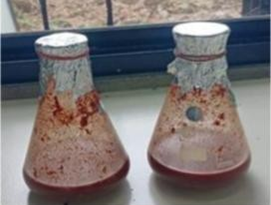
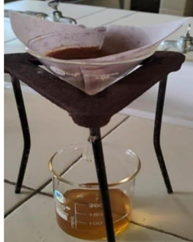
Figure 1: Extraction of Arjuna Bark and Reetha fruit by maceration method
3. Preparation of handwash powder:
The initial step involved drying all the ingredients needed for the formulation of the herbal hand wash powder. The drying process was aimed at eliminating any traces of moisture. The dried substances were then pulverized separately to form coarse powders. The substances included Terminalia arjuna bark extract (10 g), Aloe vera powder (5 g), Sapindus mukorossi extract powder (7 g), rose petal powder (4 g), and lemon essential oil (4 g). The substances were measured accurately.
The weighted crude materials were size-reduced to smaller pieces using a hand-driven mixer individually to produce fine powders. The fine powdered materials were then well mixed using a mixer to produce a uniform powdered mixture. Lemon essential oil was incrementally incorporated into the mixture to distribute evenly in the preparation.
The obtained homogeneous mixture was sifted using sieve No. 120 to get a finer size of the handwash powder. The homemade herbal handwash powder preparation work was complete. The mixture of the herbal handwash powder was collected in the airtight container.
Formulation of Herbal Hand Wash Powder
Table 4: Formulation of Herbal Handwash Powder (Batch F3 )
|
Sr. No. |
Ingredients (powder) |
Quantity (per 30 g) |
Category |
|
1. |
Arjuna bark extract |
10 g |
Antibacterial agent |
|
2. |
Reetha fruit extract |
7 g |
Foaming agent |
|
3. |
Aleo vera |
5 g |
Emollient |
|
4. |
Lemon |
4 g |
Antiseptic agent |
|
5. |
Rose petal |
4 g |
Fragrance |

Figure 2: Formulation of Herbal Handwash Powder
Characterization of herbal hand wash
Preliminary phytochemical screening of the herbal extract was carried out using standard qualitative chemical tests to identify the presence of various phytoconstituents.
A. Physical Parameters
a) Colour: The colour of the formulation was inspected visually.
b) Odour: The odour of the formulation was evaluated by sensory perception.
c) pH: The pH of the formulation was measured using a calibrated digital pH meter. Before each measurement, the pH meter was calibrated using standard buffer solutions. The electrode was rinsed with distilled water, immersed in the sample, and the pH value was recorded.
d) Stability Studies: Stability studies were conducted by storing the formulation at different temperature conditions (25 °C and 40 °C) for a period of one week. The formulation was observed for any changes in physical appearance, colour, or phase separation.
e) Angle of Repose: The angle of repose is defined as the maximum angle formed between the surface of a pile of powder and the horizontal plane. The flow properties of the powder used in the formulation were assessed.
f) Particle Size: Particle size is an important parameter affecting properties such as spreadability and grittiness. Particle size was determined by the sieving method using I.P. standard sieves. The sample was subjected to mechanical shaking for 10 minutes, and the particle size distribution was recorded.
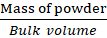
g) Bulk Density: Bulk density is defined as the ratio of the mass of powder to its bulk volume. A known quantity of dried powder was filled into a 50 mL measuring cylinder up to the 50 mL mark. The cylinder was then dropped onto a hard surface from a height of 1 inch at 2-second intervals. The final volume was noted, and the powder was weighed. Bulk density was calculated using the formula:
Bulk Density = Mass of powderBulk volume
h) Tapped Density: Tapped density is the increased bulk density obtained after mechanically tapping the container containing the powder sample. After recording the initial volume, the measuring cylinder was mechanically tapped for 1 minute until no further significant change in volume was observed. Tapped density was expressed in g/cm³.
B. Chemical Parameters
a) Foam Height: One gram of the herbal handwash sample was dispersed in 50 mL of distilled water and transferred into a 500 mL stoppered measuring cylinder. The volume was adjusted to 100 mL with distilled water. The cylinder was shaken with 25 strokes and allowed to stand. The aqueous volume was noted, and the height of the foam formed above the aqueous layer was measured.

Figure 3: Foam Height of Herbal Handwash Powder
b) Skin Irritation Test: A small quantity of the formulation was applied to the skin and left undisturbed for 30 minutes. The area was observed for any signs of redness, itching, or irritation.
c) Antimicrobial Activity: The antimicrobial activity of the herbal handwash was evaluated using the cup plate method (agar well diffusion method). In this method, the antimicrobial agent diffuses into the agar medium inoculated with the test microorganisms(E. coli and S. aureus). The plates were incubated, and the zone of inhibition around the wells was measured to assess antimicrobial activity.
RESULT & DISCUSSION
Preliminary phytochemical screening of the herbal handwash powder revealed key bioactive constituents, confirming its medicinal potential. The Salkowski reaction indicated phytosterols, known for their anti-inflammatory and skin-protective properties. The foam test showed stable foam, verifying the presence of saponins, which enhance foaming and cleansing action while supporting antimicrobial activity. Alkaloids were identified via Dragendorff’s test, contributing to antimicrobial and antifungal efficacy. Molisch’s test confirmed carbohydrates, which improve formulation texture and skin hydration. Collectively, these components substantiate the traditional use of the herbal ingredients in the handwash formulation, highlighting their cleansing, antimicrobial, and skin-friendly benefits.
Table 5: (Batch F3 )
|
Sr. No. |
Phytoconstituents |
Chemical test |
Observation |
Interference |
|
1. |
Phytosterol |
Salkowski reaction test |
Reddish brown colour was observed |
Presence of phytosterol |
|
2. |
Saponins |
Foam test |
Foam was observed for 10 min |
Presence of saponin |
|
3. |
Alkaloids |
Dragendroff’s test |
Orange red precipitate was observed |
Presence of alkaloids |
|
4. |
Carbohydrates |
Molisch’s test |
Reddish violet ring was observed |
Presence of carbohydrates |
The physical evaluation of the herbal handwash powder showed satisfactory organoleptic, physicochemical, and flow properties. The brown colour resulted from herbal extracts such as Terminalia arjuna and Sapindus mukorossi, while the lemon fragrance indicates the inclusion of lemon essential oil. With a pH of 5.68, the formulation is slightly acidic, closely matching human skin's natural pH, thus supporting skin health and reducing irritation risks. The powder demonstrated stability with no visible changes, and its bulk and tapped densities (0.4 g/mL and 0.32 g/mL) suggest good packing and flow characteristics. An angle of repose value of 0.857 indicates acceptable flow properties, ensuring easy processing and packing. Additionally, a particle size of 47 µm indicates a fine, uniform powder, enhancing spreadability and dispersion. Overall, the formulation exhibits favourable physical properties for hand cleansing and consumer appeal.
Table 5: (Batch F3 )
|
Sr.no |
Evaluation parameter |
Result |
|
1 |
Colour |
Brown |
|
2 |
Odour |
Lemon like |
|
3 |
pH |
5.68 |
|
4 |
Stable |
Stable |
|
5 |
Bulk density |
0.4gm/ml |
|
6 |
Tapped density |
0.32gm/ml |
|
7 |
Angle of repose |
0.857 |
|
8 |
Particle size |
47µm |
|
9 |
Skin irritation |
Non irritant |
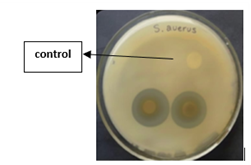
The antimicrobial activity of Terminalia arjuna bark extract was evaluated using the agar well diffusion (cup plate) method. One gram of Arjuna bark extract powder was dispersed in 2 mL of distilled water and tested against selected bacterial strains. The extract showed measurable zones of inhibition against both test organisms. A control plate without any antibacterial agent was also maintained for comparison.
Table 6: Antimicrobial activity of Herbal Handwash Powder
|
Sr.no |
Test microorganisms |
Zone of inhibition |
|
1 |
E.coli |
5mm |
|
2 |
Streptococcus aureus |
9mm |

(a)
(b)
Figure 2: (a) Plate showing zones of inhibition for E.coli and (b) Plate showing zones of inhibition for S.aureus
CONCLUSION
From the present study, it can be concluded that a herbal powder handwash was successfully formulated using Terminalia arjuna bark extract. The developed formulation exhibited sufficient antimicrobial activity, confirming the effectiveness of Arjuna bark as a natural antimicrobial agent. The herbal handwash was found to be safe and free from synthetic sulphates, making it a suitable alternative to conventional chemical-based handwash formulations. The study also demonstrated that the formulated herbal handwash effectively serves the purpose of hand cleansing while incorporating plant-based ingredients with added therapeutic benefits. Furthermore, future research should focus on long-term stability studies and extended antimicrobial evaluation to assess its potential for wider and prolonged use.
ACKNOWLEDGEMENT
The authors are thankful to the Principal of Kamla Nehru College of Pharmacy, Butibori, Nagpur, for providing laboratory facilities and constant support.
REFERENCES


Sejal Meshram, Ketki Bhatt, Manish Kamble, Noopur Gaikwad, Isha Narkhedkar, Jagdish Baheti, Formulation and Evaluation of an Herbal Powder Hand Wash Containing Arjuna (Terminalia arjuna) Bark, Int. J. of Pharm. Sci., 2026, Vol 4, Issue 1, 1225-1234. https://doi.org/10.5281/zenodo.18231498
 10.5281/zenodo.18231498
