

We use cookies to ensure our website works properly and to personalise your experience. Cookies policy
N.E.T. Pharmacy College, Raichur, Karnataka, India.
Drug Utilization Evaluation (DUE) assesses medication use to promote rational, safe and effective prescribing. Post-operative patients are commonly exposed to multiple medications, antibiotics and injectable preparations, increasing the risk of polypharmacy and irrational drug use. This study evaluated prescribing patterns, polypharmacy, Essential Medicines List (EML) compliance and WHO core prescribing indicators in post-operative surgical patients. A prospective observational study was conducted from January 1 to June 30, 2025, in the surgical ward of NMCH & RC. Data from 150 post-operative patients were collected using a structured data collection form. Prescribing patterns were assessed using descriptive statistics and WHO core prescribing indicators. The association between NRC surgical classification and antibiotic use was evaluated using the chi-square test. Of 150 patients, 62.7% were male and 37.3% female, with 38.7% aged 51–60 years. Acute appendicitis and appendectomy were the most common diagnosis and procedure (17.3% each). The mean number of drugs prescribed per patient was 7.9. Pantoprazole (95.3%), metronidazole (78.7%) and multivitamins (66.7%) were frequently prescribed. Generic prescribing was low (6.6%), while antibiotic (98.7%) and injection (97.3%) use were high. Only 58.9% of drugs were prescribed from the EML. A significant association was observed between NRC classification and antibiotic use (p = 0.0002). The study identified polypharmacy, high antibiotic and injection use, low generic prescribing and suboptimal EML compliance. Prescription audits, prescriber education and adherence to standard treatment guidelines are recommended to promote rational medication use.
Drug Utilization Evaluation (DUE), previously referred to as Drug Utilization Review (DUR) or Medication Utilization Evaluation (MUE), is a systematic, authorized, and continuous quality improvement process that assesses prescribing by healthcare providers, dispensing by pharmacists, and the use of medications by patients. 1
The principal aim of drug utilization research is to facilitate the rational use of drugs in populations. For the individual patient, the rational use of a drug implies prescribing a well-documented drug at an optimal dose, together with accurate information, at an affordable price. Without a knowledge of how drugs are being prescribed and used, it is difficult to initiate a discussion on rational drug use or to suggest measures to improve prescribing habits. Information on the past performance of prescribers is the linchpin of any auditing system.2 Irrational prescribing habits are present worldwide. More than 50% of all medicines are prescribed, dispensed, or sold inappropriately, while 50% of patients worldwide fail to take them correctly. Moreover, about one- third of the world’s population lacks access to essential medicines. 3
The need for DUE is to make possible the rational use of drugs in populations and individual patients, and provide information to improve the prescribing habits of physicians about the pattern of medicine prescribed, signs and symptoms of the patients, lab investigations and their correlation with the therapy and drug-related problems like adverse drug reactions (ADRs), drug interactions, etc. 4
The WHO has also championed efforts towards streamlining how information on medicine use is collated. In the early nineties, the WHO collaborated with the International Network for Rational Use of Drugs (INRUD) to develop a set of “core drug use indicators.” The indicators measure performance in three related areas of prescribing practices, patient care, and facility-specific factors.5 WHO has introduced standardized core prescribing and patient care indicators to analyse the trends of drug use in outpatient settings of healthcare facilities. Each core indicator has five components. 6 Percentage of medicines prescribed by generic name, Percentage of encounters with an antibiotic prescribed, Percentage of encounters with an injection prescribed, Percentage of medicines prescribed from an essential medicines list or formulary, Average number of medicines prescribed per encounter. 7
Essential medicines have been defined by WHO as “those that satisfy the priority healthcare needs of the population. They are selected because of their public health relevance, evidence on efficacy and safety, and comparative cost-effectiveness. Essential medicines are intended to be available within the context of functioning health systems at all times in adequate amounts, in the appropriate dosage forms, with assured quality and adequate information and at a price which the individual and the community can afford.” 8
Surgery is one of the most common sites for the manifestation of infections. These infections are pretty serious as they tend to be a direct infection on the systemic circulation. Hence the prevention of infections plays a major role in the safety of patient’s hospital stay. 9
Postoperative complications are undesirable consequences of surgery and are a major area of concern, adversely affecting the quality of surgical care and patient safety. These range from seemingly minor incidents that resolve without any harm to more serious incidents which may pose a threat to life, need multiple interventions, prolong hospital stay and costs, and may at times cause disability or death. 10 Postoperative complications significantly jeopardize patient outcomes, potentially leading to extended hospitalization, heightened reliance on healthcare resources, and an elevated likelihood of morbidity and mortality. 11
Polypharmacy is linked to a higher risk of drug–drug interactions and contributes to the rise in antimicrobial resistance, as well as an increased incidence of adverse drug reactions, prolonged hospital stays, and heightened morbidity and mortality. Effective drug prescribing is a crucial skill that requires ongoing evaluation and refinement. 12
There is limited research focusing on overall drug utilization patterns among surgical post-operative inpatients. Therefore, this study offers benefits such as assessing how medications are prescribed, administered, and utilized post-surgery, and the study can help identify patterns or areas of overuse/underuse.
MATERIAL AND METHODS
This prospective observational study was conducted by the NMCH & RC, Karnataka, India, from January 1, 2025, to June 30, 2025, after obtaining ethical clearance from the Institutional Ethics Committee.
Study Methodology: This study follows a prospective observational design to assess and evaluate the postoperative medication utilization patterns in the general surgery ward of a Tertiary Care Teaching Hospital, with an emphasis on medication utilization evaluation. (n=150).
Sample size: The sample size was determined using the formula n = Z²pq/d². The baseline data from our hospital were unavailable, so we calculated based on the prevalence of previous similar studies. We found that the prevalence was p=0.89 with an absolute 5% of margin of error and 95% of confidence level. Based on this, the sample size was calculated as 150.
Inclusion and Exclusion criteria: All adult post-operative patients in the surgery ward of the hospital until discharge; Only drugs prescribed after the surgical procedures will be considered, excluding any medications that are already being administered before the operation. The exclusion criteria involved Patients aged below 18 years and Patients who died postoperatively before discharge.
Study design: This prospective observational study was conducted by the NMCH & RC, Karnataka, India, from January 1, 2025 to June 30, 2025. The data were collected using a suitably structured data entry form with WHO prescribing indicators as a standard tool to evaluate the prescribing patterns of post-operative medications in the study. Data analysis and evaluation were performed using descriptive statistical methods to assess prescribing patterns and patient characteristics. The distribution of patients was analyzed according to gender and age groups, along with the type of disease and types of surgical procedures performed. Clinical care indicators included length of hospital stay and classification of surgeries based on the NRC (National Research Council) classification. Drug utilization was evaluated by identifying the most frequently prescribed drugs, commonly used fixed-dose combinations, the total number of drugs per encounter, and the number of antibiotics prescribed per encounter. Prescriptions were further assessed for the proportion of drugs prescribed from the Essential Medicines List (EML). WHO core prescribing indicators were applied to evaluate rational drug use, and additional drug utilization parameters were used to comprehensively analyze the study prescriptions and overall prescribing trends in the surgical ward.
Statistical Analysis: Data were entered into Microsoft Excel and analyzed using descriptive statistics. The Statistical analysis was performed using IBM SPSS Statistics version 25.0.
RESULTS
The Data was analysed based on the following parameters
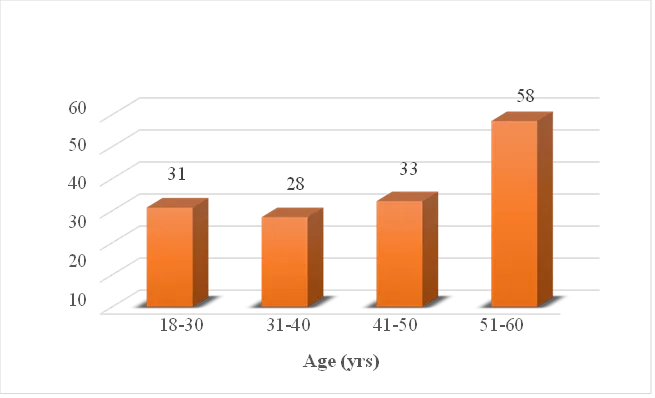
Fig 1: Age-wise distribution of patients
A total of 150 prescriptions were analyzed, a greater number of patients were found in the age group of 51-60 yrs (38.66%) followed by 41-50 yrs (22%), 18-30 yrs (20.66%) and 31-40 yrs (18.66%) respectively. This indicates that the population in this category tend to suffer from degenerative diseases, malignancies, diabetes, hypertension, and other diseases.
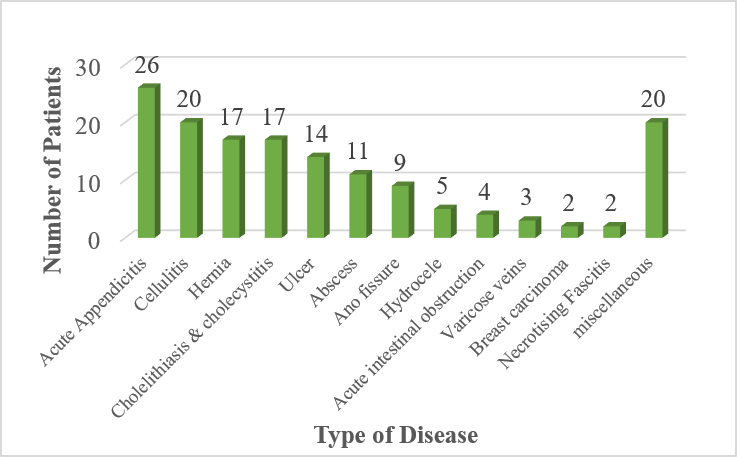
Fig. 2: Type of Disease
Among 150 patients, 26 patients were diagnosed with acute appendicitis (17.33%) which was the maximal diagnosed clinical condition, followed by 20 patients with cellulitis (13.33%) and 17 patients with hernia (11.33%).
Table 1: Type of Surgery performed in patients
|
Sl. No. |
Type of Surgery |
Number of Patients (n=150) |
Percentage (%) |
|
1 |
Appendectomy |
26 |
17.33 |
|
2 |
Debridement |
22 |
14.66 |
|
3 |
Cholecystectomy |
17 |
11.33 |
|
4 |
Hernioplasty |
16 |
10.66 |
|
5 |
Incision and drainage |
12 |
8 |
|
6 |
Fasciotomy |
11 |
7.33 |
|
7 |
Sphincterotomy |
06 |
4 |
|
8 |
Hydrocelectomy |
05 |
3.33 |
|
9 |
laparotomy |
04 |
2.66 |
|
10 |
Surgical excision |
03 |
2 |
|
11 |
Hemorrhoidectomy |
03 |
2 |
|
12 |
Trendelberg operation |
02 |
1.33 |
|
13 |
Mastectomy |
02 |
1.33 |
|
14 |
Amputation |
02 |
1.33 |
|
15 |
Orchidectomy |
02 |
1.33 |
|
16 |
Bowel re-section |
02 |
1.33 |
|
17 |
Miscellaneous(hysterectomy, laparascopic drainage, colectomy, fissurectomy, etc) |
15 |
10 |
|
|
TOTAL |
150 |
100 |
Out of 150 patients, 26 patients underwent appendectomy surgery (17.33%) followed by 22 patients for debridement (14.66%),17 patients underwent cholecystectomy (11.33%) and 16 patients undergone hernioplasty (10.66%).
Table 2: Most frequently prescribed drugs
|
Sl. No. |
Name of the Drug |
Number of Prescriptions (n=150) |
Percentage (%) |
|
1 |
Inj. Pantoprazole |
143 |
95.33 |
|
2 |
Inj. Ondansetron |
98 |
65.33 |
|
3 |
Inj. Metronidazole |
118 |
78.66 |
|
4 |
Inj. Ceftriaxone |
66 |
44 |
|
5 |
Inj. Diclofenac |
95 |
63.33 |
|
6 |
Inj. Amikacin |
40 |
26.66 |
|
7 |
Inj. Ringer lactate |
71 |
47.33 |
|
8 |
Inj. Normal saline |
67 |
44.66 |
|
9 |
Inj. Dextrose normal saline |
58 |
38.66 |
|
10 |
Inj. Tramadol |
28 |
18.66 |
|
11 |
Inj. Paracetamol |
79 |
52.66 |
|
12 |
Tab. Multivitamins |
100 |
66.66 |
|
13 |
Tab. Vitamin c |
81 |
54 |
|
14 |
Tab. Chymoral forte |
33 |
22 |
|
15 |
Inj. Metoclopramide |
4 |
2.6 |
|
16 |
Inj. Ofloxacin |
11 |
7.33 |
|
17 |
Inj. Ciprofloxacin |
2 |
1.33 |
|
18 |
Inj. Linezolid |
6 |
4 |
|
19 |
Inj.Tranexamic acid |
4 |
2.6 |
|
20 |
Tab.Doxycycline |
2 |
1.3 |
|
21 |
Inj.Omeprazole |
2 |
1.3 |
|
22 |
NSAIDS |
3 |
2 |
Among 150 prescriptions, the pantoprazole injection was most prescribed drug 143 (95.33%), which is followed by Inj. Metronidazole 118 (78.66%) and also multivitamins 100 (66.66%).
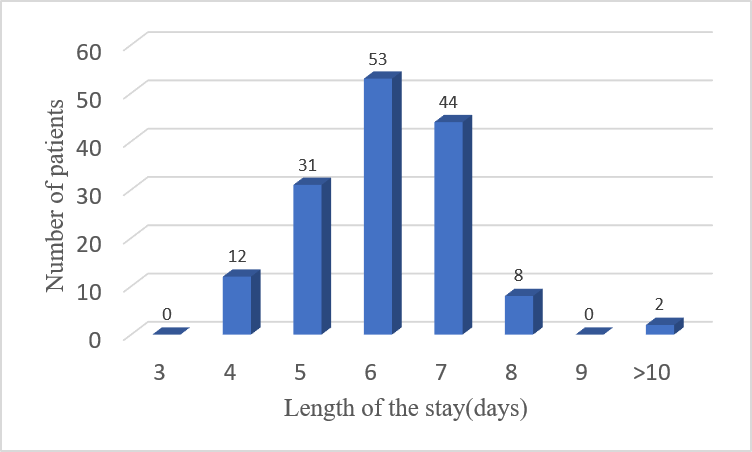
Fig: 3 Length of stay
Out of 150 patients, the majority of patients (85.3%) had a hospital stay of 5-7 days, with 6 days being the most common (35.3%) i.e 53 patients. Short stays of 3-4 days and prolonged stays beyond 10 days were observed in only a small proportion of patients.

Fig 4: Fixed dose combinations
Out of 150 patients 52 patients were prescribed with Amoxicillin+Clavulanate combination drug (34.66%), followed by Piperacillin+Tazobactam within 20 patients (13.33%) with least prescribed Sulfamethoxazole+Trimethoprim combination in 1 patient (0.66%).
Table 3: Association between NRC Classification of Surgery and Antibiotic Use
|
NRC Classification |
1 Antibiotic (%) |
2 Antibiotics (%) |
≥3 Antibiotics (%) |
Total |
|
Clean surgery (Class I) |
14 (42.4) |
16 (48.5) |
3 (9.1) |
33 |
|
Clean-contaminated surgery (Class II) |
10 (20.4) |
29 (59.2) |
10 (20.4) |
49 |
|
Contaminated surgery (Class III) |
3 (21.4) |
6 (42.9) |
5 (35.7) |
14 |
|
Dirty surgery (Class IV) |
2 (3.7) |
26 (48.1) |
26 (48.1) |
54 |
|
Total |
29 |
77 |
44 |
150 |
The Chi-square test was performed for the Association between NRC classification of surgery and Antibiotic use, which shown that Chi-square test: χ² = 26.8, df = 6, p = 0.0002 (Highly significant). A highly significant association was observed, indicating that antibiotic prescribing increases as the risk of surgical contamination rises.
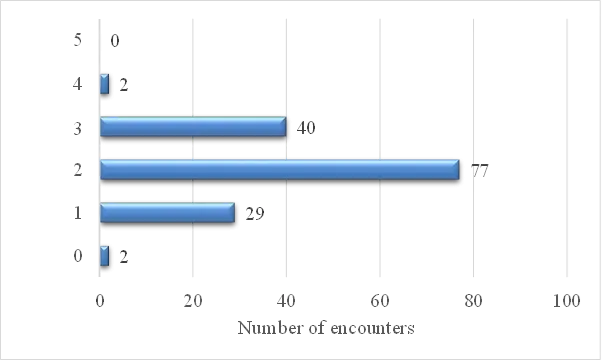
Fig 5: Number of Antibiotics prescribed in an encounter
Out of 150 patients, most encounters involved the prescription of 2 antibiotics (77 cases, 51.3%), followed by 3 antibiotics in 40 cases (26.7%) and a single antibiotic in 29 case (19.3%). Only 2 encounters (1.3%) had no antibiotics prescribed, while 4 antibiotics were given in 2 encounters (1.3%). No cases involved 5 antibiotics.
Table 4: WHO core drug indicator used to study prescription
|
WHO prescribing indicators |
Number |
Percentage (%) |
Standard Value |
|
Total number of encounters |
150 |
- |
|
|
Total number of drugs prescribed |
1185 |
- |
|
|
Average number of drugs prescribed per encounter |
7.9 (1185/150) |
- |
1.6-1.8 |
|
Percentage of drugs prescribed by generic name |
79 |
6.6 (79/1185) |
100 % |
|
The percentage of encounters in which an antibiotic was prescribed |
148 |
98.66 (148/150) |
20-26 % |
|
Percentage of encounters with an injection prescribed |
146 |
97.33 (146/150) |
13.4-24.1 % |
|
Percentage of drugs prescribed from EML |
697 |
58.88 (697/1185) |
100 % |
Out of 150 prescriptions, the average number of drugs prescribed per encounter was 7.9, 6.6% of drugs were prescribed by generic name, Antibiotics were prescribed in 98.7% of encounters and injections in 97.3% and 58.9% of drugs were prescribed from the Essential Medicines List (EML).
DISCUSSION
This research has focused on identifying prescribing patterns and drug usage among post-operative surgical patients, where certain significant trends have been observed regarding demographics, disease prevalence, prescription behaviour, and adherence to the principles of rational drug use.
Regarding the demographic profile of this study, there is a clear dominance of male patients (62.66%) over female patients (37.33%). Similar observations have been documented by other researchers, including Bhansali NB et al.,7 and P. Maheshwari et al. 13. Such a high percentage of male patients may be justified by increased occupational hazards, prevalence of trauma and other lifestyle factors, like smoking and drinking habits, and some surgical diseases that predominantly occur in males. Besides this, sociocultural reasons might also play a role in this regard, considering that many women in developing nations do not seek medical attention due to cultural constraints.
Figure 1 shows the age-wise distribution, where most of the subjects belonged to the age category of 51-60 years (38.66%). This is also supported by findings of other studies carried out by Samreen UA et al. 14. Such results are likely because people belonging to this age category tend to suffer from degenerative diseases, malignancies, diabetes, hypertension, and other diseases.
According to the information shown in Figure 2, acute appendicitis (17.33%) was seen as the most prevalent among all the surgical diseases, followed by cellulitis and hernia. As appendicitis is one of the leading causes of emergent abdominal surgery, the results presented show its prevalence rates globally, since the mechanism involved is luminal obstruction, bacterial infection, and inflammation.
Based on Table 1, the most common surgical operation done was appendicectomy (17.33%). This agrees with the studies of Arshad et al, 15 and Kumar R et al. 16. It shows that there are higher incidences of cases requiring appendicectomy due to appendicitis and its complications. Debridement and cholecystectomy are also noted in the study.
Figure 3 depicts that the majority of surgical patients stayed in the hospital for 6 days (35.33%). This corresponds to the usual recovery time after surgery. In the same manner, in other surgical drug utilization studies, the average length of stay ranged between 5-7 days according to case complexities.
According to Table 2, it can be noted that Pantoprazole (95.33%) was the most common drug prescribed, followed by Metronidazole (78.66%) and Ondansetron (65.33%). These results coincide with observations made by Deolekar et al. 17, who noticed that proton pump inhibitors and broad-spectrum antibiotics were routinely prescribed to surgical patients. High utilization of Pantoprazole could be attributed to the necessity to prevent stress-induced mucosal injury. On the other hand, the frequent prescription of Metronidazole could reflect the requirement for anaerobic coverage for patients with intra-abdominal infection.
According to Figure 4, the most common fixed dose combination (FDC), which was amoxicillin–clavulanate (34.66%), has been prescribed to the majority of patients, in accordance with the results of Madkholkar NH et al .18 Nevertheless, the high consumption of broad-spectrum antibiotics is associated with an increased risk of antibiotic resistance.
The number of antibiotics per visit, as depicted in Figure 5, demonstrates that the most common number of antibiotics used in each prescription (77 visits) is two antibiotics, followed by three antibiotics (40 visits) and one antibiotic (29 visits), whereas a very small number of prescriptions used zero or four antibiotics. This is contrary to Patel KM et al. 19, where three antibiotics were the most frequently prescribed. Hence, dual antibiotic therapy in this study might be prescribed for regular prophylaxis and treatment purposes in post-operative surgery, particularly in clean-contaminated and contaminated surgeries.
On average, 7.9 medications are prescribed per prescription, which is considerably higher compared to the recommended value according to WHO (1.6–1.8). This reflects a trend towards polypharmacy, as observed in other studies by Mondal et al.20 and Patel KM et al. 19. Polypharmacy can be considered reasonable in complicated surgical procedures; however, irrational prescribing can lead to increased adverse drug interactions, adverse drug reactions, and cost burden.
The antibiotic prescription rate was at 98.66%, which is much higher than the WHO guidelines (20–26%). This may be considered necessary considering the fact that there was a predominance of contamination and dirty surgeries, but it can also be viewed as an instance of overprescription. Studies by Faizan Sayeed et al. 21 show similar results.
The majority of surgeries (36%) were regarded as dirty surgeries, which supports the findings of Tripathi et al. 22 that the patients presented late and carried a high infection load.
From Table 3, a highly statistically significant relationship was observed between the category of the surgery (as per NRC) and the prescription of antibiotics (p = 0.0002). This clearly indicates that antibiotic prescription rates rise with an increase in the degree of risk of surgical contamination. For the low-risk category of surgeries, mostly one or two antibiotics were prescribed, which is acceptable. However, the prescription of multiple antibiotics for low-risk surgeries indicates non-compliance with prophylaxis protocols. As expected, for clean-contaminated surgeries and contaminated surgeries, a significant increase was observed in the prescription of two or more antibiotics owing to the increased risk of infection. For dirty surgeries, almost half the patients had been prescribed three or more antibiotics. This can be clinically justified, considering that these surgeries involve existing infections.
Only 58.88% of prescriptions were issued by the EML, falling short of the WHO's recommendation. This is consistent with what Mondal et al.20 have found. Such deviation could result from prescribers' preferences and the availability of non-EML fixed drug combinations.
From Table 4, the WHO indicators showed considerable discrepancies in ideal prescribing practices, including poor generic prescribing (6.6%) and excessive use of injections (97.33%). The results indicate irrational drug prescribing and are consistent with other literature reviews. The low rate of generic prescribing could be attributed to physicians' preferences and pharmaceutical companies' marketing techniques. The high injection rate contributes to higher medication costs and complications.
On the positive side, the completeness of the prescription was commendable, with a high level of recording of the dose form, duration, frequency, and diagnosis of the disease.
CONFLICT OF INTEREST
The authors declare no conflict of interest. The study was conducted independently, without any financial or personal relationships that could have influenced the outcomes or interpretations of the results.
REFERENCES



Sarfaraz Md, Aditya Kalyankar, Naisuddin Seikh, Kushal Bellary, Hashir Maaz, Assessment Of Post-Operative Medication Utilization in Surgical Ward of a Tertiary Care Teaching Hospital, Int. J. of Pharm. Sci., 2026, Vol 4, Issue 8, 4708-4718, https://doi.org/10.5281/zenodo.22144675
 10.5281/zenodo.22144675