

We use cookies to ensure our website works properly and to personalise your experience. Cookies policy
1M. Pharmacy, Department of Pharmaceutical Analysis, Sri Venkateswara College of Pharmacy, Chittoor, Andhra Pradesh, India
2Principal and Professor, Department of Pharmaceutical Analysis, Sri Venkateswara College of Pharmacy, Chittoor, Andhra Pradesh, India
3Head of the Department, Department of Pharmaceutical Analysis, Sri Venkateswara College of Pharmacy, Chittoor, Andhra Pradesh, India
Background: Simultaneous quantitative analysis of combination drug products requires a chromatographic procedure capable of providing adequate separation, reproducible response and acceptable analytical performance. Reverse-phase high-performance liquid chromatography (RP-HPLC) is widely used for pharmaceutical assay because of its versatility and compatibility with UV detection. Objective: The present study aimed to develop, optimize and validate a simple, accurate, precise, robust and cost-effective isocratic RP-HPLC method for simultaneous estimation of dapagliflozin and bisoprolol in bulk drug and tablet dosage form. Methods: Separation was developed on a C18 column (250 × 4.6 mm i.d., 5 µm) using methanol and citric-acid buffer as the mobile phase at a reported ratio of 64:36% v/v, a flow rate of 1.0 mL/min and UV detection at 227 nm. Standard and tablet sample solutions were prepared and the method was evaluated for specificity, linearity, precision, accuracy, robustness, ruggedness, limit of detection (LOD) and limit of quantification (LOQ). Results: The optimized method produced reported retention times of approximately 2.86 min for dapagliflozin and 14.20 min for bisoprolol. The thesis reports linearity over 10–30 µg/mL for dapagliflozin and 5–25 µg/mL for bisoprolol, with correlation coefficients of 0.9995 and 0.9992, respectively. Interday % RSD was 1.007% and 0.08872%, while intraday % RSD was 0.2694% and 0.3349% for dapagliflozin and bisoprolol, respectively. Mean recovery was approximately 99–101%. Assay of Gluxit Beta 5 was 99.39% for dapagliflozin and 100.68% for bisoprolol. Conclusion: The reported findings support the suitability of the developed isocratic RP-HPLC procedure for routine assay of dapagliflozin and bisoprolol in the investigated bulk and tablet samples. Before journal submission, the pH, bisoprolol linearity range, regression data and LOD/LOQ values should be checked against the original laboratory calculation sheets because the source thesis contains internal inconsistencies.
Analytical chemistry provides qualitative identification and quantitative measurement of chemical substances. In pharmaceutical analysis, validated quantitative procedures are needed to establish the identity, strength, purity, and consistency of active pharmaceutical ingredients (APIs) and finished dosage forms. Chromatographic techniques are widely used because they can separate components in complex mixtures before detection and quantification [1–4].
High-performance liquid chromatography (HPLC) separates analytes through differential interactions with a stationary phase and a flowing mobile phase. In reversed-phase HPLC (RP-HPLC), a relatively nonpolar stationary phase—commonly C18—is paired with a more polar mobile phase. Retention and selectivity can be tuned through solvent composition, buffer pH, flow rate, column dimensions, and temperature. UV detection is frequently used for compounds with suitable ultraviolet absorbance [2–5].
Dapagliflozin is a sodium–glucose cotransporter 2 (SGLT2) inhibitor. By inhibiting renal glucose reabsorption, it increases urinary glucose excretion and contributes to glycemic control in type 2 diabetes. The dissertation describes dapagliflozin as a C21H25ClO6 compound with a molecular weight of approximately 408.9 g/mol [6,7].
Bisoprolol is a β1-selective adrenergic blocker used in cardiovascular therapy. The source dissertation profiles bisoprolol fumarate and identifies the drug pair as the target of a simultaneous assay. Because the two analytes differ in structure and physicochemical behavior, chromatographic conditions must provide adequate retention, separation, and reproducible peak measurement [6,8].
Published analytical work has described RP-HPLC methods for dapagliflozin in tablets and other combinations, as well as methods involving bisoprolol with other active ingredients. The dissertation’s literature review also cites prior work on simultaneous dapagliflozin–bisoprolol analysis, including stability-indicating procedures [8–14]. A method optimized for a specific dosage form and laboratory system nevertheless requires documented validation for its intended use.
2. Aim
Objectives
3. Materials and Methods
3.1. Chemicals, reference standards, and formulation
Dapagliflozin and bisoprolol working standards were used to prepare individual stock solutions. The study evaluated the marketed tablet formulation Gluxit Beta 5, described in the dissertation as containing 10 mg dapagliflozin and 5 mg bisoprolol per tablet. Methanol, acetonitrile, citric acid, sodium hydroxide, and HPLC-grade water were used in solvent and buffer preparation. The source reports that the analytes were sparingly soluble in water and methanol and that acetonitrile was selected during preliminary solubility screening; the final mobile phase, however, used methanol and citric acid buffer.
3.2. Instrumentation and chromatographic system
Chromatographic analysis was performed using a Shimadzu LC-P series HPLC system equipped with a UV detector and data-processing system. A C18 analytical column (250 × 4.6 mm internal diameter, 5 µm particle size) was used. The method was operated in isocratic mode. The final method conditions reported in the optimization table are summarized in Table 1. The source gives the buffer pH as 3.0 in the method-development section and pH 2.8 in the summary; this discrepancy requires confirmation.
Table-1
|
Parameter |
Selected condition reported |
|
Mode |
Isocratic RP-HPLC |
|
Column |
C18, 250 × 4.6 mm, 5 µm |
|
Mobile phase |
Methanol: citric acid buffer, 64:36 (v/v) |
|
Buffer pH |
3.0 in method section; 2.8 in conclusion (needs verification) |
|
Flow rate |
1.0 mL/min |
|
Detection wavelength |
227 nm |
|
Column temperature |
Ambient |
|
Injection volume |
10 µL |
|
Operating pressure |
Approximately 1000 psi (reported) |
|
Reported retention |
Dapagliflozin ~2.86 min; bisoprolol ~14.20 min in optimization narrative |
3.3. Preparation of citric acid buffer and mobile phase
The dissertation describes preparation of 0.1 M citric acid buffer by dissolving 21.01 g citric acid monohydrate in HPLC-grade water and making the volume to 1000 mL. The pH was adjusted to approximately 3.0 using sodium hydroxide, followed by filtration through a 0.45-µm membrane and degassing by sonication. The mobile phase was prepared by mixing methanol and citric acid buffer in a 64:36 (v/v) ratio, then filtering and degassing before use. Buffer preparation details and pH should be standardized in the final laboratory SOP.
3.4. Selection of detection wavelength and method optimization
Solutions of dapagliflozin and bisoprolol were scanned in the UV range of 200–400 nm. The dissertation states that both compounds showed absorbance in the vicinity of 220 nm and that 227 nm was selected for simultaneous detection. Initial chromatographic trials used a C18 column, a 1.0-mL/min flow rate, ambient temperature, and 10-µL injection. The first trial used citric acid buffer alone and was associated with low theoretical plate count. A subsequent methanol–buffer mixture (80:20, v/v) was also reported to provide a low plate count. The final ratio of 64:36 (v/v) was selected based on the reported sharp peaks and improved separation.
3.5. Standard and sample preparation
For dapagliflozin stock solution, 50 mg was dissolved and diluted to 100 mL with methanol–water (50:50, v/v), yielding 500 µg/mL. For bisoprolol, 25 mg was similarly diluted to 100 mL, yielding 250 µg/mL. A mixed working standard was prepared by transferring 2 mL of each stock to a 50-mL volumetric flask and diluting to volume, giving nominal concentrations of 20 µg/mL dapagliflozin and 10 µg/mL bisoprolol. For sample preparation, tablet powder equivalent to 10 mg dapagliflozin and 5 mg bisoprolol was transferred to a 100-mL volumetric flask, dissolved in diluent, made to volume, and filtered through a 0.45-µm syringe filter. The dissertation describes the diluent as methanol–water (50:50, v/v).
3.6. System suitability
System suitability was assessed using chromatographic parameters including retention time, peak tailing, theoretical plate count, and resolution. The dissertation states that suitability parameters were evaluated in accordance with general ICH and pharmacopoeial concepts [15,16]. The available table reports tailing factors of 1.35 and 1.16 and theoretical plate counts of 3651 and 6568 for the two peaks. The tabulated retention times vary between sections, so the original chromatographic data should be used to identify the definitive values.
3.7. Validation procedures
3.7.1. Linearity and range
Linearity was assessed by injecting mixed standards at five concentration levels. The calibration levels were described as 10, 15, 20, 25, and 30 µg/mL for dapagliflozin, paired with 5, 7.5, 10, 12.5, and 15 µg/mL for bisoprolol. Peak area was plotted against concentration and linear regression was used to obtain the slope, intercept, and correlation coefficient. The dissertation’s summary and table contain differing bisoprolol upper limits and inconsistent regression-equation entries; therefore, the ranges and equations below are reported cautiously.
3.7.2. Precision
Precision was evaluated through repeated injections/assays and reported as interday and intraday precision. Six measurements were tabulated for each precision assessment. The percentage relative standard deviation (%RSD) was calculated from the replicate peak-area responses. A %RSD below 2% was treated in the dissertation as an acceptable precision criterion.
3.7.3. Accuracy
Accuracy was examined using the standard-addition/recovery approach. Known amounts of the two analytes were added to pre-analyzed sample solutions at 80%, 100%, and 120% of the target test concentration. The dissertation reports recovery values for each level and indicates that the recovery experiments were performed in triplicate. Recovery close to 100% and low variability were considered evidence of acceptable accuracy.
3.7.4. Limit of detection and limit of quantification
The limits of detection (LOD) and quantification (LOQ) were calculated using the response standard deviation and calibration slope, with the equations LOD = 3.3σ/S and LOQ = 10σ/S, where σ is the standard deviation of response and S is the slope. The numerical LOD/LOQ entries in the dissertation appear internally inconsistent (including LOQ values lower than LOD for one analyte); these values are not interpreted as verified performance results in this manuscript.
3.7.5. Robustness
Robustness was investigated by making deliberate small changes to chromatographic parameters. The dissertation describes flow-rate variation of ±0.2 mL/min and mobile-phase composition variation of ±2%, followed by injection of solutions and evaluation of system-suitability parameters. The source concludes that these changes did not materially affect the method. Detailed condition-wise results are not fully tabulated in the available narrative.
3.7.6. Ruggedness
Ruggedness was assessed by comparing results obtained by different analysts and, as described in the method section, potentially different instruments. The reported assay-like values for analyst I were 99.39% for dapagliflozin and 100.68% for bisoprolol; corresponding analyst II values were 100.12% and 100.64%. The dissertation’s ruggedness table gives limited detail on replicate design and instrument variation.
3.8. Assay of tablet formulation
The tablet product Gluxit Beta 5 (10 mg dapagliflozin and 5 mg bisoprolol) was analyzed using the mixed standard and sample solutions. The dissertation reports assay results of 99.39% for dapagliflozin and 100.68% for bisoprolol. The sample analysis was repeated, and the reported %RSD values were 0.363% and 0.3565%, respectively. These results are reproduced as reported; independent confirmation of the label claim, sample preparation calculations, and peak assignments is recommended.
3.9. Data handling
Results are presented using the values reported in the dissertation. No raw chromatograms or instrument files were reprocessed for this manuscript. Where the source contains contradictory numerical entries, the discrepancy is explicitly noted rather than resolved by assumption. The method is discussed as an analytical assay and not as a stability-indicating procedure, because a forced-degradation study is not documented in the reported experimental results.
4. Results
4.1. Optimization of chromatographic conditions
The method-development sequence compared a buffer-only condition and a methanol–buffer mixture before selecting methanol:citric acid buffer (64:36, v/v). The dissertation reports that the final mobile phase generated sharper peaks and improved resolution. The selected wavelength was 227 nm, and the flow rate was 1.0 mL/min. Reported retention times in different parts of the thesis are not uniform: the optimization table lists approximately 2.86 min for dapagliflozin and 14.20 min for bisoprolol, while the system-suitability table lists approximately 3.425 and 13.621 min. These differences may reflect separate runs or transcription inconsistencies and should be checked against the original chromatograms.
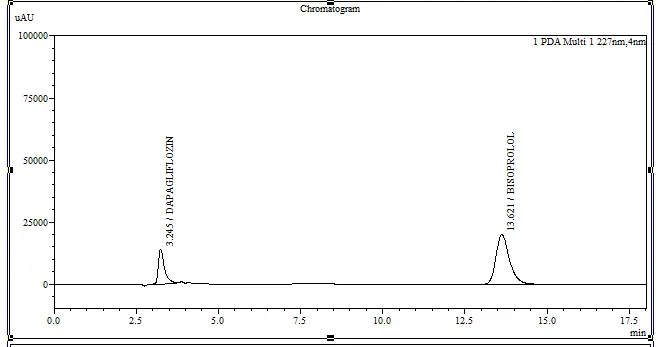
Figure 1: Optimized Chromatogram
4.2. System suitability
System-suitability data in the dissertation show a tailing factor of 1.35 for the first peak and 1.16 for the second peak, with theoretical plate counts of 3651 and 6568. A resolution value of 21.68 is reported for the pair. Taken at face value, these figures indicate distinct chromatographic peaks under the reported conditions. However, because retention-time values vary across tables, peak identity and the precise system-suitability run should be verified
Table-2
|
Parameter |
Dapagliflozin (reported) |
Bisoprolol (reported) |
|
Retention time (min) |
3.425 |
13.621 |
|
Tailing factor |
1.35 |
1.16 |
|
Theoretical plates |
3651 |
6568 |
|
Resolution |
21.68 (pairwise value reported) |
21.68 (pairwise value reported) |
4.3. Linearity
The calibration data were reported to be linear over the nominal concentration range of 10–30 µg/mL for dapagliflozin and 5–15 µg/mL for bisoprolol. The correlation coefficients were reported as 0.9995 and 0.9992, respectively. The dissertation also includes a table listing a different equation and inconsistent coefficient/limit entries. Accordingly, correlation coefficients are retained as the narrative-reported values, while the exact regression equations, intercepts, and LOD/LOQ are withheld from definitive interpretation pending source-data reconciliation.
Table -3
|
Analyte |
Nominal linearity range |
Reported correlation coefficient |
|
Dapagliflozin |
10–30 µg/mL |
0.9995 |
|
Bisoprolol |
5–15 µg/mL |
0.9992 |
4.4. Precision
Interday precision was reported as %RSD 1.007% for dapagliflozin and 0.08872% for bisoprolol. Intraday precision was reported as 0.2694% and 0.3349%, respectively. All four reported values were below the 2% criterion stated in the dissertation. Replicate peak-area values are summarized in the source thesis, but one replicate entry and the accompanying standard-deviation calculations should be checked against the raw data before reproducing the complete numerical dataset.
Table -4
|
Validation parameter |
Dapagliflozin (%RSD) |
Bisoprolol (%RSD) |
|
Interday precision |
1.007 |
0.08872 |
|
Intraday precision |
0.2694 |
0.3349 |
|
Tablet assay repeatability |
0.363 (reported) |
0.3565 (reported) |
4.5. Accuracy/recovery
The standard-addition study yielded reported recoveries close to 100% at all three levels. Dapagliflozin recoveries at 80%, 100%, and 120% were 100.37%, 99.30%, and 99.88%, respectively. Bisoprolol recoveries at the same levels were 100.127%, 99.954%, and 100.572%, respectively. These values fall within the 98–102% acceptance interval quoted in the dissertation. The reported recovery results support the accuracy of the method within the tested formulation matrix, subject to confirmation of the underlying calculations.
Table -5
|
Spike level |
Dapagliflozin recovery (%) |
Bisoprolol recovery (%) |
|
80% |
100.37 |
100.127 |
|
100% |
99.30 |
99.954 |
|
120% |
99.88 |
100.572 |
4.6. Robustness and ruggedness
The dissertation reports that small deliberate variations in flow rate and mobile-phase composition did not meaningfully affect system suitability and concludes that the method was robust. However, a complete table of each varied condition and its numerical response is not available in the summary narrative. For ruggedness, analyst-wise assay values were reported as 99.39% and 100.68% for analyst I and 100.12% and 100.64% for analyst II for dapagliflozin and bisoprolol, respectively. The source does not clearly distinguish whether these figures represent mean assay, recovery, or another response metric; this should be clarified.
Table 6 : Data for Recovery Study for Dapagliflozin
|
STANDARD SOLUTION |
AREA |
RT |
||
|
standard solution inj 01 |
137986 |
2.768 |
||
|
standard solution inj 02 |
136842 |
2.492 |
||
|
standard solution inj 03 |
137707 |
2.384 |
||
|
standard solution inj 04 |
137362 |
2.552 |
||
|
standard solution inj 05 |
137779 |
2.597 |
||
|
bracketing standard solution |
138164 |
2.624 |
||
|
Average standard Area |
137640 |
2.5695 |
||
|
Standard deviation |
475.8550199 |
0.129500193 |
||
|
Standard % RSD |
0.345724368 |
5.039898543 |
||
|
|
Accuracy 80%Solution |
|||
|
Accuracy Solution |
110881 |
2.777 |
||
|
|
Accuracy 100%Solution |
|||
|
Accuracy Solution |
137121 |
2.492 |
||
|
|
Accuracy 120%Solution |
|||
|
Accuracy Solution |
165513 |
2.777 |
||
|
Accuracy 80% |
100.3745908 |
|
||
|
Accuracy 100% |
99.30259842 |
LIMIT |
||
|
Accuracy 120% |
99.88666319 |
98.00-102.00% |
||
Table 7: Data for Recovery Study for Bisoprolol
|
STANDARD SOLUTION |
AREA |
RT |
||
|
standard solution inj 01 |
558374 |
13.98 |
||
|
standard solution inj 02 |
569812 |
13.86 |
||
|
standard solution inj 03 |
567995 |
13.77 |
||
|
standard solution inj 04 |
576890 |
13.97 |
||
|
standard solution inj 05 |
574025 |
13.98 |
||
|
bracketing standard solution |
560293 |
13.98 |
||
|
Average standard Area |
567898.1667 |
13.91333333 |
||
|
Standard deviation |
7356.787326 |
0.084301048 |
||
|
Standard % RSD |
1.295441288 |
0.605901158 |
||
|
|
Accuracy 80%Solution |
|||
|
Accuracy Solution |
449782 |
13.96 |
||
|
|
Accuracy 100%Solution |
|||
|
Accuracy Solution |
561438 |
13.864 |
||
|
|
Accuracy 120%Solution |
|||
|
Accuracy Solution |
631664 |
13.96 |
||
|
Accuracy 80% |
100.127 |
|
||
|
Accuracy 100% |
99.954 |
LIMIT |
||
|
Accuracy 120% |
100.572 |
98.00-102.00% |
||
4.7. Assay of Gluxit Beta 5 tablets
The reported assay of the tablet formulation was 99.39% of label claim for dapagliflozin and 100.68% for bisoprolol. The reported repeatability %RSD values were 0.363% and 0.3565%, respectively. These results suggest that the procedure was applied successfully to the tested product. Since only one brand/formulation is described, the findings should not be generalized to other products or matrices without further verification.
Table -8
|
Analyte |
Label claim per tablet |
Reported assay (%) |
Reported %RSD |
|
Dapagliflozin |
10 mg |
99.39 |
0.363 |
|
Bisoprolol |
5 mg |
100.68 |
0.3565 |
5. Discussion
This work describes the development and reported validation of an isocratic RP-HPLC method for simultaneous determination of dapagliflozin and bisoprolol. The selected C18 column and methanol–citric acid buffer mobile phase represent a conventional reversed-phase approach for resolving compounds with differing retention behavior. The 64:36 mobile-phase ratio was selected after preliminary trials, and UV detection at 227 nm was used for both analytes. The reported retention pattern—with an early peak assigned to dapagliflozin and a later peak assigned to bisoprolol—provides a practical basis for simultaneous quantification, provided peak identities are confirmed using individual standards.
The reported calibration correlation coefficients (0.9995 and 0.9992) indicate a strong linear association over the stated ranges. Nevertheless, linearity should not be judged from correlation coefficients alone. A publication-ready validation package should include individual calibration levels, replicate injections, regression equations, residual evaluation, and clear documentation of the claimed range. The thesis contains a mismatch between the stated bisoprolol range and the table entries, as well as a repeated regression equation that appears implausible for both analytes. These inconsistencies prevent confident reporting of slopes and intercepts.
Precision results were below the <2% RSD criterion described in the thesis, suggesting repeatable peak-area response under the tested conditions. The interday and intraday values are especially low for bisoprolol in the interday assessment; such values can occur, but they should be checked against the six individual measurements and the calculation method. The tablet assay repeatability results also show low reported variability. A complete manuscript should state the number of independent sample preparations separately from the number of replicate injections, because injection precision and method repeatability are not interchangeable.
Accuracy was evaluated by recovery at 80%, 100%, and 120% levels. The reported mean recoveries for both analytes fall close to 100% and within the acceptance range quoted in the dissertation. This supports acceptable recovery in the studied matrix. For transparent reporting, each level should include the amount added, amount recovered, mean recovery, standard deviation, and %RSD, preferably with triplicate results. The source tables should be reviewed to ensure that the recovery calculations are based on the correct analyte-specific peak areas.
Robustness was explored through small changes in flow rate and mobile-phase composition. The thesis states that system suitability remained within limits; however, it does not provide a complete numerical set of altered-condition results in the narrative. Robustness conclusions are therefore best considered preliminary until the condition-by-condition chromatographic results are supplied. Similarly, the ruggedness results are summarized by analyst-wise values but do not fully describe the experimental design or provide a clear statistical treatment.
The reported assay values—99.39% for dapagliflozin and 100.68% for bisoprolol—are near the nominal label claim for the single tablet product examined. This suggests potential applicability to routine assay of the tested formulation. Still, excipient specificity should be supported by representative placebo chromatograms or documented peak-purity/selectivity evidence. The available study does not establish stability-indicating capability because forced-degradation experiments and degradation-product separation are not described in the results.
Several technical details require harmonization before submission: (i) buffer pH is given as 3.0 in the methods and 2.8 in the summary; (ii) retention times differ among the optimization and suitability tables; (iii) bisoprolol linearity is stated as 5–15 µg/mL in one section but elsewhere as 5–25 µg/mL; (iv) regression equations and LOD/LOQ values are internally inconsistent; and (v) ruggedness values are described as percentages while labeled in places as %RSD. These issues should be resolved from original laboratory records rather than editorially inferred.
The study is consistent with the broader pharmaceutical-analysis literature in its use of RP-HPLC for drug assay and its focus on validation characteristics such as precision, accuracy, linearity, and robustness [9–16]. The present report should be framed as a method-development and assay-validation study, not as a comprehensive stability-indicating validation. Further work could include specificity against placebo and degradants, solution stability, filter compatibility, additional robustness variables, and interlaboratory reproducibility, in line with contemporary validation expectations [15,16].
6. Study limitations
The available source contains inconsistencies in key method and validation entries. The number of independent sample preparations is not always distinguished from replicate injections; full robustness data are not provided; specificity is not demonstrated with a complete placebo/interference study; and forced degradation is not documented.
7. CONCLUSION
An isocratic RP-HPLC procedure using a C18 column, methanol–citric acid buffer (64:36, v/v), a 1.0 mL/min flow rate, and UV detection at 227 nm was developed for simultaneous estimation of dapagliflozin and bisoprolol. The dissertation reports linear response over 10–30 µg/mL for dapagliflozin and 5–15 µg/mL for bisoprolol, low %RSD values for precision, recoveries near 100%, and tablet assay values of 99.39% and 100.68%, respectively. The procedure may be suitable for routine assay of the studied formulation after the source data are reconciled and the validation package is completed. Verification of buffer pH, calibration equations, LOD/LOQ, retention times, and ruggedness calculations is essential.
REFERENCES

V. Amritha*, D. Jothieswari, B. Swarupa, Method Development, Optimization And Validation For Simultaneous Estimation Of Dapagliflozin And Bisoprolol In Active Pharmaceutical Ingredient And Pharmaceutical Dosage Form By Rp-Hplc Method, Int. J. of Pharm. Sci., 2026, Vol 4, Issue 10, 1123-1134. https://doi.org/10.5281/zenodo.23221691
 10.5281/zenodo.23221691