

We use cookies to ensure our website works properly and to personalise your experience. Cookies policy
Department of Pharmaceutical Chemistry and Quality Assurance, Shri Sarvajanik Pharmacy College, Near Arvind Baug, Gujarat Technology University, Mehsana, Gujarat, India 384001
Dental plaque is the primary cause of dental caries, gingivitis, and periodontal diseases. Although mechanical plaque control is the cornerstone of oral hygiene, its effectiveness is often limited by poor patient compliance. Therefore, chemical antimicrobial agents are used as adjuncts to enhance plaque control. Chlorhexidine, a cationic bis-biguanide antiseptic, is considered the gold standard due to its broad-spectrum antimicrobial activity and prolonged substantivity. This review summarizes the mechanism of action, clinical applications, benefits, limitations, and recent advancements of chlorhexidine in oral healthcare, highlighting its continued importance in the prevention and management of plaque-related diseases.
CHX (chlorhexidine) is one of the most frequently utilized antiseptic agents for disinfecting skin and mucous membranes. In dentistry, it is employed in mouth rinses, oral irrigations, and slow-release devices. Chlorhexidine is beneficial in treating gingivitis and periodontitis and is used as an adjunct to scaling and root planing procedures. It is also effective in preventing dental caries, oropharyngeal decontamination, and endodontic treatment. Additionally, it is applied in hand hygiene for healthcare personnel, as a general skin cleanser, in catheter site preparation, and for bladder irrigation. Chlorhexidine exhibits activity against Gram-positive and Gram-negative bacteria, yeasts, and viruses. The purpose of this article is to present a comprehensive review of the applications and biological activity of chlorhexidine.[1] The cationic properties of CHX result in a bond to negatively charged sites within the biofilm including the bacteria, extracellular polysaccharides, and glycoproteins. This causes specific and strong adsorption to phosphate-containing components forming the surface of the bacterial cell.[2]
Plaque is a resilient, yellowish substance that adheres firmly to tooth surfaces and restorations. It plays a significant role in the onset of gingivitis and periodontal diseases. Complete removal of plaque through mechanical therapy is often unfeasible, which is why antimicrobial agents are employed as an adjunct to mechanical methods. chlorhexidine stands out as the most effective antimicrobial agent, with its clinical efficacy likely attributed to both its substantive and antibacterial characteristics.[3]
HISTORY:
It was initially created in 1940 by Imperial Chemical Industries and was introduced to the market as a skin antiseptic in 1954. Its applications are extensive in the fields of medicine and surgery, especially in obstetrics, gynecology, urology, and for preparing skin prior to surgical procedures.
In dentistry, it has been utilized for mouth disinfection before surgeries and in endodontic treatments. In 1969, Schroeder was the pioneer in exploring the inhibition of plaque formation. Subsequently, in 1970, Loe and Schiott demonstrated that rinsing with 0.2% chlorhexidine at a volume of 10 ml twice daily significantly reduced the development of plaque and gingivitis, even in the absence of mechanical cleaning.[4,5]
STRUCTURE:
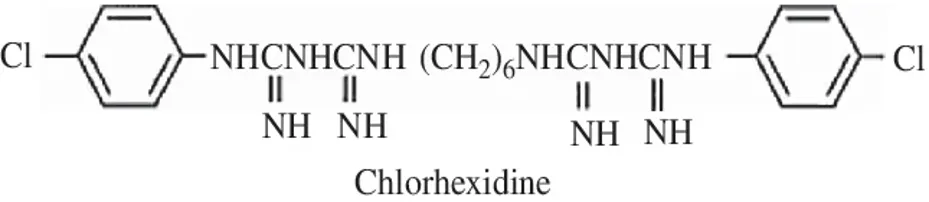
Chlorhexidine is classified as a bis-biguanide antiseptic, characterized by a symmetrical molecular structure that includes four chlorophenyl rings and two biguanide groups linked by a central hexamethylene bridge. It acts as a strong base and is di-cationic at pH levels above 3.5, exhibiting positive charges on both sides of the hexamethylene bridge. Due to its dicationic properties, it demonstrates high reactivity with anions, which contributes to its effectiveness, safety, side effects, and challenges in product formulation. It is a synthetic antimicrobial available in three forms: digluconate, acetate (water-soluble), and hydrochloride salt (sparingly soluble). [4] It acts as a strong base and is practically insoluble in water but reacts with acids to form salts that exhibit varying water solubility characteristics.[6]
MECHANISAM OF ACTION:
The antiseptic has a strong affinity for bacterial cell membranes. At lower concentrations, it increases permeability, leading to the leakage of intracellular components. At higher concentrations, chlorhexidine induces the precipitation of bacterial cytoplasm, resulting in cell death. The bacterial cell wall carries a negative charge and is composed of sulfates and phosphates.
CHEMICAL ASPECT:
The chlorhexidine molecule features a symmetrical structure consisting of two segments, each containing four chlorophenyl rings and two biguanide groups connected by a central hexa methylene bridge. As a cationic molecule, chlorhexidine's biological activity is attributed to the presence of single chlorine atoms on both phenolic rings. The chemical designation for chlorhexidine is 1,1’-hexamethylene bis (5-[4-chlorophenyl] biguanide), with the chemical formula C22H30Cl2N10. It is a strong alkali that is practically insoluble in water. However, the salts of chlorhexidine are water-soluble and have been utilized in various disinfectant formulations including chlorhexidine diacetate, chlorhexidine digluconate, and chlorhexidine dihydrochloride. Among these, chlorhexidine gluconate is the most commonly used compound in disinfectant formulations. Chlorhexidine gluconate appears as a nearly colorless or pale-yellow liquid and is highly soluble in water. In contrast, chlorhexidine acetate is a white microcrystalline powder that is very sparingly soluble in 7water but soluble in 96% ethanol.
di-D-gluconate, represented by the chemical formula C34H54Cl2N10O14. Chlorhexidine hydrochloride is characterized as a white to off-white crystalline powder, which is also quite sparingly soluble in water and very difficult to dissolve in 96% ethanol. Aqueous solutions of chlorhexidine exhibit relative resistance to elevated temperatures, with heating to 100°C not resulting in decay. However, prolonged storage under light and air can cause chlorhexidine solutions to gradually darken. The activity of chlorhexidine is influenced by the pH of the surrounding environment, with an optimal range of 5.5 to 7.0. Its effectiveness diminishes in the presence of serum, blood, and other organic materials, as well as in the presence of soaps and other anionic compounds.[1]
FORMULATION OF CHLORHEXIDINE:
Chlorhexidine is offered in various formulations. It is available as a 0.2% chlorhexidine mouthwash concentration, which is utilized for short-term plaque control. Conversely, a 0.06% concentration is recommended for daily rinsing with chlorhexidine mouthwash. In the United States, patients suffering from candidiasis infections are advised to soak their dentures in a 0.2% chlorhexidine solution for 15 minutes, twice a day.
The pH of chlorhexidine ranges from 5 to 7. It is recommended for topical use only and should never be administered systemically. Literature indicates that after a single use of chlorhexidine mouthwash, 30 percent remains in the saliva for up to 5 hours and adheres to the surface of the oral mucosa for as long as 12 hours.[8]
ADVERSE EFFECT:
The extended use of chlorhexidine is constrained by its long-term side effects. The primary adverse effect is the extrinsic staining of teeth. A brown stain can develop following the use of chlorhexidine, resulting from the polymerization reaction of carbohydrates in the pellicle, which produces pigmented substances known as melanoidins. Chlorhexidine also denatures proteins in the pellicle, forming free sulfhydryl groups that react with iron or tin ions, leading to the production of yellow pigmented compounds. Additionally, chlorhexidine interacts with dietary ketones to create insoluble, colored compounds. Other adverse effects include alterations in taste, particularly for salt, an increased likelihood of calculus formation, staining of mucous membranes, and parotid swelling.[2]
SAFETY OF CHLORHEXIDINE:
Chlorhexidine demonstrates very low toxicity as it is poorly absorbed in the gastrointestinal tract. There are no reported teratogenic effects or evidence of carcinogenic substance formation.[2]
DELIVERY SYSTEM:
MOUTH RINSE:
The use of chlorhexidine digluconate as a mouth rinse is the most frequently referenced method in existing literature. Chlorhexidine mouth rinses are available in concentrations of 0.2% and 0.12%. Both 0.2% and 0.12% rinses demonstrate equal effectiveness when administered at comparable doses. The recommended duration for rinsing is either 30 or 60 seconds, which depends on the rate at which the antiseptic is absorbed by the oral surfaces (50% of chlorhexidine binds to receptors within 15 seconds); however, this can vary among individuals. The plaque-inhibiting effect of a 0.2% chlorhexidine rinse, when used for 15, 30, and 60 seconds after a 72-hour period without brushing, showed no significant differences.
The optimal regimen is to use it twice daily (morning and night), which will provide a substantively effective duration of 12 hours.[3]
GEL:
Chlorhexidine gels are available in concentrations of 1%, 0.2%, and 0.12%. A 1% chlorhexidine gel product is utilized in conjunction with toothbrushes in trays. The distribution of the gel when applied with a toothbrush is inadequate, while trays have proven effective in controlling plaque and gingivitis.[9]
SPRAY:
Chlorhexidine sprays come in concentrations of 0.1% and 0.2%. Research has shown that the 0.2% concentration delivers a small dose of 2mg to the tooth surface, resulting in plaque inhibition comparable to that of rinses. These sprays are particularly advantageous for individuals with disabilities. The directed application of sprays to the tooth minimizes the dosage while potentially enhancing the taste.[10]
TOOTHPASTE:
Formulating chlorhexidine in toothpaste presents challenges. In 1993, Yates et al. demonstrated that chlorhexidine toothpaste, with or without fluoride, outperformed the control product. However, this was associated with increased staining and supragingival calculus formation. A formulation containing 0.12% chlorhexidine and one part per million of fluoride exhibits antiplaque effects similar to those of chlorhexidine mouthwash. Additionally, using 1% chlorhexidine as slurries and rinsing twice daily for one minute leads to a significant reduction in both plaque and gingival scores. The various application methods should be tailored to meet the specific needs of each patient.[11]
VARNISH:
Varnish formulation is utilized to prevent root caries.[12]
CHEWING GUM:
This product contains 20mg of chlorhexidine diacetate. It is recommended to chew two pieces twice daily for 10 minutes. Chewing gum that includes chlorhexidine may be beneficial for short-term plaque management. Over time, if proven equally effective, chlorhexidine-infused chewing gum could enhance oral hygiene practices for hospitalized and elderly patients, those with xerostomia, and individuals at a heightened risk of caries. Regular use of chlorhexidine chewing gum may also be advantageous in scenarios where mechanical hygiene methods or mouth rinses are not feasible, yet a chewable antiplaque solution is desirable.[3]
CHLORHEXIDINE CHIP:
The Perio Chip is a small, orange-brown, rectangular chip with one rounded end designed for insertion into periodontal pockets. Each Perio Chip weighs approximately 6.9 mg and measures 5 × 4 × 0.3 mm, containing 2.5 mg of chlorhexidine gluconate within a biodegradable matrix made of hydrolyzed gelatin cross-linked with glutaraldehyde. Additionally, glycerin and purified water are incorporated into the Perio Chip.
CHX (chlorhexidine) local drug delivery includes:
USE OF ORAL DISEASE:
Chlorhexidine is widely employed in dentistry, with common applications including (but not limited to) (i) managing oral hygiene, dental plaque, and caries with or without underlying conditions, (ii) aiding in the treatment of gingivitis, periodontitis, and peri-implant disease, (iii) serving as an irrigant during root canal procedures, (iv) addressing oral surgery and related complications, (v) managing oral mucosal diseases, and (vi) acting as a pre-rinse to minimize microbial aerosolization during dental treatments. These uses may involve public access as an over-the-counter mouth rinse or as a mouth rinse, gel, and slow-release forms (chips) utilized by dental professionals. The following sections will concentrate on the appropriateness of current applications of chlorhexidine in the management of specific oral diseases. [13]
ANTIBACTERIAL ACTIVITY:
Chlorhexidine serves as a broad-spectrum biocide, demonstrating effectiveness against Gram-positive and Gram-negative bacteria, as well as fungi. Its bactericidal properties arise from the interaction of this cationic compound with the negatively charged walls of bacterial cells. At lower concentrations, chlorhexidine exhibits a bacteriostatic effect, while at higher concentrations, it disrupts membranes leading to cell death. Compared to other antimicrobials, chlorhexidine inactivates a wider range of microorganisms and has a faster kill rate. The mechanism of action involves the disruption of the cell membrane.[14]
ANTIFUNGAL ACTIVITY:
The action mechanism against fungi closely resembles that against bacteria. Among fungi, Candida species are the most prevalent in both healthy and affected individuals. Fungi have been identified in infected root canals that have not undergone prior endodontic treatment. Chlorhexidine is rapidly absorbed by the fungus, compromising the integrity of the cell wall and plasma membrane, which allows it to penetrate the cytoplasm, causing leakage of cellular contents and ultimately leading to cell death. (chips) utilized by dental professionals. The following sections will address the appropriateness of current applications of chlorhexidine in the treatment of specific oral diseases.[14]
Fungi have occasionally been found in infencted root canals that have not had any previous endodontic treatment or in those that have become infected some time after treatment or in those that have not responded to endodontic treatment.[15]
CONCLUSION
Chlorhexidine is one of the most reliable and widely studied antiseptic agents in dentistry due to its broad-spectrum antimicrobial activity, prolonged substantivity, and demonstrated efficacy in controlling dental plaque and preventing periodontal diseases. While prolonged use can result in adverse effects such as tooth staining, altered taste sensation, and these limitations are generally manageable with appropriate clinical supervision, and the availability of multiple formulations, including mouth rinses, gels, sprays, varnishes, and local drug-delivery systems, enhance its clinical utility. Future research should strive to develop improved chlorhexidine formulations that reduce side effects while maintaining optimal antibacterial and antifungal efficacy.
REFERENCES



Romit Limbachiya, Dip Patel, Dr. Khushbu Patel, Dr. C. N. Patel, Chlorhexidine in Dentistry: A Comprehensive Review of Clinical Applications, Chemical Aspects and Biological Activity, Int. J. of Pharm. Sci., 2026, Vol 4, Issue 7, 4795-4801. https://doi.org/10.5281/zenodo.21510892
 10.5281/zenodo.21510892