

We use cookies to ensure our website works properly and to personalise your experience. Cookies policy
St. Joseph's College of Pharmacy, Dharmagiri College Campus, Naipunnya Road, Cherthala, Kerala 688524, India.
Psoriasis is a chronic immune-mediated inflammatory skin disease in which reciprocal interactions between immune cells and keratinocytes sustain inflammation, epidermal hyperplasia, abnormal differentiation and barrier dysfunction. Chrysin (5,7-dihydroxyflavone) is a naturally occurring flavone with anti-inflammatory and antioxidant activities that may be relevant to psoriasis. The most direct evidence comes from an imiquimod-induced psoriasis-like model and cytokine-stimulated keratinocytes, where chrysin reduced inflammatory signaling, CCL20 and antimicrobial peptide responses. Mechanistic studies further implicate IKK/NF-?B and MAPK pathways, whereas JAK/STAT involvement is supported by psoriasis-related experiments but remains less firmly established for native chrysin. Translation is constrained by poor aqueous solubility, limited systemic bioavailability and the challenge of achieving adequate cutaneous exposure. This review critically examines the psoriasis-relevant pharmacology of chrysin, distinguishes direct evidence from supportive evidence obtained with related skin-inflammatory models and chrysin derivatives, and evaluates pharmaceutical strategies for topical delivery. Particular attention is given to niosomes as a rational vesicular platform for poorly water-soluble flavonoids and to the potential value of incorporating niosomes into a gel. Chrysin should currently be regarded as a preclinical candidate rather than an established anti-psoriatic therapy. Future studies should link formulation attributes with skin deposition, pharmacodynamic biomarkers, in vivo efficacy, repeated-dose dermal safety and clinical translation.
Psoriasis is a chronic inflammatory skin disease characterized clinically by erythematous, scaly plaques and biologically by sustained activation of cutaneous immune cells and keratinocytes. Current evidence supports a pathogenic network involving dendritic cells, T-helper 17 (Th17) cells, cytokines and keratinocytes rather than an isolated disorder of epidermal turnover. The IL-23/IL-17 axis is central to this network, while keratinocyte-derived mediators help maintain local inflammation.¹⁻³
Therapeutic management aims to control inflammation, reduce disease burden and maintain an acceptable safety profile during repeated treatment. Topical corticosteroids, vitamin D analogues and other local therapies remain important for limited disease, while phototherapy, conventional systemic agents and biologics are selected according to disease severity and clinical context. Long-term management can nevertheless be constrained by adverse effects, treatment burden, cost and incomplete response, supporting continued investigation of alternative or adjunctive strategies.¹,³,⁴,²³
Flavonoids are attractive candidates because they can influence inflammatory and oxidative-stress pathways, but evidence must be interpreted at the level of the individual compound. Chrysin (5,7-dihydroxyflavone) is of particular interest because native chrysin has demonstrated activity in an imiquimod-induced psoriasis-like model and in cytokine-stimulated keratinocytes.⁵ Mechanistic studies in inflammatory skin models further implicate IKK/NF-κB and MAPK signaling.⁶,⁷ The present review therefore focuses on three linked questions: what is established by psoriasis-specific evidence, which mechanisms are supported by related skin models, and how pharmaceutical delivery may improve topical translation?
2. Psoriasis: Pathobiology Relevant to Chrysin
Psoriasis involves an interconnected sequence of tissue stress, innate immune activation, adaptive immune responses and keratinocyte amplification. Keratinocytes exposed to inflammatory stimuli can release antimicrobial peptides and other mediators, including LL-37 and S100 proteins. These signals contribute to activation of dendritic-cell populations and establishment of the inflammatory environment. Myeloid dendritic cells produce IL-23, which supports expansion and persistence of Th17 cells; Th17-derived IL-17A and IL-17F, together with IL-22 and other mediators, act on keratinocytes and promote further production of cytokines, chemokines and antimicrobial peptides.¹⁻³
This creates a self-reinforcing immune–keratinocyte loop. CCL20 is particularly relevant because it recruits CCR6-expressing cells and links keratinocyte activation to broader immune amplification. Antimicrobial peptides, including β-defensins and LL-37, also participate in inflammatory signaling within psoriatic skin.²,³,⁵
Oxidative stress provides an additional layer of amplification. Excess reactive oxygen species can activate redox-sensitive inflammatory pathways that intersect with NF-κB and MAPK signaling. Flavonoids may influence this component of psoriasis through antioxidant and redox-regulatory effects; however, antioxidant activity should not be equated with a psoriasis-specific mechanism for chrysin.⁸⁻¹⁰
Keratinocytes are active participants in psoriasis rather than passive targets. IL-17- and IL-22-associated signaling promotes proliferation and abnormal differentiation, while keratinocyte-derived inflammatory mediators recruit and activate immune cells. The resulting epidermal hyperplasia, altered differentiation and barrier dysfunction provide a strong rationale for interventions that reduce both inflammatory signaling and keratinocyte activation. ²,³
Four signaling systems are relevant to the present review: NF-κB, MAPK, JAK/STAT and PI3K/Akt/mTOR. These pathways do not have equivalent evidence for native chrysin in psoriasis. The strongest direct chrysin-specific evidence currently involves NF-κB/IKK, MAPK and JAK/STAT modulation in the psoriasis model, whereas PI3K/Akt/mTOR is better regarded as a supportive pathway-level context based on other flavonoids rather than an established chrysin mechanism.⁵⁻⁷,²⁰
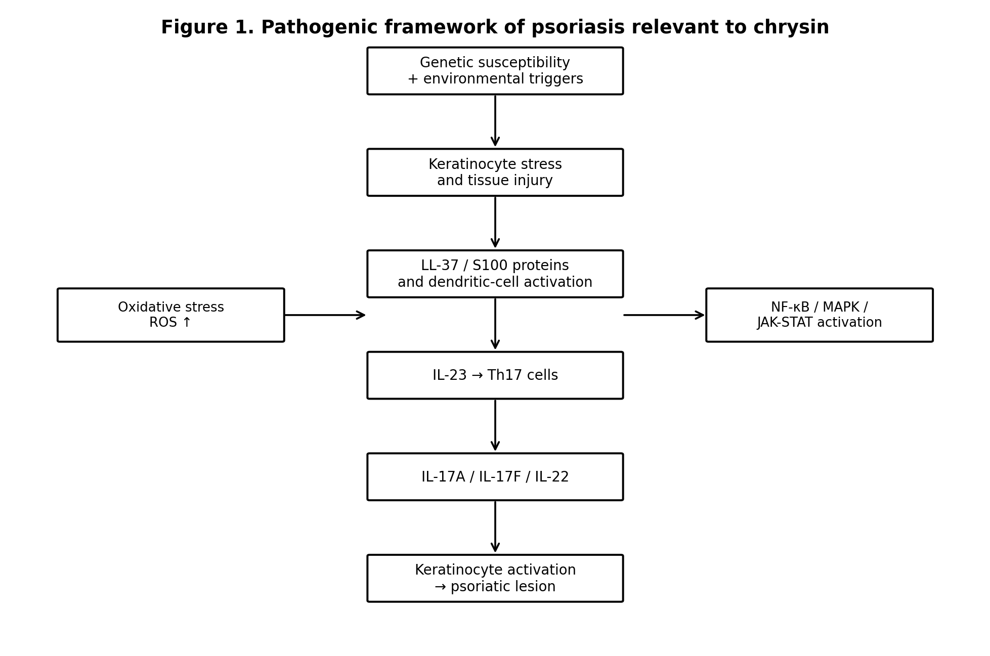
Figure 1. Pathogenic framework of psoriasis relevant to chrysin. The diagram emphasizes the IL-23/Th17–keratinocyte loop and its intersection with oxidative stress and intracellular inflammatory signaling.
3. Chrysin: Chemistry, Sources and Pharmacological Rationale
3.1 Chemical and Physicochemical Profile
Chrysin is a naturally occurring flavone chemically designated as 5,7-dihydroxyflavone. It has the molecular formula C15H10O4 and a molecular weight of 254.24 g/mol. Its flavone nucleus contains two aromatic rings connected through a heterocyclic oxygen-containing ring, with hydroxyl groups at positions 5 and 7. These structural features contribute to its physicochemical and biological properties.⁹,¹⁰
The physicochemical profile of chrysin creates important formulation challenges. Its poor aqueous solubility can limit dissolution and effective exposure in conventional aqueous systems, while its absorption and metabolism contribute to limited systemic bioavailability.⁹,¹⁰,¹² For topical therapy, the stratum corneum adds a major barrier to drug delivery. Therefore, biological activity alone does not ensure adequate local exposure; the formulation must maintain the drug in a suitable state and promote deposition within relevant skin layers.
3.2 Natural Sources
Chrysin has been identified in bee-derived products such as honey and propolis and in medicinal plants including Passiflora species.⁹,¹⁰ For pharmaceutical development, however, the relevant considerations are chemical identity, purity, standardization and reproducibility of the active material rather than natural abundance alone.
3.3 Pharmacological Rationale for Psoriasis
Chrysin has been investigated for anti-inflammatory, antioxidant and other pharmacological effects. For psoriasis, the most informative evidence comes from the study by Li et al., which demonstrated that chrysin attenuated imiquimod-induced psoriasis-like skin inflammation and reduced CCL20 and antimicrobial peptide responses in cytokine-stimulated keratinocytes.⁵ These findings provide a stronger psoriasis-specific rationale than extrapolation from unrelated inflammatory diseases. The key physicochemical and development characteristics are summarized in Table 1.
Supportive studies in inflammatory skin models show that chrysin can inhibit IKK/NF-κB-dependent CCL5 transcription and suppress TNF-α-induced TSLP expression through ERK/JNK-EGR1-associated mechanisms.⁶,⁷ These studies strengthen mechanistic plausibility but do not establish clinical efficacy in psoriasis. Chrysin should therefore be regarded as a preclinical candidate with convergent evidence rather than a clinically validated anti-psoriatic therapy.
TABLE 1. CHEMICAL AND PHYSICOCHEMICAL PROFILE OF CHRYSIN
|
Characteristic |
Chrysin |
|
Chemical class |
Flavone |
|
Chemical name |
5,7-Dihydroxyflavone |
|
Molecular formula |
C15H10O4 |
|
Molecular weight |
254.24 g/mol |
|
Representative sources |
Honey, propolis, Passiflora spp. and medicinal plants |
|
Psoriasis-relevant activities |
Anti-inflammatory; antioxidant; immunomodulatory potential |
|
Key mechanistic evidence |
IKK/NF-κB, MAPK and JAK/STAT modulation |
|
Major pharmaceutical limitation |
Poor aqueous solubility |
|
Additional delivery concerns |
Limited systemic bioavailability and uncertain cutaneous exposure |
|
Preferred development route |
Topical |
4. Molecular Mechanisms of Chrysin in Psoriasis
The pharmacological relevance of chrysin is best understood as a network effect rather than inhibition of a single psoriasis target. The available evidence indicates that chrysin can influence several points in the inflammatory cascade, particularly within keratinocytes. Because evidence strength differs among pathways, mechanistic claims should be graded according to whether they derive from native chrysin in psoriasis, related skin models or chemically modified derivatives. The proposed convergence of these pathways is illustrated in Figure 2.
4.1 IKK/NF-κB Signaling
NF-κB is a central transcriptional regulator of inflammatory gene expression. Inflammatory stimulation activates IκB kinase (IKK), promoting IκB degradation and NF-κB activation. The resulting transcriptional program includes cytokines, chemokines and other mediators that sustain inflammation.²,⁶
Yeo et al. reported that chrysin targets IKK and suppresses NF-κB-dependent CCL5 transcription in an atopic-dermatitis-like inflammatory environment.⁶ In the psoriasis-specific study by Li et al., chrysin reduced inflammatory signaling together with CCL20 and antimicrobial peptide release.⁵ Taken together, these findings support NF-κB/IKK as one of the best-supported chrysin-sensitive inflammatory pathways relevant to psoriasis, while recognizing that direct target engagement has not been comprehensively established in human psoriatic tissue.
4.2 MAPK Signaling
MAPK pathways, including ERK1/2, JNK and p38, regulate inflammatory responses, proliferation and differentiation. In psoriasis, excessive MAPK activity can contribute to inflammatory mediator production and abnormal keratinocyte behavior.²,³ Chrysin reduced ERK/JNK-associated signaling in inflammatory keratinocyte models and suppressed TNF-α-induced TSLP expression through an EGR1-linked mechanism.⁷
The relevance of MAPK modulation to psoriasis is therefore biologically plausible but should not be overstated. The strongest mechanistic evidence comes from inflammatory keratinocyte models, whereas the psoriasis-specific study supports the broader anti-inflammatory phenotype.⁵,⁷ Direct exposure–response studies in psoriasis models would strengthen the causal link between chrysin and MAPK inhibition.
4.3 JAK/STAT-Associated Signaling
JAK/STAT signaling transmits cytokine signals relevant to psoriatic inflammation. The psoriasis-specific chrysin study reported attenuation of cytokine-induced JAK/STAT signaling in keratinocytes, providing direct evidence that this pathway is affected by native chrysin in a psoriasis-related experimental system.⁵ Chrysin derivatives provide additional evidence for NF-κB/STAT3 modulation in anti-psoriatic activity.¹¹
JAK/STAT should nevertheless be regarded as less firmly established than the overall anti-inflammatory phenotype and should not be inferred to have the same magnitude or mechanism in human disease. Results obtained with optimized derivatives cannot automatically be assigned to parent chrysin; altered target affinity, exposure or both may account for their greater activity.
4.4 CCL20 and Antimicrobial Peptide Regulation
CCL20 is a functionally important mediator linking keratinocyte activation with recruitment of inflammatory immune cells. Li et al. showed that chrysin reduced CCL20 release from keratinocytes stimulated with TNF-α, IL-17A and IL-22 and also reduced antimicrobial peptide production.⁵ This observation places chrysin within the immune–keratinocyte feedback loop rather than treating inflammation as an isolated cytokine endpoint.
The reduction of antimicrobial peptides is also relevant because molecules such as LL-37 and β-defensins participate in inflammatory amplification in psoriatic skin.²,³ The available evidence does not yet establish whether CCL20 suppression is a primary molecular action or a downstream consequence of broader pathway inhibition; pathway-selective and rescue experiments could help resolve this relationship.
4.5 Oxidative Stress and Antioxidant Mechanisms
Oxidative stress is an important component of psoriatic inflammation, and flavonoids can modulate redox imbalance through several mechanisms.⁸,⁹ Chrysin has recognized antioxidant activity, but antioxidant effects should be interpreted as complementary to its demonstrated anti-inflammatory actions rather than as proof of a psoriasis-specific Nrf2 mechanism.
Evidence for a specific chrysin–Nrf2 mechanism in psoriasis remains limited. Nrf2 is an established regulator of antioxidant and inflammatory responses in skin, while studies of other flavonoids, such as rutin, provide platform-level evidence that redox modulation can influence psoriasis-like inflammation.⁸ The latter evidence supports a research hypothesis, not a demonstrated mechanism of native chrysin.
4.6 Keratinocyte Regulation and Immunomodulation
The pathological consequences of sustained inflammatory signaling include excessive keratinocyte proliferation, abnormal differentiation and epidermal remodeling. Chrysin has shown anti-inflammatory activity in keratinocyte models and reduced inflammatory skin changes in preclinical studies.⁵⁻⁷ These observations are consistent with secondary normalization of keratinocyte behavior following suppression of cytokine and chemokine signaling.
Systemic immunomodulation should be interpreted even more cautiously. Although flavonoids can influence dendritic-cell and T-cell responses in experimental systems, the direct psoriasis-specific evidence for native chrysin remains centered on keratinocyte-associated inflammatory signaling.⁵,¹⁴,²¹
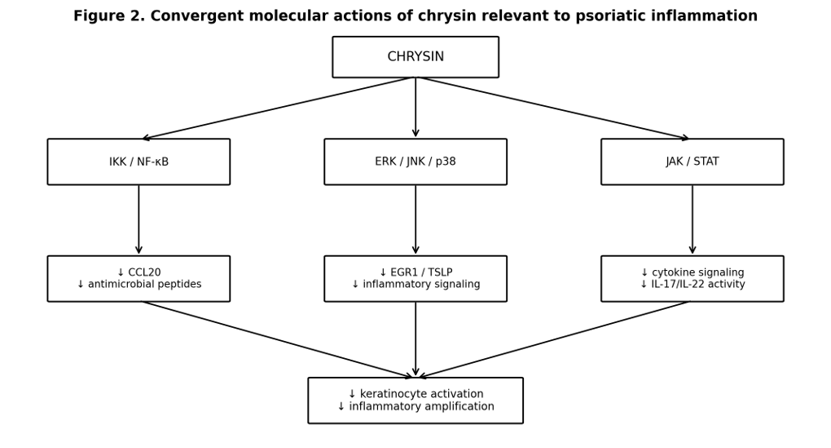
Figure 2. Convergent molecular actions of chrysin relevant to psoriatic inflammation. NF-κB/IKK and MAPK are supported by the strongest chrysin-specific evidence; JAK/STAT and antioxidant pathways are presented as supportive or emerging mechanisms requiring further validation.
5. Experimental Evidence for Chrysin in Psoriasis
The experimental evidence for chrysin can be divided into three levels: direct psoriasis evidence using native chrysin, supportive evidence from inflammatory skin models, and evidence from chemically modified chrysin derivatives. Keeping these categories separate prevents overinterpretation of the literature.
5.1 Native Chrysin in Psoriasis Models
The central study by Li et al. evaluated chrysin in an imiquimod-induced psoriasis-like mouse model and in human epidermal keratinocytes stimulated with psoriasis-associated cytokines.⁵ Chrysin attenuated skin inflammation and barrier dysfunction in vivo and reduced cytokine-induced signaling, CCL20 and antimicrobial peptide responses in keratinocytes. These findings provide the strongest direct evidence currently available for native chrysin in psoriasis.
The study should nevertheless be interpreted within the limitations of preclinical psoriasis models. Imiquimod-induced inflammation reproduces important features of psoriasis but does not fully reproduce human disease heterogeneity, chronicity or comorbidity. Efficacy in an experimental model does not establish the dose, formulation, treatment duration or safety required for human use. The most defensible conclusion is that native chrysin has demonstrated preclinical anti-psoriatic activity and warrants further formulation and translational investigation.
5.2 Supportive Inflammatory Skin Evidence
Studies in other inflammatory skin conditions provide mechanistic support. Chrysin inhibited IKK/NF-κB-dependent CCL5 transcription in keratinocytes and suppressed TNF-α-induced TSLP expression through ERK/JNK-EGR1-associated mechanisms.⁶,⁷ Choi et al. also reported anti-inflammatory activity in an atopic-dermatitis model.¹³ These findings are supportive rather than psoriasis-specific.
5.3 Chrysin Derivatives
Chemical modification provides a complementary strategy for improving the activity of the chrysin scaffold. Zhao et al. reported novel chrysin derivatives with enhanced anti-inflammatory effects; compound 4o reduced IL-6, IL-17A, IL-22, IL-23 and TNF-α in experimental systems and showed anti-psoriatic activity with involvement of NF-κB and STAT3.¹¹ These findings support structure optimization but should not be used as direct evidence for unmodified chrysin.
TABLE 2. EVIDENCE FOR CHRYSIN IN PSORIASIS AND RELATED SKIN INFLAMMATION
|
Evidence type |
Model / study |
Principal finding |
Interpretation |
|
Direct |
IMQ-induced psoriasis-like model; cytokine-stimulated keratinocytes |
Reduced skin inflammation, barrier dysfunction, CCL20 and antimicrobial peptide responses |
Strongest evidence for native chrysin in psoriasis.⁵ |
|
Mechanistic support |
Inflammatory keratinocytes |
IKK/NF-κB inhibition and reduced CCL5 transcription |
Supports NF-κB/IKK mechanism.⁶ |
|
Mechanistic support |
TNF-α-stimulated keratinocytes |
Reduced ERK/JNK-associated signaling and TSLP expression |
Supports MAPK-related mechanism.⁷ |
|
Related skin disease |
Atopic dermatitis models |
Suppressed inflammatory responses |
Supportive, not psoriasis-specific.¹³ |
|
Derivative evidence |
Chrysin derivatives; psoriasis models |
Enhanced anti-inflammatory activity; NF-κB/STAT3 involvement |
Supports scaffold optimization, not direct parent-drug evidence.¹¹ |
6. Pharmaceutical Delivery of Chrysin
A major translational issue is that pharmacological activity alone does not guarantee effective topical therapy. For a hydrophobic compound such as chrysin, the formulation must maintain adequate solubilization or dispersion, protect the active ingredient during storage and administration, provide intimate contact with the skin, and achieve sufficient local deposition. These requirements are particularly relevant in psoriasis because plaques may exhibit altered barrier properties and substantial epidermal thickening.11,12
6.1 Conventional Topical Limitations
Conventional creams, gels and solutions are straightforward to manufacture, but hydrophobic flavonoids may precipitate, remain incompletely dissolved or exhibit limited skin availability. Increasing organic-solvent or surfactant levels may improve apparent solubilization but can also increase irritation or stability concerns. The formulation should therefore be designed around the desired local exposure profile rather than simply maximizing nominal drug concentration.
6.2 Nanocarrier Strategies
Nanotechnology provides several approaches for modifying the pharmaceutical behavior of poorly water-soluble compounds. Liposomes, niosomes, nanoemulsions, solid lipid nanoparticles (SLNs), nanostructured lipid carriers (NLCs), polymeric nanoparticles and microneedles differ in their mechanisms, formulation complexity and ability to influence skin deposition.¹⁴⁻¹⁶
The evidence from other flavonoids demonstrates that delivery can alter the pharmacological outcome. For example, flavanone derivatives have been evaluated with skin permeation and cell-based assays, while luteolin- and other flavonoid-loaded lipid systems have demonstrated improved skin deposition and sustained delivery in experimental settings.18,20 A psoriasis review of nanotechnological systems also describes improved skin deposition with several lipid and vesicular carriers. These findings support the general proposition that formulation is a critical determinant of topical phytochemical performance.
6.3 Why Niosomes Are Attractive for Chrysin
Niosomes are vesicular carriers composed primarily of nonionic surfactants and cholesterol. Their relevance to chrysin arises from the ability of the vesicular membrane to accommodate hydrophobic molecules while providing a dispersed aqueous formulation. Cholesterol can contribute to membrane organization, while surfactant composition can be adjusted to modify vesicle size, rigidity and drug entrapment. Niosomes can also be incorporated into a gel vehicle to improve application and residence at the skin surface. Table 3 compares major delivery strategies relevant to topical chrysin development.
Evidence from related flavonoids and poorly soluble anti-inflammatory compounds supports the platform rationale. A celastrol-loaded niosome hydrogel improved topical permeation and anti-psoriatic activity in an imiquimod-induced mouse model, providing psoriasis-specific evidence for the delivery platform; this does not establish efficacy for chrysin.¹⁸ Luteolin has also been formulated in nonionic surfactant-based vesicles and niosomal transgel systems with improved topical delivery characteristics, while a separate luteolin nanovesicle study demonstrated enhanced topical delivery after incorporation into a Carbopol 934 gel.¹⁷,¹⁹ These studies support the delivery principle but are not evidence that chrysin niosomes will produce the same outcome.
Niosomes should not, however, be assumed to solve every delivery problem. Vesicle aggregation, leakage, surfactant-related irritation, batch variability and changes in size or entrapment during storage can compromise performance. Consequently, a chrysin niosomal gel should be evaluated as a complete product rather than by particle size alone. Relevant quality attributes include particle size distribution, PDI, zeta potential, entrapment efficiency, drug content, morphology, rheology, pH, release, ex vivo deposition, stability and skin compatibility. The overall formulation rationale is shown in Figure 3.
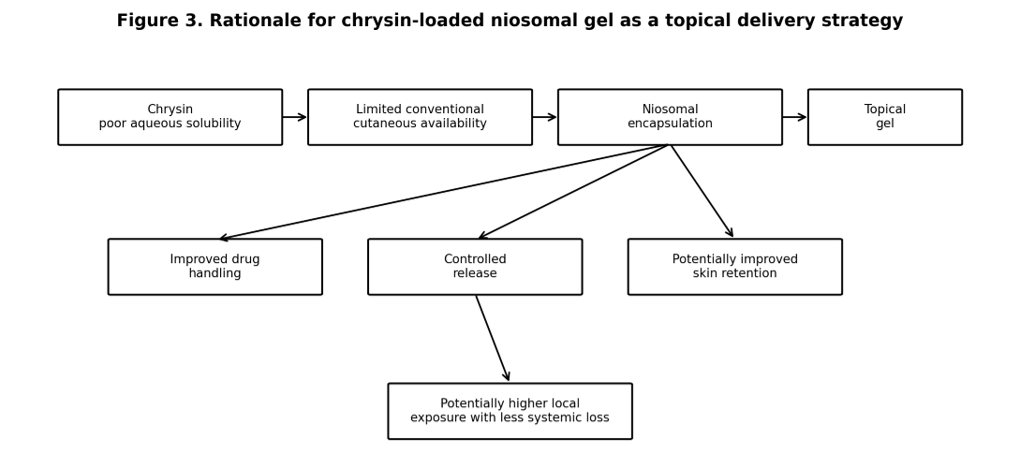
Figure 3. Rationale for chrysin-loaded niosomal gel as a topical delivery strategy. The proposed benefits are formulation and platform hypotheses that require direct experimental validation for chrysin in psoriasis.
TABLE 3. TOPICAL DELIVERY STRATEGIES RELEVANT TO CHRYSIN
|
Delivery strategy |
Primary advantage |
Important limitation |
Relevance to chrysin |
|
Liposomes |
Biocompatibility; versatile encapsulation |
Leakage and physical stability concerns |
High |
|
Niosomes |
Hydrophobic-drug encapsulation; relatively simple topical vesicles |
Aggregation, leakage and surfactant-related issues |
High potential |
|
Nanoemulsions |
High solubilization capacity; small droplets |
May require relatively high surfactant/co-surfactant levels |
High |
|
SLNs |
Protection, occlusion and controlled release |
Drug loading and expulsion can be limiting |
Moderate |
|
NLCs |
Higher loading and less ordered lipid matrix |
More complex formulation |
Emerging |
|
Polymeric nanoparticles |
Controlled release and surface modification |
Manufacturing complexity |
Emerging |
|
Microneedles |
Bypass of stratum corneum |
Specialized fabrication; dosing limitations |
Future |
|
Mesoporous silica nanoparticles |
High loading and stimulus-responsive options |
Need extensive safety evaluation |
Future |
7. Chrysin-Loaded Niosomal Gel: Translational Rationale
The rationale for a chrysin-loaded niosomal gel can be expressed as a chain linking pharmacology to pharmaceutical design. First, chrysin has psoriasis-relevant anti-inflammatory activity. Second, its physicochemical properties create a barrier to conventional delivery. Third, vesicular encapsulation offers a means of dispersing a hydrophobic compound and potentially modifying its interaction with the skin. Fourth, incorporation of the vesicles into a gel can improve application, residence and handling. The resulting system therefore attempts to address the delivery problem without changing the pharmacological identity of chrysin.
A rational formulation development program should optimize both formulation variables and biological performance. Surfactant type and concentration, cholesterol ratio, drug loading, hydration conditions, sonication or size-reduction parameters and gel composition can influence vesicle characteristics. Design of experiments can be used to identify interactions between critical formulation variables and responses such as particle size, PDI, zeta potential, entrapment efficiency and release. However, statistical optimization should ultimately be connected to clinically meaningful or mechanistically informative endpoints such as skin deposition and inflammatory biomarker modulation.
The final gel should also be assessed beyond physicochemical characterization. In vitro release can indicate whether encapsulation changes the release profile, but release alone does not establish topical efficacy. Ex vivo permeation and skin-retention studies are more informative for a dermatological product because they distinguish delivery into skin from passage across the skin. Ideally, dermatomkinetic analysis should quantify chrysin in the stratum corneum, epidermis and dermis over time. A successful formulation would be expected to increase local exposure while avoiding unnecessary systemic transport.
For psoriasis, efficacy testing should include both macroscopic and molecular endpoints. Histopathological evaluation can quantify epidermal thickness and inflammatory infiltration, while biomarkers such as TNF-α, IL-17-associated signaling, CCL20, NF-κB activity and selected antimicrobial peptides can connect formulation performance with the proposed mechanism. Skin irritation and repeated-dose dermal safety are essential because psoriasis treatment is chronic. These studies would transform the niosomal gel concept from a formulation hypothesis into a translationally testable therapeutic strategy.
8. Current Evidence Gaps and Future Perspectives
The principal limitation of the current chrysin literature is not absence of biological activity but insufficient translational depth. Direct evidence in psoriasis remains concentrated in a small number of preclinical studies, while much of the mechanistic literature comes from related inflammatory skin models. Human evidence for chrysin as an anti-psoriatic treatment remains insufficient to support clinical recommendations. A 2025 randomized crossover study showed that a micellar oral formulation containing chrysin, quercetin and rutin increased systemic chrysin exposure and was tolerated during 30 days of use in healthy adults; however, this study does not establish topical anti-psoriatic efficacy or the independent clinical effect of chrysin.²² A staged translational roadmap is presented in Figure 4.
8.1 Link Formulation Attributes to Biological Exposure
Future studies should move beyond reporting particle size, PDI and entrapment efficiency as isolated formulation endpoints. The critical question is whether a particular formulation produces a reproducible increase in active chrysin concentration at the relevant skin compartment. Comparative studies of free chrysin, conventional gel and chrysin-loaded niosomal gel using identical doses would help establish whether observed benefits arise from encapsulation rather than simply from dose differences.
8.2 Pharmacodynamic Validation
A stronger translational package would connect skin exposure with mechanism. Measurements of NF-κB nuclear activity, IKK signaling, ERK/JNK phosphorylation, CCL20 release and oxidative-stress markers could establish pharmacodynamic relationships. This would allow formulation optimization to be guided by biological activity rather than by physicochemical criteria alone.
8.3 Safety and Chronic-Use Considerations
Psoriasis often requires repeated topical administration, so short-term tolerability is not sufficient. Repeated-dose dermal irritation, sensitization, histological assessment and systemic exposure should be evaluated. Nanocarrier-specific safety also needs attention because surfactant composition, vesicle characteristics and impurities can influence tolerability. A favorable safety profile should therefore be demonstrated experimentally rather than inferred solely from the natural origin of chrysin.
8.4 Standardization and Scale-Up
Laboratory-scale vesicles can show excellent characteristics while being difficult to reproduce during scale-up. Manufacturing studies should identify critical material attributes and critical process parameters and establish acceptable ranges for particle size, PDI, drug loading, entrapment and release. Stability studies should assess both chemical potency and physical changes in the vesicles. Quality-by-design approaches may be particularly useful because they allow formulation variables and their interactions to be evaluated systematically.
8.5 Structure Optimization and Intelligent Delivery
The discovery of active chrysin derivatives suggests two complementary development paths: improve the molecule or improve its delivery. Structure optimization may enhance potency or pharmacokinetic properties, whereas nanocarriers can modify solubility, stability and local exposure without changing the parent scaffold. Future work could investigate combinations of these strategies. Stimuli-responsive systems are conceptually attractive but remain a future research direction and should not be presented as established chrysin therapies.¹¹,¹⁴,¹⁵
8.6 Clinical Translation
Before clinical investigation, evidence should progress through standardized in vivo efficacy, dermal safety, pharmacokinetic or dermatokinetic assessment and reproducible manufacturing. Early clinical studies would need to determine tolerability, appropriate topical dosing, local exposure and preliminary efficacy. Randomized controlled trials would ultimately be required to compare chrysin formulations with established topical treatments. Development should also account for disease severity, plaque characteristics, concomitant therapy and patient-reported outcomes. The principal evidence gaps and priority experiments are summarized in Table 4.
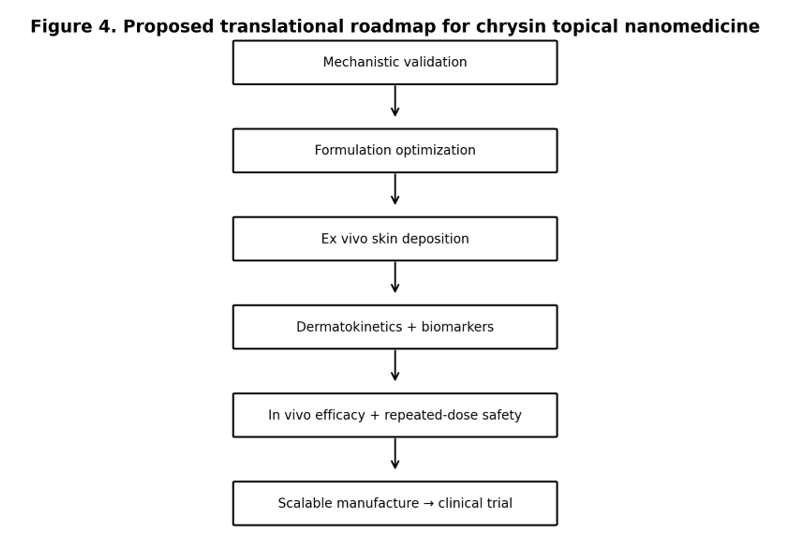
Figure 4. Proposed translational roadmap for chrysin topical nanomedicine. Each stage should be supported by predefined quality, exposure, efficacy and safety criteria before progression.
TABLE 4. CURRENT EVIDENCE GAPS AND PRIORITY EXPERIMENTS
|
Research gap |
Why it matters |
Priority experiment |
|
Limited native-chrysin psoriasis studies |
Evidence base is narrow |
Independent in vivo replication using standardized chrysin |
|
Uncertain skin exposure |
Pharmacological dose does not equal dermal exposure |
Dermatokinetic and skin-deposition studies |
|
Limited PK/PD linkage |
Mechanism and formulation are not connected quantitatively |
Exposure–biomarker relationship |
|
Few head-to-head delivery comparisons |
Best carrier remains uncertain |
Free drug vs gel vs niosomal gel |
|
Limited chronic safety |
Psoriasis requires repeated treatment |
Repeated-dose dermal safety and sensitization |
|
Scale-up uncertainty |
Laboratory formulation may not be reproducible |
QbD/process validation and stability |
|
Clinical evidence gap |
Human efficacy is unknown |
Phase-appropriate controlled clinical studies |
CONCLUSION
Chrysin has a credible preclinical rationale for investigation in psoriasis because native chrysin affects inflammatory processes central to the disease, particularly NF-κB, MAPK and JAK/STAT signaling and the production of mediators such as CCL20 and antimicrobial peptides.⁵⁻⁷ The strongest evidence comes from the imiquimod-induced psoriasis-like model and cytokine-stimulated keratinocytes, while studies in related inflammatory skin disorders and chrysin derivatives provide complementary mechanistic information.¹¹,¹³
The principal challenge is translational rather than conceptual. Chrysin's poor aqueous solubility, limited systemic bioavailability and the need for effective local skin exposure make formulation a critical component of therapeutic development. Nanocarriers can address several of these barriers, and niosomes are a rational platform because they can accommodate hydrophobic molecules and can be incorporated into topical gels. Nevertheless, the current literature supports niosomal gel as a development strategy—not as an already validated chrysin anti-psoriatic therapy.
Future work should integrate formulation science with psoriasis pharmacology. A well-designed chrysin-loaded niosomal gel program should demonstrate reproducible critical quality attributes, enhanced skin deposition, appropriate release, pharmacodynamic activity, repeated-dose safety and meaningful benefit over an appropriate conventional chrysin formulation. If these relationships are established, chrysin may progress from a promising flavonoid with preclinical activity toward a more rigorously defined topical candidate for psoriasis.
ABBREVIATIONS
AMP, antimicrobial peptide; CCL20, C-C motif chemokine ligand 20; CCR6, C-C chemokine receptor 6; EGR1, early growth response 1; ERK, extracellular signal-regulated kinase; IKK, IκB kinase; IL, interleukin; IMQ, imiquimod; JAK, Janus kinase; JNK, c-Jun N-terminal kinase; MAPK, mitogen-activated protein kinase; NLC, nanostructured lipid carrier; NF-κB, nuclear factor kappa B; Nrf2, nuclear factor erythroid 2-related factor 2; PDI, polydispersity index; PI3K, phosphoinositide 3-kinase; ROS, reactive oxygen species; SLN, solid lipid nanoparticle; STAT, signal transducer and activator of transcription; TSLP, thymic stromal lymphopoietin; TNF-α, tumor necrosis factor-alpha.
ETHICAL STATEMENT
Not applicable; this is a narrative review and reports no new experiments involving humans or animals.
CONFLICT OF INTEREST
The authors declare no conflict of interest.
REFERENCES





Fasna Nargees N H, Santy Rose P, Nimmi Thankam Biju, Krishnapriya E K, Gopikrishna S Pai, Chrysin in Psoriasis: Mechanistic Insights, Therapeutic Potential, and Topical Delivery Perspectives, Int. J. of Pharm. Sci., 2026, Vol 4, Issue 9, 2572-2586. https://doi.org/10.5281/zenodo.22890170
 10.5281/zenodo.22890170