

We use cookies to ensure our website works properly and to personalise your experience. Cookies policy
Government College of Pharmacy, Karad, India.
Hormone-based treatments especially synthetic progestins like norethindrone acetate remain essential for managing menopause symptoms, hormone replacement, and conditions like endometriosis. But taking this drug orally has major drawbacks: the liver breaks down much of it before it can act, absorption varies widely between patients, and higher doses raise the risk of dangerous blood clots. Skin-based (transdermal) delivery avoids the digestive system and liver, giving steadier drug levels and making treatment easier to stick with. The problem is the skin's outer layer, which naturally blocks most substances except small, fat-soluble molecules. In recent years, a type of nanoparticle called a cubosome has changed what's possible here. These particles have a unique cube-shaped internal structure with a huge surface area, letting them carry fat-soluble drugs effectively and blend well with the skin's own lipid layers. Mixing cubosomes into a gel called a "cubogel" helps the treatment stay in place on the skin, flow well during application, and release the drug gradually over time. This review covers how norethindrone acetate-loaded cubosomal gels are built, tested, and evaluated for treatment use. It looks closely at key ingredients like glyceryl monooleate and phytantriol and the physical/chemical principles (packing parameter theory) that shape how they behave. It also examines testing methods from X-ray scattering to study particle structure, to skin-permeation testing using Franz diffusion cellsalong with mathematical models (like Peppas-Sahlin) for predicting drug release, and skin-safety testing (modified Draize scoring). Together, these give a solid scientific basis for moving progestin-loaded cubogels from the lab toward real clinical use.
The incorporation of synthetic progestins into clinical practice has significantly advanced the treatment of various women’s health conditions, providing effective therapeutic options for menstrual disorders, contraception, and estrogen-related diseases. Norethindrone acetate (NETA) is a potent first-generation progestin that exerts its primary pharmacological effects by binding to nuclear progesterone receptors present in target tissues. This interaction converts the estrogen-stimulated proliferative endometrium into a secretory phase and reduces local estrogen-receptor activity, thereby limiting excessive and uncontrolled growth of endometrial tissue. This mechanism is especially important in the treatment of endometriosis, a chronic inflammatory and progressive disorder in which endometrial-like tissue develops outside the uterine cavity. The condition affects approximately 10% of women of reproductive age and can cause severe chronic pelvic pain, dysmenorrhea, dyspareunia, and infertility, often requiring prolonged and continuous pharmacological treatment. In addition, norethindrone acetate is widely used for its counter-estrogenic effects in continuous combined hormone replacement therapy (HRT). In postmenopausal women who have an intact uterus, combining NETA with estrogen helps reduce the risk of endometrial hyperplasia and endometrial carcinoma. At the same time, this therapeutic combination can provide relief from menopausal symptoms such as vasomotor disturbances and genitourinary symptoms.[1–4]
Despite its well-established therapeutic effectiveness, conventional oral administration of norethindrone acetate (NETA) is associated with several important pharmacokinetic and systemic limitations. Following oral administration, progestins undergo substantial hepatic first-pass metabolism, during which a considerable portion of the drug is metabolized through processes such as reduction, sulfation, glucuronidation, and oxidation before entering the systemic circulation. Consequently, higher oral doses may be required to attain adequate therapeutic plasma concentrations, while hepatic exposure may also contribute to alterations in liver enzyme activity. More importantly, the oral administration of hormones in hormone replacement therapy (HRT) has been associated with an increased, dose-related risk of venous thromboembolism (VTE). This increased thrombotic risk is largely related to the direct exposure of the liver to high concentrations of the hormone through the portal circulation. Such hepatic exposure can modify the synthesis of important coagulation factors and inflammatory biomarkers, potentially contributing to an altered coagulation profile.[5]
In comparison, transdermal and topical drug delivery systems (TDDS) offer a non-invasive approach that completely avoids the gastrointestinal tract. In this method, the active pharmaceutical ingredient (API) is transported across the skin and reaches the dermal capillary circulation, thereby bypassing hepatic first-pass metabolism. As a result, transdermal administration can achieve therapeutic drug levels with lower systemic doses and provide more consistent plasma concentrations for prolonged periods. This approach may also reduce the risk of venous thromboembolism (VTE) associated with oral hormone therapy and can enhance patient convenience and treatment compliance.[6–8]
However, achieving efficient transdermal drug delivery is challenging because of the highly complex structure of human skin, particularly its outermost layer, the stratum corneum. This layer serves as the major physical and chemical barrier against the penetration of foreign substances into the body. It consists of non-nucleated, keratin-rich corneocytes embedded within a well-organized intercellular lipid matrix. The structure of the stratum corneum is commonly explained using the “brick-and-mortar” model, in which corneocytes represent the bricks, while the surrounding intercellular lipids function as the mortar. These lipids mainly include ceramides, free fatty acids, and cholesterol, which together form a highly effective barrier against drug penetration. As a result, passive drug diffusion through the skin is generally more favorable for molecules having suitable physicochemical properties, particularly an octanol water partition coefficient (logP) of approximately 1.0–3.0 and a relatively low molecular weight, generally below 400 Da. Conventional chemical penetration enhancers, including alcohols, surfactants, and fatty acids, can temporarily alter the stratum corneum and improve drug permeation. However, their application may cause undesirable effects such as erythema, skin irritation, and cellular toxicity, which can limit their practical use.[9]
To overcome the barrier posed by the stratum corneum while minimizing toxicity, recent pharmaceutical research has increasingly focused on the development of nanostructured lipid-based carriers. The development of these delivery systems initially involved conventional liposomes, which demonstrated excellent biocompatibility but were limited by poor penetration through the skin, thermodynamic instability, and inadequate encapsulation of highly lipophilic drugs. These limitations encouraged the development of second-generation ultradeformable vesicular systems, including ethosomes and transferosomes. Ethosomes contain a high proportion of ethanol, which increases membrane flexibility and facilitates skin penetration, whereas transferosomes incorporate edge activators such as sodium deoxycholate to enhance vesicle deformability. Although these flexible vesicles generally provide better skin permeation than conventional liposomes, they may experience premature drug leakage and can undergo aggregation during extended storage, thereby affecting their long-term stability.[10–13]
Cubosomes have emerged as an advanced nanocarrier system with considerable potential in topical nanomedicine and lipid-based drug delivery. These systems are self-assembled lyotropic liquid crystalline nanoparticles and differ from conventional hollow vesicles because of their highly organized internal structure. Cubosomes consist of a continuous lipid bilayer that is extensively folded into a triply periodic minimal surface, generating two separate and continuous aqueous channels that extend throughout the nanoparticle. This distinctive internal architecture provides several important advantages, including a very high internal surface area, which facilitates efficient incorporation of hydrophilic, lipophilic, and amphiphilic drugs. In addition, their organized lipid structure provides good resistance to mechanical disruption and enables considerable thermodynamic stability in excess aqueous media. Following topical application, the liquid-crystalline lipid bilayers of cubosomes demonstrate strong bioadhesive properties. They can interact and fuse with the endogenous intercellular lipids present within the stratum corneum, temporarily increasing lipid fluidity and reducing the barrier effect of the skin. This interaction can establish localized drug concentration gradients, thereby enhancing drug movement across the skin and promoting deeper tissue permeation.[14–17]
For effective topical administration of cubosomes, the initially formed low-viscosity aqueous nanoparticle dispersion can be incorporated into a suitable secondary delivery system. Entrapping cubosomes within a polymeric hydrogel matrix, commonly prepared using cross-linked hydrophilic polymers such as Carbopol or cellulose derivatives, produces a formulation known as a cubogel. This system can improve the residence time of the formulation on the skin, facilitate accurate dosing, and provide a smooth, uniform, and cosmetically acceptable application. In addition, cubogels can provide a dual-controlled drug-release mechanism. The incorporated active pharmaceutical ingredient (API) must initially migrate from the complex cubic lipid structure of the cubosome and then pass through the interconnected polymeric network of the hydrogel. This sequential diffusion process can help regulate drug release and provide sustained and controllable release kinetics, potentially approaching a zero-order release profile under suitable formulation conditions.[18,19]
2. MATERIALS AND METHODS
The effective formulation and optimization of a topical norethindrone acetate-loaded cubosomal gel largely rely on achieving suitable physicochemical compatibility among the active pharmaceutical ingredient (API), structure-forming amphiphilic lipids, steric stabilizers, and the continuous polymeric gel matrix. Proper compatibility between these components is essential for maintaining formulation stability, ensuring efficient drug incorporation, and achieving the desired topical drug-release and delivery characteristics.
Norethindrone acetate (NETA), also known as NET acetate, is a synthetic steroidal small molecule. Its IUPAC name is (1S,2R,10R,11S,14R,15S)-14-ethynyl-15-methyl-5-oxotetracyclo[8.7.0.0²,⁷.0¹¹,¹⁵]heptadec-6-en-14-yl acetate. It has the molecular formula C₂₂H₂₈O₃ and an average molecular weight of approximately 340.456 g/mol. Under normal conditions, norethindrone acetate occurs as a white, odorless crystalline powder with a mildly bitter taste. Its melting point is reported to be approximately 161–162°C when the compound is crystallized using a methylene chloride–hexane solvent system.[20]
As a structural derivative of 19-nortestosterone, norethindrone acetate contains an ethinyl group at the 17α-position, which helps reduce rapid hepatic metabolism. It also possesses an acetate ester at the 17β-position, a structural modification that enhances its progestational activity and improves systemic bioavailability compared with naturally occurring, non-esterified progesterone. From a biopharmaceutical perspective, norethindrone acetate exhibits the typical characteristics of a highly lipophilic drug. It has very low aqueous solubility, with a reported solubility of approximately 0.98 mg/L (around 2.8 × 10⁻⁶ M) in double-distilled water. In contrast, the compound shows high solubility in organic solvents such as chloroform, dioxane, and ether. This pronounced lipophilicity and poor water solubility are important considerations when designing an effective topical delivery system for norethindrone acetate.[21,22]
The pronounced lipophilic character of norethindrone acetate is reflected by its octanol–water partition coefficient (logP) of approximately 2.97. Based on established principles of passive transdermal drug permeation, compounds suitable for topical delivery generally have a molecular weight below 400 Da and a logP ranging from approximately 1.0 to 3.0. Norethindrone acetate falls within both of these physicochemical ranges, making it a suitable candidate for passive transdermal delivery. Its logP value of 2.97 provides adequate lipophilicity for the drug to partition effectively into the lipid-rich and ceramide-containing regions of the stratum corneum. At the same time, its physicochemical properties allow the molecule to move from the relatively lipidic stratum corneum into the more aqueous environment of the viable epidermis and dermal circulation. This balanced lipophilicity can facilitate skin permeation while reducing the likelihood of excessive retention within the subcutaneous adipose tissue.[23]
The fundamental structure of cubosomes is formed through the spontaneous lyotropic self-assembly of amphiphilic lipids when they come into contact with an aqueous environment. Among the various lipids investigated for cubosome development, glyceryl monooleate (GMO), commonly known as monoolein, and phytantriol are the two most widely studied and frequently employed lipid materials.[24,25]
Glyceryl monooleate (GMO) is a polar amphiphilic lipid consisting of a hydrophilic glycerol headgroup esterified to a hydrophobic, unsaturated 18-carbon fatty acid chain derived from oleic acid. The oleic acid chain contains a cis-double bond between the C9 and C10 positions. This double bond produces a characteristic bend or “kink” in the hydrocarbon chain, giving the molecule a distinct wedge-shaped geometry. When GMO is progressively hydrated at physiological temperatures, it undergoes a characteristic sequence of lyotropic phase transitions. At relatively low water content, it initially exists in a fluid lamellar phase (Lα). With increasing hydration, it reorganizes into an inverse bicontinuous cubic phase (V₂). In the presence of excess water, the system approaches equilibrium, with the Pn3m cubic phase existing alongside the excess aqueous phase. GMO is widely regarded as a biocompatible lipid and is approved by the FDA for use as a generally recognized as safe (GRAS) excipient. However, its ester bond can undergo enzymatic hydrolysis by endogenous esterases present in the skin and systemic circulation. Such enzymatic degradation may destabilize the cubosomal structure during transdermal administration, potentially resulting in premature drug release (dose dumping) or a reduction in the intended therapeutic effect.[26–28]
To address the chemical instability associated with ester-containing lipids, phytantriol (3,7,11,15-tetramethyl-1,2,3-hexadecanetriol) has gained considerable attention as an alternative lipid for developing topical liquid-crystalline nanocarriers. It is a well-characterized and highly biocompatible lipid that has been extensively used in cosmetic and dermatological applications. Phytantriol consists of a highly branched phytanyl hydrophobic chain attached to a hydrophilic headgroup containing three hydroxyl groups. Importantly, its structure does not contain ester functional groups. Consequently, it is not readily susceptible to esterase-mediated hydrolysis, which can provide the resulting cubosomes with improved chemical stability when exposed to complex biological environments. The phytantriol water phase behavior is broadly comparable to that of monoolein. At ambient and physiological temperatures, progressive hydration produces a predictable sequence of structural changes. The system can transition from fluid lamellar phases to inverse bicontinuous cubic phases, including Ia3d and Pn3m structures. With further addition of water, the system ultimately reaches a stable equilibrium in which the Pn3m cubic phase coexists with excess water. This predictable phase behavior facilitates controlled and reproducible preparation of phytantriol-based cubosomal dispersions.[26–28]
The formation of inverse cubic mesophases, rather than conventional vesicular structures such as liposomes, by these particular lipids can be explained using the Critical Packing Parameter (CPP). CPP is a dimensionless geometrical parameter that describes the molecular packing characteristics of an amphiphilic lipid and can be expressed as:
CPP=va0⋅lc
Here, v represents the volume occupied by the hydrophobic hydrocarbon region, a₀ is the optimal cross-sectional area of the hydrophilic headgroup at the lipid–water interface, and lc represents the maximum extended length of the hydrophobic chain. The CPP provides an indication of the preferred curvature adopted by amphiphilic molecules during self-assembly. Generally, amphiphiles with a CPP < 1, such as many single-chain surfactants and conventional phospholipids, tend to produce positive interfacial curvature, resulting in structures such as spherical micelles, cylindrical micelles, or closed bilayer vesicles. When the CPP is approximately equal to 1, the molecules favor nearly zero-curvature arrangements and commonly form planar lamellar structures. In contrast, monoolein and phytantriol possess relatively bulky, branched, or kinked hydrophobic regions combined with comparatively compact hydrophilic headgroups. These structural characteristics produce a CPP > 1, favoring negative interfacial curvature. To accommodate this curvature energetically, the lipid bilayers bend inward and become highly folded. This self-organization reduces the overall thermodynamic free energy of the system and promotes the formation of complex inverse bicontinuous cubic phases (V₂) with triply periodic internal architectures.[26,27]
Although bulk cubic phases are thermodynamically stable, they typically exist as highly viscous, rigid, and optically isotropic gel-like materials. For effective topical drug delivery, this bulk cubic material needs to be converted into submicron colloidal particles known as cubosomes. However, breaking the bulk cubic phase into smaller particles exposes a large amount of the hydrophobic lipid surface to the surrounding aqueous medium. This creates considerable interfacial tension, making the cubosomes thermodynamically prone to aggregation, flocculation, and fusion with one another. Such processes can ultimately cause the nanoparticles to reassemble into a bulk cubic phase. Therefore, the incorporation of suitable steric stabilizers is essential. These stabilizers form a protective layer around the cubosome particles, providing steric hindrance that reduces particle–particle interactions and helps maintain the stability of the colloidal dispersion.[28,29]
Poloxamer 407 (commercially known as Pluronic F127) is widely used as a standard steric stabilizer in cubosome preparation. It is a non-ionic triblock copolymer consisting of a hydrophobic central poly(propylene oxide) (PPO) segment flanked by two hydrophilic poly(ethylene oxide) (PEO) chains. During cubosome dispersion, the hydrophobic PPO block penetrates and anchors within the lipid bilayer, resulting in strong adsorption of the polymer onto the cubosome surface. In contrast, the hydrophilic PEO chains extend into the surrounding aqueous phase. This arrangement forms a dense, highly hydrated steric layer or corona around the cubosomes, which creates a physical barrier against particle–particle contact. Consequently, it minimizes aggregation and fusion of nanoparticles and maintains the long-term colloidal stability of the cubosomal dispersion.[28]
After obtaining a stable aqueous dispersion of norethindrone acetate-loaded cubosomes, the next major formulation step is to incorporate the cubosomal dispersion into a secondary hydrogel matrix. Commonly used polymers include Carbopol 934, a high-molecular-weight cross-linked polyacrylate, and semi-synthetic cellulose derivatives such as hydroxypropyl methylcellulose (HPMC). For Carbopol-based gels, the polymer is initially dispersed in the aqueous medium in its un-neutralized form, allowing it to undergo hydration. Subsequent addition of a neutralizing agent such as triethanolamine (TEA) ionizes the carboxylic acid groups present along the Carbopol polymer chains. The resulting repulsion between negatively charged carboxylate groups causes the initially coiled polymer chains to expand and uncoil. This produces a highly viscous, cross-linked, pseudoplastic hydrogel network. The resulting three-dimensional polymeric structure helps retain the dispersed cubosomes within the formulation, thereby minimizing or preventing runoff following topical application. In addition, the hydrogel matrix acts as a secondary diffusion barrier, enabling controlled regulation of the release of norethindrone acetate from the formulation and its subsequent delivery into the skin.[18,29]
The preparation of a progestin-loaded cubosomal gel involves a carefully controlled and sequential multi-step manufacturing process. Modern pharmaceutical formulation development follows the Quality by Design (QbD) approach, in which critical quality attributes and process requirements are identified and systematically controlled from the early stages of development. This approach ensures that the desired quality, safety, efficacy, and performance of the final formulation are incorporated into the product and manufacturing process from the outset.[30]
The Quality by Design (QbD) approach begins with the establishment of the Quality Target Product Profile (QTPP), which defines the desired characteristics and performance requirements of the transdermal cubogel. These include effective skin permeation, controlled and localized sustained drug release, adequate physical stability during storage, and good dermatological safety and tolerability. Based on the predefined QTPP, the Critical Quality Attributes (CQAs) of the formulation are subsequently identified. For cubosomal dispersions, important CQAs generally include nanometric particle size, preferably below 200 nm, a narrow polydispersity index (PDI < 0.3), high entrapment efficiency (EE%), and an appropriate zeta potential, commonly below −20 mV or above +20 mV. These characteristics contribute to maintaining the physical stability of the colloidal system by minimizing particle aggregation through electrostatic repulsive forces.[17,30]
To consistently achieve the predefined Critical Quality Attributes (CQAs), formulation development requires systematic identification and control of Critical Material Attributes (CMAs) and Critical Process Parameters (CPPs). This can be accomplished through structured risk assessment approaches and Design of Experiments (DoE) techniques, including Box–Behnken Design (BBD) and Central Composite Design (CCD). Important CMAs include the ratio of the structure-forming lipid, such as phytantriol or glyceryl monooleate (GMO), to the steric stabilizer Poloxamer 407, along with the initial concentration of the drug incorporated into the formulation. Increasing the concentration of Poloxamer 407 can generally promote a reduction in cubosome particle size by providing greater steric stabilization. However, beyond an optimum concentration, excessive stabilizer may modify the overall critical packing behavior of the system and induce an undesirable phase transition, resulting in the formation of micellar or vesicular structures instead of the intended cubic phase. The major CPPs are primarily associated with the mechanical energy and thermal conditions applied during manufacturing. These include homogenization pressure, sonication amplitude, sonication duration, and precise temperature control during the self-assembly and phase-formation process. Appropriate optimization of these parameters is essential for obtaining reproducible cubosomes with the desired physicochemical characteristics and formulation performance.[30–32]
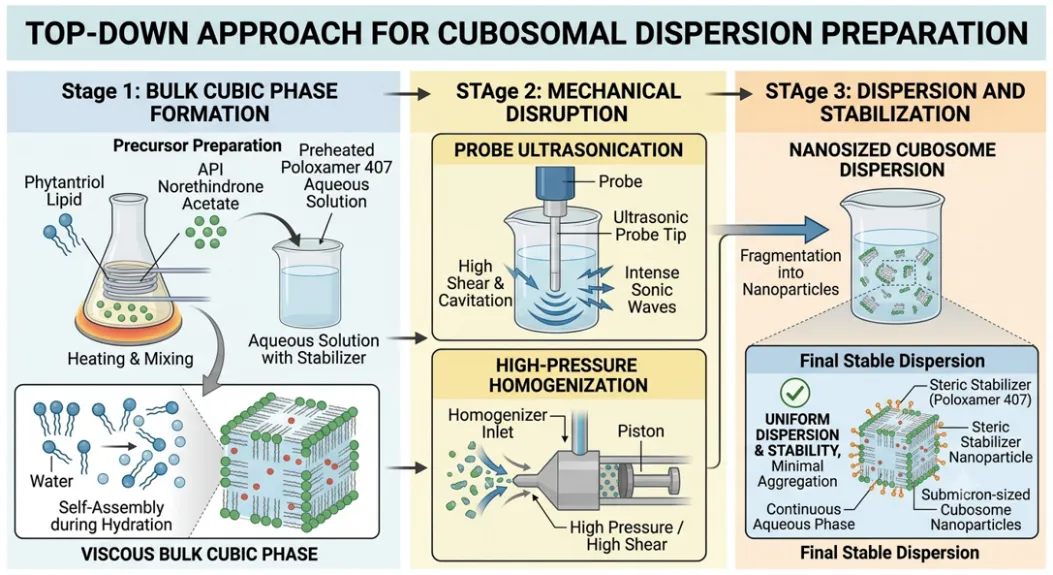
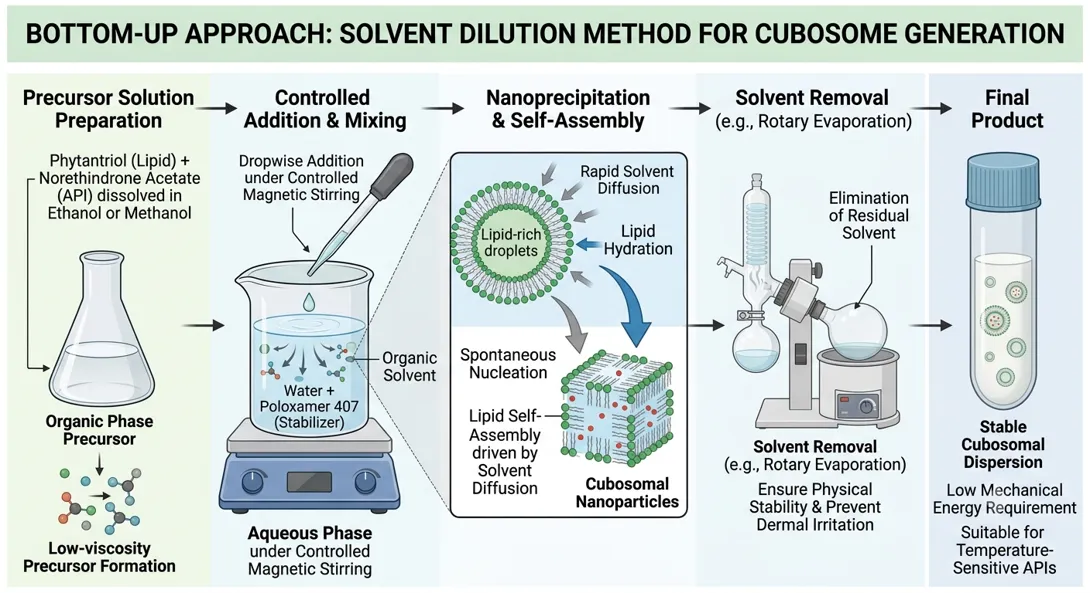
The preparation of a cubosomal dispersion is generally carried out using one of two established techniques: the top-down method, in which bulk cubic phases are subsequently fragmented into nanosized particles, or the bottom-up (solvent dilution) method, in which cubosomes are formed through controlled self-assembly during solvent dilution. [33]
The top-down method is one of the most widely employed techniques for preparing cubosomal dispersions in both research and pharmaceutical formulation studies. The method involves the initial formation of a bulk cubic liquid-crystalline phase, followed by its mechanical disruption into nanosized cubosomal particles.
In this approach, the structure-forming lipid, such as phytantriol, is combined with the active pharmaceutical ingredient (API), norethindrone acetate, and heated under controlled temperature conditions to obtain a uniform lipidic phase. A preheated aqueous solution containing Poloxamer 407 is then gradually incorporated into the lipid phase. Upon hydration and equilibration, the amphiphilic lipid molecules undergo spontaneous self-assembly, producing a highly viscous and optically isotropic bulk cubic liquid-crystalline phase.
The resulting bulk cubic phase is subsequently subjected to intense mechanical forces using techniques such as high-pressure homogenization or probe ultrasonication. The applied shear and cavitation forces disrupt the bulk cubic structure and break it into smaller particles. This process generates submicron-sized cubosome nanoparticles, which become uniformly dispersed throughout the continuous aqueous phase. The use of an appropriate steric stabilizer helps maintain the resulting cubosomes as a stable colloidal dispersion and minimizes particle aggregation. [15] [32]
The bottom-up method utilizes controlled solvent manipulation and nanoprecipitation to generate cubosomes without first producing a highly viscous bulk cubic phase. In this technique, the structure-forming lipid phytantriol and the API norethindrone acetate are dissolved in a water-miscible organic solvent or hydrotrope, such as ethanol or methanol. The solvent temporarily disrupts lipid–lipid interactions and facilitates the formation of a low-viscosity precursor solution.
The resulting organic phase is then introduced gradually, generally dropwise, into an aqueous phase containing Poloxamer 407 under controlled magnetic stirring. As the water-miscible solvent rapidly diffuses from the lipid-rich phase into the surrounding aqueous medium, the local solvent composition and hydration conditions change rapidly. This shift in the thermodynamic environment promotes lipid hydration and initiates spontaneous nucleation and self-assembly of the cubic liquid-crystalline structure, leading to the formation of discrete cubosomal nanoparticles through a bottom-up process.
A major advantage of this approach is its relatively low requirement for mechanical energy and its suitability for APIs that may be sensitive to elevated temperatures. However, the organic solvent used during preparation must be efficiently eliminated from the final dispersion. Residual solvent may cause dermal irritation and can adversely affect the physical stability of the formulation during storage. Therefore, solvent-removal techniques such as rotary evaporation may be employed to obtain a stable and suitable cubosomal dispersion.[33,34]
After obtaining the optimized cubosomal dispersion, it is incorporated into a viscous hydrogel system suitable for topical or transdermal application. A predetermined quantity of a gelling polymer, such as Carbopol 934 (approximately 0.5–1.5% w/w), is gradually dispersed in distilled water under continuous mechanical stirring. Controlled dispersion promotes uniform hydration and swelling of the polymer chains while minimizing the formation of undispersed polymer aggregates or “fish-eyes.”
Once adequate hydration of the polymer is achieved, the norethindrone acetate-loaded cubosomal dispersion is gradually incorporated and mixed uniformly throughout the hydrated polymeric base. Subsequently, triethanolamine (TEA) is added slowly as a neutralizing agent to adjust the formulation pH to a skin-compatible range, typically around 5.5–6.5.
Neutralization causes ionization and expansion of the polyacrylate chains, resulting in the development of a three-dimensional, highly viscous gel network. The cubosomal nanoparticles become uniformly entrapped within this polymeric matrix, producing a transparent, shear-thinning cubosomal hydrogel with suitable consistency and spreadability for transdermal application.[18,29]
Comprehensive physicochemical and performance characterization of the developed cubosomal gel is essential to verify its nanostructural properties, determine the efficiency of drug incorporation, evaluate its rheological behavior, and establish its overall formulation performance. These characterization studies are also important for assessing and predicting the ex vivo skin permeation and in vivo therapeutic performance of the final cubogel formulation.
4.1 Colloidal Properties and Entrapment Profiling
Dynamic Light Scattering (DLS), based on photon correlation spectroscopy, is commonly employed to determine the hydrodynamic particle size and Polydispersity Index (PDI) of cubosomal dispersions before their incorporation into the gel matrix. Optimized top-down formulations generally exhibit particle sizes within the 100–250 nm range with a PDI below 0.3, indicating a relatively uniform particle-size distribution. Nanometric particle dimensions are advantageous for facilitating interaction with and penetration through the complex lipidic barrier of the stratum corneum. The zeta potential of the cubosomal dispersion can be evaluated using Phase Analysis Light Scattering (PALS). An adequate magnitude of surface charge, such as a zeta potential below −20 mV, together with the steric stabilization provided by the hydrated Poloxamer 407 layer, contributes to colloidal stability. These stabilizing effects reduce interparticle interactions and help minimize coalescence, aggregation, and particle-size growth during prolonged storage under ambient conditions.[35,36]
The Entrapment Efficiency (EE%) of norethindrone acetate in the cubosomal system can be evaluated using an indirect ultracentrifugation method. The cubosomal dispersion is subjected to high-speed centrifugation, for example 15,000–20,000 rpm at approximately 4°C, causing the relatively dense liquid-crystalline cubosomal particles to sediment and form a pellet. Any unencapsulated or free drug remains predominantly in the supernatant. The collected supernatant is subsequently analyzed using High-Performance Liquid Chromatography (HPLC) or UV–Visible spectrophotometry against a previously validated calibration curve. The amount of free drug obtained from the supernatant can then be used to calculate the percentage of drug entrapped within the cubosomes. Norethindrone acetate possesses considerable lipophilicity, with a reported logP of approximately 2.97, which promotes its preferential partitioning into the hydrophobic regions of phytantriol or glyceryl monooleate (GMO) lipid structures. This favorable lipid–drug interaction can contribute to high entrapment efficiency, potentially reaching approximately 85–95% or higher, depending on the formulation composition and preparation conditions. The extensive lipidic domains of cubosomes provide substantial capacity for incorporating lipophilic drugs compared with conventional vesicular systems with predominantly aqueous internal compartments.[35,36]
4.2 Crystallographic and Morphological Analysis
A characteristic feature of cubosomes is their complex internal architecture based on a triply periodic minimal surface (TPMS) geometry. Confirmation of this distinctive nanostructure requires the use of advanced microscopic and X-ray scattering techniques.
High-Resolution Cryogenic Transmission Electron Microscopy (Cryo-TEM) is employed to visualize cubosomes in their near-native, fully hydrated state. Unlike conventional electron microscopy, Cryo-TEM rapidly immobilizes the aqueous dispersion at cryogenic temperatures, thereby minimizing structural deformation associated with drying and sample preparation. The resulting micrographs can demonstrate the characteristic ordered internal organization of lipid bilayers, which may appear as repeating square-, hexagonal-, or honeycomb-like patterns. Less ordered vesicular or lamellar structures may also be observed near the particle boundaries, reflecting structural heterogeneity within the cubosomal dispersion.[17,34]
Crystallographic Characterization by Small-Angle X-ray Scattering , Although microscopic techniques provide valuable information about cubosome morphology, morphological observations alone cannot conclusively identify or quantitatively confirm the specific internal liquid-crystalline phase. Small-Angle X-ray Scattering (SAXS) is therefore employed as a highly sensitive technique for characterizing the internal organization and phase structure of lyotropic liquid-crystalline systems. In SAXS analysis, the cubosomal dispersion is exposed to an X-ray beam, which interacts with the regularly organized lipid bilayer structure within the particles. The periodic arrangement of the lipid lattice produces scattering at characteristic angles, generating distinct Bragg diffraction peaks. These diffraction patterns are represented as a function of the scattering vector (q) and can be analyzed to identify the specific cubic phase and its crystallographic symmetry. Thus, SAXS provides structural evidence for the formation and preservation of the desired cubosomal liquid-crystalline architecture.[14,33]
The relative mathematical spacing between the observed Bragg peaks provides characteristic information that can be used to determine the crystallographic space group of the cubosome. According to established biophysical literature, cubosomes generally exhibit one of three major inverse bicontinuous cubic phases:
|
Space Group |
Topology |
Morphological Features |
Typical Peak Spacing Ratios |
|
Pn3m |
Double Diamond |
Consists of two separate but interconnected water-channel networks that meet at tetrahedral nodes. This topology is commonly observed in water-rich phytantriol systems. |
√2 : √3 : √4 : √6 |
|
Im3m |
Primitive |
Characterized by a continuous network of channels connected through orthogonal nodes. It is generally associated with a highly interconnected cubic arrangement. |
√2 : √4 : √6 : √8 |
|
Ia3d |
Gyroid |
Contains interconnected channels that meet at planar or non-linear junctions, forming a highly organized three-dimensional structure. This phase is generally observed at relatively lower hydration levels. |
√6 : √8 : √14 : √16 |
Identification of the crystallographic space group from the SAXS scattering pattern enables accurate determination of the lattice parameter (a_Q), representing the characteristic dimension of the repeating unit cell within the cubic lipid structure. Incorporation of a bulky lipophilic drug such as norethindrone acetate into the lipid bilayer can modify the local molecular packing and produce measurable changes in the lattice parameter, either through expansion or contraction of the cubic unit cell. Such variations in a_Q detected by SAXS provide strong structural evidence that the drug is incorporated within the internal lipid architecture of the cubosome rather than being predominantly associated with its hydrophilic surface.[17]
4.3 Rheological Evaluation of the Cubogel
Following the incorporation of cubosomes into the macroscopic cubogel, comprehensive rheological evaluation is performed to assess its physical applicability, spreadability, and structural stability. A rotational viscometer or dynamic shear rheometer can be used to determine the flow resistance of the gel under different applied shear rates. An optimized pharmaceutical cubogel generally demonstrates pseudoplastic (shear-thinning) and thixotropic characteristics. Under static conditions, the cross-linked polymeric network provides high zero-shear viscosity, which helps maintain the cubosomes uniformly dispersed and minimizes sedimentation, while also preventing excessive flow or dripping from the skin after application. When shear is applied during spreading, the polymer chains progressively orient in the direction of flow, resulting in a reduction in viscosity and allowing smooth and uniform application over the skin. After removal of the applied shear, the polymeric network gradually reconstructs, enabling recovery of the gel structure. The pH of the formulated cubogel is also evaluated and maintained within the range of 5.0–6.0, which is compatible with the mildly acidic environment of human skin. Maintaining an appropriate pH helps minimize the risk of skin irritation while supporting the normal protective barrier and antimicrobial functions of the skin.[29,31,37]
4.4 Ex Vivo Permeation and Transdermal Flux Analysis
To assess the potential in vivo performance and therapeutic efficacy of the norethindrone acetate-loaded cubogel, comprehensive in vitro drug-release and ex vivo transdermal permeation studies are conducted. The vertical Franz diffusion cell is widely used for evaluating transdermal drug delivery systems. It consists of a donor compartment, where a defined and clinically relevant quantity of cubogel is applied, and a receptor compartment containing an appropriate physiological release medium. The donor and receptor chambers are separated by a suitable permeation membrane or biological skin barrier. Excised human cadaver skin and full-thickness porcine ear skin have traditionally been used as ex vivo permeation models because of their similarities to human skin in terms of lipid composition, follicular characteristics, and stratum corneum thickness. However, the use of biological tissues can be associated with challenges such as limited availability, inter-sample variability, ethical considerations, and difficulties in obtaining standardized samples. Therefore, synthetic membranes such as Strat-M® are increasingly used as alternative permeation barriers in transdermal research. Strat-M® is a multilayer synthetic membrane composed primarily of polyethersulfone and polyolefin, designed to reproduce important physicochemical characteristics of the skin barrier, including permeability, tortuosity, and lipophilic interactions. Its use provides a standardized, reproducible, and ethically favorable model for preliminary evaluation of transdermal formulations. Comparative studies have reported a strong relationship between drug permeation through Strat-M® and human skin, supporting its application for screening and evaluating transdermal nanocarrier systems.[38–40]
A fundamental thermodynamic requirement for obtaining reliable results in Franz diffusion studies is the maintenance of appropriate sink conditions in the receptor compartment. According to Fick’s First Law of Diffusion, drug flux across a permeation barrier is dependent on the concentration gradient between the donor and receptor compartments. If the permeated lipophilic drug progressively accumulates in the receptor medium and approaches saturation, the concentration gradient decreases, which may result in an artificially reduced apparent permeation rate.
Because norethindrone acetate exhibits very low aqueous solubility, with reported solubility below 1 mg/L, phosphate-buffered saline (PBS, pH 7.4) alone may not provide adequate sink conditions. Therefore, suitable solubilizing agents, such as organic co-solvents including ethanol (approximately 20–30% v/v), or surfactants such as sodium lauryl sulfate and Tween 80, may be incorporated into the PBS receptor medium to enhance drug solubilization and maintain sink conditions. The receptor medium is continuously stirred using a magnetic stir bar to ensure uniform drug distribution and is maintained at 37 ± 0.5°C using appropriate temperature control. This setup provides controlled experimental conditions that approximate physiological temperature and supports consistent receptor-phase sampling during transdermal permeation studies.[12,41]
The principal parameter obtained from a Franz diffusion study is the steady-state transdermal flux (Jₛₛ), which is determined from the slope of the linear portion of the cumulative amount of drug permeated versus time profile. The enhancement ratio can subsequently be used to compare the permeation performance of different formulations. Cubosomal formulations may demonstrate enhanced transdermal drug permeation compared with conventional drug suspensions and other vesicular or semisolid delivery systems, including liposomes, ethosomes, and conventional transdermal formulations. The extent of enhancement depends on the composition, particle characteristics, drug loading, and experimental conditions of the cubosomal system.
The enhanced transdermal permeation associated with cubogels can be attributed to the distinctive physicochemical interactions between cubosomal liquid-crystalline nanoparticles and the stratum corneum. The lipid matrix of the stratum corneum is highly organized into densely packed and relatively rigid lamellar structures, which constitute the principal barrier to transdermal drug transport. Upon contact with the skin, cubosomal lipids such as monoolein or phytantriol can interact with the endogenous ceramides, cholesterol, and free fatty acids present within the intercellular lipid domains. These interactions may promote partial mixing or fusion of cubosomal lipid structures with the skin's intercellular lipid matrix, thereby disturbing the organized lipid arrangement and temporarily increasing lipid fluidity. Such changes can reduce the barrier resistance and facilitate drug diffusion through the stratum corneum. Norethindrone acetate, incorporated within the hydrophobic regions of the cubosomal lipid network, can partition from the nanostructured lipid phase into the lipophilic domains of the stratum corneum, supporting its subsequent diffusion toward the viable epidermis and dermis. In addition, the interconnected aqueous channels characteristic of bicontinuous cubic phases may contribute to hydration of the skin surface and corneocytes, which can further influence the diffusional properties of the stratum corneum. Thus, the combined effects of lipid–skin interactions, modification of lipid packing, enhanced drug partitioning, and skin hydration may contribute synergistically to the improved transdermal delivery of norethindrone acetate from the cubosomal gel.[12,13,42]
4.5 Mathematical Modeling of Release Kinetics
To investigate the underlying mechanisms controlling the release of norethindrone acetate from the combined macro-polymeric hydrogel and nano-lipidic cubosomal system, cumulative in vitro drug-release data are analyzed using established mathematical kinetic models. Commonly applied models in pharmaceutical research include Zero-Order, First-Order, and Higuchi diffusion kinetics, which help characterize the pattern and rate of drug release from the formulation. However, these conventional kinetic models may not fully describe the complex release behavior of swellable polymeric hydrogels. In such systems, drug transport is influenced not only by molecular diffusion but also by polymer swelling, relaxation, and structural changes within the hydrated polymeric network. Therefore, additional mathematical approaches may be required to adequately characterize the combined effects of diffusion and polymer relaxation on drug release.[12,43,44]
For more reliable characterization of the complex drug-release behavior of such systems, power-law mathematical models are commonly applied. Among these, the Korsmeyer–Peppas model is widely used to describe the overall release mechanism, while the more advanced Peppas–Sahlin model provides further insight into the relative contributions of Fickian diffusion and polymer relaxation to drug transport. These models are particularly useful for interpreting release from formulations in which both the cubosomal lipid structure and the polymeric hydrogel network influence drug-release kinetics.[44,45]
The Korsmeyer–Peppas Model
The Korsmeyer–Peppas model is a semi-empirical mathematical model commonly employed to characterize and interpret drug-release behavior from polymeric matrix systems. The model is represented by the following equation:
MtM∞=ktn

Where:


In the Korsmeyer–Peppas equation, Mt/M∞

The Peppas–Sahlin Model
While the Korsmeyer–Peppas model is primarily used to identify the predominant drug-release mechanism, the Peppas–Sahlin model offers a more detailed quantitative assessment of the release process. It enables the individual contributions of Fickian drug diffusion and polymer-chain relaxation to be estimated separately, providing a better understanding of drug transport from complex polymeric delivery systems. The model is mathematically represented by the following equation:[46]
MtM∞=K1tm+K2t2m
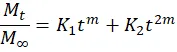
In the Peppas–Sahlin model, the first term, K1tm


For a norethindrone acetate-loaded cubosomal gel, application of the Peppas–Sahlin model provides useful insight into the dual mechanisms involved in drug release. Initially, norethindrone acetate must partition from the hydrophobic lipid domains of the cubosomal nanoparticles into the surrounding aqueous phase of the hydrogel. Due to the high lipophilicity of norethindrone acetate and its limited affinity for the aqueous environment, this initial drug-transfer step is expected to be influenced predominantly by concentration-gradient-driven Fickian diffusion. Consequently, a relatively higher contribution of the K1 term may be observed during the early stages of drug release, indicating the predominant role of diffusional transport at the initial time points.[35,47,48]
During topical application, moisture from the skin gradually hydrates the Carbopol-based polymeric matrix. Progressive hydration promotes swelling and relaxation of the cross-linked polyacrylate chains, resulting in changes in the structure and mesh dimensions of the hydrogel network. As the polymer chains expand and undergo relaxation, the diffusional resistance within the matrix may decrease, facilitating the movement of norethindrone acetate and, depending on the formulation characteristics, potentially influencing the mobility of cubosomal structures within the gel.
This time-dependent change in polymer relaxation can be reflected by an increasing contribution of the K2 term in the Peppas–Sahlin model. Thus, drug release from a cubosomal gel may initially be governed predominantly by Fickian diffusion and subsequently exhibit an increasing contribution from polymer relaxation-controlled transport. The relative contributions of these mechanisms over an extended period, such as 24–48 hours, can be determined from the fitted kinetic parameters. Such combined diffusional and relaxation mechanisms may contribute to sustained and controlled drug release from the transdermal cubosomal gel.[35,47,48]
4.6 Biocompatibility and Dermatological Safety Assessment
Although cubosomal gels can enhance transdermal drug permeation, their potential clinical application requires comprehensive evaluation of dermatological safety and biocompatibility. An effective transdermal formulation should achieve an appropriate balance between permeation enhancement and skin tolerability. The formulation must facilitate temporary modification of the lipid organization within the stratum corneum to promote drug transport while minimizing disruption to the viable epidermis. Therefore, safety assessment should determine whether the formulation causes persistent alterations in skin structure, inflammatory responses, cellular damage, or keratinocyte toxicity following topical application.[49–51]
4.7 The Modified Draize Scoring System
The primary skin irritation test, derived from the conventional Draize scoring method, is a commonly used approach for evaluating the dermal tolerability of topical formulations in vivo. The method involves systematic macroscopic assessment of acute skin reactions following topical exposure. Two major indicators of cutaneous irritation are evaluated: erythema, characterized by skin redness associated with increased local blood flow and capillary dilation, and edema, characterized by localized swelling resulting from increased vascular permeability and accumulation of fluid within the interstitial tissues of the dermis.[52]
In controlled preclinical studies, the test formulation is applied to a predetermined area of shaved and intact skin of an appropriate laboratory animal, such as a New Zealand White rabbit or Wistar rat, according to the approved experimental protocol. The treated area may be covered with an occlusive dressing for a defined period to maintain contact with the formulation. After removal of the dressing, the skin is examined by trained observers at predetermined time intervals, such as 1, 24, 48, and 72 hours following application. The severity of erythema and edema is assessed using a standardized numerical scoring system, generally ranging from 0 (no visible skin reaction) to 4 (severe reaction associated with marked inflammation or tissue damage). [53,54]
Table 1: Standardized grading criteria utilized in the modified Draize skin irritation test for the preclinical evaluation of topical formulations. [54,55]
|
Score |
Erythema Evaluation Criteria |
Edema Evaluation Criteria |
|
0 |
No discernible erythema |
No discernible edema |
|
1 |
Very slight, barely perceptible erythema |
Very slight edema, barely perceptible |
|
2 |
Well-defined erythema |
Slight edema, edges of area well-defined by definite raising |
|
3 |
Moderate to severe erythema |
Moderate edema, raised approximately 1 millimeter |
|
4 |
Severe erythema (beet redness) to slight eschar formation |
Severe edema, raised more than 1 millimeter and extending beyond the area of exposure |
Available toxicological and formulation literature suggests that cubosomal systems prepared using biocompatible amphiphilic lipids such as phytantriol or monoolein can exhibit favorable skin tolerability when appropriately formulated. These lipids have structural characteristics compatible with naturally occurring lipid components and may therefore be better tolerated than formulations containing high concentrations of potentially irritating chemical penetration enhancers. Following topical application, cubosomal lipids may interact with the endogenous lipid components of the stratum corneum and undergo redistribution or metabolism within the skin.
Poloxamer 407, a non-ionic triblock copolymer commonly employed as a steric stabilizer, is generally considered suitable for pharmaceutical and topical formulations and may provide better tolerability than some strongly ionic surfactants at comparable applications. Nevertheless, the concentration of Poloxamer 407 and the presence of other formulation components can influence overall skin compatibility.
The cubosomal gel can function as a localized drug-delivery system, potentially reducing rapid fluctuations in drug exposure compared with conventional formulations. However, the actual dermatological safety of a norethindrone acetate-loaded cubogel must be established experimentally through appropriate irritation, sensitization, and biocompatibility studies. A low Draize irritation score, including a score of 0 for erythema and edema, would indicate the absence of observable irritation under the specific experimental conditions and observation period. Such findings may support the potential suitability of the formulation for prolonged topical application, but they cannot by themselves establish complete safety in human subjects.[56,57]
4.8 Histopathological Validation
Histopathological examination provides microscopic confirmation of the macroscopic observations obtained from skin irritation assessments such as the Draize scoring system. Following completion of the in vivo permeation or dermal exposure study, representative full-thickness skin samples from the treated and control sites are collected according to the approved experimental protocol. The tissue specimens are fixed in 10% neutral buffered formalin, followed by routine processing and embedding in paraffin wax. Thin tissue sections are prepared using a microtome and subsequently stained with hematoxylin and eosin (H&E) for microscopic evaluation of the skin architecture and potential treatment-related pathological changes.[49]
Microscopic examination of skin samples treated with the optimized cubosomal gel can be used to assess the preservation of normal epidermal and dermal architecture. Histopathological evaluation should specifically examine the presence or absence of keratinocyte degeneration or necrosis, inflammatory cell infiltration within the dermis, and alterations at the dermo-epidermal junction. The absence of significant pathological changes, when compared with an appropriate untreated or control group, would support the dermatological tolerability of the formulation.
Such findings, together with favorable macroscopic irritation scores and permeation data, may indicate that the enhanced drug permeation is associated primarily with temporary modification of the stratum corneum lipid barrier rather than significant damage to viable skin tissues. However, histopathological observations alone cannot definitively establish the precise molecular mechanism responsible for enhanced permeation or prove complete reversibility of the lipid modifications.[57,58]
The development of a norethindrone acetate-loaded cubosomal gel represents a multidisciplinary formulation strategy that integrates lipid physical chemistry, polymer science, nanotechnology, and transdermal biopharmaceutics. Encapsulation of the highly lipophilic synthetic progestin within the complex bicontinuous cubic architecture of liquid-crystalline nanoparticles, particularly using enzymatically stable lipids such as phytantriol, can facilitate the formation of stable and efficient nanostructured drug reservoirs. Incorporating these nanocarriers into a pseudoplastic polymeric hydrogel can further address important formulation requirements, including appropriate rheological behavior, improved skin residence and adhesion, ease of application, and controlled regulation of drug release.
Advanced analytical approaches, particularly the accurate determination of internal lattice parameters using Small-Angle X-ray Scattering (SAXS) and the quantitative differentiation of diffusion- and relaxation-controlled release mechanisms through the Peppas–Sahlin model, have provided valuable insights into the structural and release characteristics of these advanced drug delivery systems. Importantly, the ability of cubogels to interact with and partially integrate into the organized lipid domains of the stratum corneum may contribute to enhanced transdermal drug flux while maintaining skin integrity. These effects can be evaluated through systematic dermatological assessment, including Draize irritation scoring and histopathological examination, which together provide evidence regarding the skin tolerability and structural effects of the formulation.
Ultimately, the development and optimization of advanced topical nanocarrier systems such as cubogels represent a promising approach for improving the systemic delivery of steroidal hormones. Transdermal administration of norethindrone acetate through a cubosomal gel may provide more sustained and consistent drug exposure, which could be beneficial in the management of conditions such as endometriosis and menopausal symptoms. By bypassing gastrointestinal absorption and hepatic first-pass metabolism, this delivery strategy may reduce the hepatic metabolic burden associated with conventional oral administration and potentially modify factors contributing to thrombotic risk. However, the extent of these therapeutic and safety advantages requires confirmation through comprehensive preclinical and clinical evaluation.
The authors thank the Principal and the Department of Pharmaceutics, Government College of Pharmacy, Karad, for providing library and infrastructure facilities.
The authors declare that there is no conflict of interest.
This research received no specific grant from any funding agency in the public, commercial or not-for-profit sectors.
REFERENCES


Sawase Kiran, Rutuja Jedhe, Avinash Hosmani, Yogesh Patil, Nishant Mali, Design, Formulation, and Evaluation of Norethindrone Acetate-Loaded Cubosomal Hydrogels for Enhanced Topical Delivery: A Comprehensive Review, Int. J. of Pharm. Sci., 2026, Vol 4, Issue 10, 1949-1970. https://doi.org/10.5281/zenodo.23355928
 10.5281/zenodo.23355928