

We use cookies to ensure our website works properly and to personalise your experience. Cookies policy
Mahadev Kanchan College of Pharmaceutical Education and Research.
Herbal face packs are topical cosmetic formulations composed mainly of plant?derived ingredients that aim to cleanse, nourish, and protect facial skin while providing additional benefits such as skin brightening and antioxidant activity. Moroccan Nila powder (blue indigo mineral clay) has recently gained popularity in traditional and social?media–driven beauty practices for its claimed complexion?brightening, soothing, and detoxifying effects, although robust clinical evidence remains limited. Extra?virgin olive oil is a widely used natural lipid rich in phenolic antioxidants, squalene, and vitamin E, which supports barrier repair, moisturization, and protection against oxidative stress when used appropriately in topical preparations. This review paper compiles and interprets available literature on herbal face packs, Moroccan Nila powder, and plant?based antioxidants to propose a rational formulation concept for a Moroccan Nila–olive oil herbal face pack intended for skin brightening and antioxidant activity. Key aspects discussed include the traditional background of Moroccan Nila, its proposed mechanisms of action, the role of olive oil and co?herbal ingredients, formulation strategy, evaluation parameters such as physicochemical properties and in vitro antioxidant assays, and safety considerations including issues about irritation and inconsistent quality of raw Nila. The review suggests that, with careful ingredient selection and standardization, a Moroccan Nila–olive oil face pack could serve as a promising natural cosmetic product; however, controlled in vivo studies are required to substantiate claims of long?term skin brightening and to fully establish safety.
Herbal face packs are semi‑solid or powder formulations applied topically to the facial skin for a specific period to provide cleansing, toning, moisturizing, and therapeutic cosmetic benefits. They often consist of multiple botanical powders, clays, and natural liquids that exhibit complementary antibacterial, anti‑inflammatory, antioxidant, and skin‑revitalizing properties. Compared with conventional synthetic cosmetics, herbal packs are perceived as safer and more biocompatible because they utilize plant‑based ingredients and avoid harsh chemical bleaches or strong acids.
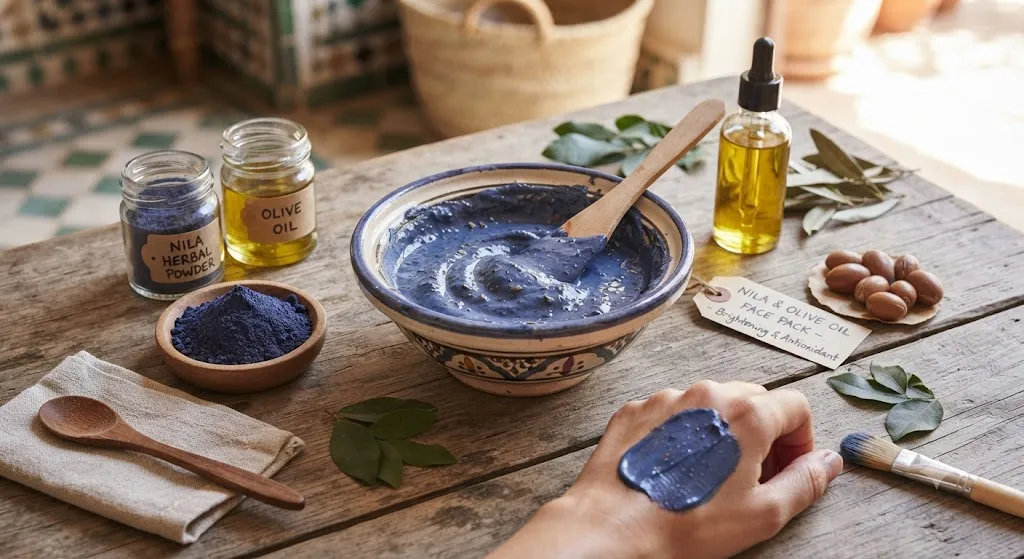
Figure 1: Herbal Face Pack
Recent years have seen growing interest in specialized herbal face packs targeting skin brightening and anti‑aging, primarily through mechanisms such as exfoliation, melanin regulation, and free‑radical scavenging. Multiple studies have formulated polyherbal face packs containing ingredients like orange peel, turmeric, sandalwood, Multani mitti, neem, butterfly pea flowers, and aloe vera, demonstrating improvements in skin texture, glow, and antioxidant parameters such as DPPH and FRAP without significant irritation. Parallel to these developments, Moroccan Nila powder—also known as blue Nila, blue clay, or indigo mineral—has emerged as a popular brightening ingredient in North African beauty traditions and global social‑media trends.
Moroccan Nila is described as a fine blue mineral powder derived from indigo‑containing stones or desert minerals, rich in trace elements such as magnesium, sulfur, calcium, and iron. Traditional use by Tuareg and Saharan women involves application on the face and body to soften rough areas, improve complexion, and protect against harsh sun exposure. Contemporary accounts attribute to Nila a combination of exfoliating, pH‑balancing, detoxifying, and colour‑correcting actions, which may temporarily enhance radiance and reduce apparent hyperpigmentation; however, dermatologists caution that scientific data on its long‑term brightening efficacy and safety are still sparse.
Olive oil, particularly extra‑virgin quality, is another key natural cosmetic ingredient valued for its emollient and antioxidant profile. Its content of phenolic compounds, squalene, tocopherols, and oleic acid helps protect skin lipids from oxidative damage while maintaining hydration and barrier integrity. Combining Moroccan Nila with olive oil and other herbal actives into a face pack may synergistically address dullness, uneven tone, and oxidative stress associated with environmental insults such as UV radiation and pollution. This review therefore focuses on the conceptualization of a Moroccan Nila–olive oil herbal face pack for skin brightening and antioxidant activity, summarizing existing evidence on herbal face packs and outlining formulation and evaluation considerations relevant to academic and industrial researchers.
MATERIAL AND METHODS
4.1 Literature Sources and Search Strategy
The review is based on scientific articles, review papers, cosmetic science texts, and credible web resources published in recent years on herbal face packs, Moroccan Nila powder, indigo‑based preparations, and plant‑derived antioxidant ingredients. Electronic databases and search engines were queried using combinations of keywords such as “herbal face pack formulation”, “Moroccan Nila powder skin brightening”, “indigo antioxidant activity”, “polyherbal face pack antioxidant evaluation”, and “olive oil topical antioxidant”. Preference was given to peer‑reviewed journals and academic publications; however, because clinical literature on Moroccan Nila is limited, curated information from dermatology experts and reputable cosmetic brands was also considered with appropriate caution.
4.2 Typical Herbal Ingredients for Skin Brightening Face Packs
Published formulations of herbal face packs aimed at complexion improvement commonly utilize dried powders of orange peel, turmeric, sandalwood, Multani mitti (fuller’s earth), neem, tulsi, butterfly pea flowers, rice flour, and aloe vera, among others. Orange peel provides vitamin C and flavonoids like hesperidin, which support collagen synthesis, reduce pigmentation, and offer potent antioxidant effects. Turmeric contributes curcumin, a well‑known anti‑inflammatory and antioxidant compound, while sandalwood and neem add antimicrobial, soothing, and astringent properties beneficial for acne‑prone or oily skin. 3 Nov 2026
Multani mitti acts as an absorbent clay, removing excess sebum, impurities, and keratinized cells, thereby enhancing smoothness and light reflection from the skin surface. Aloe vera provides hydration, mucopolysaccharides, and anti‑inflammatory effects, helping to balance any drying properties of clays and brightening agents. These ingredients are generally processed by drying, pulverizing, and sieving (often through sieve no. 100–120), then geometrically mixing for uniform distribution in the final powder base, which can be later reconstituted with liquids like water, rose water, or glycerin.
4.3 Materials for Moroccan Nila–Olive Oil Face Pack
Ingredient selection must consider compatibility with Nila’s pigment, avoidance of harsh chemical bleaches, and suitability for different skin types, especially sensitive or dry skin given the potential irritancy of certain indigo‑based materials.
4.4 General Method of Preparation
Most herbal face pack formulations adopt a standardized method involving drying, grinding, sieving, geometric mixing, and packaging of powdered ingredients. A conceptual preparation process for the Moroccan Nila–olive oil face pack could follow these steps:
1. Powder processing: Accurately weigh dried herbal powders (e.g., Moroccan Nila, orange peel, Multani mitti, butterfly pea, neem) using a digital balance; grind if necessary and pass through an appropriate sieve (no. 100–120) to obtain uniform fine particles.
2. Powder blending: Mix the sieved powders using geometric dilution or mechanical mixing to ensure homogeneous distribution of actives and excipients.
3. Liquid phase preparation: In a separate vessel, prepare the liquid phase containing olive oil, rose water, glycerin, and, if required, aloe vera gel and natural preservatives; emulsify or disperse using suitable mixing equipment.
4. Incorporation: Gradually add the powder blend into the liquid phase under continuous stirring to obtain a smooth paste of desired viscosity, avoiding lumps and ensuring proper wetting of Nila particles.
5. Adjustment and filling: Adjust pH and consistency with permissible natural additives; fill the prepared face pack into suitable containers (e.g., jars or laminated tubes), label, and store for evaluation.
If the product is intended as a dry powder mask, olive oil and hydrating liquids may be recommended to the user at the time of application rather than incorporated during manufacturing, which can simplify preservation and stability.
5)Evaluation Methods for Herbal Face Packs
Table 1: Evaluation Table
| Evaluation category | Parameter/Test | Purpose/Observation |
|---|---|---|
| Organoleptic evaluation | Colour | Ensures the face pack has an acceptable and uniform appearance. |
| Organoleptic evaluation | Odour | Assesses whether the product has a pleasant, acceptable, and stable fragrance. |
| Organoleptic evaluation | Texture | Evaluates smoothness, homogeneity, and freedom from grittiness. |
| Physicochemical evaluation | pH | Confirms compatibility with the skin and helps prevent irritation caused by excessively acidic or alkaline formulations. |
| Physical evaluation | Particle size | Determines powder fineness and contributes to smooth application and non-gritty texture. |
| Physical evaluation | Spreadability | Measures how easily and uniformly the face pack can be applied over the skin surface. |
| Physical evaluation | Viscosity | Evaluates the consistency and flow behaviour of the prepared formulation. |
| Performance evaluation | Drying time | Determines the time required for the applied face pack to dry completely on the skin. |
| Stability evaluation | Stability studies | Assesses changes in colour, odour, pH, texture, viscosity, and overall appearance during storage. |
| Physical acceptability | Smoothness and aesthetic acceptability | Confirms that the formulation is smooth, easily spreadable, non-gritty, and consumer acceptable. |
RESULTS AND DISCUSSION
6.1 Evidence on Herbal Face Packs for Skin Brightening and Antioxidant Activity
Multiple studies have reported that herbal face packs containing plant‑based ingredients such as orange peel, turmeric, neem, sandalwood, aloe vera, and butterfly pea flowers can improve skin texture, enhance glow, and exhibit significant antioxidant activity without major adverse effects. One formulation utilizing orange peel as the primary ingredient demonstrated suitable pH, viscosity, spreadability, and low irritation, along with notable improvements in complexion and reduction of blemishes upon regular use. Another polyherbal face pack incorporating butterfly pea flowers and traditional herbs showed smooth, washable consistency and promising results as a natural alternative to synthetic anti‑aging treatments.
Reviews on herbal face packs emphasize that antioxidants such as flavonoids, phenolic compounds, and vitamins play a central role in neutralizing reactive oxygen species generated by UV radiation and pollution, thereby preventing oxidative damage and supporting anti‑aging and depigmenting effects. Inhibition of tyrosinase and modulation of melanin synthesis by certain plant‑derived constituents also contribute to skin‑lightening outcomes. These findings provide a mechanistic basis for combining brightening herbs with antioxidant‑rich oils like olive oil in face pack formulations aimed at complexion improvement.
6.2 Reported Properties of Moroccan Nila Powder
Commercial and traditional sources describe Moroccan Nila powder as a mineral pigment used for centuries in North African beauty rituals to brighten the skin, reduce pigmentation, and impart a natural glow. It is said to help fade dark spots, hyperpigmentation, and uneven tone while detoxifying the skin and providing anti‑inflammatory and antibacterial benefits. Some accounts attribute to Nila rich antioxidant content and anti‑aging effects, suggesting that regular use may minimize fine lines and wrinkles.
Mechanistically, Nila’s fine particles may offer mild exfoliation by lifting away dead skin cells, improving light reflection and immediate radiance. Its mineral composition (including magnesium and sulfur) may contribute to pH regulation, soothing of irritation, and reduction of inflammation, thereby enhancing the appearance of reactive or sun‑exposed skin. The vivid blue pigment can function as a natural colour corrector by neutralizing yellow or sallow undertones, giving the impression of brighter and more even complexion even in the absence of deep melanin reduction.
6.3 Scientific and Safety Considerations Regarding Moroccan Nila
Despite impressive traditional claims, dermatology experts caution that strong scientific evidence supporting Moroccan Nila as a potent skin‑brightening agent with melanin‑inhibiting properties is currently lacking. Articles reviewing Nila note that its viral reputation as a “miracle” brightening powder is largely driven by social‑media trends rather than controlled clinical trials, and that many products may mix Nila with proven brightening ingredients such as vitamin C, niacinamide, licorice, or kojic acid, thereby attributing their effects incorrectly to Nila alone.
Potential risks include skin irritation, allergic contact dermatitis, drying effects, and, in some cases, paradoxical pigmentation such as lichen planus pigmentosus or ashy dermatosis triggered by indigo‑based preparations in susceptible individuals. Moreover, the absence of standardization and variable quality of raw Moroccan Nila powders (some of which may be adulterated with synthetic dyes) complicates safety assessment and underscores the need for patch testing and dermatological consultation before widespread use. Therefore, any formulation involving Nila must incorporate risk‑mitigation strategies such as low concentrations, inclusion of soothing agents, and clear usage instructions.
6.4 Role of Olive Oil and Co‑Herbal Ingredients
Olive oil has been widely recognized in cosmetic science for its emollient, antioxidant, and photoprotective properties. Phenolic compounds and vitamin E present in olive oil help neutralize free radicals and prevent lipid peroxidation in the stratum corneum, thereby reducing oxidative stress associated with photoaging. Its occlusive and moisturizing effects can counteract the potential drying action of clays and exfoliating powders, improving user comfort and barrier function when incorporated into face packs.
Combining olive oil with brightening herbs such as orange peel, licorice, butterfly pea, and aloe vera may deliver synergistic benefits: orange peel and licorice offer established depigmenting and antioxidant actions, while butterfly pea contributes anti‑inflammatory and antibacterial effects valuable for acne‑prone skin. Aloe vera and rose water provide soothing, hydrating, and anti‑irritant functions that can help offset any sensitizing potential of Nila or other actives. Thus, a Moroccan Nila–olive oil face pack formulated within a polyherbal matrix can be rationally designed to maximize brightening and antioxidant benefits while supporting skin comfort.[9][10][8][2]
6.5 Formulation Rationale for Moroccan Nila–Olive Oil Herbal Face Pack
On the basis of the reviewed literature, the conceptual formulation of a Moroccan Nila–olive oil herbal face pack would aim to unite four key functions: gentle exfoliation and detoxification, optical brightening and tone correction, antioxidant protection, and moisturization/soothing. Moroccan Nila powder would primarily contribute exfoliation, detoxification, anti‑inflammatory properties, and visual brightening through colour correction; olive oil would provide robust antioxidant and emollient activity; and co‑herbal powders like orange peel, licorice, butterfly pea, neem, and Multani mitti would support depigmenting, antibacterial, and sebum‑regulating effects.
In practice, this formulation must be optimized for particle size, rheology, stability, and sensory attributes to ensure consumer acceptance. The proportion of Nila should be carefully controlled to balance visible blue masking action with spreadability and to minimize potential irritation, while olive oil concentration must suit the target skin type (lower for oily, higher for dry skin) to avoid greasiness. Considering the risk profile of Nila, product labelling should emphasize patch testing, limited contact time, avoidance on compromised skin, and consultation for individuals with a history of pigmentary disorders.
REFERENCES


Sakshi Kotwal, Dr. Nitin Gawai, Rekha Kolape, Formulation and Evaluation of Moroccan Nila–Olive Oil Herbal Face Pack for Skin Brightening and Antioxidant Activity, Int. J. of Pharm. Sci., 2026, Vol 4, Issue 11, 263-268. https://doi.org/10.5281/zenodo.23913979
 10.5281/zenodo.23913979