

We use cookies to ensure our website works properly and to personalise your experience. Cookies policy
1 Master's Program in Pharmaceutical Sciences, Faculty of Pharmacy, Hasanuddin University, Makassar, South Sulawesi, Indonesia
2Phytochemistry Laboratory, Faculty of Pharmacy, Hasanuddin University, Makassar, South Sulawesi, Indonesia 3Pharmaceutical Chemistry Laboratory, Faculty of Pharmacy, Hasanuddin University, Makassar, South Sulawesi, Indonesia
Pharmacognostic studies of medicinal plants play an important role in ensuring the identity, quality, safety, and consistency of herbal extracts as raw materials for phytopharmaceutical products. Dayak onion (Eleutherine palmifolia (L.) Merr.) is a medicinal plant with broad pharmacological potential, particularly as an antioxidant and antidiabetic agent, which is associated with its secondary metabolite content. However, the pharmacognostic characterization of Dayak onion extract has still been reported partially and has not been comprehensively integrated. This study employed a literature review method by examining scientific articles obtained from five databases, namely PubMed, Google Scholar, Garuda, SINTA, and ScienceDirect. The results showed that the pharmacognostic characterization of Dayak onion extract includes organoleptic evaluation, chromatographic profiling as a chemical fingerprint, and identification of secondary metabolites belonging to the naphthoquinone and flavonoid groups as candidate marker compounds. In addition, the commonly reported non-specific parameters include moisture content, loss on drying, total ash content, and acid-insoluble ash as indicators of extract stability and safety. To date, there has been no consensus regarding a quantitatively validated primary marker compound or standardized quality parameter limits. These findings indicate that an integrated pharmacognostic approach through phytochemical characterization, chromatographic fingerprinting, bioactivity evaluation, and analytical validation is required to support the development of Dayak onion extract as a high-quality, safe, and consistent phytopharmaceutical raw material.
Pharmacognostic evaluation of medicinal plants is a fundamental aspect of modern herbal medicine development to ensure the identity, quality, safety, and consistency of herbal products. The global use of herbal medicines has continued to increase as part of complementary and integrative healthcare systems. The World Health Organization (WHO) reported that a large proportion of the population in developing countries still relies on traditional medicine for primary healthcare services (WHO, 2013). This growing utilization necessitates quality assurance and safety standards for herbal products that are comparable to those applied in modern pharmaceutical preparations (EMA, 2011).
The variability in the chemical composition of medicinal plants represents one of the major challenges in phytopharmaceutical development. Geographical origin, extraction techniques, solvent selection, and post-harvest handling may significantly influence the composition of secondary metabolites present in plant extracts (Azwanida, 2022). Such variations in bioactive constituents may lead to fluctuations in biological activities and reduce the reproducibility of both scientific research and industrial-scale production. Therefore, pharmacognostic characterization is essential to provide a scientific basis for ensuring the consistency and quality of herbal extracts.
Pharmacognostic characterization of herbal extracts comprises both specific and non-specific parameters. Specific parameters include chemical identification through chromatographic profiling, extract fingerprinting, phytochemical screening, and the determination of chemical marker compounds. In contrast, non-specific parameters encompass moisture content, loss on drying, total ash, and acid-insoluble ash determinations, which are closely related to extract stability, purity, and safety (WHO, 2017; BPOM RI, 2019). However, these parameters are frequently evaluated independently without adequate integration with bioactivity data or comprehensive analytical validation.
Eleutherine palmifolia (L.) Merr., commonly known as Dayak onion, is a medicinal plant that possesses various pharmacological properties, including antioxidant and antidiabetic activities. Traditionally, it has been used for the treatment of diabetes mellitus and inflammatory disorders (Galingging, 2019). Phytochemical investigations have demonstrated that E. palmifolia contains several bioactive secondary metabolites, particularly naphthoquinones and flavonoids, which are considered responsible for its pharmacological effects (Chen et al., 2018; Kamarudin et al., 2021). The presence of these bioactive compounds highlights the potential of Dayak onion as a valuable source of raw material for phytopharmaceutical development.
Available evidence indicates that research on E. palmifolia remains fragmented. Some studies have focused primarily on the isolation and identification of bioactive compounds, whereas others have emphasized selected physicochemical parameters without correlating them with validated chemical markers or standardized quality specifications (Ahmad et al., 2016; Muthia et al., 2021). Furthermore, there is currently no consensus regarding quantitatively validated marker compounds or harmonized quality standards for Dayak onion extracts. The lack of integration among phytochemical characterization, chromatographic fingerprinting, bioactivity evaluation, and quality control has limited the advancement of E. palmifolia extracts toward standardized phytopharmaceutical products.
Based on these considerations, this review aims to critically evaluate the pharmacognostic characteristics of Eleutherine palmifolia bulb extracts by synthesizing the available scientific literature. The review covers specific and non-specific quality parameters, phytochemical profiles, and the biological activities of the extracts. It is expected to provide a more comprehensive and integrated scientific framework to support the development of high-quality, safe, and consistent E. palmifolia extracts as standardized raw materials for phytopharmaceutical products.
Methodology
Research Design
This study employed a systematic literature review (SLR) approach to identify, evaluate, and synthesize scientific evidence regarding the pharmacognostic characterization of Eleutherine palmifolia extracts. This approach was selected to provide a comprehensive overview of the reported extract characteristics, including specific and non-specific quality parameters, phytochemical profiles, chromatographic fingerprints, and biological activities, while simultaneously identifying conceptual and methodological gaps in the existing literature.
Data Sources and Search Strategy
A comprehensive literature search was conducted using five scientific databases: PubMed, ScienceDirect (Scopus-indexed journals), SINTA, Google Scholar, and Garuda. The search strategy employed combinations of the following keywords:
"Eleutherine palmifolia," "Dayak onion," "herbal standardization," "specific parameters," "non-specific parameters," "phytochemical analysis," and "secondary metabolites."
Boolean operators (AND and OR) were applied to optimize the sensitivity and specificity of the search results. Only studies published between 2016 and 2024 were considered to ensure the relevance and currency of the evidence.
Inclusion and Exclusion Criteria
The inclusion criteria were as follows:
The exclusion criteria included:
Literature Selection Process
The literature selection was performed through several stages, including identification of potentially relevant articles, title and abstract screening, full-text assessment, and final selection based on the predefined inclusion and exclusion criteria. Duplicate records were removed during the initial screening stage. The selection process was conducted systematically to minimize selection bias and enhance the methodological transparency of this literature review.
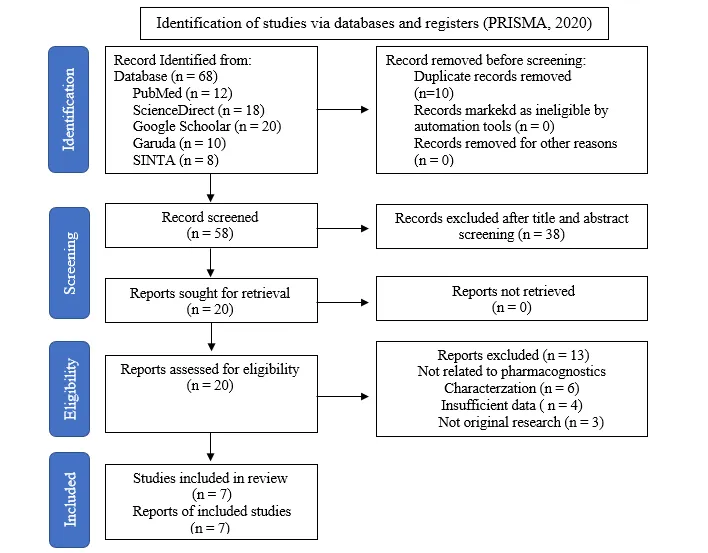
The study selection process was conducted in accordance with the Preffered Reporting Items for Systematic Reviews and Meta-Analyses (PRISMA, 2020) guidelines. The detailed flow of study identification, screening, eligibility assessment, and inclusion is presented in Figue 1.
Data Extraction and Analysis
The extracted data included:
Data were analyzed using a descriptive-comparative approach by identifying reporting patterns related to pharmacognostic characterization, consistency in the use of marker compounds, secondary metabolite profiles, and quality parameters across the included studies.
Quality Assessment
To ensure the methodological rigor of the included studies, a quality assessment was conducted using the Joanna Briggs Institute (JBI) Critical Appraisal Cheklist for Analytical Cross-Sectional Studies, which has been widely adopted in systematic reviews of health and pharmaceutical research, Each article was indepebdebtly evaluated based on study objectives, methodological appropriateness, sample description, analitycal procedures, validityof outcome measurements, statistical analysis, and clarity of reporting. Each fulfilled criterion was assigned one point, and the overall methodological quality was categorized as high quality (8-9 points), moderate quality (5-7 points), or low quality (<5 points).Only studies with moderate to high methodological quality were included in the final qualitative synthesis to ensure the realibility and validity of the evidence presented.
Table 2. Methodological Quality Assessment of Included Studies Using The JBI Cheklist
|
Author |
Study Design |
JBI Score |
Quality |
|
Ahmad et al., (2016) |
Experimental |
8/9 |
High |
|
Apriliani et al ., (2016) |
Experimental |
8/9 |
High |
|
Wigati & Rahardian (2018) |
Experimental |
7/9 |
Moderate |
|
Chen et al., (2018) |
Experimental |
9/9 |
High |
|
Ahmad et al., (2018) |
Experimental |
8/9 |
High |
|
Muthia et al., (2021) |
Experimental |
8/9 |
High |
|
Toar et al., (2023) |
Experimental |
8/9 |
High |
Results and Discussion
Article Selection Results
Overall, studies on Eleutherine palmifolia bulb extracts have predominantly focused on the identification of secondary metabolites and their biological activities, whereas investigations on the pharmacognostic characterization of the extracts as raw materials for herbal medicines remain limited and lack comprehensive integration. Previous studies have reported various aspects of pharmacognostic characterization, including specific and non-specific quality parameters, phytochemical profiles, chromatographic fingerprinting, and biological activities.
In the present review, a systematic literature search was conducted using keywords related to pharmacognostic characterization, specific and non-specific parameters, methanolic maceration extracts, and Eleutherine palmifolia bulbs. The initial search yielded 68 articles. After screening based on the predefined inclusion and exclusion criteria and assessing their relevance to the objectives of this review, eight eligible articles were selected from Google Scholar, PubMed, ScienceDirect, Garuda, and SINTA for qualitative synthesis.
Table 3. Summary of Included Studies on Pharmacognostic Characterization of Eleutherine palmifolia
|
No. |
Title, Author, |
Population |
Intervention |
Comparison |
Outcomes |
|
and Year |
Specific Quality Standards |
Non-specific Quality Standards |
|||
|
1 |
Qualitative and Quantitative Analysis of Bioactive Components Obtained from Dayak Onion Extraction (Apriliani et al., 2017) |
Eleutherine palmifolia (L.) Merr. bulbs |
Cold maceration extraction using 30% methanol followed by DPPH antioxidant assay. |
Maceration versus Soxhlet extraction and different maceration durations were compared regarding specific and non-specific quality parameters. |
Methanolic extracts contained antioxidant bioactive compounds as demonstrated by the DPPH assay. The purple DPPH solution changed to yellow, indicating antioxidant activity. Longer maceration periods resulted in stronger antioxidant activity. |
|
2 |
Determination of Non-specific Standardization Parameters of Ethanolic Percolation Extract of Dayak Onion (Eleutherine palmifolia (L.) Merr.) Bulbs (Wigati & Rahardian, 2018) |
Ethanolic extract of Eleutherine palmifolia bulbs |
Determination of non-specific parameters including loss on drying, moisture content, total ash, acid-insoluble ash, and TLC phytochemical screening. |
The obtained non-specific parameters were compared with herbal extract quality standards and conceptually with previous extraction methods. |
TLC analysis using different mobile phases demonstrated various Rf values corresponding to alkaloids, flavonoids, saponins, tannins, and quinones. |
|
3 |
The Effect of Extraction Methods of Bawang Dayak (Eleutherine palmifolia (L.) Merr.) Against TLC Profiles and Sunscreen Activities (Ahmad et al., 2016) |
Eleutherine palmifolia bulbs |
Extraction using maceration, reflux, and Soxhlet methods with n-hexane, ethyl acetate, ethanol, and methanol, followed by TLC profiling and in vitro sunscreen activity evaluation. |
Extraction methods and solvents were compared based on extraction yield, TLC profile (Rf values and number of spots), and sunscreen activity. |
TLC fingerprinting showed characteristic chromatographic profiles using n-hexane:ethyl acetate and chloroform:methanol solvent systems. The number of spots varied depending on extraction method and solvent. |
|
4 |
New Naphthalene Derivatives from the Bulbs of Eleutherine americana with Their Protective Effect on the Injury of HUVECs (Chen et al., 2018) |
Eleutherine americana/E. palmifolia bulbs |
Methanolic maceration followed by fractionation, column chromatography, TLC, HPLC, and structural elucidation using UV, IR, HR-ESI-MS, and NMR spectroscopy. |
Newly isolated compounds were compared with known compounds and evaluated using normal and high-glucose HUVEC models. |
Methanolic extracts contained characteristic marker compounds, including naphthalene, naphthoquinone, and anthraquinone derivatives such as eleutherol A–C and eleuthinone B–C. Chromatographic fingerprints may serve as specific quality markers. |
|
5 |
Standardization of Specific Parameters of Dayak Onion (Eleutherine americana Merr.) Bulb Extract (Toar et al., 2023) |
Eleutherine americana bulbs |
Ethanolic (96%) maceration followed by organoleptic evaluation, determination of water- and ethanol-soluble extractive values, phytochemical screening, and total flavonoid assay using UV–Vis spectrophotometry. |
Specific parameters were compared with herbal extract quality requirements and previous reports. |
The extract was thick, reddish-brown, bitter, and possessed a characteristic odor. It contained alkaloids, flavonoids, saponins, quinones, steroids, and triterpenoids. Water-soluble extractive value was 26.388%, ethanol-soluble extractive value 4.522%, and total flavonoid content 1.2%. |
|
6 |
Oral Glucose Tolerance Activity of Eleutherine palmifolia (L.) Merr. Bulb Extract Based on Different Extraction Methods (Ahmad et al., 2018) |
Eleutherine palmifolia bulbs |
Methanolic extraction using maceration, reflux, and Soxhlet methods followed by extraction yield determination and oral glucose tolerance test (OGTT) in mice. |
Extraction methods were compared with negative and positive controls (glibenclamide and metformin). |
Extraction method influenced the profile of extracted bioactive compounds, reflected by differences in pharmacological activity among extracts. |
|
7 |
Standardization of Eleutherine bulbosa Urb. Bulbs and Total Flavonoid Content from Three Locations in Kalimantan, Indonesia (Muthia et al., 2021) |
Eleutherine bulbosa bulbs collected from Banjarbaru, Palangkaraya, and Balikpapan |
Extraction by maceration using 70% ethanol followed by evaluation of specific parameters (identity, organoleptic, macroscopic and microscopic characteristics, extractive values, TLC profile, total flavonoid content) and non-specific parameters (specific gravity, moisture content, total ash, acid-insoluble ash, residual solvent, heavy metals, microbial contamination, molds, and yeasts). |
Comparison of specific and non-specific quality parameters among extracts from different geographical origins. |
Extracts were reddish-brown, bitter, and possessed a characteristic odor. They were more soluble in ethanol than in water. TLC analysis revealed four characteristic spots using an n-hexane:ethyl acetate (7:3) mobile phase. Total flavonoid content ranged from 5.035 to 7.585 mg QE/g extract, with the highest value observed in samples from Palangkaraya. |
Article Review Based on the PICO Approach for the Quality Standards of Methanolic Extracts of Eleutherine palmifolia Bulbs
The review of the seven articles that met the inclusion criteria demonstrated that studies on Eleutherine palmifolia bulb extracts have predominantly employed experimental approaches, focusing on the identification of secondary metabolites, extract characterization, and biological activities. However, based on the PICO framework, the reporting of pharmacognostic characterization, including both specific and non-specific quality parameters, remains highly variable and lacks consistent integration across studies. This finding indicates the absence of a standardized pharmacognostic approach for the characterization of E. palmifolia extracts intended for use as herbal medicinal raw materials.
Regarding the Population (P) component, all included studies investigated bulbs of Eleutherine palmifolia (L.) Merr. as the research material. Nevertheless, variations were observed in sample preparation, geographical origin of the crude drug (simplicia), and extraction conditions, all of which may influence extract characteristics and the composition of secondary metabolites. These differences suggest that population uniformity in pharmacognostic characterization has not yet been achieved, thereby limiting direct comparison among studies.
The Intervention (I) component revealed substantial differences in extraction techniques and solvent selection. The reviewed studies employed various extraction methods, including maceration, Soxhlet extraction, and reflux extraction. These methodological variations significantly affected extraction yield, chromatographic profiles, secondary metabolite composition, and the reported quality parameters of the extracts. Therefore, the extraction method is considered a critical factor in pharmacognostic characterization because it directly influences the chemical identity and consistency of herbal extracts.
With respect to the Outcome (O) component, several studies reported specific quality parameters, including extract identity, phytochemical screening, chromatographic fingerprinting, and the identification of secondary metabolites. However, these parameters were not reported uniformly, and most studies were limited to thin-layer chromatography (TLC) analysis or the identification of selected compounds without comprehensive evaluation of non-specific quality parameters. For example, the study by Apriliani et al. primarily emphasized biological activity without providing a complete assessment of non-specific pharmacognostic parameters, thereby limiting its application as a comprehensive reference for extract standardization.
In contrast, the study by Wigati and Rahardian (2018) contributed important information regarding non-specific quality parameters, including moisture content, loss on drying, and ash values. Although these parameters complied with general herbal extract quality standards, the use of ethanol as the extraction solvent and the limited reporting of specific parameters restricted direct comparison with methanolic maceration extracts. Similar limitations were observed in the studies conducted by Ahmad et al. (2016) and Chen et al. (2018), which provided detailed phytochemical and compound identification but lacked quantitative evaluation of non-specific quality parameters.
The Comparison (C) component was also inadequately addressed in most studies because clear comparisons among extraction methods, extraction solvents, and pharmacognostic quality parameters were generally absent. This limitation restricts the identification of the most appropriate extraction procedure capable of consistently producing extracts with optimal quality characteristics.
Overall, the PICO-based analysis indicates that current research on methanolic extracts of E. palmifolia bulbs remains fragmented, with separate emphasis on secondary metabolite identification, biological activity, and selected pharmacognostic parameters. No single study has comprehensively integrated all pharmacognostic aspects within one investigation. This substantial knowledge gap highlights the need for systematic reviews that integrate specific quality parameters, non-specific quality parameters, phytochemical profiles, chromatographic fingerprinting, and biological activities to support the development of high-quality, safe, and standardized E. palmifolia extracts for phytopharmaceutical applications.
Specific Parameters: Chemical Identity and Marker Compound Validation
Specific quality parameters play an essential role in pharmacognostic characterization by ensuring the chemical identity and consistency of herbal extracts. Modern pharmacognostic approaches employ high-resolution chromatographic fingerprinting to control variations in secondary metabolite composition (Li et al., 2016; Liang et al., 2018). Studies on E. palmifolia generally utilize Thin-Layer Chromatography (TLC) and High-Performance Liquid Chromatography (HPLC) to identify secondary metabolites, particularly naphthoquinones and flavonoids. However, most published studies remain qualitative or semi-quantitative in nature (Kamarudin et al., 2021; Chen et al., 2018).
Reliable pharmacognostic characterization requires validated analytical methods capable of demonstrating accuracy, precision, linearity, limits of detection, and limits of quantification (ICH, 2022). Nevertheless, analytical validation for E. palmifolia extracts remains limited, making it difficult to ensure the consistency of their chemical identity. This situation contrasts with medicinal plants such as Curcuma longa and Andrographis paniculata, which possess internationally recognized quantitative marker compounds and validated analytical methods incorporated into official pharmacopoeial monographs (Sasidharan et al., 2018; Chao & Lin, 2017).
The absence of consensus regarding suitable marker compounds indicates that pharmacognostic characterization and extract standardization of E. palmifolia are still under development. The use of a single marker compound is considered insufficient to represent the chemical complexity of extracts containing multiple bioactive constituents (Liang et al., 2018). Consequently, multi-marker strategies or quantitative chromatographic fingerprinting using HPLC-DAD or LC-MS have been proposed as more appropriate approaches for ensuring extract identity and quality consistency (Li et al., 2016).
Although chromatographic fingerprinting has been widely employed in the included studies, most investigations remain qualitative and lack validated quantitative marker compounds. This limitation reduces inter-study comparability and hinders the establishment of universally accepted quality standards of Eleutherine palmifolia exctracts. Future studies should prioritize multi-marker quantitative fingerprinting using validated HPLC ot LC-MS methods to improve extract standardization.
Non-specific Parameters: Physicochemical Stability and Safety
Non-specific parameters constitute an essential component of pharmacognostic characterization for evaluating the stability, safety, and overall quality of herbal extracts. Commonly assessed parameters include moisture content, loss on drying, total ash, and acid-insoluble ash (WHO, 2019). Moisture content is closely associated with degradation of active constituents and microbial growth, whereas ash values provide information regarding inorganic contamination within herbal extracts.
Low moisture content and low loss on drying indicate good storage stability and reduced susceptibility to microbial contamination. Similarly, total ash and acid-insoluble ash values reflect mineral composition and potential contamination by extraneous inorganic materials. Relatively low ash values indicate that the preparation of crude drugs and extraction processes have been appropriately conducted with minimal contamination (WHO, 2011; Wigati & Rahardian, 2018; BPOM RI, 2019).
For E. palmifolia, acceptable limits for these non-specific parameters still rely on general herbal extract standards and have not been specifically established according to the unique chemical characteristics of this species (Muchtaridi et al., 2017; Kamarudin et al., 2021). Moreover, the relationship between moisture content and the long-term stability of naphthoquinone compounds has not yet been systematically investigated.
This situation differs from internationally standardized medicinal plants such as Ginkgo biloba and Panax ginseng, where long-term stability studies are based on changes in validated marker compounds. Such approaches strengthen quality specifications by linking physicochemical stability with active constituent retention (Xie et al., 2019; Li et al., 2020). However, similar stability-based evaluation models have not yet been fully implemented for E. palmifolia extracts.
The absence of stability studies focusing on the degradation of active compounds limits the readiness of E. palmifolia extracts for phytopharmaceutical development. Currently, non-specific parameters continue to function primarily as general quality requirements rather than as components of a risk-based quality control system recommended for modern herbal medicines (ICH, 2022).
The literature review also revealed that not all studies comprehensively reported non-specific quality parameters. This finding indicates that extract safety and stability remain underemphasized despite their fundamental role in pharmacognostic characterization and quality assurance of standardized herbal raw materials (BPOM RI, 2019).
Despite the importance of moisture content, ash values, and exctractive values for ensuring extract quality, only a limited number of studies comphrehensively reported these parameters. Moreover, none of the reviewed studies correlated physicochemical stability with changes in validated marker compounds during storage. Cnsequently, current quality specifications remain incomplete for long term phytopharmaceutical development.
Influence of Maceration and Methanol Extraction on Extract Quality
Methanol maceration is among the most widely employed extraction techniques in pharmacognostic studies of E. palmifolia bulbs because it effectively extracts polar to semi-polar constituents without direct heating. This approach minimizes thermal degradation of thermolabile secondary metabolites during extraction (Tiwari et al., 2011; Azwanida, 2015).
Extraction methods substantially influence extraction yield, secondary metabolite composition, and the chemical characteristics of herbal extracts. Maceration duration has been shown to affect the quantity of extracted bioactive compounds, as prolonged extraction facilitates diffusion of metabolites from plant tissues into the solvent until equilibrium is reached (Apriliani et al., 2017).
Compared with Soxhlet and reflux extraction, both of which involve heating, maceration better preserves the stability of bioactive constituents despite generally producing lower extraction yields (Ahmad et al., 2016; Do et al., 2014). Consequently, methanolic maceration remains one of the preferred methods for pharmacognostic characterization of E. palmifolia because it better preserves secondary metabolite integrity and chromatographic fingerprint profiles.
Although methanolic maceration effectively preserves thermolabile compounds, considerable variability exists in solvent concentration, extraction duration, and solvent to material ratio among published studies. This methodological heterogeneity limits direct comparisonof extraction efficiency and phytochemical composition across studies. Establishing standardized extraction protocols would substantially improve reproducibility and facilitate quality control.
Conceptual Gaps and Integration of Bioactivity
Pharmacognostic characterization should not be limited to chemical profiling but should also establish clear relationships between chemical composition and biological activity. Correlations between validated marker compounds and biological responses are necessary to provide scientifically robust quality specifications for herbal extracts (Heinrich et al., 2020).
The reviewed literature indicates that studies investigating the bioactivity and pharmacognostic characteristics of E. palmifolia have generally been conducted independently. Bioactivity studies primarily evaluate antioxidant and antidiabetic effects, whereas pharmacognostic investigations focus on chromatographic fingerprinting and phytochemical identification without directly correlating these findings with pharmacological efficacy. Consequently, extract quality assessment remains insufficiently supported by biological evidence.
Chemical–biological correlation approaches have been successfully implemented in several medicinal plants to ensure that validated marker compounds accurately reflect therapeutic potential (Li et al., 2016; Heinrich et al., 2020). However, this strategy has not yet been systematically applied to E. palmifolia. Integrating phytochemical characterization with biological activity evaluation is therefore essential for developing standardized and therapeutically reliable phytopharmaceutical raw materials.
Future research should integrate quantitative chromatographic fingerprinting, validated analytical methods, stability testing, and correlation analyses between secondary metabolite content and biological activity within a unified experimental framework. Such integration would establish quality standards that are not only chemically consistent but also pharmacologically relevant, thereby supporting the development of standardized herbal medicines and phytopharmaceutical products derived from E. palmifolia (WHO, 2013; BPOM RI, 2019).
Overall, the fragmented nature of current evidence demonstrates that pharmacognostic characterization of E. palmifolia has not yet reached a comprehensive and stardardized approach. Future research should integrate phytochemical profiling, analytical validation physicochemical quality evaluation and biological activity assessment within a unified framework to support the development of standardized phytopharmaceutical products.
Crytical Analysis of Current Evident
Although the reviewed studies consistently demonstrated that Eleutherine palmifolia possesses considerable pharmacognostic potential, several methodological limitations remain remain evident. Most studies primarily focused on the qualitative identificatin of secondary metabolites using phytochemical screening and thin layer cromatography, where as quantitative validation of marker compounds was rarely performed. Consequently, comparison among studies remains difficult due to the absence of standardized analytical protocols.
Another important is the inconsistent reporting of specific and non-specific quality parameters. Some studies emphasized chromatoraphic fingerprinting and phytocemical characterization without evaluating physicochemical stability. Whereasothers reported moisture content, ash values, and extractive values without integrating these parameters with biological activity. This fragmented approach limits the development of comprehensive quality standards for E. palmifolia extract.
Furthermore, most studies evaluated antioxidant or antidiabetic activities independently from pharmacognostic characterization. Correlations between validated chemical markers and biological activities have rarely been investigated, despite their importance for phytopharmaceutical standardization. Therefore, current evidence remains insufficient to establish internationally accepted quality specifications for E. palmifolia extracts.
These finding indicate a significant research gap in the integration of extraction standardization, chromatographic fingerprinting, analytical validation, and bioactivity assessment. Future investigations should adopt a comprehensive pharacognostic approach to generate reproducible and scientifically validated quality standards.
Proposed Pharmacognostic Standardization Framework
Based on the evidence synthesized in this review, an integrated pharmacognostic standardization framework for Eleutherine palmifolia bulb extracts is proposed. Unlike previous studies that investigated individual quality parameters separately, this framework integrates all essential components required for herbal extract standardization into a unified quality control system.
The proposed framework consists of five sequential stages: (1) authentication of plant materials, (2) standardized extraction procedures, (3) evaluation of specific quality parameters including chromatographic fingerprinting and marker compounds, (4) evaluation of non-specific quality parameters including moisture content, ash values, and extractive values, and (5) integration of phytochemical characterization with biological activity evaluation through validated analytical methods.
This integrated framework may serve as a scientific reference for future pharmacognostic investigations and contribute to the development of standardized Eleutherine palmifolia extracts as high-quality phytopharmaceutical raw materials. The framework also addresses the methodological inconsistencies identified in previous studies and provides a conceptual basis for establishing internationally acceptable quality standards.
CONCLUSION
The pharmacognostic characterization of Eleutherine palmifolia extracts indicates that Dayak onion bulb extracts contain secondary metabolites with significant potential as bioactive compounds, particularly naphthoquinones and flavonoids. However, the characterization of both specific and non-specific quality parameters remains inconsistent across published studies. Although naphthoquinones have been widely proposed as potential marker compounds, their application has not been supported by comprehensive quantitative validation or well-defined acceptance criteria. Furthermore, non-specific parameters, including moisture content, loss on drying, and ash values, are still employed primarily as general quality indicators without being systematically correlated with the stability of the extract's bioactive metabolites.
A major research gap in E. palmifolia lies in the lack of integration between pharmacognostic characterization and bioactivity evaluation. Some studies have focused primarily on the identification of secondary metabolites and chemical fingerprinting, whereas others have emphasized biological activities without establishing relationships with extract quality parameters. Consequently, the characterization and standardization of E. palmifolia extracts havenot yet been fully supported by pharmacological evidence.
The development of E. palmifolia extracts as standardized phytopharmaceutical raw materials requires a more integrated pharmacognostic approach involving the application of validated multi-marker systems, high-resolution quantitative chromatographic fingerprinting, and the incorporation of stability testing and bioactivity assessment into a unified quality control framework. A chemistry–bioactivity correlation approach is expected to provide a robust scientific basis for producing Dayak onion extracts that are of high quality, safe, chemically consistent, and pharmacologically relevant, thereby supporting their development as modern herbal medicinal products.
REFERENCES


Windi Astutie Harahap, Abdul Rahim, Syaharuddin Kasim , Literature Review: Pharmacognostic Characterization Of Dayak Onion Bulb Extract (Eleutherine Palmifolia (L.) Merr.), Int. J. of Pharm. Sci., 2026, Vol 4, Issue 7, 4602-4616. https://doi.org/ 10.5281/zenodo.21493290
 10.5281/zenodo.21493290