

We use cookies to ensure our website works properly and to personalise your experience. Cookies policy
1MBBS Third Year, Department of Pharmacology, Fergana Medical Institute of Public Health, Uzbekistan.
2Assistant Professor, Department of Pharmacology, fergana Medical Institute of Public Health, Uzbekistan.
Solid tumors develop within a physical environment that is stiffer, more tense and more architecturally ordered than the tissue they arise from. Cancer cells detect these cues through integrins, mechanosensitive ion channels and the actomyosin cytoskeleton, and convert them into transcriptional programs. Evidence from stem cells, fibroblasts and epithelial cells shows that these programs can outlast the mechanical stimulus that triggered them. This phenomenon, called mechanical memory, implies that a cell's past physical environment can shape its present behavior. In this review we examine how mechanical memory could arise in tumors and what it may mean for progression. We summarize the biophysical basis of memory, the mechanotransduction pathways (integrin-clutch, YAP/TAZ, PIEZO1 and nuclear mechanics) that encode it, and the epigenetic mechanisms (chromatin condensation, histone modification, Polycomb regulation and microRNA circuits) that may store it. We then discuss how extracellular matrix remodeling by lysyl oxidase, cancer-associated fibroblasts and collagen realignment reinforces memory, and how memory could prime invasion, survival in confined spaces and metastatic colonization. We consider the interplay with the immune and metabolic microenvironment and evaluate the consequences for drug resistance. Finally, we appraise therapeutic strategies that target the matrix, mechanosensors or epigenetic regulators, including the disappointing clinical results of stromal-targeting trials, and identify the central knowledge gaps. A key conclusion is that direct evidence of mechanical memory in tumor cells in vivo remains limited. Much of the supporting data comes from non-malignant cells or short-term cancer models, so the concept is best treated as a well-motivated, testable framework rather than a settled mechanism.
A solid tumor is more than a mass of proliferating cells. It is an abnormal organ in which tissue architecture, matrix composition, vascular function and physical properties change as the disease advances, and these changes are now considered part of the broader framework of cancer hallmarks
[1]. Among them, the mechanical properties of the tissue have attracted growing attention. Cells sense the stiffness of their substrate and adjust their shape, cytoskeleton, adhesion and gene expression accordingly [2]. In tumors, this sensing is not a passive bystander process. Increased matrix stiffness, elevated tissue tension and altered matrix alignment have been linked to enhanced proliferation, invasion and survival, and the forces involved have been described as an active driver of malignant progression [3].
The conventional assumption is that cellular mechanical responses are reversible. When the mechanical input changes, the cell is expected to adjust and the response to fade. Work over the past decade has challenged this. Human mesenchymal stem cells cultured on stiff substrates for an extended period retained a mechanically conditioned state after transfer to soft hydrogels, and the retention depended on how long they had been exposed [4]. Lung fibroblasts showed a comparable persistence of the contractile, myofibroblast-like phenotype [5]. Epithelial cells pre-conditioned on stiff matrix migrated differently as a collective even after the stiff cue was removed [6]. A microRNA-based mechanism has also been proposed to sustain a fibrotic mechanical memory in stem cells [7]. Collectively, these findings describe mechanical memory: the persistence of a cell state or behavior after the mechanical stimulus that induced it has been withdrawn.
The relevance to cancer is straightforward in principle. Tumor cells traverse tissues with very different mechanical properties during progression: the soft primary tissue, the stiffened tumor margin, confined interstitial spaces, the vasculature, and finally a distant organ whose stiffness may differ markedly from that of the primary site. A cell that carries a record of earlier mechanical environments could behave differently from one that responds only to its current surroundings. This could affect where, when and how efficiently it colonizes, and how it responds to therapy. The physical traits of cancer, including solid stress, elevated interstitial fluid pressure and altered stiffness, are increasingly recognized as determinants of tumor biology and treatment response [8].
This review has four aims. First, we define the biophysical and molecular basis of mechanical memory and separate it from simple, continuous mechanosensing. Second, we examine how memory is encoded and stored, with emphasis on mechanotransduction pathways and epigenetic mechanisms. Third, we discuss how it interacts with matrix remodeling, invasion, metastasis, the tumor microenvironment and therapy. Fourth, we evaluate the strategies proposed to reverse it, and we state plainly where the evidence is weak. Throughout, we distinguish observations made in cancer cells from those made in other cell types, because the extrapolation from the latter to tumors is a central uncertainty in the field.
4. Biological Basis of Tumor Mechanical Memory
4.1 Tissue stiffness as an input
The ability of cells to read substrate stiffness was established in work showing that matrix elasticity directs stem-cell lineage specification [9]. In cancer, the relevant observation is that stiffness is not uniform or static. Tensional homeostasis, the balance between cellular contractility and the resistance of the matrix, is disrupted in malignant mammary epithelium, and increased matrix rigidity can promote a malignant phenotype through integrin signaling and cytoskeletal tension
[10]. Matrix cross-linking has been shown to enhance integrin signaling and PI3K activity and to drive tumor progression [11]. Atomic force microscopy of human breast biopsies revealed a distinct nanomechanical signature separating benign from malignant tissue, with a heterogeneous stiffness landscape in tumors [12]. Stiffness in breast cancer also correlates with matrix features and immune cell infiltration, which indicates that mechanics is linked to tumor composition and not a separate variable [13].
4.2 What distinguishes memory from mechanosensing
Continuous mechanosensing means that the cell state tracks the current mechanical input. Mechanical memory requires three features. First, the cell must have been exposed to the stimulus for a sufficient dose, which is usually a combination of magnitude and duration. Second, the induced state must persist after the stimulus is withdrawn. Third, the persistence must be attributable to a self-sustaining intracellular mechanism, not to continued external signals such as matrix the cell itself has deposited. This third criterion is the hardest to satisfy experimentally, because cells actively remodel their surroundings and a stiff matrix can, in effect, be rebuilt by the cell.
The dose dependence is a defining property. In stem cells, short exposure to stiff substrate was reversible, whereas prolonged exposure caused a state that persisted [4]. Persistent chromatin remodeling after extended stiff culture has been documented directly, supporting the view that duration converts a reversible response into a stable one [15]. Condensation of chromatin under mechanical load and the associated histone deacetylase activity were also proposed as a way of stabilizing cell state [14]. Computational modeling has since suggested that memory can be acquired through dynamic self-reinforcement of gene expression, in which a positive feedback loop locks in a state once a threshold is crossed [16].
4.3 Memory in the tumor setting
In tumors, the mechanical history of a cell is spatially and temporally structured. Cells at the invasive margin, where stiffness and tension are highest, may be exposed for long periods, whereas those in softer regions are not. Tissue force has been proposed to program cell fate and tumor aggressiveness, which implies a lasting effect and not only a momentary adaptation [17]. Soft environments also matter: matrix softness regulated the plasticity of tumor-repopulating cells through H3K9 demethylation and Sox2 expression [18], and soft fibrin gels selected for tumorigenic cells [19]. These results show that both stiff and soft cues can induce states relevant to tumor-initiating potential, and that the relationship between stiffness and aggressiveness is not monotonic. Table 1 collects the main experimental observations that support, or are adjacent to, the concept of mechanical memory. It also shows how few of them were obtained in cancer cells.
Table 1: Selected Experimental Evidence Relevant to Mechanical Memory.
| Cell type | Mechanical conditioning | Observed persistent state | Proposed mechanism | Ref. |
|---|---|---|---|---|
| Human mesenchymal stem cells | Culture on stiff substrate, then soft hydrogel | Retained mechanically conditioned state; dose-dependent | YAP-linked and transcriptional | [4] |
| Lung fibroblasts | Culture on stiff substrate, then softer substrate | Retained myofibroblast-like phenotype | Sustained contractile signaling | [5] |
| Mammary epithelial cells | Pre-conditioning on stiff matrix | Altered collective migration after stiffness removed | Mechanical priming | [6] |
| Mesenchymal stem cells | Prolonged stiff exposure | Fibrotic memory maintained | microRNA-21 circuit | [7] |
| Mesenchymal stem cells | Sustained mechanical culture | Persistent chromatin condensation | Histone deacetylation, chromatin architecture | [14] |
| Mesenchymal stem cells | Extended stiff exposure | Persistent chromatin remodeling | Altered chromatin accessibility | [15] |
| Tumor-repopulating cells | Soft fibrin matrix | Stem-like plasticity | H3K9 demethylation, Sox2 |
[18] |
| Tumorigenic cells | Soft fibrin gels | Selection and growth of tumorigenic cells | Matrix softness-dependent selection | [19] |
Note: Only the last two rows involve cancer cells, and they report matrix-dependent states, not memory in the strict sense defined in Section 4.2.
5. Mechanotransduction Pathways in Cancer Cells
5.1 Integrins, focal adhesions and the molecular clutch
Mechanotransduction begins where cells meet their matrix. The coupling of extracellular and intracellular mechanics, and the homeostatic feedback between cell-generated force and matrix properties, are reviewed in detail elsewhere [20]. Integrins act as biomechanical sensors that link matrix ligands to the actin cytoskeleton through adhesion complexes, and force changes their conformation and signaling activity [21]. The molecular clutch model describes how the stiffness of the substrate determines the loading rate on these linkages, and thus whether force is transmitted and signals are triggered [22]. For memory, the importance of this layer is that adhesion strength, cytoskeletal tension and downstream signaling are tightly coupled, so a sustained stiff signal can reinforce itself by promoting further contractility.
5.2 Mechanosensitive ion channels
PIEZO1 and PIEZO2 were identified as pore-forming subunits of mechanically activated cation channels [23]. In glioma, a feedforward loop was described in which PIEZO1 expression is increased by tissue stiffness and in turn promotes aggression and further matrix stiffening [24]. This is an example of a mechanism in which a mechanical input is amplified through a self-reinforcing circuit. Circuits of this type are the type of architecture that could, in principle, stabilize a state after the initial stimulus has gone.
5.3 YAP/TAZ as central integrators
The transcriptional co-activators YAP and TAZ were shown to relay mechanical signals from the matrix and cell shape to the nucleus, in a manner that depends on Rho GTPase activity and actomyosin tension [25]. Reviews describe their roles across physiology and disease [26], and their position at the roots of cancer, where they influence proliferation, stemness and therapy resistance, is well supported [27]. A mechanical checkpoint controlling multicellular growth operates through YAP/TAZ regulation by actin-processing factors [28]. At the nuclear level, force can open nuclear pores and thereby regulate YAP entry [29]. In cancer-associated fibroblasts (CAFs), YAP-dependent matrix remodeling is required for the generation and maintenance of the CAF phenotype, again suggesting a loop in which mechanics, transcription and matrix production reinforce each other [30]. Because YAP/TAZ activity both responds to and promotes matrix stiffening, it is a leading candidate for a node that holds mechanical memory, although its persistence after stimulus withdrawal in tumor cells has not been systematically tested.
5.4 The nucleus as a mechanosensor
The nucleus is not only the recipient of signals but also a mechanical element. Lamin-A levels scale with tissue stiffness, and this scaling affects matrix-directed differentiation and nuclear mechanical properties [31]. A stiffer, lamin-rich nucleus resists deformation, which affects how a cell moves through confined spaces (Section 8). Changes in nuclear architecture can also modify chromatin organization, which provides a direct physical route from external mechanics to epigenetic state.
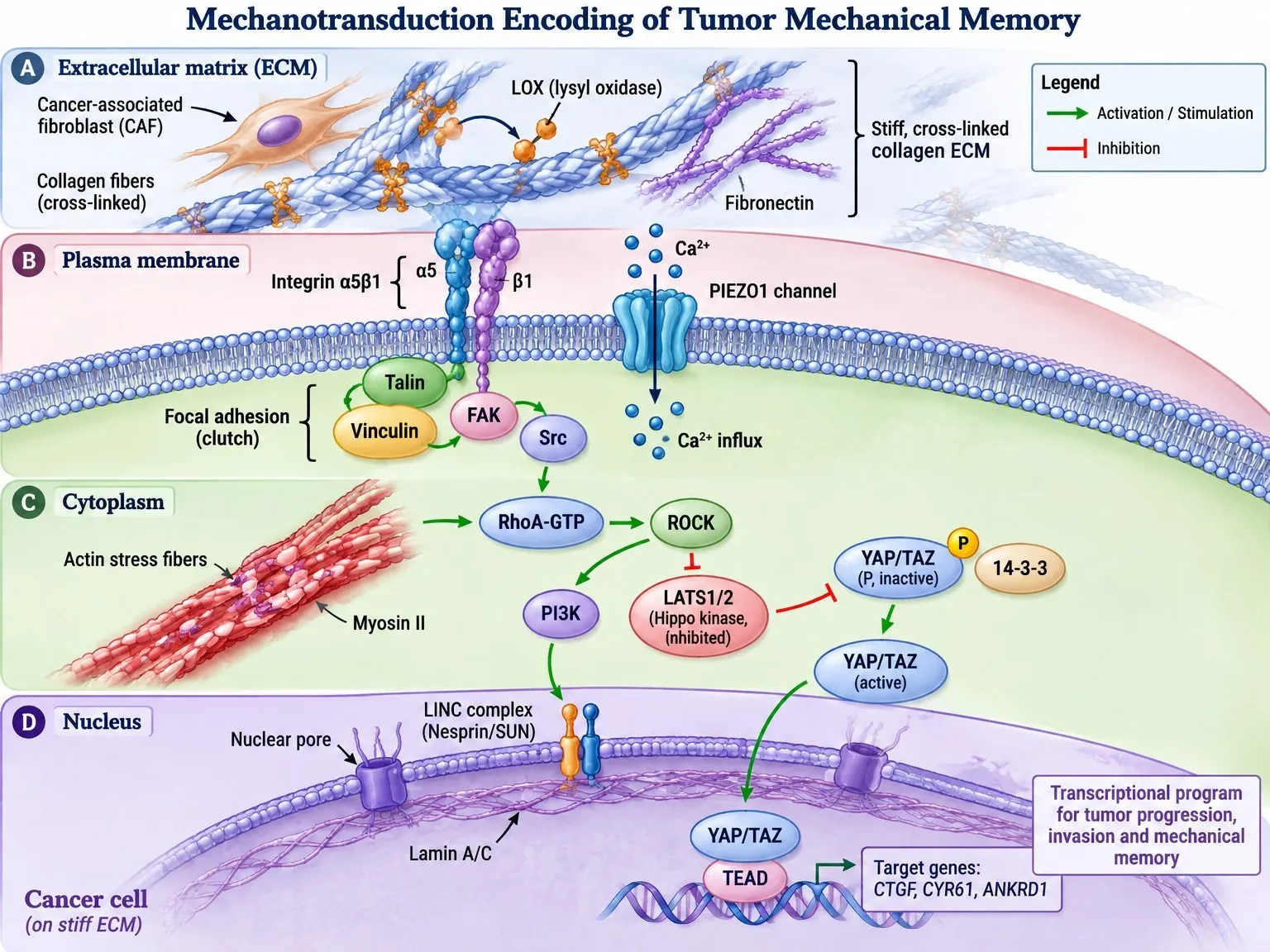
Figure 1: Mechanotransduction encoding of tumor mechanical memory. (A) Stiff, LOX-cross-linked ECM; (B) integrin/focal adhesion clutch and PIEZO1; (C) RhoA-ROCK and Hippo-YAP/TAZ signaling; (D) LINC complex, lamin A/C and YAP/TAZ-TEAD transcription.
6. Epigenetic Reprogramming and Cellular Memory
6.1 From force to chromatin
Epigenetic regulation is the most plausible storage mechanism for mechanical memory, because chromatin states can be propagated through cell division and can persist without the initiating signal. Mechanical forces influence chromatin through several routes. Cytoskeletal tension is transmitted to the nucleus, changes nuclear shape and tension, and alters chromatin compaction, histone modification patterns and the accessibility of regulatory regions [32]. In one example, mechanical regulation of transcription controlled Polycomb-mediated gene silencing during lineage commitment [33]. In another, heterochromatin-driven nuclear softening protected the genome from mechanical stress-induced damage, which indicates that chromatin state is also a mechanical adaptation and not only a transcriptional one [34].
6.2 Histone modification, microRNA and positive feedback
Several molecular modules have been linked to persistence. Histone deacetylation and chromatin condensation were associated with retained cell state in stem cells after mechanical conditioning [14]. Persistent chromatin remodeling was detected after extended stiff culture [15]. A microRNA-21 circuit was shown to preserve the fibrotic memory of mesenchymal stem cells [7]. Models propose that the common design principle is positive feedback: a mechanically induced factor promotes its own expression or that of an upstream regulator, so the state becomes self-sustaining once a threshold is crossed [16].
In cancer specifically, tissue mechanics modulated a microRNA-dependent regulation of PTEN and thereby affected malignant progression, which links mechanics to a tumor suppressor axis through post-transcriptional control [35]. This connection between mechanics and PI3K signaling resonates with earlier evidence that matrix stiffness enhances integrin-PI3K signaling [11].
6.3 Epithelial-mesenchymal plasticity as a memory-prone state
Epithelial-mesenchymal transition (EMT) is an obvious candidate for mechanically encoded memory, because EMT states can be metastable. Matrix stiffness was reported to drive EMT and metastasis through a TWIST1-G3BP2 mechanotransduction pathway [36], and matrix rigidity controlled epithelial-mesenchymal plasticity and metastasis through an EPHA2/LYN complex [37]. In both cases the data show that mechanics regulates the position of cells along the epithelial-mesenchymal spectrum. Whether such positioning persists after the stiff cue is removed, and for how long, is the unresolved question.
6.4 Epigenetic plasticity and non-genetic memory in cancer
Epigenetic plasticity is recognized as a feature that supports multiple cancer hallmarks, including phenotypic plasticity and non-mutational reprogramming [38]. Targeting the cancer epigenome for therapy is an active area of drug development [39]. If mechanical history is recorded epigenetically, then epigenetic drugs may offer one route to erase or modify memory (Section 11). The caveat is that the evidence tying a specific mechanical exposure to a specific, durable epigenetic mark in a tumor in vivo is still thin, and most of the mechanistic detail has been obtained in stem cells and fibroblasts.
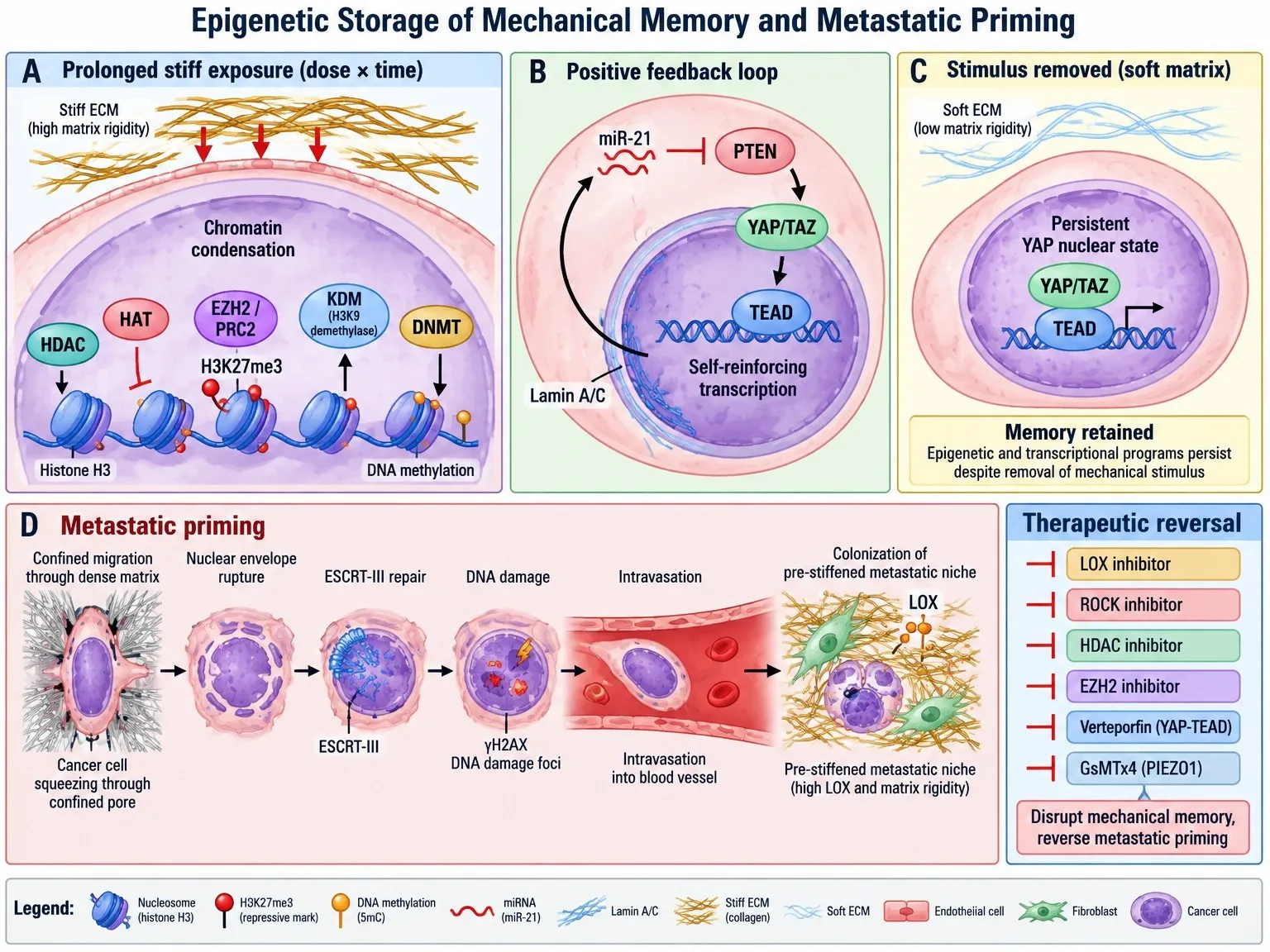
Figure 2: Epigenetic storage of mechanical memory and metastatic priming. (A) Chromatin modifiers under prolonged stiffness; (B) miR-21/YAP positive feedback;
(C) persistence after stimulus removal; (D) confined migration and colonization; right, therapeutic reversal strategies.
7. Extracellular Matrix Remodeling and Tumor Stiffness
7.1 Enzymatic cross-linking and fibrosis
The extracellular matrix (ECM) is dynamically assembled, degraded and cross-linked, and the balance between these processes is altered in fibrotic disease and in cancer [40]. In tumors the matrix serves as a dynamic niche that supplies both biochemical and physical signals to cancer cells [41]. Lysyl oxidase (LOX) is a central enzyme in this context. Hypoxia-induced LOX was shown to be a critical mediator of bone marrow cell recruitment to form the pre-metastatic niche [42], and LOX-mediated collagen cross-linking was responsible for fibrosis-enhanced metastasis [43]. These findings place matrix stiffening upstream of metastatic competence and imply that the mechanical state of a distant organ can be modified before tumor cells arrive.
This point is directly relevant to memory. If a tumor cell is conditioned by a stiff primary tumor and then arrives in a distant site whose matrix has been pre-conditioned by LOX activity, the cell and the tissue may both be in mechanically primed states. The extent to which these states interact has not been tested directly.
7.2 Collagen architecture and alignment
Stiffness is only one parameter. The orientation and organization of collagen also matter. Reorganization of collagen at the tumor-stromal interface facilitates local invasion, and specific alignment patterns, in which fibers lie perpendicular to the tumor boundary, were described as invasion-promoting [44]. Aligned collagen was later reported as a prognostic signature for survival in human breast carcinoma [45]. Matrix stiffness and composition jointly regulate the induction of malignant phenotypes in mammary epithelium, which demonstrates that mechanical and biochemical inputs cannot be separated cleanly [46]. In pancreatic cancer, genotype tuned tissue tension to induce matricellular fibrosis and tumor progression, which links oncogenic signaling to the mechanical state of the stroma [47].
7.3 Positive feedback between cells and matrix
A recurring theme is that cells and matrix form a feedback loop. Fibrous matrices show nonlinear elasticity that enables positive mechanical feedback between cells and ECM, so cell-generated forces can stiffen the surrounding fibers and thereby increase cell contractility further [48]. Collagen microarchitecture controls myofibroblast differentiation mechanically, which shows that the geometry of the matrix feeds back on the stromal cells that make it [49]. This feedback complicates the experimental separation of intracellular and extrinsic memory: an apparent cellular memory could be partly a record held in the matrix that the cell itself has modified. We therefore propose that tumor mechanical memory is best viewed as a distributed property of the cell-matrix system, with an intracellular component (epigenetic and signaling) and an extracellular component (cross-linked and aligned matrix).
8. Tumor Mechanical Memory in Invasion and Metastasis
8.1 The mechanical journey of a tumor cell
Metastasis exposes a cell to a sequence of mechanical environments, each with distinct demands on the cytoskeleton and nucleus. A comprehensive account of this journey describes how forces influence migration, intravasation, survival in circulation and colonization [50]. The physics of cancer, including physical interactions and mechanical forces in metastasis, has been reviewed as a coherent subfield [51]. Because the sequence is ordered, early mechanical exposures could in principle influence later steps if they leave persistent traces.
8.2 Invasion modes and migratory plasticity
Tumor cells can invade as single cells or collectively, and they can switch between modes depending on matrix properties and cell state [52]. The microenvironment and the cell influence each other reciprocally during invasion [53]. Stiffness and confinement regulate migration independently of each other, which means that a cell's migratory behavior depends on at least two separable mechanical inputs [54]. A cell that has been primed by stiff matrix could therefore show altered migration when it later encounters confinement, a prediction that is consistent with the priming of collective migration in epithelial cells [6].
8.3 Nuclear deformation, envelope rupture and genome instability
Migration through narrow spaces forces the nucleus to deform. Nuclear envelope rupture and repair were observed during cancer cell migration through confining constrictions [55]. DNA damage followed depletion of repair factors after pore migration and was associated with genome variation in cancer cells [56]. These observations raise the possibility that mechanical history may leave a genetic as well as an epigenetic trace: repeated confinement could generate DNA damage that persists in descendant cells. This is a distinct form of memory, since a mutation is irreversible, and it should be considered separately from reversible epigenetic states. The stiffness of the nucleus, governed by lamin-A and chromatin condensation [31,34], would be expected to modulate how much damage a cell accumulates.
8.4 Metastatic priming and colonization
Emerging principles of metastasis emphasize that cell state and plasticity, rather than fixed genetic traits alone, determine metastatic success [57]. Metastasis-initiating cells and their supportive ecosystems have been described as a unifying framework [58]. Pre-metastatic niches are organ-specific sites that are modified by primary tumor-derived factors before cells arrive [59], and LOX is among the factors implicated [42]. The following hypotheses link these ideas to mechanical memory, and each is testable:
None of these has been demonstrated in a way that excludes continuing extrinsic signals. We emphasize that they are hypotheses.
9. Interactions Between Mechanical Memory and the Tumor Microenvironment
9.1 Cancer-associated fibroblasts
Fibroblasts in cancer are heterogeneous and have roles in matrix production, signaling and immune regulation [60]. A consensus framework for CAF research has been proposed to standardize nomenclature and experimental approach [61]. Because fibroblasts are among the cell types in which mechanical memory has been best documented [5], CAFs are the most credible cells in which persistent mechanical programs could sustain a stiff matrix. A stiff matrix activates fibroblasts, activated fibroblasts deposit and cross-link more matrix, and the cycle continues even if the original trigger was transient. Therapies that target only the tumor cells would leave this stromal memory intact.
9.2 Immune cells
Matrix architecture affects the location and migration of T cells in human lung tumors, as dense fiber regions restrict their entry into tumor nests [62]. TGF-beta signaling was associated with exclusion of T cells and reduced response to PD-L1 blockade [63]. In pancreatic cancer, contact guidance of T cells along matrix fibers causes intrastromal trapping [64]. Tumor-associated macrophages are also an established therapeutic target [65], and they respond to matrix stiffness and composition. Together, these observations suggest that mechanical state indirectly determines immune access to tumor cells. If stromal cells and matrix hold a persistent mechanical state, immune exclusion could persist as well, which could contribute to resistance to immunotherapy.
9.3 Metabolic coupling
Mechanics influences metabolism. Cytoskeletal architecture mechanically regulates glycolysis, since the availability of glycolytic enzymes depends on actin organization [66]. Tumor-stroma mechanics also coordinate amino acid availability to sustain tumor growth in pancreatic cancer [67]. Metabolic state affects histone acetylation and methylation through the supply of acetyl-CoA and other cofactors, so metabolism may be one route by which mechanical history becomes an epigenetic record. This link is plausible but, as far as we are aware, has not been established for mechanical memory specifically.
10. Implications for Cancer Therapy and Drug Resistance
10.1 Physical barriers and mechanical resistance
Mechanical forces in tumors limit therapy through at least two classes of mechanism. The first is physical: solid stress compresses vessels, interstitial pressure rises, and drug delivery falls [68]. The second is cellular: matrix stiffness directly changes how cancer cells respond to drugs. In
hepatocellular carcinoma cells, matrix stiffness modulated proliferation, chemotherapeutic response and dormancy [69]. In pancreatic cancer cells, stiffness induced EMT and promoted chemoresistance [70].
10.2 Mechanical memory as a source of non-genetic resistance
If mechanical history is epigenetically recorded, a drug-resistant state could be acquired during residence in a stiff region and retained when cells are redistributed, for instance after a drug has reduced tumor stiffness. This idea parallels non-genetic resistance models, but it must be tested with controlled experiments that expose cells to stiff matrix, remove the stimulus, and then quantify drug response over time.
10.3 Lessons from stroma-targeting trials
The clinical experience with stromal modification is cautionary. Preclinical work showed that enzymatic targeting of the stroma can remove physical barriers to treatment in pancreatic ductal adenocarcinoma [71], and angiotensin inhibition decompressed tumor blood vessels and improved drug delivery and chemotherapy efficacy in mouse models [72]. However, depletion of carcinoma-associated fibroblasts and fibrosis accelerated pancreatic cancer in mice, with immunosuppression and reduced survival [73], and genetic deletion of stromal elements gave tumors that were more aggressive and undifferentiated [74]. These two studies showed that the stroma has restraining as well as promoting functions.
Clinically, a randomized phase II study of PEGPH20 added to nab-paclitaxel and gemcitabine prolonged progression-free survival, most clearly in hyaluronan-high tumors, but with an increase in thromboembolic events [75]. The subsequent phase III trial in hyaluronan-high metastatic pancreatic cancer did not demonstrate improvement in progression-free or overall survival [76]. Inhibition of the matrix enzyme LOXL2 with simtuzumab gave no clinical benefit in a randomized phase II pancreatic cancer trial [77]. In preclinical models, inhibition of focal adhesion kinase reduced fibrosis and made pancreatic tumors more responsive to checkpoint immunotherapy [78]. Taken together, these data show that indiscriminate matrix depletion is unlikely to work, and that targeting the cellular mechanisms of sensing and memory may be a more refined strategy.
10.4 YAP-mediated resistance and dormancy
YAP activity promoted resistance to RAF- and MEK-targeted therapies [79], and YAP-mediated transcriptional reprogramming of the apoptotic pathway underlay treatment-induced tumor dormancy [80]. Since YAP is a mechanically regulated integrator (Section 5.3), these findings provide a plausible bridge between matrix mechanics and persistent drug-tolerant states, although the mechanical component was not the focus of those studies.
11. Emerging Therapeutic Strategies to Reverse Mechanical Memory
If mechanical memory exists in tumors, therapy could aim to prevent its acquisition, erase it, or exploit it. Four families of approach are under investigation, and Table 2 summarizes them. It should be stated at the outset that none of these has been validated as a memory-reversing intervention. The evidence listed concerns the underlying targets.
11.1 Matrix-directed approaches
Reducing matrix stiffness or tension addresses the extrinsic component of memory and the physical barrier to drug delivery together. Approaches include hyaluronan degradation, angiotensin-pathway inhibition to reduce stromal collagen and hyaluronan, and inhibition of cross-linking enzymes (Section 10.3). The mixed clinical outcomes show that the goal should be normalization of matrix mechanics rather than wholesale depletion. Strategies for re-engineering the physical tumor microenvironment to improve drug delivery, based on mathematical modeling and clinical translation, have been reviewed [85].
11.2 Targeting mechanosensors and signaling hubs
The Hippo pathway effectors YAP and TAZ, and their partner TEAD transcription factors, are being pursued as cancer targets, and the opportunities and limitations of this strategy have been reviewed [81]. Since YAP/TAZ are a likely node of mechanical memory, inhibiting them could in principle prevent a mechanically induced state from becoming self-sustaining. A concern is that YAP/TAZ have essential roles in normal tissue repair, which narrows the therapeutic window. Mechanosensitive channels are a second class of targets. The peptide GsMTx4 inhibits PIEZO1 [82], and the small molecule Yoda1 activates it [83]. These tools are used mainly in the laboratory, where they allow causal tests of whether channel activity is needed to establish or maintain a mechanically induced state. Given the PIEZO1-stiffness feedforward loop described in glioma [24], channel inhibition is a rational approach for tumors that show such a loop, but selectivity and tolerability remain open issues.
11.3 Epigenetic erasure
Because persistent chromatin states are the most likely storage medium, epigenetic modulators are a logical choice. Targeting epigenetic modifications has produced approved agents and many candidates, and the field has been comprehensively reviewed [84]. The mechanical memory literature supplies concrete hypotheses: histone deacetylase activity was linked to retention of mechanical state [14], and H3K9 demethylation to soft-matrix plasticity [18]. A pharmacological test of memory reversibility would expose mechanically conditioned cells to a defined epigenetic agent and measure return to the baseline state after stimulus withdrawal. A sobering consideration is that epigenetic drugs act globally and are not specific to mechanically induced marks.
11.4 Combination and sequencing
A logical strategy is to combine a matrix-normalizing agent, which lowers the mechanical input, with an agent that targets the cellular response, and to sequence them. For instance, a stromal-normalizing drug might first improve perfusion and immune access, and then a drug targeting YAP or epigenetic regulators could be used to block residual memory in tumor cells. The FAK inhibition result [78] is of interest because it combined stromal remodeling with improved immunotherapy response. Sequencing, dosing and biomarkers (for example, imaging-based stiffness maps) would need to be defined for any trial.
Table 2: Therapeutic Strategies Relevant to Reversal of Mechanical Memory, and the Status of the Evidence.
| Strategy | Molecular target | Key evidence | Main limitation | Ref. |
|---|---|---|---|---|
| Hyaluronan degradation | Stromal hyaluronan | Reduced physical barriers in preclinical models; phase II benefit in HA-high tumors; no survival benefit in phase III | Failed to improve outcome; thromboembolic events | [71,75,76] |
| Angiotensin-pathway inhibition | Stromal collagen, hyaluronan, vessel compression | Decompressed vessels, improved delivery in mice | Evidence mainly preclinical | [72] |
| Cross-link enzyme inhibition | LOX family, LOXL2 | LOX drives cross-linking and metastasis; LOXL2 antibody tested clinically | No clinical benefit in phase II pancreatic cancer | [43,77] |
| Focal adhesion kinase inhibition | FAK | Reduced fibrosis and improved checkpoint response in mouse models | Not validated as a memory-reversing agent | [78] |
| Hippo/YAP-TEAD inhibition | YAP/TAZ, TEAD | YAP linked to drug resistance and dormancy; target reviewed | Essential in normal tissue repair | [79,80,81] |
| Mechanosensitive channel modulation | PIEZO1 | Pharmacological tools exist; feedforward loop in glioma | Selectivity and tolerability unknown | [24,82,83] |
| Epigenetic modulation | HDACs, histone |
Chromatin states linked to mechanical | Global, non-specific action | [14,18,84] |
| demethylases, others | state | |||
|---|---|---|---|---|
| Wholesale stromal depletion (caution) | Fibroblasts, fibrosis | Depletion accelerated tumors in mice | Stroma also restrains tumor growth | [73,74] |
12. Current Evidence, Knowledge Gaps, and Research Challenges
The central message of this review is that the concept of tumor mechanical memory is plausible and attractive but incompletely demonstrated. The strongest direct evidence derives from non-malignant cells, mainly mesenchymal stem cells, fibroblasts and epithelial cells [4-7,14,15]. In cancer, there is strong evidence that mechanics drives malignant phenotypes, EMT, drug resistance and metastasis [10,11,35-37,69,70], but this evidence mostly shows continuous mechanosensing and does not show persistence after stimulus withdrawal. We identify six gaps.
with a mechanical state. Targeted editing or inhibition of the proposed marks, followed by tests of persistence, would establish necessity and sufficiency.
state survives, and whether it is transmitted to daughter cells in tumors.
Technical challenges include the difficulty of tuning stiffness dynamically without altering ligand density, and the reliance on a small number of cell lines. Reproducibility across laboratories is also a concern for studies of cell mechanics, where substrate preparation strongly affects results.
13. Future Perspectives
Several developments could move the field forward. Dynamic hydrogels that stiffen or soften on demand, combined with single-cell chromatin profiling, would allow the construction of a quantitative dose-persistence relationship for tumor cells [4,15]. Mathematical models of self-reinforcing gene expression [16] can generate predictions of threshold and hysteresis behavior that are directly testable. Intravital imaging of nuclear mechanics and DNA damage during migration [55,56] could be combined with lineage tracing to follow the fate of cells exposed to confinement. Organoid and patient-derived xenograft systems with defined stromal mechanics may give the closest preclinical approximation of human disease.
On the clinical side, trials that incorporate stiffness imaging as a biomarker, and that sample tissue for epigenetic read-outs before and after matrix-normalizing therapy, would show whether mechanical state can be changed in patients and whether the change persists. The experience with hyaluronan and LOXL2 targeting [75-77] argues for patient selection based on mechanical or stromal biomarkers and for careful phase II designs. Computational approaches that integrate imaging, spatial transcriptomics and mechanical modeling are likely to be valuable for mapping the mechanical history of tumor regions.
CONCLUSION
Tumor cells live in a mechanically heterogeneous and evolving environment, and a growing body of work shows that cells in other contexts can store information about past mechanics through epigenetic, signaling and matrix-based mechanisms. These observations make a persuasive case that mechanical memory could contribute to invasion, metastatic priming and drug tolerance in cancer. However, the evidence for memory in tumor cells, as opposed to continuous mechanosensing, is still sparse, and the main therapeutic implication of the concept, that memory can be reversed, remains untested. The failures of broad stromal depletion argue for precise strategies that normalize matrix mechanics and target the cellular machinery of mechanosensing and chromatin regulation. Progress will require agreed definitions, experimental designs that separate intrinsic from extrinsic memory, and biomarkers that can be measured in patients.
REFERENCES


Yash Jain, Shivprasad Dhage, Mechanical Memory in the Tumor Microenvironment: Linking Cellular Mechanotransduction, Epigenetic Adaptation, and Metastasis, Int. J. of Pharm. Sci., 2026, Vol 4, Issue 11, 175-190. https://doi.org/10.5281/zenodo.23877078
 10.5281/zenodo.23877078