

We use cookies to ensure our website works properly and to personalise your experience. Cookies policy
1Department of Pharmaceutics, Government College of Pharmacy, Karad, India.
2Department of Pharmaceutical Chemistry, Government College of Pharmacy, Karad, India.
3-5Department of Pharmaceutics, Government College of Pharmacy, Karad, India.
Fungal infections remain a major global health challenge, causing substantial illness and death, especially among immunocompromised patients. Posaconazole is a broad-spectrum triazole antifungal that acts mainly by inhibiting fungal lanosterol 14?-demethylase. Despite its therapeutic value, its high lipophilicity, poor water solubility, variable oral absorption, and hepatic first-pass metabolism can limit drug exposure. Cubosomes self-assembled, bicontinuous liquid-crystalline nanoparticles typically made from amphiphilic lipids such as glyceryl monooleate and stabilized with Poloxamer 407 offer a potential strategy for improving delivery of poorly soluble drugs. This review examines the formulation, development, and evaluation of posaconazole-loaded cubosomes. It outlines top-down preparation methods involving high-energy fragmentation and bottom-up methods based on controlled self-assembly, and considers how formulation composition and processing conditions affect the resulting systems. The role of Quality by Design and Design of Experiments in formulation optimization is also discussed. Characterization approaches include dynamic light scattering to assess particle size, polydispersity, and zeta potential; electron microscopy to examine morphology; and Small-Angle X-ray Scattering to verify internal cubic structure. In vitro studies suggest that cubosomal incorporation can improve posaconazole dissolution and regulate its release, which is often analyzed using Higuchi and Korsmeyer–Peppas models.
1.1 The Clinical Burden and Epidemiology of Fungal Infections
Over the last three decades, the epidemiology of fungal diseases has changed considerably, transforming fungal infections from relatively uncommon clinical conditions into an increasingly important global public health concern. Although superficial fungal infections involving the skin and subcutaneous tissues continue to affect large populations, the growing prevalence of severe invasive fungal diseases represents a particularly serious clinical challenge. This increasing burden is closely associated with the expanding number of individuals with impaired immune function, including patients receiving intensive anticancer chemotherapy, recipients of solid-organ and hematopoietic stem-cell transplants, people with advanced HIV/AIDS, and critically ill patients recovering from severe viral respiratory infections such as SARS-CoV-2.[1]
Immunosuppression substantially reduces the host's ability to control opportunistic fungal organisms, allowing normally harmless commensal fungi and environmental molds to invade tissues and disseminate throughout the body. Such invasive infections are associated with substantial morbidity and mortality and are estimated to contribute to more than one million deaths worldwide each year. The major fungal pathogens responsible for this increasing clinical burden include Candida species, which are commonly associated with candidemia; Aspergillus species, particularly in cases of invasive pulmonary aspergillosis; and various members of the order Mucorales, which cause mucormycosis. [2]
The increasing global burden of fungal infections is further complicated by the emergence of antifungal resistance, which has become an important therapeutic challenge. The development of resistance involves several interconnected and complex mechanisms. One major mechanism is the increased expression of multidrug efflux pumps, which actively transport antifungal compounds out of fungal cells and consequently reduce their intracellular concentration below levels required for effective activity. Genetic alterations, including single-nucleotide polymorphisms, may also produce amino acid substitutions in drug-target proteins or enzymes, thereby modifying the interaction between the antifungal agent and its molecular target and reducing drug susceptibility. In addition, the ability of pathogenic fungi to form biofilms presents another significant barrier to successful treatment. These organized microbial communities are embedded within a protective extracellular polymeric matrix that can restrict the diffusion and penetration of conventional antifungal agents. Therefore, the development of innovative drug delivery approaches is increasingly important for improving antifungal therapy. Advanced delivery systems may help overcome resistance-associated barriers, promote drug deposition and penetration at the intended site of infection, and improve the effective bioavailability of existing antifungal drugs. [3]
1.2 Pharmacology and Biopharmaceutical Limitations of Posaconazole
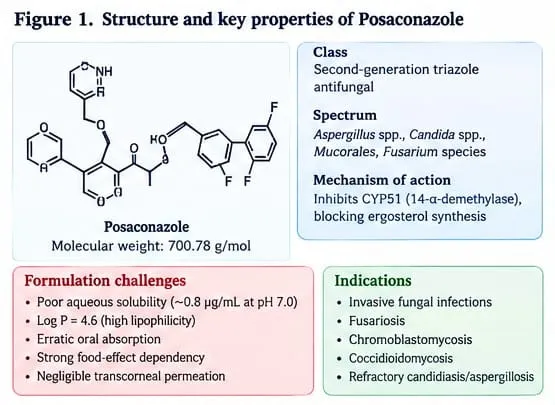
The development of increasingly effective antifungal agents has been closely associated with advances in medicinal chemistry and the progressive structural modification of azole compounds. This evolution has led from the earlier imidazole derivatives, which generally exhibited comparatively limited selectivity, toward potent and broad-spectrum triazole antifungal agents. Posaconazole is considered an important advancement within this class. As a second-generation triazole, its antifungal activity primarily results from the selective inhibition of the cytochrome P450-dependent enzyme lanosterol 14α-demethylase, also designated as CYP51p or ERG11p Th.is enzyme plays an essential role in the biosynthetic pathway responsible for the production of ergosterol, a major sterol required for maintaining the structure and functional properties of the fungal cell membrane. Inhibition of lanosterol 14α-demethylase by posaconazole markedly interferes with ergosterol biosynthesis, leading to depletion of membrane ergosterol along with the accumulation of potentially toxic 14α-methylated sterol intermediates. The combined effects of reduced ergosterol availability and abnormal sterol accumulation disturb the organization, fluidity, and functional asymmetry of the fungal cell membrane. These alterations can subsequently impair membrane-associated enzyme functions and increase membrane permeability, resulting in leakage of intracellular components and ultimately contributing to fungal cell death.[4,5]
Despite its potent antifungal activity and broad therapeutic spectrum, the clinical application of posaconazole is significantly affected by its unfavourable physicochemical characteristics. According to the Biopharmaceutics Classification System (BCS), posaconazole is categorized as a Class II drug, which is characterized by high permeability across biological membranes but limited aqueous solubility. This poor water solubility can create a major biopharmaceutical challenge, as dissolution of the drug may become a rate-limiting factor in achieving adequate and consistent drug absorption. [6,7]
Table 1: Physicochemical and Pharmacokinetic Profiling of Posaconazole.[2,5,6,8]
| Physicochemical Parameter | Posaconazole Characteristic | Clinical Implication |
|---|---|---|
| Drug Classification | Triazole Antifungal (BCS Class II) | Formulation requires aggressive solubilization strategies. |
| Aqueous Solubility | Practically insoluble (< 1 µg/mL) | Severely limits dissolution in gastrointestinal and physiological fluids. |
| Lipophilicity (LogP) | Highly lipophilic (LogP ≈ 5.4 - 6.2) | Drives extensive partitioning into lipid membranes but impedes aqueous transport. |
| Molecular Weight | 700.8 g/mol | Large molecular size hinders passive diffusion across tight cellular junctions. |
| Plasma Protein Binding | > 98% (highly bound) | Reduces the fraction of free, pharmacologically active drug in systemic circulation. |
| Oral Bioavailability | Variable (34% – 40%) | Results in erratic therapeutic profiles; necessitates high, frequent dosing. |
| Metabolism & Elimination | Hepatic first-pass metabolism; t1/2 of 2.1–4.2 h | Contributes to inter-individual variability and potential hepatotoxicity. |
The pronounced lipophilic nature and relatively high molecular mass of posaconazole contribute to considerable variability in its oral absorption and bioavailability, which can be influenced by factors such as food intake and gastric pH. In addition, extensive hepatic first-pass metabolism can further affect systemic drug exposure. These biopharmaceutical characteristics may necessitate carefully optimized dosing to achieve and sustain therapeutic drug concentrations. Higher or repeated exposure may, however, increase the likelihood of adverse effects, including hepatic toxicity, renal toxicity, and gastrointestinal disturbances.
The delivery of posaconazole to localized sites of fungal infection presents additional challenges. In topical treatment of cutaneous mycoses, penetration through the highly organized lipid-rich structure of the stratum corneum can restrict drug transport into deeper skin layers. Similarly, the tightly organized epithelial barrier of the cornea can limit the ocular penetration of poorly water-soluble and relatively large drug molecules, which may reduce their therapeutic effectiveness. Consequently, improving the therapeutic performance of posaconazole may require an advanced drug-delivery approach that can enhance its apparent solubility, improve drug incorporation, and facilitate transport across relevant biological barriers. Nanocarrier-based systems therefore represent a potential strategy for addressing both the poor aqueous solubility of posaconazole and the permeability limitations associated with localized drug delivery. [1][4][8] [9]
1.3 Cubosomes: Advanced Nanostructured Lipid Carriers
The incorporation of nanotechnology into antifungal drug delivery initially led to the development and application of lipid-based vesicular carriers, including conventional liposomes, niosomes, and ethosomes. These early nanocarrier systems demonstrated potential for improving the solubilization and delivery of poorly water-soluble antifungal drugs. However, their practical application has often been limited by intrinsic physicochemical instability. Conventional vesicular carriers may undergo structural disruption, aggregation, phase separation, and leakage of the entrapped drug during prolonged storage or following administration. Such instability can adversely affect formulation integrity, drug retention, and ultimately the consistency of therapeutic performance.[10]
Cubosomes have gained increasing attention as an advanced class of lipid-based nanocarriers because of their distinctive structural characteristics and potential to address limitations associated with conventional vesicular systems. These carriers are self-assembled liquid-crystalline nanoparticles that exhibit a highly organized internal structure based on a bicontinuous cubic phase. In contrast to the relatively simple concentric lipid bilayers characteristic of conventional liposomes, cubosomes contain a continuous lipid bilayer that is intricately curved and arranged along an infinite periodic minimal surface (IPMS). This organization produces a compact and highly convoluted three-dimensional cubic network within the nanoparticle. As a result of this characteristic architecture, the internal aqueous region is separated into two continuous and interconnected channel systems that remain spatially distinct without directly intersecting.[10,11]
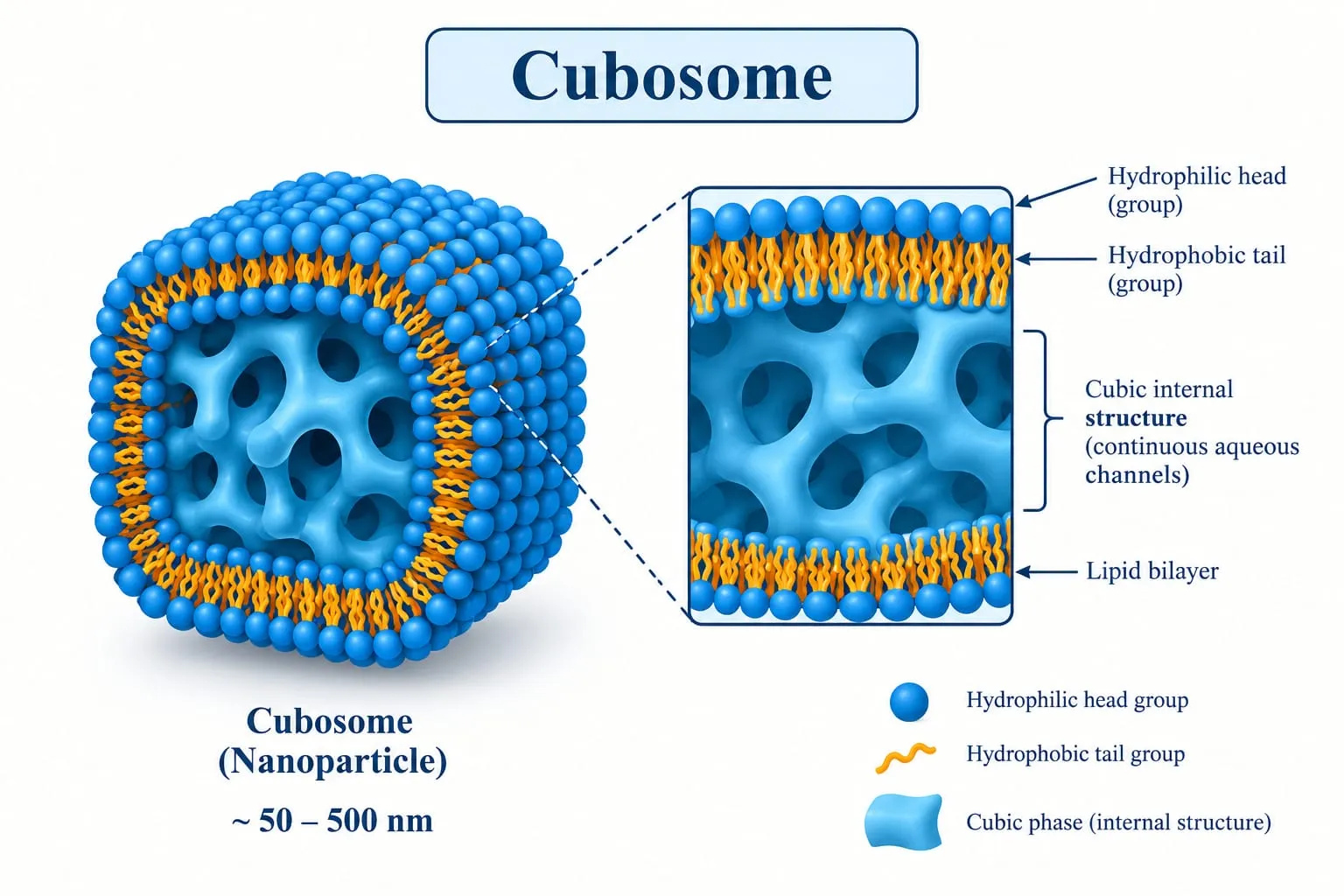
Figure 1: Cubosome
The selection of cubosomes as a delivery platform for posaconazole is supported by several important advantages arising from their distinctive physicochemical properties:
Extensive Interfacial Surface for Amphiphilic Drug Encapsulation: The highly convoluted organization of the lipid bilayer around the infinite periodic minimal surface (IPMS) generates a substantially greater internal interfacial area than that provided by conventional liposomes of comparable size. This extensive lipid–water interface offers a large domain for incorporating highly lipophilic drugs such as posaconazole, potentially enabling high drug loading while minimizing drug precipitation. At the same time, the interconnected aqueous compartments within the cubosomal structure can accommodate hydrophilic molecules, allowing the carrier to support the incorporation of compounds with different physicochemical characteristics.[8]
Enhanced Thermodynamic Stability: The bicontinuous cubic phase represents an isotropic and energetically favorable liquid-crystalline state, contributing to the inherent stability of cubosomes. This organized structure can provide greater resistance to physical destabilization, particle fusion, and premature drug leakage compared with conventional vesicular carriers. Such stability may support prolonged storage, maintain formulation integrity, and preserve the structural characteristics of the nanocarrier under physiological conditions.[8]
Tunable, Sustained Release Kinetics: The extensive internal surface area and highly tortuous network of aqueous channels within cubosomes can substantially restrict the diffusion of encapsulated drug molecules. Posaconazole molecules located within the lipid domains must traverse this complex internal pathway before reaching the surrounding physiological environment. This characteristic architecture can therefore promote controlled and prolonged drug release, helping to regulate the rate of drug diffusion and minimize the possibility of an excessive initial burst release.[12]
Biomimetic Permeation Enhancement: The lipid components of cubosomes possess characteristics that can resemble the lipid environment encountered in biological barriers, including the stratum corneum and precorneal tear film. This lipid-based compatibility may enhance adhesion of the nanocarrier to biological surfaces and facilitate interactions with cellular membranes. Such interactions can increase membrane fluidity and promote transcellular transport of posaconazole, potentially improving its penetration across biological barriers that otherwise restrict the movement of the unformulated drug.
2. METHODOLOGY:MATERIALS AND METHODS
The successful and reproducible development of posaconazole-loaded cubosomes requires careful selection of appropriate materials and precise control of the formulation and manufacturing processes. Formation of a stable dispersed cubic phase from the lipid components is influenced by several critical factors, including the molecular characteristics of the lipids, the nature and concentration of the stabilizing agent, and the controlled application of mechanical or thermodynamic energy during preparation. Careful optimization of these parameters is essential for obtaining cubosomes with consistent physicochemical characteristics and satisfactory drug-delivery performance.
2.1 Critical Material Attributes (CMA)
2.1.1 The Primary Lipid Matrix: Glyceryl Monooleate (GMO)
The structural framework of cubosomal nanocarriers is primarily determined by the self-assembly behavior of amphiphilic lipids. Glyceryl monooleate (GMO), also known as monoolein, is one of the most extensively utilized lipids for the formation of inverse bicontinuous cubic phases. Its ability to generate these structures is closely associated with its critical packing parameter, which reflects the relationship between the molecular dimensions of the hydrophilic and hydrophobic regions of the lipid.
GMO exhibits an asymmetric molecular structure consisting of a relatively small and polar hydrophilic head group attached to a larger unsaturated cis-hydrocarbon chain. This molecular geometry favors the development of negative interfacial curvature when GMO comes into contact with an aqueous medium. As a result, the lipid molecules tend to organize into non-lamellar liquid-crystalline structures rather than forming simple planar bilayers. Under appropriate hydration and temperature conditions, hydrated GMO can form highly ordered inverse bicontinuous cubic phases, commonly represented by the (v2) phase.
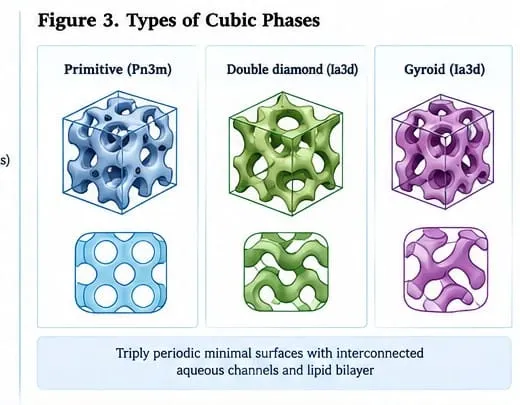
Figure 2: Types of Cubic Phase
Among the cubic structures formed by GMO, the Pn3m phase, associated with diamond-type geometry, and the Im3m phase, corresponding to primitive-type geometry, are particularly important. These well-organized three-dimensional lipid architectures provide the structural basis for the cubosomal system and contribute to its ability to incorporate and deliver poorly water-soluble compounds such as posaconazole.[13]
2.1.2 Polymeric Steric Stabilizers: Poloxamer 407
Although GMO is responsible for establishing the internal cubic structure of cubosomes, the physical stability of the resulting aqueous nanoparticle dispersion is largely governed by the presence of an appropriate polymeric stabilizer. In the absence of a stabilizing agent, cubosomal particles dispersed in an aqueous medium possess considerable surface free energy, which promotes particle–particle interactions. Consequently, the nanoparticles may undergo flocculation, aggregation, and fusion, potentially resulting in the conversion of the dispersed cubosomal system into a bulk cubic gel. Incorporation of a suitable steric stabilizer such as Poloxamer 407 helps reduce these interactions and supports the maintenance of a stable colloidal dispersion.
To minimize undesirable phase separation and maintain the colloidal dispersion, Poloxamer 407, commercially known as Pluronic F-127, can be incorporated as a surface stabilizing agent. It is a non-ionic triblock copolymer consisting of a hydrophobic polyoxypropylene (PPO) segment positioned between two hydrophilic polyoxyethylene (PEO) chains. During cubosome formation, the hydrophobic PPO portion interacts with and becomes associated with the outer lipid region of the GMO-based cubosome, while the hydrophilic PEO chains extend into the surrounding aqueous medium. This arrangement produces a hydrated polymeric layer at the particle surface that provides steric stabilization.
When cubosomal particles come into close proximity, the surface-associated PEO chains generate steric and osmotic repulsive forces, thereby reducing direct particle–particle interactions and limiting aggregation. This surface protection contributes to the maintenance of a stable nanosized dispersion over extended periods. In some preparation approaches, additional stabilizing polymers such as polyvinyl alcohol (PVA) may also be employed to assist in reducing interfacial tension and improving dispersion stability during emulsification.[14]
Table 2: Summary of the Critical Excipients Employed in the Formulation of Posaconazole-Loaded Cubosomes. [14]
| Formulation Component | Chemical Designation | Primary Function in Cubosomes | Supplier/Source (Representative) |
|---|---|---|---|
| Active Ingredient | Posaconazole | Broad-spectrum triazole antifungal agent. | Commercial API Suppliers |
| Primary Lipid Matrix | Glyceryl Monooleate (GMO) | Induces inverse bicontinuous cubic phase (V2). | Mohini Organics Pvt. Ltd. |
| Polymeric Stabilizer | Poloxamer 407 (Pluronic F-127) | Provides dense steric hindrance to prevent aggregation. | Vishal Chem Pvt. Ltd. |
| Auxiliary Emulsifier | Polyvinyl Alcohol (PVA) | Lowers surface tension during nanoparticle fragmentation. | Standard Chemical Suppliers |
2.2 Formulation Methodologies
The conversion of a bulk liquid-crystalline phase into a uniform nanosized cubosomal dispersion can be accomplished primarily through two established formulation strategies. These include the top-down approach, which relies on high-energy mechanical disruption of the bulk cubic phase, and the bottom-up approach, in which cubosomal nanoparticles are generated through controlled solvent dilution and self-assembly of the lipid components.
2.2.1 The Top-Down Approach (High-Energy Fragmentation)
The top-down method is one of the most widely reported approaches for cubosome preparation and offers good potential for reproducible and scalable production of stable cubosomal dispersions. In this technique, the lipid phase and stabilizer are initially combined to generate the bulk cubic phase, which is subsequently fragmented into nanosized particles using high-energy mechanical forces.
Typically, glyceryl monooleate (GMO) and Poloxamer 407 are heated together at an elevated temperature, generally in the range of 60–70°C, until a homogeneous lipid melt is obtained. Because of its high lipophilicity, posaconazole can then be incorporated into the lipid phase and mixed thoroughly to achieve uniform drug distribution. Following this, a predetermined quantity of the aqueous phase, such as distilled water or an appropriate buffer, is gradually incorporated into the lipid melt. Hydration of GMO promotes spontaneous molecular self-assembly and results in the formation of a highly viscous, structured bulk cubic phase. This macroscopic cubic gel subsequently serves as the starting material for the high-energy fragmentation step, during which it is reduced to a nanosized cubosomal dispersion.[15,16]
Because the resulting bulk cubic gel is not suitable for direct administration as a nanoscale drug-delivery system, it must undergo subsequent size reduction. The hydrated bulk phase is therefore exposed to high mechanical energy, commonly through prolonged probe sonication or high-pressure homogenization (HPH). The intense shear forces generated during homogenization and the cavitation effects produced by ultrasonic treatment disrupt the bulk cubic structure, producing a large number of discrete cubosomal nanoparticles within the sub-micron size range.
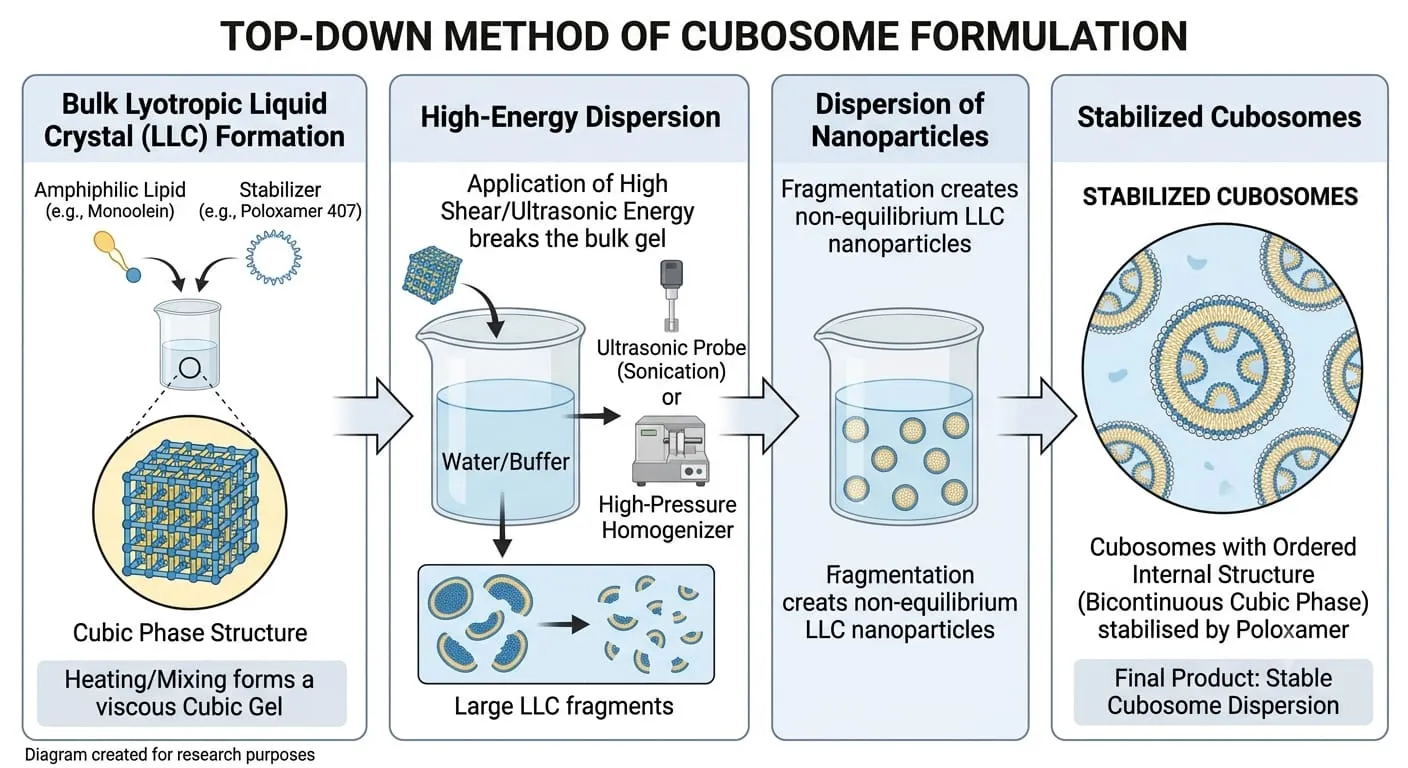
Figure 3: Top Down Method
Although this approach can effectively generate nanosized cubosomal dispersions, the high energy input may lead to considerable heat generation during processing. Accordingly, strict temperature control is important throughout the size-reduction step. External cooling or suitable temperature-regulation systems may be employed to minimize thermal stress, thereby reducing the risk of posaconazole degradation and preserving the structural integrity of the cubic lipid phase.[16]
2.2.2 The Bottom-Up Approach (Thin-Film Hydration)
The bottom-up approach, including thin-film hydration, can be employed as an alternative to the high-energy top-down technique, thereby reducing the requirement for intense mechanical processing and associated heat generation. In this strategy, cubosomal structures are generated through the spontaneous self-assembly of lipid molecules and other formulation components under relatively mild processing conditions.
In a typical procedure, posaconazole and glyceryl monooleate (GMO) are dissolved together in a suitable volatile organic solvent, such as chloroform, methanol, or ethanol. Co-dissolution facilitates uniform molecular distribution of the drug throughout the lipid phase. The organic solvent is subsequently eliminated under reduced pressure using a rotary evaporator, producing a thin and homogeneous lipid–drug film deposited on the inner surface of the flask. The resulting film is then hydrated with an aqueous phase containing Poloxamer 407, generally at room temperature or under controlled mild heating.
During hydration, gentle agitation or brief bath sonication facilitates interaction between the lipid phase and aqueous medium, promoting spontaneous self-organization of the lipid molecules into liquid-crystalline cubic structures. This process produces an initial cubosomal dispersion that can subsequently be subjected to further processing or optimization, depending on the desired formulation characteristics. For poorly water-soluble drugs such as posaconazole, prior dissolution of the drug with GMO may facilitate its incorporation into the hydrophobic regions of the lipid matrix and can help reduce the likelihood of drug precipitation during subsequent hydration and self-assembly.[9,17,18]
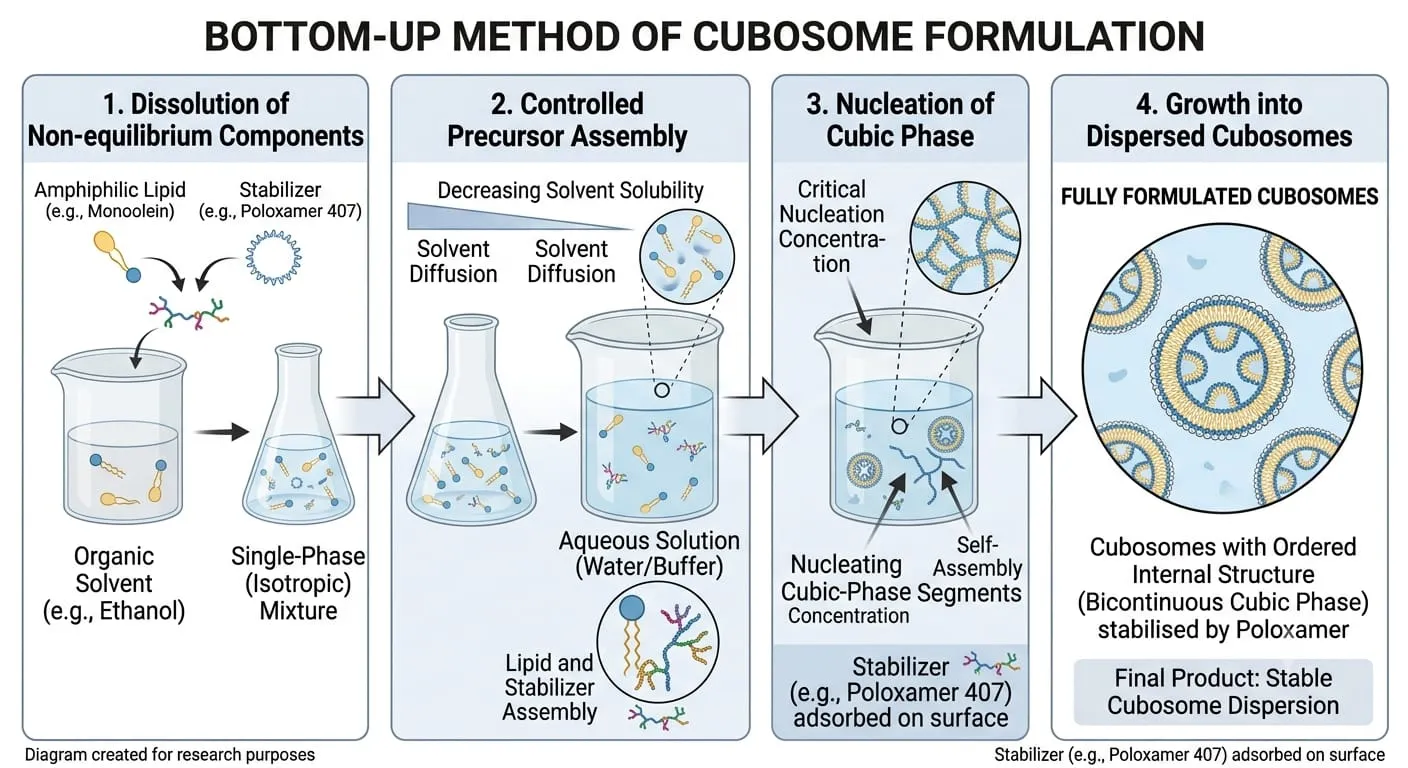
Figure 4: Bottom up Method
2.3 Quality by Design (QbD) and Statistical Optimization
The development of advanced nanocarrier systems is increasingly guided by the Quality by Design (QbD) framework, which replaces conventional trial-and-error formulation development with a systematic and statistically supported optimization strategy. The application of Design of Experiments (DoE) approaches, including Box–Behnken design, full factorial design, and D-optimal mixture design, enables researchers to investigate multiple formulation and process variables in a structured manner. These experimental designs allow simultaneous preparation and evaluation of different formulation combinations, facilitating the identification of individual factor effects as well as interactions among critical variables. Consequently, DoE-based QbD approaches provide a rational means of establishing relationships between formulation variables and critical quality attributes, thereby supporting the development of robust and reproducible nanocarrier formulations.[15,19,20]
In the optimization design for posaconazole-loaded cubosomes, the selected independent variables (critical material attributes and process parameters) typically include:
The formulation performance is assessed through specific dependent variables, or Critical Quality Attributes (CQAs), which are essential for determining the quality and optimization of the developed system. These include:
By generating mathematical response-surface models, optimization studies can establish the formulation composition and process conditions that provide the desired nanocarrier characteristics. Statistical analysis may demonstrate that an increase in Poloxamer 407 concentration lowers interfacial tension and consequently contributes to a reduction in the mean particle size of cubosomes. However, an excessive concentration of stabilizer may influence the organization and integrity of the internal cubic structure, potentially promoting a transition toward less ordered structures such as micellar or lamellar phases. Such structural changes can adversely affect drug incorporation and may increase the risk of premature posaconazole release. Therefore, the Quality by Design (QbD) approach facilitates the establishment of an appropriate design space in which steric stabilization, particle-size control, drug entrapment, and structural integrity are simultaneously optimized to obtain a stable and reproducible cubosomal formulation.[18]
3. RESULTS AND DISCUSSION: PHYSICOCHEMICAL CHARACTERIZATION
After the formulation and optimization of the posaconazole-loaded cubosomal system, comprehensive physicochemical and analytical evaluations are performed to assess its structural characteristics, thermodynamic properties, and drug-loading performance.
3.1 Particle Size, Polydispersity Index, and Zeta Potential
Particle size, size distribution, and surface charge are important characteristics that can influence the stability, biological behavior, interaction with physiological media, and cellular uptake of cubosomal formulations. These parameters are commonly determined using Dynamic Light Scattering (DLS), also known as photon correlation spectroscopy. Instruments such as the HORIBA SZ-100 may be employed under controlled analytical conditions, for example, using a 90° scattering angle at 25°C. Before analysis, the cubosomal dispersion is appropriately diluted with filtered double-distilled water to minimize multiple-scattering effects and obtain reliable particle-size measurements.[9,11]
Particle Size: Particle size is an important parameter for cubosomal systems intended for topical, transdermal, or transcorneal applications. Formulations within the submicron range, particularly around 100–300 nm, have been investigated for such delivery approaches. Reported optimized posaconazole cubosomal formulations have demonstrated mean particle sizes within this range, with examples including 193.34 ± 14.84 nm and approximately 198 nm. The small particle dimensions provide a relatively high surface-area-to-volume ratio, which may promote close interaction with biological barriers such as the stratum corneum or corneal epithelium. This enhanced interfacial contact may contribute to improved drug deposition and facilitate posaconazole transport across or into relevant tissue layers through transcellular and/or paracellular pathways.[9,18]
Polydispersity Index (PDI): The Polydispersity Index (PDI) is an important parameter used to assess the uniformity and breadth of the particle-size distribution within a cubosomal formulation. A PDI value close to 0 represents a highly homogeneous, nearly monodisperse population, whereas higher values indicate greater variability in particle dimensions and may reflect aggregation or reduced formulation stability. In optimized posaconazole cubosomal systems, PDI values below 0.3 are generally considered indicative of a relatively narrow and uniform particle-size distribution, suggesting good formulation consistency and controlled preparation conditions.[9,18]
Zeta Potential: Zeta potential is commonly determined from electrophoretic mobility using a zeta potential analyzer and represents the electrical potential associated with the slipping or shear plane surrounding the dispersed nanoparticles. Since glyceryl monooleate (GMO) is a non-ionic lipid, the measured surface charge can be affected by the composition and nature of the stabilizing system. Cubosomes stabilized with Poloxamer 407 may exhibit negative zeta-potential values, with reported formulations showing values in the approximate range of −20 to −30 mV. Along with steric stabilization provided by the hydrophilic polyethylene oxide (PEO) chains of Poloxamer 407, the surface charge can contribute to reduced particle–particle interactions and improved resistance to aggregation and flocculation. Consequently, zeta potential serves as an important indicator for evaluating the colloidal stability of the optimized cubosomal dispersion.[9,18]
3.2 Morphological and Solid-State Characterization
3.2.1 Scanning and Transmission Electron Microscopy (SEM/TEM)
Detailed assessment of the surface morphology, particle shape, and structural features of the developed cubosomal nanocarriers can be performed using advanced electron microscopy techniques. Cryogenic Transmission Electron Microscopy (Cryo-TEM) and Field-Emission Scanning Electron Microscopy (FE-SEM) are widely utilized to obtain high-resolution images of cubosomal systems. These techniques provide complementary information regarding the external morphology and, particularly in the case of Cryo-TEM, the internal nanostructural organization of the cubosomes.[3,9,21]
SEM Analysis: For Scanning Electron Microscopy (SEM) examination, the posaconazole-loaded cubosomal dispersion may first be subjected to lyophilization to obtain a dry sample suitable for imaging. The dried formulation can then be analyzed using a high-resolution electron microscope, such as an FEI system, under appropriate accelerating-voltage conditions. SEM micrographs can provide information regarding the surface morphology, particle shape, and overall distribution of the cubosomal structures. The observation of discrete, relatively uniform, quasi-spherical or angular particles with minimal visible aggregation can support the successful formation and physical integrity of the developed cubosomal formulation.[3,18,21]
TEM Analysis: Transmission Electron Microscopy (TEM) provides high-resolution visualization of the internal and morphological characteristics of cubosomal nanoparticles. TEM images can reveal the characteristic internal organization associated with the cubic liquid-crystalline structure, including the interconnected lipid bilayers and aqueous channels that produce a honeycomb-like appearance. Such morphological evidence can support the formation and self-assembly of the cubosomal system and complement other structural characterization techniques used to confirm the cubic phase.[21]
3.2.2 Small-Angle X-ray Scattering (SAXS)
Although electron microscopy provides valuable information regarding the morphology and surface characteristics of cubosomes, Small-Angle X-ray Scattering (SAXS) is particularly useful for investigating their internal liquid-crystalline organization. SAXS analysis enables characterization of the structural arrangement and lattice parameters of the lipid-based phase by measuring X-ray scattering at small diffraction angles. The resulting Bragg reflections and their characteristic peak-spacing ratios can be used to identify and differentiate various liquid-crystalline structures, thereby providing important evidence for the formation and structural organization of the cubosomal cubic phase.[13]
3.2.3 Spectroscopic Compatibility and Thermal Analysis
The chemical compatibility of posaconazole with the lipid matrix and stabilizing agent is evaluated using Fourier Transform Infrared Spectroscopy (FT-IR). This analysis helps determine whether significant chemical interactions or alterations occur between the drug, glyceryl monooleate (GMO), and Poloxamer 407 during formulation. Comparison of the characteristic absorption bands of the pure drug with those of the physical mixture and optimized cubosomal formulation can provide evidence regarding the preservation of the drug's major functional groups and overall chemical compatibility within the developed system.[9]
FT-IR Spectroscopy: FT-IR spectra are comparatively evaluated for the pure posaconazole, individual excipients or their physical mixture, and the optimized cubosomal formulation to assess drug–excipient compatibility. The spectrum of glyceryl monooleate (GMO) typically demonstrates a broad O–H stretching band around 3399 cm⁻¹, along with characteristic C–H stretching vibrations of long hydrocarbon chains near 2923 and 2853 cm⁻¹. In the optimized posaconazole-loaded cubosomes, retention of the characteristic absorption bands of GMO and the principal functional-group signals of posaconazole, without the development of new prominent peaks or substantial shifts in the characteristic bands, suggests the absence of significant chemical incompatibility. These spectral observations support the physical compatibility of the drug with the selected excipients and indicate that no major chemical interaction is evident under the formulation conditions.[9]
Thermal and Diffractometric Analysis (DSC & XRD): Differential Scanning Calorimetry (DSC) and X-ray Diffraction (XRD) are commonly employed to investigate the thermal behavior and solid-state characteristics of posaconazole within the developed formulation. Pure posaconazole generally exhibits distinct, intense crystalline diffraction peaks at characteristic 2θ values, including approximately 10.0°, 11.05°, 12.8°, 15.2°, 15.6°, and 17.6°, reflecting its ordered crystalline structure. Following incorporation into the lipid-based cubosomal system, a marked reduction in the intensity of these characteristic crystalline reflections may be observed, accompanied by the appearance of a broader diffuse halo. Such changes indicate a reduction in the degree of crystallinity and may suggest that a substantial proportion of posaconazole exists in a less crystalline or amorphous state within the formulation. DSC thermograms can further support these observations by demonstrating changes in the drug's characteristic thermal transition. These solid-state modifications may contribute to improved drug dissolution and apparent solubility, which is particularly relevant for addressing the poor aqueous solubility associated with BCS Class II drugs such as posaconazole.[12,22]
3.3 Entrapment Efficiency (%EE) and Drug Loading (%DL)
The ability of the cubosomal system to incorporate and retain an adequate amount of posaconazole is an important parameter for evaluating formulation performance. Entrapment Efficiency (%EE) and Drug Loading (%DL) are therefore determined quantitatively to assess the extent of drug incorporation within the cubosomal matrix. These parameters can be evaluated using an indirect ultracentrifugation method, in which the unentrapped drug is separated from the cubosomal dispersion and subsequently quantified. High entrapment efficiency together with appropriate drug loading indicates effective incorporation of the drug into the lipidic nanocarrier and may contribute to improved formulation stability and drug-retention characteristics.[9]
To determine the amount of unentrapped drug, a measured aliquot of the prepared cubosomal dispersion is subjected to high-speed refrigerated centrifugation, such as using a REMI-C24 BL centrifuge operated at 12,000 rpm for 1 hour at 4°C. The applied centrifugal force facilitates efficient separation of the denser posaconazole-loaded cubosomal nanoparticles from the transparent aqueous supernatant containing the unentrapped or free drug. The resulting supernatant is carefully collected, appropriately diluted with a suitable organic solvent such as methanol, and quantitatively analyzed using a UV-Visible spectrophotometer, for example, a Shimadzu V-1800. The analysis is performed at the characteristic maximum absorption wavelength (lambda max) of posaconazole, generally reported around 259 nm.[9,12]
The principal drug-loading characteristics of the cubosomal formulation are calculated using the following standard equations:
%EE=((Total Amount of Drug Added-Amount of Free Drug)/(Total Amount of Drug Added))×100
%DL=((Total Amount of Drug Added-Amount of Free Drug)/(Total Amount of Lipid Added))×100
Systematic optimization studies involving factorial formulations, typically represented by batches F1–F9, demonstrate the high drug-entrapment potential associated with the cubic lipidic structure. The extensive internal surface area provided by the highly lipophilic GMO-based bicontinuous lipid bilayer facilitates substantial incorporation of hydrophobic posaconazole within the cubosomal matrix. In comparatively less-optimized formulations, moderate entrapment efficiencies may be observed, as demonstrated by formulation F9, which exhibits a %EE of 80.3%. In contrast, optimized formulations demonstrate considerably enhanced drug incorporation. Among these, formulation F5 exhibits a maximum %EE of 92.3% ± 0.16%, along with a drug-loading capacity of more than 17.1% ± 0.04%. Similarly, formulations F6 and F7 demonstrate high entrapment efficiencies of 90.3% and 90.1%, respectively.
The consistently elevated entrapment efficiencies observed across the optimized formulations highlight the strong capacity of the cubic lipidic architecture to accommodate highly lipophilic compounds such as posaconazole. These findings indicate the potential of cubosomal systems as an effective nanocarrier platform for incorporating poorly water-soluble, high-molecular-weight triazole antifungal agents when compared with conventional micellar and simple nanoemulsion-based delivery systems.[9]
4. RESULTS AND DISCUSSION: IN VITRO RELEASE AND PERMEABILITY
4.1 In Vitro Drug Release Kinetics and Mathematical Modeling
For an effective advanced localized drug delivery system, controlled drug release is an essential requirement. The formulation should minimize or avoid an excessive initial release of drug, commonly referred to as burst release, while ensuring the gradual and sustained availability of therapeutic drug concentrations at the intended site of action over an extended period.[1,23]
4.1.1 Dialysis Membrane Diffusion Technique
The in vitro drug release behavior of posaconazole-loaded cubosomes is evaluated using a standardized dialysis membrane diffusion method. A precisely measured quantity of the lyophilized cubosomal formulation, or an equivalent amount of the developed cubosomal gel, is placed inside a semi-permeable dialysis membrane with a typical molecular weight cut-off (MWCO) of 12,000–14,000 Da. The sealed dialysis bag is then immersed in approximately 900 mL of phosphate-buffered saline (PBS) maintained at physiological pH, typically 7.2–7.4, to provide conditions that closely simulate the physiological environment.
The release study is conducted under controlled sink conditions, with the dissolution medium maintained at 37 ± 0.5°C and continuously agitated at a gentle speed of approximately 50 rpm. At predetermined sampling intervals, extending from 1 to 24 hours, aliquots of approximately 2 mL are withdrawn from the release medium. Each withdrawn volume is promptly replaced with an equivalent quantity of fresh PBS to maintain a consistent concentration gradient and minimize any disruption of sink conditions. The collected samples are subsequently analyzed spectrophotometrically at 259 nm to determine the amount of posaconazole released at each time point.[8,9]
4.1.2 Biphasic Release Profile and Kinetic Fitting
Conventional posaconazole suspensions generally demonstrate limited and variable drug dissolution, with cumulative drug release often remaining below 36.32–40% even after 24 hours of continuous agitation. This restricted dissolution behavior can be associated with the drug’s strong crystalline structure and extremely low aqueous solubility. In contrast, optimized posaconazole-loaded cubosomal formulations demonstrate a more controlled and reproducible biphasic drug-release pattern, characterized by two distinct phases:[9]
Initial Phase (0–4 hours): During the initial stage of the release study, the cubosomal formulation exhibits a controlled and gradual release of posaconazole, with approximately 8% drug release at 1 hour, increasing to 63.6% by 4 hours. This early release may be attributed to the dissolution and diffusion of posaconazole molecules present near the outer interfacial regions of the cubosomal particles. Such an initial release phase can facilitate the prompt availability of the drug at the target site while minimizing an uncontrolled burst-release effect.[1,9]
Sustained Phase (4–24 hours): After the initial release period, the formulation enters a prolonged and controlled release phase. The cumulative release increases to approximately 90.23% at 12 hours and reaches 101.36% by 24 hours, indicating near-complete drug release. This sustained behavior can be attributed to the localization of posaconazole within the internal GMO lipid bilayers of the cubosomal structure. The entrapped drug molecules must diffuse through the complex and highly tortuous aqueous channels characteristic of the cubic phase before reaching the surrounding release medium. This extended diffusion pathway provides a structural barrier to drug transport, thereby reducing the diffusion rate and contributing to the prolonged release of posaconazole over time.[9]
To determine the underlying mechanism responsible for posaconazole release from the cubosomal system, the experimentally obtained dissolution data are evaluated using several well-established mathematical kinetic models. These models include:
Table 3: Comparative Assessment of Mathematical Models Describing Posaconazole Release Kinetics from Cubosomal Nanocarriers.[9,15]
| Kinetic Model Evaluated | Governing Physical Mechanism | Model Correlation (R2 Value for Optimized Batches) |
|---|---|---|
| Zero-Order | Concentration Independent Erosion | Lower fit |
| First-Order | Concentration Dependent Diffusion | Lower fit |
| Higuchi Model | Porous Matrix Diffusion | High Fit (R2>0.98) |
| Korsmeyer-Peppas | Complex/Anomalous Transport | Highest Fit (R2>0.99) |
Comprehensive regression analysis indicates that the release behavior of posaconazole from the cubosomal formulation is most appropriately represented by the Higuchi and Korsmeyer–Peppas models. In particular, analysis of the release exponent ($n$) obtained from the Korsmeyer–Peppas model generally produces values within the range of 0.45 < n < 0.89. which is characteristic of an anomalous or non-Fickian release mechanism.
This finding suggests that posaconazole liberation from the cubosomal matrix is not governed solely by passive molecular diffusion. Instead, the overall release process may involve the combined contribution of drug diffusion through the internal, tortuous aqueous channels of the cubic structure and gradual lipid matrix erosion or structural relaxation as the GMO-based architecture interacts with the surrounding aqueous environment. The simultaneous contribution of these mechanisms provides a controlled and prolonged release of posaconazole, thereby supporting the sustained drug-delivery characteristics of the cubosomal system.[12,15]
4.2 Ex Vivo Permeability and Steady-State Flux Analysis
Since posaconazole-loaded cubosomal formulations are often investigated for site-specific therapeutic applications, including topical treatment of dermatophytic infections and ocular delivery for severe fungal keratitis, evaluation of their ex vivo permeation behavior across biological barrier tissues is essential. Such studies provide valuable information regarding the ability of the cubosomal system to facilitate drug transport across relevant biological membranes and to maintain effective drug concentrations at the intended site of action.[9]
Permeation studies are performed using vertical Franz diffusion cells under controlled experimental conditions. The receptor compartment is filled with an appropriate simulated physiological medium, such as phosphate-buffered saline (PBS) containing a small proportion of methanol, to facilitate maintenance of sink conditions throughout the study. The donor compartment is loaded with the prepared posaconazole cubosomal dispersion. A suitable excised biological membrane is positioned between the donor and receptor compartments to provide a representative barrier for permeation assessment. For transdermal studies, goat ear skin may be employed, whereas freshly excised porcine corneal tissue can be utilized for ocular permeation investigations. The mounted tissue serves as a biological barrier, allowing evaluation of drug transport from the cubosomal formulation across tissue under conditions designed to approximate physiological permeation.[24]
Mechanisms of Enhanced Tissue Permeation: Conventional aqueous suspensions of unencapsulated posaconazole generally demonstrate very limited steady-state drug flux across biological barriers such as the corneal epithelium and stratum corneum, primarily because of the drug’s poor aqueous solubility and physicochemical characteristics. In contrast, posaconazole-loaded cubosomal formulations may enhance drug transport across biological tissues through multiple complementary mechanisms. The improved permeation behavior can be attributed to three synergistic mechanisms, which collectively facilitate drug movement across the tissue barrier:[25,26]
1.Chemical Surfactant Effect: The GMO lipid and Poloxamer 407 used in the cubosomal system exhibit notable surface-active properties that can contribute to enhanced tissue permeation. Following contact with the biological membrane, these components may interact with the ordered lipid structures of the stratum corneum or corneal epithelium. Such interactions can disturb the organized lipid packing within the membrane, increasing its fluidity and reducing the barrier resistance to drug transport. Consequently, these changes may facilitate the formation or widening of pathways that support paracellular movement of posaconazole across the biological barrier.[12,23]
2.Bioadhesion and Direct Vesicle Fusion: The lipid-rich composition of cubosomes provides a biomimetic structural characteristic that may promote strong interactions with biological membranes. Following contact with cellular surfaces, cubosomes may exhibit enhanced bioadhesion and interact closely with the external cell membrane, potentially facilitating membrane fusion. This interaction may reduce the dependence on conventional extracellular diffusion and promote direct transfer of the lipophilic posaconazole payload across the cellular membrane, thereby enhancing intracellular drug delivery.[9,12]
3.Maintenance of a High Concentration Gradient: By converting posaconazole into a highly soluble amorphous form at the site of administration, cubosomes establish and sustain a high localized drug concentration at the tissue interface. This pronounced concentration gradient enhances passive drug diffusion into deeper tissue layers in accordance with Fick’s first law.[27]
Quantitative assessments consistently indicate a significant increase in both the steady-state drug flux and the apparent permeability coefficient (Kp) of posaconazole following incorporation into cubosomal nanostructures, in comparison with unformulated drug suspensions. Various ex vivo permeation studies have reported high permeation efficiencies, ranging from approximately 87% to 92.7% within 24 hours.[4]
5. RESULTS AND DISCUSSION: INCORPORATION INTO SECONDARY VEHICLES (NANOCUBOSOMAL GELS)
Although aqueous cubosome dispersions possess well-optimized nanoparticulate characteristics, they remain physically as low-viscosity liquid systems. Consequently, they are susceptible to rapid drainage, clearance, and removal from physiological sites of application, particularly from the ocular surface because of continuous tear turnover and from the skin due to mechanical friction. To enhance the residence time of the formulation at the intended site, optimized liquid cubosome dispersions can be uniformly incorporated into high-viscosity hydrogel matrices, resulting in the development of an advanced Nanocubosomal Gel.[8]
5.1 Selection of Hydrogel Base and Matrix Preparation
Carbopol polymers, particularly high-molecular-weight grades such as Carbopol 934 and Carbopol 940, along with HPMC (Hydroxypropyl methylcellulose) and ZnHA, are commonly employed as secondary polymeric gelling agents. The hydrogel base is prepared by gradually and uniformly dispersing the dry Carbopol powder in distilled water, followed by sufficient hydration and swelling of the polymer. Since Carbopol is an acidic polymer, its aqueous dispersion initially exhibits low viscosity and remains in a fluid state. Controlled addition of an alkaline neutralizing agent, such as triethanolamine, increases polymer ionization and promotes rapid gel formation. Following gel formation, the previously optimized posaconazole cubosomal dispersion is incorporated into the hydrogel base under gentle mechanical stirring to ensure uniform distribution and achieve macroscopic homogeneity throughout the formulation.[21]
5.2 Rheological and Texture Profile Analysis (TPA)
The developed nanocubosomal gel undergoes comprehensive physical characterization to evaluate its rheological and textural properties, thereby ensuring suitable patient acceptability, ease of application, and optimal formulation performance.[8]
Optimized posaconazole nanocubosomal gels containing approximately 1–2% Carbopol generally demonstrate favorable firmness and enhanced adhesive properties when compared with the corresponding plain gel formulations. The increased adhesiveness can promote prolonged retention of the formulation at the intended physiological site, potentially reducing the frequency of administration and improving localized exposure to the antifungal drug, thereby supporting enhanced therapeutic performance.[8]
6. CLINICAL EFFICACY, PHARMACOKINETIC PROFILE, AND STABILITY
6.1 Antifungal Activity: In Vitro Evaluation and Biofilm Eradication
The primary pharmacological objective of a posaconazole-loaded cubosomal system is to achieve effective inhibition and elimination of clinically important fungal pathogens, including strains with substantial resistance. Comprehensive microbiological evaluations are performed to assess the antifungal performance of the formulation against clinically relevant organisms, particularly Candida albicans, Aspergillus fumigatus, different dermatophyte species, and emerging pathogenic fungi such as Candida auris.[11]
6.2 Pharmacokinetics and Enhancement of Systemic Bioavailability
For formulations intended for systemic or deeper tissue delivery, including oral and deep transdermal administration, in vivo pharmacokinetic evaluation, commonly conducted using Wistar rat models, can be used to determine the effect of cubosomal incorporation on drug absorption and systemic exposure. In conventional oral administration, the bioavailability of posaconazole may be limited by factors such as gastrointestinal precipitation and hepatic first-pass metabolism. Lipid-based self-assembling nanocarriers can potentially modify these limitations by maintaining posaconazole in a more solubilized and protected state within the lipidic matrix.
In particular, incorporation of posaconazole into a GMO-based lipid structure may reduce drug precipitation following exposure to gastrointestinal fluids and facilitate intestinal absorption. The lipidic formulation can also promote interaction with intestinal lipid-transport pathways, including chylomicron-associated transport, which may enhance lymphatic uptake and reduce the extent of hepatic first-pass exposure. Consequently, optimized cubosomal formulations may produce higher systemic drug concentrations and greater overall exposure, as reflected by pharmacokinetic parameters such as maximum plasma concentration (Cmax), time to reach maximum plasma concentration (Tmax), and area under the plasma concentration–time curve (AUC0-t). Reported studies have demonstrated substantial, multi-fold improvements in Cmax and AUC for optimized nanocarriers compared with unformulated posaconazole, indicating the potential of cubosomal delivery to enhance systemic bioavailability and therapeutic drug exposure.[15]
6.3 Physical Stability and Compliance with ICH Guidelines
To assess the long-term stability and potential commercial applicability of the optimized formulation, cubosomal dispersions and nanocubosomal gels are subjected to systematic stability studies in accordance with relevant International Council for Harmonisation (ICH) guidelines. The formulations are maintained under controlled environmental conditions using stability chambers, including refrigerated storage at (4∘C±2∘C) and accelerated storage at (25∘C±2∘C with 60% relative humidity). These studies are generally conducted over an extended period of approximately 3–6 months to monitor changes in the formulation's physical and performance characteristics.
During the stability study, the formulations are periodically examined for important changes in visual appearance, macroscopic phase separation, pH variation, increases in particle size, and drug loss, which can be assessed through changes in entrapment efficiency (%EE) over time. Owing to the relatively stable nature of the bicontinuous cubic phase, optimized posaconazole cubosomal formulations may demonstrate good resistance to common physical instability mechanisms, including Ostwald ripening and lipid coalescence. Minimal changes in Polydispersity Index (PDI) and %EE throughout the stability period would indicate satisfactory physical integrity and drug retention. Such findings can support the potential of GMO- and Poloxamer 407-based cubosomal systems as stable and promising advanced drug-delivery platforms for further pharmaceutical development.[9,15]
CONCLUSION
The clinical management of severe, invasive, and superficial fungal infections remains challenging because of the biopharmaceutical limitations associated with many existing antifungal agents. Although posaconazole exhibits broad-spectrum antifungal activity against several clinically important pathogens, its therapeutic performance can be limited by its high lipophilicity, poor aqueous solubility, relatively high molecular weight, and variable pharmacokinetic behavior. Incorporation of posaconazole into a nanostructured cubosomal delivery system provides a promising strategy to address these formulation and delivery-related challenges.
The combined use of amphiphilic lipids such as glyceryl monooleate and steric stabilizers such as Poloxamer 407 enables the development of relatively uniform, submicron, bicontinuous cubic nanocarriers capable of efficiently incorporating posaconazole. Optimized formulations may achieve high entrapment efficiencies, with several reported systems demonstrating values above 92%, while the ordered cubic lipid structure can contribute to favorable physical stability during storage. Mathematical modeling of in vitro drug-release data further suggests that the complex internal architecture of cubosomes can support controlled and sustained drug release, with release behavior commonly described using kinetic models such as Higuchi and Korsmeyer–Peppas.
Ex vivo permeation studies and microbiological evaluations also indicate the potential of cubosomes to improve the delivery of posaconazole across biological barriers, including the skin and ocular tissues, while enhancing localized drug availability against fungal pathogens. Their nanoscale dimensions, lipidic composition, and controlled drug-release characteristics may contribute to improved tissue interaction and permeation. Furthermore, incorporation of optimized cubosomal dispersions into rheologically suitable hydrogel matrices can enhance formulation retention and bioadhesive performance, making these systems particularly attractive for topical, ocular, and transdermal applications.
Overall, the systematic development and optimization of posaconazole-loaded cubosomes, supported by Quality by Design (QbD) principles and comprehensive physicochemical, pharmaceutical, and biological evaluation, represents a promising advancement in nanostructured drug-delivery research. By addressing key limitations associated with drug solubility, release, permeation, and bioavailability, cubosomal delivery may provide opportunities for improved therapeutic exposure and localized antifungal activity while potentially reducing unnecessary systemic exposure. Further in vivo investigations, long-term stability studies, scale-up evaluation, and clinical validation are required to establish the translational potential of posaconazole-loaded cubosomal systems in future antifungal therapy.
8. ACKNOWLEDGMENT
The authors thank the Principal and the Department of Pharmaceutics, Government College of Pharmacy, Karad, for providing library and infrastructure facilities.
REFERENCES


Yogesh Patil, Harshada Kundale, Nishant Mali, Kiran Sawase, Sadhana Shahi, Posaconazole-Loaded Cubosomes as a Novel Drug Delivery System: Formulation, Development, and Evaluation Strategies: A Comprehensive Review, Int. J. of Pharm. Sci., 2026, Vol 4, Issue 10, 1874-1893. https://doi.org/10.5281/zenodo.23341338
 10.5281/zenodo.23341338