

We use cookies to ensure our website works properly and to personalise your experience. Cookies policy
Bharat school of Pharmacy, JNTUH, Telangana, India.
Coronary artery disease (CAD) is a leading cause of morbidity and mortality worldwide and is commonly associated with dyslipidemia. Statins, particularly atorvastatin and rosuvastatin, are the cornerstone of lipid-lowering therapy and play a vital role in reducing cardiovascular events. However, concerns remain regarding their effects on glycemic control and liver function during long-term treatment. A comparative retrospective and prospective study was conducted in the Department of Cardiology at Durgabai Deshmukh Hospital and Research Centre, Hyderabad, after obtaining institutional ethical approval. A total of 200 adult patients with CAD were included, with 100 patients receiving atorvastatin and 100 receiving rosuvastatin. Demographic details, HbA1c, liver function tests (bilirubin, ALT, AST, and ALP), and lipid profile parameters (total cholesterol, triglycerides, HDL, LDL, and VLDL) were collected before and after treatment and analyzed using appropriate statistical methods. The results demonstrated that both atorvastatin and rosuvastatin significantly improved lipid profiles by reducing total cholesterol, LDL, VLDL, and triglyceride levels, while rosuvastatin showed superior efficacy in lowering LDL cholesterol and triglycerides. Both statins were associated with a statistically significant increase in HbA1c levels, suggesting a mild impact on glycemic control. Liver enzyme changes were minimal in both treatment groups, although rosuvastatin produced a greater increase in total and indirect bilirubin, which remained within the normal clinical range. Overall, both atorvastatin and rosuvastatin were effective and well tolerated in patients with CAD, with rosuvastatin providing greater lipid-lowering efficacy. Regular monitoring of blood glucose and liver function is recommended during long-term statin therapy to ensure safe and effective patient management.
Hyperlipidemia is a common metabolic disorder characterized by elevated levels of cholesterol, triglycerides, or both, significantly increasing the risk of atherosclerotic cardiovascular disease (ASCVD). It is broadly classified into hypercholesterolemia and hypertriglyceridemia. Hypercholesterolemia may result from polygenic, familial, or combined genetic disorders, whereas hypertriglyceridemia is frequently associated with obesity, diabetes mellitus, and increased very-low-density lipoprotein (VLDL) levels. Plasma lipids are transported by lipoproteins, including chylomicrons, VLDL, intermediate-density lipoprotein (IDL), low-density lipoprotein (LDL), and high-density lipoprotein (HDL).
Chylomicrons transport dietary triglycerides, while VLDL carries endogenously synthesized triglycerides from the liver. LDL is the primary carrier of cholesterol and is the major contributor to atherosclerosis, whereas HDL facilitates reverse cholesterol transport and offers cardiovascular protection. Lipoprotein metabolism occurs through exogenous (dietary) and endogenous (hepatic) pathways, regulated by various apolipoproteins such as Apo B-100, Apo A-I, Apo C-II, and Apo E.
Atherosclerosis develops through the accumulation of LDL cholesterol within the arterial wall, leading to macrophage uptake, foam cell formation, fatty streaks, and ultimately fibrous plaque formation. Elevated LDL cholesterol is one of the strongest risk factors for cardiovascular diseases, including myocardial infarction and stroke.
Cholesterol is an essential component of cell membranes and serves as the precursor for bile acids, vitamin D, and steroid hormones. Cholesterol homeostasis depends on dietary intake, endogenous synthesis (primarily in the liver), intestinal absorption, biliary excretion, and enterohepatic circulation. Bile acids facilitate fat digestion, while cholesterol also serves as the substrate for steroid hormone synthesis in adrenal glands and gonads.
Statins are first-line lipid-lowering agents that inhibit HMG-CoA reductase, the rate-limiting enzyme in cholesterol biosynthesis. By reducing hepatic cholesterol production, statins increase LDL receptor expression, enhance LDL clearance, lower triglyceride production, stabilize atherosclerotic plaques, reduce inflammation, and decrease cardiovascular morbidity and mortality. Common statins include atorvastatin, rosuvastatin, simvastatin, pravastatin, fluvastatin, lovastatin, and pita vastatin. Based on LDL reduction, statins are classified into low-, moderate-, and high-intensity therapy, with atorvastatin and rosuvastatin being the most potent agents.
Statins are recommended for both primary prevention in individuals with elevated ASCVD risk and secondary prevention in patients with established cardiovascular disease. Baseline assessment should include a lipid profile, liver function tests, creatine kinase (CK), and thyroid function. Lipid levels should be reassessed approximately 6–8 weeks after initiation and periodically thereafter. Although generally safe and well tolerated, statins may cause adverse effects such as myalgia, elevated liver enzymes, gastrointestinal disturbances, headache, sleep disorders, and, less commonly, rhabdomyolysis, hepatotoxicity, renal dysfunction, and a slight increase in the risk of type 2 diabetes. Drug interactions involving CYP3A4 inhibitors, fibrates (especially gemfibrozil), calcium channel blockers, bile acid sequestrants, and antacids may alter statin concentrations and increase toxicity or reduce efficacy. Overall, statins remain the cornerstone of hyperlipidemia management because of their proven ability to reduce LDL cholesterol, prevent atherosclerotic plaque progression, lower cardiovascular events, and improve long-term survival when combined with lifestyle modification and appropriate monitoring.
Aim and Objectives
The primary aim of this study is to evaluate the impact of statin therapy on liver function and glycemic parameters in patients with coronary artery disease (CAD). The specific objectives are: 1. To assess the effect of different statin dosages on liver function tests (LFTs) and HbA1c levels in patients with CAD. 2. To compare the effects of rosuvastatin and atorvastatin on lipid profile, glycemic status (predisposition to diabetes and glucose intolerance), and liver function tests in adult patients with CAD.
Methodology
This study will be conducted in the Department of Cardiology, Durgabai Deshmukh Hospital and Research Centre, Vidya Nagar, Hyderabad, over a period of six months. A retrospective and prospective observational study design will be employed, with an estimated sample size of approximately 200 patients. Data will be collected from patient case records and laboratory investigation reports, including lipid profile, liver function tests, and HbA1c values. Ethical approval will be obtained from the Institutional Ethics Committee before commencement of the study, and the study will be conducted in accordance with institutional ethical guidelines. The comparison between two drugs will be done Chi-square test / Fischer exact test for categorical data.
Statistical Analysis
Table 1. Distribution of Subjects According to Age Group Drug Mean Age (Years) Standard Deviation
P Value Atorvastatin 55.14 12.765 0.453
Rosuvastatin 56.41 11.072
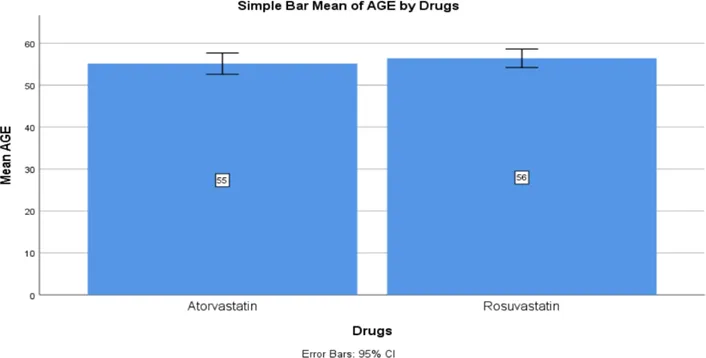
The mean age of patients receiving atorvastatin was 55.14 ± 12.77 years, while that of the rosuvastatin
group was 56.41 ± 11.07 years. There was no statistically significant difference in age between the two
groups (p = 0.453), indicating that both groups were comparable at baseline with a similar age distribution
. TABLE 2:
DISTRIBUTION OF SUBJECTS ACCORDING TO THE GENDER.
|
Gender |
Drug |
Total No. (%) |
P value |
|
|
Atorvastatin No. (%) |
Rosuvastatin No. (%) |
|||
|
Female |
29 (29) |
38 (38) |
67 (33.5) |
0.178 |
|
Male |
71 (71) |
62 (62) |
133 (66.5) |
|
|
Total |
100 |
100 |
200 |
|
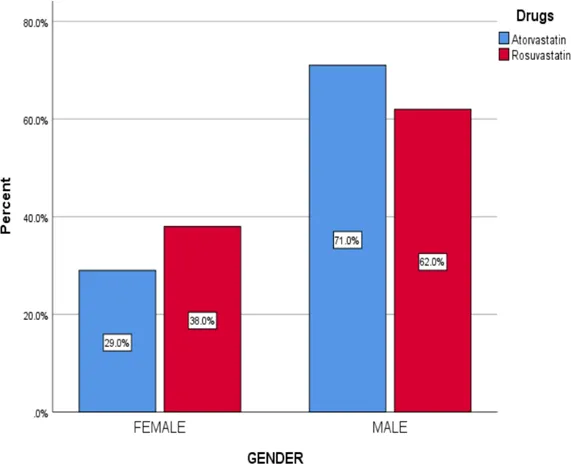
FIGURE 2:
Table 2 indicates the distribution of genders among the atorvastatin and rosuvastatin groups was not notably different. This indicates that gender did not significantly influence the selection between
atorvastatin and rosuvastatin in the population studied. Additional research might be necessary to examine other elements affecting the prescribing of these drugs.
TABLE 3:
The table assessed the effects of atorvastatin and rosuvastatin on hbA1c levels before and after treatment.
|
Paired Samples Statistics |
|||||
|
Drugs |
Mean |
Std. Deviation |
P value |
||
|
Atorvastatin |
Pair |
HbA1C_Before |
5.965 |
0.4272 |
<0.001 |
|
HbA1C_After |
6.355 |
0.2231 |
|||
|
Rosuvastatin |
Pair |
HbA1C_Before |
6.061 |
0.3703 |
<0.001 |
|
HbA1C_After |
6.395 |
0.1987 |
|||
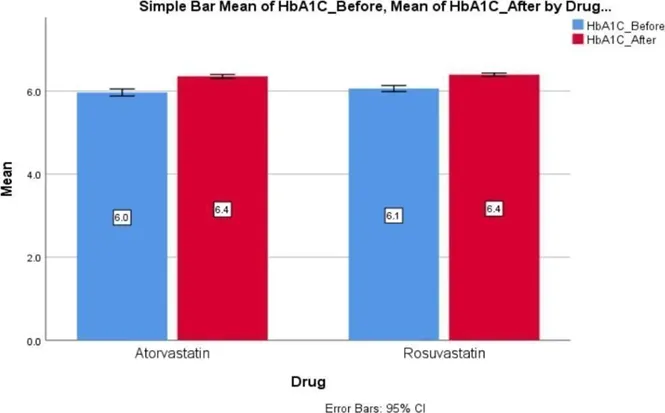
FIGURE 3
shows that both Atorvastatin and Rosuvastatin significantly increased HbA1C levels, indicating a possible mild impact on glucose control. However, the cardiovascular benefits of statins should be considered, especially in patients with diabetes or prediabet
TABLE 4:
The table assessed the effects of atorvastatin and rosuvastatin on total, direct, and indirect serum bilirubin levels before and after treatment.
|
Paired Samples Statistics |
|||||
|
Drugs |
Mean |
Std. Deviation |
P value |
||
|
Atorvastatin |
Pair 1 |
S.BILIRUBIN_B |
.6549 |
.32162 |
0.066 |
|
|
|
S.BILIRUBIN_A |
.6778 |
.36285 |
|
|
|
Pair 2 |
S.BILIRUBIN (DIRECT)_B |
.1606 |
.08587 |
0.121 |
|
|
|
S.BILIRUBIN (DIRECT)_A |
.1666 |
.09415 |
|
|
|
Pair 3 |
S.BILIRUBIN (INDIRECT)_B |
.4943 |
.33368 |
0.067 |
|
|
|
S.BILIRUBIN (INDIRECT)_A |
.5218 |
.34150 |
|
|
Rosuvastatin |
Pair 1 |
S.BILIRUBIN_B |
.6597 |
.30611 |
0.003 |
|
|
|
S.BILIRUBIN_A |
.7052 |
.34075 |
|
|
|
Pair 2 |
S.BILIRUBIN (DIRECT)_B |
.1453 |
.08307 |
0.061 |
|
|
|
S.BILIRUBIN (DIRECT)_A |
.1524 |
.08561 |
|
|
|
Pair 3 |
S.BILIRUBIN (INDIRECT)_B |
.5144 |
.31546 |
0.006 |
|
|
|
S.BILIRUBIN (INDIRECT)_A |
.5526 |
.32448 |
|
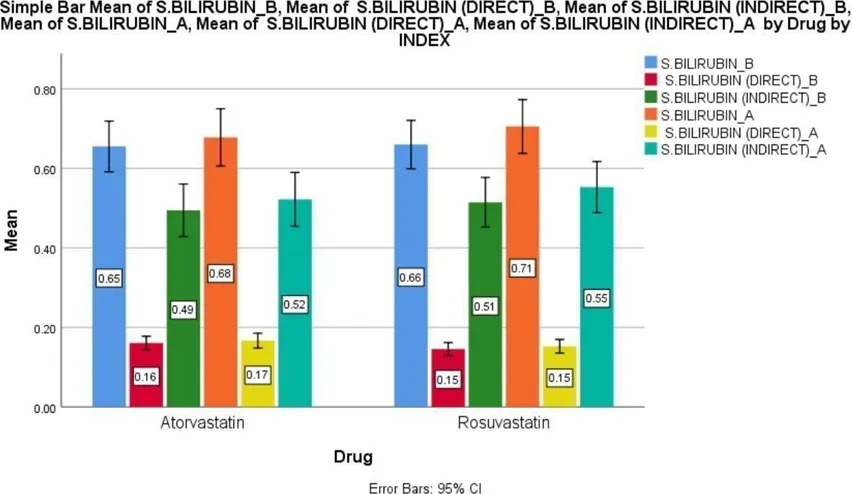
FIGURE 4:
Atorvastatin showed minor, non-significant bilirubin changes, while Rosuvastatin caused a greater increase in total and indirect bilirubin. However, all changes remained within the normal range.
TABLE 5:
The table examined the impact of atorvastatin and rosuvastatin on liver enzymes (ALT, AST, and ALP) before and after treatment.
|
Paired Samples Statistics |
|||||
|
Drugs |
Mean |
Std. Deviation |
P value |
||
|
Atorvastatin |
Pair 4 |
ALT_B |
42.8650 |
15.36460 |
0.031 |
|
|
|
ALT_A |
43.0404 |
15.48272 |
|
|
|
Pair 5 |
AST_B |
38.0441 |
10.66280 |
<0.001 |
|
|
|
AST_A |
40.5510 |
8.84032 |
|
|
|
Pair 6 |
ALP_B |
93.2380 |
24.28237 |
0.017 |
|
|
|
ALP_A |
95.5636 |
24.74273 |
|
|
Rosuvastatin |
Pair 4 |
ALT_B |
42.6310 |
13.71178 |
0.006 |
|
|
|
ALT_A |
43.0541 |
13.58644 |
|
|
|
Pair 5 |
AST_B |
38.3716 |
10.24745 |
<0.001 |
|
|
|
AST_A |
41.2062 |
7.46823 |
|
|
|
Pair 6 |
ALP_B |
80.6853 |
21.40628 |
0.018 |
|
|
|
ALP_A |
83.5962 |
23.47719 |
|
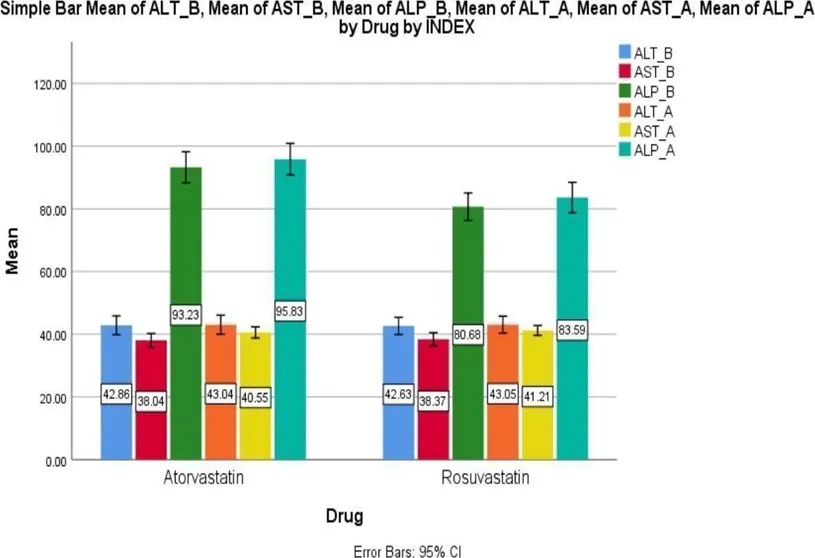
FIGURE 5: Both Atorvastatin and Rosuvastatin increased liver enzymes, with significant changes in AST and ALP. Rosuvastatin showed a slightly greater effect on ALT and AST, while Atorvastatin had a similar impact on ALP. These changes suggest a possible effect on liver function, though values remained mostly within normal limits.
TABLE 6:
The table and graph analyzed the effects of atorvastatin and rosuvastatin on lipid profile parameters before and after treatment.
|
Paired Samples Statistics |
|||||
|
Drugs |
Mean |
Std. Deviation |
P value |
||
|
Atorvastatin |
Pair 1 |
T.CHOLESTEROL_B |
214.9366 |
39.22313 |
<0.001 |
|
T.CHOLESTERO_A |
159.8383 |
31.13555 |
|||
|
Pair 2 |
TRIGLYCERIDES_B |
160.0318 |
64.20041 |
<0.001 |
|
|
TRIGLYCERIDES_A |
118.5365 |
58.25433 |
|||
|
Pair 3 |
HDL_B |
73.4743 |
33.94415 |
0.008 |
|
|
HDL_A |
70.0373 |
29.56822 |
|||
|
Pair 4 |
LDL_B |
126.5059 |
27.66492 |
0.010 |
|
|
LDL_A |
100.6175 |
17.24133 |
|||
|
Pair 5 |
VLDL_B |
56.536 |
16.2626 |
<0.001 |
|
|
VLDL_A |
37.436 |
5.6772 |
|||
|
Rosuvastatin |
Pair 1 |
T.CHOLESTEROL_B |
212.1554 |
42.13876 |
<0.001 |
|
T.CHOLESTERO_A |
161.2732 |
32.65787 |
|||
|
Pair 2 |
TRIGLYCERIDES_B |
159.4539 |
75.96202 |
<0.001 |
|
|
TRIGLYCERIDES_A |
107.3943 |
52.14012 |
|||
|
Pair 3 |
HDL_B |
73.9261 |
35.45160 |
0.251 |
|
|
HDL_A |
72.3921 |
33.93451 |
|||
|
Pair 4 |
LDL_B |
123.1041 |
33.07844 |
<0.001 |
|
|
LDL_A |
96.1651 |
19.28898 |
|||
|
Pair 5 |
VLDL_B |
51.838 |
17.4673 |
<0.001 |
|
|
|
|
VLDL_A |
36.206 |
5.3820 |
|
RESULTS
Both Atorvastatin and Rosuvastatin effectively improved lipid profiles by reducing total cholesterol, LDL, VLDL, and triglycerides. Rosuvastatin showed greater lipid-lowering efficacy with stable HDL levels, making it preferable for patients requiring intensive lipid management.
CONCLUSION
Both Atorvastatin and Rosuvastatin effectively improved lipid profiles, with Rosuvastatin showing greater reduction in LDL and triglycerides while maintaining HDL levels. Both caused minor changes in liver function and a slight increase in HbA1C, suggesting a possible mild effect on glucose metabolism. Rosuvastatin may be preferred for intensive lipid management with careful monitoring of liver parameters.
CONFLICT OF INTEREST
The authors have no conflicts of interest regarding this investigation.
REFERENCES

Mohd Shahnawaz, Dr. Haritha. P, Dr. Swathi Boddupally, Deepika Pallati, P. S. V. Sandeep, Rudra Sandhya, The Comparision Between Rosuvastatin And Atorvastatin On Lipid Profile, Predisposition To Diabetes & Glucose Intolerance & Liver Function Test In Adult Patient’s, Int. J. of Pharm. Sci., 2026, Vol 4, Issue 8, 2549-2558, https://doi.org/10.5281/zenodo.21948651
 10.5281/zenodo.21948651