
1Department of pharmaceutics, centre for pharmaceutical sciences UCESTH JNTUH Kukatpally.
2Professor & Principal: JNTUH University college of pharmaceutical sciences, Sultanpur, Pulkal, Sanga Reddy JNTU-H,-85.
3Assistant Professor(c), Centre for Pharmaceutical Sciences, UCESTH, JNTUH
Extended-release (ER) matrix tablets represent a cornerstone of oral controlled drug delivery, providing sustained therapeutic exposure through rational modulation of drug release kinetics. By embedding the active pharmaceutical ingredient within a polymeric matrix, these systems regulate mass transport via diffusion, swelling, and erosion processes, thereby minimizing plasma concentration fluctuations and reducing dosing frequency. Their structural simplicity, manufacturing feasibility, and established regulatory acceptance have facilitated extensive commercial translation across diverse therapeutic categories.Recent advancements have expanded the functional scope of ER matrix systems beyond conventional diffusion-based designs. Innovations in polymer engineering, including tailored viscosity grades, hybrid polymer networks, and stimuli-responsive materials, have enhanced release predictability and robustness. Process innovations such as hot-melt extrusion and additive manufacturing enable improved content uniformity, structural precision, and customization of release profiles. Concurrently, the adoption of Quality-by-Design principles and predictive modeling has strengthened mechanistic understanding and formulation optimization.This review critically evaluates classification frameworks, fundamental drug release mechanisms, polymer selection strategies, and emerging technological developments shaping contemporary ER matrix design. The translational relevance of these systems in chronic disease management is also highlighted. Ongoing integration of advanced materials, computational tools, and intelligent manufacturing approaches positions ER matrix tablets as a continuously evolving platform in modern pharmaceutical development.
Oral administration continues to be the preferred route for long-term pharmacotherapy owing to its convenience, non-invasiveness, and high patient compliance [1,2]. However, conventional immediate-release formulations often result in rapid drug absorption followed by a decline in plasma concentration below therapeutic levels, necessitating multiple daily dosing [2,3]. Such fluctuations may compromise therapeutic efficacy and increase the likelihood of adverse effects, particularly in chronic disease management [3,4].
To address these limitations, extended-release (ER) drug delivery systems were developed to provide controlled and sustained drug input over prolonged durations [2,4]. By maintaining relatively stable plasma concentrations, ER formulations reduce dosing frequency, enhance treatment adherence, and may improve overall therapeutic outcomes [3,4]. Despite these advantages, certain challenges remain, including variability due to gastrointestinal physiology, food effects, and the potential risk of dose dumping [4].
Among various ER strategies, matrix-based delivery systems have emerged as one of the most practical and scalable approaches [5,6]. In matrix systems, the active pharmaceutical ingredient is uniformly dispersed within a polymeric framework that governs drug liberation through a combination of hydration, swelling, diffusion, and erosion processes [5-7]. Owing to their formulation simplicity, manufacturing adaptability, and proven clinical performance, extended-release matrix tablets continue to play a central role in modern oral drug delivery research and development [10].
2. Classification of Matrix Systems Used in Extended-Release Tablets
Extended-release (ER) matrix tablets may be systematically categorized according to the nature of the matrix-forming material, internal structural characteristics, and the dominant mechanism responsible for drug release [5,6]. Such classification assists in rational polymer selection, prediction of release kinetics, and optimization of formulation performance.
Hydrophilic matrices are composed of water-swellable polymers that interact with gastrointestinal fluids to form a hydrated, viscous gel layer surrounding the tablet.This gel barrier acts as a diffusional interface regulating drug migration. Drug liberation occurs through a combination of solvent penetration, polymer swelling, chain relaxation, and surface erosion [5,6,11]. Owing to their manufacturing simplicity and reproducible performance, hydrophilic matrices remain the most widely implemented ER approach.
Hydrophobic matrices utilize water-insoluble polymers that maintain structural integrity throughout dissolution. Upon exposure to biological fluids, the medium penetrates the matrix through pores and interparticulate voids, creating pathways for drug diffusion. The release profile in such systems is largely influenced by matrix porosity, tortuosity, and drug solubility characteristics [7,9].
In lipid matrices, the drug is dispersed within hydrophobic waxy carriers. These systems generally release drug via diffusion through the lipid network, and in certain cases through gradual surface dissolution. Melt granulation and fusion techniques are commonly employed for their preparation [7].
Biodegradable matrices are formulated using polymers capable of undergoing hydrolytic or enzymatic degradation under physiological conditions. Drug release from these systems is governed by both diffusion and progressive polymer breakdown, making them suitable for long-term and specialized controlled-release applications [8].
These systems contain relatively large, interconnected pores that permit drug diffusion primarily through aqueous channels formed within the matrix [9].
Microporous systems possess smaller pore dimensions, resulting in a more tortuous diffusion pathway and comparatively slower drug transport [21].
In dense matrices, the polymer phase lacks defined aqueous channels, and drug molecules diffuse directly through the polymeric network itself rather than through fluid-filled pores [23].
Drug molecules migrate along a concentration gradient from the interior of the matrix to the surrounding dissolution medium . The rate is influenced by diffusivity within the polymer and the structural resistance of the hydrated barrier [9,13].
In these systems, the rate-limiting step is the dissolution of either the drug or the matrix material [7]. The overall release profile depends on solubility and dissolution kinetics.
Here, polymer hydration leads to volumetric expansion, chain disentanglement, and gradual erosion [31]. Drug release is therefore governed by dynamic structural changes within the matrix during exposure to biological fluids [11,12].
3.Mechanisms of Drug Release from ER Matrix Tablets
Drug release from ER matrix tablets is a dynamic process involving fluid penetration, polymer hydration, structural modification, and mass transport phenomena. Upon ingestion, gastrointestinal fluids diffuse into the matrix, initiating polymer swelling and formation of a gel layer in hydrophilic systems. This hydrated barrier functions as the principal regulatory interface controlling drug liberation [5,10].
3.1 Diffusion-Controlled Release :
Once dissolved within the hydrated region, drug molecules traverse the gel network toward the external medium driven by a concentration gradient [36]. The release rate depends on gel thickness, viscosity, polymer crosslink density, and diffusional resistance within the matrix structure [9].
Hydration induces expansion and relaxation of polymer chains, altering the internal microstructure of the matrix. As the polymer network loosens, drug mobility increases, facilitating sustained transport in conjunction with diffusion processes. The extent of swelling directly influences release predictability and duration [12].
In certain matrices, especially those with lower gel strength, polymer chains gradually disentangle and dissolve from the tablet surface. This surface erosion contributes to drug release, particularly when diffusional resistance decreases over time [8,15].
Most practical ER systems exhibit a combination of diffusion and erosion mechanisms operating simultaneously. The relative contribution of each mechanism evolves during dissolution, resulting in complex yet predictable sustained-release behavior. This coupled transport phenomenon is frequently described as anomalous or non-Fickian release [13].
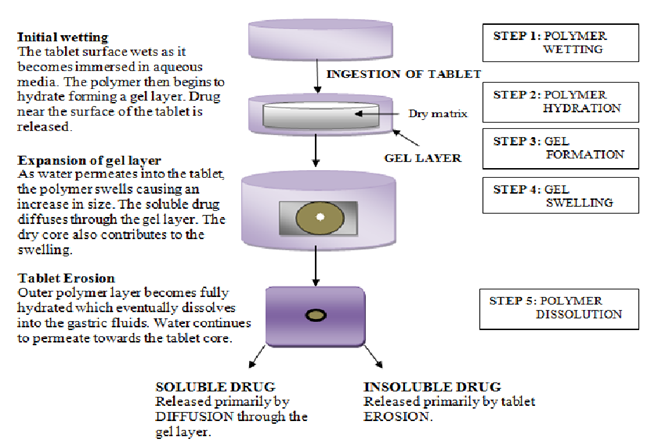
Fig: Mechanism of drug release from a hydrophilic matrix tablet
4.Polymers used in Extended-Release matrix Tablets
Extended-release (ER) matrix tablets rely heavily on polymers to control drug release. These polymers act by forming a network or barrier that modulates diffusion, swelling, and erosion of the drug from the matrix. Selection of appropriate polymers based on physicochemical properties, compatibility, and regulatory acceptability is critical for achieving desired release behavior [5,15] .
Hydrophilic polymers swell when exposed to gastrointestinal fluids, forming a gel-like barrier that slows drug release predominantly by diffusion and erosion mechanisms. These are the most commonly used class in ER matrix tablets due to their ease of processing, predictable behavior, and wide regulatory acceptance.
Examples include:
Hydroxypropyl methylcellulose (HPMC): Most widely used hydrophilic polymer in ER matrices, available in multiple viscosity grades allowing fine control of release profiles [ 10,15].
Hydroxypropyl cellulose (HPC) and hydroxyethyl cellulose (HEC): Often blended with other polymers to tailor release [15].
Polyethylene oxide (PEO): A high molecular weight, non-ionic polymer with excellent gel-forming ability; its effect on matrix release has been described in detail [16].
Natural gums: Such as xanthan gum, guar gum, pectin, and chitosan offer biocompatibility and biodegradability, and can be combined with synthetic polymers to improve mechanical properties [17].
Hydrophobic polymers retard drug release mainly by creating a water-insoluble matrix that limits fluid penetration and drug diffusion. These systems can be particularly useful for highly water-soluble drugs that would otherwise dissolve too rapidly.
Examples include:
Ethyl cellulose (EC) and polyvinyl acetate (PVA): Widely used to slow drug release through diffusion control [18]
Waxes and lipid polymers: Such as carnauba wax, used to provide a hydrophobic matrix via melt granulation [19].
Biodegradable polymers are increasingly studied for ER systems, especially for implants or long-term delivery devices where polymer degradation aids drug release. Examples include polylactic acid (PLA), polyglycolic acid (PGA), polycaprolactone (PCL), and polyorthoesters [8].
These polymers resist degradation and provide stable, insoluble matrices useful for prolonged release. Examples include cellulose acetate (CA), polyvinyl chloride (PVC), polyether urethanes, and others [20].
Some polymers can adhere to the mucosal surface, enhancing residence time and modifying release. Examples are carbopol, sodium carboxymethyl cellulose, and polyacrylic acid [22].
5. Advances in Extended-Release Matrix Tablets
Conventional matrix systems primarily relied on passive diffusion and polymer erosion to achieve sustained drug release. However, contemporary research has significantly expanded the functional capabilities of extended-release (ER) matrices through advancements in material science, process engineering, and formulation modeling. Modern systems emphasize improved robustness, predictable release kinetics, and adaptability to diverse drug properties.
The development of polymers with tailored physicochemical characteristics represents a major advancement in ER matrix technology. Variations in molecular weight, substitution degree, and viscosity grade enable precise modulation of gel strength and hydration dynamics [25]. In addition to traditional hydrophilic polymers such as hydroxypropyl methylcellulose (HPMC), newer materials exhibit improved gel integrity and reduced sensitivity to physiological variability [31]. Stimuli-responsive polymers capable of altering solubility or permeability in response to pH or environmental conditions have further enhanced site-specific and controlled drug delivery. These materials improve reproducibility of release behavior and minimize inter-patient variability.
Hot-melt extrusion (HME) has emerged as a transformative solvent-free technique for the fabrication of ER matrices [26]. In this process, drug and polymer are intimately mixed under controlled thermal and shear conditions to produce homogeneous dispersions . HME offers several advantages, including improved content uniformity, enhanced mechanical strength, and suitability for poorly soluble drugs through molecular dispersion within the polymeric network [27].
The shift toward continuous manufacturing has further improved reproducibility and scalability. Integration of process analytical technology (PAT) tools enables real-time monitoring of critical parameters, thereby strengthening quality assurance and regulatory compliance [42].
Modern ER formulations frequently employ polymer blends to achieve synergistic control over release kinetics. Combining hydrophilic and hydrophobic polymers allows simultaneous modulation of diffusion, swelling, and erosion mechanisms. Such hybrid systems reduce burst release and enhance matrix stability, particularly for highly water-soluble drugs.
Multi-layered and multi-phase matrix designs have also been explored to achieve sequential or biphasic release profiles, thereby expanding therapeutic versatility [32].
Incorporation of nanoscale drug particles and nanocomposites within matrix tablets represents a promising strategy to improve dissolution behavior and bioavailability. Reduction in particle size increases surface area, thereby enhancing drug dispersion and release uniformity. Nanostructured systems are particularly beneficial for Biopharmaceutics Classification System (BCS) Class II drugs, where solubility limitations compromise therapeutic performance [34].
Additive manufacturing has introduced unprecedented flexibility in ER matrix design. Three-dimensional (3D) printing enables precise control over internal architecture, geometry, and infill density, allowing programmable drug release profiles. Techniques such as fused deposition modeling (FDM) facilitate fabrication of tablets with customized release kinetics, including immediate-plus-sustained or pulsatile patterns within a single dosage form [36-40].
The regulatory approval of the first 3D-printed pharmaceutical product by the U.S. Food and Drug Administration marked a significant milestone, validating the feasibility of additive manufacturing in drug delivery [40].
The adoption of Quality by Design (QbD) principles has shifted formulation development from empirical approaches toward systematic, science-based strategies. Identification of critical material attributes and process parameters allows establishment of robust design spaces ensuring consistent drug release performance. Mathematical modeling and simulation tools further enhance understanding of hydration, swelling, and erosion dynamics, reducing development time and improving regulatory confidence [41].
Recent research also focuses on prolonging gastrointestinal residence time to enhance therapeutic efficacy. Floating, expandable, and mucoadhesive matrices enable tablets to remain in specific regions of the stomach for extended durations, improving absorption of drugs with narrow windows. Such targeted strategies maximize drug utilization while maintaining the advantages of sustained release [42,43].
6.Clinical Applications and Marketed Products of Extended-Release Matrix Tablets
Extended-release (ER) matrix tablets are primarily used in the management of chronic diseases requiring sustained therapeutic levels and reduced dosing frequency. They are particularly beneficial for drugs with short half-lives and for long-term therapy. Major applications include cardiovascular disorders, diabetes mellitus, central nervous system conditions, and chronic pain management [2,46] .
Table 1 : Marketed Extended-Release Matrix Tablet Products
|
S.NO |
Brand name |
Drug |
Therapeutic use |
Company |
|
1 |
Glucophage XR |
Metformin |
Type 2 Diabetes Mellitus |
Bristol-Myers Squibb |
|
2 |
Procardia XL |
Nifedipine |
Hypertension, Angina |
Pfizer |
|
3 |
Wellbutrin XL |
Bupropion |
Depression |
GlaxoSmithKline |
|
4 |
Effexor XR |
Venlafaxine |
Depression, Anxiety |
Pfizer |
Product information and regulatory data supporting these marketed ER formulations are documented in approved prescribing information and regulatory databases [46,47,48,49].
7. Future Perspectives
Future developments in extended-release (ER) matrix tablets will focus on novel polymers, improved release predictability, and patient-centric formulation design[50]. The use of artificial intelligence and advanced modeling tools may enhance formulation optimization], while 3D printing technologies offer potential for personalized dosage forms [51]. Additionally, continuous manufacturing and Quality-by-Design approaches are expected to improve product consistency and regulatory compliance [41].
Overall, future research aims to achieve more precise, reliable, and adaptable controlled-release systems.
8. CONCLUSION
Extended-release matrix tablets continue to represent a cornerstone of oral controlled drug delivery owing to their formulation flexibility, economic viability, and consistent clinical performance. Advances in polymer engineering, hybrid matrix configurations, and process intensification techniques have enhanced the predictability and robustness of drug release profiles. The integration of modern manufacturing platforms and modeling tools has further strengthened formulation control, scalability, and regulatory confidence.The sustained commercial success of matrix-based ER products across multiple therapeutic areas demonstrates their translational reliability from laboratory design to large-scale production. Looking forward, the convergence of advanced materials, computational modeling, and personalized manufacturing technologies is expected to expand the functional capabilities of ER matrix systems. Continuous innovation in this domain will be critical for achieving more precise, adaptable, and patient-focused drug delivery solutions in chronic disease management and future pharmaceutical development.
REFERENCES



Menga Divya*, Dr. M. Sunitha Reddy, Dr. K. Anie Vijetha, Advances In Extended-Release Matrix Tablets: Polymer Engineering, Release Mechanisms, And Future Perspectives, Int. J. of Pharm. Sci., 2026, Vol 4, Issue 4, 614-623. https://doi.org/10.5281/zenodo.19410897
 10.5281/zenodo.19410897
