

We use cookies to ensure our website works properly and to personalise your experience. Cookies policy
1,3,4Sagar Institute of Pharmaceutical Sciences (SIPS), Patheriya Jat, Sagar, Madhya Pradesh, Pin code: 470003, India
2Department of Pharmaceutics, Indore Institute of Pharmacy, Pithampur Road, opposite to IIM, Rau, Indore, Madhya Pradesh, Pin code: 453331, India
In the fields of pharmaceutical, therapeutic, environmental, and food sciences, High Performance Liquid Chromatography (HPLC) has become one of the most potent, adaptable, and extensively used analytical methods. HPLC' sensitivity, repeatability, and dependability have made it essential for quality assurance, drug development, and regulatory compliance. The separation of analytes according to their interactions with stationary and mobile phases under high pressure is the fundamental idea behind HPLC, which enables accurate identification and quantification of complicated mixtures. Its application has been further improved by recent developments like reversed-phase HPLC, gradient elution, and hyphenated systems (LC-MS, HPLC-MS/MS).To ensure reliable and repeatable separation, method development in HPLC necessitates careful consideration of the physicochemical parameters of analytes, column selection, mobile phase optimization, and detector selection. Chromatographic performance is greatly influenced by parameters like pH, buffer type, and chemical modifiers. The process of developing analytical methods is a methodical one that includes scouting runs, system suitability testing, and optimization for sensitivity, retention duration, and resolution.Method validation, which makes sure the created approach is appropriate for its intended use, is equally crucial. The ICH, FDA, and USP requirements are followed for performing validation, which includes testing for system appropriateness, robustness, specificity, linearity, accuracy, precision, limit of detection (LOD), limit of quantification (LOQ), and precision. For stability testing, impurities, and pharmaceutical formulations, these validation parameters give assurance that the procedure regularly yields correct and trustworthy results.The principle, applications, technique development, and validation procedures of HPLC are highlighted in this study, with an emphasis on its crucial significance in pharmaceutical sciences. By connecting basic principles with contemporary advancements, HPLC keeps developing as a pillar of analytical chemistry, guaranteeing the efficacy, safety, and quality of drugs
HIGH PERFORMANCE LIQUID CHROMATOGRAPHY
High-Performance Liquid Chromatography, also known as High-Pressure Liquid Chromatography, is a type of column chromatography that is commonly used in biochemistry and analysis to separate, identify, and quantify active chemicals. It is a popular analytical technique for separating, identifying, and quantifying each element of a mixture. HPLC is a sophisticated column liquid chromatography technology. The solvent normally flows through the column due to gravity, but in the HPLC process, the solvent is pushed under high pressures of up to 400 atmospheres. so that the sample can be separated into different constituents based on differences in relative affinities. HPLC generally comprises a column that contains packing material (stationary phase), a pump that drives the mobile phase(s) through the column, and detector that detects the molecule retention times.[2] HPLC is a separation technique that involves: The injection of a small volume of liquid sample into a tube packed with tiny particles (3 to 5 micron (μm) in diameter called the stationary phase) where individual components of the sample are moved down the packed tube (column) with a liquid (mobile phase) forced through the column by high pressure delivered by a pump. These components are separated from one another by the column packing that involves various chemical and/or physical interactions between their molecules and the packing particles. These separated components are detected at the exit of this tube (column) by a flow-through device (detector) that measures their amount. Output from this detector is called an “HPLC” In principle, LC and HPLC work the same way except for the speed, efficiency, sensitivity, and ease of operation of HPLC are vastly superior.[3]
CLASSIFICATION OF HPLC
• Preparative HPLC And Analytical HPLC (Based on Scale of Operation).
• Affinity Chromatography, Adsorption Chromatography, Size Exclusion Chromatography, Ion Exchange Chromatography, Chiral Phase Chromatography (Based on Principle of Separation).
• Gradient Separation and Isocratic Separation, (Based on Elution Technique).
• Normal Phase Chromatography and Reverse Phase Chromatography (Based on
Modes of Operation).[4]
A. NORMAL PHASE CHROMATOGRAPHY:
In Normal Phase Chromatography, mobile phase is non- polar and stationary phase is polar. Hence, the station phase retains the polar analyte. An increase in polarity of solute molecules increases the adsorption capacity leading to an increased elution time. Chemically modified silica (cyanopropyl, aminopropyl and diol) is used as a stationary phase in this chromatography. For example. A typical column has an internal diameter of around 4.6 mm, and a length in the range of 150 to 250 mm. Polar compounds in the mixture that are passed through the column will stick longer to the polar silica than the non-polar compounds. Therefore, the non-polar ones will pass more quickly through the column.[5]
B. RP-HPLC (Reversed phase HPLC): RP-HPLC a non-polar stationary phase and polar or moderately polar mobile phase. RP-HPLC is based on the principle of hydrophobic interaction. in a mixture of components those analytes which are relatively less polar will be retained by the non-polar stationary phase longer than those which are relatively more polar. Therefore, the most polar component will elute first.[6]
INSTRUMENTATION OF HPLC
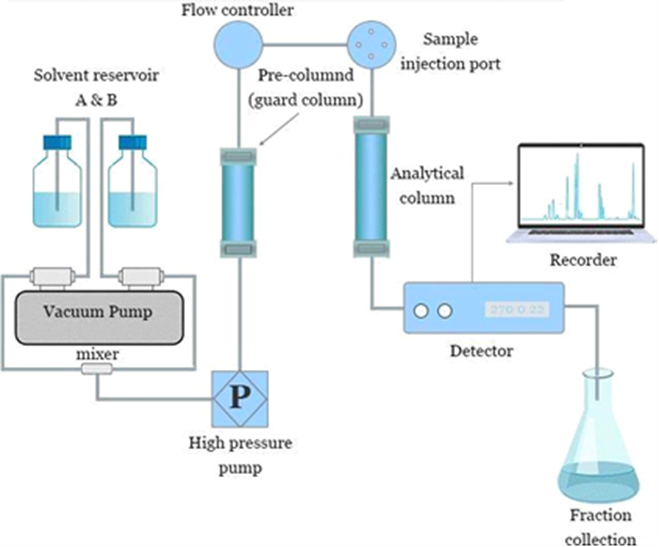
Figure: Schematic representation of HPLC
APPLICATIONS OF HPLC
There is a wide variety of applications throughout the process of creating a new drug from drug discovery to the manufacture of formulated products that will be administered to patients. This Process to create a new drug can be divided into 3 main stages:
HPLC METHOD DEVELOPMENT:
Developing and validating analytical methods is crucial in pharmaceutical research, development, and production. These methods ensure the identification, purity, potency, and effectiveness of pharmaceutical products. Method development involves considering factors like physicochemical characteristics (pKa, log P, solubility) for selecting the appropriate detection mode, especially in UV detection. The validation of an HPLC method for stability indication is a significant aspect of analytical development. It focuses on separating and quantifying the primary active ingredient, reaction impurities, synthetic intermediates, and degradants, ensuring the reliability and accuracy of the analytical process in pharmaceutical quality control.[21]
RECOGNIZING THE PHYSICOCHEMICAL PROPERTIES OF DRUG MOLECULES
When developing an analytical method for a medicinal molecule, understanding its physicochemical characteristics is essential. Initial considerations include the drug molecule's pH, polarity, solubility, and pKa. Polarity, a key physical characteristic, guides the choice of solvent and mobile phase composition. Molecular solubility, linked to polarity, adheres to the principle "like dissolves like." Selection of mobile phase or diluents is influenced by analyte solubility, ensuring compatibility. Analytes must not react with components and be soluble. Parameters like pH and pKa are critical in High-Performance Liquid Chromatography (HPLC) method development, influencing solvent selection and overall method success. pH equals -log10[H3O+] In High-Performance Liquid Chromatography (HPLC), achieving sharp and symmetrical peaks is often a result of optimizing the pH for ionizable analytes. Sharp, symmetrical peaks are crucial for obtaining low detection limits, low relative standard deviations between injections, and repeatable retention durations in quantitative analysis, ensuring the precision and sensitivity required for accurate measurements and reliable results.[22]
During the initial development of a method, a set of conditions, including the detector, column, and mobile phase, is chosen to generate the sample's initial "scouting" chromatograms. Commonly, reversed- phase separations using a C18 column with UV detection are employed. At this stage, the decision arises on whether to develop a gradient method or opt for an isocratic approach, each offering distinct advantages depending on the specific separation requirements and characteristics of the analytes in the sample.
The column is the cornerstone of a chromatograph, playing a pivotal role in achieving reliable and accurate analyses. A well-chosen column ensures good chromatographic separation, contributing to trustworthy results. Conversely, improper column selection can lead to inadequate and confusing separations, rendering results invalid or challenging to interpret. In High Performance Liquid Chromatography (HPLC) systems, the column is central, and altering it significantly influences analyte resolution during method development. Considerations like particle size, retention capacity, stationary phase chemistry, and column dimensions are crucial for selecting the ideal column tailored to a specific analytical application. In an HPLC column, the three essential components are the hardware, matrix, and stationary phase. Matrices, such as alumina, zirconium, polymers, and most commonly silica, support the stationary phase. Silica matrices are favored for their strength, consistent spherical size, ease of derivatization, and resistance to compression under pressure. When selecting the ideal column, considerations encompass particle size, retention capacity, stationary phase chemistry, and column dimensions. These factors collectively influence the efficiency and effectiveness of the column in achieving accurate and reliable separations for specific analytical applications. In an HPLC column, the key components include hardware, matrix, and stationary phase. Various matrices, including alumina, zirconium, polymers, and most commonly silica, support the stationary phase. Silica matrices, widely used, offer strength, consistent spherical size, ease of derivatization, and resistance to compression under pressure. These characteristics contribute to the efficiency and reliability of HPLC columns in achieving precise separations for analytical applications. Silica is chemically stable in the majority of organic solvents and low pH environments. However, a drawback is that traditional silica-based solid supports disintegrate above pH 7. Recently developed silica- supported columns allow operation at higher pH levels. The composition, shape, and particle size of silica contribute to effective separation, with larger particle sizes increasing the number of theoretical plates. The suitability of the separation selectivity in HPLC can vary between columns from different manufacturers and even within batches from the same manufacturer. Key factors influencing this variability include parameters of the bonded stationary phase, properties of the silica substrate, and column diameters. Silica-based packing is commonly preferred in modern HPLC columns due to its favourable physical features, offering versatility and efficiency in achieving diverse and precise separations for analytical applications.[23]
Chromatographic modes are dictated by the analyte's polarity and molecular weight. Reversed- phase chromatography (RPC) takes precedence in case studies, especially for small organic compo ends. RPC is extensively utilized for separating ionizable substances, such as acids and bases, employing ion-pairing reagents or buffered mobile phases to prevent analyte ionization.
Optimization of Mobile phase
Various buffers, including acetate, sodium phosphate, and potassium phosphate, were evaluated based on overall chromatographic performance and system suitability criteria. Through a series of experiments, potassium dihydrogen phosphate emerged as the most suitable buffer for successful separation of all peaks. Test concentrations of 0.02 M, 0.05 M, and 0.1 M were examined. Interestingly, altering the buffer concentration did not significantly impact the elution pattern and resolution, although the 0.05 M concentration enhanced the sensitivity of the technique without substantial changes in the separation characteristics.[24]
For ionizable analytes, determining the appropriate mobile-phase pH is crucial, guided by the analyte's pKa. This ensures that the target analyte is either in a neutral or ionized form. The ability to adjust the pH of the mobile phase is a powerful tool in the chromatographer's toolkit. This capability allows simultaneous modifications to retention and selectivity, providing a strategic means to optimize separation conditions, particularly for critical pairs of components in the sample. pH adjustment plays a vital role in tailoring chromatographic conditions to achieve desired separation outcomes.[25]
Selecting the organic modifier for reverse- phase HPLC is typically straightforward, with acetonitrile and methanol being the most popular choices (occasionally THF). Achieving optimal elution for every component in complex multicomponent samples under isocratic conditions, where the solvent strength remains constant, can be challenging. Hence, gradient elution is often employed, allowing for varying solvent compositions between k (retention factor) 1 and 10. This dynamic approach enhances separation efficiency and is particularly useful in handling intricate mixtures in high performance liquid chromatography.[26]
After chromatographic separation, the target analyte is identified using appropriate detectors. Common detectors in liquid chromatography (LC) include UV, fluorescence, electrochemical, refractive index (RI), and mass spectrometry (MS). The choice of detector is influenced by the nature of the sample and the analytical objectives. For example, in multicomponent analysis, the absorption spectra may shift to longer or shorter wavelengths than those of the parent chemical, influencing the choice of a suitable detector for accurate and selective identification. Detector selection plays a crucial role in achieving the desired sensitivity and specificity in LC analysis. In UV detection, the spectra of the target analyte and contaminants must be acquired at various levels, superimposed, and then normalized. Selecting a wavelength is crucial to ensure a sufficient response for the majority of analytes, allowing for accurate and reliable detection in liquid chromatography. The careful consideration of UV spectra at different levels ensures that the analytical method is sensitive to all relevant components in the sample, contributing to the precision and reliability of the analysis.[27]
The initial stage in developing an analytical method for Reverse Phase High- Performance Liquid Chromatography (RP-HPLC) involves selecting various chromatographic parameters such as the mobile phase, column, mobile phase flow rate, and mobile phase pH. Through trials, each characteristic is optimized and then compared against system suitability parameters. Typical parameters include a retention time of more than five minutes, a theoretical plate count exceeding 2000, a tailing factor less than two, a resolution greater than five, and a percent Relative Standard Deviation (R.S.D.) of the area of analyte peaks in standard chromatograms not exceeding two percent. These parameters ensure the reliability and precision of the RP-HPLC method. In simultaneous estimation of two components, the detection wavelength is typically chosen at an isobestic point. Following this, the linearity of the drug is assessed to determine the concentration range exhibiting a linear pattern. The established approach for simultaneous estimation is further validated by analyzing a laboratory combination. Subsequently, the commercial product is diluted to match the linearity concentration range for analysis. This systematic process ensures the practicality, accuracy, and reliability of the method for simultaneous estimation in liquid chromatography.[28]
Sample preparation is a crucial step in High-Performance Liquid Chromatography (HPLC) analysis, ensuring a homogeneous and repeatable solution for injection onto the column. The goal of sample preparation is to create an interference-free aliquot that is column-compatible and compatible with the desired HPLC method. This involves selecting a sample solvent that dissolves in the mobile phase without compromising retention or resolution. The initial steps in sample preparation involve sample collection and injection into the HPLC column, laying the foundation for accurate and reliable chromatographic analysis.
Identify the weaknesses in the approach and employ experimental design to enhance it. Assess the impact of the approach on various samples, equipment configurations, andenvironmental factors. This iterative process helps refine the methodology, ensuring robustness, reliability, and applicability across diverse conditions in High-Performance Liquid Chromatography (HPLC) analysis.[29]
Validation is the systematic process of assessing and providing objective evidence that specific requirements for a particular intended use are met. It involves evaluating a method's performance and demonstrating its capability to meet specific criteria. Essentially, validation provides a thorough understanding of what your technique can reliably produce, particularly when dealing with low doses or challenging conditions in analytical methods like High-Performance Liquid Chromatography (HPLC).
METHOD VALIDATION [30]
Validation is the process of laboratory testing to demonstrate that the performance characteristics of an analytical method meet the requirements of the intended analytical application. Whether used by multiple operators with the same equipment in the same or different laboratories, any new or updated method must be validated to ensure it consistently produces repeatable and reliable results. The specific method and its intended uses determine the type of validation program required, ensuring that the analytical process is robust and fit for its purpose in various settings. Method validation results are a crucial aspect of any robust analytical procedure, providing an evaluation of the quality, consistency, and reliability of analytical results. Essential to the validation process is the use of equipment that meets specifications, is correctly calibrated, and is operating and functional. The validation process ensures that analytical methods are thoroughly assessed and either validated for use or invalidated if they do not meet the required criteria. This ensures the accuracy and dependability of analytical results in various applications.
The following are typical parameters recommended by the FDA, USP, and ICH.
1. Specificity
2. Linearity & Range
3. Precision
I. Method precision (Repeatability)
II. Intermediate precision (Reproducibility)
4. Accuracy (Recovery)
5. Solution stability
6. Limit of Detection (LOD)
7. Limit of Quantification (LOQ)
8. Robustness
9. Range
10. System suitability
Selectivity and specificity are often used interchangeably in the context of method validation. Specificity refers to the ability to unequivocally assess the analyte in the presence of other components that may be present. This is the capacity to distinguish the analyte with absolute certainty in the presence of potentially interfering substances. To determine specificity, a comparison is made between test results from an analysis of samples containing contaminants, degradation products, or placebo ingredients and those from an analysis of samples without such elements. This comparison controls and evaluates the method’s ability to selectively identify and quantify the analyte of interest amidst potential interferences, ensuring the reliability and accuracy of the analytical method.
Linearity in an analytical process refers to its ability to produce test results that are directly proportional to the concentration of the analyte in the sample, within a specified range. It is crucial to evaluate this linear relationship across the spectrum of the analytical technique. The suggested approach involves diluting a normal stock solution containing the constituent parts of the medicinal product to directly demonstrate linearity on the drug substance. In establishing linearity, the confidence interval around the slope of the regression line is commonly employed. According to ICH recommendations, a minimum of five concentrations is proposed for establishing linearity. The range of an analytical method is defined as the interval between the higher and lower values that have been demonstrated to be determined with precision, accuracy, and linearity using the method. This comprehensive assessment ensures the reliability and validity of the analytical method over a defined concentration range.[31]
Precision in the context of analytical methods represents the degree of agreement or scattering between a series of measurements made under specific conditions from several samplings of the same homogeneous material. Precision is a critical parameter for assessing the entire analytical process's reproducibility. Precision consists of two components: repeatability and intermediate precision. Repeatability is the variation experienced by a single analyst on a single instrument. It does not distinguish between variance introduced by the sample preparation procedure and that caused by the instrument or system. During validation, numerous replicates of an assay composite sample are analysed using the analytical procedure to determine repeatability, and recovery value is calculated. Intermediate precision refers to the fluctuation that occurs within a laboratory on different days, with different instruments, and involving different analysts. These components of precision assessment ensure a comprehensive understanding of the reliability and reproducibility of the analytical method under varying conditions and across different operators.[32]
Accuracy is the extent to which a measured value aligns with the true or accepted value. In practice, accuracy refers to the discrepancy between the true value and the mean value obtained. To calculate accuracy, the method is applied to samples with known analyte concentrations, which are then compared to blank and standard solutions to ensure there is no interference. Accuracy is computed as a percentage of the analyte recovered by the assay based on the test results. It is commonly expressed as the assay-based recovery of known, additional analyte levels, providing a measure of how well the analytical method reflects the true values.[33]
During validation, the stability of standards and samples is assessed under various conditions, including normal settings, standard storage conditions, and sometimes within the instrument. This evaluation helps determine whether specific storage conditions, such as refrigeration or protection from light, are necessary to maintain the stability of standards and samples. Understanding the impact of storage conditions is crucial for ensuring the reliability and integrity of analytical results over time, and it informs the appropriate handling and storage practices for the substances involved in the analysis.[34]
The detection limit of a single analytical method is the most basic measure of an analyte in a sample that can be identified but not accurately quantified. This limit represents the lowest concentration at which the presence of the analyte can be reliably detected, providing a fundamental indicator of the method's sensitivity.[35]
The quantitation limit of a specific analytical system is the lowest quantity of analyte in a sample that can be precisely and accurately measured quantitatively. This limit serves as a quantitative test parameter for assessing low levels of analytes in test matrices. The quantitation limit is crucial in identifying impurities and/or contaminants in samples and provides a threshold for reliable quantitative measurements in analytical methods.[36]
The robustness of an analytical procedure isa measure of its reliability under typical conditions and its ability to withstand small but intentional alterations in method parameters. This quality assessment ensures that the analytical method remains dependable and produces consistent results even when subjected to minor variations or deliberate adjustments in its parameters. Robust methods are less sensitive to changes and variations, contributing to the method's reliability in real world analytical applications.[37]
The range of an analytical method refers to the interval between the higher and lower values of an analyte that have been demonstrated with sufficient linearity, precision, and accuracy. This range is typically determined based on a linear or nonlinear response curve and is expressed in the same unit as the test findings. Establishing a defined range is essential for accurately assessing and reporting results within the method's validated and reliable concentration limits Range determination.[38]
System suitability tests are a standard practice in liquid chromatographic procedures. They serve as a guarantee that the chromatographic system's repeatability, resolution, and detection sensitivity are sufficient for the intended analysis. These tests are based on the concept that the tools, electronics, processes involved in the analysis, and the samples to be examined are all components of a larger system that can be assessed as a whole. Key parameters such as peak resolution, the number of theoretical plates, peak tailing, and capacity are examined during system suitability tests to assess the adequacy and performance of the employed analytical method. This comprehensive evaluation ensures the reliability and fitness of the chromatographic system for accurate and reproducible analyses.[39]
FUTURE PERSPECTIVES
Future advancements in HPLC are expected to focus on miniaturization, automation, and the development of greener chromatographic techniques. The integration of HPLC with hyphenated technologies such as LC-MS/MS, HPLC-NMR, and microfluidic systems will further expand its application in metabolomics, proteomics, and biomarker discovery. The use of eco-friendly solvents, high-speed columns, and artificial intelligence-driven method optimization will address current challenges of cost, time, and environmental impact. Additionally, the growing need for real-time and point-of-care analysis will push HPLC technology toward portable, high-throughput, and user-friendly systems. As pharmaceutical research evolves, HPLC will continue to adapt, offering unparalleled accuracy, sensitivity, and efficiency for future drug discovery and development.
CONCLUSION
High Performance Liquid Chromatography (HPLC) stands as an indispensable analytical tool for the separation, identification, and quantification of pharmaceutical and biological compounds. Its ability to deliver highly precise and reproducible results has made it a gold standard technique in drug development, quality control, and regulatory analysis. Method development strategies focusing on physicochemical properties, mobile phase optimization, and detector selection play a pivotal role in achieving robust and accurate results. Moreover, method validation ensures reliability, compliance, and reproducibility, thereby establishing HPLC as an essential component of pharmaceutical sciences.
ACKNOWLEDGEMENT
The authors express sincere gratitude to all researchers whose valuable contributions have formed the basis of this review. The support and insights from mentors, colleagues, and institutions involved in facilitating access to relevant resources are also gratefully acknowledged.
REFERENCES

Anjali Jain*, Saransh Jain, Varsha Kashaw2, Yuvraj Singh Dangi, Review on “High Performance Liquid Chromatography (HPLC), Method Development, and Validation”, Int. J. of Pharm. Sci., 2026, Vol 4, Issue 1, 1973-1986. https://doi.org/10.5281/zenodo.18316033
 10.5281/zenodo.18316033