

We use cookies to ensure our website works properly and to personalise your experience. Cookies policy
R.G Sapkal College of Pharmacy, Sapkal Knowledge Hub, Kalyani Hills, Anjaneri, Trimbakeshwar Rd, Nashik, 422213, Maharashtra, India.
Poor aqueous solubility remains one of the most significant challenges in modern drug development, limiting the oral bioavailability and therapeutic efficacy of many pharmaceutical compounds. A substantial proportion of newly discovered drug molecules fall into Biopharmaceutics Classification System (BCS) Class II and Class IV categories, where dissolution becomes the rate-limiting step for systemic absorption. Conventional formulation approaches such as micronization, salt formation, and solid dispersions have been employed to enhance drug solubility; however, these methods often suffer from limitations including physical instability, recrystallization, limited drug loading, and lack of controlled release. In recent years, nanotechnology-based drug delivery systems have emerged as promising strategies to address these challenges by simultaneously enhancing solubility and enabling sustained drug release. This review discusses the biopharmaceutical challenges associated with poorly water-soluble drugs and highlights the rationale for employing nanotechnology in sustained drug delivery. Various nanocarrier systems including polymeric nanoparticles, lipid-based nanocarriers, polymeric micelles, dendrimers, nanosuspensions, nanosponges, and nanoemulsions are examined with respect to their structural characteristics and drug release behavior. The mechanisms governing sustained release from nanocarriers, such as diffusion-controlled, degradation-controlled, swelling-controlled, and stimuli-responsive processes, are also discussed. Additionally, key formulation design considerations, characterization techniques, and in-vitro and in-vivo evaluation strategies are summarized. Recent advances including smart nanocarriers, targeted nano-delivery, combination therapy, and integration with 3D printing technologies are highlighted. Finally, current challenges related to large-scale manufacturing, stability, regulatory approval, and cost-effectiveness are discussed along with future perspectives for personalized nanomedicine. Overall, nanotechnology-enabled sustained release systems offer a promising platform to improve the solubility, bioavailability, and therapeutic performance of poorly soluble drugs.
Although drug discovery has made significant strides, the design of poorly water-soluble drugs still represents a primary challenge in pharmaceutical formulation. The majority of novel chemical entities show poor aqueous solubility; this is a well-known causative factor limiting oral bioavailability and therapeutic utility. Statistical data shows that 40 % or more of marketed drugs and most pipeline compounds are classified as Biopharmaceutics Classification System (BCS) Class II (low solubility, high permeability) or Class IV (low solubility, low permeability), where dissolution kinetics rather than permeability is rate limiting to systemic absorption. This low solubility is often associated with erratic pharmacokinetics, subtherapeutic concentrations in plasma and increased inter-patients variability1.
Micronization, salt formation, solid dispersions and inclusion complexes are classical formulation methods used to enhance dissolution of hydrophobic drugs. But such approaches are typically hindered by physical instability, low drug loading capacity, a tendency toward recrystallization, and a lack of controlled, sustained release over extended periods. Conventional immediate-release systems yield particularly difficult challenges to maintain therapeutic drug concentrations in a range of high enough concentration but low enough not to produce toxicity, necessitating multiple dosing and the risk of increased adverse events and decreased patient compliance2.
Formulation science has thus increasingly relied on sustained and controlled drug delivery systems to mitigate these limitations. Sustained release aim to provide drug levels in the therapeutic range for longer periods of time, reduce dosing frequency and minimize peaktrough fluctuations. To attain consistent absorption and therapeutic assessment for poorly soluble drugs, solubility enhancement prolonged release profiles3.
In this context, the use of nanotechnology-enabled drug delivery systems has become one of the most promising platforms. Nanocarriers (polymeric nanoparticles, lipid-based nanocarrier, nanosuspension, nanoemulsion, dendrimers and other nanoscale architectures) enhance the apparent solubility and dissolution rate of hydrophobic drugs due to reduction in particle size with high surface area as well stabilization of amorphous or highly dispersed states. In addition, release kinetics can be tailored by modifying the matrix composition and surface or making them responsive; thus, using nanostructured carriers ensures controlled/sustained release. These systems can also provide ancillary benefits, including targeted delivery, protection of labile compounds from degradation and improved biopharmaceutical action4.
Although significant progress has been made in developing nanotechnology-based sustained release formulations, challenges still exist with their rational design, large-scale production, regulatory approval and clinical translation. Thus, this review addresses nanotechnology-based approaches to overcome the solubility problem of poorly water-soluble drugs simultaneously with sustained and controlled release. It covers issues of physicochemical and biopharmaceutical barriers, leading classes of nanocarriers, mechanistic aspects of sustained release, design considerations in formulation as well as innovation drivers and future directions for R&D5 .
2. BIOPHARMACEUTICAL CHALLENGES OF POORLY SOLUBLE DRUGS:
2.1 Biopharmaceutics Classification System (BCS):
The Biopharmaceutics Classification System (BCS) is a system for classifying drugs based on their aqueous solubility and intestinal permeability, which helped in differentiating the rate-limiting steps involved in oral drug absorption and oral bioavailability. Class I drugs according to BCS standards exhibit high solubility and permeability, while Class II and Class IV drugs maintain low solubility (with Class II having high permeability), whereas the Class IV drug features both low solubility along with low permeability 9. Classes II and IV poorly soluble APIs tend to exhibit dissolution-limited absorption after oral administration regardless of their intrinsic permeability profiles, resulting in highly variable systemic availability. The BCS class has practical considerations for formulation planning and decision in the context of regulatory biowaiver application, especially when there is a strong correlation between in vitro dissolution and in vivo performance6.
In BCS Class II drugs, gastrointestinal fluid dissolution becomes the rate–limiting factor to oral absorption because such compounds are poorly soluble in aqueous media but highly permeable through intestinal epithelium. By contrast, Class IV drugs have their biopharmaceutical limitations compounded by both poor solubility and low permeability which dramatically reduce oral bioavailability as well as making formulation design even more complex7.
2.2 Factors Affecting Solubility:
Requisite biopharmaceutical characteristics of the drug molecules are significantly governed by some inherent physicochemical features which affect aqueous solubility. Leveraging this interdependence in our compound design, terms for lipophilicity (traditionally expressed as the partition coefficient [log P]) are inversely correlated with water solubility, meaning that compounds with increasingly positive log P values will preferentially partition into lipophilic environments rather than aqueous media, decreasing solubility in GI fluids. Other parameters, such as pKa and ionization state also strongly influence solubility through the gastrointestinal tract’s pH gradient especially for weak acids and bases, where it is the more polar ionized form of a weak acid or base that is more soluble in water compared to its respective unionized forms8.
Polymorphism and crystallinity also influence these metrics greatly: for crystalline forms, they typically have lower apparent solubility and slower dissolution rates than amorphous or metastable forms due to their strong lattice energy which also reduces molecular mobility. For this reason, dissolution behavior, stability and manufacturability of solid dosage forms can be influenced by the presence of various polymorphs. Additionally, the particle size and surface area play highly significant roles in dissolution under the Noyes–Whitney relationship, where smaller particles possess increased surface area that enables more interaction of solvent with solid material and correspondingly higher rate of dissolution due to reactive interface layers; conversely, nanoscale reduction can also generate significant apparent saturation solubility increases via thermodynamic effects explicated by Kelvin/Ostwald–Freundlich relationships9.
2.3 Clinical Consequences:
The poor solubility and dissolution properties have a direct impact on the pharmacokinetics and subsequently therapeutic efficacy of orally administered drugs. For poorly soluble drugs, variable absorption profiles are commonly observed because of heterogeneous dissolution in the gastrointestinal environment leading to fluctuating plasma concentration-time profiles that compromise dose predictability and increase inter-individual variability. Dose escalation is a commonly used approach to compensate for low absorption, but this can lead to systemic exposure exceeding safe levels and potentially increase the risk of toxicity without ensuring enhanced efficacy7.
From a clinical standpoint, poor and unpredictable bioavailability can result in sub-optimal therapeutic response resulting in therapeutic failure oring around designed concentrations due to poor or non-conjugated bioavailability. This not only influences patient compliance but also adds more challenges to formulation and regulatory processing. The complex relationship between low bioavailability owing to poor dissolution, incomplete absorption, and physiological aspect necessitates innovative delivery systems capable of sustained release and improvement in solubility as well as systemic availability8.
3. Rationale for Sustained Release Using Nanotechnology:
Nanotechnology offers a versatile platform for prolonged and controlled drug release especially of poorly soluble drugs with dissolution limited bioavailability. Different nanocarriers like polymeric nanoparticles, lipid-based systems and nanosuspensions can be designed so that drug release is governed by simple diffusion, matrix degradation or swelling; or other stimuli responsive mechanisms. Such FBCs with controlled release behaviors allow the sustained therapeutic concentrations of drugs to be achieved over a period longer than that seen with most traditional formulations, preventing rapid burst release.
Long residence time in systemic circulation or at the target site less frequent dosing with sustained release systems. The lower frequency of administration this enables makes it easier for patients to adhere to a therapeutic regime, which is particularly important in chronic disease management with long term therapies. Better adherence directly leads to better therapeutic results and less variability in the clinical response10.
Moreover, controlled release from nanocarriers helps minimize peak plasma concentrations, thereby reducing dose-related toxicity and adverse effects. By maintaining drug levels within the therapeutic window, nanotechnology-enabled systems improve safety profiles, especially for drugs with narrow therapeutic indices11.
In addition, nanotechnology offers targeted delivery potential through passive mechanisms (e.g., enhanced permeation and retention effect) and active ligand-mediated targeting. Such strategies enable site-specific accumulation and sustained local drug exposure, improving therapeutic efficacy while limiting systemic side effects. Collectively, these advantages underscore the rationale for employing nanotechnology in the sustained delivery of poorly soluble drugs12.
4. TYPES OF NANOTECHNOLOGY-BASED DRUG DELIVERY SYSTEMS:
Nanotechnology has enabled the development of diverse carrier platforms capable of improving the solubility, stability, and release kinetics of poorly soluble drugs. Each class of nanocarrier offers unique structural and functional attributes that can be tailored to sustain release and enhance therapeutic efficacy13.
4.1 Polymeric Nanoparticles:
Polymeric nanoparticles are colloidal carriers typically ranging from 10 to 1 000 nm, formulated from biodegradable and biocompatible polymers such as poly(lactic-co-glycolic acid) (PLGA), chitosan, and polycaprolactone (PCL). These polymers form matrices that entrap poorly soluble drugs, enabling controlled drug diffusion and matrix erosion over extended periods. In PLGA systems, drug release is governed by polymer degradation and diffusion through the polymer network, providing sustained release profiles that can simultaneously protect labile molecules. Chitosan-based nanoparticles, owing to their mucoadhesive properties, enhance residence time at mucosal surfaces and improve absorption, whereas PCL’s slower degradation rate is advantageous for long-term release applications14.
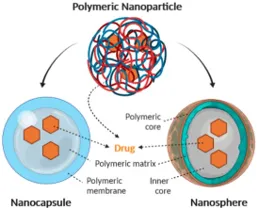
Figure No. 1: Structural representation of polymeric nanoparticles showing nanocapsule and nanosphere drug delivery systems15.
4.2 Lipid-Based Nanocarriers:
Lipid-based systems comprise various carriers in which drugs are encapsulated within lipophilic matrices or vesicular structures.
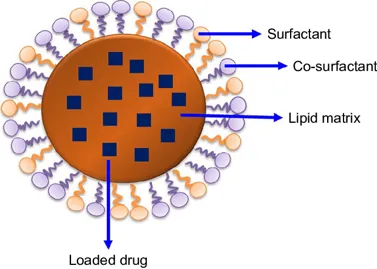
Figure No. 2: Schematic representation of a Solid Lipid Nanoparticle (SLN) showing lipid matrix, surfactant, and drug loading11.
4.3 Polymeric Micelles:
Polymeric micelles are self-assembled nanoparticles formed from amphiphilic block copolymers such as PEG-PLA and PEG-PCL. They possess a hydrophobic core that solubilizes poorly water-soluble drugs and a hydrophilic shell that stabilizes the structure in aqueous environments. The core–shell architecture facilitates drug encapsulation and sustained release as the drug diffuses out of the hydrophobic core, and polymer composition can be tailored to adjust release rates17.
4.4 Dendrimers:
Dendrimers are highly branched, tree-like polymers with defined, monodisperse structures and numerous surface functional groups. Their internal cavities and multivalent surfaces enable high drug loading through encapsulation or covalent attachment. Surface functionalization with targeting ligands or hydrophilic polymers further modulates biodistribution and release behavior. Although dendrimers’ synthesis can be complex, their unique architecture allows controlled drug release and enhanced solubility of hydrophobic molecules.
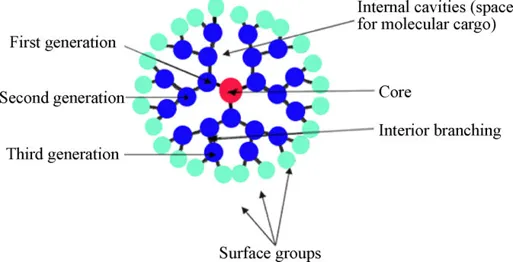
Figure No 3: Structural architecture of dendrimers showing generations, internal cavities, and surface functional groups18.
4.5 Nanosuspensions:
Nanosuspensions are submicron colloidal dispersions of drug particles stabilized by surfactants or polymers. By drastically reducing particle size, nanosuspensions increase surface area and dissolution rate, which enhances solubility. Stabilization techniques such as high-pressure homogenization and wet milling prevent particle aggregation and maintain nanoscale size. Sustained release can be achieved by modifying the particle surface or combining the suspension with release-controlling excipients17.
4.6 Nanosponges:
Nanosponges are porous, three-dimensional structures (often cyclodextrin-based) capable of forming inclusion complexes with drug molecules. Their porous architecture traps hydrophobic drugs within internal cavities, enhancing apparent solubility and providing sustained release as drugs gradually desorb from the pores. Nanosponges have been shown to improve the solubility and controlled release of poorly soluble compounds such as quercetin and itraconazole19.
4.7 Nanoemulsions:
Nanoemulsions are thermodynamically unstable but kinetically stable dispersions of oil and water phases with droplet sizes typically below 100 nm. In oil-in-water (O/W) nanoemulsions, poorly soluble drugs are solubilized within the oil phase and released as they partition into the aqueous environment. The high interfacial area enhances dissolution, while controlled emulsifier composition and droplet size distribution help modulate release kinetics, making nanoemulsions suitable for both solubility enhancement and sustained drug delivery13.
5. MECHANISMS OF SUSTAINED DRUG RELEASE FROM NANOCARRIERS:
The sustained release behavior of nanocarrier systems is governed by physicochemical interactions between the drug, carrier matrix, and biological environment. By engineering material composition, structural architecture, and surface properties, nanotechnology-based systems can modulate the rate and duration of drug liberation. The principal mechanisms underlying sustained release from nanocarriers include diffusion-controlled, degradation-controlled, swelling-controlled, and stimuli-responsive release processes20.
5.1 Diffusion-Controlled Release:
Diffusion-controlled release is one of the most common mechanisms in polymeric and lipid-based nanocarriers. In this system, drug molecules gradually diffuse from the carrier matrix into the surrounding biological medium along a concentration gradient. The release rate depends on factors such as drug solubility within the matrix, polymer porosity, particle size, and diffusion coefficient11.
In matrix-type nanoparticles (e.g., PLGA nanoparticles or lipid matrices), the drug is uniformly dispersed throughout the carrier, and release occurs as the drug diffuses through aqueous-filled pores or channels formed upon hydration. In reservoir-type systems, the drug is confined within a core surrounded by a rate-controlling membrane, where diffusion through the outer layer governs release kinetics. Diffusion-controlled systems often follow Higuchi-type kinetics, particularly when drug diffusion is the dominant release mechanism. Particle size reduction to the nanoscale further influences diffusion pathways and enhances surface-area-driven release behavior20.
5.2 Degradation-Controlled Release:
Degradation-controlled release occurs when the drug is released primarily as a result of carrier matrix breakdown. This mechanism is particularly relevant in biodegradable polymer-based nanocarriers such as those composed of poly(lactic-co-glycolic acid) (PLGA), polycaprolactone (PCL), or polyanhydrides. In such systems, hydrolytic or enzymatic cleavage of polymer chains progressively reduces molecular weight and structural integrity, facilitating drug liberation21.
Polymer degradation may occur via bulk erosion or surface erosion. In bulk-eroding systems (e.g., PLGA), water penetrates the matrix and uniformly degrades the polymer throughout the structure. In contrast, surface-eroding systems degrade layer by layer from the exterior. The degradation rate is influenced by polymer composition, molecular weight, crystallinity, and environmental conditions (e.g., pH, temperature). Degradation-controlled systems are advantageous for long-term sustained delivery, as release profiles can be tailored by adjusting polymer chemistry and architecture22.
5.3 Swelling-Controlled Release:
Swelling-controlled release is typically observed in hydrophilic polymeric nanocarriers such as hydrogels and certain polysaccharide-based nanoparticles (e.g., chitosan or alginate systems). Upon exposure to aqueous media, the polymer matrix absorbs water and swells, increasing chain mobility and creating enlarged diffusion pathways. This swelling facilitates drug diffusion from the matrix into the surrounding environment23.
The degree of swelling depends on polymer crosslinking density, ionic strength, and pH of the medium. In weakly ionizable polymers, environmental pH can significantly alter swelling behavior due to ionization of functional groups, thereby modulating release kinetics. Swelling-controlled systems are particularly useful for mucosal or localized delivery applications where hydration-triggered expansion governs sustained drug release24.
5.4 Stimuli-Responsive Release (pH, Temperature, Enzymes):
Stimuli-responsive (smart) nanocarriers are designed to release drugs selectively in response to specific physiological or pathological triggers. These systems offer spatial and temporal control over drug delivery, enhancing therapeutic precision while minimizing systemic exposure.
Stimuli-responsive nanocarriers represent an advanced strategy for achieving on-demand sustained release, particularly in oncology and inflammatory diseases, where pathological microenvironments can be exploited for selective drug activation25.
6. FORMULATION STRATEGIES AND DESIGN CONSIDERATIONS:
The successful development of nanotechnology-based sustained release systems for poorly soluble drugs requires rational formulation design grounded in physicochemical principles and biological performance requirements. Critical parameters including material selection, drug loading approach, surface engineering, particle size control, and stability optimization collectively determine the therapeutic efficacy, safety, and translational feasibility of nanocarriers.
6.1 Selection of Polymer or Lipid:
The choice of polymeric or lipid material plays a central role in defining drug encapsulation efficiency, release kinetics, biodegradability, and biocompatibility. Biodegradable polymers such as poly(lactic-co-glycolic acid) (PLGA), polycaprolactone (PCL), chitosan, and polyethylene glycol (PEG)-based copolymers are widely employed due to their established safety profiles and tunable degradation rates. The polymer’s molecular weight, crystallinity, hydrophobicity, and monomer ratio (e.g., lactide:glycolide in PLGA) directly influence drug diffusion and degradation-controlled release behavior26.
In lipid-based nanocarriers, selection of solid lipids, liquid lipids, and surfactants determines drug solubilization capacity, matrix integrity, and long-term stability. Lipid melting point, polymorphic transitions, and compatibility with the drug must be carefully considered to prevent drug expulsion during storage. Overall, material selection must align with the intended route of administration, duration of release, and therapeutic indication27.
6.2 Drug Loading Methods:
Drug incorporation into nanocarriers can be achieved through physical encapsulation, adsorption, or chemical conjugation, depending on the carrier system and drug characteristics. Common preparation techniques include solvent evaporation, nanoprecipitation, emulsification–diffusion, high-pressure homogenization, and self-assembly methods10.
Drug loading efficiency is influenced by drug solubility in the selected matrix, drug–polymer/lipid interactions, preparation parameters, and process conditions. For poorly soluble drugs, hydrophobic interactions with polymeric or lipid cores often enhance entrapment efficiency. Optimizing the drug-to-carrier ratio is essential to achieve high payload without compromising particle stability or release behavior. Excessive drug loading may lead to burst release, crystallization, or structural instability28.
6.3 Surface Modification:
Surface engineering of nanocarriers significantly impacts biological interactions, circulation time, cellular uptake, and targeting efficiency. Surface modification strategies include PEGylation (to enhance steric stabilization and reduce opsonization), ligand conjugation (e.g., antibodies, peptides, folate) for active targeting, and charge modulation to influence cellular internalization.
Surface characteristics such as zeta potential affect nanoparticle stability and biodistribution. Slightly negative or neutral surfaces are generally preferred for prolonged systemic circulation, whereas positively charged systems may enhance mucoadhesion or cellular uptake but risk increased toxicity. Functionalization must therefore balance targeting efficiency with safety and immunocompatibility.
6.4 Particle Size Optimization:
Particle size is a critical determinant of dissolution rate, drug release kinetics, biodistribution, and clearance. Nanoscale dimensions (typically 10–200 nm for systemic applications) enhance surface area and dissolution of poorly soluble drugs while enabling passive targeting through biological barriers. Smaller particles generally exhibit faster drug release due to shorter diffusion pathways; however, excessively small sizes may compromise stability or promote rapid clearance29.
Size distribution (polydispersity index) must be tightly controlled to ensure reproducibility and predictable performance. Techniques such as dynamic light scattering (DLS), electron microscopy, and nanoparticle tracking analysis are routinely employed for size characterization. Optimization of homogenization speed, solvent composition, surfactant concentration, and stirring conditions is essential for achieving uniform particle size30.
6.5 Stability Considerations:
Stability is a major challenge in the development and commercialization of nanocarrier systems. Instability may arise from particle aggregation, drug leakage, polymorphic transitions, or hydrolytic degradation of the carrier material. Both physical stability (particle size retention, absence of aggregation) and chemical stability (drug integrity and polymer degradation) must be evaluated under accelerated and long-term storage conditions10.
Strategies to improve stability include appropriate surfactant selection, cryoprotectant use during lyophilization, optimization of zeta potential, and incorporation of antioxidants or stabilizing excipients. For polymeric systems, controlling residual solvent content and moisture levels is crucial. Additionally, scale-up processes must preserve critical quality attributes established during laboratory development31.
7. CHARACTERIZATION TECHNIQUES:
Comprehensive physicochemical and functional characterization is essential to ensure the quality, reproducibility, and performance of nanotechnology-based sustained release systems. Characterization techniques provide critical insights into particle attributes, drug encapsulation efficiency, release behavior, and overall stability, which directly influence therapeutic efficacy and regulatory compliance.
7.1 Particle Size and Zeta Potential:
Particle size is a fundamental parameter governing dissolution rate, drug release kinetics, biodistribution, and cellular uptake. Nanoscale dimensions increase surface area, thereby enhancing solubility and influencing diffusion-controlled release. Particle size and size distribution are typically measured using dynamic light scattering (DLS), which provides hydrodynamic diameter and polydispersity index (PDI). A low PDI (generally <0.3) indicates uniform size distribution and formulation homogeneity32.
Zeta potential reflects the surface charge of nanoparticles and is a key indicator of colloidal stability. It is commonly measured using electrophoretic light scattering. High absolute zeta potential values (typically > ±30 mV) contribute to electrostatic repulsion between particles, preventing aggregation and improving suspension stability. Surface charge also influences interaction with biological membranes, protein adsorption, and in vivo circulation time. Therefore, optimizing both particle size and zeta potential is critical for ensuring stability and predictable biological performance33.
7.2 Morphological Characterization (SEM and TEM):
Morphological evaluation provides information about particle shape, surface topology, and structural integrity. Scanning Electron Microscopy (SEM) is used to examine surface characteristics and external morphology, revealing features such as smoothness, porosity, and aggregation. SEM is particularly useful for assessing dried nanoparticle samples and identifying surface irregularities that may affect drug release34.
Transmission Electron Microscopy (TEM) offers higher resolution imaging and enables visualization of internal structure, core–shell architecture, and nanoscale dimensions. TEM is especially valuable for confirming particle size obtained from DLS and for characterizing vesicular systems such as liposomes or micelles. Morphological assessment ensures structural consistency and aids in correlating physical characteristics with release behavior34.
7.3 Entrapment Efficiency and Drug Loading:
Entrapment efficiency (EE%) and drug loading capacity are critical parameters that determine the therapeutic potential and dosage feasibility of nanocarriers. Entrapment efficiency refers to the percentage of drug successfully incorporated into the nanocarrier relative to the total amount used during formulation, whereas drug loading indicates the proportion of drug within the nanoparticle mass35.
These parameters are typically quantified by separating free (unencapsulated) drug from nanoparticle-associated drug using centrifugation, ultrafiltration, dialysis, or gel filtration techniques, followed by analytical quantification through high-performance liquid chromatography (HPLC), UV–visible spectroscopy, or LC–MS. High entrapment efficiency is particularly desirable for poorly soluble drugs, as it enhances dose uniformity and minimizes burst release. Optimizing formulation variables such as polymer concentration, drug-to-carrier ratio, and solvent system is essential to achieve high encapsulation efficiency and controlled release profiles35.
7.4 In-Vitro Drug Release Studies:
In vitro drug release studies are performed to evaluate the release kinetics and sustained release performance of nanocarrier systems under simulated physiological conditions. Commonly employed methods include dialysis bag diffusion, sample-and-separate techniques, and modified dissolution apparatus systems. The release medium is selected based on drug solubility and intended route of administration, often incorporating surfactants to maintain sink conditions for poorly soluble drugs.
Release studies are conducted over extended time intervals to characterize both initial burst release and subsequent sustained release phases. Parameters such as temperature, agitation speed, pH, and medium composition are carefully controlled to mimic in vivo environments. Data obtained from in vitro studies provide insight into release mechanisms and are essential for predicting in vivo performance36.
7.5 Release Kinetic Modeling:
Mathematical modeling of release data helps elucidate the mechanism governing drug release from nanocarriers. Experimental release profiles are fitted into established kinetic models, including:
The correlation coefficient (R²) and model fitting parameters are used to determine the best-fit model. In many nanocarrier systems, drug release follows a combination of diffusion and degradation mechanisms, resulting in non-Fickian or anomalous transport behavior. Kinetic modeling thus provides mechanistic understanding and supports rational optimization of sustained release formulations37.
8. IN-VITRO AND IN-VIVO EVALUATION:
Comprehensive in-vitro and in-vivo evaluation is essential to establish the therapeutic potential, safety, and translational feasibility of nanotechnology-based sustained release systems. These studies provide critical information regarding drug release behavior, systemic exposure, tissue distribution, and biological compatibility. A systematic evaluation strategy ensures correlation between physicochemical properties and biological performance38.
8.1 Dissolution Studies:
In-vitro dissolution studies are fundamental for assessing the release characteristics of nanocarrier systems, particularly for poorly soluble drugs. These studies simulate physiological conditions to evaluate drug release kinetics and ensure maintenance of sustained release profiles. Common methods include dialysis membrane techniques, USP dissolution apparatus adaptations, and sample-and-separate methods.
For poorly soluble drugs, maintaining sink conditions is critical and often requires the addition of surfactants or co-solvents in the dissolution medium. Parameters such as pH, temperature (typically 37 ± 0.5 °C), agitation speed, and ionic strength are carefully controlled to mimic gastrointestinal or systemic environments. Dissolution data not only confirm sustained release behavior but also support in-vitro–in-vivo correlation (IVIVC), which is essential for regulatory approval and product optimization39.
8.2 Pharmacokinetic Evaluation:
Pharmacokinetic (PK) studies are conducted to assess systemic drug exposure following administration of nanocarrier formulations. Key parameters include maximum plasma concentration (C max), time to reach maximum concentration (T max), area under the plasma concentration–time curve (AUC), half-life (t_1/2), clearance, and volume of distribution.
Sustained release nanocarriers typically demonstrate prolonged circulation time, reduced peak plasma levels, and increased AUC compared to conventional formulations. These changes reflect controlled drug release and improved bioavailability. PK studies are usually performed in appropriate animal models (e.g., rodents or rabbits), with plasma drug quantification conducted using validated analytical techniques such as high-performance liquid chromatography (HPLC) or liquid chromatography–mass spectrometry (LC-MS/MS). Comparative pharmacokinetic analysis is crucial for demonstrating the therapeutic advantage of nano-enabled sustained delivery systems40.
8.3 Biodistribution Studies:
Biodistribution studies evaluate the spatial distribution of drug or nanocarrier components across organs and tissues. These studies are particularly important for targeted or site-specific delivery systems. Tissue samples are collected at predefined time intervals and analyzed to determine drug concentration in organs such as liver, spleen, kidneys, lungs, brain, or tumor tissue41.
Advanced imaging techniques, including fluorescence imaging, radiolabeling, positron emission tomography (PET), and magnetic resonance imaging (MRI), are frequently employed to track nanoparticle localization in vivo. Biodistribution data help assess targeting efficiency, accumulation in the reticuloendothelial system (RES), and potential off-target exposure. For sustained release systems, prolonged retention at the target site and reduced accumulation in non-target tissues are considered favorable outcomes42.
8.4 Toxicity Assessment:
Safety evaluation is a critical component of nanocarrier development. Toxicity assessment includes both in-vitro and in-vivo studies to determine cytotoxicity, immunogenicity, and systemic safety.
In-vitro cytotoxicity assays such as MTT, XTT, or Alamar Blue tests are commonly used to assess cell viability following nanoparticle exposure. Hemocompatibility studies evaluate hemolysis and blood compatibility, while oxidative stress and inflammatory marker analyses provide additional safety insights.
In-vivo toxicity studies involve acute and sub-chronic evaluations in animal models to monitor changes in body weight, hematological parameters, biochemical markers (e.g., liver and kidney function tests), and histopathological examination of major organs. Biodegradable and biocompatible materials such as PLGA and lipid-based systems generally exhibit favorable safety profiles; however, surface charge, particle size, and excipient selection can significantly influence toxicity outcomes43.
9. RECENT ADVANCES AND EMERGING TRENDS:
Rapid progress in materials science, nanotechnology, and biomedical engineering has significantly expanded the scope of sustained release systems for poorly soluble drugs. Emerging strategies focus not only on improving solubility and release kinetics but also on enhancing therapeutic precision, personalization, and multifunctionality. Key advances include the development of smart nanocarriers, stimuli-responsive platforms, targeted nano-delivery systems, combination therapy approaches, and integration of nanocarriers with 3D printing technologies44.
9.1 Smart Nanocarriers:
Smart nanocarriers are advanced systems capable of adapting to physiological environments and modulating drug release in a controlled manner. These systems are designed using intelligent polymers or hybrid materials that respond to environmental cues, enabling precise spatial and temporal drug delivery. Smart nanocarriers often incorporate multifunctional components that allow for imaging, targeting, and controlled release within a single platform.
Such systems enhance therapeutic outcomes by minimizing premature drug leakage and maximizing drug accumulation at the desired site of action. The integration of biodegradable polymers with responsive moieties has facilitated the development of nanocarriers capable of prolonged circulation and on-demand drug release45.
9.2 Stimuli-Responsive Systems:
Stimuli-responsive nanocarriers represent a major advancement in sustained release technology. These systems are engineered to release drugs selectively in response to internal or external triggers. Internal stimuli include variations in pH, redox potential, enzyme concentration, and temperature within pathological microenvironments such as tumors or inflamed tissues. External stimuli may involve light, magnetic fields, ultrasound, or electrical signals.
For example, pH-responsive nanoparticles exploit the acidic tumor microenvironment to trigger drug release, while thermo-responsive polymers undergo phase transitions at physiological temperatures to control drug liberation. Enzyme-sensitive linkers enable selective degradation in tissues where specific enzymes are overexpressed. Such responsiveness enhances site-specific delivery, reduces systemic toxicity, and improves therapeutic efficiency46.
9.3 Targeted Nano-Delivery:
Targeted nano-delivery aims to increase drug accumulation at specific tissues or cellular receptors while minimizing off-target exposure. Targeting strategies are broadly classified into passive and active targeting.
Passive targeting primarily relies on the enhanced permeation and retention (EPR) effect, which allows nanoparticles to accumulate preferentially in tumor tissues due to leaky vasculature and impaired lymphatic drainage. Active targeting involves surface functionalization of nanocarriers with ligands such as antibodies, peptides, folate, aptamers, or transferrin that bind to specific receptors overexpressed on target cells.
Surface engineering enhances cellular uptake, improves pharmacokinetic profiles, and supports sustained local drug concentrations. Targeted nano-delivery systems are particularly promising for oncology, neurological disorders, and inflammatory diseases47.
9.4 Combination Therapy:
Combination therapy using nanocarriers has gained significant attention as a strategy to overcome drug resistance and improve therapeutic synergy. Nanocarriers can co-encapsulate multiple drugs with different mechanisms of action within a single platform, ensuring synchronized delivery and controlled release.
This approach is especially valuable in cancer therapy, where simultaneous delivery of chemotherapeutic agents, gene therapy components, or immunomodulators can enhance efficacy while reducing systemic toxicity. Nanocarriers allow precise control over drug ratios and release sequences, enabling optimization of synergistic interactions48.
9.5 3D Printing with Nanocarriers:
The integration of nanotechnology with 3D printing (additive manufacturing) represents a transformative trend in personalized medicine. 3D printing enables the fabrication of customized dosage forms with precise control over geometry, drug distribution, and release profiles.
Incorporating nanocarriers into printable matrices allows the development of sustained release systems with tailored dosing regimens and patient-specific drug combinations. This approach offers flexibility in designing complex drug delivery architectures, including multilayer tablets and compartmentalized systems, facilitating individualized therapy49.
10. CHALLENGES AND FUTURE PERSPECTIVES:
Despite remarkable advancements in nanotechnology-enabled sustained release systems for poorly soluble drugs, several scientific, regulatory, and economic challenges continue to limit widespread industrial adoption and clinical translation. Addressing these barriers is essential to fully realize the therapeutic and commercial potential of nanomedicine50.
10.1 Industrial Translation Barriers:
One of the principal challenges in nanocarrier development is the gap between laboratory-scale research and large-scale industrial manufacturing. Many nanoscale fabrication techniques are optimized under controlled laboratory conditions but face reproducibility issues when scaled up. Maintaining uniform particle size, narrow polydispersity, consistent drug loading, and batch-to-batch reproducibility becomes increasingly complex during industrial production.
Furthermore, regulatory requirements demand comprehensive characterization and strict control of critical quality attributes (CQAs), which can complicate manufacturing workflows. The absence of harmonized global regulatory frameworks specific to nanomedicines also adds uncertainty in approval pathways. Bridging the translational gap requires standardized manufacturing protocols, implementation of Quality by Design (QbD) principles, and integration of process analytical technologies (PAT) to ensure robust and scalable production51.
10.2 Stability Issues:
Physical and chemical instability remains a major concern in nanocarrier formulations. Nanoparticles are prone to aggregation, sedimentation, polymorphic transitions, drug leakage, and hydrolytic degradation during storage. Poorly soluble drugs encapsulated in amorphous or dispersed states may recrystallize over time, leading to altered release profiles and reduced bioavailability.
Environmental factors such as temperature, humidity, light exposure, and mechanical stress can further compromise stability. Lyophilization, cryoprotectants, surface stabilization with polymers (e.g., PEG), and optimization of zeta potential are commonly employed strategies to enhance long-term stability. Nevertheless, ensuring consistent performance throughout shelf life remains a critical challenge that requires thorough stability testing under accelerated and real-time conditions52.
10.3 Cost-Effectiveness:
Although nanotechnology offers therapeutic advantages, the high cost of raw materials, specialized equipment, quality control procedures, and regulatory compliance can limit cost-effectiveness. Complex manufacturing processes and stringent quality requirements may increase production costs compared to conventional dosage forms.
Additionally, scale-up inefficiencies and low manufacturing yields can further impact economic feasibility. To ensure broader accessibility and commercial viability, future research must focus on simplifying formulation methods, improving process efficiency, and adopting continuous manufacturing approaches. Economic modeling and cost–benefit analysis are essential to justify the clinical value of nano-enabled sustained release systems53.
10.4 Personalized Nanomedicine:
Personalized nanomedicine represents a promising future direction in drug delivery. Advances in genomics, biomarker identification, and patient stratification have opened opportunities for individualized therapeutic strategies. Nanocarriers can be engineered to accommodate patient-specific drug combinations, dose adjustments, and targeted delivery approaches.
Emerging technologies such as 3D printing and modular nanoparticle design allow customization of dosage forms according to disease phenotype, genetic profile, or pharmacokinetic variability. However, personalized nanomedicine also presents challenges related to regulatory approval, manufacturing flexibility, and economic scalability. Developing adaptable production systems and regulatory frameworks capable of accommodating individualized therapies will be critical for the successful implementation of this approach54.
CONCLUSION:
Poor aqueous solubility continues to be a major barrier in the development of effective pharmaceutical formulations, particularly for drugs classified under Biopharmaceutics Classification System (BCS) Class II and Class IV. Limited solubility often results in poor dissolution, low oral bioavailability, variable pharmacokinetic profiles, and inconsistent therapeutic outcomes. Traditional formulation approaches such as micronization, salt formation, and solid dispersions have provided partial solutions; however, these strategies frequently encounter limitations related to physical instability, recrystallization, and inadequate control over drug release. Consequently, the need for more advanced delivery systems capable of simultaneously improving solubility and providing sustained drug release has become increasingly important.
Nanotechnology-based drug delivery systems have emerged as highly promising platforms to address these challenges. Various nanocarriers including polymeric nanoparticles, lipid-based nanocarriers, polymeric micelles, dendrimers, nanosuspensions, nanosponges, and nanoemulsions offer unique structural advantages that enhance drug solubility, protect drug molecules from degradation, and enable controlled or sustained release profiles. By manipulating carrier composition, particle size, surface properties, and drug–carrier interactions, these systems can significantly improve dissolution behavior, pharmacokinetics, and therapeutic efficacy of poorly soluble drugs.
Furthermore, advances in smart nanocarriers, stimuli-responsive delivery systems, targeted nano-delivery, and combination therapy strategies have expanded the potential of nanotechnology in modern drug delivery. Despite these advancements, challenges related to large-scale manufacturing, long-term stability, regulatory approval, and cost-effectiveness must still be addressed to facilitate broader clinical translation. Future research should focus on scalable manufacturing techniques, robust quality control strategies, and integration with emerging technologies such as personalized medicine and 3D printing. Overall, nanotechnology-enabled sustained release systems represent a powerful and evolving approach for overcoming solubility limitations and improving the therapeutic performance of poorly soluble drugs.
REFERENCES

Darshan Jadhav, Sheetal Gondkar, Khanderao Jadhav, Rishikesh Bachhav, Nanotechnology-Enabled Strategies for Sustained Release of Poorly Soluble Drugs, Int. J. of Pharm. Sci., 2026, Vol 4, Issue 6, 2554-2573. https://doi.org/10.5281/zenodo.20616725
 10.5281/zenodo.20616725