

We use cookies to ensure our website works properly and to personalise your experience. Cookies policy
Shri Gajanan Maharaj Shikshan Prasarak Mandal’s Dnyanvilas College of Pharmacy, Dudulgaon, Pune 411081
Pomegranate peel contains a high amount of polyphenolic compounds and contains considerable amounts of ellagic acid, which is well known for its antioxidant and therapeutic activities. This study aims to extract, isolate, and identify ellagic acid from pomegranate peel using a pharmaceutical approach. The dried peel was first extracted with methanol, followed by acid hydrolysis to liberate ellagic acid from ellagitannins. Further isolation was carried out using column chromatography, and the compound was confirmed by thin layer chromatography (TLC). The method developed was found to be simple, economical, and effective for the recovery of ellagic acid.
Natural products are essential in the process of finding and developing novel drugs. The peel of pomegranate (Punica granatum) is an important agricultural waste that contains a high amount of bioactive constituents, including flavonoids, tannins, and phenolic acids. Among these compounds, ellagic acid is notable for its potent radical neutralizing, Immunomodulatory, and antitumor properties. Therefore, the extraction and recovery of such valuable compounds using simple pharmaceutical methods like solvent extraction and chromatographic techniques are highly significant for both research purposes and industrial applications.
Ellagic acid is an endogenous polyphenolic substance, a member of hydrolysable tannins and is formed by the dimerization of gallic acid units. It is found in a variety of plant sources including pomegranate peel, berries, grapes, walnuts, and several medicinal plants. In plants, ellagic acid commonly exists in bound form as ellagitannins, which yield free ellagic acid upon hydrolysis.
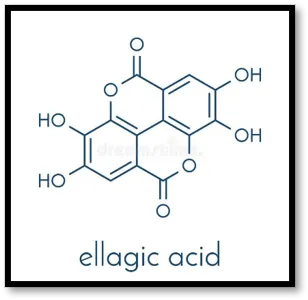
|
Sr. No. |
Property |
Details |
|
1 |
Name |
Ellagic acid |
|
2 |
Chemical class |
Polyphenolic compound (hydrolysable tannin derivative) |
|
3 |
Empirical Formula |
C₁₄H₆O₈ |
|
4 |
Molecular weight |
302.19 g/mol |
|
5 |
Physical appearance |
Yellowish to light brown crystalline powder |
|
6 |
Miscibility |
Poorly soluble in water; soluble in methanol, ethyl acetate |
|
7 |
Fusion point |
~350°C (decomposes) |
|
8 |
Source |
Pomegranate peel, berries, grapes, walnuts, oak species |
|
9 |
UV absorption |
Strong absorption at 254 nm and 366 nm |
|
10 |
Chemical nature |
Weak organic acid, polyphenolic antioxidant |
|
11 |
Stability |
Stable under dry conditions; sensitive to light and alkaline pH |
|
12 |
Biological activity |
Antioxidant, anti-inflammatory, anticancer, antimicrobial |
|
13 |
Mechanism of action |
Free radical scavenging, metal ion chelation |
|
14 |
Therapeutic relevance |
Used in prevention of oxidative stress-related diseases |
|
15 |
Pharmaceutical importance |
Used in nutraceuticals |
MATERIALS AND METHODS
I. Sampling and Preparation of Sample
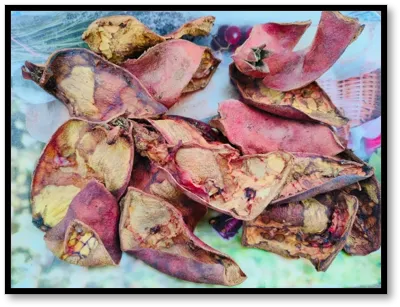
Pomegranates were purchased from a local fruit store. The peel was stripped off the fruit and used as the test material. The samples obtained were then rinsed using running tap water in order to remove the impurities, while the peels were dried in the sun for four days. After drying, the samples were milled into powder form using a miller machine and subsequently sieved with a No. 60 mesh sieve before storage in an airtight container.
II. Chemicals and Reagents
pomegranate peel powder, beeswax, almond oil, borax, olive oil, sandalwood, distilled water, ethanol, Molisch’s reagent, concentrated sulfuric acid (H₂SO₄), Fehling’s solution A & B, Wagner’s reagent, lead acetate, ninhydrin reagent, diluted sulfuric acid, ferric chloride (FeCl₂), DPPH reagent, gallic acid, E. coli bacteria, rose water, 20% sodium carbonate solution, and ruthenium red dye.
III. Equipment and Apparatus
|
Sr. no |
Name of Apparatus |
Sr. no |
Name of Apparatus |
|
1 |
No. 60 mesh sieve |
2 |
Aluminum foil |
|
3 |
Test Tubes |
4 |
Porcelain dish |
|
5 |
Nutrients agar Plates |
6 |
Thermometer |
|
7 |
Buchner Funnel |
8 |
Colorimeter |
|
9 |
pH meter |
10 |
Microscope slide |
|
11 |
Viscometer |
12 |
250 mL round-bottom flask |
|
13 |
Whatman filter paper no.41
|
14 |
Two glass sides of dimensions 20 cm × 20 cm |
III. Extraction of compounds from pomegranate
Extraction Procedure of Ellagic Acid
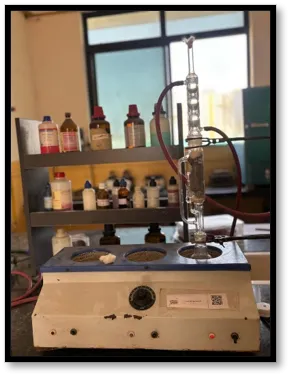
Fresh peels of pomegranate were washed, dried under shade for 5 to 7 days and then ground into a fine powder form. Approximately 50 to 100 grams of the powder obtained was defatted by means of petroleum ether through Soxhlet apparatus for a period of 4 to 6 hours. The plant material was subjected to primary extraction with 70 to 100 percent methanol or ethanol through Soxhlet process for 6 to 8 hours till the solvent became clear. The extract obtained was concentrated with the help of rotary evaporator at a temperature ranging between 40 to 50 degrees centigrade.
TLC Method-
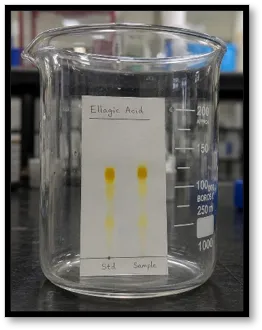
Thin Layer Chromatography (TLC) was performed for the identification of phytochemical constituents present in the extract.
Result
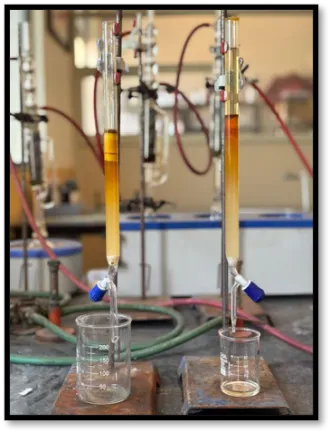
Column Chromatography
Materials Required
Procedure
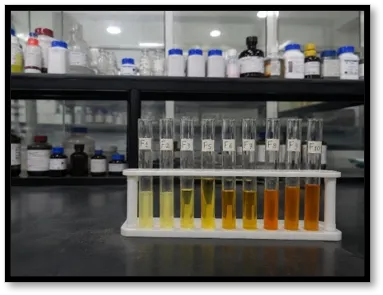
Cotton wool and stationary phase are placed at the base of the column as a support for the stationary phase. Slurry of silica gel made in petroleum ether is slowly packed into the column, tapped to expel air bubbles, and topped with stationary phase. The extract is mixed with silica gel, made into dry flowing powder and applied on the column, then topped with sand. Fractionation is performed in an ascending manner by using eluents of increasing polarity starting with petroleum ether and toluene to ethyl acetate and methanol solutions, with a fixed flow rate. Eluates are collected in appropriately labeled test tubes of 10-20 mL each. The fractions are checked, and the ones that contain the ellagic acid compound can be distinguished based on their Rf values.
UV visible spectroscopy
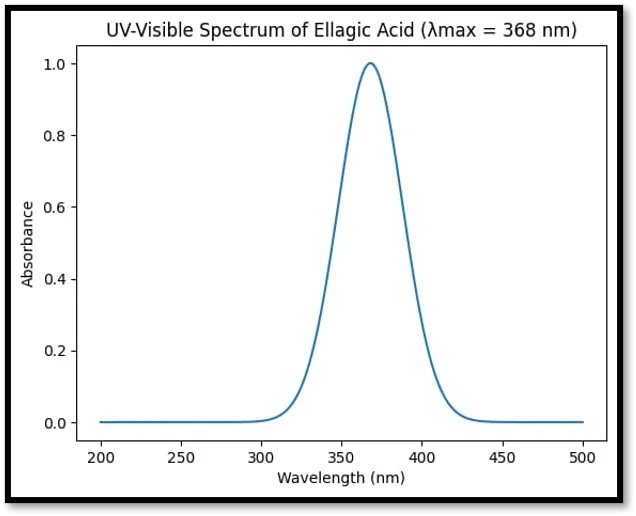
The pomegranate peel extract and standard ellagic acid solution were prepared in methanol. The solutions were scanned in the UV-visible region between 200 and 800 nm using a UV-Visible spectrophotometer. The absorption spectrum of the extract was compared with the spectrum of standard ellagic acid. The presence of similar absorption peaks indicated the presence of ellagic acid and related phytoconstituents in the extract.
CREAM FORMULATION
Shelf-life evaluation of creams and the role of herbal formulations in delaying skin aging.”
The aging of skin is mainly due to the phenomenon called redox imbalance that occurs when the formation of reactive oxygen species exceeds the biological protection and natural antioxidants in the body. This reactive oxygen species are formed due to metabolism and other extrinsic factors, like ultraviolet rays and environmental pollution. They damage proteins, lipids, and DNA, causing a decline in collagen and elasticity of the skin.
Natural herbal products are considered safe and suitable for almost all skin types. Natural herbs, like phenolic compounds and flavonoids, act as strong antioxidants for the skin.
Phytochemical Screening of Pomegranate Extract-
|
Sr.No. |
Test Name |
Procedure |
Observation |
Inference |
|
1 |
Molisch’s test Carbohydrates |
2-3 drops of molisch reagent added to extract and add sodium hydroxide in test tube. |
Apprance of violet and purplecat the junction of the layers. |
Presence of Cabohydrates. |
|
2 |
Fehling’s Test (Reducing Sugars) |
Add Fehling’s solutions A and B to the , then heat the mixture in a water bath. |
Formation brick-red colored precipitate. |
Presence of reducing sugars |
|
3 |
Test for Alkaloids (Mayer’s test) |
Add mayers reagent to solution. |
Cream or pale yellow precipitate. |
Presence of alkaloids. |
|
4 |
Test for Tannins (ferric chloride test) |
A few drops of 5% ferric chloride (FeCl₃) solution are added to the extract. |
A blue-black or greenish color is formed. |
Presence of tannins (ellagic acid is a type of hydrolysable tannin derivative). |
|
5 |
Test for Amino Acids (Ninhydrin Test) |
Add ninhydrin reagent and heat the solution. |
Purple or bluish color appears. |
Presence of amino acids. |
|
6 |
Test for Flavonoids (Alkaline reagent test) |
A few drops of NaOH solution are added to the extract and add of dilute acid. |
A strong yellow coloration is observed, which disappears upon the addition of acid. |
Presence of Flavonoids. |
|
7 |
Test for Phenols (Ferric Chloride Test) |
Add neutral FeCl₃ to the extract. |
Deep blue, green, or violet coloration. |
Presence of phenolic compounds (ellagic acid confirmed as a polyphenol). |
DPPH free radical scavenging assay for evaluating antioxidant activity.
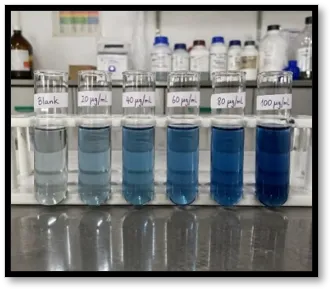
The procedure of the assay involves dissolving the DPPH compound in methanol to form a 0.1 mM concentration. The DPPH solution is kept away from light because it is highly unstable. The concentrations of pomegranate peel extracts and ellagic acid are dissolved in methanol at different levels ranging from 20 to 100 µg/mL. Similarly, an antioxidant standard like ascorbic acid is also dissolved in methanol at the same range. One milliliter of the DPPH solution is combined with another milliliter of the samples or the standards. However, in the control group, DPPH is combined with methanol only.
% inhibition = [(A_control − A_sample) / A_control] × 100.
Calculations
|
Sr. No. |
Concentration (µg/mL) |
Absorbance (Sample) |
Absorbance (Control) |
% Inhibition |
|
1 |
20 |
0.620 |
0.800 |
22.50 |
|
2 |
40 |
0.540 |
0.800 |
32.50 |
|
3 |
60 |
0.420 |
0.800 |
47.50 |
|
4 |
80 |
0.300 |
0.800 |
62.50 |
|
5 |
100 |
0.180 |
0.800 |
77.50 |
3. Sample Calculation (for 20 µg/mL)
0.8000.180×100=22.50%
IC₅₀ Determination
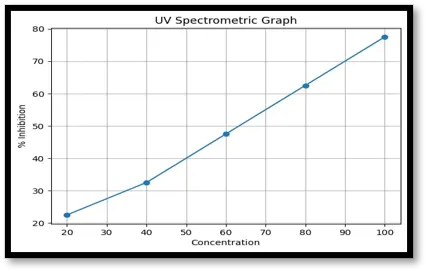
So IC₅₀ ≈ ~65–70 µg/mL
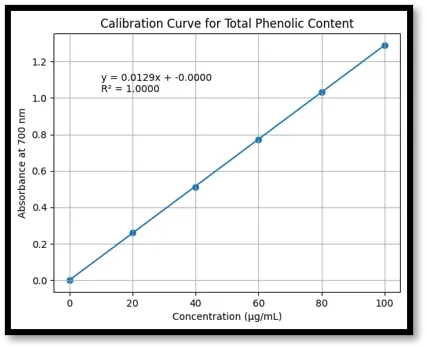
Estimation of total phenolic compounds present.
The reaction between phenols present in the extract and ferric ions (Fe³⁺), along with potassium ferricyanide, results in the formation of the Prussian blue complex. Initially, the extract is mixed with potassium ferricyanide, and ferric chloride is added in an acidic medium to generate the blue color. The intensity of this blue color varies depending on the concentration of phenolic compounds. After leaving the reaction mixture to rest for 15 to 30 minutes, the absorbance is determined at approximately 700 nm through the UV-Vis spectroscopy.
Antibacterial Bacterial Activity
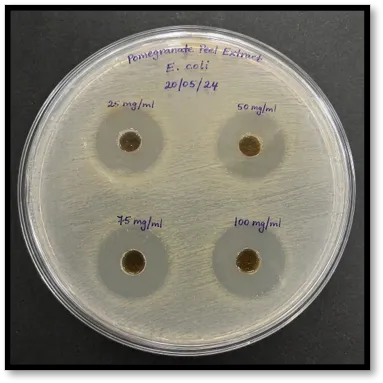
To determine the anti-bacterial efficacy of the pomegranate peel extract, the Kirby-Bauer agar well diffusion test was used. The bacterium culture was inoculated into the nutrient agar plate. Bore holes of about 8 mm and then fill them with the extracts. Incubate for 24 hours at 37°C, after which time the anti-bacterial activity is assessed based on the size of the zone of inhibition produced.
Formulation of Anti-aging Cream-
|
Sr. No. |
Ingredient |
Role in Formulation |
|
1 |
Beeswax |
It functions as a thickening agent and emulsifier, aiding in the formation of a stable cream while also creating a protective layer on the skin. |
|
2 |
Borax |
Serves as an emulsifying agent; helps in blending oil and water phases and stabilizes the cream. |
|
3 |
Almond Oil |
Functions as an emollient; moisturizes and nourishes the skin, improves skin tone, and reduces dryness. |
|
4 |
Olive Oil |
Provides deep hydration; rich in antioxidants and helps in preventing skin aging and improving elasticity. |
|
5 |
Sandalwood |
Acts as a soothing and cooling agent; has anti-inflammatory and mild antimicrobial properties, and enhances skin texture and fragrance. |
Formulation Composition of Anti-Aging Cream (B1–B3)
|
Sr. No. |
Ingredients |
B1 |
B2 |
B3 |
|
1 |
White Beeswax |
4 g |
4.3 g |
4.5 g |
|
2 |
Almond Oil |
10 g |
10 g |
9.9g |
|
3 |
Borax |
0.14 g |
0.17g |
0.17 g |
|
4 |
Punica Extract |
1.5mL |
1.5mL |
1.5mL |
|
5 |
Distilled Water |
4.3 ml |
3.8ml |
4ml |
|
6 |
Olive Oil |
0.2ml |
0.2ml |
0.2ml |
|
7 |
Sandalwood Powder |
0.1 g |
0.1 g |
0.1 g |
|
8 |
Rose Water |
0.1 mL |
0.1 mL |
0.1 mL |
Procedure for Preparation of Anti-Aging Cream
Weigh the required amounts of beeswax, almond oil, and olive oil, and heat them to melt the beeswax by putting them into a clean beaker through a water bath. Prepare the aqueous phase by dissolving borax in distilled water and heat the solution to bring the temperature up to that of the oil phase (70–75°C). Slowly add the aqueous phase to the oil phase with continuous stirring to produce an emulsion for the cream base. Mix sandalwood powder or extract in the mixture during stirring. Leave the cream to cool at room temperature with continuous stirring. Store the prepared cream in a cool, dry place.
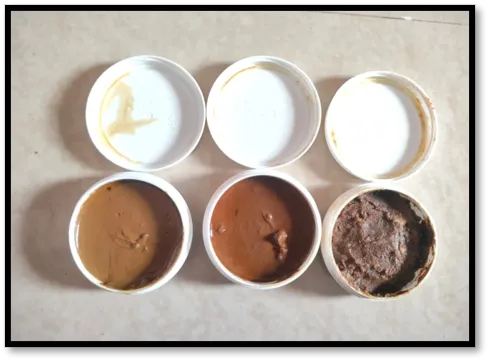
Final Observation
RESULTS AND DISCUSSION
Organoleptic evaluation of formulated cream
|
Sr. no. |
Evaluations Parameters |
Results |
|
1 |
Physical state |
Semisolid |
|
2 |
Odour |
Characteristic |
|
3 |
Colour |
Yellowish Brown |
|
4 |
Consistency |
smooth |
|
5 |
Type of Emulsion |
(O/W) |
|
6 |
Homogeneity |
Uniform and homogeneous |
pH of the cream
the range of pH 6.0 to 6.35. These values indicate that the formulation is well suited for the skin since the pH values are similar to those of natural skin.
|
Sr. No. |
Formulation |
pH |
|
1 |
F1 |
6.00 |
|
2 |
F2 |
6.22 |
|
3 |
F3 |
6.20 |
Viscosity
|
Sr. No. |
Formulation |
Viscosity |
|
1 |
F1 |
596 |
|
2 |
F2 |
650 |
|
3 |
F3 |
645 |
The viscosity of the cream was found to be in the range of 500–1000 cps, indicating that it can be easily spread with minimal application of shear force.
Spreadability
The range from 13 to 18 g·cm/min, indicating good spreadability with a shorter spreading time.
|
Sr. No. |
Formulation |
Weight on Upper Glass Slide (g) |
Length Moved (cm) |
Time Taken (s) |
Spreadability |
|
1 |
F1 |
2.50 |
0.25 ± 0.34 |
15 |
13 |
|
2 |
F2 |
2.50 |
0.31 ± 0.25 |
15 |
13 |
|
3 |
F3 |
2.50 |
0.32 ± 0.28 |
15 |
15 |
DPPH Activity –
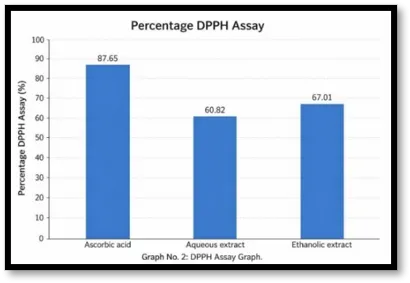
The solvents tested, the maximum radical scavenging activity observed was 70%.
DPPH Radical Scavenging Activity
|
Sr. No. |
Sample |
Absorbance |
% DPPH Scavenging Activity |
|
1 |
Blank |
0.97 |
97.32 ± 2.34 |
|
2 |
Ascorbic acid |
0.12 |
87.65 ± 2.87 |
|
3 |
Aqueous extract |
0.38 |
60.82 ± 10.43 |
|
4 |
Ethanolic extract |
0.32 |
67.01 ± 3.65 |
Total Phenolic Content
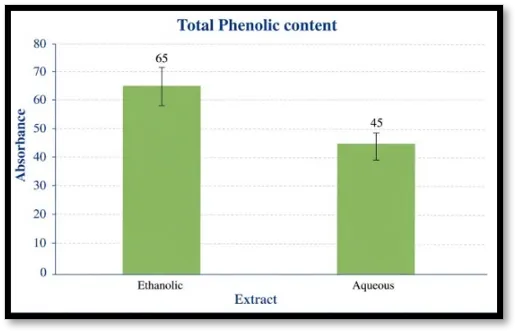
The contents were analyzed in different parts of pomegranate such as peel, flesh, seeds, and whole fruit. The phenolic content was found to increase with more polar solvents. The highest level (67.34 ± 2.77 mg) was recorded in the methanolic extract of the peel. These results agree with Elfalleh et al., who reported higher polyphenol content in methanolic extracts of pomegranate parts.
|
Sr. No. |
Extract Type |
Absorbance |
|
1 |
Ethanolic |
65 |
|
2 |
Aqueous |
45 |
Antimicrobial Activity
The biological activities of Punica granatum, especially its antibacterial effects, have been extensively studied. In this work, the aqueous extract showed a 22 mm zone of inhibition against E. coli. Its strong antibacterial activity is likely due to its high tannin content (~25%) and other secondary metabolites present in the plant.
Applications
CONCLUSION
Aging of skin is becoming increasingly popular among women and has prompted the need for conducting this study. This research work focused on preparing a natural anti-aging cream that is free from synthetic compounds. Punica granatum (peel extract) was chosen as the principal active agent since it has a high concentration of polyphenols, flavonoids, tannins, and anthocyanins that are responsible for antioxidant and anti-aging properties proven by DPPH assay and total phenol content. Other natural products such as beeswax, borax, almond oil, sandal wood powder, and olive oil were used to make four different formulations using different concentrations. It was found that formulation F1 had excellent stability and smooth texture properties.
REFERENCES

Rasika Tilekar, Bhagyashri Gandhile, Atharva Naikare, Swadeep Karpe, Pramod Ingale, Agro-Waste Valorization of Pomegranate Peel: Isolation of Ellagic Acid and Development of an Antioxidant Cosmeceutical Cream, Int. J. of Pharm. Sci., 2026, Vol 4, Issue 6, 2529-2540. https://doi.org/10.5281/zenodo.20616451
 10.5281/zenodo.20616451