

We use cookies to ensure our website works properly and to personalise your experience. Cookies policy
Dr. Vedprakash Patil College of Pharmacy, Chh. Sambhajinagar, Maharashtra, India
Skin diseases such as psoriasis, eczema and dermatitis are frequently seen in clinical practice and they often require topical treatment for effective management. Corticosteroids are widely prescribed drugs for reducing inflammation, itching and redness associated with many dermatological disorders. Halcinonide is considered a potent topical corticosteroid that is useful in treatment of several inflammatory skin conditions. However, the therapeutic performance of the drug depends not only on the pharmacological activity but also on the type of dosage form used for delivery. Among the available topical dosage forms, gel formulations have attracted attention because they are non?greasy, easy to apply, comfortable for patients and capable of providing better drug diffusion through the skin layers. Gels can improve patient compliance and also provide better cosmetic acceptability compared with ointments. For this reason many researchers have explored gel systems for delivering corticosteroids and other dermatological drugs. The review focuses on formulation development and evaluation of Halcinonide topical gel. In this review we discuss formulation components, preparation methods, evaluation parameters and previous research studies related to topical gel formulations. Overall the review highlights that Halcinonide gel formulation may provide effective topical therapy with improved patient acceptability.
Skin diseases are a major health problem affecting a high proportion of the population in India. Skin diseases can place a heavy emotional and psychological burden on patients that may be far worse than the physical impact.(1) The skin is the largest organ of the human body and acts as a protective barrier against environmental factors, microorganisms and physical damage. (2) Despite this protective function, the skin is also affected by many types of diseases such as psoriasis, eczema, dermatitis, fungal infections and allergic reactions. (3) These disorders often cause symptoms like inflammation, itching, redness and irritation which can significantly affect the quality of life of patient.(4,5,6) Topical therapy helps to reduce systemic exposure of the drug and therefore minimizes adverse effects. In addition, topical formulations can provide rapid relief from symptoms since the drug is applied directly on the diseased skin area. (7,8,9,10)
Corticosteroids represent one of the most important classes of drugs used in dermatology. They possess strong anti‑inflammatory and immunosuppressive activities which help to control inflammatory skin reactions. Halcinonide is a synthetic corticosteroid which shows potent anti‑inflammatory action and is used in the management of corticosteroid responsive dermatoses.(11,12) Although many topical dosage forms are available such as creams, ointments and lotions, gel formulations have become increasingly popular. (13) Gels are semi‑solid systems where the drug is dispersed within a three‑dimensional polymer network. They offer advantages like better spreadability, non‑greasy nature and cooling effect on skin. Because of these characteristics, gels are considered suitable carriers for topical delivery of anti‑inflammatory drugs. (14)
1.2 Structure of Skin
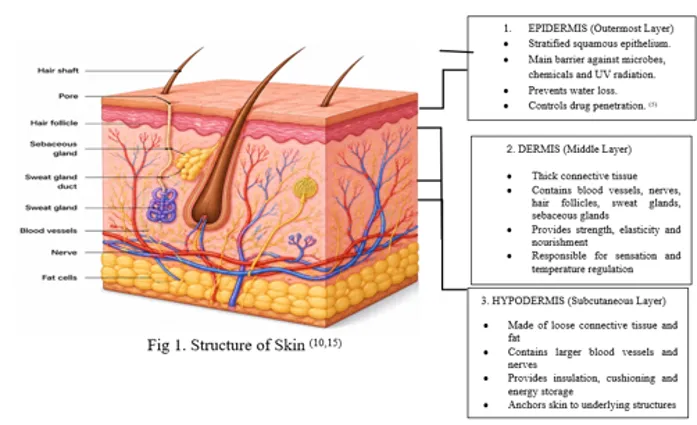
Fig 1. Structure of Skin (10,15)
Skin diseases include all conditions that irritate, clog or damage your skin, as well as skin cancer. You may inherit a skin condition or develop a skin disease. Many skin diseases cause itchiness, dry skin or rashes. Often, you can manage these symptoms with medication, proper skin care and lifestyle changes. However, treatment can reduce symptoms and may even keep them at bay for months at a time. (15)
Table No.1 Dermatological Disorder
|
Diseases |
Symptoms |
Inflammation Mechanism |
Treatment |
|
Psoriasis |
Red, scaly plaques; itching and pain |
Hyperproliferation of keratinocytes and immune dysregulation |
Localized action with reduced systemic side effects (25) |
|
Atopic Dermatitis |
Dry, itchy skin; redness and scaling |
Th2 immune response and skin barrier defect |
Controls inflammation and relieves symptoms at the site |
|
Contact Dermatitis |
Redness, itching, blisters |
Type IV hypersensitivity reaction |
Targets affected local area and avoids systemic exposure (16) |
|
Eczema |
Dry, inflamed skin; itching and scaling |
Skin barrier dysfunction and immune activation |
Provides effective local symptom relief |
|
Seborrheic Dermatitis |
Red, greasy scales; itching |
Malassezia overgrowth and inflammation |
Reduces inflammation and scaling locally (17,26) |
Several preparation methods have been described in pharmaceutical literature for manufacturing topical gel formulations. Among these methods the polymer dispersion technique is the most widely used approach for developing dermatological gels. (18)
Polymer dispersion method is most commonly used for preparing gel. In this method, the required amount of polymer such as Carbopol, HPMC, or sodium carboxymethyl cellulose is dispersed in purified water and allowed to hydrate completely. Hydration of polymer leads to swelling and formation of a three‑dimensional network which forms the gel base. The drug is dissolved separately in a suitable solvent like propylene glycol or ethanol. The drug solution is then incorporated into the hydrated polymer base with continuous stirring. Finally, neutralizing agent such as triethanolamine is added to adjust the pH and convert the polymer dispersion into a gel structure. (2,7, 19)
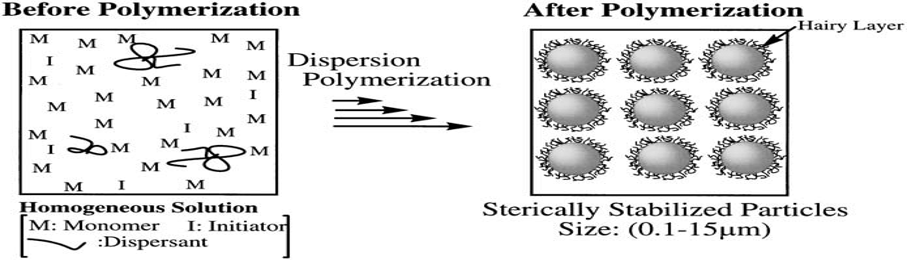
Fig 2. Polymer Dispersion Method
The cold method is commonly used when the formulation contains heat‑sensitive ingredients. In this technique, the polymer is slowly dispersed in cold water under constant stirring. The mixture is allowed to stand for sufficient time to allow complete hydration of the polymer. (6,8) The drug and other excipients such as preservatives, humectants, and penetration enhancers are dissolved separately and then added to the polymer dispersion. Continuous stirring ensures uniform mixing and formation of a homogenous gel. (15,20)
3.3 Hot Method of Gel Preparation
The hot method is used when certain polymers require heating for proper dissolution. In this method, the aqueous phase is heated to a specific temperature and the polymer is slowly added while stirring continuously. Heating helps in dissolving polymers such as methyl cellulose and hydroxypropyl methylcellulose. After complete dissolution, the solution is cooled gradually. The drug and other excipients are then incorporated into the gel base under continuous stirring. (2, 21)
Evaluation of topical gel formulations is an essential step to ensure quality, stability and therapeutic performance. Several physicochemical tests are carried out during formulation development.
Organoleptic properties of the gel formulation are evaluated visually. This includes examination of color, odor, appearance, and homogeneity. A good gel formulation should be smooth, free from lumps and have uniform appearance. These parameters are important because they influence patient acceptance and cosmetic appeal of the topical product.
Viscosity determines the consistency and thickness of the gel formulation. It is generally measured using a Brookfield viscometer with suitable spindle at controlled temperature. Proper viscosity ensures that the gel remains stable and spreads easily on the skin surface.
Spreadability is an important parameter that determines how easily the gel spreads on the skin. It can be determined using two glass slides and a specific weight. The time required for the upper slide to move over the lower slide indicates the spreadability of the formulation.
Formula commonly used:
Spreadability = (M × L) / T
Where:
M = weight tied to upper slide
L = length of glass slide
T = time taken to separate slides
Drug content analysis ensures uniform distribution of Halcinonide within the gel formulation. A known quantity of gel is dissolved in a suitable solvent and analyzed using UV spectrophotometry or HPLC. The drug content should be within acceptable limits to ensure therapeutic effectiveness.
Extrudability indicates the ease with which the gel can be removed from the container or tube. This test is usually performed by measuring the amount of gel extruded from a collapsible tube when a specific force is applied.(22)
In‑vitro diffusion studies are carried out to evaluate the rate of drug release from the gel formulation. This study is generally performed using a Franz diffusion cell apparatus. A suitable membrane such as dialysis membrane or animal skin is placed between donor and receptor compartments. The amount of drug diffusing into receptor medium is measured at specific time intervals. (12, 23)
Skin irritation studies are performed to determine the safety of the topical gel formulation. The gel is applied to animal skin or human volunteers under controlled conditions and the area is observed for signs of redness, swelling, or irritation.
Stability studies are conducted to determine the shelf life and physical stability of the gel formulation. The formulation is stored at different conditions such as: Room temperature, Refrigerated conditions, Accelerated stability conditions (40°C ± 2°C, 75% RH), Parameters such as pH, viscosity, appearance, and drug content are monitored over time.
Homogeneity testing ensures that the gel formulation is uniform in texture and free from aggregates or lumps. The gel is examined visually after being set in the container. A homogeneous gel indicates proper mixing and dispersion of drug within the polymer matrix.
Washability test determines how easily the gel can be removed from the skin surface using water. Topical gels are expected to be easily washable compared to ointments, which improves patient comfort and hygiene.
Rheological behavior of gels is important for understanding flow characteristics and spreadability. Rheological studies evaluate whether the gel shows Newtonian or non‑Newtonian flow behavior. Most pharmaceutical gels show pseudoplastic flow, which means viscosity decreases when shear stress increases.
4.12 Determination of pH
The pH of the gel formulation is measured using a digital pH meter. The pH of topical preparations should be close to the natural pH of skin, usually around 5–7, to avoid irritation or damage to skin tissues. The measurement is typically performed by dispersing a small amount of gel in distilled water before testing.(16, 23)
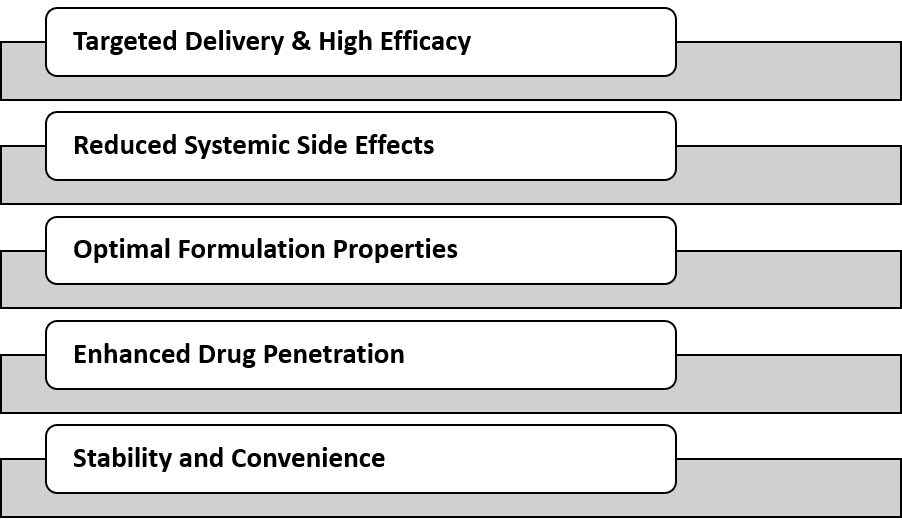
Topical gel formulation show the various advantages over traditional drug delivery system. It is convenient as well as show the targeted drug delivery. (10,24)
CONCLUSION
Topical gel formulations offer several advantages including improved patient compliance, better cosmetic acceptability and efficient drug delivery to skin layers. Halcinonide topical gel represents a promising dosage form for management of inflammatory skin disorders. polymer selection, penetration enhancers and viscosity adjustment strongly influence drug release behaviour of topical gels. Many studies support the use of Carbopol and HPMC polymers for preparing stable dermatological gels with good spreadability. pH, viscosity, spreadability, drug content, and in‑vitro diffusion are essential for assessing the quality and effectiveness of topical gels. Many studies confirmed that Carbopol‑based gels often provide better spreadability and controlled drug release compared with other gel bases. Stability studies also indicate that maintaining suitable pH and storage conditions is important to preserve the physical and chemical stability of the formulation. It provide a useful foundation for further research and development of improved Halcinonide topical gel formulations. Future research may focus on advanced delivery systems that further enhance dermal penetration and stability of corticosteroid formulations.
REFERENCES


Mayur Narode, Vinayak Munde, A Comprehensive Review on Formulation Development and Evaluation of Topical Gel, Int. J. of Pharm. Sci., 2026, Vol 4, Issue 6, 3799-3805. https://doi.org/10.5281/zenodo.20711153
 10.5281/zenodo.20711153