

We use cookies to ensure our website works properly and to personalise your experience. Cookies policy
SWGP’S Loknete Shri Dadapatil Pharate College of Pharmacy Mandavgan Pharata.
Erdafitinib is a potent pan-fibroblast growth factor receptor (FGFR) inhibitor approved for the treatment of locally advanced or metastatic urothelial carcinoma harboring FGFR genetic alterations. Accurate and reliable analytical methods are essential for the quality control, stability assessment, and regulatory compliance of Erdafitinib pharmaceutical formulations. Reverse Phase High-Performance Liquid Chromatography (RP-HPLC) has emerged as a preferred analytical technique owing to its high sensitivity, selectivity, precision, and reproducibility. The present review summarizes the physicochemical properties of Erdafitinib, analytical approaches reported for its estimation, and the significance of stability-indicating RP-HPLC methods. Particular emphasis is placed on chromatographic method development, optimization of analytical parameters, forced degradation studies, and validation requirements according to International Council for Harmonisation (ICH) guidelines. The review highlights current advancements and future perspectives in the development of robust stability-indicating methods for routine quality control and stability testing of Erdafitinib dosage forms
Cancer is one of the most significant public health challenges worldwide and remains a leading cause of morbidity and mortality. According to global cancer statistics, millions of new cancer cases and cancer-related deaths are reported annually, creating an enormous burden on healthcare systems and society. The complexity of cancer
arises from uncontrolled cell proliferation, genetic mutations, invasion of surrounding tissues, and metastasis to distant organs. Over the past few decades, considerable advances have been made in understanding the molecular mechanisms underlying cancer development and progression, leading to the emergence of targeted therapeutic approaches that offer improved efficacy and reduced toxicity compared with conventional chemotherapy.
Traditional anticancer treatments such as surgery, radiotherapy, and cytotoxic chemotherapy have played an important role in cancer management. However, these treatment modalities often lack specificity and may damage normal healthy cells, resulting in severe adverse effects. Consequently, modern oncology has shifted toward precision medicine and targeted therapies, which are designed to selectively inhibit specific molecular pathways involved in tumor growth and survival. Targeted therapeutic agents have revolutionized cancer treatment by improving clinical outcomes and enhancing the quality of life of patients suffering from various malignancies.
Among the recently developed targeted anticancer agents, Erdafitinib has gained significant attention due to its effectiveness in treating cancers associated with fibroblast growth factor receptor (FGFR) genetic alterations. Erdafitinib is an orally active, potent, and selective pan-fibroblast growth factor receptor (FGFR) tyrosine kinase inhibitor that targets FGFR1, FGFR2, FGFR3, and FGFR4. Fibroblast growth factor receptors are transmembrane receptor tyrosine kinases that play crucial roles in cell proliferation, differentiation, angiogenesis, migration, and survival. Aberrant activation of FGFR signaling pathways due to mutations, amplifications, or gene fusions has been implicated in the development and progression of several types of cancer, including urothelial carcinoma, cholangiocarcinoma, breast cancer, lung cancer, and gastric cancer.
Erdafitinib exerts its pharmacological action by competitively inhibiting the ATP-binding domain of FGFR kinases, thereby preventing receptor autophosphorylation and blocking downstream signaling pathways such as MAPK, PI3K/AKT, and STAT pathways. Inhibition of these signaling cascades suppresses tumor cell proliferation, promotes apoptosis, and reduces angiogenesis. Owing to its promising therapeutic efficacy, Erdafitinib received accelerated approval from the United States Food and Drug Administration (FDA) in 2019 for the treatment of adult patients with locally advanced or metastatic urothelial carcinoma harboring susceptible FGFR3 or FGFR2 genetic alterations who have progressed during or following platinum-containing chemotherapy. This approval marked a significant milestone in precision oncology, as Erdafitinib became the first FGFR-targeted therapy approved for the treatment of urothelial carcinoma.
The growing clinical importance of Erdafitinib has generated a substantial need for reliable analytical methods capable of accurately determining the drug in bulk pharmaceutical materials and finished dosage forms. Analytical methods play a critical role throughout the pharmaceutical product lifecycle, including drug development, formulation optimization, quality control, stability assessment, regulatory approval, and post-marketing surveillance. Regulatory agencies such as the FDA, European Medicines Agency (EMA), and International Council for Harmonisation (ICH) require validated analytical procedures to ensure the identity, strength, quality, purity, and stability of pharmaceutical products.
Among the various analytical techniques available for pharmaceutical analysis, High-Performance Liquid Chromatography (HPLC) has become one of the most widely utilized and accepted methods due to its high sensitivity, specificity, accuracy, precision, and reproducibility. HPLC enables efficient separation and quantification of active pharmaceutical ingredients, impurities, degradation products, and excipients within complex pharmaceutical matrices. In particular, Reverse Phase High-Performance Liquid Chromatography (RP-HPLC) is extensively employed in pharmaceutical industries because of its versatility, robustness, and compatibility with a wide range of compounds possessing varying physicochemical properties.
RP-HPLC operates using a non-polar stationary phase, commonly octadecylsilane (C18)-bonded silica, and a relatively polar mobile phase consisting of aqueous buffers mixed with organic solvents such as methanol or acetonitrile. Separation is achieved based on differences in hydrophobic interactions between analytes and the stationary phase. The technique offers excellent resolution, short analysis time, high throughput, and superior quantitative performance, making it particularly suitable for routine quality control and stability studies of pharmaceutical products.
One of the most important requirements for pharmaceutical analytical methods is their ability to function as stability-indicating methods. A stability-indicating method is an analytical procedure that accurately and specifically measures the active pharmaceutical ingredient in the presence of degradation products, process-related impurities, excipients, and other potential interfering substances. Such methods are indispensable for evaluating the stability profile of pharmaceutical compounds and establishing appropriate storage conditions and shelf-life specifications.
Drug substances and pharmaceutical formulations may undergo degradation when exposed to various environmental factors, including heat, light, humidity, oxidation, acidic conditions, and alkaline conditions. These degradation processes can lead to reduced therapeutic efficacy, altered pharmacokinetic behavior, and the formation of potentially toxic degradation products. Therefore, regulatory guidelines recommend conducting forced degradation studies under different stress conditions to assess the intrinsic stability of pharmaceutical compounds and to demonstrate the stability-indicating capability of analytical methods.
The International Council for Harmonisation (ICH) guidelines Q1A(R2) and Q2(R1) provide comprehensive recommendations regarding stability testing and analytical method validation. According to these guidelines, a stability-indicating method should be validated for parameters such as specificity, linearity, accuracy, precision, robustness, limit of detection (LOD), limit of quantification (LOQ), and system suitability. Compliance with these validation requirements ensures that the developed analytical method consistently generates reliable and reproducible results.
Although several analytical methods including UV-visible spectrophotometry, LC-MS/MS, and conventional HPLC techniques have been reported for the estimation of Erdafitinib, limited information is available regarding comprehensive stability-indicating RP-HPLC methods specifically designed for routine quality control and stability evaluation of pharmaceutical dosage forms. Consequently, there is a growing interest in developing simple, rapid, cost-effective, precise, and robust RP-HPLC methods capable of accurately quantifying Erdafitinib while effectively separating it from degradation products and formulation excipients.
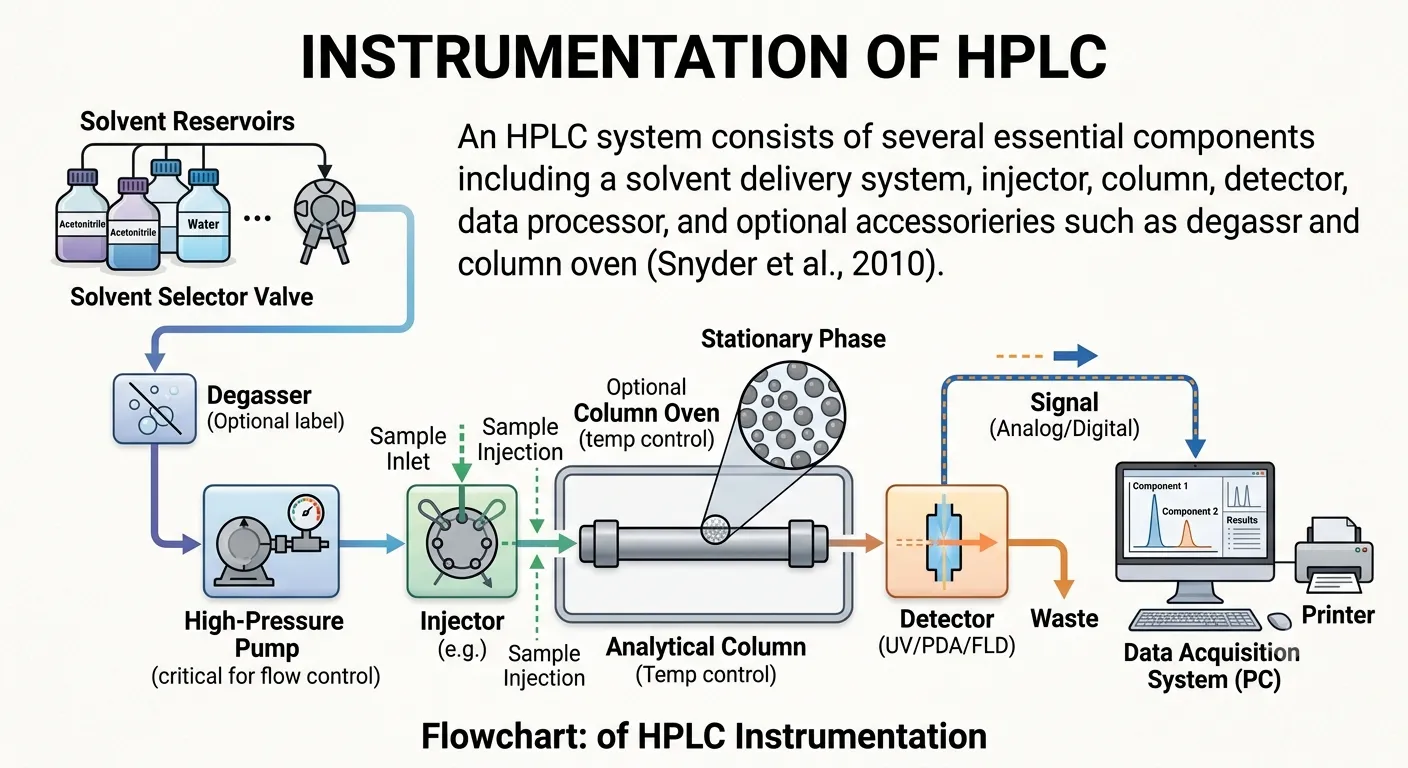
Fig. No.: 1 Flow Chart Instrumentation of HPLC
The development of a validated stability-indicating RP-HPLC method for Erdafitinib offers numerous advantages, including improved quality assurance, enhanced regulatory compliance, reliable stability assessment, and effective monitoring of pharmaceutical formulations throughout their shelf life. Such methods facilitate routine quality control testing and contribute significantly to ensuring the safety, efficacy, and quality of Erdafitinib-containing pharmaceutical products.
Therefore, the present review aims to comprehensively discuss the principles, strategies, and recent advances in stability-indicating RP-HPLC method development and validation for the estimation of Erdafitinib in pharmaceutical dosage forms. Particular emphasis is placed on chromatographic optimization, forced degradation studies, validation parameters according to ICH guidelines, and the practical applications of these methods in pharmaceutical quality control and stability testing.
II. DRUG PROFILE OF ERDAFITINIB
2.1 Chemical Information
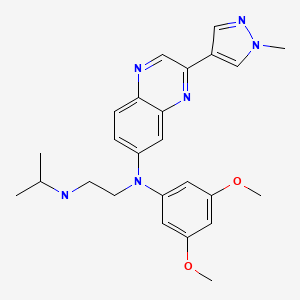
Fig. No.: 02 Structure of Erdafitinib
2.2 Mechanism of Action
Erdafitinib inhibits FGFR-mediated signaling pathways responsible for cellular proliferation, differentiation, angiogenesis, and survival. By blocking receptor autophosphorylation, the drug suppresses downstream signaling pathways such as MAPK and PI3K/AKT, leading to inhibition of tumor growth and induction of apoptosis.
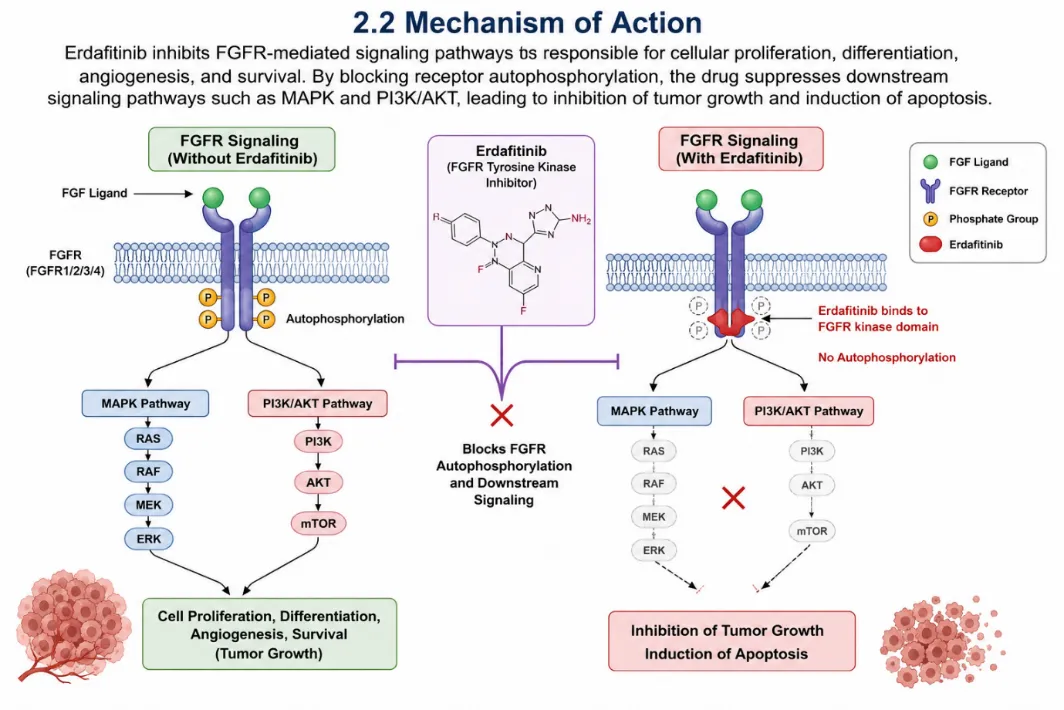
Fig No.: 03 Mechanism of Action
2.3 Pharmacokinetic Properties
The pharmacokinetic profile of Erdafitinib plays a crucial role in its therapeutic efficacy, dosing regimen, and overall clinical performance. Erdafitinib is an orally administered pan-fibroblast growth factor receptor (FGFR) tyrosine kinase inhibitor that exhibits favorable pharmacokinetic characteristics, including efficient absorption, extensive tissue distribution, hepatic metabolism, prolonged elimination half-life, and predictable excretion patterns. These properties contribute significantly to its effectiveness in the treatment of patients with FGFR-altered malignancies, particularly locally advanced or metastatic urothelial carcinoma.
Absorption
Following oral administration, Erdafitinib is rapidly and efficiently absorbed from the gastrointestinal tract. Clinical pharmacokinetic studies have demonstrated that the drug possesses high oral bioavailability, enabling adequate systemic exposure after administration. Peak plasma concentrations (Cmax) are typically achieved within 2 to 4 hours (Tmax) following oral dosing, indicating rapid absorption into the systemic circulation.
The absorption of Erdafitinib is not significantly affected by food intake, allowing flexibility in dosing with or without meals. The predictable absorption profile facilitates consistent plasma drug concentrations and contributes to improved patient compliance. Following repeated dosing, steady-state plasma concentrations are generally achieved within approximately two weeks of continuous treatment, ensuring sustained therapeutic activity.
Distribution
After absorption into the bloodstream, Erdafitinib undergoes extensive distribution throughout the body. The drug exhibits a large apparent volume of distribution, indicating its ability to penetrate various tissues and reach target sites effectively. This extensive tissue distribution is advantageous in oncology therapy, as it enhances drug exposure within tumor tissues and contributes to its antitumor activity.
Erdafitinib demonstrates a high degree of plasma protein binding, exceeding 99%, primarily to serum albumin and alpha-1-acid glycoprotein. Although highly protein-bound, the free fraction of the drug remains sufficient to exert pharmacological effects through inhibition of FGFR signaling pathways. The extensive binding also contributes to prolonged systemic retention and maintenance of therapeutic concentrations over an extended period.
Metabolism
Metabolism represents a critical component of Erdafitinib pharmacokinetics. The drug undergoes extensive hepatic biotransformation primarily through the cytochrome P450 enzyme system. The principal metabolic enzymes involved in Erdafitinib metabolism are CYP2C9 and CYP3A4, which convert the parent compound into several metabolites through oxidative and other metabolic pathways.
Among these enzymes, CYP2C9 plays a major role in the metabolic clearance of Erdafitinib, while CYP3A4 contributes to a lesser extent. Genetic polymorphisms affecting CYP2C9 activity may influence individual patient responses and plasma drug concentrations. Consequently, variations in metabolic capacity can result in differences in therapeutic efficacy and toxicity among patients.
Drug-drug interactions may also occur when Erdafitinib is co-administered with potent CYP2C9 or CYP3A4 inhibitors or inducers. Such interactions can alter systemic exposure and necessitate dosage adjustments or careful clinical monitoring. Understanding the metabolic profile of Erdafitinib is therefore essential for optimizing treatment outcomes and minimizing adverse effects.
Elimination
Erdafitinib exhibits a relatively long elimination half-life of approximately 32 hours, which supports once-daily oral dosing. The prolonged half-life ensures sustained inhibition of FGFR signaling pathways and helps maintain effective therapeutic plasma concentrations throughout the dosing interval.
The elimination process follows first-order kinetics, with plasma concentrations gradually decreasing over time after administration. The extended half-life reduces fluctuations between peak and trough concentrations, thereby promoting stable pharmacological activity and enhancing treatment efficacy. This pharmacokinetic characteristic also contributes to improved patient adherence by reducing the frequency of dosing.
Excretion
Excretion of Erdafitinib and its metabolites occurs primarily through fecal elimination, with a smaller proportion being eliminated via the urinary route. Studies have shown that the majority of administered drug-related material is recovered in feces, indicating that biliary excretion represents the dominant elimination pathway. A comparatively lower percentage is excreted through urine, mainly in the form of metabolites.
The dual excretion pathways help facilitate efficient clearance of the drug and its metabolic products from the body. Since renal excretion contributes only partially to total drug elimination, mild to moderate renal impairment generally has a limited effect on overall pharmacokinetics. Nevertheless, patient-specific factors such as hepatic dysfunction, renal impairment, age, and concomitant medications should be considered when evaluating Erdafitinib therapy.
III. CLINICAL SIGNIFICANCE OF PHARMACOKINETIC PROPERTIES
The favorable pharmacokinetic profile of Erdafitinib contributes significantly to its clinical success as a targeted anticancer therapy. Rapid absorption ensures timely achievement of therapeutic plasma levels, while extensive tissue distribution enables effective tumor penetration. Hepatic metabolism through CYP2C9 and CYP3A4 facilitates biotransformation and clearance, whereas the prolonged elimination half-life supports convenient once-daily dosing. Furthermore, predominant fecal excretion reduces dependence on renal elimination and provides flexibility in patients with varying degrees of renal function.
Overall, Erdafitinib exhibits predictable and well-characterized pharmacokinetic behavior that supports its safe and effective use in cancer treatment. Understanding these pharmacokinetic properties is essential for dosage optimization, therapeutic monitoring, management of drug interactions, and the successful development of analytical methods for its quantitative determination in pharmaceutical dosage for
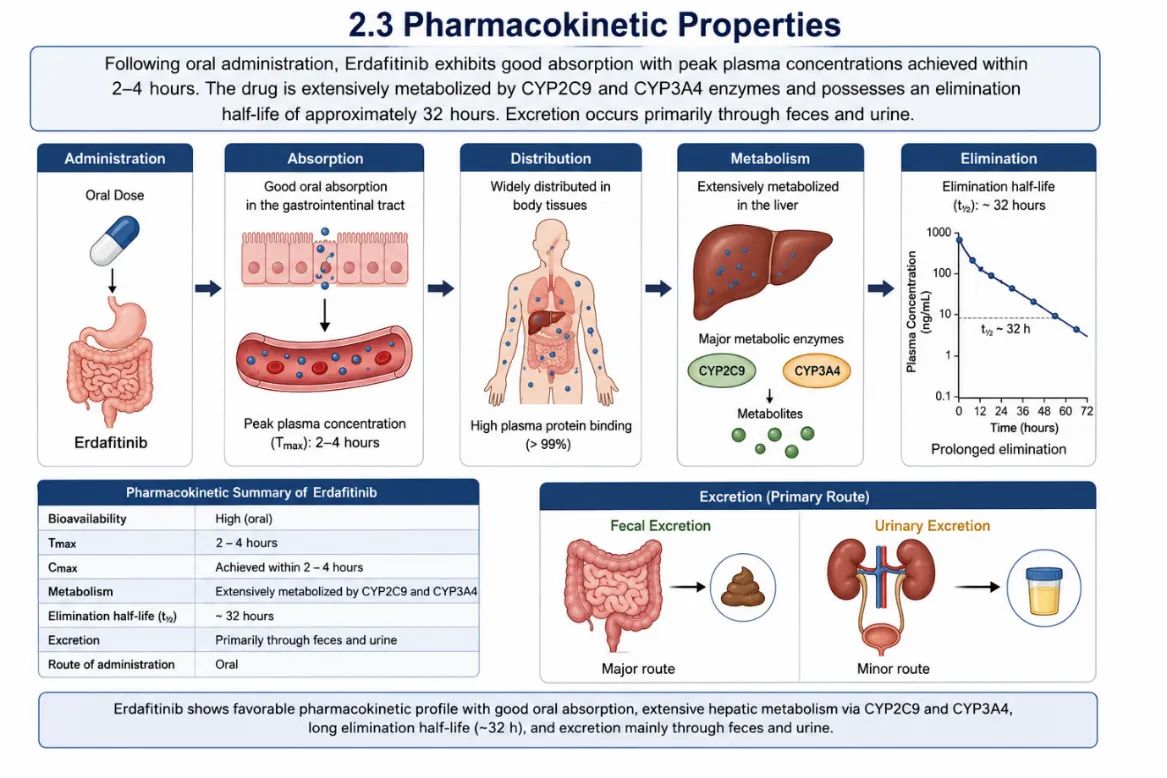
Fig No.: 04 Pharmacokinetic Properties
IV. IMPORTANCE OF STABILITY-INDICATING ANALYTICAL METHODS
Stability studies are critical during pharmaceutical development and commercialization. Drug substances may undergo degradation due to environmental factors such as temperature, humidity, light, acidic or alkaline conditions, and oxidation.
A stability-indicating method should:
V. RP-HPLC IN PHARMACEUTICAL ANALYSIS
High-Performance Liquid Chromatography (HPLC) is one of the most powerful and widely utilized analytical techniques in pharmaceutical sciences. Among its various modes, Reverse Phase High-Performance Liquid Chromatography (RP-HPLC) has emerged as the most commonly employed chromatographic method for the qualitative and quantitative analysis of pharmaceutical compounds. Owing to its exceptional sensitivity, specificity, reproducibility, and versatility, RP-HPLC plays a vital role in drug discovery, formulation development, quality control, stability testing, bioanalysis, and regulatory compliance.
The pharmaceutical industry relies heavily on RP-HPLC for the identification, separation, and quantification of active pharmaceutical ingredients (APIs), impurities, degradation products, excipients, and metabolites. The technique is particularly valuable because it can analyze compounds with diverse physicochemical properties while maintaining high analytical accuracy and precision. RP-HPLC methods are routinely used throughout the pharmaceutical product lifecycle, from research and development to commercial manufacturing and post-marketing surveillance.
One of the major reasons for the widespread adoption of RP-HPLC is its ability to provide excellent chromatographic separation even in complex pharmaceutical matrices. The technique offers robust performance, minimal sample preparation requirements, and compatibility with various detection systems such as ultraviolet (UV), photodiode array (PDA), fluorescence, refractive index (RI), and mass spectrometric (MS) detectors. These advantages make RP-HPLC an indispensable tool in modern pharmaceutical analysis.
Principle of RP-HPLC
Reverse Phase High-Performance Liquid Chromatography operates on the principle of hydrophobic interactions between analyte molecules and a non-polar stationary phase. In RP-HPLC, the stationary phase is generally composed of silica particles chemically bonded with hydrophobic groups, most commonly octadecylsilane (C18), octylsilane (C8), or phenyl functional groups. Among these, C18 columns are the most widely used due to their superior retention and separation characteristics.
The mobile phase typically consists of a mixture of water or aqueous buffers and organic solvents such as methanol or acetonitrile. Since the stationary phase is non-polar and the mobile phase is relatively polar, compounds are separated according to their hydrophobicity. Molecules with greater hydrophobic character exhibit stronger interactions with the stationary phase and therefore have longer retention times, whereas more polar compounds elute more rapidly.
As the sample passes through the chromatographic column under high pressure, individual components interact differently with the stationary and mobile phases, resulting in their separation and subsequent detection. The generated chromatogram provides information regarding retention time, peak area, peak height, and peak shape, which are utilized for qualitative and quantitative analysis.
Advantages of RP-HPLC
RP-HPLC offers numerous advantages that make it the preferred analytical technique in pharmaceutical laboratories:
High Sensitivity and Selectivity
RP-HPLC can detect and quantify compounds at very low concentration levels with excellent specificity. This characteristic is particularly important for impurity profiling and trace-level analysis.
Excellent Reproducibility
The technique provides highly reproducible retention times and peak areas, ensuring consistency in analytical results across multiple runs and laboratories.
Rapid Analysis
Modern RP-HPLC systems allow rapid separation and quantification of analytes, reducing analysis time and increasing laboratory productivity.
Compatibility with Multiple Detection Systems
RP-HPLC can be coupled with UV, PDA, fluorescence, and mass spectrometric detectors, enhancing its analytical capabilities.
Suitability for Stability Studies
The technique is highly effective in stability-indicating method development because it can separate active pharmaceutical ingredients from degradation products and impurities.
Effective Separation of Complex Mixtures
RP-HPLC provides excellent resolution for compounds present in complex pharmaceutical formulations, biological matrices, and degradation samples.
Wide Applicability
The method can be applied to a broad range of pharmaceutical compounds, including anticancer agents, antibiotics, antihypertensive drugs, antidiabetic agents, and biological products.
Applications of RP-HPLC in Pharmaceutical Analysis
RP-HPLC is extensively utilized for:
VI. METHOD DEVELOPMENT CONSIDERATIONS FOR ERDAFITINIB
The development of a robust, accurate, and stability-indicating RP-HPLC method for Erdafitinib requires systematic optimization of several chromatographic parameters. Method development aims to achieve efficient separation of Erdafitinib from degradation products, impurities, and formulation excipients while maintaining acceptable analytical performance characteristics such as accuracy, precision, sensitivity, and robustness.
A successful RP-HPLC method should provide symmetrical peaks, adequate resolution, reproducible retention times, and acceptable analysis time. The optimization process generally involves selection of the chromatographic column, mobile phase composition, detection wavelength, flow rate, injection volume, pH, and temperature.
Selection of Chromatographic Column
The chromatographic column is one of the most critical components affecting method performance. Selection of an appropriate stationary phase significantly influences retention behavior, peak symmetry, resolution, and overall chromatographic efficiency.
For Erdafitinib analysis, C18 reverse-phase columns are most commonly employed due to their excellent retention characteristics and compatibility with moderately lipophilic compounds. The hydrophobic interactions between Erdafitinib molecules and the C18 stationary phase provide effective separation and improved peak shape.
Commonly used column specifications include:
Mobile Phase Optimization
The composition of the mobile phase plays a decisive role in chromatographic separation and directly affects retention time, peak shape, resolution, and analytical sensitivity.
During method development for Erdafitinib, various combinations of aqueous buffers and organic solvents are investigated to achieve optimum chromatographic performance. Commonly utilized solvents include:
Organic Solvents
Aqueous Components
Acetonitrile is frequently preferred because of its lower viscosity, superior elution strength, and ability to produce sharper chromatographic peaks. Methanol may also be used either alone or in combination with acetonitrile to improve selectivity and resolution.
Buffer selection is important for maintaining consistent pH and minimizing peak tailing. Ammonium formate and phosphate buffers are commonly employed due to their excellent buffering capacity and compatibility with UV detection.
Optimization of mobile phase composition aims to achieve:
Detection Wavelength Selection
Selection of an appropriate detection wavelength is essential for obtaining maximum analytical sensitivity and accurate quantification.
Ultraviolet spectral analysis of Erdafitinib reveals strong absorbance in the UV region, with a maximum absorbance (λmax) observed around 292 nm. Therefore, detection at or near 292 nm is generally selected for routine chromatographic analysis.
The choice of λmax offers several advantages:
Optimization of Flow Rate and pH
Flow rate and mobile phase pH significantly influence chromatographic performance. Most reported methods for Erdafitinib utilize a flow rate of approximately 1.0 mL/min, which provides a balance between resolution and analysis time.
The pH of the mobile phase is generally maintained within the acidic range (approximately pH 3.0–4.5) to improve peak symmetry and minimize analyte ionization. Appropriate pH control also contributes to enhanced reproducibility and method robustness.
Method Development Objectives
The primary objectives during RP-HPLC method development for Erdafitinib include:
VII. LITERATURE REVIEW OF REPORTED ANALYTICAL METHODS FOR ERDAFITINIB
The increasing therapeutic significance of Erdafitinib has necessitated the development of reliable analytical methods for its identification, quantification, pharmacokinetic evaluation, and quality control. Several analytical approaches have been reported in the literature, including UV spectrophotometric methods, Reverse Phase High-Performance Liquid Chromatography (RP-HPLC), and Liquid Chromatography coupled with Tandem Mass Spectrometry (LC-MS/MS). These methods differ in terms of sensitivity, selectivity, instrumentation requirements, cost, and applicability in routine pharmaceutical analysis.
UV Spectrophotometric Methods
UV-visible spectrophotometry is one of the simplest and most economical analytical techniques employed for pharmaceutical analysis. The technique is based on the absorption of ultraviolet radiation by drug molecules at specific wavelengths and is widely utilized for routine quality control purposes.
Hemalatha et al. developed a simple, rapid, and cost-effective UV spectrophotometric method for the quantitative estimation of Erdafitinib. The method utilized methanol as a solvent and measured absorbance at a wavelength of 293 nm, corresponding to the maximum absorbance (λmax) of the drug. Validation studies demonstrated satisfactory linearity, precision, accuracy, and robustness within the selected concentration range.
The developed UV method exhibited good correlation coefficients, acceptable recovery values, and low relative standard deviation (%RSD), indicating its suitability for routine analysis. However, despite its simplicity and affordability, UV spectrophotometry possesses limited specificity because it cannot effectively distinguish the drug from its degradation products, impurities, or formulation excipients. Consequently, its application in stability studies and impurity profiling remains restricted.

Fig. No.: 05 UV Spectrophotometric Methods
RP-HPLC Methods
Reverse Phase High-Performance Liquid Chromatography (RP-HPLC) has emerged as the preferred analytical technique for the determination of Erdafitinib due to its superior sensitivity, specificity, and chromatographic resolution.
Maithani et al. reported a validated RP-HPLC method for the quantitative estimation of Erdafitinib in pharmaceutical dosage forms. The chromatographic separation was achieved using a Hypersil ODS C18 column as the stationary phase. The optimized mobile phase consisted of sodium acetate buffer, methanol, and acetonitrile in appropriate proportions, providing satisfactory peak symmetry and resolution.
The developed method demonstrated excellent linearity with a correlation coefficient (R²) greater than 0.999, indicating a strong relationship between concentration and detector response. Accuracy studies yielded recovery values close to 100%, confirming the reliability of the analytical procedure. Precision studies showed low %RSD values, while robustness testing indicated minimal variation under deliberate changes in chromatographic conditions.
RP-HPLC methods offer several advantages over spectrophotometric techniques, including enhanced specificity, improved sensitivity, effective separation of degradation products, and compatibility with stability-indicating applications. As a result, RP-HPLC remains the most widely accepted method for routine quality control and stability assessment of Erdafitinib formulations.
LC-MS/MS Methods
Liquid Chromatography coupled with Tandem Mass Spectrometry (LC-MS/MS) represents one of the most advanced analytical techniques available for pharmaceutical and bioanalytical investigations. The combination of chromatographic separation and mass spectrometric detection provides exceptional sensitivity, selectivity, and structural information.
Perera et al. developed an LC-MS/MS method for the determination of Erdafitinib during preclinical and pharmacokinetic investigations. The method enabled accurate quantification of Erdafitinib at very low concentration levels in biological matrices and facilitated detailed pharmacokinetic evaluations.
Similarly, Bahleda et al. employed LC-MS/MS techniques during clinical studies to assess the pharmacokinetic profile, bioavailability, metabolism, and systemic exposure of Erdafitinib in cancer patients. These methods demonstrated excellent sensitivity and specificity, allowing detection of trace concentrations of the drug and its metabolites.
Despite their superior analytical performance, LC-MS/MS methods require sophisticated instrumentation, highly skilled personnel, extensive maintenance, and substantial operational costs. Therefore, their routine implementation in quality control laboratories may not be economically feasible. Consequently, RP-HPLC continues to be the preferred choice for routine pharmaceutical analysis and stability studies.
Comparative Assessment of Reported Methods
Among the available analytical approaches, UV spectrophotometric methods provide simplicity and cost-effectiveness but lack adequate specificity. LC-MS/MS methods offer unparalleled sensitivity and selectivity but involve significant operational expenses. RP-HPLC provides an ideal balance between analytical performance, cost-effectiveness, reproducibility, and regulatory acceptance, making it the most suitable technique for routine analysis and stability-indicating studies of Erdafitinib.
VIII. FORCED DEGRADATION STUDIES
Forced degradation studies, also known as stress testing studies, are essential components of stability-indicating method development. These studies are designed to evaluate the intrinsic stability characteristics of a drug substance by exposing it to extreme environmental and chemical conditions. The primary objective is to identify potential degradation pathways, characterize degradation products, and demonstrate the ability of the analytical method to separate the active pharmaceutical ingredient from degradation products.
According to International Council for Harmonisation (ICH) guidelines, forced degradation studies should be conducted under various stress conditions, including acidic, alkaline, oxidative, thermal, and photolytic environments.
Acidic Degradation
Acid hydrolysis studies are performed to assess the susceptibility of Erdafitinib to degradation under acidic conditions. Typically, hydrochloric acid (HCl) solutions of varying concentrations are employed to induce degradation.
Exposure of Erdafitinib to acidic media may result in partial degradation and formation of degradation products through hydrolytic reactions. The extent of degradation depends on factors such as acid concentration, exposure time, and temperature. The developed RP-HPLC method should be capable of resolving the parent drug peak from all acid-induced degradation products.
Alkaline Degradation
Alkaline hydrolysis studies evaluate the stability of Erdafitinib under basic conditions. Sodium hydroxide (NaOH) is commonly used as the degrading agent.
Erdafitinib may undergo significant hydrolysis and structural modification when exposed to alkaline environments. In many pharmaceutical compounds, alkaline degradation occurs more rapidly than acidic degradation. Therefore, chromatographic methods must effectively separate the parent compound from all alkaline degradation products to ensure accurate quantification.
Oxidative Degradation
Oxidative degradation studies investigate the susceptibility of Erdafitinib to oxidation reactions. Hydrogen peroxide (H₂O₂) is generally employed as the oxidizing agent.
Oxidative stress can generate several degradation products through reactions involving electron transfer and molecular oxygen. Observation of degradation under oxidative conditions indicates the drug's vulnerability to atmospheric oxygen and oxidative impurities during manufacturing and storage. RP-HPLC analysis should clearly distinguish oxidation products from the intact drug peak.
Thermal Degradation
Thermal degradation studies are conducted by exposing the drug substance to elevated temperatures for predetermined periods.
Heat-induced degradation may lead to structural alterations and formation of degradation products that compromise drug potency and stability. Thermal stress testing provides valuable information regarding storage, transportation, and processing conditions. The analytical method should accurately detect and quantify degradation resulting from thermal exposure.
Photolytic Degradation
Photostability studies evaluate the effect of ultraviolet and visible light on the stability of Erdafitinib.
Exposure to light may initiate photochemical reactions leading to degradation and formation of photoproducts. Such studies help determine appropriate packaging requirements and storage recommendations. A stability-indicating RP-HPLC method should effectively resolve photolytic degradation products from the parent drug peak.
Significance of Forced Degradation Studies
Forced degradation studies provide critical information regarding:
IX. VALIDATION OF STABILITY-INDICATING RP-HPLC METHODS
Analytical method validation is a documented process that confirms the suitability of an analytical method for its intended purpose. Validation ensures that the developed RP-HPLC method consistently generates accurate, reliable, and reproducible results.
The International Council for Harmonisation guideline ICH Q2(R1) specifies various validation parameters that should be evaluated during method validation.
Specificity
Specificity refers to the ability of the analytical method to accurately measure Erdafitinib in the presence of impurities, degradation products, excipients, and other potential interfering substances.
A stability-indicating RP-HPLC method should demonstrate complete chromatographic separation between the Erdafitinib peak and all degradation products generated during forced degradation studies. Peak purity assessment using PDA detection further confirms method specificity.
Linearity
Linearity evaluates the relationship between analyte concentration and detector response.
For Erdafitinib, linearity is typically assessed over a concentration range of 5–30 μg/mL. Calibration curves generally exhibit excellent linearity with correlation coefficients (R²) greater than 0.999, indicating proportional detector response across the selected concentration range.
Accuracy
Accuracy reflects the closeness of measured values to the true value.
Accuracy is commonly determined through recovery studies performed at different concentration levels, such as 80%, 100%, and 120% of the target concentration. Acceptable recovery values for Erdafitinib generally range between 98% and 102%, confirming the reliability of the analytical method.
Precision
Precision evaluates the degree of agreement among individual measurements under specified conditions.
Repeatability (Intra-day Precision)
Repeatability is assessed by analyzing multiple replicates of the same sample on the same day under identical conditions.
Intermediate Precision (Inter-day Precision)
Intermediate precision evaluates reproducibility on different days, by different analysts, or using different instruments.
Sensitivity
Sensitivity determines the lowest concentration of analyte that can be detected or quantified.
Typical values reported for Erdafitinib include:
Robustness
Robustness assesses the reliability of the method when subjected to small deliberate variations in analytical parameters.
Parameters commonly evaluated include:
System Suitability Testing
System suitability testing verifies the performance of the chromatographic system before sample analysis.
Important parameters include:
X. FUTURE PERSPECTIVES
Emerging analytical technologies continue to improve pharmaceutical analysis. Future research directions include:
These advancements may enhance analytical efficiency while reducing solvent consumption and analysis time.
CONCLUSION
Erdafitinib is an important targeted anticancer agent requiring accurate and reliable analytical methods for quality assessment and stability evaluation. Stability-indicating RP-HPLC methods provide a robust, precise, sensitive, and cost-effective approach for the quantitative estimation of Erdafitinib in pharmaceutical dosage forms. The successful separation of degradation products from the parent drug ensures method specificity and regulatory compliance. Validation according to ICH guidelines confirms the suitability of RP-HPLC methods for routine quality control, formulation development, and stability studies. Continued advancements in chromatographic technologies are expected to further improve the analytical assessment of Erdafitinib and other targeted anticancer agents.
REFERENCES


Komal Humbe, Sonawane A., Sugriv Ghodke, Dr. H. Kamble, A Comprehensive Review on Stability-Indicating RP-HPLC Methods for the Estimation of Erdafitinib in Pharmaceutical Dosage Forms, Int. J. of Pharm. Sci., 2026, Vol 4, Issue 7, 1167-1183, https://doi.org/10.5281/zenodo.21218230
 10.5281/zenodo.21218230