

We use cookies to ensure our website works properly and to personalise your experience. Cookies policy
KYDSCTs College of Pharmacy , Sakegaon , Bhusawal 425201, Dist., Jalgaon, MS, India.
The roots and foundation of green chemistry focus on driving both environmental health and financial success globally. This review systematically surveyed a cohesive framework of 12 principles. The basic concepts of Green and Sustainable Chemistry, focusing on atom and economy principles, are presented in the context of organic synthesis. The chemists, both current and future, are trained to design products and processes with heightened environmental awareness. This article presents selected examples of green chemistry principles applied in everyday life. The article explores emerging directions in Green Chemistry, focusing on the obstacles involved in applying the principle as an integrated framework.
Green Chemistry is defined as design of chemical process & Product to reduce or eliminate hazardous substance [1] . The Concept of green Chemistry were formulate at beginning of 1990’s nearly 20 yrs ago [2]. The first green chemistry research initiatives, Alternative Synthetic Pathways research Solitication, were started in 1991 by the US Environmental Protection Agency's Office of Pollution Prevention & Toxic [3].
The National Science Foundation inked an official partnership agreement with the Environmental Protection Agency (EPA) in 1992 and launched a specific initiative to study environmentally friendly chemical processes. The EPA formally launched the "U.S. Green Chemistry Program" in 1993 [4].The US Presidential Green Chemistry Award was established in 1995 [5],5 and the first five awards were given out in 1996 [6].
The Green Chemistry Institute was established in 1997 [7]. In 1998, Paul Antas and John Warner introduced Twelve Principle of Green Chemistry [8].The Chemistry Royal Society Green Chemistry published its first issue in 1999 [9].
During 1990s, Both Italy and the United States launched significant programs in green chemistry in the A consortium of Italian universities made green chemistry their primary area of study. Kingdom Researcher, United States Create a new green chemistry research and education initiative. Japan established the Green 7 Sustainable Chemistry Network (GSCN) in the late 1990s to advance eco-friendly chemistry research and development [10]. The first books, research papers, and conferences on green chemistry were published [11].
The important Aspect of Green chemistry is Concept Of Design. It is essential element requiring aware & discussing use of Criteria , principle, Methodologies in Green Chemistry [2].
Twelve Principles of Green Chemistry :-
The twelve concept of Green chemistry introduced by parul antas & John Warner in 1998 (fig1) [8]. They are guiding the framework of new chemical process & Product applying
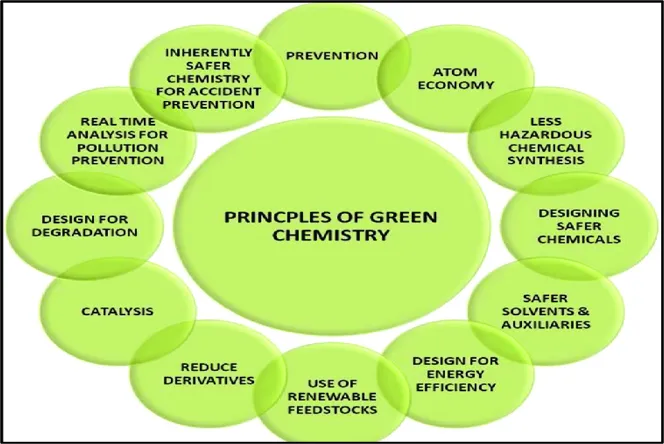
Figure 1: Principle of Green Chemistry
for all aspect of process of lifecycle from the raw material used for safety of Product & design rule to helps chemists to achieve international goal of suitanibility [12] .
1. Prevention: Preventing waste is preferable to treating it after it has already occurred.
2. Atom Economy: Synthetic techniques should be created to optimize the final product's inclusion of all elements used during the process.
3. Less dangerous chemical synthesis: Synthetic processes should be created to use and produce materials that are safe for the environment and human health.
4. Creating Safer Chemicals: Chemical products should minimize toxicity while maintaining their functional performance.
5. Safer solvents and auxiliary substances: Whenever feasible, avoid using auxiliary substances.
6. Design for Energy Efficiency: The economic and environmental impact of energy requirements should be reduced.
7. Use of Renewable Feedstocks: Whenever technically possible, a raw resource should be renewable rather than depleting.
8.Reduce Derivatives: Since blocking groups and short-term physical/chemical process modifications call for extra reagents, they should be used as little as possible.
9. Catalysis: Stoichiometric reagents are inferior than catalytic reagents
10. Design for degradation: Chemical goods should be made to break down into harmless degradation products at the end of their useful lives.
11. Real-time Analysis for Pollution Prevention: Real-time analysis requires the development of analytical techniques.
12. Inherently Safer Chemistry for Accident Prevention: Materials used in chemical processes should be selected to reduce chemical mishaps, such as flames and leaks.
Applications of Green Chemistry in Daily Life :-
1) Green Clothes for Dry Cleaning:
The solvent used to dry clean clothing is perchloroethylene.It may be carcinogenic and contaminate groundwater when disposed of.The Micell technique, created by Joseph De Simons, Timothy Remark, and James McClain, uses liquid carbon dioxide as a surfactant to dry clothing [13] .
2) Green bleaching agents:
When making white paper, lignin is extracted by immersing small pieces of wood in a solution of sodium hydroxide and sodium sulfide, then chlorine interacts with clilovines. lignin to produce furans and chlorinated dioxins. These carcinogens can lead to compounds that cause health issues [14].
3) Wind Generator :
The cost of a wind generator at home is extremely high, and it uses off-the-shelf parts from nearby hardware stores. To support power purchased from the local electrical grid, it either bought kits or paid for professional installation.
4) Home Insulation:
According to the EPA, 10% of household energy consumption is lost each year as a result of inadequate insulation [15] .
5) Drugs:
By producing less lethal waste, the pharmaceutical industry creates medications with negative side effects [16].The second-generation green synthesis of sitagliptin, which is used to treat type 2 diabetes, was created by Merck and Codexis [17].
Fields of Green chemistry with new technologies Development :-
Green chemistry and green engineering have advanced across various research and technology fields, offering cutting-edge research and practical applications spanning the chemical product spectrum. The primary focus of the Research and Technology field of Green Chemistry and Green Engineering involves as
1) Reduction of global warming
2) Use of Carbon Dioxide as raw material for chemical stSynthesis
3) Microwave
4) Electrochemical & Ultrasound Synthetic Method
5) Solvent Free Reaction
6) Phytoremediation
7) Waste Management
8) Innovative Food Product
9) Biocatalysis
10) Renewable Energy Source [18].
Emergencies Technology :-
1) Artificial Intelligence:
AI functions as an intelligent assistant that can identify the most suitable, environmentally friendly solvent to reduce laboratory waste. Prior to conducting laboratory tests, the algorithm can simulate the optimisation of energy efficiency and perform predictive virtual screening of sustainable chemicals [19].
2) Green solvent :-
Ionic liquids , Ecofriendly solvent , supercritical fluid safer than Volatile organic solvent .it adapted to target specific Reactions enhancing yields.
3) Green Catalyst :-
Nano structured , biomimetic, Single atom catalysts improves selectivity & recyclability. Sunlight will reaction at room temperature through Photocatalysis & Electrocatalysis [20].
4) Biological Engineering :-
Protein engineering is highly specific & efficient biocatalyst for individual reactions. microbial Fermentation can generate chemicals,medicines , materials from renewable biomass [21].
5) Sustainable Chemistry :-
Future analytical methods to stop Hazardous by product.Sensor based technologies Like Raman & NMR Spectroscopy enable data collection & pollution control [22].
Challenges of Green Chemistry:
1) Economic Factor:
The significant financial investment required to implement green technologies hinders many industries from embracing them[23].
2) Sustainability Factor:
Green technologies are still in development and may not be financially viable[22].
3) Compliance Factor:
The regulatory framework for adopting urgent green technologies leads to delays[24].
Future Scope & Challenges :-
1.Research challenges :-
The transformation using energy in place of material. Visible light enables the efficient splitting of water. Solvent systems that promote efficient heat and mass transfer, facilitate reactions, and inherently assist product separation. A synthetic methodology “toolbox” that is atom economical and safe for human health and the environment. Plastics and polymers crafted to decompose harmlessly without the need for additives. Materials are designed to optimize decisions between recycling and reusing based on their embedded entropy. The continuous incorporation of growing knowledge about biological and environmental mechanisms into the design of chemical products, forming “ preventative toxicology.” Produce photovoltaic cells that are more efficient using less energy-intensive manufacturing methods. The progression of sustainable, low-resource power alternatives.
2.Implementation Challenges :-
Regulatory flexibility. Cleaner tech adoption incentives. Programs supporting technology transfer between universities, government agencies, and companies. Extended patent life for optimizing cleaner production processes.
3.Education Challenges :-
Molecular design can systematically identify and adjust hazard and toxicity as intrinsic physical and chemical attributes. We created and used hands-on labs to show green chemistry ideas. Textbook organic chemical equations balanced and “yield” swapped for “atom economy”. The course starts with fundamental chemical toxicology concepts and the molecular origins of hazards. Including green chemistry themes in professional certification assessments. Materials for teachers looking to incorporate green chemistry into their courses. Legislators were educated about green chemistry's advantages[25].
Compliance With Ethical Standards Acknowledgements
The Author Wish to Thank KYDSCT COP , Sakegaon Bhusawal for their willing support & Constant encouragement.
Disclosure of Conflict of interest
The authors declare no conflict of interest, financial or otherwise.
Availability of data and materials
Supplementary material that is available on the publisher’s website along with the published article contains spectroscopic data of all compounds.
REFERENCES

Gomati Bhole, Prajakta Pachpande, Disha Patil, Gayatri Nehete, A Review on Green Chemistry, Int. J. of Pharm. Sci., 2026, Vol 4, Issue 11, 5352-5356. https://doi.org/10.5281/zenodo.24579480
 10.5281/zenodo.24579480