

We use cookies to ensure our website works properly and to personalise your experience. Cookies policy
Shree Santkrupa College of Pharmacy, Ghogaon, Karad. Dist. Satara, SUK, Maharashtra-415 111, India.
The liquisolid system, or powder solution technology, is one of the formulation approaches that can be used to improve the dissolving properties of poorly water-soluble drugs. Drugs which are poorly soluble in water can be incorporated in suitable non-volatile liquid vehicles and then adsorbed on to suitable carrier and coating materials to produce dry looking, non-adherent, free flowing and acceptable compressible powders. The liquisolid powder thus obtained is then subjected to preformulation investigations such as FTIR spectroscopy, differential scanning calorimetry (DSC), solubility test, flow-property assessment and drug–excipient compatibility studies. Solubility is a major hurdle in the development of about one-third of therapeutic candidates, especially those with low water solubility. The liquisolid technique is considered a promising approach for enhancing drug dissolution by increasing their apparent solubility and wettability. Liquisolid compact technology is a new approach for oral drug delivery. The liquisolid formulation concept is based on the conversion of liquid drugs (e.g. water-insoluble drug solutions or suspensions in suitable non-volatile liquid vehicles) into dry, free flowing and sufficiently compressible powders through blending with selected carrier and coating excipients. The method has the potential to improve oral bioavailability of poorly water-soluble drugs by improving drug solubility. The main reasons for better dissolution are the better wettability of the drug, more surface area available for dissolution and molecular dispersion of the drug in the liquid vehicle. The liquisolid approach is very easy to apply in the traditional pharmaceutical manufacturing procedures. It has also been studied for prolonged, controlled and rapid release systems for drug delivery. Thus, liquisolid technology is an effective and perhaps commercially viable approach to overcome the limitations of poorly water soluble drugs in terms of solubility and dissolution.
Poor aqueous solubility is one of the major challenges encountered during the formulation and development of oral dosage forms. A large proportion of newly developed drug candidates exhibit limited aqueous solubility, which may result in slow dissolution, incomplete gastrointestinal absorption and consequently reduced or variable bioavailability. Therefore, improving the solubility and dissolution rate of poorly water-soluble drugs remains an important objective in pharmaceutical formulation development [1-5].
Several approaches have been investigated to improve the dissolution and bioavailability of poorly water-soluble drugs, including particle-size reduction, solid dispersion, complexation, salt formation, cosolvency, surfactant-based systems, nanotechnology and lipid-based formulations. Among these approaches, the liquisolid technique has emerged as a relatively simple and versatile formulation strategy for improving the dissolution performance of poorly water-soluble drugs [2-5] .
The liquisolid technique, also referred to as powder-solution technology, involves converting a liquid medication or a drug solution/suspension in a suitable non-volatile solvent into a dry-looking, free-flowing and compressible powder by incorporating appropriate carrier and coating materials. The resulting powder can subsequently be compressed into tablets or filled into capsules [1,6-8]. The technique is particularly useful for poorly water-soluble and lipophilic drugs because the drug can be molecularly dispersed or dissolved within the liquid vehicle, thereby improving its availability for dissolution [6,7].
Javadzadeh and Siahi described the liquisolid technique as an approach for enhancing the physicochemical properties and dissolution behavior of poorly water-soluble drugs. The fundamental principle is based on the ability of porous carrier particles to absorb or retain the liquid medication while maintaining acceptable flow and compression properties after addition of a suitable coating material [6]. The technique has subsequently been investigated for numerous drugs and dosage forms, with reported improvements in dissolution performance [7-11].
An important advantage of the liquisolid approach is that it can be applied using conventional pharmaceutical processing equipment. The method involves relatively simple processing steps and may therefore provide a practical alternative to more complex solubility-enhancement technologies [1,8]. In addition to immediate-release formulations, modification of the formulation composition, particularly through the use of hydrophobic carriers or matrix-forming polymers, can facilitate sustained drug release [7,9].
The performance of a liquisolid formulation depends on several formulation and process variables, including the solubility of the drug in the selected liquid vehicle, liquid load factor, carrier-to-coating ratio, surface area and porosity of excipients, type and concentration of disintegrant, compression characteristics and physicochemical compatibility of the formulation components [6-10]. Therefore, systematic optimization and appropriate preformulation and post-compression evaluation are essential for the successful development of liquisolid dosage forms.
2. THEORY AND CONCEPT OF LIQUISOLID SYSTEM:
The theoretical basis of the liquisolid technique is related to the conversion of a liquid medication into a dry, non-adherent and free-flowing powder. The liquid medication is first prepared by dissolving or dispersing the drug in a suitable non-volatile liquid vehicle. This liquid is then incorporated into a porous carrier material capable of absorbing the liquid. A fine-particle coating material is subsequently added to improve the flowability and compressibility of the resulting powder [6,8,10].
The mathematical model proposed for liquisolid systems considers the ability of carrier and coating materials to retain liquid while maintaining acceptable flow and compression properties. The liquid retention capacity of the powder system can be described using the concepts of the Φ-value and Ψ-number. These parameters are useful in determining the appropriate quantity of liquid vehicle that can be incorporated without compromising the handling properties of the formulation [6].
The excipient ratio (R) is an important formulation parameter and is defined as the ratio between the weight of carrier material (Q) and coating material (q):
R = Q/q
The liquid load factor (Lf) represents the amount of liquid medication that can be loaded onto a given quantity of carrier and coating materials while maintaining acceptable flowability and compressibility. The mathematical relationship may be expressed as:
Lf = Φ + φ(1/R)
Similarly, the liquid load factor based on the Ψ-number can be represented as:
ΨLf = Ψ + ψ(1/R)
For a particular formulation, the required quantities of carrier and coating materials can be estimated from the liquid load factor. The amount of carrier material can be calculated using:
Q₀ = W/L₀
where Q₀ is the required weight of carrier material, W is the weight of liquid medication and L₀ is the liquid load factor.
The corresponding amount of coating material can be calculated using:
q₀ = Q₀/R
These relationships are useful during formulation development because the carrier-to-coating ratio and liquid load factor directly influence powder flow, compressibility and the final quality of the liquisolid compact [6,8].
3. MECHANISM OF DRUG RELEASE FROM LIQUISOLID SYSTEMS:
The enhanced dissolution of drugs from liquisolid formulations can be attributed primarily to improved wetting, increased effective surface area and enhanced apparent solubility of the drug. These mechanisms work together to facilitate rapid contact between the drug and dissolution medium [1,6-10].
3.1 Increased Effective Surface Area:
In conventional tablets, poorly water-soluble drug particles may exhibit limited contact with the aqueous dissolution medium. In a liquisolid system, the drug is dissolved or molecularly dispersed in the liquid vehicle and distributed throughout the carrier material. Consequently, after exposure to the dissolution medium, the drug becomes available over a larger effective surface area, which may enhance the dissolution rate [6,7].
3.2 Improved Apparent Aqueous Solubility:
The selected non-volatile liquid vehicle can act as a solvent or cosolvent for the drug. Dissolution of the drug within the liquid vehicle may improve its apparent solubility in the formulation and facilitate transfer of the drug into the aqueous dissolution medium [1,6,8]. The extent of this effect depends strongly on the affinity of the drug for the selected solvent.
3.3 Improved Wetting Properties:
Improved wetting of drug particles is another important mechanism responsible for enhanced dissolution. The liquid vehicle facilitates intimate contact between the drug and dissolution medium and can reduce the interfacial resistance to wetting. Consequently, the drug can dissolve more rapidly than the corresponding conventional powder or directly compressed formulation [1,7,10].
These mechanisms have been demonstrated in experimental liquisolid formulations of different poorly water-soluble drugs. For example, the liquisolid technique has been investigated for ketoprofen and telmisartan, where improvement in dissolution characteristics was reported compared with conventional formulations [10,21].
4. OPTIMIZATION OF FORMULATION PARAMETERS:
Optimization of formulation variables is essential for obtaining a liquisolid powder with adequate flowability, compressibility and drug-release characteristics. The principal formulation variables include the liquid vehicle, carrier material, coating material, carrier-to-coating ratio and disintegrant.
Table No. 01: Formulation parameters
|
Formulation parameter |
Desired characteristic |
|
Liquid vehicle |
High drug-solubilizing capacity |
|
Carrier material |
High specific surface area and adequate liquid-retention capacity |
|
Coating material |
High surface area and good flow-enhancing ability |
|
Superdisintegrant |
Rapid tablet disintegration |
|
Excipient ratio |
Appropriate R-value providing acceptable flow and compression |
The concentration and type of liquid vehicle should be selected according to the solubility of the drug. Similarly, the carrier and coating materials should possess suitable porosity, surface area and liquid-retention capacity. The amount of superdisintegrant may be optimized to facilitate rapid tablet disintegration and subsequent drug release [6-10].
5. MECHANISM OF SUSTAINED DRUG RELEASE:
Although liquisolid systems are commonly used to enhance dissolution, the technology can also be adapted for sustained drug delivery. Sustained release may be achieved by incorporating hydrophobic carriers, hydrophobic liquid vehicles or suitable matrix-forming polymers into the formulation [7,9].
Hydrophobic materials can reduce the penetration of the dissolution medium into the compact and consequently retard drug diffusion. Similarly, polymers such as hydroxypropyl methylcellulose can form a hydrated gel layer around the tablet, providing resistance to drug diffusion. The absence or reduction of rapidly acting disintegrants may further contribute to prolonged drug release [7,9].
Thus, the selection of excipients and formulation architecture determines whether a liquisolid system produces rapid dissolution or modified/sustained drug release.
6. REQUIREMENTS FOR PREPARATION OF LIQUISOLID TABLETS:
Successful preparation of liquisolid tablets requires careful selection of the drug, liquid vehicle, carrier material, coating material and other formulation excipients.
6.1 Drug Candidate:
The liquisolid technique is particularly suitable for poorly water-soluble and lipophilic drugs, especially drugs for which dissolution represents a major limitation to oral absorption. Drugs belonging to BCS Class II and, in selected cases, Class IV may be considered potential candidates [1,6-8].
Examples reported in the literature include carbamazepine, famotidine, piroxicam, indomethacin, hydrocortisone, naproxen and prednisolone [2,6-9].
6.2 Non-Volatile Liquid Vehicle:
The liquid vehicle is a critical component of a liquisolid formulation because it dissolves or disperses the drug and facilitates its subsequent release. The solvent should preferably be non-volatile, pharmaceutically acceptable, chemically compatible with the drug and excipients, and sufficiently capable of dissolving the drug [6-8].
Commonly investigated liquid vehicles include polyethylene glycol 200, polyethylene glycol 400, glycerin, propylene glycol and polysorbate 80 [1,6,21].
6.3 Carrier Material:
Carrier materials absorb or adsorb the liquid medication and provide the bulk structure required to produce a free-flowing powder. An appropriate carrier should possess adequate porosity, specific surface area, liquid-retention capacity and compressibility.
Microcrystalline cellulose, starch, sorbitol and other cellulose-based materials have been investigated as carrier materials in liquisolid formulations [6-10]. Microcrystalline cellulose grades such as Avicel PH102 and Avicel PH200 are frequently considered because of their favorable flow and compression properties.
6.4 Coating Material:
Coating materials consist of fine, highly adsorptive particles that interact with the liquid-loaded carrier surface and improve the flowability of the powder. Colloidal silicon dioxide and silica-based materials are commonly employed as coating materials.
Examples include Aerosil 200, silica and calcium silicate. Neusilin-type materials may also be used depending on the formulation requirements [6-8].
6.5 Disintegrant:
A suitable superdisintegrant can be incorporated to promote rapid breakup of the tablet following contact with the dissolution medium. Commonly used disintegrants include sodium starch glycolate, crospovidone and pregelatinized starch.
The concentration should be optimized because excessive quantities may adversely affect tablet properties, whereas insufficient quantities may result in delayed disintegration and drug release [7-10].
6.6 Additional Excipients:
Other excipients such as lubricants, glidants, binders and flow enhancers may be incorporated depending on the characteristics of the formulation. Magnesium stearate, talc and colloidal silicon dioxide are examples of commonly used auxiliary excipients.
6.7 Glidant:
A glidant improves the flowability of the final liquisolid powder and facilitates uniform die filling during compression. Fine silica-based materials are commonly employed for this purpose [6-8].
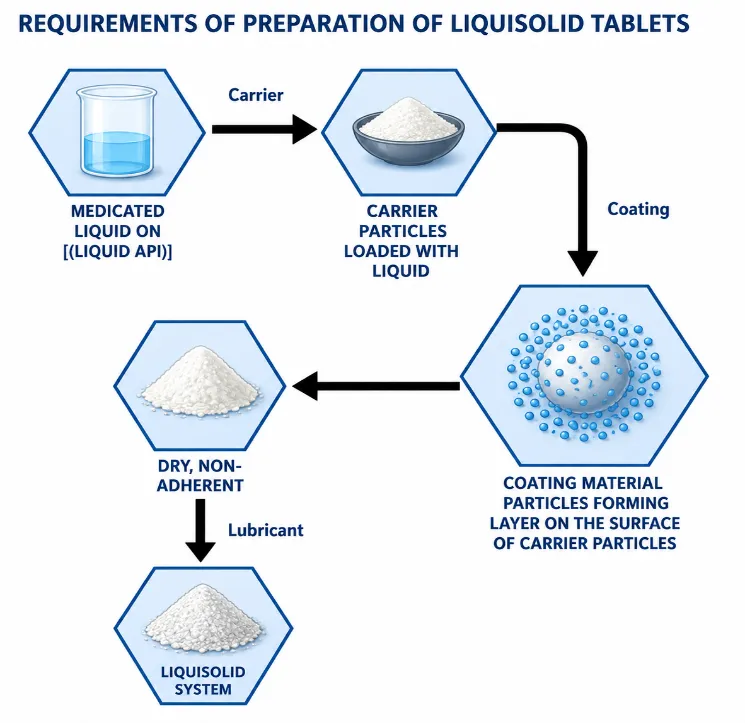
Chart No.01: Requirements for preparation of liquisolid tablets
7. CLASSIFICATION OF LIQUISOLID SYSTEMS:
Liquisolid systems can broadly be classified according to the nature of the liquid medication and the method used for preparing the final dosage form.
7.1 Based on Type of Liquid Medication:
Liquisolid systems may contain:
7.2 Based on Formulation Technique:
Depending on the final dosage form and manufacturing approach, liquisolid systems may be prepared as:
The technique has been explored in both immediate-release and sustained-release formulations [7-10].
8. PREPARATION OF LIQUISOLID TABLETS:
The preparation of liquisolid tablets generally involves the following steps:
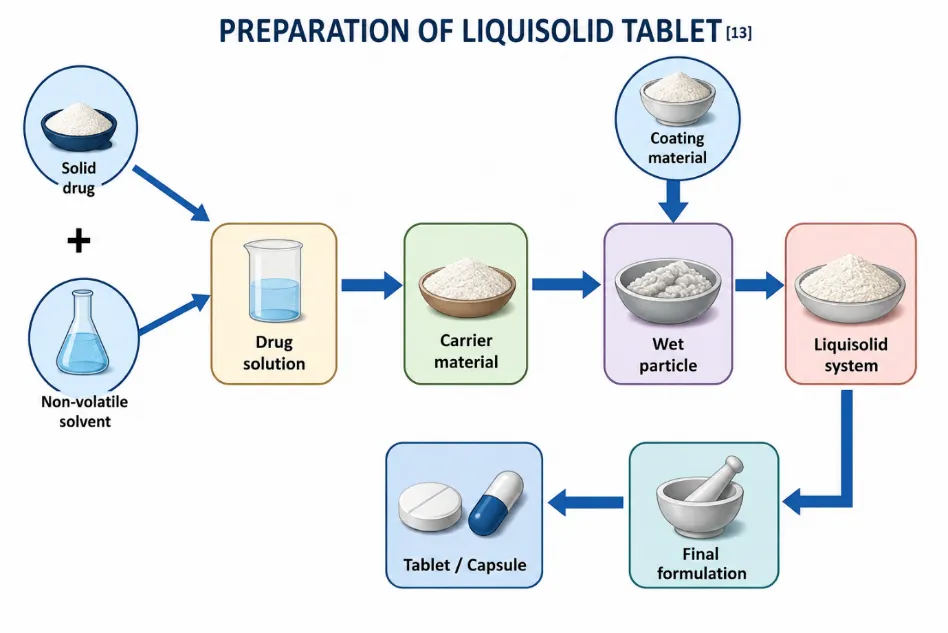
Chart No.02: Preparation of liquisolid tablets
A staged mixing process may be used to obtain uniform distribution of the liquid medication. The powder is typically mixed initially, allowed to equilibrate, and then subjected to further mixing before compression. This approach facilitates uniform adsorption and distribution of the liquid phase throughout the carrier-coating system [6-10].
9. PRE-COMPRESSION EVALUATION:
Pre-compression evaluation is performed to determine whether the prepared liquisolid powder possesses suitable flow and packing characteristics for tablet compression.
9.1 Differential Scanning Calorimetry:
Differential scanning calorimetry (DSC) can be used to investigate the thermal behavior of the drug and excipients and to identify possible physical interactions or changes in the crystalline state.
9.2 X-Ray Diffraction:
X-ray diffraction (XRD) is useful for determining the crystalline or amorphous nature of the drug. Changes in characteristic diffraction peaks may indicate alterations in drug crystallinity following incorporation into the liquisolid system [6-10].
9.3 Scanning Electron Microscopy:
Scanning electron microscopy (SEM) can be used to examine the surface morphology of the drug, carrier, coating material and optimized liquisolid formulation. It provides information regarding particle shape, surface structure and distribution of the liquid-loaded powder.
10. EVALUATION OF LIQUISOLID POWDER:
10.1 Angle of Repose:
The angle of repose is commonly used to evaluate the flowability of the powder. A lower angle generally indicates better flow properties.
10.2 Bulk Density:
Bulk density is determined by measuring the mass of powder occupying a known volume before tapping. It provides information about powder packing characteristics.
10.3 Tapped Density:
Tapped density is determined after mechanically tapping the powder for a specified number of times until a relatively constant volume is obtained.
10.4 Carr's Compressibility Index:
Carr's index can be calculated from bulk density and tapped density:
Carr's Index (%) = [(Tapped Density − Bulk Density) / Tapped Density] × 100
Carr's index provides an indication of the compressibility and flow characteristics of the powder. Together with angle of repose and Hausner's ratio, it can be used to assess the suitability of the liquisolid powder for compression [6-10].
11. POST-COMPRESSION EVALUATION:
11.1 Hardness and Thickness:
Tablet hardness is determined to assess the mechanical strength of the prepared tablets. Thickness is measured to determine dimensional uniformity among individual tablets.
11.2 Friability:
Friability indicates the ability of tablets to withstand mechanical abrasion during handling, packaging and transportation. The percentage weight loss after friability testing should remain within acceptable pharmacopeial limits.
11.3 In-vitro Dispersion/Disintegration:
The dispersion or disintegration behavior of liquisolid tablets is evaluated to determine the time required for the tablet to break down into smaller particles following exposure to the dissolution medium. Rapid disintegration is generally desirable for immediate-release liquisolid formulations.
11.4 Uniformity of Drug Content:
Drug-content uniformity is determined to ensure that each tablet contains the intended quantity of active pharmaceutical ingredient. Adequate mixing of the liquid medication with the carrier and coating materials is essential for achieving content uniformity.
11.5 In-vitro Drug Release:
In-vitro dissolution testing is one of the most important evaluation parameters for liquisolid tablets because the principal objective of the technique is generally to improve drug dissolution.
Dissolution testing may be performed using an appropriate pharmacopoeial apparatus with a specified dissolution medium maintained at approximately 37 ± 0.5°C. Samples are withdrawn at predetermined time intervals, filtered and analyzed using a suitable analytical method. The percentage of drug released is then calculated and compared with the pure drug or conventional formulation [6-10,21].
Studies on liquisolid formulations have demonstrated improved dissolution characteristics for several poorly water-soluble drugs. In particular, liquisolid formulations of ketoprofen and telmisartan have been investigated as approaches for enhancing dissolution [10,21].
11.6 Fourier-Transform Infrared Spectroscopy:
Fourier-transform infrared spectroscopy (FTIR) can be used to investigate drug-excipient compatibility. The characteristic absorption bands of the drug are compared before and after formulation. The absence of significant changes, disappearance or appearance of major characteristic peaks generally suggests the absence of significant chemical interaction between the drug and formulation components [6-10].
12. ADVANTAGES OF LIQUISOLID SYSTEMS:
The major advantages of liquisolid technology include:
The technique has therefore attracted considerable attention as a practical strategy for formulation of poorly water-soluble drugs [7,8].
13. DISADVANTAGES:
Despite its advantages, the liquisolid technique has certain disadvantages. The amount of liquid medication that can be incorporated is limited by the flowability and compressibility of the final powder. High quantities of liquid vehicle may produce a sticky or poorly flowing formulation and may make tablet compression difficult.
The selection of carrier and coating materials is therefore critical. In addition, the high quantity of excipients required in some formulations can increase tablet weight and size, which may affect patient acceptability [6-9].
14. LIMITATIONS:
The major limitations of liquisolid systems include:
Therefore, appropriate selection of liquid vehicle and excipient composition is necessary to obtain a physically stable and manufacturable liquisolid system.
15. APPLICATIONS OF LIQUISOLID TECHNOLOGY:
Liquisolid technology has been investigated for a wide range of pharmaceutical applications. Its primary application is the enhancement of dissolution of poorly water-soluble drugs. The technique has also been explored for improving apparent solubility, oral bioavailability and drug-release characteristics [1,6-10].
The technique has been applied to drugs such as ketoprofen, telmisartan, atorvastatin calcium and other poorly soluble therapeutic agents. Experimental studies have demonstrated that appropriate selection of liquid vehicle, carrier and coating material can substantially influence the dissolution behavior of the resulting formulation [10,11,21].
Liquisolid technology can also be adapted for modified-release drug delivery by incorporating hydrophobic excipients or polymeric materials. Thus, the technique provides flexibility in designing both rapid-release and sustained-release dosage forms [7-9].
CONCLUSION
Liquisolid technology represents a promising and relatively simple formulation approach for addressing the dissolution limitations associated with poorly water-soluble drugs. The technique converts liquid medication into a dry-looking, free-flowing and compressible powder through the appropriate combination of a non-volatile liquid vehicle, carrier and coating materials.
The enhancement in drug dissolution can primarily be attributed to improved wetting, increased effective surface area and improved apparent solubility of the drug. Appropriate optimization of the liquid load factor, carrier-to-coating ratio, liquid vehicle and disintegrant is essential for obtaining desirable powder and tablet characteristics.
The literature indicates that liquisolid systems can be successfully employed for improving the dissolution characteristics of poorly soluble drugs and may also be adapted for sustained-release drug delivery. Their relatively simple preparation, potential compatibility with conventional manufacturing processes and versatility make liquisolid technology an attractive approach in pharmaceutical formulation development.
REFERENCES



Roshani Atugade, Shreya Desai, Prerana Kadam, A Review on Liquisolid Tablets: Formulation and Evaluation, Int. J. of Pharm. Sci., 2026, Vol 4, Issue 9, 961-971, https://doi.org/10.5281/zenodo.22677974
 10.5281/zenodo.22677974