

We use cookies to ensure our website works properly and to personalise your experience. Cookies policy
St. Joseph's College of Pharmacy, Dharmagiri College Campus, Naipunnya Road, Cherthala, Kerala 688524, India.
Parkinson’s disease (PD) is a progressive neurodegenerative disorder characterized predominantly by degeneration of nigrostriatal dopaminergic neurons and depletion of dopamine within the striatum. Levodopa (L-DOPA), the metabolic precursor of dopamine, remains a principal symptomatic therapy for the management of motor manifestations of PD because of its established clinical efficacy. However, conventional administration is associated with extensive peripheral metabolism, variable pharmacokinetic exposure and progressive fluctuations in therapeutic response. Efficient delivery of therapeutic quantities of Levodopa to the brain is therefore an important pharmaceutical challenge. Intranasal administration has emerged as a non-invasive approach for central drug delivery by exploiting anatomical connections between the nasal cavity and the brain, particularly through olfactory and trigeminal pathways. Nanocarrier systems may further improve this approach by modifying drug stability, nasal residence, release characteristics and interaction with the nasal mucosa. Cubosomes are structured lipid-based nanocarriers characterized by a bicontinuous cubic architecture with interconnected aqueous channels and lipid domains, providing a versatile environment for drug incorporation and controlled release. Chitosan coating may additionally contribute to mucoadhesion and enhanced interaction with the nasal mucosa. This review critically examines the pharmacological limitations of conventional Levodopa delivery, the biological basis of nose-to-brain transport, and the potential roles of cubosomal and chitosan-based nanocarriers. Direct evidence from intranasal Levodopa-loaded chitosan nanoparticles and other Levodopa nanocarriers is considered alongside platform-level evidence from chitosan-coated cubosomes and cubosomal systems investigated for central delivery of other therapeutic agents. Particular emphasis is placed on formulation characteristics, brain-targeting assessment, nasal safety, optimization and translational challenges. Chitosan-coated cubosomal Levodopa therefore represents a rational formulation strategy supported by convergent pharmaceutical evidence, although direct validation of the complete formulation remains necessary
Parkinson’s disease (PD) is a progressive neurodegenerative disorder characterized by the degeneration of dopaminergic neurons in the substantia nigra pars compacta and consequent depletion of dopamine within the striatum. The resulting disruption of basal ganglia circuitry contributes primarily to motor manifestations such as bradykinesia, rigidity and resting tremor. PD is, however, biologically heterogeneous, and its pathogenesis involves several interconnected processes, including abnormal α-synuclein accumulation, mitochondrial dysfunction, oxidative stress, impaired proteostasis and neuroinflammatory mechanisms.¹
Levodopa (L-DOPA), the metabolic precursor of dopamine, remains a central component of symptomatic treatment for PD. Unlike dopamine, Levodopa can cross the blood–brain barrier (BBB) and is subsequently converted to dopamine within the central nervous system. Its established efficacy has made dopamine replacement through Levodopa administration an important therapeutic strategy. Nevertheless, the pharmacokinetic behaviour of Levodopa presents substantial pharmaceutical challenges. The drug undergoes extensive peripheral metabolism, and its systemic exposure can vary according to absorption, metabolism, disease progression and concomitant therapy. Peripheral aromatic L-amino acid decarboxylase inhibitors are therefore used clinically to reduce peripheral conversion of Levodopa to dopamine.²–³
The limitations of conventional Levodopa therapy become increasingly important during disease progression. Alterations in dopaminergic neuronal storage and buffering capacity can increase the clinical consequences of fluctuations in plasma and brain Levodopa exposure. Consequently, repeated intermittent administration may result in variations in dopaminergic stimulation and contribute to motor fluctuations and dyskinesia in susceptible patients. Current research therefore includes approaches intended to provide more sustained or controlled dopaminergic stimulation and improve the delivery of Levodopa to the central nervous system.²–³,²¹
The BBB represents an additional challenge for CNS drug delivery. Although Levodopa possesses the physicochemical and transport characteristics required for BBB penetration, systemic administration exposes the drug to peripheral metabolism and distribution before reaching the brain. Increasing the fraction of administered drug reaching the CNS while limiting unnecessary systemic exposure is therefore a relevant objective in pharmaceutical development.¹–³
Intranasal administration has attracted considerable interest as a potential route for CNS delivery. The anatomical relationship between the nasal cavity and the brain provides access to olfactory and trigeminal pathways through which drugs and nanocarriers may reach CNS-associated compartments. Intranasal administration can also avoid gastrointestinal degradation and hepatic first-pass metabolism associated with oral administration. However, the effectiveness of nose-to-brain delivery depends on formulation deposition, nasal residence, mucociliary clearance, epithelial permeability and the anatomical region receiving the formulation.⁴–⁷,²²
Nanocarrier-based systems have consequently been investigated to overcome some of these limitations. Polymeric and lipid-based nanoparticles can modify the physicochemical behaviour of Levodopa and potentially improve its stability, release characteristics and interaction with the nasal mucosa. Experimental studies have demonstrated that intranasal Levodopa-loaded chitosan nanoparticles and other nanoparticulate systems can modify brain drug exposure in animal models.¹¹–¹⁴ A recent review of Levodopa-loaded nanoparticles further highlights polymeric, lipid and intranasal systems as important areas of investigation for improving CNS delivery of L-DOPA.¹¹–¹⁴²⁰–²¹²³
Cubosomes represent an alternative lipid-based nanocarrier platform. They are self-assembled nanoparticles containing a bicontinuous cubic liquid-crystalline structure consisting of interconnected aqueous channels separated by lipid bilayers. This architecture provides a large internal surface area and permits incorporation of hydrophilic, lipophilic and amphiphilic molecules. Cubosomes have therefore been investigated for controlled and targeted drug delivery through several administration routes, including intranasal delivery.⁹–¹⁰,¹⁸–¹⁹
Chitosan provides an additional pharmaceutical function for nasal delivery. Its mucoadhesive properties may increase contact between the formulation and nasal mucosa, while interactions with epithelial structures may influence permeability. Chitosan and its derivatives have consequently been investigated extensively as nasal absorption enhancers and components of nanoparticulate systems intended for nose-to-brain delivery.⁷–⁸,²⁵
Importantly, the individual components of the proposed formulation already have relevant experimental support. Direct studies have investigated intranasal Levodopa-loaded chitosan nanoparticles, while other studies have demonstrated enhanced brain delivery of Levodopa using polymeric and chitosan-derived nanocarriers.¹¹–¹⁴,¹⁷ In addition, chitosan-coated cubosomal nanoparticles have been investigated for nasal-to-brain delivery of paliperidone palmitate, demonstrating the feasibility of combining the cubosomal platform with chitosan surface modification.¹⁵ Intranasal cubosomal delivery has also been investigated for selegiline hydrochloride, an antiparkinsonian drug, with experimental evidence of increased brain exposure in mice.¹⁶
The present review therefore examines the pharmacological basis of Levodopa therapy, the limitations associated with conventional administration, the biological basis of nose-to-brain delivery, and the potential contribution of cubosomal and chitosan-based nanocarriers. Direct evidence involving Levodopa is distinguished from platform-level evidence obtained with other drugs. Particular emphasis is placed on the rationale for chitosan-coated cubosomal Levodopa, formulation development, evaluation of brain targeting, nasal safety and the research required for further translational development.
2.PARKINSON’S DISEASE: PATHOPHYSIOLOGY RELEVANT TO LEVODOPA DELIVERY
PD is characterized by progressive dysfunction and loss of dopaminergic neurons, particularly within the substantia nigra pars compacta. Reduction in dopaminergic input to the striatum disrupts the balance of basal ganglia pathways involved in the regulation of movement. The resulting functional abnormalities contribute to the characteristic motor manifestations of the disease.¹–²
The pathological mechanisms underlying dopaminergic neurodegeneration are multifactorial. Abnormal aggregation and propagation of α-synuclein, mitochondrial dysfunction, oxidative stress, impaired lysosomal and proteasomal degradation and neuroinflammatory responses have all been implicated in PD pathogenesis. These processes may interact rather than operate as independent mechanisms, creating a pathological environment in which neuronal vulnerability and degeneration are progressively amplified.¹
Oxidative stress is particularly relevant to dopaminergic neurons because of their high metabolic activity and biochemical characteristics. Mitochondrial dysfunction and impaired antioxidant capacity can increase reactive oxygen species, while dopamine metabolism itself may contribute to oxidative burden. Neuroinflammatory mechanisms involving activated glial cells and inflammatory mediators may further contribute to neuronal injury.¹
The progressive reduction in striatal dopamine produces a functional deficit that can be partially corrected by dopamine replacement. Levodopa is particularly important because it serves as a precursor that can be converted to dopamine within the CNS. The therapeutic response therefore depends not only on the administered dose but also on the amount of Levodopa reaching the relevant brain regions and the capacity of the remaining dopaminergic system to utilize and buffer dopamine.²–³
During disease progression, the relationship between plasma Levodopa concentration and clinical response can become increasingly complex. Loss of dopaminergic neurons reduces the ability of the striatum to store and regulate dopamine derived from intermittent Levodopa administration. This contributes to greater dependence of motor response on fluctuating drug concentrations and helps explain the development of motor complications in some patients receiving long-term treatment.²–³
From a pharmaceutical perspective, these characteristics support investigation of delivery systems capable of producing more consistent CNS exposure. An intranasal nanocarrier system is not intended to alter the fundamental pharmacological action of Levodopa; rather, the objective is to modify the route and characteristics of drug delivery so that a greater or more sustained fraction may become available to the brain.
3.LEVODOPA: CHEMISTRY, PHARMACOLOGICAL RATIONALE AND DELIVERY CHALLENGES
3.1 Chemical and physicochemical profile
Levodopa is the naturally occurring L-isomer of 3,4-dihydroxyphenylalanine and functions as the immediate metabolic precursor of dopamine. Its structure contains a catechol moiety and an amino-acid functionality, which contribute to its polarity and ionization behavior. These characteristics are compatible with aqueous pharmaceutical systems but also influence membrane partitioning, chemical stability and formulation behavior.³
The catechol group is chemically susceptible to oxidation, particularly under unfavorable pH, oxygen, light or trace-metal conditions. Formulation development therefore requires attention to pH, oxygen exposure, antioxidant strategy where appropriate, packaging and storage conditions. These factors become particularly relevant when Levodopa is incorporated into nanostructured systems because processing and storage may alter the drug’s solid state, microenvironment and release profile.²⁶
3.2 Pharmacological rationale
Following absorption, Levodopa is transported into the CNS and converted to dopamine by aromatic L-amino acid decarboxylase. Peripheral metabolism is partly responsible for the need for decarboxylase inhibition in conventional oral therapy and contributes to the pharmacokinetic complexity of systemic administration.³,⁴ The central pharmaceutical objective is therefore to improve the efficiency with which administered Levodopa produces therapeutically relevant CNS exposure.³–⁴
3.3 Limitations of conventional delivery
Conventional oral administration exposes Levodopa to gastrointestinal absorption variability and extensive peripheral metabolism. Plasma concentrations can change substantially over the dosing interval, and the short pharmacokinetic persistence of Levodopa complicates maintenance of stable dopaminergic stimulation.³ Long-term treatment can be associated with motor fluctuations and dyskinesia, although these phenomena are multifactorial and cannot be attributed solely to one pharmacokinetic variable.²–³
These limitations support investigation of alternative delivery systems, but an intranasal formulation introduces its own constraints, including limited administration volume, mucociliary clearance, epithelial permeability, formulation viscosity, local tolerability and variability in deposition. A nanocarrier must therefore solve a specific delivery problem without introducing new safety or manufacturing problems.
TABLE 1. PHARMACOLOGICAL AND PHARMACEUTICAL CHARACTERISTICS OF LEVODOPA RELEVANT TO NOSE-TO-BRAIN DELIVERY
|
Characteristic |
Relevance to delivery |
|
Therapeutic class |
Dopamine precursor; antiparkinsonian agent |
|
Primary pharmacological action |
CNS conversion to dopamine following transport of Levodopa into brain tissue |
|
Major delivery challenge |
Achieving adequate and consistent cerebral exposure |
|
Peripheral limitation |
Extensive peripheral metabolism before CNS availability |
|
BBB consideration |
Levodopa crosses via amino-acid transport mechanisms; dopamine itself does not efficiently cross |
|
Pharmacokinetic concern |
Short persistence and variable exposure over the dosing interval |
|
Long-term therapeutic concern |
Fluctuating dopaminergic stimulation and motor complications |
|
Intranasal rationale |
Potential access through olfactory/trigeminal-associated pathways plus systemic absorption |
|
Nanocarrier rationale |
Protection, modified release, mucosal interaction and formulation stability |
|
Cubosome rationale |
Bicontinuous lipid architecture and large interfacial area |
|
Chitosan rationale |
Mucoadhesion and interaction with nasal mucosa |
4. NOSE-TO-BRAIN DELIVERY: BIOLOGICAL AND MECHANISTIC BASIS
4.1 Olfactory pathway
The olfactory region provides an anatomical interface between the nasal cavity and the CNS. Olfactory sensory neurons project through the cribriform plate toward the olfactory bulb, creating potential extracellular and neuronal routes for drug movement. Transport may involve perineural and perivascular spaces, extracellular diffusion or intracellular trafficking within neuronal processes.⁵–⁶,²²
4.2 Trigeminal pathway
The trigeminal nerve provides a second anatomical connection between the nasal cavity and the CNS. Its ophthalmic and maxillary branches innervate nasal regions and can provide pathways toward brainstem-associated structures. The trigeminal route may be particularly relevant for formulations deposited outside the limited olfactory epithelium, although transport kinetics and anatomical relevance differ from the olfactory pathway.⁵–⁶,²²
4.3 Nasal mucociliary clearance
The nasal mucosa is an efficient clearance system. Mucus and ciliary movement can rapidly remove dissolved drugs and particulate systems from the deposition site, thereby limiting residence time. Formulation strategies such as mucoadhesive polymers, increased viscosity, in situ gelling and optimized particle characteristics have therefore been investigated to increase contact time.⁵,⁷
4.4 Factors affecting nose-to-brain transport
Nose-to-brain performance is influenced by drug physicochemical properties, particle size, surface charge, mucoadhesion, formulation viscosity, administration volume, device geometry, nasal anatomy, epithelial condition and deposition site. Animal models also introduce important anatomical differences, particularly in the relative size of the olfactory region compared with humans. Consequently, brain exposure observed in rodents should not be interpreted as a direct prediction of human deposition or clinical efficacy.⁵,⁷,²²
A critical methodological distinction is required between increased systemic absorption and preferential brain delivery. Brain/plasma concentration ratios, drug-targeting efficiency calculations, cerebrospinal fluid measurements where justified, tissue distribution, microdialysis or appropriately designed pharmacodynamic endpoints can provide stronger evidence than plasma pharmacokinetics alone.¹⁴,²²
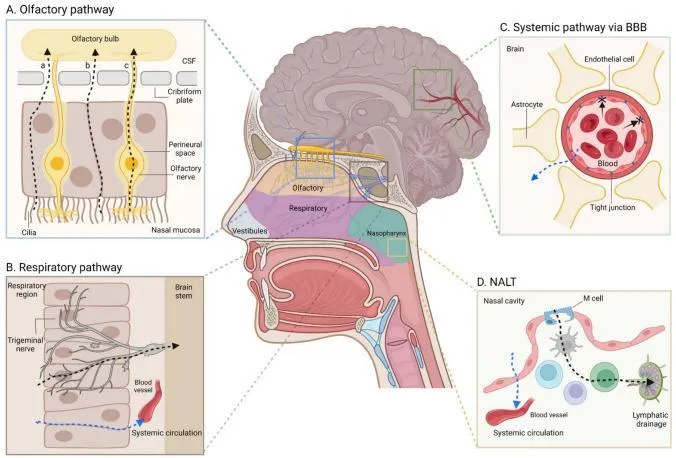
FIGURE 1. ANATOMICAL BASIS OF NOSE-TO-BRAIN DELIVERY THROUGH OLFACTORY AND TRIGEMINAL PATHWAYS. Source: Drath et al. (ref. 5).
5. EXPERIMENTAL EVIDENCE FOR INTRANASAL LEVODOPA DELIVERY
5.1 Direct evidence
Direct evidence is available for intranasal Levodopa-loaded chitosan nanoparticles. Chitosan nanoparticles prepared by ionic gelation were evaluated for physicochemical properties and intranasal pharmacokinetics. The selected formulation showed a particle size of approximately 553 nm, positive surface charge and high encapsulation efficiency. In rats, intranasal administration produced approximately two-fold higher absolute bioavailability and AUC than intranasal Levodopa solution, with a delayed peak concentration consistent with modified absorption.¹¹
Earlier work also investigated Levodopa-loaded chitosan nanoparticles incorporated into a thermoreversible Pluronic gel. The study reported measurable brain drug recovery after intranasal administration and provided early evidence that chitosan-based particulate systems can be used to investigate brain-directed Levodopa delivery.¹²
5.2 Supportive evidence
Other intranasal Levodopa nanocarriers provide complementary evidence. PLGA nanoparticles modified with wheat germ agglutinin have been evaluated in an experimental PD model and demonstrated increased brain delivery and motor-related outcomes compared with free drug.¹² A separate chitosan-derivative nano-in-microparticle system produced increased brain dopamine after nasal administration, while dopamine was not detected in the brain after nasal administration of free Levodopa under the reported experimental conditions.¹³–¹⁴
5.3 Platform-level evidence
Platform evidence supports the separate components of the proposed formulation. Chitosan-coated cubosomal nanoparticles have been characterized for size, PDI, surface charge, mucoaffinity, epithelial permeability and nasal deposition using a 3D-printed nasal cast. The formulation demonstrated strong interaction with mucin and substantial deposition in the olfactory region, supporting the feasibility of combining cubosomal architecture with a chitosan surface for nasal delivery.¹⁵
Cubosomal delivery has also been investigated for an antiparkinsonian drug using a thermoreversible mucoadhesive nasal gel. The optimized system showed nanoscale particle size, sustained release and increased brain pharmacokinetic exposure relative to drug solution in mice.¹⁶ This provides supportive evidence for cubosomes as a formulation platform in Parkinsonian drug delivery, but it does not establish the performance of Levodopa-loaded chitosan-coated cubosomes.¹⁶
The evidence converges at the level of individual components but remains incomplete at the level of the exact proposed formulation. There is direct evidence for Levodopa-loaded chitosan nanoparticles, direct or supportive evidence for other intranasal Levodopa nanocarriers, and platform-level evidence for chitosan-coated cubosomes. The combined formulation—Levodopa-loaded cubosomes with a chitosan surface intended for intranasal nose-to-brain delivery—requires direct experimental validation of formulation characteristics, nasal deposition, brain exposure, pharmacodynamic effect, safety and stability.
TABLE 2. EXPERIMENTAL EVIDENCE RELEVANT TO INTRANASAL LEVODOPA AND THE PROPOSED PLATFORM
|
Evidence level |
System |
Key findings |
Interpretation |
|
Direct |
Levodopa-loaded chitosan nanoparticles |
Higher intranasal AUC and absolute bioavailability than free Levodopa; positive surface charge and mucoadhesive behavior |
Supports chitosan-based intranasal Levodopa delivery |
|
Direct/supportive |
Levodopa-loaded chitosan nanoparticles in thermoreversible gel |
Brain drug recovery after intranasal dosing; formulation optimization based on chitosan/TPP and gel properties |
Supports chitosan and nasal residence strategies |
|
Supportive |
WGA-modified PLGA–Levodopa nanoparticles |
Enhanced brain delivery and pharmacodynamic effects in experimental PD model |
Supports particulate nose-to-brain delivery of Levodopa |
|
Supportive |
GCPQ–Levodopa nano-in-microparticles |
Increased brain dopamine after nasal administration compared with free Levodopa |
Supports chitosan-derivative particulate delivery |
|
Platform |
Chitosan-coated paliperidone cubosomes |
Mucoaffinity, epithelial permeability and olfactory-region deposition demonstrated |
Supports chitosan-coated cubosome architecture for nasal delivery |
|
Platform |
Selegiline cubosomal thermoreversible nasal gel |
Increased brain pharmacokinetic exposure and sustained release |
Supports cubosomal delivery for antiparkinsonian agents |
|
Evidence gap |
Levodopa-loaded chitosan-coated cubosomes |
Direct brain-targeting and pharmacodynamic validation not yet established |
Requires dedicated formulation and biological validation |
6. PHARMACEUTICAL DELIVERY OF LEVODOPA
6.1 Conventional intranasal limitations
Although intranasal delivery reduces first-pass hepatic metabolism, a conventional aqueous Levodopa solution remains vulnerable to rapid mucociliary clearance and limited nasal residence. The formulation must also remain within a physiologically acceptable pH and osmolality range and should not adversely affect ciliary function or epithelial integrity. Administration volume and device performance can substantially influence deposition and therefore biological performance.⁵,⁷,²²
6.2 Nanocarrier strategies
Nanocarriers can address several of these limitations by incorporating the drug within a structured matrix or lipid phase, modifying release kinetics and altering the interaction of the formulation with nasal mucus. Polymeric nanoparticles, lipid nanoparticles, nanoemulsions, liposomes, nanocrystals and nanostructured lipid systems have all been explored for intranasal CNS delivery.⁶–⁷,²⁴
6.3 Cubosomes as a delivery platform
Cubosomes are dispersed nanostructured particles derived from bicontinuous cubic liquid-crystalline phases. Common structures include gyroid, diamond and primitive cubic arrangements. Their interconnected aqueous channels and lipid domains provide a large interfacial environment that can accommodate hydrophilic, hydrophobic and amphiphilic compounds. Their internal architecture can also influence diffusion and release behavior.⁹–¹⁰,¹⁸–¹⁹
For Levodopa, the principal rationale for cubosomal incorporation is not simply increased solubility. Rather, the cubosomal matrix can provide a structured microenvironment that may protect the drug during formulation and permit controlled release. The actual suitability of a cubosome composition for Levodopa must, however, be established experimentally because drug loading, phase behavior, particle size and release kinetics depend on lipid composition, stabilizer concentration, hydration conditions and processing.
6.4 Chitosan as a functional coating
Chitosan can be used as a matrix or surface coating. In a coated cubosome, the lipid nanostructure provides the internal carrier while chitosan modifies the interface presented to the nasal environment. The expected benefits include increased interaction with mucus and potentially prolonged residence. Chitosan may also alter surface charge, aggregation behavior and epithelial interaction; therefore, coating thickness and molecular characteristics must be optimized rather than assumed to be beneficial at all concentrations.⁷–⁸,¹⁵,²⁵
6.5 Formulation considerations for Levodopa-loaded chitosan-coated cubosomes
A formulation development program should identify critical quality attributes including particle size, PDI, zeta potential, encapsulation efficiency, drug content, pH, viscosity, cubic phase structure, surface coating, in vitro release and physical stability. For a nasal product, additional attributes include mucoadhesive behavior, spray or dose uniformity, deposition pattern, epithelial compatibility and preservation of mucociliary function.¹⁵,²³
Levodopa stability should be monitored during preparation and storage because oxidative degradation may alter drug content and performance. Analytical methods should therefore distinguish intact Levodopa from degradation products where possible, and stability studies should consider temperature, light, oxygen exposure and formulation pH.²⁶
TABLE 3. FORMULATION ATTRIBUTES RELEVANT TO LEVODOPA-LOADED CHITOSAN-COATED CUBOSOMES
|
Attribute |
Purpose |
Development relevance |
|
Particle size |
Controls dispersion, deposition and biological interaction |
Optimize for reproducible nanoscale distribution without excessive aggregation |
|
PDI |
Describes size distribution |
Low and reproducible PDI supports formulation consistency |
|
Zeta potential |
Indicates surface charge and colloidal behavior |
Positive charge may support mucosal interaction but excessive charge may raise tolerability concerns |
|
Encapsulation efficiency |
Quantifies incorporated Levodopa |
Should support efficient drug utilization and reproducible dosing |
|
Cubical phase structure |
Confirms intended lipid architecture |
SAXS/XRD and complementary methods can verify internal organization |
|
Chitosan coating |
Provides surface functionalization |
Coating level should balance mucoadhesion, permeability and safety |
|
Drug release |
Controls availability after deposition |
Should be sufficiently sustained without preventing therapeutic availability |
|
Nasal pH and osmolality |
Supports local tolerability |
Must remain within an acceptable physiological range |
|
Mucoadhesion/mucoaffinity |
Controls residence at nasal surface |
Should be experimentally quantified rather than inferred from zeta potential alone |
|
Nasal deposition |
Determines anatomical exposure |
Device and formulation should be assessed using appropriate models |
|
Nasal safety |
Protects epithelial and olfactory function |
Repeated-dose histology, ciliary and cytotoxicity studies are required |
|
Stability |
Maintains quality during storage |
Chemical, physical and microbiological stability must be established |
7. CHITOSAN-COATED CUBOSOMAL LEVODOPA: TRANSLATIONAL RATIONALE
The proposed formulation can be viewed as a sequence of linked pharmaceutical decisions rather than as a claim of established brain targeting. The first problem is the need for therapeutically relevant CNS exposure from a drug whose systemic administration is influenced by peripheral metabolism and pharmacokinetic variability. The second is the limited residence and absorption capacity of the nasal cavity. The third is the need for a carrier that can incorporate Levodopa while maintaining physical and chemical stability. The fourth is the need for a surface that interacts appropriately with nasal mucus without producing unacceptable local toxicity.³,⁵,⁷,²⁶
Cubosomal encapsulation addresses the carrier-level problem by providing a structured lipid environment with interconnected aqueous domains. Chitosan coating addresses the interface-level problem by introducing a cationic, mucoadhesive surface. Intranasal administration then provides the route-level opportunity for olfactory and trigeminal-associated transport. These layers form a coherent development hypothesis, but each step must be experimentally linked to the next. A formulation that is mucoadhesive is not automatically brain-targeting; a formulation that increases plasma exposure is not automatically CNS-targeting; and a formulation that increases brain concentration is not automatically therapeutically effective.⁹–¹⁰,¹⁵,²²,²⁵
The translational sequence should therefore proceed from formulation characterization to nasal compatibility, deposition assessment, pharmacokinetic comparison and brain distribution, followed by pharmacodynamic testing in an appropriate PD model. Where possible, studies should include free Levodopa, blank carrier, uncoated cubosome, chitosan-coated cubosome and an established comparator so that the contribution of each formulation component can be distinguished.¹¹–¹⁶
This component-wise approach is especially important for optimization. If chitosan concentration increases mucoadhesion but also increases PDI or epithelial toxicity, the formulation cannot be optimized using a single response. A quality-by-design framework can integrate critical material attributes, process parameters and biological responses to identify a robust design space rather than selecting a formulation solely from one physicochemical endpoint.¹⁵,¹⁸,²³
8. CURRENT EVIDENCE GAPS AND FUTURE PERSPECTIVES
8.1 Formulation–brain exposure relationship
Future studies should establish quantitative relationships between particle characteristics, chitosan coating, nasal deposition, systemic exposure and brain concentrations. Pharmacokinetic endpoints should be reported with sufficient detail to distinguish total exposure from preferential CNS exposure.⁷,¹⁵,²²,²⁴–²⁵
8.2 Brain-targeting validation
Brain-targeting claims should be supported using tissue distribution, brain/plasma ratios, targeting-efficiency calculations or complementary approaches capable of separating direct transport from systemic redistribution. Experimental designs should include appropriate controls and should account for the possibility that intranasal delivery increases systemic exposure without providing preferential CNS delivery.¹⁴,²²
8.3 Pharmacodynamic validation
For Levodopa, pharmacodynamic evaluation should extend beyond brain concentration. Motor behavior, striatal dopamine restoration and other validated PD-relevant endpoints can determine whether formulation-induced changes in exposure translate into biological activity. Such studies should be designed to avoid interpreting a single behavioral endpoint as proof of brain targeting.¹³–¹⁴
8.4 Nasal safety
Repeated exposure requires careful evaluation of nasal epithelial integrity, inflammation, ciliary function and olfactory function. The cationic nature of chitosan may be beneficial for mucoadhesion but excessive interaction with epithelial membranes can also produce adverse effects. Long-term safety data for repeated administration remain an important translational requirement.⁷–⁸,²⁵
8.5 Optimization and scale-up
QbD approaches can be used to identify critical material attributes and critical process parameters for cubosome formation and chitosan coating. Reproducibility of particle size, PDI, surface charge, encapsulation efficiency, phase structure and drug release must be demonstrated across batches. Scale-up should preserve the nanostructural properties established during laboratory development.¹⁵,¹⁸,²³–²⁴
8.6 Clinical translation
Human translation requires attention to anatomical differences, nasal deposition, device compatibility, dose volume, formulation tolerability and patient-to-patient variability. Animal studies provide mechanistic evidence but cannot by themselves establish clinical nose-to-brain targeting. Human-relevant nasal models, deposition studies and carefully designed early-phase pharmacokinetic investigations are therefore required before clinical efficacy can be inferred.⁵–⁶,²²,²⁴–²⁵
TABLE 4. CURRENT EVIDENCE GAPS AND PRIORITY RESEARCH DIRECTIONS
|
Evidence gap |
Key question |
Suggested evaluation |
|
Formulation–exposure relationship |
Which CQAs control brain exposure? |
Design-of-experiments linked to brain/plasma pharmacokinetics |
|
Brain targeting |
Is increased brain exposure preferential rather than systemic? |
Brain/plasma ratios, tissue distribution, targeting-efficiency metrics and appropriate controls |
|
Pharmacodynamics |
Does altered exposure improve PD-relevant outcomes? |
Validated motor, biochemical and neurochemical endpoints |
|
Nasal safety |
Is repeated dosing locally tolerated? |
Histopathology, epithelial integrity, ciliary function and olfactory assessment |
|
Chitosan coating |
What coating level balances mucoadhesion and safety? |
Systematic coating optimization with permeability and toxicity testing |
|
Cubosome structure |
Does internal phase structure remain stable after loading/coating? |
SAXS, cryo-TEM/TEM and stability studies |
|
Stability |
Does Levodopa remain chemically intact? |
Assay, degradation profiling and accelerated/long-term stability |
|
Device compatibility |
Can the formulation be reproducibly deposited in the target region? |
Human-relevant nasal cast and device performance testing |
|
Scale-up |
Can critical attributes be maintained during manufacture? |
Process characterization, batch reproducibility and QbD-based control strategy |
|
Clinical translation |
Does the formulation produce meaningful CNS exposure in humans? |
Early clinical PK/PD and safety studies after adequate preclinical validation |
CONCLUSION
Levodopa remains an important symptomatic therapy for Parkinson’s disease, but conventional delivery is influenced by peripheral metabolism, short pharmacokinetic persistence and variability in cerebral exposure. Intranasal administration provides an alternative route that can exploit anatomical connections between the nasal cavity and CNS, while nanocarriers can modify formulation stability, residence and release. Direct experimental evidence supports intranasal Levodopa-loaded chitosan nanoparticles, and additional studies support Levodopa nanocarriers, chitosan-based nasal systems and cubosomal delivery platforms.¹¹–¹⁶,²⁰–²¹,²³
The combination of a Levodopa-loaded cubosomal core with a chitosan surface is therefore a scientifically rational development strategy supported by convergent evidence from related systems. However, the exact formulation should be described as proposed rather than clinically validated. Future development should establish the relationship between formulation attributes, nasal deposition, brain exposure and pharmacodynamic effect, while giving equal importance to repeated-dose nasal safety, chemical stability, manufacturing reproducibility and device compatibility. Successful completion of these studies would provide the evidence base required to determine whether chitosan-coated cubosomal Levodopa can progress from formulation concept to a translational nose-to-brain delivery platform.
ETHICAL STATEMENT
Not applicable. This article is a literature-based review and does not report new experiments involving human participants or animals.
CONFLICT OF INTEREST
The authors declare no conflict of interest related to this review.
REFERENCES






Krishnapriya E K, Preethi Cherian, Gopikrishna S Pai, Fasna Nargees N H, Nimmi Thankam Biju, Athira B Nair, Chitosan-Coated Cubosomes for Nose-to-Brain Delivery of Levodopa in Parkinson’s Disease: Mechanistic Rationale, Formulation Advances and Future Perspectives, Int. J. of Pharm. Sci., 2026, Vol 4, Issue 9, 3905-3919, https://doi.org/10.5281/zenodo.23038220
 10.5281/zenodo.23038220