

We use cookies to ensure our website works properly and to personalise your experience. Cookies policy
College of Pharmacy, PGIMS, Pandit Bhagwat Dayal Sharma, University of Health Sciences, Rohtak.
Oral disintegrating tablets (ODTs) are easy and patient-friendly dosage forms that quickly dissolve in the mouth. They are especially useful for dysphagic, elderly, and pediatric patients. Conventional ODTs, on the other hand, are typically produced as standardized dosage forms and may have drawbacks with regard to dose flexibility, tablet design, drug loading, mechanical strength, and unique drug-release characteristics. Artificial intelligence (AI) and three-dimensional (3D) printing have opened up novel avenues for the creation of smart ODTs with digitally controlled and patient-focused features. While AI and machine learning (ML) can support formulation optimization, prediction of critical quality attributes, printability assessment, and selection of appropriate manufacturing parameters, 3D printing allows for customization of tablet geometry, internal structure, drug loading, porosity, and drug-release behavior. The creation of personalized ODTs with programmable release profiles, numerous drug combinations, on-demand manufacturing capabilities, and customizable doses may be made easier by the integration of AI/ML with 3D printing. Pediatric, elderly, dysphagic, and polypharmacy populations may find these systems especially helpful. Despite all these possible benefits, issues like restricted drug loading, mechanical strength, moisture sensitivity, taste masking, data quality, model validation, manufacturing reproducibility, scalability, cost, regulatory requirements, and patient-data security continue to be significant factors. Thus, smart ODTs is an emerging strategy for patient-centered, technologically enabled, and customized oral medication delivery. To incorporate these systems into standard pharmaceutical practice, more study, experimental validation, regulatory development, and digital technology integration is needed
Oral drug delivery is one of the most popular approaches due to its ease of use, patient acceptability, non-invasiveness, and simplicity of preparation. However, in pediatric, elderly, and geriatric patients, they have difficult to administer conventional tablets. Oral disintegrating tablets (ODTs) have drawn a lot of attention because they dissolve rapidly in mouth cavity and demand very little water to consume. This has resulted in improvement of patient compliance and easier drug administration. However, dose flexibility, tablet geometry, drug loading, mechanical strength, and customized drug-release properties may be limited in conventional ODTs, which are typically produced as standardized dosage forms (1,2).
With the ability to produce dosage forms having personalized geometry, internal structure, drug quantity, and release properties, three-dimensional (3D) printing has become a cutting-edge pharmaceutical production method. In contrast to traditional manufacturing, 3D printing offers options for customized and on-demand fabrication of oral dose forms and digital control over formulation architecture. According to recent research, 3D printing may be used to produce customized ODTs, including dose forms with various dosages and intricate structures (2,3).
Simultaneously, artificial intelligence (AI) and machine learning (ML) are being researched more and more for the development and optimization of pharmaceutical formulations. AI-based methods can evaluate complicated datasets and assist in the optimization of manufacturing parameters, formulation performance prediction, and essential quality attributes. Therefore, combining AI with 3D printing could offer a data-driven method where patient-specific needs are converted into digital formulations that are optimized and then produced as customized dose forms (1,4).
An emerging paradigm for smart drug delivery is represented by a combination of ODTs, 3D printing, AI, and personalized medicine. Specific dosing, customizable tablet design, programmable drug release, and on-demand manufacturing may be made possible by such systems, especially for patient populations who need specific therapy, such as children and the elderly. The validation of AI models, data quality, dose consistency, material selection, manufacturing reproducibility, scalability, regulatory requirements, and patient-data security are still issues that need to be resolved (1,2,4).
The development of ODTs toward smart dosage forms, recent developments in pharmaceutical 3D printing, applications of AI and ML in the development of formulation, integration of AI with 3D printing, personalized drug-delivery applications, evaluation and quality considerations, regulatory challenges, and future prospects are all covered in this review paper. The potential of AI-driven 3D printing to enable digitally created, patient-specific, on-demand ODTs is highlighted in particular.
Oral Disintegrating Tablet
ODTs are a specific class of solid oral dose forms designed to increase drug adherence and patient convenience. Unlike traditional tablets, which must be taken with water, ODTs disintegrate fast when placed on the tongue, allowing the dose form to be absorbed with saliva. ODT is defined by the FDA as "a solid dosage form containing medical substances which disintegrate rapidly, usually within a matter of seconds, when placed upon the tongue."
The European Pharmacopeia states that "uncoated tablets should disintegrate within 3 minutes and are intended to be placed in the mouth, where they disperse rapidly before being swallowed" (5,6).
Advantage of ODTs (5,7–9)
Limitation of ODTs (6,10,11)
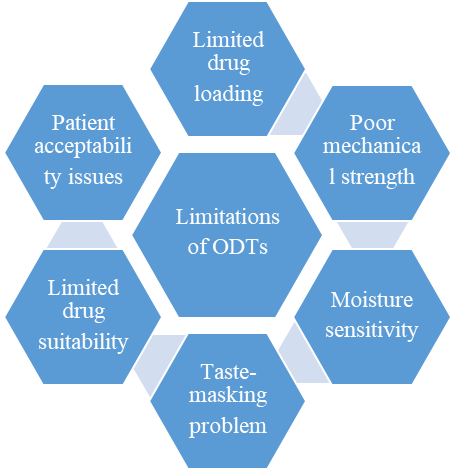
Figure 1: Limitations of ODTs
Evolution of Conventional ODTs to Smart ODTs
From a historical viewpoint, the groundbreaking launch of OraSolv® in the 1980s laid the groundwork for commercially available fast-dissolving tablets, which is where ODTs originated. This was the first attempt at pharmaceutical innovation with the goal of improving patient experience and adherence. ODT technology witnessed a paradigm shift in the ensuing decades due to constant developments. ODTs have evolved from simple tablets to complex and user-friendly dosage forms due to technological advancements, taste masking improvements, and a strong dedication to patient-centric formulations. ODTs' transformation represents a shift from traditional medication delivery to patient-focused formulations (5,12). ODTs have evolved from traditional compressed tablets to sophisticated dosage forms intended to enhance patient acceptability, palatability, disintegration, dissolving, and administration simplicity. The main goal of traditional ODT technologies was to achieve rapid disintegration by using specialized excipients, porous architectures, superdisintegrants, and production techniques including sublimation and freeze-drying. However, these traditional methods typically use uniform pill shapes and preset medication dosages, which limits their capacity to meet the needs of specific patients (13,14).
More control over tablet geometry, porosity, drug loading, and release characteristics is now possible owing to the development of sophisticated pharmaceutical production technology, especially three-dimensional 3D printing. Simultaneously, data-driven formulation optimization and product performance prediction have been made possible by AI and ML. As a result, the development of smart ODTs as a possible platform for customized oral medication delivery has been aided by the integration of these technologies (15,16).
Definition of Smart ODTs
Conceptually, smart ODTs are sophisticated oral disintegrating dosage forms that allow for digital optimization or customization of formulation composition, dose, structure, drug-release behavior, or manufacturing parameters in accordance with preset therapeutic or patient-specific needs. In contrast to traditional ODTs, smart ODTs may use additive manufacturing, digital design, and AI-assisted optimization to deliver customized and on-demand dose forms. Patient-centric formulation science, digital pharmaceutical production, and intelligent computational technology come together to form "smart ODT," despite the fact that it is an emerging concept rather than a globally regulated regulatory category (15,16).
Characteristics of smart ODTs (15–17)
Table 1: Difference between Conventional ODTs vs Smart ODTs
|
Parameters |
Conventional ODTs |
Smart ODTs |
|
Dose |
Generally standardized |
Potentially patient-specific |
|
Tablet design |
Predetermined geometry |
Digitally customizable |
|
Manufacturing |
Conventional batch manufacturing |
Potentially 3D-printed/on-demand |
|
Drug release |
Primarily formulation-dependent |
Potentially programmable and digitally optimized |
|
Patient personalization |
Limited |
High potential |
|
Formulation optimization |
Experimental/QbD approaches |
AI/ML-assisted optimization possible |
|
Production model |
Large-scale batch production |
Personalized or decentralized production possible |
|
Digital integration |
Limited |
Integration with digital design and patient data |
|
Main objective |
Rapid disintegration and convenient administration |
Rapid disintegration plus personalization and intelligent manufacturing |
Formulation Strategies for ODTs
In order to achieve rapid disintegration, acceptable mechanical strength, satisfying mouthfeel, and enough drug release, the active pharmaceutical ingredient (API), excipients, and manufacturing method must be carefully chosen in the formulation of ODTs (18). API selection is a crucial first step because physicochemical characteristics like dosage, aqueous solubility, particle size, crystal morphology, hygroscopicity, compressibility, and taste can greatly affect ODT (18,19). High-dose or extremely bitter medications may need additional formulation techniques, although low-dose medications with appropriate solubility and compressibility are typically more accessible to ODT creation (20).
The choice of excipient is equally essential. Super disintegrants like crospovidone, croscarmellose sodium, and sodium starch glycolate, and fillers like lactose, mannitol, and microcrystalline cellulose, binders, lubricants, sweeteners, and flavors are examples of frequently used excipients. While preserving sufficient hardness, low friability, high flowability, and a pleasing mouthfeel, these excipients should encourage quick water absorption and tablet breakdown (19,20). Since the medication gets into direct contact with taste buds after disintegration, taste masking is an especially crucial tactic. Bitterness can be decreased by a variety of physical and chemical methods, such as the use of flavors and sweeteners, polymer coating or microencapsulation, ion-exchange resins, solid dispersion, pH alteration, and complexation with cyclodextrins.
Formulation strategies such as solid dispersion, cyclodextrin complexation, particle-size reduction, and other solubility-enhancement approaches can be used to increase dissolution for poorly soluble APIs (21,22). Lastly, depending on the drug's qualities and the required tablet features, production processes such as direct compression, wet or dry granulation, sublimation, spray drying, molding, and freeze-drying can be chosen (23). Therefore, quick disintegration and dissolution must be balanced with mechanical strength, dose loading, stability, taste, and patient acceptability for ODT development to be successful (18,21).
Techniques for ODT Preparation
ODTs have been developed using a variety of techniques. These techniques are as under:
Direct compression: It is the simplest and least expensive way to construct ODTs. Compared to other approaches, it requires comparatively fewer steps. This process compresses every ingredient directly into a single pill. Because this process uses a lot of superdisintegrants, tablets made using this technology can occasionally be quite brittle (24).
Freezing drying: It's also referred to as lyophilization. For thermolabile medications, this technique is typically employed. This technique involves dispersing the medication in a solvent or aqueous solution, which is then instantly lyophilized. Water-soluble medications can create low freezing eutectic mixtures; therefore, this approach is not appropriate for them (25).
Spraying drying: Tablets are made utilizing a gelatin matrix during the spray drying process. After mixing all the components, including the API and excipients, a spray dryer is used to dry them (26).
Molding: The molding process entails either moisten, dissolving, or dispersing the drug with a solvent and then molding the moist mixture into tablets (compression molding with lower pressure than conventional tablet compression) or evaporating the solvent from the drug solution or suspending the drug at ambient pressure (no vacuum lyophilization). The pills are air-dried following compression molding. Because less compression force is applied than with conventional tablets, the molded tablet creates an extremely porous structure that accelerates the product's dissolution and disintegration. To speed up the product's dissolution, the powder mixture should be sieved through a very fine screen. Tablet disintegration and tongue feel are improved since the molding process is usually applied to soluble chemicals (saccharides). However, when handled, the low mechanical strength of molded tablets leads to erosion and fracture (24,26).
Sublimation: In this process, sublimizing materials like urea and camphor are used to compress the API and excipients. When taken orally, the tablet disperses rapidly due to the sublimation of the volatile ingredient, which makes it porous (27).
Cotton candy: After the polysaccharide matrix is recrystallized to create candy floss, excipients and API are combined and compacted to create tablets. Additionally, they can keep tablets strong (28).
Table 2: List of Patented and Proprietary Technology Used in Manufacturing of ODTs
|
Patented / proprietary technology |
Company / developer |
Basic manufacturing principle |
Key technological feature |
Example drug / marketed product |
|
Zydis® |
Catalent / R.P. Scherer |
Freeze-drying (lyophilization) |
Highly porous matrix; very rapid disintegration |
Ondansetron – Zofran ODT |
|
Lyoc® |
L. Lafon / Cephalon |
Freeze-drying |
Porous, rapidly dispersing tablet |
Phloroglucinol – Spasfon Lyoc |
|
OraSolv® |
Cima Labs |
Direct compression + effervescence |
Rapid disintegration with taste masking |
Zolmitriptan – Zomig Rapimelt |
|
DuraSolv® |
Cima Labs |
Direct compression |
Higher mechanical strength with rapid disintegration |
Hyoscyamine – NuLev |
|
FlashDose® / Shearform® |
Fuisz Technologies |
Cotton-candy/fibrous matrix technology |
Highly porous, rapidly dissolving carbohydrate fibers |
Diphenhydramine – Benadryl Fastmelt |
|
WowTab® |
Yamanouchi |
Compression using highly water-soluble sugars |
Good balance of hardness and rapid dissolution |
Famotidine – Pepcid RPD |
|
FlashTab® |
Prographarm |
Direct compression |
Rapid disintegration + taste masking |
Ibuprofen – Nurofen FlashTab |
|
AdvaTab® |
Eurand |
Direct compression |
Rapid disintegration using engineered excipients |
Loratadine – AdvaTab formulations |
|
OraQuick® |
KV Pharmaceutical |
Compression with taste-masking technology |
Rapid dissolution and taste masking |
Ondansetron – Zuplenz |
|
Frosta® |
Akina |
Direct compression |
Rapid disintegration with improved tabletability |
Various ODT formulations |
|
Pharmaburst™ |
SPI Pharma |
Direct compression using a co-processed excipient system |
Rapid disintegration and good tablet strength |
Various drug formulations |
Advance Manufacturing Techniques for ODTs
3D Printing
Binder jet printing (BJP): One possible 3D printing technique for the creation of ODTs is binder jet printing (BJP), also known as inkjet or drop-on-powder printing. The procedure involves adding a liquid binder layer by layer on top of a powder bed composed of excipients and APIs. BJP's solvent-based, heat-free nature makes it particularly suitable for thermolabile medications and enables the creation of extremely porous forms that can easily dissolve in the mouth (29,30).
Dose personalization, geometrically complicated design, and enhanced patient compliance—particularly in the juvenile and elderly patient populations—are among the main advantages of BJP. However, achieving adequate mechanical strength, preventing drug-binder incompatibilities, and guaranteeing stability are challenges. The first FDA-approved 3D-printed product, Spritam® (levetiracetam), was approved, demonstrating the method's clinical potential. In order to improve the reproducibility and scalability of BJP for more pharmaceutical applications, current research focuses on formulation optimization, binder selection, and post-processing methods (31).
Selective Laser Sintering (SLS): When particles are sintered using a laser, strong, porous tablets with adjustable release profiles result. ODTs that release less than 90% of the drug in 5 minutes and disintegrate in less than 15 seconds have been printed using SLS. Using laser energy to selectively heat powder particles, SLS is a powder bed fusion process that produces 3D structure by partially melting the powder, fusing the particles, and then solidifying. SLS is a widely used process that uses a laser as a power source to sinter tiny layers of powdered materials that cover the platform of a printing bed (32).
Fused Deposition Modeling (FDM): One of the most widely used and accessible 3D printing technologies available today is FDM. It creates objects layer by layer using a computer model by extruding melted thermoplastic filament through a heated nozzle. PLA, ABS, PETG, and TPU are common materials with distinct qualities for a range of uses. It is inexpensive, simple to use, and versatile for educational tools, low-volume manufacture of functional parts, and prototyping, FDM is a popular choice. Its drawbacks include obvious layer lines, reduced resolution, and possible warping with specific materials. Despite this, its widespread use in several industries demonstrates its worth as a dependable and affordable additive manufacturing technique (33).
Stereolithography (SLA): SLA is an additive manufacturing technique that produces extremely precise and detailed three-dimensional products by selectively curing liquid photopolymer resin into solid layers using a UV laser. SLA, one of the earliest 3D printing techniques, is renowned for its smooth surface finish, high resolution, and ability to create intricate geometries with fine details (34).
A build platform is lowered into resin soup during the SLA process, and each layer is burned out using a laser in accordance with a computer model. The portion builds up layer by layer as the platform gradually descends as each layer solidifies. SLA-printed parts typically require post-processing, such as UV curing and washing. SLA is frequently used in applications that need high surface polish and precision, such as complex engineering prototypes and dental and medical models. Even while SLA printing is more accurate than FDM, it has drawbacks such as higher material costs, limited part mechanical strength, and environmental sensitivity (35).
Direct Powder Extrusion (DPE): DPE is a new additive manufacturing technique that eliminates the requirement for filament creation by directly processing powdered materials, usually thermoplastics or composites. DPE entails putting dry powder into a heated screw-based extruder, where it is melted and deposited layer by layer to create three-dimensional pieces, in contrast to typical FDM, which extrudes a pre-formed filament. By removing the filament-making stage, this technique allows for increased material versatility and cost savings. It is especially useful for processing composites with functional fillers, bespoke material blends, and high-performance polymers (36).
AI/ML-Assisted Formulation of Smart ODTs
For the development, optimization, and quality evaluation of smart ODTs, AI and ML are becoming important technologies. To find appropriate combinations of APIs, excipients, and processing conditions, conventional formulation development frequently relies on repeated experimental trials. This method can be costly, time-consuming, and ineffective, especially when multiple formulation factors affect tablet performance at the same time. By finding complex links in formulation and manufacturing data and utilizing these associations to forecast desired product attributes, AI/ML-based techniques might lessen this burden.
AI/ML models can assess the impact of API characteristics, excipient type and concentration, particle size, moisture content, compression force, printing temperature, infill density, and tablet shape in the development of smart ODTs. Critical quality qualities, like mechanical strength, porosity, wetting time, disintegration time, drug loading, dissolving behavior, and printability, may be associated with these variables. For example, Elbadawi et al. created the M3DISEEN machine-learning technique to forecast pharmaceutical formulations' three-dimensional printability. In order to improve development efficiency, their work showed that machine-learning models might help find appropriate formulations and processing conditions prior to substantial laboratory trial (37).
AI/ML can also help with excipient selection by forecasting how they will affect tablet performance. Excipient combinations that offer sufficient mechanical integrity while preserving quick disintegration may be found by algorithms trained using experimental formulation datasets. This is especially crucial for Smart ODTs because, although insufficient mechanical strength can result in tablet damage during handling, packing, or shipping, excessive mechanical strength could delay decomposition. Predictive models can also be used to estimate drug-release profiles and determine how modifications to the architecture, porosity, or infill pattern of tablets impact immediate or modified release.
It is possible to optimize several formulation and production factors at once using more sophisticated computational techniques such as artificial neural networks, random forests, support vector machines, evolutionary algorithms, and Bayesian optimization. Digital designs for 3D-printed ODTs with predetermined dose, geometry, drug combination, and release characteristics may be produced with the aid of these techniques. By combining patient-specific information with formulation data to enable customized dose selection and on-demand production, AI can also enhance personalized medicine. This more comprehensive idea was defined by Abdalla et al. as an AI-enabled approach that connects digital manufacturing, customized oral medicine delivery, and data-driven formulation creation. In addition to these benefits, the application of AI/ML necessitates high-quality datasets, defined experimental protocols, interpretability, cybersecurity, model validation, and regulatory supervision. Therefore, rather than totally replacing laboratory research, AI/ML should be viewed as a decision-support tool that enhances pharmaceutical knowledge and experimental verification (38).
Personalized Drug Delivery Using Smart ODTs
Personalized medicine is an approach to drug therapy in which the treatment strategy is tailored to the individual characteristics and medical needs of each patient rather than applying the same strategy to all patients. Patient-specific factors include age, body weight, disease condition, differences in how the body handles drugs, genetic factors, and organ function. Opportunities to construct customized oral dosage forms with unique dose, shape, drug combination, and release properties have been made possible by recent developments in digital pharmaceutical technologies and additive manufacturing. These ideas may be combined with the benefits of quick disintegration and simplicity of administration in smart ODTs, especially for patients who have trouble swallowing traditional tablets (39–41).
Need for Individualized Dosing
Significant variations in medication exposure and therapeutic response can arise from interindividual variances in drug absorption, distribution, metabolism, and excretion. As a result, not every patient may experience the same therapeutic result at a fixed dose. When precise dose adjustment is clinically necessary or when medication exposure is significantly impacted by patient-specific variables, individualized dosing is especially important. To assist customized dose selection, model-informed precision dosing techniques take into account pharmacokinetic variability, drug concentrations, and patient characteristics (42). By enabling the creation of various dosage strengths and release profiles in accordance with the recommended therapeutic requirement, smart ODTs may supplement such strategies (40).
Patient-Specific Dose Adjustment
Adjusting a patient's dosage based on clinically significant patient features is known as patient-specific dose adjustment. By regulating drug loading, tablet size, geometry, and release properties, advanced manufacturing technologies like three-dimensional 3D printing can enable personalized dosage forms. The possibility of 3D printing to create patient-specific dosages and dosage forms, such as tablets with various medication strengths and release patterns, has been discussed in studies and reviews (40,41). As a result, smart ODT platforms might offer a technological foundation for creating customized dosage strengths, but the final dose needs to be established in accordance with established pharmaceutical and clinical standards (40).
Table 3: Patient-Specific Factors and Their Potential Role in Personalized Smart ODT Development
|
Patient-specific factor |
Personalization requirement |
Potential role of Smart ODTs |
|
Age |
Drug requirements can differ between pediatric, adult, and geriatric populations. |
Development of age-appropriate dose strengths, tablet dimensions, taste, and disintegration characteristics |
|
Body weight |
Certain medicines require weight- or body-size-related dose adjustment. |
Variable drug loading or tablet size may facilitate individualized dose preparation. |
|
Disease condition |
Disease severity and therapeutic response may influence the required treatment regimen. |
Customized dose and, where clinically justified, modified release characteristics may be incorporated |
|
Pharmacokinetic variability |
Differences in absorption, metabolism, distribution, and elimination can produce different drug exposures. |
Patient-specific dosing supported by pharmacokinetic information can be combined with flexible dosage-form manufacturing. |
|
Renal function |
Reduced renal clearance can require adjustment of dose or dosing interval for appropriate drugs. |
Customized lower-strength dosage forms may facilitate clinically prescribed dose adjustments. |
|
Hepatic function |
Changes in hepatic metabolism can alter systemic drug exposure. |
Flexible dosage strengths may support individualized regimens when dose adjustment is clinically indicated. |
|
Pediatric requirements |
Children may require lower doses, flexible strengths, palatable formulations, and easy administration. |
Low-dose, taste-masked, and rapidly disintegrating formulations may improve administration and acceptability. |
|
Geriatric requirements |
Dysphagia, polypharmacy, and difficulty swallowing conventional tablets can affect medication administration. |
Rapidly disintegrating dosage forms and personalized polypill approaches may reduce administration difficulties and pill burden. |
Therefore, when paired with digital formulation design and additive manufacturing, smart ODTs offer a viable platform for patient-focused and customized oral medication delivery. The more general idea of customized pharmaceutical manufacture is supported by 3D-printing techniques, which can offer flexibility in dose, dosage-form geometry, drug combination, and release characteristics (41). Before being routinely used in clinical settings, individualized smart ODTs still need to be well validated for dose accuracy, content homogeneity, mechanical characteristics, disintegration, dissolution, stability, reproducibility, and regulatory compliance (39,40).
Application of Smart ODTs (43–47)
Limitations and Difficulties with Smart ODTs (45,46) (47)
FUTURE PROSPECTS
Future smart ODTs are anticipated to prioritize patient-centered, technologically connected, and customized medication delivery. Pharmaceutical formulation development may benefit from the prediction and optimization of API–excipient combinations, dose requirements, tablet characteristics, printability, and drug-release profiles when AI and ML are integrated. This could reduce the need for traditional trial-and-error experimentation.
An integrated workflow where patient-specific requirements are transformed into optimum digital formulations and then created as customized ODTs could be made possible by combining AI/ML with three-dimensional 3D printing (39,47). Thus, future Smart ODTs might offer patient-specific tablet dimensions and compositions, numerous APIs in a single dosage form, programmable drug-release patterns, and personalized dosages.
Patients with dysphagia, elderly and pediatric patients, and those needing dose modifications or various drugs may find these technologies very helpful. Further enabling the production of customized medications in hospitals, pharmacies, or specialized facilities in accordance with clinical criteria is the development of decentralized and on-demand manufacturing.
Furthermore, data-driven and responsive medication distribution may be made possible by integration with electronic prescribing systems and digital health technology. However, advancements in manufacturing repeatability, AI model validation, product stability, quality control, cybersecurity, and regulatory frameworks for digitally made personalized pharmaceuticals are necessary for successful clinical translation. Hence, the combination of AI/ML, 3D printing, improved excipient engineering, and personalized medicine has the potential to change traditional ODTs into flexible and intelligent dosage forms that can satisfy specific therapeutic needs (39,47).
CONCLUSION
The patient-friendly characteristics of conventional ODTs are combined with artificial intelligence, machine learning, 3D printing, and customized pharmaceutical manufacture to create smart oral disintegrating tablets, a new development in oral medication administration. Although traditional ODTs provide quick disintegration and easy administration, customization may be limited by their uniform dosages and designs. AI/ML can assist with formulation optimization, printability prediction, and control of important quality features, while 3D-printed tablets provide flexibility in geometry, drug loading, internal structure, and release properties.
Combination or polypill systems, programmable drug-release profiles, optimal dosing, and on-demand manufacture based on specific therapeutic needs can all be made possible by the integration of these technologies. Pediatric, elderly, dysphagic, and polypharmacy groups may find these skills especially useful. However, dosing accuracy, material consistency, mechanical properties, disintegration, solubility, stability, reproducibility, data quality, AI model validation, manufacturing scale, regulatory compliance, and cybersecurity must all be carefully taken into account when converting smart ODTs from research to routine clinical use.
Therefore, future research should concentrate on AI/ML models that have been experimentally validated, standardized datasets, reliable 3D printing procedures, enhanced formulation materials, dependable quality-control techniques, and suitable regulatory frameworks. Digital design, AI/ML, additive manufacturing, and customized medicine might all come together to change ODTs from standardized dose forms into flexible and patient-focused drug delivery systems.
REFERENCES


Manish Dhall, Paramjeet, Smart Oral Disintegrating Tablets: Integration of 3D Printing, AI, and Personalized Drug Delivery, Int. J. of Pharm. Sci., 2026, Vol 4, Issue 9, 3952-3967, https://doi.org/10.5281/zenodo.23038434
 10.5281/zenodo.23038434