

We use cookies to ensure our website works properly and to personalise your experience. Cookies policy
M.Pharmacy (Pharmaceutics) Shivnagar Vidya Prasarak Mandal’s college of Pharmacy
Fast dispersible tablet is a unique type of drug delivery system in which we required specific innovative ideas and technology. fast dispersible tablet is solid dosage form containing active ingredient which disintegrate rapidly and gives fast onset of action. The various patient like geriatric, pediatric and unconscious patient may feel difficulty in swallowing the tablet in this case the fast dispersible tablet plays vital role for treating the diseases. In the formulation of fast dispersible tablet ease of drug administration and patience compliance has mainly considered. There are various technologies and methods are developed for preparation of fast dispersible tablet like direct compression, spray drying, freeze drying, molding, sublimation. This review emphasizes the various Technologies, Method, various disintegrants, various polymer, different types of challenges and limitation for formulation of fast dispersible tablet.
The Oral route of drug delivery system is commonly preferred due to accurate dosing, self-medication, affordable treatment, non-invasive and easy to administer. There are many patients which have difficulty to swallow the hard tablet and various gelatin tablets and due to this they do not get proper medication and treatment as prescribed. To overcome this problem the researcher prepared the fast dispersible tablet which gives fast onset of action and easily dispersed in mouth(1). The Fast Dispersible Tablet mainly used for person suffering from dysphagia, psychiatric patient and hospitalized patient which are unconscious and having various types of disorder like heart attack ,stroke and other neurological disorder (2)
Fast Dispersible tablet is also known as Oro dispersible tablet, fast disintegrating tablet, rapid dissolving tablet, Oro disintegrating tablet. The European Pharmacopeia prefers the term fast dispersible tablet. This May be defined as the uncoated tablet to be placed in the mouth where they disperse readily within 3 min before swallowing. this Fast Dispersible Tablet gaining the effective new drug delivery system in which the dosage form dispersed or disintegrate in the oral cavity within few seconds without need of water or chewing (3).This Fast Dispersible Tablet have various types of advantages like no swallowing problems, better patient compliance ,fast onset of action, increased bioavailability and good stability. The important ingredient for formulation of fast dispersible tablet is super disintegrants. The function of super disintegrants is to breakdown the tablet when it comes in contact with water or saliva. Without super disintegrants we cannot formulate the ideal fast dispersible tablet .therefore during formulation of fast dispersible tablet the formulator has to choose proper combination and concentration of super disintegrants which has to add in formulation for better bioavailability(4).
ADVANTAGES (5)
DISADVANTAGES (6)
CHALLENGES FOR FORMULATION OF FAST DISPERSIBLE TABLET (7,8)
1. Taste Masking: Inappropriate taste masking of unpleasant drug may affect the patient compliance due to this proper and efficient taste masking of unpleasant drug must be done so that the taste of unpleasant drug not felt in oral cavity.
2. Mechanical strength and disintegration time: For fast onset of action the tablet must break down in oral cavity therefore they are formulated with very small compression force resulting in less mechanical strength of tablet. As the mechanical strength is less than the tablet is easily breakdown in oral cavity. As the disintegration time of the tablet will extend then the mechanical strength of tablet is more therefore proper amount required for formulation of fast dispersible tablet.
3. Mouthfeel: As the unpleasant drug disintegrate in the oral cavity it gives unpleasant taste. Therefore, proper flavoring agent and cooling agent are required for formulation of fast dispersible tablet. Flavoring agent and cooling agent enhance the mouth feel.
4. Sensitivity To Environmental condition: Fast dispersible tablet should have less sensitivity to humidity, temperature and other environmental condition.
5. Cost: Reduce the cost of fast dispersible tablet is most important challenge
6. Amount of drug: Low dose of drug is required for formulation of fast dispersible tablet. for freeze dried dosage form the drug dose must be lower than 4000 mg for insoluble drug and less than 60mg for soluble drug.
7. Size of tablet: The normal size of tablet to swallow is 7-8 mm and for handling is greater than 8 mm. therefore it is very challenging to get normal size of fast dispersible tablet
CRITERIA FOR FAST DISPERSABLE DRUG DELIVERY SYSTEM (9–11)
Drug selection criteria for fast dispersible tablet (12–14)
Techniques:
Many techniques are used for formulation of fast dispersible tablet. following are some of the techniques used for preparation of FDT
1. Direct Compression ; (15–17)
In the direct Compression technique, the process starts with choosing excipients such as super disintegrants like crospovidone fillers like microcrystalline cellulose and lubricant like magnesium sterate. these components are passed through a fine mesh to achieve constant particle size. The active pharmaceutical ingredient (API) and excipients are then mixed in blender to create a uniform powder mixture. Following this a lubricant is added and mixed gently to avoid capping or lamination during the compression stage. The final mixture is then introduced into a tablet press machine to form tablets. these tablets are subsequently assessed for weight consistency, hardness, friability, disintegration time and dissolution to ensure they meet quality standards.
Advantages: This method is straight forward, cost efficient and quick. It involves fewer step and minimal equipment, making it ideal for API that are stable and possess good flow characteristics.
Process: The powder mixture of API and excipients directly compressed into tablets using a tablet press.
Limitation: Direct Compression might not be appropriate for API with poor flow characteristics or those needing extensive taste masking.
2. Freeze Drying /Lyophilization (18–20)
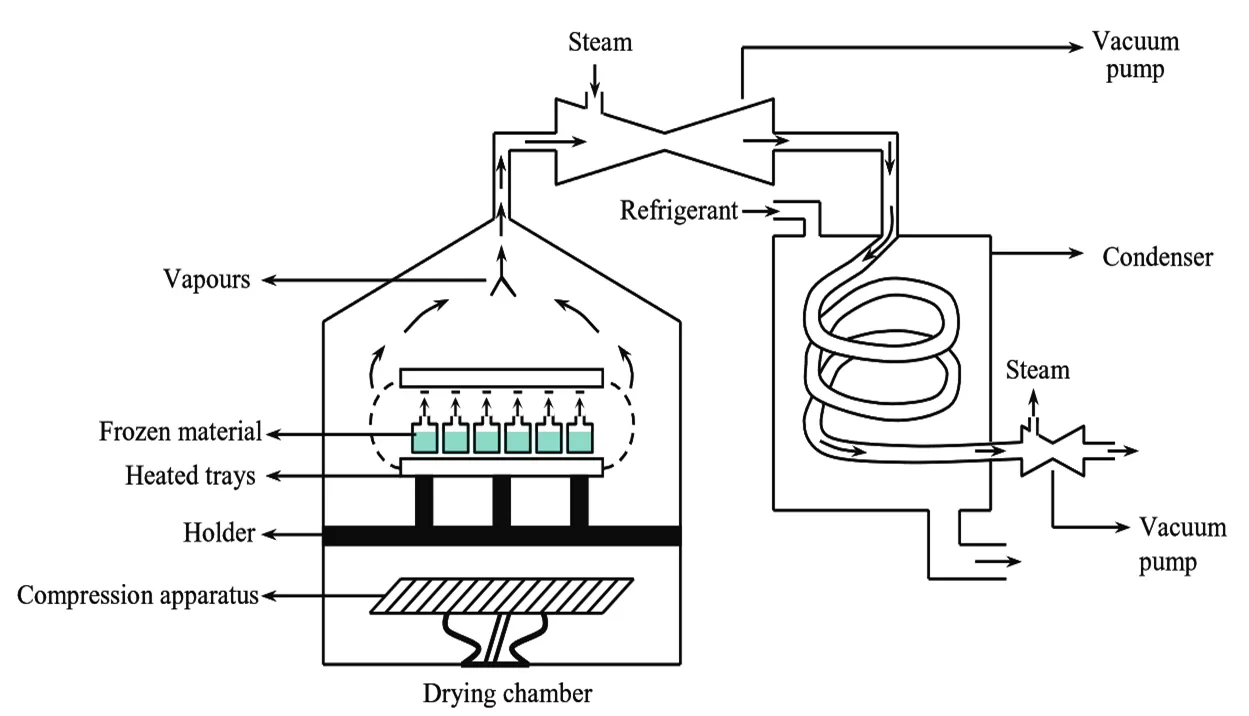
Freeze drying is a technique employed to improve the dissolution rate and oral bioavailability of medication that are poorly soluble but higher permeable classified as class II in the biopharmaceutical classification system. This process also known as lyophilization, involves removing water from substance after it has been frozen. there are several method to achieve the same final product. For instance, the drug can be physically embedded in water soluble matrix, which is combination of sugars and polymers designed for quick dispersion and structural integrity. The mixture is freeze dried to create a product that rapidly dissolves when placed in mouth. these formulations require a chemically inert and water insoluble drug with particle size 50 micrometers. porous solids are developed by freezing an aqueous dispersion or solution containing active ingredient and then removing the water using significant amount of alcohol (solvent extraction). This approach allows for the development thermolabile drugs at low temperature, avoiding harmful thermal effects and maintaining a dry state with minimal shelf-life stability issue.
3. Tablet Molding (21–23)
The Molding Process can be categorized into two types; the solvent method and the heat method. Tablet produced using the solvent method are less dense then compressed tablets and have a porous structure that accelerate dissolution. the mechanical strength of molded tablets is a significant concern to enhance this strength; binding agent must be added. additionally, taste masking presents a challenge in this technology and the masked drug particles are created by spray congealing a molten blend of hydrogenated polyethylene glycol, cottonseed oil, lecithin and sodium carbonate with an active ingredient into a lactose-based tablet triturate form. compared to the lyophilization technique, tablet made through the molding process are, easier to scale up for industrial production.
4. Sublimation (24,25)
Compressed tablet with lot of water-soluble ingredients may dissolve slowly because of low tablet porosity, which lessens water seeping in the matrix. conventional techniques compress volatile compounds into tablets, which can then be sublimated to eliminate the volatile materials and create incredibly porous structures. ammonium carbonate, urea, ammonium bicarbonate, camphor and hexamethylene tetramine are among the volatile substances that can be employed. Thymol, menthol, camphor, fatty acid such arachidic acid, myristic acid, capric acid and palmitic acid as well as organic acid like adipic acid were occasionally employed as volatile ingredients. The sublimation temperature ranged from 40 to 60 degree Celsius. it was discovered that the mouth disintegration time was around 25 sec.
5.Spray Drying (26)
One method for creating fine, very porous powders is spray drying. Spray dryers are generally employed in the pharmaceutical business to generate highly porous powders. Spray drying creates extremely porous and fine powders and offers a quick and cost-effective approach to remove solvents. Mannitol is used as a bulking ingredient, hydrolyzed and non-hydrolyzed gelatin as supportive agents and sodium starch glycolate or croscarmellose sodium as disintegrating agent in formulations. To improve dissolving and disintegration by suitable alkaline or acidic substance. This method has been used to produce fast dispersible tablet, according to allen et.al. A porous powder was produced by spray drying mixture.
Patented Technologies for FDT:
The quick disintegration of Fast dispersible tablet is typically ascribed to water quick entry into the tablet matrix, which causes the tablet matrix to disintegrate quickly. A number of technologies have emerged on the based on many methods and formulation elements and it is patented by number of pharmaceutical corporations. The technology that is patented is explained below;
1. Zydis Technology (27)
The first new technology tablet to be introduced was zydis, the most well-known of the quick disintegrating tablet formulation. After being placed on the tongue, the tablet dissolves in mouth in matter of seconds. The medicine is lyophilized or freeze dried in a matrix, typically made of gelatin, to create a zydis tablet. The product tablet needs to be administered in a unique blister pack because it is extremely lightweight and delicate. patients should be instructed to to peel back the foil layer to release the tablet rather than pushing it through.it takes two to three seconds for zydis product to dissolve on the tongue. because the ultimate water content in a freeze-dried product is too low, the zydis formulation is also self-preserving.
2. Nanocrystal Technology (28)
Elan’s in-house nanocrystal technology can facilitate formulation and enhance the qualities of the finished product and compound activity. The surface area will rise as the particle size decreases, increasing the rate of disintegration. Advantages of pharmacokinetics of oral nanoparticles (less than 2 microns) in the form of a tablet matrix that dissolves quickly. Water soluble GRAS (Generally Regarded as Safe) components are mixed with drug material nanocrystal colloidal dispersion, poured into blisters and lyophilized. This approach circumvents production processes like wet granulation, mixing and tableting for extremely powerful and dangerous medication.
3.Durasolv Technology(29)
Durasolv is the name of the unique equipment used in CIMA labs. Using this technique, tablets are made with a drug, a filler and a lubricant. Traditional machinery is used to make tablets, which are very stiff. these can be placed in blisters or other conventional packing methods. Durasolv is an appropriate technique for goods that need a little amount of active substances.
4.Orasolv Technology (29)
CIMA Labs developed Orasolv Technologies. This approach hides the flavour of the active drug. An explosive disintegration agent is also included. Tablets are made utilizing a direct compressive process with a modest compressive force in order to shorten the oral dissolving time. Tablet machine and conventional blenders are used to make the tablets. the tablets created are pliable and brittle.
5.Advatab Technology (30)
Errand Pharmaceuticals Was the company that created this. It manufactures FDT tablets using a proprietary tablet composition that was created and patented by Kyowa Hakko Kogyo (Tokyo, Japan). During the manufacturing process, a spray is used to apply lubricant to each tablet. Advara pills can be 30-40% stronger than regular tablets and are made with 13-30 times less hydrophobic lubricant.
Evaluation of Fast dispersible tablet:
Precompression parameters of tablet
The angle of repose can be used to calculate the frictional forces in loose powder or grains. This is the angle formed by the horizontal plane and the surface of pile of grains or powder. the funnel method determines it. pour the mixture through a funnel that has maximum cone height (h) that can be raised vertically.it is necessary to measure the heap radius(r).The following formula is used to determine the angle of repose

The 100ml measuring cylinder should be filled with a precisely weighed quantity of powder. After noting the initial volume, the cylinder should be tapped 100 times on a level, firm surface and the amount of packaging that is tapped should be noted. the following formula should be determining bulk density (BD) and tapped density (TD)
Carr’s index of powder can be determined by following formula;
Hausner’s ratio is an index of ease of powder flow. Hausner’s ratio is calculated by the following formula ;
Post compression parameters of powders
Weigh each of the 20 randomly chosen tablets, then determine the average weight.
Monsanto hardness tester is used for determine the hardness of tablet.
The weight of a tablet that is removed from its holder due to removal of small particles from its surface is known as friability. To determine the tablets ability to pass through scraped regions during handlings, transportation and bundling, a friability test was conducted.(33) The Roche friabilitor was used to monitor the tablets friability.20 tablets were taken out of each detail and weighed .
Where, W1 = Initial weight of tablet
W2 = weight of tablet after friability
The die and punches used to make the tablets determine their diameter and punch size. A screw gauge is used to measure the tablet thickness. The thickness of tablets should be kept within a defined range of ±5%. Controlling the thickness is a also necessary to make packaging easier. A screw gauge should be used to measure each of ten pre weighed tablet thickness in millimeters(mm). It is necessary to report the average thickness and standard deviation
Using a tablet disintegration tester, six tablets are used in water at 37.0ºC for this test. The amount of time needed for this tablet to disintegrate and fully flow through the sieve is note.
The USP dissolving testing device 2 (paddle method) is used to measure the drug release rate from fast dispersible tablet. At 37 ±0.5ºC and 100 rpm , 900ml of 0.1 N HCL is used for dissolving test
CONCLUSION:
The successful formulation of fast dispersible tablet depends mainly on the proper selection of super disintegrants, taste masking strategies and optimization of mechanical strength and disintegration time. While they offer several advantages of such as convenience, rapid therapeutics effect and improved patient compliance.
Various manufacturing technique such as direct compression, freeze drying, molding, sublimation and spray drying are available each with specific benefits and limitations. proper evaluation through pre and post compression parameters ensure product quality, stability and performance. Overall fast dispersible tablet is promising and patient friendly drug delivery system with growing pharmaceutical application
REFERENCES


Shrinivas Jadhav*,H.A.Joshi,An Overview of Fast Dispersible Tablet Techniques and Evaluation, Int. J. of Pharm. Sci., 2026, Vol 4, Issue 6, 3928- 3936. https://doi.org/ 10.5281/zenodo.20720557
 10.5281/zenodo.20720557