

We use cookies to ensure our website works properly and to personalise your experience. Cookies policy
Surabhi Dayakar Rao College of Pharmacy, Rimmanaguda, Telangana, India, Pin Code: 502312
A simple, reliable, and efficient reverse-phase high-performance liquid chromatography (RP-HPLC) method was successfully developed and validated for the estimation of Brivaracetam in bulk and pharmaceutical dosage forms. Chromatographic separation was achieved using a PLATISIL C18-EP column (250 × 4.6 mm, 5 µm) with a mobile phase of methanol and KH?PO? buffer (70:30 v/v) at a flow rate of 1.2 mL/min, and detection at 278 nm. The method demonstrated acceptable system suitability parameters, including a tailing factor of 1.59 and theoretical plate count above 2000, confirming good peak symmetry and column efficiency. Validation studies performed as per ICH guidelines showed excellent linearity (10–50 µg/mL, R² ? 0.999), high precision (%RSD < 2%), and accuracy with recovery values within 98–102%. The assay result of 99.8% confirmed the applicability of the method for routine quality control. Sensitivity was established with LOD and LOQ values of 0.04µg/mL and 0.1 µg/mL, respectively. Robustness studies indicated that minor variations in flow rate and mobile phase composition did not significantly affect chromatographic performance, ensuring method stability. Overall, the developed RP-HPLC method is precise, accurate, sensitive, robust, and reproducible, making it suitable for routine pharmaceutical analysis and quality control of Brivaracetam in bulk and dosage forms
Analytical method development and validation play a crucial role in the pharmaceutical industry to ensure the quality, safety, and efficacy of drug products1. The identification, measurement, and purity evaluation of active pharmaceutical ingredients (APIs) and completed dosage forms depend on accurate analytical methods2. Because of its sensitivity, accuracy, precision, and repeatability, High-Performance Liquid Chromatography (HPLC) has become one of the most popular and favored analytical procedures. 3, 4, 5, 6The increasing demand for high-quality pharmaceutical products has led regulatory authorities such as the International Council for Harmonisation to establish stringent guidelines for analytical method validation. According to ICH Q2 (R1), validation ensures that an analytical method is suitable for its intended purpose. Parameters such as accuracy, precision, specificity, and linearity, limit of detection (LOD), limit of quantitation (LOQ), robustness, and system suitability are evaluated during validation.7
Validation of the developed analytical method is a mandatory requirement to confirm its reliability. According to International Council for Harmonisation guidelines, the following parameters Specificity Linearity Accuracy Precision Limit of Detection (LOD) Robustness System Suitability are evaluated. Validation ensures that the analytical method produces reliable and reproducible results suitable for routine quality control. 7, 8
Validated analytical methods are essential for brivaracetam for assay of bulk drug and finished dosage forms; stability testing under various environmental conditions, detection of degradation products and routine quality control analysis The absence of a validated method may lead to inaccurate results, affecting drug safety and efficacy.9
To create and verify a straightforward, accurate, and economical analytical technique for the measurement of brivaracetam in pharmaceutical dosage forms and bulk utilizing reverse phase high-performance liquid chromatography (RP-HPLC). To improve chromatographic conditions so that brivaracetam can be separated effectively and choose the proper column, mobile phase, and detection wavelength for the analysis and to determine the parameters for system suitability and retention time for brivaracetam. In order to make sure the developed method is dependable and repeatable for routine analysis of brivaracetam in different pharmaceutical dosage forms, it must be validated in accordance with ICH guidelines (Q2 (R1)) for parameters like accuracy, precision, specificity, linearity, range, detection limit, quantization limit, robustness, and system suitability and to ensure the method is reliable and reproducible for routine analysis of Brivaracetam in various pharmaceutical dosage forms.Brivaracetam (BRV), a propyl analog of levetiracetam, functions as an antiseizure medication through its high-affinity binding to synaptic vesicle protein 2A (SV2A).10 The U.S. Food and Drug Administration first approved BRV in 2016 as an adjunctive treatment for focal onset seizures in patients aged 16 years and older. Its approval was later expanded to include monotherapy for focal onset seizures in the same age range in 2017. In 2018, its indications were further expanded to include patients 4 years of age and older, and in 2021, it was approved for patients 1 month of age and older. BRV is currently authorized in Europe as an adjuvant treatment for patients two years of age and older who have focal onset seizures, with or without secondary generalization. In 2019, the Ministry of Food and Drug Safety in South Korea authorized BRV as an adjuvant treatment for focal onset seizures in the form of oral solution and film-coated tablets.
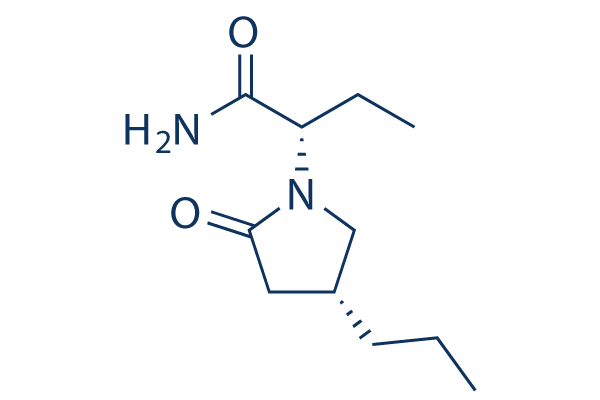
Figure 1: Chemical Structure of Brivaracetam
2. MATERIALS AND METHODS:
Table 1: Optimized Chromatographic Conditions
|
Instrument used |
High performance liquid chromatography equipped with Auto sampler and PDA detector |
|
Temperature |
Ambient |
|
Column |
PLASTICIL C18.EP(4.6x250mm,5µm) |
|
Mobile Phase |
70% Methanol: 30% KH2PO4 3 (70:30ml) |
|
Flow rate |
1.2ml/min |
|
Wavelength |
278mm |
|
Injection volume |
20µl |
|
Run time |
10min |
Preparation of Potassium Phosphate buffer PH- 3
To prepare Potassium phosphate buffer solution, add 13.6gm of phosphate buffer in 1000ml water. Adjust this solution to pH by using diluted HCL.
Preparation of mobile phase:
Mix a mixture of above Methanol 700ml (70%) and 300 ml potassium dihydrogen phosphate (30%) and degas in ultrasonic water bath for 5 minutes. Filter through 0.45 µ filter under vacuum filtration.
Standard Solution Preparation:
Accurately weigh and transfer 25 mg of Brivaracetam working standard into a 25 ml clean dry volumetric flask add Diluents and sonicate to dissolve it completely and make volume up to the mark with the same solvent. (Stock solution).Further pipette 0.3ml of the above stock solution into a 10ml volumetric flask and dilute up to the mark with Diluents. (30ppm)
VALIDATION PARAMETERS:
ASSAY:
Standard Solution Preparation:
Accurately weigh and transfer 25 mg of Brivaracetam working standard into a 25 ml clean dry volumetric flask add Diluents and sonicate to dissolve it completely and make volume up to the mark with the same solvent. (Stock solution)
Further pipette 0.3ml of the above stock solution into a 10ml volumetric flask and dilute up to the mark with Diluents. (30ppm)
Sample Solution Preparation:
Accurately weigh and transfer equivalent to 25 mg of Brivaracetam equivalent weight (50mg) of the sample into a 25 ml clean dry volumetric flask add about 7ml of Diluents and sonicate to dissolve it completely and make volume up to the mark with the same solvent. Further pipette 0.3ml of the above stock solution into a 10ml volumetric flask and dilute up to the mark with Diluents.
Inject 10 L of the standard, sample into the chromatographic system and measure the areas for the Brivaracetam peaks and calculate the % Assay by using the formulae.
Preparation of drug solutions for Linearity (Level 1-V):
To make 10 ppm, 20 ppm, 30 ppm, 40 ppm, and 50 ppm concentrations of brivaracetam solutions, pipette out 0.1, 0.2, 0.3, 0.4, and 0.5 ml of stock solution and mix up to 10 ml with diluents. Measure the peak area after injecting each level into the chromatographic apparatus. Plot the peak area against concentration on a graph. Further pipette 0.3ml of the above stock solution into a 10ml volumetric flask and dilute up to the mark with Diluents.
Inject 10 L of the standard, sample into the chromatographic system and measure the areas for the Brivaracetam peaks and calculate the % Assay by using the formulae.
Precision:
The standard solution was injected for six times and measured the area for all six injections in HPLC. The %RSD for the area of six replicate injections was found to be within the specified limits.
Intermediate Precision/Ruggedness:
The standard solution was injected for six times and measured the area for all six injections in HPLC. The %RSD for the area of six replicate injections was found to be within the specified limits.
ACCURACY:
Preparation of 50%, 100% and 150% standard stock solution:
Accurately weigh and transfer 12.5mg, 25mg and 37.5mg of Brivaracetam working standard into a 25 ml clean dry volumetric flask add Diluents and sonicate to dissolve it completely and make volume up to the mark with the same solvent. (Stock solution).Pipette 0.3ml of the above stock solution into a 10ml volumetric flask and dilute up to the mark with Diluents.
Inject the standard solution, Accuracy -50%, Accuracy -100% and Accuracy -150% solutions.
Calculate the Amount found and Amount added for Brivaracetam and calculate the individual recovery and mean recovery values.
LIMIT OF DETECTION:
Preparation of Brivaracetam solution:
Preparation of 0.04µg/ml solution:
Accurately weigh and transfer 25 mg of Brivaracetam working standard into a 25 ml clean dry volumetric flask add Diluents and sonicate to dissolve it completely and make volume up to the mark with the same solvent. (Stock solution)
Pipette 1 milliliter of the stock solution mentioned above into a 10 milliliter volumetric flask, then use diluents to dilute it to the appropriate level. Pipette 0.1 ml of the stock solution mentioned above into a 10 ml volumetric flask, then use diluents to dilute it to the appropriate level. Pipette 0.4 ml of the stock solution mentioned above into a 10 ml volumetric flask, then use diluents to dilute it to the appropriate level. (0.04 ppm)
LIMIT OF QUANTIFICATION:
Preparation of Brivaracetam solution:
Preparation of 0.1µg/ml solution:
Accurately weigh and transfer 25 mg of Brivaracetam working standard into a 25 ml clean dry volumetric flask add Diluents and sonicate to dissolve it completely and make volume up to the mark with the same solvent. (Stock solution).Pipette 1 ml of the stock solution mentioned above into a 10 ml volumetric flask, then use diluents to dilute it to the desired level. After pipetting 1 milliliter of the previously indicated stock solution into a 10 milliliter volumetric flask, dilute it to the proper concentration using diluents.
After pipetting 0.1 ml of the previously described stock solution into a 10 ml volumetric flask, dilute it to the proper concentration using diluents. 0.1 parts per million.
ROBUSTNESS:
As part of the Robustness, deliberate change in the Flow rate, Mobile Phase composition, Temperature Variation was made to evaluate the impact on the method.
Brivaracetam standard solution (30µg/ml) was made and analyzed using different flow rates and method flow rates. The Organic composition in the Mobile phase was varied from 40% to 60%.A standard solution containing 30 µg/ml of Brivaracetam was made and examined using both the method's true mobile phase composition and the modified mobile phase composition.
3.RESULTS:
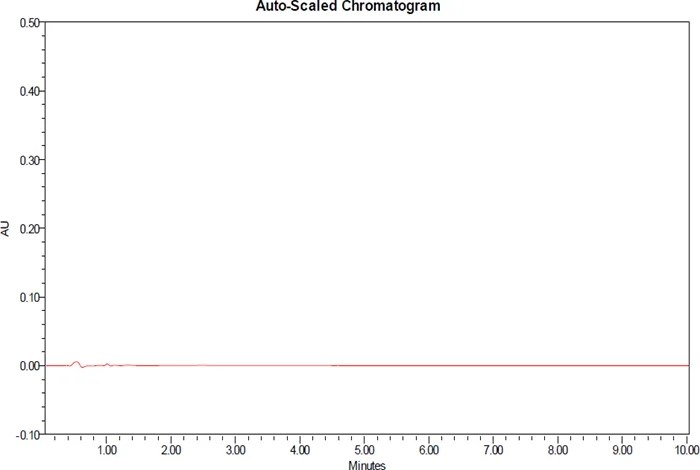
Figure 1: Chromatogram showing Blank
Table 2: Area of different concentration of Brivaracetam
|
S. No |
Brivaracetam |
|
|
Concentration (µg/ml) |
Area |
|
|
1 |
10 |
587635 |
|
2 |
20 |
1065090 |
|
3 |
30 |
1557341 |
|
4 |
40 |
2057454 |
|
5 |
50 |
2650378 |
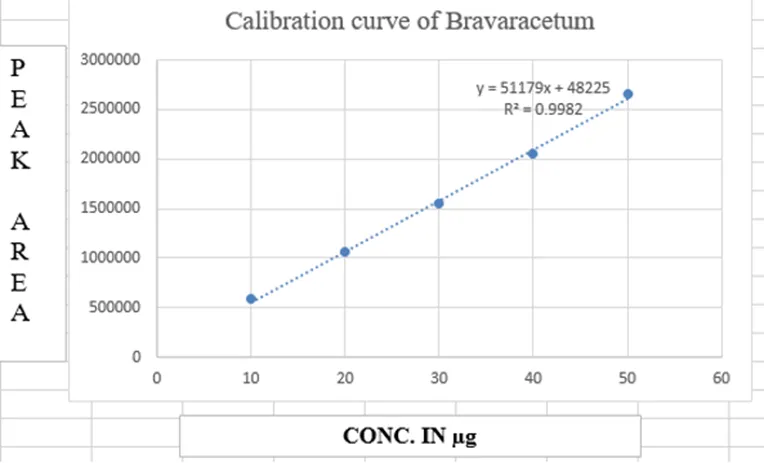
Figure 2: Calibration graph for Brivaracetam
Table 3: Results of system suitability parameters
|
S.No |
Name |
RT(min) |
Area (µV sec) |
Height (µV) |
USP tailing |
USP plate count |
|
1 |
Brivaracetam |
2.146 |
1557341 |
201251 |
1.59 |
2120.71 |
Standard and sample solution injected as described under experimental work. The corresponding chromatograms and results are shown below.
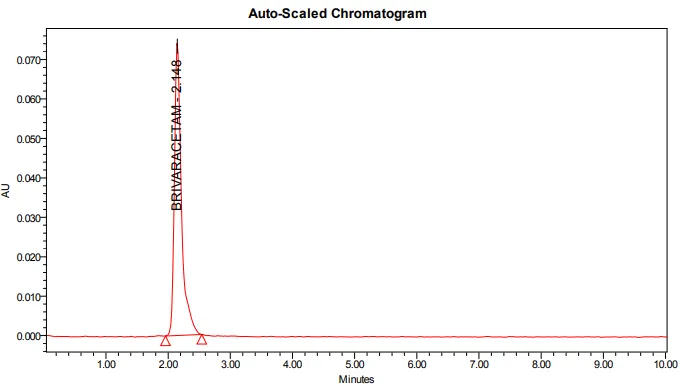
Figure 3: Chromatogram for Standard
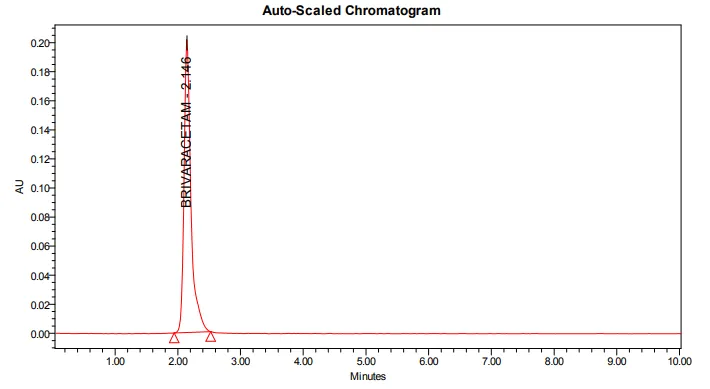
Figure 4: Chromatogram for Sample
TABLE 4: ASSAY TABLE
|
S.No |
Name |
RT(min) |
Area (µV sec) |
Height (µV) |
USP tailing |
USP plate count |
|
1 |
Brivaracetam (Standard) |
2.148 |
1587635 |
74363 |
1.66 |
2027 |
|
2 |
Brivaracetam (Sample) |
2.146 |
1557341 |
201251 |
1.59 |
2120 |
LINEARITY:
The plot of Concentration (x) versus the Average Peak Area (y) data of Brivaracetam is a straight line and the linearity range was found to lie from 10µg/ml to 50µg/ml of Brivaracetam with
Slope (m) = 51179
Intercept (c) = 48225 and
Correlation coefficient (R2) = 0.998
PRECISION:
Precision of the method was carried out for both sample solutions as described under experimental work. The corresponding results are shown below.
Table 5: Results of Precision for Brivaracetam
|
Injection |
Area |
|
Injection-1 |
2053103 |
|
Injection-2 |
2013546 |
|
Injection-3 |
1994995 |
|
Injection-4 |
2047454 |
|
Injection-5 |
2053103 |
|
Injection-6 |
2058347 |
|
Average |
2036758 |
|
Standard Deviation |
26068.19 |
|
%RSD |
1.2 |
%RSD for sample should be NMT 2 which is within the limits hence method is precise.
INTERMEDIATE PRECISION (ruggedness)
There was no significant change in assay content and system suitability parameters at different conditions of ruggedness like day to day and system to system variation
Table 6: Results of Intermediate precision for Brivaracetam
|
Injection |
Area |
|
Injection-1 |
2053103 |
|
Injection-2 |
2013546 |
|
Injection-3 |
1994995 |
|
Injection-4 |
2047454 |
|
Injection-5 |
2051103 |
|
Injection-6 |
2048347 |
|
Average |
2034758 |
|
Standard Deviation |
24415.54 |
|
%RSD |
1.1 |
%RSD of six different sample solutions should not more than 2 which is within the limit, hence the method is rugged.
ACCURACY:
Sample solutions at different concentrations (50%, 100%, and 150%) were prepared and the % recovery was calculated.
Table 7: Accuracy (recovery) data for Brivaracetam
|
%Concentration
(at specification Level) |
Area* |
Amount Added (mg) |
Amount Found (mg) |
% Recovery |
Mean Recovery |
|
50% |
778670.5 |
12.5 |
12.38 |
99.04 |
99.08 |
|
100% |
1557341 |
25 |
24.92 |
99.68 |
|
|
150% |
2336011.5 |
37.5 |
36.95 |
98.53 |
*Average of three determinations
The percentage recovery was found to be within the limit (98-102%).The results obtained for recovery at 50%, 100%, 150% are within the limits.
LIMIT OF DETECTION FOR BRIVARACETAM
The lowest concentration of the sample was prepared with respect to the base line noise and measured the signal to noise ratio.
Limit of Detection for Brivaracetam is 0.04µg/ml and Limit of Quantitation for Brivaracetam is 0. 1µg/ml respectively.
ROBUSTNESS:
The standard and samples of Brivaracetam were injected by changing the conditions of chromatography. There was no significant change in the parameters like resolution, tailing factor, asymmetric factor, and plate count.
Table 8: Results for variation in flow for Brivaracetam
|
S. No |
Flow Rate (ml/min) |
System Suitability Results |
|
|
USP Plate Count |
USP Tailing |
||
|
1 |
1 |
2485 |
1.30 |
|
2 |
1.2 |
2475 |
1.28 |
|
3 |
1.4 |
2479 |
1.29 |
Table 9: Results for variation in mobile phase composition for Brivaracetam
|
S. No |
Change in Organic Composition in the Mobile Phase |
System Suitability Results |
|
|
USP Plate Count |
USP Tailing |
||
|
1 |
10% less(63ml) |
2485 |
1.30 |
|
2 |
*Actual(70ml) |
2475 |
1.28 |
|
3 |
10% more(77ml) |
2479 |
1.29 |
* Results for actual Mobile phase composition have been considered from Accuracy standard and for actual flow (1.2 ml/min) have been considered from Assay standard.
CONCLUSION
The developed RP-HPLC method for the estimation of Brivaracetam was found to be simple, reliable, and efficient. The system suitability results demonstrated acceptable chromatographic performance with a tailing factor of 1.59 and theoretical plates above 2000, indicating good peak symmetry and column efficiency. Precision and intermediate precision studies showed %RSD values less than 2%, confirming that the method is both repeatable and rugged. Robustness studies revealed that small deliberate variations in flow rate and mobile phase composition did not significantly affect the chromatographic performance, ensuring method stability. Overall, the developed method complies with ICH validation guidelines and can be effectively applied for routine analysis and quality control of Brivaracetam in bulk and dosage forms.
REFERENCES

Neela Swathi, Chelimeti Bhandavi, Nalla Ramya, Beethoju Sravanthi, Putlagari Akhila, Challa Uma ReddyAnalytical Method Development and Validation of Brivaracetam in Pharmaceutical Dosage Form, Int. J. of Pharm. Sci., 2026, Vol 4, Issue 6, 3888-3896, https://doi.org/10.5281/zenodo.20715884
 10.5281/zenodo.20715884