

We use cookies to ensure our website works properly and to personalise your experience. Cookies policy
Research Scholar, Maharishi School Of Pharmaceutical Sciences, Maharishi School of College, Lucknow, Uttar Pradesh, India.
Pyrimidine-containing heterocycles are widely investigated in medicinal chemistry because their electronic properties and hydrogen-bonding capacity support recognition of diverse biological targets. This review organizes the chemistry and biological findings reported in the supplied source document, with emphasis on cyanopyrimidine derivatives investigated as anticancer and anti-inflammatory candidates. The reported synthetic sequence comprises Biginelli condensation of substituted aromatic aldehydes, ethyl cyanoacetate and thiourea, followed by alkylation, POCl3-mediated chlorination and amine substitution. The resulting compounds were evaluated by sulforhodamine B assays, selected NCI-60 screening, apoptosis-related staining, DNA fragmentation, cell-cycle analysis and wound-healing experiments. Anti-inflammatory assessment included hyaluronidase inhibition and carrageenan-induced rat paw edema. Molecular docking was performed against lysine-specific histone demethylase-1 (LSD-1; PDB 2DW4), and computational drug-likeness parameters were also reported. Several derivatives showed notable activity in the reported experimental systems, including LIP12 in HCT-116 and HL-60 cells and LMN12 in SiHa cells and the paw-edema model. These observations support continued medicinal-chemistry optimization, while also emphasizing the need for target-specific biochemical validation, pharmacokinetic studies and comprehensive toxicology before therapeutic translation.
Pyrimidine is a nitrogen-containing heterocycle of continuing interest in medicinal chemistry. Its compact heteroaromatic framework provides a useful platform for introducing substituents that can modulate polarity, lipophilicity and molecular recognition. Reviews published in recent years continue to describe pyrimidine derivatives as important sources of anticancer candidates, particularly in kinase-oriented and structure–activity relationship programs [1–5].The supplied source focuses on cyanopyrimidine derivatives developed through systematic structural modification and evaluated for anticancer and anti-inflammatory effects. The work is relevant to current medicinal-chemistry practice because the compounds were examined using complementary phenotypic, mechanistic and computational approaches rather than relying on a single biological endpoint. The cancer-related evaluation described in the source includes a broad cell-line panel and selected NCI-60 testing. The National Cancer Institute describes the NCI-60 methodology as a standardized growth-inhibition platform using multiple tumor-cell types and SRB-based measurement of cellular protein content [6]. The source therefore places the synthesized compounds in a recognized screening framework.Inflammation is also considered because inflammatory signaling can participate in tumor initiation and progression. The source consequently investigates selected compounds in hyaluronidase inhibition and carrageenan-induced paw-edema models, providing a second biological dimension to the medicinal-chemistry profile.
1. Scope and Organization of the Review
This article is a source-based review prepared from the supplied literature-review/thesis material, supplemented only where needed by current bibliographic context. The wording has been independently composed to avoid reproducing the source text verbatim. Quantitative values are retained only when they are explicitly reported in the supplied material.The review concentrates on four connected themes: (i) chemical construction and structural diversification of cyanopyrimidines;(ii) anticancer evaluation; (iii) anti-inflammatory evaluation; and (iv) molecular docking and drug-likeness assessment. The emphasis is on interpreting the relationships among these components rather than reproducing a compound-by-compound thesis narrative.
2. Pyrimidine as a Medicinal-Chemistry Scaffold
Recent reviews continue to document broad medicinal interest in pyrimidine-containing molecules, including anticancer, anti-inflammatory and other pharmacological applications [1–5]. The ring can participate in hydrogen-bonding interactions and can be incorporated into kinase-directed architectures, fused heterocycles and hybrid pharmacophores.The source highlights the presence of pyrimidine-related structural motifs in clinically relevant medicinal chemistry and discusses the use of substituent variation to tune biological properties. It also describes interest in lipophilic alkyl groups and heterocyclic amines as vectors for molecular diversification.From a design perspective, the investigated cyanopyrimidine series is useful because multiple structural positions can be modified while preserving the core heterocycle. This allows changes in alkyl-chain length, aromatic substitution and terminal amine identity to be examined within a common chemical framework.
3. Synthetic Chemistry of the Reported Cyanopyrimidines
The source describes a convergent multistep strategy. The first transformation is a three-component Biginelli condensation involving substituted aromatic benzaldehydes, ethyl cyanoacetate and thiourea, furnishing substituted 1,6-dihydropyrimidine-5-carbonitrile intermediates. The second step is base-catalyzed SN2 alkylation using isopropyl, isobutyl or isopentyl bromide.
The resulting alkylated intermediates are subjected to POCl3-mediated conversion of the hydroxyl functionality to a chloro derivative. In the final diversification step, the chloride is displaced by different aliphatic, aromatic or cyclic amines. This sequence generates a small library in which both hydrophobic and heterocyclic substituents can be varied.The strategy is attractive for SAR work because the same core synthetic sequence can generate analogues with controlled substitution patterns. However, the source does not provide a complete comparative yield table for every analogue in the excerpted material; therefore, this review does not infer synthetic efficiency beyond the documented route.

Figure 1. Generalized synthetic sequence reconstructed from the supplied source material.
4. Structural Features and SAR Considerations
The source gives particular attention to substituent effects. Alkyl groups such as isopropyl, isobutyl and isopentyl were introduced to alter the hydrophobic character of the molecules. Such changes may influence membrane association and cellular exposure, but the source does not establish a universal monotonic relationship between chain length and potency.A 3,4,5-trimethoxyphenyl motif is discussed as a recurring antitumor pharmacophore in the broader literature. Heterocyclic amines including morpholine, piperidine and piperazine provide additional vectors for modifying polarity and target interactions. These design elements create a framework for examining how steric, electronic and physicochemical changes affect biological response.Accordingly, the most defensible SAR conclusion from the supplied material is that cyanopyrimidine activity is substituent-dependent and that several structurally related compounds warrant further optimization. A definitive SAR model would require matched-pair analyses across the complete compound set, which is beyond the quantitative information available in the supplied document.
5. Anticancer Evaluation
The reported compounds were evaluated using sulforhodamine B assays against selected cancer-cell lines. Thirty-two compounds from the two synthetic schemes were additionally selected for screening by the U.S. National Cancer Institute against the NCI-60 panel. Remaining compounds were evaluated against selected cell-line panels.The source identifies LPR5 as showing growth-inhibition activity across multiple leukemia, lung, colon, CNS, melanoma, ovarian, renal, prostate and breast cancer cell lines. LIP2 likewise showed activity across a broad set of tumor-cell types. These observations indicate a broad phenotypic screening response, although growth-inhibition percentages from an NCI-type screen should not be interpreted as proof of selectivity or mechanism.LIB12 was reported to show IC50 values of 3.21 ± 0.16 µg/mL against MDA-MB-231 and 3.36 ± 0.21 µg/mL against MCF-7 cells. LIP12 showed IC50 values of 1.86 ± 0.06 µg/mL against HCT-116 and 1.21 ± 0.11 µg/mL against HL-60 cells. The source further reports mechanistic follow-up of LIP12 using apoptosis-related assays.In the second series, LMN11 was selected for NCI-60 five-dose evaluation because of its reported broad activity. LMN12 showed an IC50 of 3.49 ± 0.17 µg/mL against SiHa cells in the reported experiment. These values are source-derived and should be interpreted within their respective assay conditions rather than directly equated across different experimental systems.
6. Mechanistic Investigations
The source uses several complementary experiments to explore how active compounds affect cancer-cell behavior. DAPI staining can be used to visualize nuclear morphological changes, while acridine orange/ethidium bromide staining can distinguish viable and membrane-compromised/apoptotic cell populations. DNA fragmentation and cell-cycle analysis provide additional evidence concerning apoptosis and cell-cycle perturbation.Wound-healing experiments were used to investigate changes in cellular migration. These assays are useful as exploratory indicators of migration-related effects but are not, by themselves, evidence of antimetastatic efficacy in vivo.The source also discusses the biological relationship between cancer and inflammation. This provides a rationale for evaluating the same chemical series in anti-inflammatory models, although shared biological activity does not establish a single molecular mechanism.
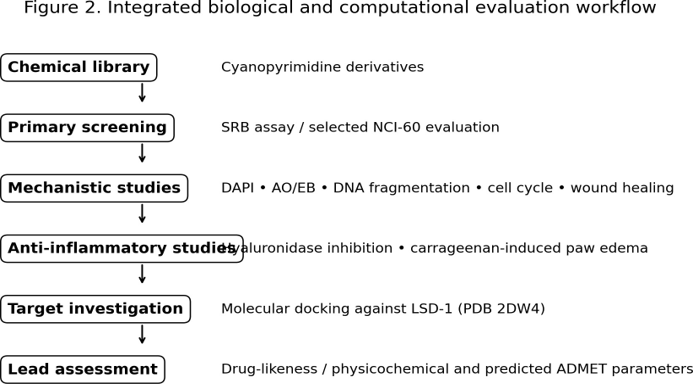
Figure 2. Integrated workflow used to characterize the synthesized cyanopyrimidine series.
7. Anti-Inflammatory Activity
Anti-inflammatory activity was examined by in-vitro hyaluronidase inhibition and by carrageenan-induced rat paw edema. LIPR12 showed the strongest reported in-vitro hyaluronidase inhibition. Selected anticancer-active compounds were then evaluated in vivo.LIB11 and LMN12 were reported to reduce carrageenan-induced paw edema by 67.83% and 65.74%, respectively, whereas diclofenac sodium produced an 83.22% reduction at 4 h in the described experiment. A separate statement in the source reports 68.76% reduction for LMN12; this difference indicates that experimental details should be checked against the full original dataset before publication of a definitive numerical table.Because the supplied document contains this internal numerical discrepancy, the present manuscript flags it rather than silently choosing one value. The final journal submission should use the value and experimental conditions verified from the original experimental chapter or laboratory record.
8. Molecular Docking and Target Considerations
Molecular docking was performed against lysine-specific histone demethylase-1 (LSD-1), using PDB ID 2DW4. The source reports favorable binding interactions for the synthesized cyanopyrimidines at the target binding site.Docking is valuable for generating hypotheses about ligand–protein recognition, but predicted binding poses and scores do not by themselves establish biochemical inhibition. Consequently, the docking results are best regarded as supportive evidence for future target-validation studies.The reported docking work can be integrated with the phenotypic assays to formulate testable hypotheses. For example, active compounds can be evaluated in biochemical LSD-1 inhibition assays, followed by target-engagement experiments in relevant cell models. Such validation would clarify whether the docking target contributes materially to the observed antiproliferative effects.
9. Drug-Likeness and ADMET Considerations
The source reports evaluation of molecular descriptors relevant to oral drug development, including polar surface area, molecular weight, hydrogen-bond donors and acceptors. It further reports predicted intestinal absorption, human serum binding, aqueous solubility and hERG K+ channel-blocking potential within the stated computational ranges.These findings are useful as prioritization criteria, but computational ADMET outputs are not substitutes for experimental pharmacokinetic and toxicological studies. In particular, hERG-related predictions require experimental electrophysiological confirmation when a compound advances toward development.An integrated optimization program should therefore balance potency with solubility, permeability, metabolic stability, plasma protein binding and safety liabilities. The source indicates that further structural expansion of lead-like molecules, including LPR4, LIP1, LIP12 and LMN12, was ongoing.
10. Comparative Summary of Representative Compounds
The following table consolidates the quantitative findings explicitly available in the supplied material. It is intentionally limited to documented values and does not assign an overall ranking to the compounds.
Table 1. Representative findings explicitly reported in the supplied source material.
|
Compound |
Model / cell line |
Reported result |
Interpretive note |
|
LPR5 |
Multiple NCI-60 lines |
Broad growth inhibition |
Phenotypic screen |
|
LIP2 |
Multiple NCI-60 lines |
Broad growth inhibition |
Phenotypic screen |
|
LIB12 |
MDA-MB-231 / MCF-7 |
3.21 ± 0.16 / 3.36 ± 0.21 µg/mL |
Breast cancer |
|
LIP12 |
HCT-116 / HL-60 |
1.86 ± 0.06 / 1.21 ± 0.11 µg/mL |
Mechanistic follow-up |
|
LIPR12 |
Hyaluronidase |
Strongest reported inhibition |
In-vitro |
|
LMN11 |
NCI-60 |
Broad activity |
Five-dose evaluation |
|
LMN12 |
SiHa |
3.49 ± 0.17 µg/mL |
Cervical cancer |
|
LMN12 |
Paw edema |
~66–69% reduction |
Source discrepancy |
11. Research Gaps and Future Perspectives
The current evidence supports additional study of cyanopyrimidine derivatives but also identifies several gaps. Target-specific biochemical assays are needed to determine whether LSD-1 or other proteins mediate the observed cellular effects. Selectivity studies against non-malignant cells are important for distinguishing general cytotoxicity from preferential anticancer activity.
Pharmacokinetic studies should establish exposure, clearance and metabolite profiles, while in-vivo efficacy models can test whether cellular activity translates to antitumor effects. Repeated-dose toxicology is also necessary before any therapeutic claims can be made.
From a chemistry perspective, future SAR programs can systematically vary aromatic substitution, alkyl-chain length and terminal amine identity. Matched molecular-pair analysis and quantitative SAR modeling could help identify the structural features most strongly associated with potency and developability.
CONCLUSION
Cyanopyrimidine derivatives provide a chemically versatile platform for medicinal-chemistry research. The supplied source documents a coherent sequence from multistep synthesis through phenotypic anticancer screening, mechanistic assays, anti-inflammatory evaluation, molecular docking and drug-likeness assessment.
Several derivatives showed notable activity in the reported systems, including LIP12 in HCT-116 and HL-60 cells and LMN12 in SiHa cells and the carrageenan-induced paw-edema model. The results justify continued investigation of the chemical series, while the limitations of docking, in-vitro cytotoxicity and predicted ADMET data should be recognized.
Future work should prioritize reproducible SAR analysis, target validation, pharmacokinetic characterization and comprehensive safety testing. This integrated approach can help determine which cyanopyrimidine structures, if any, merit progression from experimental leads toward more advanced preclinical evaluation.
Author Information
Vijay Kumar Singh — Research Scholar, Maharishi School of Pharmacy, Maharishi School of College, Lucknow, Uttar Pradesh, India. Email: singhvijaykumar1859@gmail.com
Conflict of Interest: No conflict of interest statement was provided in the source material. Confirm before submission.
Funding: Funding information was not provided in the source material. Add the applicable statement before submission.
Ethical statement: This review uses previously reported/source material and contains no new human or animal experiments
REFERENCES

Vijay Kumar Singh, Cyanopyrimidine Derivatives as Promising Anticancer and Anti-Inflammatory Agents: Chemistry, Biological Evaluation, Molecular Docking and Future Perspectives, Int. J. of Pharm. Sci., 2026, Vol 4, Issue 9, 4038-4044, https://doi.org/10.5281/zenodo.23051068
 10.5281/zenodo.23051068