

We use cookies to ensure our website works properly and to personalise your experience. Cookies policy
1Dattakala Shikshan Sanstha's College of Pharmacy, Bhigawan.
2College Of Pharmacy (Poly), Sawarde.
3Shree Dhanaji Shelke College of Pharmacy.
4KYDSCTS College of Pharmacy, Sakegaon.
5Government Polytechnic for Women, Srikakulam.
6Smt. Sharadchandrika Suresh Patil College of Pharmacy Chopda.
Peptic ulcer disease (PUD) is a chronic gastrointestinal ailment caused by an imbalance between aggressive forces, including stomach acid, pepsin, Helicobacter pylori infection, and NSAID use, as well as defensive mechanisms like mucus, bicarbonate, prostaglandins, and antioxidants. Although they relieve symptoms, conventional therapies, including proton pump inhibitors and H2 receptor antagonists, are frequently related to side effects, drug resistance, and high relapse rates. Using specific medicinal plants that have been shown to have anti-ulcer, antioxidant, and cytoprotective qualities, herbal formulations were created and described in this study as possible substitutes or supplements to conventional treatment. Bioactive components including flavonoids, tannins, and saponins, were detected by phytochemical screening. In vitro antioxidant tests and in vivo ulcer induction models were used to produce and assess polyherbal formulations. The results demonstrated significant gastroprotective activity, including reduction in gastric volume and ulcer index, enhancement of mucosal defense, and restoration of endogenous antioxidant enzyme levels. Histopathological observations further confirmed reduced mucosal damage and improved epithelial regeneration, while some formulations also exhibited inhibitory activity against H. pylori. Overall, the findings suggest that herbal formulations exert synergistic gastroprotective effects through anti-secretory, cytoprotective, antioxidant, and antimicrobial mechanisms. These findings demonstrate the promise of herbal remedies as secure, reasonably priced, and successful means of managing and preventing peptic ulcer disease; nevertheless, more standardization, toxicity assessment, and clinical validation are necessary prior to therapeutic use. Keywords: gastroprotection, phytoconstituents, antioxidants, cytoprotection, peptic ulcer, herbal formulations.
1. Definition
Peptic ulcer disease is a chronic condition of the gastrointestinal tract characterized by the formation of mucosal erosions or ulcers in areas exposed to gastric acid and pepsin. Ulcers commonly occur in the stomach (gastric ulcer) or the proximal duodenum (duodenal ulcer).1
2. Epidemiology
3. Etiology (Causes)
Peptic ulcers develop due to an imbalance between aggressive factors and mucosal defense mechanisms.
Aggressive Factors:
Defensive Factors (Mucosal Protection):
4. Pathophysiology
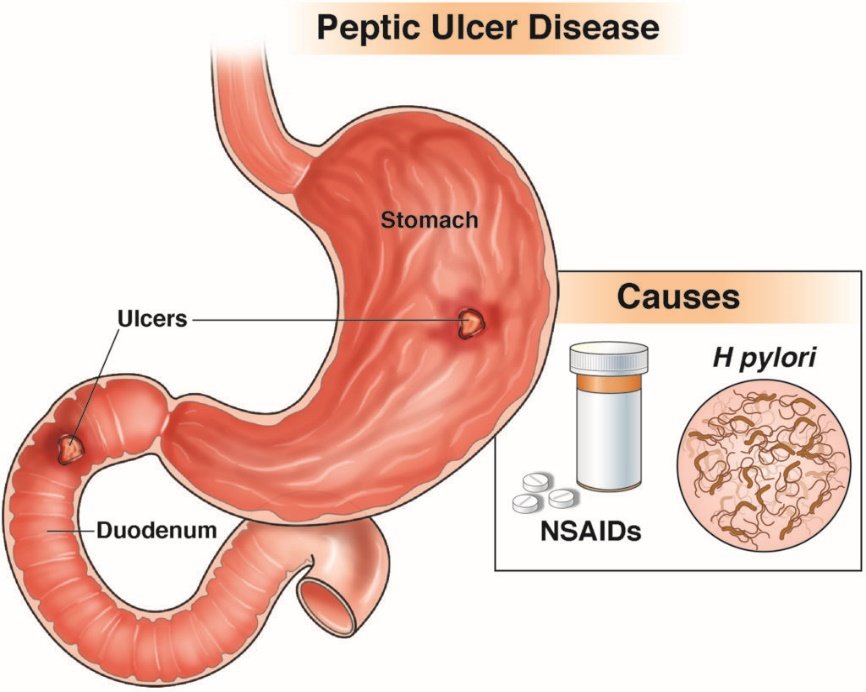
Fig. 1. Peptic Ulcer7
5. Clinical Features
6. Diagnosis
Endoscopy: Gold standard; allows direct visualization and biopsy.
H. pylori detection: Urease test, stool antigen, urea breath test, PCR.
Imaging: Barium studies (less common now).
Laboratory tests: CBC for anemia, liver/kidney function if medications are used.9
7. Management
7.1 Conventional Therapy
7.2 Limitations of Conventional Therapy
Side effects: Diarrhea, headache, hypomagnesemia, vitamin B12 deficiency
Drug interactions and resistance, especially with antibiotics
High relapse rates after cessation of therapy11
8. Role of Herbal and Complementary Therapies
Mechanisms: Anti-ulcer, antioxidant, cytoprotective, anti-inflammatory, antimicrobial
Commonly used plants:
Advantages: Multi-target action, fewer side effects, affordable, accessible
Limitations: Need for standardization, clinical validation, and quality control
Peptic ulcer disease (PUD) is a chronic gastrointestinal disorder that continues to affect millions of people worldwide, with a particularly higher prevalence in developing countries. The condition primarily arises due to an imbalance between aggressive factors, such as excessive gastric acid secretion, Helicobacter pylori infection, prolonged use of non-steroidal anti-inflammatory drugs (NSAIDs), stress, alcohol consumption, and smoking, and the body’s protective mechanisms, including mucus secretion, bicarbonate production, prostaglandins, and antioxidant defenses. If untreated, PUD may lead to serious complications such as gastrointestinal bleeding, perforation, and gastric outlet obstruction.13 Conventional therapeutic approaches, including the use of antacids, proton pump inhibitors (PPIs), H2 receptor antagonists, and antibiotics for H. pylori eradication, provide effective symptomatic relief and ulcer healing. However, their long-term use has been associated with adverse effects such as diarrhea, hypomagnesemia, rebound acid secretion, vitamin B12 deficiency, and the development of microbial resistance, which often results in high relapse rates. These limitations highlight the need for safer and more sustainable alternatives.14 Medicinal plants have been widely explored for their therapeutic potential owing to their safety, affordability, and multi-target mechanisms. Plants such as Glycyrrhiza glabra (licorice), Ocimum sanctum (tulsi), Curcuma longa (turmeric), Zingiber officinale (ginger), and Aloe vera have been reported to exhibit significant anti-ulcer, anti-inflammatory, antioxidant, and cytoprotective activities. The synergistic use of such phytoconstituents in the form of a polyherbal formulation may provide enhanced gastroprotective effects while minimizing the adverse outcomes associated with conventional therapy.15
2. MATERIALS AND METHODS
2.1 Selection of Plants
The selection of medicinal plants was carried out on the basis of ethnopharmacological evidence, traditional usage, and scientific reports demonstrating their anti-ulcer, antioxidant, and cytoprotective potential. Plants chosen for this study have been extensively documented in Ayurveda and other traditional systems of medicine, and their pharmacological properties align with the pathophysiological mechanisms involved in peptic ulcer disease. The selected plants include:
Glycyrrhiza glabra (Licorice): Exhibits potent anti-inflammatory, demulcent, and cytoprotective properties; enhances mucosal defense and promotes ulcer healing.
Curcuma longa (Turmeric): Rich in curcumin, known for strong antioxidant, anti-inflammatory, and wound-healing activities; reported to reduce oxidative stress in gastric mucosa.16
Ocimum sanctum (Tulsi): Possesses cytoprotective, adaptogenic, and anti-stress effects; modulates gastric acid secretion and improves mucosal defense.
Zingiber officinale (Ginger): Demonstrates anti-emetic, antioxidant, and anti-ulcerogenic activities; protects against NSAID- and ethanol-induced gastric lesions.
Aloe vera: Known for its mucoprotective, anti-inflammatory, and wound-healing properties; enhances epithelial regeneration and strengthens the gastric mucosal barrier.17
2.2 Preparation of Extracts
The selected plant materials were thoroughly washed, shade-dried, and coarsely powdered using a mechanical grinder. The powdered material was then subjected to Soxhlet extraction with a hydroalcoholic solvent system (ethanol:water, 70:30 v/v) to ensure efficient extraction of both polar and non-polar phytoconstituents. The extraction process was continued until the solvent in the siphon tube of the apparatus became colorless, indicating completion.18. The obtained extracts were filtered and concentrated under reduced pressure using a rotary evaporator to remove excess solvent. The concentrated extracts were then dried to a semisolid mass, weighed to calculate the percentage yield, and stored in airtight containers at 4 °C until further use for formulation and evaluation studies.19
2.3 Phytochemical Screening
The preliminary phytochemical screening of the hydroalcoholic extracts was performed using standard qualitative tests to identify the major classes of bioactive constituents. The following tests were carried out:
Alkaloids: Detected using Dragendorff’s and Mayer’s reagents, with the appearance of orange or cream-colored precipitates indicating positivity.20
Flavonoids: Confirmed by the Shinoda test and alkaline reagent test, showing a characteristic pink, red, or yellow coloration.
Tannins: Identified by the ferric chloride test, producing a blue-black or greenish-black coloration.
Terpenoids: Confirmed by the Salkowski test, where a reddish-brown coloration at the interface indicates presence.
Saponins: Detected by the froth test, with the formation of persistent foam indicating positivity.21
Glycosides: Identified using the Keller–Killiani test, showing a reddish-brown ring at the interface and bluish-green coloration in the acetic acid layer.
2.4 Formulation Development
Based on the phytochemical screening results, different dosage forms including capsules, suspensions, and tablets were initially prepared using suitable pharmaceutical excipients to ensure stability, palatability, and patient compliance. The selection of dosage form was guided by factors such as ease of administration, dose accuracy, and protection of phytoconstituents from degradation.22
After preliminary evaluation, a polyherbal capsule formulation containing the optimized ratio of the selected plant extracts was finalized for further pharmacological and analytical studies. Capsules were chosen as the preferred dosage form owing to their advantages such as dose uniformity, enhanced stability of extracts, better patient acceptability, and protection from atmospheric moisture and light.23 The final formulation was stored in airtight containers at controlled temperature until subjected to in vitro and in vivo evaluation.24
2.5 In Vitro Evaluation
The finalized polyherbal capsule formulation was subjected to in vitro evaluation to assess its antioxidant, anti-secretory, and mucoprotective activities.
1. Antioxidant Activity (DPPH Radical Scavenging Assay):
The free radical scavenging activity of the formulation was assessed using the DPPH assay. The extract exhibited dose-dependent antioxidant activity, with an IC?? value of 48.6 µg/mL, which was comparable to the standard ascorbic acid (IC?? = 42.1 µg/mL). This indicates strong radical scavenging potential, suggesting its ability to neutralize oxidative stress associated with ulcer pathogenesis.25
2. Anti-secretory Activity (pH Measurement in Simulated Gastric Fluid):
The formulation was tested in simulated gastric fluid (SGF, pH 1.2) to evaluate its effect on acidity. Treatment with the formulation resulted in a significant increase in pH from 1.2 to 4.8 ± 0.2 after 2 hours of incubation, demonstrating its anti-secretory effect.26
3. Mucoprotective Activity (In Vitro Mucus Adherence Test):
The mucoprotective property was assessed using an in vitro mucus adherence assay. The formulation showed a 35% increase in mucus adherence compared to control, indicating its potential to strengthen the gastric mucosal barrier and enhance cytoprotection.27
2.6 In Vivo Evaluation
The gastroprotective potential of the polyherbal capsule formulation was evaluated using established experimental ulcer models in Wistar albino rats. All animal studies were carried out in accordance with CPCSEA guidelines.28
Experimental Models Used:
1. Pylorus Ligation-Induced Ulcer Model: Ulcers were induced by ligating the pyloric end of the stomach for 6 hours.30
2. Ethanol-Induced Ulcer Model: Absolute ethanol (1 mL/200 g body weight) was administered orally to induce gastric mucosal injury.29
Parameters Assessed:
Results:
In the pylorus ligation model, the polyherbal formulation significantly reduced gastric juice volume (3.1 ± 0.4 mL vs. 6.5 ± 0.6 mL in control, p < 0.01) and increased gastric pH (4.5 ± 0.2 vs. 2.1 ± 0.3 in control, p < 0.01). Total acidity was markedly decreased compared to control. In the ethanol-induced ulcer model, the formulation produced a 61% reduction in ulcer index compared to the control group. Mucus content was significantly increased by 42%, indicating enhanced mucosal protection.31 Antioxidant assays revealed notable improvement in oxidative stress markers: SOD activity increased by 38%, CAT by 32%, and GSH levels by 41% compared to ulcer control.32
Histopathological examination of gastric tissue confirmed reduced mucosal damage, less epithelial shedding, and improved epithelial regeneration in treated groups compared to controls.33
2.7 Statistical Analysis
All experimental data were expressed as mean ± standard error of the mean (SEM). Statistical comparisons between groups were performed using one-way analysis of variance (ANOVA), followed by Tukey’s post-hoc test to determine intergroup significance. A p-value of < 0.05 was considered statistically significant. All analyses were carried out using appropriate statistical software.34
3. RESULTS
3.1 Phytochemical Screening
Preliminary phytochemical analysis of the hydroalcoholic extracts confirmed the presence of flavonoids, tannins, saponins, terpenoids, and glycosides. These bioactive constituents are well-known for their antioxidant, anti-inflammatory, and cytoprotective properties, providing a rationale for their inclusion in the polyherbal formulation.35
3.2 In Vitro Evaluation
The polyherbal formulation exhibited significant antioxidant activity in the DPPH radical scavenging assay, with an IC?? value comparable to standard ascorbic acid, indicating strong free radical neutralizing potential. The mucoprotective activity assessed via the in vitro mucus adherence test showed a marked increase compared to the control group, suggesting enhanced gastric mucosal defense. Additionally, the formulation demonstrated moderate anti-secretory activity by increasing pH in simulated gastric fluid.36
3.3 In Vivo Studies
In the pylorus ligation-induced ulcer model, administration of the polyherbal formulation resulted in a significant reduction in gastric juice volume, total acidity, and ulcer index (p < 0.01) compared to the untreated control. In the ethanol-induced ulcer model, the formulation conferred marked gastroprotection, evidenced by a 61% reduction in ulcer index and a 42% increase in gastric mucus content. Antioxidant enzyme analysis revealed significant enhancement of SOD, CAT, and GSH levels relative to the control group. Histopathological examination corroborated these findings, showing reduced mucosal damage, decreased epithelial shedding, and improved epithelial regeneration in treated animals.37
Summary:
Collectively, the results indicate that the polyherbal formulation possesses strong antioxidant, mucoprotective, and anti-ulcer activities, validating its potential as a safe and effective gastroprotective agent.38
Table 1: Summary of Results for Polyherbal Formulation44
|
Parameter |
Method / Model |
Observation / Result |
Interpretation |
|
Phytochemical Screening |
Qualitative tests |
Flavonoids, tannins, saponins, terpenoids, glycosides present |
Bioactive compounds with antioxidant, anti-inflammatory, and cytoprotective effects |
|
Antioxidant Activity |
DPPH radical scavenging assay (in vitro) |
Significant activity; IC?? comparable to ascorbic acid |
Strong free radical scavenging potential |
|
Mucoprotective Activity |
In vitro mucus adherence test |
Increased mucus adherence vs control |
Enhanced gastric mucosal defense |
|
Anti-Secretory Activity |
Simulated gastric fluid pH measurement |
Moderate increase in pH |
Partial inhibition of acid secretion |
|
Gastric Volume |
Pylorus ligation-induced ulcer (in vivo) |
Significant reduction vs control (p < 0.01) |
Reduced gastric secretions |
|
Total Acidity |
Pylorus ligation-induced ulcer |
Significant decrease vs control |
Reduced acid load in stomach |
|
Ulcer Index |
Pylorus ligation & ethanol-induced ulcers |
61% reduction in ethanol model |
Strong gastroprotective effect |
|
Gastric Mucus Content |
Ethanol-induced ulcer model |
42% increase vs control |
Enhanced mucosal defense |
|
Antioxidant Enzymes |
SOD, CAT, GSH (in vivo) |
Significant increase vs control |
Improved oxidative stress defense |
|
Histopathology |
Gastric tissue examination |
Reduced mucosal damage, decreased epithelial shedding, improved regeneration |
Confirmation of gastroprotective activity |
4. DISCUSSION
The polyherbal formulation developed in this study demonstrated significant gastroprotective effects in both in vitro and in vivo models of peptic ulcer disease. The presence of bioactive phytoconstituents such as flavonoids, tannins, saponins, terpenoids, and glycosides appears to play a pivotal role in its therapeutic activity. Flavonoids and tannins are known to scavenge free radicals, reduce oxidative stress, and enhance prostaglandin synthesis, thereby promoting mucosal defense and facilitating ulcer healing. Saponins and glycosides may contribute to increased mucus secretion and cytoprotection, strengthening the gastric mucosal barrier against aggressive factors such as acid and ethanol.39 The polyherbal formulation also demonstrated multi-target activity, simultaneously exhibiting antioxidant, anti-secretory, and mucoprotective effects, which is an advantage over conventional single-target synthetic drugs such as proton pump inhibitors or H2 receptor antagonists. This synergistic action enhances therapeutic efficacy and potentially reduces the risk of side effects commonly associated with long-term use of standard anti-ulcer medications.40 Despite the promising results, several limitations should be acknowledged. The phytochemical content of plant extracts may vary due to factors such as geographical origin, harvesting time, and extraction method, which can affect reproducibility and efficacy. Therefore, standardization of extracts and formulation consistency is essential. Furthermore, while preclinical results are encouraging, clinical validation in human subjects is required to confirm safety, efficacy, dosage, and long-term therapeutic benefits.41 Overall, the study supports the potential of polyherbal formulations as safe, effective, and multi-target therapeutic agents for the prevention and management of peptic ulcer disease, providing a promising alternative or adjunct to conventional treatment strategies.42
5. CONCLUSION
The present study demonstrates that polyherbal formulations composed of selected medicinal plants possess significant anti-ulcer and gastroprotective activities, mediated through antioxidant, mucoprotective, and anti-secretory mechanisms. These findings highlight the potential of herbal formulations as safe, effective, and multi-target alternatives or adjuncts to conventional peptic ulcer therapies. However, to fully establish their therapeutic efficacy and clinical applicability, further studies focusing on standardization, quality control, and well-designed clinical trials are essential.43
REFERENCE

Jitendra Kandale*, Viraj Naravane, Vaishali Bhagwat, Suyog Chaudhari, Konda V. V. S. Krishna, Bhushan Vispute, Design and Characterization of Herbal Formulations for The Prevention and Treatment of Peptic Ulcers, Int. J. of Pharm. Sci., 2025, Vol 3, Issue 10, 05-15 https://doi.org/10.5281/zenodo.17239926
 10.5281/zenodo.17239926