
View Article

  • Emerging Advance in Self-Nanoemulsifying Drug Delivery System (SNEDDS): Formulation Strategies, Characterization, and Application in Oral drug Delivery

  • 1Department of Pharmaceutics, Pioneer Pharmacy College, Vadodara – 390019, Gujrat, India

Abstract

SNEDDS is an innovative lipid-based delivery system that address problem associated with solubility and bioavailability of drugs belonging to BCS classes II and IV. SNEDDS comprise isotropic blends of lipids, surfactants, co surfactants and co solvents that create stabilized oil in water nano emulsion with droplet below 200 nm upon mild agitation in GIT. SNEDDS not only increase the solubility and permeation of drugs across biological membrane but also facilitate drug absorption via lymphatic uptake, thus circumventing first pass effect. The principal factor used for characterization of SNEDDS include droplet size, zeta potential, polydispersity index, emulsification time, and thermodynamic stability. This review paper offers a comprehensive account of SNEDDS regarding their composition, types, mode of action, formulation processes, characterization techniques, innovation, and application in the field of clinical medicine.

Keywords

Self-Nanoemulsifying Drug Delivery Systems, lipid based drug delivery system, oral bioavailability enhancement.

Introduction

× Popup Image

self-nanoemulsifying drug delivery systems (SNEDDS), when considered to be preconcentrates of individual nano emulsions, can also be handled as true anhydrous forms of these same individual nano emulsions. The ingredient of SNEDDS include isotropic mixture of one or more natural and synthetic oils, surfactants, and co-surfactants; rather than depending on water medium, there are one or more hydrophilic solvents and respective cosolvent for forming fine O/W nano emulsion out of SNEDDS, provided under mild agitation.[1-2] In terms of droplet size following emulsification, the classification will be made into two categories: SEDD having size 100-300 nm and SMEDD having droplet size <50nm.[3] Drugs that nano emulsified have the ability to be absorbed via the lymphatic route since they are of smaller sizes than conventional drug formulation; thus such formulation can bypass the first pass effect in the liver when administered orally.[4]   The conversion of the lipid emulsion into smaller particle size as a result of contact with bile salts and lipase in the intestine and becoming micelles after absorption via intestinal villi is that make them more soluble and absorbable. [5] There was many examples of recent developments in SNEDDS, SMEDDS, and SEDDS which enhance the solubility of poorly-soluble BCS Class II and Class IV drugs; this is accomplished by using medium-chain triglyceride oils in combination with a non-ionic surfactant to create the SNEDDS formulation as required for oral administration. [6] The Self Nanoemulsifying Drug Delivery System is also known as Nano emulsion, Mini emulsion, ultrafine emulsion, Submicron emulsion.[7]

Classify: SNEDDS [8-9]

On basis of composition of Nano-emulsion system (SNEDDS) are divided into 3 types such as:

  1. Oil in Water SNEDDS

Oil is dispersed into continuous Water phase (O/W).

  1. Water in Oil SNEDDS

Water is dispersed into continuous oil phase (W/O).

  1. Bi continuous SNEDDS

 This Surfactants solubility in two phases, oily & watery phase and droplets were immersed with two oily and watery Phase.

Formulation consideration:

The SNEDDs is mainly composed of the following: [10]

 Drugs, Oil, Surfactant, Co-surfactant, Co-solvents.

Drugs:

Many drugs that are poorly soluble in water are made as Self-Nanoemulsifying Drug Delivery Systems (SNEDDs). Most commonly used for producing SNEDDs are drugs in the BCS class II and IV. There was multiple physicochemical characteristics of the drug that can dramatically change the ability to produce a successful SNEDD system like log P, p Ka, molecular weight, ionizable functional groups and their number. [11] Those types of drugs that are in BCS classes II and IV. Must be a poorly soluble intermediate partition coefficient (i.e. log P between 2-4). [12-18] Whereas log P Value above 5 show excellent potential for forming SNEDDS like lipophilic drugs. [19]

Table: 1 Types of Drug used in SNEDDS

Class II Drugs

Class IV Drugs

Artemether

Albendazole

Ibuprofen

Nelfinavir

Dapsone

Indinavir

Oil:

It is pertinent to mention that the oil phase is very crucial in SNEDDS because physicochemical properties of oil are responsible for spontaneity in nano emulsification.[20] In case of developing nano emulsion using fixed oil the presence of long chain hydrocarbon may cause difficulties during their development process. [21]   In terms of the effectiveness of long chain triglyceride in comparison with medium chain triglyceride it is known that the former have been found to promote more efficient transport of drugs through intestinal lymph system. It seems that they prevent first pass effect of drugs. [11] Multiple types of oils must be used to achieve the best quality as the oily phase. In some instance a combination of fixed oil and medium chain triglycerides has been shown to provide a good balance between the need for drug loading and the need for emulsification of the drug.[22] The use of the mentioned fixed oils and medium chain triglycerides are also applicable to nano-emulsions and micro-emulsions however they have been replaced by new forms of semi-synthetic medium chain amphipathic surfactant compounds in the production of SNEDDS. [23] Type of oil used with drug in SNEDDS: palm oil, castor oil, lemon oil.

Surfactant:

As an amphiphile the surfactant is able to stay at the interface between oil and water, thus assisting in the preparation of the nano emulsion, while lowering its surface tension at same time. The two most common categories for classifying surfactants are by their charge types anionics, cationic, ampholytic and non-ionic by their respective HLB values. Unlike ionic surfactants, the non-ionic surfactants are less toxic and work efficiency at different value of the nano emulsion pH and ionic strength. [24] The emulsification data showed that various surfactants possess diverse emulsifying capabilities. [25] A specific combination of both low and high overall HLB surfactants is required to achieve a proper blend to form a self-nano-emulsifying system that remains stable through the course of mixing. [26] An optimal surfactant mixture in terms of HLB value between 14 and 16 is required for maximum emulsification when these surfactants are mixed with aqueous phases. [27] The presence of higher HLB surfactants could possibly increase fluidity and enhance emulsification of SNEDDS.[28] The concentration of the surfactant with in the SNEDDS has responsible for influence on the droplet size of nano emulsion.[29]

Classification Of Surfactant:

 Molecules of surfactant has major four forms of classification.

1. Anionic-surfactants

2. Cationic-surfactants

3. Ampholytic-surfactants

4. Non ionic surfactants

  1. Anionic Surfactant:

Those surfactant in which surface-active ion is negatively charged in solution are anionic surfactants. anionic groups may be directly connected to hydrophobic part or these may be connected through ester, ether, amide or amidine links. E.g., sodium dodecyl sulphate  

  1. Cationic surfactants:

Those surfactants in which surface-active ion is positively charged in solution, are cationic surfactants. E.g., sulphonium salts, phosphonium salts.

  1. Ampholytic Surfactants:

Able to form a surface active ion with both positive and negative charge. E.g., Alkyl imidazolines.

  1. Non ionic surfactants:

Hydrophilic part of the molecule is made up of multiple uncharged polar group.

E.g., - Poly oxyethylene (20) sorbitan monooleate.

Compared to ionic surfactants with non ionic surfactants have lower toxicities therefore, they improve absorption by increasing the permeability through the intestinal lumen. To produce a stable SNEDD 30%-60% concentration of surfactants is required during formulation. This increased concentration of surfactants and co-surfactants will enhance the oral bioavailability of poorly water-soluble drugs due to the increase of surfactants and co-surfactants with oil in the lipid mixtures prior to the formation of SNEDD.

Table 2: Type of surfactants utilized in marketed SNEDDS

Surfactant

Marketed drug product

Drug

Span 20

soft gelatine capsule

lopinavir

Cremophor RH 40

Neural soft gelatine capsule

Cyclosporine A

Surfactant concentrations were highly dependent on droplet size as the size of the droplet increases, the surfactant concentration will increase. Surfactants play an important role in the formulating of nano emulsions to increase the solubility of poorly soluble drugs in water. [30]

co-surfactant:

A single surfactant will not be sufficient to create low interfacial tension and therefore a co-surfactant is typically required to be added. Co-surfactants can work synergistically with surfactants to enhance drug solubility and surfactant ability to disperse within the oil so they can help maintain the stability and uniformity of the nano-emulsion.[31] Co-surfactants play an important role in developing SNEDDS by reducing the oil-water interface to create an increased surface area to enable the spontaneous formation of nano emulsions. SNEDDS formulations use fairly high concentrations (>30 % w/w) of surfactants, but adding a co-surfactant can decrease the Number of surfactants needed. Both types of surfactants reduce interfacial tension to a negative value, allowing for the expansion of mixed surfactants and the formation of fine oil-in-water droplets as excess surfactant get adsorbed. Once enough surfactant has been added, interfacial tension will increase to a positive value and “spontaneous emulsification” can occur. [32] Non-ionic surfactants generally require co-surfactants to help facilitate the emulsification of oils in water and create a stable emulsified system. The HLB values between 10 - 14 for co-surfactants commonly used in the formulation of SNEDDS will vary depending on the surfactant used, as discussed above. Some examples of hydrophilic co-surfactants, with a mid-chain-length alcohol classification, include hexanol and octanol. These types of co-surfactants function by reducing the interfacial tension between oil and water and promoting the impulsive formation of microemulsions.[33]

Table 3 : Co-Surfactants Used for SNEDDS

Co-Surfactant

Chemical name

HLB

Caproyl 90

Propylene glycol mono caprylate

6

Lauro glycol 90

Propylene glycol monolaurate

5

PEG 400

Polyethylene glycol 400

11.6

Co-solvents:[34]

Cosolvents can enhance drug solubility in formulation but must be used sparingly due to high polarity. After aqueous dispersion, cosolvents can rapidly move into the aqueous phase, causing precipitation of the drug. Co-solvents such as ethanol, propylene glycol, and polyethylene glycol must be used to help dissolve large amounts of hydrophilic surfactant.

volatile cosolvents such as alcohols, may evaporate from capsules and precipitate the drug within them. Additional components can be included in the SNEDDS formulation known as antioxidants, viscosity enhancers and modified release components.

Polymers:

An inert polymer matrix (5% - 40% by weight) is being used, it does not ionize at the physiological and creates a matrix. Hydroxy propyl methyl cellulose or ethyl cellulose can be used as surfactants.[20]

Aqueous phase:

SNEDDS form from the incorporation of oils, surfactants and co-solvents with drug molecules when placed into an aqueous environment. Generally, the pH of the stomach is acidic, ranging from approximately pH 1.5 to 2.5, plus the many ionic components of the G.I. significantly affect properties like size and stability of nano-emulsions.[25]

Mechanism of Self Emulsification:

The change in entropy favourable upon dispersion is greater than the energy required to increase the surface of dispersion. Therefore, for a conventional emulsion (ΔG) the free energy (ΔG) is considered to be a negative to the extent that the energy required to create a new surface between the two phases (o/w) is offset by the energy used to stabilize an emulsion. The free energy for a conventional emulsion (ΔG) is mathematically linked to (ΔG) as shown below:

ΔG = Σ i Ni r²i σ

G stands for the process's free energy.

N is the total number of droplets.

r is the radius of the droplets.

σ is the Interfacial energy.

Duo phases of an emulsion do not typically stay together for very long because they naturally want to separate themselves from each other, thus making the two liquid phases separating away from each other have less of an interfacial surface area; the emulsifying agent will create a monolayer on each of the emulsion droplet surfaces, thereby also reducing interfacial energy and acting as a physical barrier against coalescence.[35]

PREPARATION OF SNEDDS:[36]

The Self-Nanoemulsifying drug delivery system (SNEDDS) is Prepared by two ways.

Preparation of Liquid SNEDDS

A self-nano-emulsifying drug delivery system has been created using a pseudo ternary phase diagram to obtain a surfactant-to-cosurfactant ratio and the required emulsifiers for forming the two of the three classes of emulsions known as self-emulsifying and Nano-emulsifying. By adjusting the concentrations of the oil, surfactant and cosurfactant, several formulations were created by mixing weighed amounts of the oil and surfactants and dissolving the drug in that oil/surfactant mixture before placing them at room temperature for storage.

Preparation of Solid SNEDDS

The second most important technique for preparing a SNEDDS. Accurately weighed quantities of oil were placed in screw capped vials. If it require the oil was melted using a water bath. To the oil, a positive displacement pipette was used to add the surfactant and co-surfactant. Next, the oily ingredients were stirred with a vortex mixer in order to create an even mixture. A SSNEDDS was created by dropwise addition of the prepared liquid SNEDDS onto an equal or greater amount of a novel absorbent followed by mixing with a glass rod until the mixture becomes sufficiently damp to allow for sieving through no. 120 mesh, after which the SSNEDDS was dried at ambient temperature.

Preparation methods for SNEDDS:

The components required for the manufacture of self-nanoemulsifying drug delivery system comprise active pharmaceutical ingredients, excipients, polymer, and emulsifiers. The manufacturing procedure of SNEDDS may broadly be classified into two categories:

A. High-energy-emulsification     B. Low-energy-emulsification  High-energy emulsification technique involve mechanical approaches like high-pressure homogenization (HPH), ultrasonication, and micro fluidization to develop self-nanoemulsifying system. low energy emulsification processes are based on spontaneous emulsification and phase inversion. Reverse self-nanoemulsifying drug delivery systems are made through the combination of high-energy and low-energy emulsification technique, thus forming a highly viscous solution. [37-38]

High Energy Emulsification Method:

The formation of a nano emulsion when using high energy approach is based on the mixture composition, which includes surfactant, co-surfactant, cosolvents, and another functional chemical, and energy is used to prepare the mixture.

  1. High pressure homogenisation (HPH):

Nano-formulations require high-pressure to be produced. A fine emulsion can be created with high sheer stress based on the application of two types of turbulence and cavitation. By using these methods, nano-emulsion droplets can be produced at a size of less than 100 nm. The following factors determine the size of the nano-emulsion droplets produced by a high-pressure homogenizer: the type of homogenizer, sample composition, and the homogenizer operating condition like time, intensity, and temperature. [39]

  1. Ultra-sonication:

Among various potential techniques to create SNEDDS, one of the easiest to use and cleanup is the use of ultrasonication for emulsifying the different formulation components. The use of cavitation from ultrasonic waves converts macroemulsions into nano emulsions through the energy that is generated through the cavitation bubbles collapsing during sonication. This process leads to a reduction in the size of the droplets in the emulsion until the emulsion consists of droplets that are of a nano size.[40]  It is common to find this technique used in many laboratories for consistently producing mixed droplets that are 0.2mm or less in diameter; however, this technique can only be employed on small volume batches of nano emulsion.

  1. Micro-fluidization:

A micro fluidizer uses a micro fluidisation process, which has an outlet for a fluid to run through. A positive displacement pump is connected to the outlet, which forces the fluid to enter the interaction chamber. The fluid will then move from the interaction chamber through the microchannel to the impingement zone, Where the coarse emulsion will be formed by the addition of oil and water to the homogenizer. After that it goes through another area of the process to produce a homogeneous, clear and stable nano emulsion.[41]

Such device are employed in a high-pressure positive displacement pump (500-20000 PSI) In a micro-fluidizer, the coarse emulsion gets processed and becomes a homogeneous, clear and stable nano emulsion using the micro-fluidizer. [42-43]

Low Energy Emulsification:

  1. Phase inversion emulsification method:

There is another method of causing the phase transition in emulsification process through use of extremely hot path This can result in either micro or nano emulsion with the latter needing a higher temperature reaction.   There are several physical changes that can take place in this scenario, some of which include changes in the physiochemical characteristics, change in the mean particle size of emulsion, and speed with which the drug in an emulsion can be released into an entity. By changing the emulsion formation spontaneously, one can achieve the desired emulsions by use of non-ionic surfactants, and by changing the temperature of the mixture o/w nano emulsions form at lower than higher than ambient temperatures.[44]

  1. Continuous emulsification:

There will always be an emulsion created in this system, wherein the basis for a consistent and standardised organic resolution contains two phases, a hydrophilic and miscible surfactant phase and an oil (lipophilic) surfactant phase (greasy infill). This Oil-in-Water emulsion was produced when the organic phase was introduced to the aqueous phase by way of sufficiently continuous and strong stirring. The emulsion then became separated as the aqueous phase was subjected to increased shear demands. [45-46]

SNEDDS Mechanism of Action

After administration, the SNEDDS form oil-in-water nano emulsions immediately and instantaneously as a result of gentle agitation from gastric compression, with nanoparticles of less than 200nm in diameter. The drug incorporated into the oil phase provides a high interfacial area for drug loading and promotes dispersion of the drug into the gastrointestinal fluids, providing improved drug solubility and permeability by modifying the mass transport characteristics in the GI tract.[47] The rapid digestion of the nanodroplets will result in the drug being rapidly absorbed into the gastrointestinal tract as a result of improved drug dissolution.[48] Nano size droplets experience rapid digestion followed by quicker absorption of the drug into the GI tract.
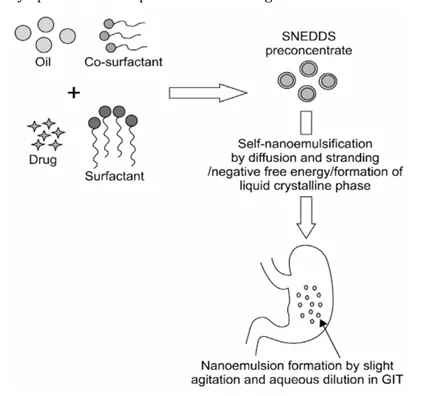
 

Figure 1: SNEDDS Mechanism of Action

The oral dose of SNEDDS can range from 25 mg to 2 gm. [49] This allows for a high degree of stability, palatability and acceptance of this type of product because the way the drug is presented in the packaging provides this stability, palatability and acceptance. [11] In general SNEDDS have a greater capacity to hold drugs when compared to other formulations based upon lipids.

Characterization of self-nanoemulsifying drug delivery systems (SNEDDS):

  1. Morphological Study:

Morphology is an important aspect of the physical appearance of a formulation since it determines the external characteristics of the product such as colour odour consistency density and visual appearance. The morphology of the droplets present in a nano-emulsion can be visualized with transmission electron microscopy (TEM) or scanning electron microscopy (SEM). [50-51]

  1. Thermodynamic Stability Studies: [52-56]

Thermodynamic stability indicates a dispersion's kinetic stability and is an important parameter to evaluate the chemical reactions that can occur between dispersion components. When dispersions are poorly stable, the resulting phase separation or precipitation can impact the drug's therapeutic effectiveness as well as its ability to be absorbed.

 Heating cooling cycle

We conducted a minimum of six temperature cycles (40 °C to 450 °C) over a minimum of 48 hours per cycle on the formulation before performing the centrifuge tests on those formulations that successfully passed storage at those temperatures.

Centrifugation

Centrifuged thaw cycles between 21°C and 25°C with storage at each temperature for not less than 48 hours are performed at 3500rpm for 30 minutes. The freeze thaw stress test is performed on formulations that do not exhibit any phase separation.

Freeze thaw cycle

Three freeze-thaw cycles were trial using SNEDDS at 3500rpm for a period of 30 minutes. The formulation was placed in a centrifuge and frozen at 4oC for 24 hours and then thawed at 40oC for 24 hours. After centrifugation for 5 minutes using a rotor with a speed of 3000 RPM, the samples were analyzed for evidence of phase separation and the samples passed if there was no evidence of phase separation, creaming, or cracking. The results indicate that these formulations show good stability.

  1. Zeta potential:

The zeta potential is indicative of the stability of the emulsion after it has been diluted. A large zeta potential indicates that the formulation will maintain its stability. Zwitterion charged particles have greater biocompatibility and longer blood residence times when compared to particles with either a positive or negative charge.[57]

  1. Viscosity:

Liquid SNEDDS have generally been filled into capsules. Liquid SNEDDS with a low viscosity can leak from the sleeve, while those with too high of a viscosity cannot be filled due to their low flowability. [58-59] When determining the viscosity of liquid SNEDDS the Brookfield cone and plate viscometer is typically used.

  1. Droplet Size Analysis Particle Size Measurements:

To measure the droplet size of the emulsions, both photon correlation spectroscopy (a method for measuring the size of small particles by analyzing their movement from the scattering of light) and a Zeta sizer that can analyzed particles in the size range of 10 to 5000 nm were used. The droplet sizes were measured at 25°C, with the angle of incidence measuring light scattering at a 90° angle. In addition, the polystyrene beads were used to conduct external standards against which to measure the level of scattering, so that it is possible to compare to polystyrene beads to confirm the level of size and scattering of droplets in the emulsion after dilution with 100 parts more water to each part of emulsion to show that the particles still fall within the nano meter range and that the system was able to function with additional water.[60]

  1. Refractive Index and Percent Transmittance:

To determine the transparency of the formulation, both the index of refraction and percent transmittance were used. An index of refraction of a system can be determined using a refractometer by placing a small drop of the solution on a slide and comparing this to the index of refraction of water (1.333). A percent transmittance reading of a system can be obtained using a UV spectrophotometer at a certain wavelength while blanking with distilled water. If the formulation is transparent both the index of refraction of the system will be similar to the index of the refraction of water (1.333) and the percent transmittance will be greater than 99% when the system is measured with a UV spectrophotometer.[61] Determining the index of refraction will also allow for analysis of the thermodynamic stability of the formulation. If there is almost no change in the index of refraction throughout the various time points studied, this generally means that the structure of the SNEDDS is stable and the SNEDDS are Thero dynamically stable at the times evaluated.[62]

  1. Stability Study:

The ICH guidelines were used to identify the guideline requirements for stability testing of the samples. The samples sensitivity to the storage conditions and the shelf life will be evaluated including testing for moisture and thermal conditions as defined in the current ICH guidelines. The standard of care for long-term (25°C ± 2°C/ 60% RH ± 5% RH) and accelerated (40°C ± 2°C/ 75% RH ± 5% RH) testing will also be used. [29,47,63]

  1. Emulsification time:

The USP II dissolution apparatus can be used to measure the emulsification duration. The formulation is placed into a basket with water and kept at 37 ◦C with mild agitation 100 rpm. The emulsification time is recorded as the time necessary to achieve a clear dispersion.[64] Emulsification time is related to the concentration of oil and surfactants emulsions with surfactants less than 60% (W/W) form spontaneously because of the rapid release of oil droplets from the penetration of water into the oil-water interface. Emulsions with surfactants greater than 60% (W/W) may take longer to form. The emulsification time will be greater due to the increased viscosity of the surfactants. Rapid emulsification may be an indication of rapid drug release and a shorter time until action starts. [65]

  1. Drug Content:

 The active ingredient in a pre-weighed SEDDS formulation is extracted via solubilisation into an appropriate solvent. The amount of active ingredient within a solvent extraction is compared to the amount of active ingredient within a known standard solvent solution using an appropriate analytical method.[66]

  1. Dispersibility Test:

A standard USP XXII Dissolution Apparatus 2 was used to determine how well hourly self-emulsification was occurring for oral nano and/or micro-emulsions at 37 °C. Approximately 1 ml of each formulation was added to 500 ml of water and gently mixed with a stainless steel paddle at a speed of 50 rpm. To determine the overall performance of each formulation in vitro, a visual grading system was developed. [67-68]

Grade A: Rapidly forming taken less than 1 min to form nano emulsion a Transparent or bluish appearance.

Grade B: Rapidly forming, slightly less transparent emulsion, having a bluish white appearance.

Grade C: It is a Fine Whitish milky emulsion that formed within 2 min.

Grade D: Dull, greyish white emulsion having slightly oily appearance that is slow to emulsification process.

Grade E: Formulation, exhibiting either less or minimal Emulsification with large oil globules present on the surface.

 Grade A and Grade B formulation will remain as nano emulsion was dispersed in GIT. While formulation was falling in Grade C could be recommend for SNEDDS as well as SEDDS of formulation.

  1. Fourier-transform infrared spectroscopy (FTIR) spectral analysis:

FTIR can be used to study interactions between excipients and drugs and evaluating both polymerization and cross-linking, as well as drug loading in formulations FTIR can identify different functional groups by their mode of connection. Molecules in their ground state have relatively low-energy levels; higher-energy levels are produced as members of the molecule absorb radiative energy at various wavelengths. By determining the difference in energy between the molecule's ground state and two or more excitation states, IR spectroscopy may help in determining the amount of energy absorbed by the sample when different types of energy were applied to it. FTIR samples can be prepared using several techniques like Nujols mulls or by preparing potassium bromide pellets for analysis; once prepared FTIR samples will be loaded into the FTIR for scanning at moderate scanning rates between 400 and 400cm-1. [69]

  1. In vitro dissolution study:

In vitro dissolution testing is widely used as an indication of future gastrointestinal  dissolution of the drug, and therefore serves as a way to estimate the rate and extent of absorption of poorly soluble drugs in water. The speed at which drugs dissolves is also determined by various factors including: wetting ability, solubility, viscosity of the solution and size of the emulsion droplet and volume of GI contents.[70] To determine the in vitro dissolution profile of the SNEDDS a dissolution apparatus of Type II should be used with dissolution media that correlates to the route of administration, like pH 1.2 and pH 6.8 for oral route of administration. A cumulative plot of the amount of drug dissolved versus the time of preparation will be constructed for comparison to the results from the pure drug.

Advancements in SNEDDS:

Supersaturated SNEDDS:

How much a drug will dissolve in the excipients used to make an SNEDD formulation will ultimately determine how much can be loaded into the formulation. If the lipid content is decreased, the solubilizing ability of the SNEDD will also be decreased and the drug will precipitate out. When a drug is solubilized in a larger amount of surfactant or co-surfactant than that found in the lipophilic phase it will, therefore, have an increased tendency to precipitate, as these excipients’ solubilizing ability will decrease as they dilute. Thus, the large majority of SNEDD formulations contain drugs with less than their maximum solubility at equilibrium. To overcome this limitation; the use of s-SNEDD systems containing hydrophilic precipitation inhibitors have been investigated. [71-72] The use of hydrophilic precipitation inhibitors (PPIs) that are polymers and water-soluble will provide a longer precipitation time than mean absorption time, due to the incorporation of said PPIs. The following polymers are some examples of typically used PPIs; Polyvinyl pyrrolidone (PVP), Hydroxypropyl methylcellulose (HPMC), Sodium carboxymethyl cellulose (Na CMC), and Methylcellulose (MC) as commonly used examples. In vitro comparisons show that many drugs which precipitate as an amorphous solid will have increased rates of dissolution after they precipitate, compared with other precipitating drugs. Therefore the rate of drug precipitation reflects the level of bioavailability obtainable. [73-74] s-SNEDDS enhance the stability, concentration vs. time profile, drug release rate, the scope of absorption, drug bioavailability, half-life, and feat of hydrophobic and less lipophilic drugs. [75-76 ]

Solid SNEDDS:

Common challenges with both liquid SNEDDSs and solid SNEDDSs are drug precipitation during storage, capsule shell and filling interactions, and formulation stability during storage. The primary strategy used to solve these problems has been to convert liquid SNEDDSs into solid dosage SNEDDSs formulations. Converting a liquid SNEDDSs to a solid SNEDDSs provides many advantages including lower costs of production, improved formulation stability, ease of handling, accurate dosing, and ultimately improved patient compliance. [77-80] In general, the methods utilized to manufacture solid SNEDDSs include adsorption to inert carriers, spray drying, melt granulation, and extrusion- spheronization.[81]

Mucus Permeation SNEDDS:

Mucosae are protected by adhesive layers of mucus that allow them to form barriers and provide protection for mucous tissue. Mucous barriers are located within the nasal cavity, eyes, lungs, intestines, and vagina. The formulation of SNEDDS as mucous-penetrating gels is a challenge in the field SNEDDS are superior pancreatic mucous-penetrating carriers because of their hydrophobicity and their ability to pass through with little or no trapping. The optimal particle size for the mucous-penetrating effect is less than 50 nm because all formulations are permeated by particles according to their size.[82] In a study using SNEDDS, SNEDDS with an average particle size of < 12 nm resulted in 70% of SNEDDS being penetrated to the gastrointestinal tract, while those with an average particle size of 450 nm resulted in only 8% penetration.[83]

Self-Double Nano Emulsifying Drug Delivery Systems (SDEDDS):

The majority of anti-cancer agents cannot be taken orally like proteins and have to be delivered via SDEDDS. However, SDEDDS made up of oil-water-oil emulsions can provide sufficient methods for delivering peptide and protein drugs and protecting these macromolecules from the enzymatic degradation of GIT as well as increasing their efficacy through the use of SDNEDDS.[84]

Targeted SNEDDS:

Targeted delivery of medications can increase the effectiveness of treatment and lower the toxicity associated with many medications. Cationic droplets have been shown to target anionic membranes and are ultimately taken up by the liver to help with targeted drug delivery. PEGylation refers to the addition of PEG linkages to a nanodroplet's surface, providing an enzymatic degradation barrier on the surface and thus increasing the stability of the nanodroplet. In addition, HPMC and thiolated chitosan can also be used to retain drugs in the GI tract. [85-86]

Controlled/sustained release self-emulsifying pellets:

A few advantages of pellets are that they allow for flexibility in the manufacturing process, create lower levels of variation between subjects and within an individual when looking at plasma concentrations, and cause less gastrointestinal irritation without reducing drug absorption. Solid dispersions that self-emulsify may help increase the rate at which hydrophobic drugs dissolve and improve bioavailability; however, manufacturers and suppliers of solid dispersions must be aware of potential stability issues when using solid dispersions and self-emulsifying excipients.[87]

Enhancing Oral Delivery of Proteins

Due to the hydrophilicity poor permeability and inability of peptides to withstand the harsh conditions of the gastrointestinal tract, they are not suitable for delivery via the oral route. SNEDDS offer an alternative method for facilitating the absorption of protein.  To enhance the lipophilicity of a protein while decreasing leakage of the protein from a formulation, an ion-pairing agent that is compatible with the protein is used in the formulation. In addition, a phospholipid or lipid is also used to conjugate with the protein to prevent leakage from the formulation. [88-89]

Improved Oral Delivery of Natural Phytochemicals

Phytochemicals that are derived from nature and are thought to have therapeutic applications against various diseases, including cancer, arthritis, and hepatitis, generally have low water solubility and low metabolic stability. SNEDDS is a viable delivery system for phytochemicals. Additionally, the efficacy of a number of phytochemicals like triterpenoids, alkaloids, carotenoids, and hepatoprotective agents has been improved by enhancing their bioavailability through SNEDDS. [90]

Protection against Biodegradation:

The SNEDDS had greater potential for reduced drug degradation and improved absorption of drugs with low bioavailability. Most drugs in the body experience their own degradation. Some of these processes include the acidic environment of the stomach, enzyme activity, and hydrolysis. When a drug is committed to be part of an SNEDD formulation it is protected from exposure to these conditions that trigger drug degradation. An example of a drug that has undergone hydrolysis is aspirin; hydrolysis of aspirin into salicylic acid occurs in the GI tract. Therefore formulation of aspirin into an SNEDD resulted in a higher plasma concentration than that of the original formulation. Bioavailability of the orally administered drug reached 73% with an SNEDD formulation. [11].

Advantages of SNEDDS over microemulsions:

Stability: SNEDDS have been assessed for stability through evaluation of their droplet sizes, polydisperse indices, and zeta potentials, and provide superior long-term physicochemical stability than comparable nano emulsions. [91]

Palatability: Even though SNEDDS are suitable for encapsulation in soft gel capsules, they do not exhibit significant palatability issues compared with other types of drug delivery systems.[11]

Drug loading: Because natural lipids solubilise a lesser degree of a substance with a moderate partition coefficient (log P 1-3) than amphiphilic surfactants or co-surfactants, the overall amount of drug contained in an SNEDD is increased by having a higher level of surfactant and co-surfactant and by using less oil when compared to lipids solutions. This has resulted in commercial products like Fortovase® occurring in sufficiently high concentrations (e.g., 200mg/capsule) that they contribute to the successful performance of SNEDDs overall. [92-93]

Quick onset of action: There is the need for quick response in different situations such as irritation, high blood pressure, and angina. When the SNEDDS is used in the oral route, there will be rapid onset since it spontaneously forms an emulsion in the gastrointestinal tract. In relation to conventional drug formulation, the result from pharmacokinetic of SNEDDS showed a marked decrease in t max for SNEDDS. [94]

Reduction in the drug dose: SNEDDS has higher Cmax, oral bioavailability, and efficacy. Several hydrophobic drugs such as antihypertensive and antidiabetic have increased bioavailability when made into SNEDDS with lower drug dose and dose-dependent side effects.

Disadvantages:

1. SNEDDS has inadequate Mixing/dissolving part for higher melting substances.

2. The stability of SNEDDS is affected by environmental parameters including pH and high temperatures.

4. The NE preparations involve complicated techniques that are not easy because it requires extraordinary skill of technique and procedure.

5. Preparation of SNEDDS is quite complicated as it involves peak pressure homogenizers and ultrasonic devices which have been developed in recent times.

 6. SNEDDS formulations are quite expensive to produce.

7. The formulation of SNEDDS and its stability is affected by high temperatures and pH levels.

Table 4:  Marketed formulations of SNEDDS [95-98]

API

Brand name

Category

Valproic acid

Convulex/Pharmacia

Anti-epileptic

Calcitriol

Rocaltrol/Roche

Calcium regulator

Ritonavir

Norvir/Abbott

Antiviral (HIV)

Amprenavir

Agenerase

Antiviral (HIV)

Applications of SNEDDS Drug Delivery Systems:

Improving Water Solubility of Poorly Water-Soluble Drug: Self-Nanoemulsifying Drug Delivery Systems (SNEDDS) are necessary for enhancing water solubility of poorly water soluble drugs and increasing their oral bioavailability. [99]

Applications of Nano emulsion in Drug Delivery: SNEDDS have been widely used as cosmetic, transdermal drug delivery system such as cosmetic, transdermal drug delivery, cancer treatment vaccines, cell culture, drug formulation for improving the oral bioavailability of poorly soluble drug, ophthalmic drug delivery, intranasal drug delivery and parenteral drug delivery.[100]

 Protection Against Biodegradation: SMEDDS and SEDDS play an important role in the drug delivery process for delivering macromolecule such as peptides, hormone and enzymes. The substrates are inhibitor and they must be protected from enzymatic degradation.[101]

CONCLUSION:

The SNEDDS provide a novel approach that solve the historical challenges of poor aqueous solubility and low oral bioavailability of drugs from BCS classes II and IV. Being spontaneously converted into water in oil nano emulsion through gentle agitation with GI fluid, SNEDDS ensure better dissolution, permeability, and absorption of drugs without first pass effect because lymphatic transport. Rational formulation of oils, surfactants, cosurfactants, and cosolvents based on pseudo-ternary diagrams is vital for maximizing the performance of SNEDDS. In addition, a diversity technique including supersaturation, solid state transition, mucus penetration and target specific drug delivery system, make SNEDDS applicable in protein, natural extract, and anticancer agents. Despite problem related to instability, high surfactants concentration, and expenses of manufacturing, research on SNEDDS solidification technique and new amphiphilic vehicle will facilitate future commercialization of SNEDDS.

REFERENCES

  1. Girish C, Soni SK, Prajapati SK, Chaudhri N. Self-Nano emulsion, Advance Form of Drug Delivery System. World J Pharm Pharma Sci. 2014;3(10):410-436.
  2. Shah NH, Carvajal MT, Patel CI, Infeld MH, Malick AW. Self-emulsifying drug delivery systems (SEDDS) with poly glycolyzed glycerides for improving in vitro dissolution and oral absorption of lipophilic drugs. Int J Pharm. 1994;106(1):15-23.
  3. Misal RS, Potphode VR, Mahajan VR. Review on: new approaches in self-micro-emulsifying drug delivery system. Res J Pharm Technol. 2017;10(4):1215-24.
  4. Singh B, Bandopadhyay S, Kapil R, Singh R, Katare O. Self-emulsifying drug delivery systems (SEDDS): formulation development, characterization, and applications. Crit Rev Ther Drug Carrier Syst. 2009;26(5):427-521.
  5. Boyd BJ, Bergström CAS, Vinarov Z, Kuentz M, Brouwers J, Augustijns P, et al. Successful oral delivery of poorly water-soluble drugs both depends on the intraluminal behaviour of drugs and of appropriate advanced drug delivery systems. Eur J Pharm Sci. 2019; 137: 104967.
  6. Chandrasekhara Rao B, Vidyadhara S, Sasidhar RLC, Chowdary YA. Design and Evaluation of Self Nano emulsified Drug Delivery System of Docetaxel by Optimizing the Particle Size using Response Surface Methodology. IAJPS. 2014;1(1):35-45.
  7. Mangale MR, Pathak S, Mene HR, More BA. Nano emulsion, As Pharmaceutical Overview. Int J Pharm Sci Rev Res. 2015;33(1):244-252.
  8. Suhery WN, Sumirtapura YC, Pamudji JS, Mudhakir D. Solid Self Nano Emulsifying Drug Delivery System of Fenofibric Acid: Physicochemical Properties and In-vitro Evaluation.
  9. Nair AB, Singh B, Shah J, Jacob S, Aldhubiab B, Sreeharsha N, et al. Formulation and evaluation of self-nanoemulsifying drug delivery system derived tablet containing sertraline. Pharmaceutics. 2022;14(2):336.
  10. Anton N, Benoit JP, Saulnier P. Design and production of nanoparticles formulated from nano-emulsion templates. J Control Release. 2008;128(3):185-199.
  11. Khan AW, Kotta S, Ansari SH, Sharma RK, Ali J. Potentials and challenges in self-nanoemulsifying drug delivery systems. Expert Opin Drug Deliv. 2012;9(10):1305-17.
  12. Pouton CW. Formulation of poorly water-soluble drugs for oral administration: physicochemical and physiological issues and the lipid formulation classification system. Eur J Pharm Sci. 2006;29(3-4):278-87.
  13. Brouwers J, Brewster ME, Augustijns P. Supersaturating drug delivery systems: the answer to solubility-limited oral bioavailability? J Pharm Sci. 2009;98(8):2549-72.
  14. Stillhart C, Kuentz M. Trends in the assessment of drug supersaturation and precipitation in vitro using lipid-based delivery systems. J Pharm Sci. 2016;105(9):2468-76.
  15. Kuentz M. Drug supersaturation during formulation digestion, including real-time analytical approaches. Adv Drug Deliv Rev. 2019;142:50-61.
  16. Sinko PJ, Singh Y. Martin's Physical Pharmacy and Pharmaceutical Sciences: Physical Chemical and Biopharmaceutical Principles in the Pharmaceutical Sciences. 5th ed. Philadelphia: Lippincott Williams & Wilkins; 2011.
  17. Ye J, Wu H, Huang C, Lin W, Zhang C, Huang B, et al. Comparisons of in vitro Fick's first law, lipolysis, and in vivo rat models for oral absorption on BCS II drugs in SNEDDS. Int J Nanomedicine. 2019;14:5623-36.
  18. Warren DB, Benameur H, Porter CJH, Pouton CW. Using polymeric precipitation inhibitors to improve the absorption of poorly water-soluble drugs: a mechanistic basis for utility. J Drug Target. 2010;18(10):704-31.
  19. Pouton CW, Porter CJ. Formulation of lipid-based delivery systems for oral administration: materials, methods and strategies. Adv Drug Deliv Rev. 2008;60(6):625-637.
  20. Gursoy RN, Benita S. Self-emulsifying drug delivery systems (SEDDS) for improved oral delivery of lipophilic drugs. Biomed Pharmacother. 2004;58(3):173-82.
  21. Kovvasu SP, Kunamaneni P, Yeung S, Rueda J, Betageri GV. Formulation of dronedarone hydrochloride-loaded proliposomes: in vitro and in vivo evaluation using Caco-2 and rat model. AAPS PharmSciTech. 2019;20(6):226.
  22.  Jumaa M, Müller BW. Formulating and stability of benzodiazepines in a new lipid emulsion formulation. Pharmazie. 2002;57(11):740-743.
  23. Porter CJ, Trevaskis NL, Charman WN. Lipids and lipid-based formulations optimizing the oral delivery of lipophilic drugs. Nat Rev Drug Discov. 2007;6:231-48.
  24. Li L, Zhou CH, Xu ZP. Self-Nanoemulsifying Drug-Delivery System. In: Nanocarriers for Drug Delivery. Amsterdam: Elsevier; 2019. p. 421-449.
  25. Cherniakov I, Domb AJ, Hoffman A. Self-nano-emulsifying drug delivery systems: an update of the biopharmaceutical aspects. Expert Opin Drug Deliv. 2015;12(7):1121-33.
  26. Kuentz M. Oral self-emulsifying drug delivery systems, from biopharmaceutical to technical formulation aspects. J Drug Deliv Sci Technol. 2011;21(1):17-26.
  27. Guccione C, Bergonzi MC, Awada KM, Piazzini V, Bilia AR. Lipid nanocarriers for oral delivery of serenoa repens CO2 Extract: A study of microemulsion and self-microemulsifying drug delivery systems. Planta Med. 2018;84(9-10):736-42.
  28. Sampathi S, Achanta R, Tiriya P, Gera S, Reddy PS, Talla V. Formulation and evaluation of carvedilol loaded lactide nanoparticles: an appraisal to anti-hypertensive and anti-inflammatory therapy. Adv Sci Engng Med. 2016;8(7):503-14.
  29. Wang L, Dong J, Chen J, Eastoe J, Li X. Design and optimization of a new self-nano emulsifying drug delivery system. J Colloid Interface Sci. 2009;330(2):443-448.
  30. Nigade PM, Patil SL, Tiwari SS. Self Emulsifying Drug Delivery System (SEDDS), A Review. IJPBS. 2012;2(2):42-52.
  31. Cerpnjak K, Zvonar A, Gašperlin M, Vrecer F. Lipid Based System as a Promising Approach for Enhancing the Bioavailability of Poorly Water-Soluble Drugs. Acta Pharm. 2013;63:427-445.
  32. Porter CJ, Trevaskis NL, Charman WN. Lipids and lipid-based formulations optimizing the oral delivery of lipophilic drugs. Nat Rev Drug Discov. 2007;6(2):231-248.
  33. Harman WN, Porter CJ, Mithani S, Dressman JB. Physicochemical and physiological mechanisms for the effects of food on drug absorption the role of lipids and pH. J Pharm Sci. 1997;86(3):269-282.
  34. Date AA, Nagarsenker MS. Design and evaluation of self nanoemulsifying drug delivery systems (SNEDDS) for cefpodoxime proxetil. Int J Pharm. 2007;329(1-2):166-172.
  35. Sama Mallikarjun Reddy, Sunitha Reddy M, Rikanth Reddy N, Muralidhar Reddy O. Formulation and Evaluation of Novel Lipid Based Solid Self-Nano Emulsifying Drug Delivery System of Repaglinide. Int Pharm Sci. 2014;6(4):106-110.
  36.  Gadhave AD. Nano emulsions: Formation, Stability and Applications. Int J Res Sci Adv Technol. 2014;3(2):038-043.
  37. Singh H, Nathani S, Singh N, Roy P, Paul S, Sohal HS, et al. Development and characterization of solid-SNEDDS formulation of DHA using hydrophilic carrier with improved shelf life, oxidative stability and therapeutic activity. J Drug Deliv Sci Technol. 2019;54:101326.
  38. Mustapha O, Kim KS, Shafique S, Kim DS, Jin SG, Seo YG, et al. Development of novel cilostazol loaded solid SNEDDS using a SPG membrane emulsification technique: Physicochemical characterization and in-vivo evaluation. Colloids Surf B Biointerfaces. 2017;150:216-22.
  39. Basha SP, Rao KP, Vedantham C. A brief introduction to methods of preparation, applications and characterization of nano emulsion drug delivery systems. Indian J Res Pharm Biotechnol. 2013;1:25.
  40. Mishra V, Nayak P, Yadav N, et al. Orally administered self-emulsifying drug delivery system in disease management: advancement and patents. Expert Opin Drug Deliv. 2021;18:315-32.
  41. Patel PK, Patel MR, Patel KR. A Review on Self-Micro Emulsifying Drug Delivery Systems. ARPB. 2014;4(1):590-598.
  42. Siqueira SD, Müllertz A, Gräeser K, Kasten G, Mu H, Rades T. Influence of drug load and physical form of cinnarizine in new SNEDDS dosing regimens: in-vivo and in-vitro evaluations. AAPS J. 2017;19(2):587-94.
  43. Nasr A, Gardouh A, Ghorab M. Novel solid self-nanoemulsifying drug delivery system (S-SNEDDS) for oral delivery of olmesartan medoxomil: design, formulation, pharmacokinetic and bioavailability evaluation. Pharmaceutics. 2016;8(3):20.
  44. Jain K, Kumar RS, Sood S, Gowthamarajan K. Enhanced Oral Bioavailability of Atorvastatin via Oil-in-Water Nanoemulsion using Aqueous Titration Method. J Pharm Sci Res. 2013;5(1):18-25.
  45. Balakumar K, Raghavan CV, Abdu S. Self nanoemulsifying drug delivery system (SNEDDS) of rosuvastatin calcium: design, formulation, bioavailability and pharmacokinetic evaluation. Colloids Surf B Biointerfaces. 2013;112:337-43.
  46. Patel J, Patel A, Raval M, Sheth N. Formulation and development of a self-nanoemulsifying drug delivery system of irbesartan. J Adv Pharm Technol Res. 2011;2(1):9.
  47. Shafiq S, Shakeel F, Talegaonkar S. Development and bioavailability assessment of ramipril nanoemulsion formulation. Eur J Pharm Biopharm. 2007;66:227-243.
  48. Shakeel F, Iqbal M, Ezzeldin E. Bioavailability enhancement and pharmacokinetic profile of an anticancer drug ibrutinib by self nanoemulsifying drug delivery system. J Pharm Pharmacol. 2016;68:772-780.
  49. Chime S, Kenechukwu F, Attama A. Nanoemulsions—Advances in Formulation, Characterization and applications in drug delivery. In: Ali DS, editor. Application of Nanotechnology in Drug Delivery. Croatia: InTech; 2014. p. 77-111.
  50. Kapil A, Aggarwal G, Harikumar SL. Formulation and Evaluation of Nanosuspension and Nanoemulsion of Rosuvastatin and Their Comparative Study. Asian J Biochem Pharm Res. 2015;1(5):101-116.
  51. Singh D, Bedi N, Tiwary AK. Enhancing solubility of poorly aqueous soluble drugs: critical appraisal of techniques. J Pharm Investig. 2018;48(5):509-26.
  52. Zhuang X, Tian X, Zheng Y, Lan N, Liu L, Zhang R, et al. Formulation and Physicochemical Characterisation of a Novel Self-Microemulsifying Delivery System as Hydrotropic and Solubilising Agent for Penfluridol. Procedia Eng. 2011;18:59-65.
  53. Wakerly MG, Pouton CW, Meakin BJ, Morton FS. Self emulsification of vegetable oil-non-ionic surfactant mixtures. ACS Symp Ser. 1988;311(2):242-255.
  54. Yadav SA, Singh D, Poddar SK. Influence of Components of Nano emulsion System for Transdermal Drug Delivery of Nimodipine. Asian J Pharm Clin Res. 2012;5(3):209-214.
  55. Dabros T, Yeung J, Masliyah J. Emulsification through area contraction. J Colloid Interface Sci. 1986;210(1):222-224.
  56. Kaur G, Chandel P, Harikumar SL. Formulation Development of Self Nanoemulsifying Drug Delivery System (SNEDDS) of Celecoxib for Improvement of Oral Bioavailability. Pharmacophore. 2013;4(4):120-133.
  57. Balakrishnan P, Lee BJ, Oh DH, et al. Enhanced oral bioavailability of dexibuprofen by a novel solid self-emulsifying drug delivery system (SEDDS). Eur J Pharm Biopharm. 2009;72:539-45.
  58. Parikh KJ, Sawant KK. Solubilization of Vardenafil HCl in Lipid-Based Formulations Enhances Its Oral Bioavailability in Vivo: A Comparative Study Using Tween-20 and Cremophor-EL. J Mol Liq. 2019;277:189-199.
  59. Betageri GV. Self-emulsifying drug delivery systems and their marketed products: a review. Asian J Pharm. 2019;13:73-84.
  60. Sagar VS, Subhashini NJP. Novel Self Nano emulsion Drug Delivery System of Fenofibrate with Improved Bio-Availability. Int J Pharma Bio Sci. 2013;4(2):511-521.
  61. Rang MJ, Miller C. Spontaneous emulsification of oils containing hydrocarbon, non-ionic surfactant and oleyl alcohol. J Colloid Interface Sci. 1999;209:179-92.
  62. Zhao Y, Wang C, Chow AH, Ren K, Gong T, Zhang Z, et al. Self nano emulsifying drug delivery system (SNEDDS) for oral delivery of Zedoary essential oil: formulation and bioavailability studies. Int J Pharm. 2010;383(1-2):170-7.
  63. Rachmawati H, Yee CW, Rahma A. Formulation of Tablet Containing Curcumin Nanoemulsion. Int J Pharm Pharm Sci. 2014;6(3):116-120.
  64. •  Basalious EB, Shawky N, Badr-Eldin SM. SNEDDS Containing Bioenhancers for Improvement of Dissolution and Oral Absorption of Lacidipine. I: Development and Optimization. Int J Pharm. 2010;391:203-211.
  65. Zajkowska-Kosnik A, Szekalska M, Amelian A, Szymanska E, Winnicka K. Development and Evaluation of Liquid and Solid Self-Emulsifying Drug Delivery Systems for Atorvastatin. Molecules. 2015;20:21010-21022.
  66. Pathak CV, Gujarathi NA, Rane BR, Pawar SP. A review on self-micro emulsifying drug delivery system. Int J Pharm Sci. 2013;4(1):3628-3648.
  67. Dabros T, Yeung J, Masliyah J. Emulsification through area contraction. J Colloid Interface Sci. 1986;210(1):222-224.
  68. Kaur G, Chandel P, Harikumar SL. Formulation Development of Self Nanoemulsifying Drug Delivery System (SNEDDS) of Celecoxib for Improvement of Oral Bioavailability. Pharmacophore. 2013;4(4):120-133.
  69. Rao SV, Shao J. Self-nanoemulsifying drug delivery systems (SNEDDS) for oral delivery of protein drugs: I. Formulation development. Int J Pharm. 2008;362(1-2):2-9.
  70. Kohli K, Chopra S, Dhar D, Arora S, Khar RK. Self-Emulsifying Drug Delivery Systems: An Approach to Enhance Oral Bioavailability. Drug Discov Today. 2010;15:958-965.
  71. Mohsin K, Long MA, Pouton CW. Design of lipid-based formulations for oral administration of poorly water-soluble drugs: precipitation of drug after dispersion of formulations in aqueous solution. J Pharm Sci. 2009;98:3582-3595.
  72. Do Thi T, Van Speybroeck M, Barillaro V. Formulate-ability of ten compounds with different physicochemical profiles in SMEDDS. Eur J Pharm Sci. 2009;38:479-488.
  73. Bandyopadhyay S, Katare O, Singh B. Development of optimized super saturable self-nano emulsifying systems of ezetimibe: effect of polymers and efflux transporters. Expert Opin Drug Deliv. 2014;11:479-492.
  74. Chen Y, Chen C, Zheng J. Development of a solid super saturatable self emulsifying drug delivery system of docetaxel with improved dissolution and bioavailability. Biol Pharm Bull. 2011;34:278-286.
  75. Gao P, Akrami A, Alvarez F. Characterization and optimization of AMG 517 super saturatable self-emulsifying drug delivery system (S-SEDDS) for improved oral absorption. J Pharm Sci. 2009;98:516-528.
  76. Thomas N, Holm R, Garmer M. Supersaturated self-nanoemulsifying drug delivery systems (super-SNEDDS) enhance the bioavailability of the poorly water-soluble drug simvastatin in dogs. AAPS J. 2013;15:219-227.
  77. Milovic M, Simovic S, Losic D, Dashevskiy A, Ibric S. Solid Self-Emulsifying Phospholipid Suspension (SSEPS) with Diatom as a Drug Carrier. Eur J Pharm Sci. 2014;63:226-232.
  78. Chavan RB, Modi SR, Bansal AK. Role of Solid Carriers in Pharmaceutical Performance of Solid Super saturable SEDDS of Celecoxib. Int J Pharm. 2015;495:374-84.
  79. Soliman KAB, Ibrahim HK, Ghorab MM. Formulation of Avanafil in a Solid Self-Nanoemulsifying Drug Delivery System for Enhanced Oral Delivery. Eur J Pharm Sci. 2016;93:447-455.
  80. Aleksovski A, van Bockstal PJ, Roškar R, Sovány T, Regdon G, de Beer T, et al. Comparison of Metoprolol Tartrate Multiple-Unit Lipid Matrix Systems Produced by Different Technologies. Eur J Pharm Sci. 2016;88:233-245.
  81. Tarate B, Chavan R, Bansal A. Oral Solid Self-Emulsifying Formulations: A Patent Review. Recent Pat Drug Deliv Formul. 2014;8:126-143.
  82. Patel VF, Liu F, Brown MB. Advances in oral transmucosal drug delivery. J Control Release. 2011;153:106-116.
  83. Dünnhaupt S, Kammona O, Waldner C. Nano-carrier systems: Strategies to overcome the mucus gel barrier. Eur J Pharm Biopharm. 2015;96:447-453.
  84. Qi X, Wang L, Zhu J. Self-double-emulsifying drug delivery system (SDEDDS): a new way for oral delivery of drugs with high solubility and low permeability. Int J Pharm. 2011;409:245-251.
  85. Feeney OM, Williams HD, Pouton CW. 'Stealth' lipid-based formulations: Poly (ethylene glycol)-mediated digestion inhibition improves oral bioavailability of a model poorly water soluble drug. J Control Release. 2014;192:219-227.
  86. Barthelmes J, Dünnhaupt S, Hombach J. Thiomer nanoparticles: stabilization via covalent cross-linking. Drug Deliv. 2011;18:613-19.
  87. Nigade PM, Patil SL, Tiwari SS. Self emulsifying drug delivery system (SEDDS): a review. Int J Pharm Biol Sci. 2012;2:42-52.
  88. Rao SV, Agarwal P, Shao J. Self-nanoemulsifying drug delivery systems (SNEDDS) for oral delivery of protein drugs: II. In vitro transport study. Int J Pharm. 2008;362:10-15.
  89. Rao SV, Yajurvedi K, Shao J. Self-nanoemulsifying drug delivery system (SNEDDS) for oral delivery of protein drugs: III. In vivo oral absorption study. Int J Pharm. 2008;362:16-19.
  90. Xi J, Chang Q, Chan CK. Formulation development and bioavailability evaluation of a self-nano emulsified drug delivery system of oleanolic acid. AAPS PharmSciTech. 2009;10:172-182.
  91. Alghananim A, Ozalp Y, Mesut B, Serakinci N, Ozsoy Y, Gungor S. A solid ultra fine self-nanoemulsifying drug delivery system (S-SNEDDS) of deferasirox for improved solubility: optimization, characterization, and in vitro cytotoxicity studies. Pharmaceuticals (Basel). 2020;13(8):1-24.
  92.  Kovvasu SP, Kunamaneni P, Yeung S, Rueda J, Betageri GV. Formulation of dronedarone hydrochloride-loaded proliposomes: in vitro and in vivo evaluation using Caco-2 and rat model. AAPS PharmSciTech. 2019;20(6):226.
  93. Buya AB, Beloqui A, Memvanga PB, Preat V. Self-nano emulsifying drug-delivery systems: from the development to the current applications and challenges in oral drug delivery. Pharmaceutics. 2020;12(12):11-65.
  94. Morakul B. Self-nanoemulsifying drug delivery systems (SNEDDS): an advancement technology for oral drug delivery. Pharm Sci Asia. 2020;47(3):205-20.
  95. Kalepu S, Manthina M, Padavala V. Oral lipid-based drug delivery systems–an overview. Acta Pharm Sin B. 2013;3(6):361-72.
  96. Park H, Ha ES, Kim MS. Current status of supersaturable self-emulsifying drug delivery systems. Pharmaceutics. 2020;12(4):365.
  97. Patel G, Shelat P, Lalwani A. Statistical modeling, optimization and characterization of solid self nano emulsifying drug delivery system of lopinavir using design of experiment. Drug Deliv. 2016;23(8):3027-42.
  98. Cherniakov I, Domb AJ, Hoffman A. Self-nano-emulsifying drug delivery systems: an update of the biopharmaceutical aspects. Expert Opin Drug Deliv. 2015;12(7):1121-33.
  99. Saroj S, Baby DA, Sabitha M. Current Trends in Lipid Based Delivery Systems and Its Applications in Drug Delivery. Asian J Pharm Clin Res. 2012;5(3):4-9.
  100. Dixit RP, Nagarsenker MS. Self-nanoemulsifying granules of ezetimibe, design, optimization and evaluation. Eur J Pharm Sci. 2008;35(5):3183-3192.
  101. Rawat S, Derle DV, Parve BS, Shinde PR. Self Emulsifying Drug Delivery System (SEDDS), A Method for Bioavailability Enhancement. IJPCBS. 2014;4(3):479-494.
  102. Akiladevi D, Hari Prakash, Biju GB, Madumitha N. Nano-novel approach: Self Nano Emulsifying Drug Delivery System (SNEDDS) - Review Article. Res J Pharm Technol. 2020;13(2):983-990.

Reference

  1. Girish C, Soni SK, Prajapati SK, Chaudhri N. Self-Nano emulsion, Advance Form of Drug Delivery System. World J Pharm Pharma Sci. 2014;3(10):410-436.
  2. Shah NH, Carvajal MT, Patel CI, Infeld MH, Malick AW. Self-emulsifying drug delivery systems (SEDDS) with poly glycolyzed glycerides for improving in vitro dissolution and oral absorption of lipophilic drugs. Int J Pharm. 1994;106(1):15-23.
  3. Misal RS, Potphode VR, Mahajan VR. Review on: new approaches in self-micro-emulsifying drug delivery system. Res J Pharm Technol. 2017;10(4):1215-24.
  4. Singh B, Bandopadhyay S, Kapil R, Singh R, Katare O. Self-emulsifying drug delivery systems (SEDDS): formulation development, characterization, and applications. Crit Rev Ther Drug Carrier Syst. 2009;26(5):427-521.
  5. Boyd BJ, Bergström CAS, Vinarov Z, Kuentz M, Brouwers J, Augustijns P, et al. Successful oral delivery of poorly water-soluble drugs both depends on the intraluminal behaviour of drugs and of appropriate advanced drug delivery systems. Eur J Pharm Sci. 2019; 137: 104967.
  6. Chandrasekhara Rao B, Vidyadhara S, Sasidhar RLC, Chowdary YA. Design and Evaluation of Self Nano emulsified Drug Delivery System of Docetaxel by Optimizing the Particle Size using Response Surface Methodology. IAJPS. 2014;1(1):35-45.
  7. Mangale MR, Pathak S, Mene HR, More BA. Nano emulsion, As Pharmaceutical Overview. Int J Pharm Sci Rev Res. 2015;33(1):244-252.
  8. Suhery WN, Sumirtapura YC, Pamudji JS, Mudhakir D. Solid Self Nano Emulsifying Drug Delivery System of Fenofibric Acid: Physicochemical Properties and In-vitro Evaluation.
  9. Nair AB, Singh B, Shah J, Jacob S, Aldhubiab B, Sreeharsha N, et al. Formulation and evaluation of self-nanoemulsifying drug delivery system derived tablet containing sertraline. Pharmaceutics. 2022;14(2):336.
  10. Anton N, Benoit JP, Saulnier P. Design and production of nanoparticles formulated from nano-emulsion templates. J Control Release. 2008;128(3):185-199.
  11. Khan AW, Kotta S, Ansari SH, Sharma RK, Ali J. Potentials and challenges in self-nanoemulsifying drug delivery systems. Expert Opin Drug Deliv. 2012;9(10):1305-17.
  12. Pouton CW. Formulation of poorly water-soluble drugs for oral administration: physicochemical and physiological issues and the lipid formulation classification system. Eur J Pharm Sci. 2006;29(3-4):278-87.
  13. Brouwers J, Brewster ME, Augustijns P. Supersaturating drug delivery systems: the answer to solubility-limited oral bioavailability? J Pharm Sci. 2009;98(8):2549-72.
  14. Stillhart C, Kuentz M. Trends in the assessment of drug supersaturation and precipitation in vitro using lipid-based delivery systems. J Pharm Sci. 2016;105(9):2468-76.
  15. Kuentz M. Drug supersaturation during formulation digestion, including real-time analytical approaches. Adv Drug Deliv Rev. 2019;142:50-61.
  16. Sinko PJ, Singh Y. Martin's Physical Pharmacy and Pharmaceutical Sciences: Physical Chemical and Biopharmaceutical Principles in the Pharmaceutical Sciences. 5th ed. Philadelphia: Lippincott Williams & Wilkins; 2011.
  17. Ye J, Wu H, Huang C, Lin W, Zhang C, Huang B, et al. Comparisons of in vitro Fick's first law, lipolysis, and in vivo rat models for oral absorption on BCS II drugs in SNEDDS. Int J Nanomedicine. 2019;14:5623-36.
  18. Warren DB, Benameur H, Porter CJH, Pouton CW. Using polymeric precipitation inhibitors to improve the absorption of poorly water-soluble drugs: a mechanistic basis for utility. J Drug Target. 2010;18(10):704-31.
  19. Pouton CW, Porter CJ. Formulation of lipid-based delivery systems for oral administration: materials, methods and strategies. Adv Drug Deliv Rev. 2008;60(6):625-637.
  20. Gursoy RN, Benita S. Self-emulsifying drug delivery systems (SEDDS) for improved oral delivery of lipophilic drugs. Biomed Pharmacother. 2004;58(3):173-82.
  21. Kovvasu SP, Kunamaneni P, Yeung S, Rueda J, Betageri GV. Formulation of dronedarone hydrochloride-loaded proliposomes: in vitro and in vivo evaluation using Caco-2 and rat model. AAPS PharmSciTech. 2019;20(6):226.
  22.  Jumaa M, Müller BW. Formulating and stability of benzodiazepines in a new lipid emulsion formulation. Pharmazie. 2002;57(11):740-743.
  23. Porter CJ, Trevaskis NL, Charman WN. Lipids and lipid-based formulations optimizing the oral delivery of lipophilic drugs. Nat Rev Drug Discov. 2007;6:231-48.
  24. Li L, Zhou CH, Xu ZP. Self-Nanoemulsifying Drug-Delivery System. In: Nanocarriers for Drug Delivery. Amsterdam: Elsevier; 2019. p. 421-449.
  25. Cherniakov I, Domb AJ, Hoffman A. Self-nano-emulsifying drug delivery systems: an update of the biopharmaceutical aspects. Expert Opin Drug Deliv. 2015;12(7):1121-33.
  26. Kuentz M. Oral self-emulsifying drug delivery systems, from biopharmaceutical to technical formulation aspects. J Drug Deliv Sci Technol. 2011;21(1):17-26.
  27. Guccione C, Bergonzi MC, Awada KM, Piazzini V, Bilia AR. Lipid nanocarriers for oral delivery of serenoa repens CO2 Extract: A study of microemulsion and self-microemulsifying drug delivery systems. Planta Med. 2018;84(9-10):736-42.
  28. Sampathi S, Achanta R, Tiriya P, Gera S, Reddy PS, Talla V. Formulation and evaluation of carvedilol loaded lactide nanoparticles: an appraisal to anti-hypertensive and anti-inflammatory therapy. Adv Sci Engng Med. 2016;8(7):503-14.
  29. Wang L, Dong J, Chen J, Eastoe J, Li X. Design and optimization of a new self-nano emulsifying drug delivery system. J Colloid Interface Sci. 2009;330(2):443-448.
  30. Nigade PM, Patil SL, Tiwari SS. Self Emulsifying Drug Delivery System (SEDDS), A Review. IJPBS. 2012;2(2):42-52.
  31. Cerpnjak K, Zvonar A, Gašperlin M, Vrecer F. Lipid Based System as a Promising Approach for Enhancing the Bioavailability of Poorly Water-Soluble Drugs. Acta Pharm. 2013;63:427-445.
  32. Porter CJ, Trevaskis NL, Charman WN. Lipids and lipid-based formulations optimizing the oral delivery of lipophilic drugs. Nat Rev Drug Discov. 2007;6(2):231-248.
  33. Harman WN, Porter CJ, Mithani S, Dressman JB. Physicochemical and physiological mechanisms for the effects of food on drug absorption the role of lipids and pH. J Pharm Sci. 1997;86(3):269-282.
  34. Date AA, Nagarsenker MS. Design and evaluation of self nanoemulsifying drug delivery systems (SNEDDS) for cefpodoxime proxetil. Int J Pharm. 2007;329(1-2):166-172.
  35. Sama Mallikarjun Reddy, Sunitha Reddy M, Rikanth Reddy N, Muralidhar Reddy O. Formulation and Evaluation of Novel Lipid Based Solid Self-Nano Emulsifying Drug Delivery System of Repaglinide. Int Pharm Sci. 2014;6(4):106-110.
  36.  Gadhave AD. Nano emulsions: Formation, Stability and Applications. Int J Res Sci Adv Technol. 2014;3(2):038-043.
  37. Singh H, Nathani S, Singh N, Roy P, Paul S, Sohal HS, et al. Development and characterization of solid-SNEDDS formulation of DHA using hydrophilic carrier with improved shelf life, oxidative stability and therapeutic activity. J Drug Deliv Sci Technol. 2019;54:101326.
  38. Mustapha O, Kim KS, Shafique S, Kim DS, Jin SG, Seo YG, et al. Development of novel cilostazol loaded solid SNEDDS using a SPG membrane emulsification technique: Physicochemical characterization and in-vivo evaluation. Colloids Surf B Biointerfaces. 2017;150:216-22.
  39. Basha SP, Rao KP, Vedantham C. A brief introduction to methods of preparation, applications and characterization of nano emulsion drug delivery systems. Indian J Res Pharm Biotechnol. 2013;1:25.
  40. Mishra V, Nayak P, Yadav N, et al. Orally administered self-emulsifying drug delivery system in disease management: advancement and patents. Expert Opin Drug Deliv. 2021;18:315-32.
  41. Patel PK, Patel MR, Patel KR. A Review on Self-Micro Emulsifying Drug Delivery Systems. ARPB. 2014;4(1):590-598.
  42. Siqueira SD, Müllertz A, Gräeser K, Kasten G, Mu H, Rades T. Influence of drug load and physical form of cinnarizine in new SNEDDS dosing regimens: in-vivo and in-vitro evaluations. AAPS J. 2017;19(2):587-94.
  43. Nasr A, Gardouh A, Ghorab M. Novel solid self-nanoemulsifying drug delivery system (S-SNEDDS) for oral delivery of olmesartan medoxomil: design, formulation, pharmacokinetic and bioavailability evaluation. Pharmaceutics. 2016;8(3):20.
  44. Jain K, Kumar RS, Sood S, Gowthamarajan K. Enhanced Oral Bioavailability of Atorvastatin via Oil-in-Water Nanoemulsion using Aqueous Titration Method. J Pharm Sci Res. 2013;5(1):18-25.
  45. Balakumar K, Raghavan CV, Abdu S. Self nanoemulsifying drug delivery system (SNEDDS) of rosuvastatin calcium: design, formulation, bioavailability and pharmacokinetic evaluation. Colloids Surf B Biointerfaces. 2013;112:337-43.
  46. Patel J, Patel A, Raval M, Sheth N. Formulation and development of a self-nanoemulsifying drug delivery system of irbesartan. J Adv Pharm Technol Res. 2011;2(1):9.
  47. Shafiq S, Shakeel F, Talegaonkar S. Development and bioavailability assessment of ramipril nanoemulsion formulation. Eur J Pharm Biopharm. 2007;66:227-243.
  48. Shakeel F, Iqbal M, Ezzeldin E. Bioavailability enhancement and pharmacokinetic profile of an anticancer drug ibrutinib by self nanoemulsifying drug delivery system. J Pharm Pharmacol. 2016;68:772-780.
  49. Chime S, Kenechukwu F, Attama A. Nanoemulsions—Advances in Formulation, Characterization and applications in drug delivery. In: Ali DS, editor. Application of Nanotechnology in Drug Delivery. Croatia: InTech; 2014. p. 77-111.
  50. Kapil A, Aggarwal G, Harikumar SL. Formulation and Evaluation of Nanosuspension and Nanoemulsion of Rosuvastatin and Their Comparative Study. Asian J Biochem Pharm Res. 2015;1(5):101-116.
  51. Singh D, Bedi N, Tiwary AK. Enhancing solubility of poorly aqueous soluble drugs: critical appraisal of techniques. J Pharm Investig. 2018;48(5):509-26.
  52. Zhuang X, Tian X, Zheng Y, Lan N, Liu L, Zhang R, et al. Formulation and Physicochemical Characterisation of a Novel Self-Microemulsifying Delivery System as Hydrotropic and Solubilising Agent for Penfluridol. Procedia Eng. 2011;18:59-65.
  53. Wakerly MG, Pouton CW, Meakin BJ, Morton FS. Self emulsification of vegetable oil-non-ionic surfactant mixtures. ACS Symp Ser. 1988;311(2):242-255.
  54. Yadav SA, Singh D, Poddar SK. Influence of Components of Nano emulsion System for Transdermal Drug Delivery of Nimodipine. Asian J Pharm Clin Res. 2012;5(3):209-214.
  55. Dabros T, Yeung J, Masliyah J. Emulsification through area contraction. J Colloid Interface Sci. 1986;210(1):222-224.
  56. Kaur G, Chandel P, Harikumar SL. Formulation Development of Self Nanoemulsifying Drug Delivery System (SNEDDS) of Celecoxib for Improvement of Oral Bioavailability. Pharmacophore. 2013;4(4):120-133.
  57. Balakrishnan P, Lee BJ, Oh DH, et al. Enhanced oral bioavailability of dexibuprofen by a novel solid self-emulsifying drug delivery system (SEDDS). Eur J Pharm Biopharm. 2009;72:539-45.
  58. Parikh KJ, Sawant KK. Solubilization of Vardenafil HCl in Lipid-Based Formulations Enhances Its Oral Bioavailability in Vivo: A Comparative Study Using Tween-20 and Cremophor-EL. J Mol Liq. 2019;277:189-199.
  59. Betageri GV. Self-emulsifying drug delivery systems and their marketed products: a review. Asian J Pharm. 2019;13:73-84.
  60. Sagar VS, Subhashini NJP. Novel Self Nano emulsion Drug Delivery System of Fenofibrate with Improved Bio-Availability. Int J Pharma Bio Sci. 2013;4(2):511-521.
  61. Rang MJ, Miller C. Spontaneous emulsification of oils containing hydrocarbon, non-ionic surfactant and oleyl alcohol. J Colloid Interface Sci. 1999;209:179-92.
  62. Zhao Y, Wang C, Chow AH, Ren K, Gong T, Zhang Z, et al. Self nano emulsifying drug delivery system (SNEDDS) for oral delivery of Zedoary essential oil: formulation and bioavailability studies. Int J Pharm. 2010;383(1-2):170-7.
  63. Rachmawati H, Yee CW, Rahma A. Formulation of Tablet Containing Curcumin Nanoemulsion. Int J Pharm Pharm Sci. 2014;6(3):116-120.
  64. •  Basalious EB, Shawky N, Badr-Eldin SM. SNEDDS Containing Bioenhancers for Improvement of Dissolution and Oral Absorption of Lacidipine. I: Development and Optimization. Int J Pharm. 2010;391:203-211.
  65. Zajkowska-Kosnik A, Szekalska M, Amelian A, Szymanska E, Winnicka K. Development and Evaluation of Liquid and Solid Self-Emulsifying Drug Delivery Systems for Atorvastatin. Molecules. 2015;20:21010-21022.
  66. Pathak CV, Gujarathi NA, Rane BR, Pawar SP. A review on self-micro emulsifying drug delivery system. Int J Pharm Sci. 2013;4(1):3628-3648.
  67. Dabros T, Yeung J, Masliyah J. Emulsification through area contraction. J Colloid Interface Sci. 1986;210(1):222-224.
  68. Kaur G, Chandel P, Harikumar SL. Formulation Development of Self Nanoemulsifying Drug Delivery System (SNEDDS) of Celecoxib for Improvement of Oral Bioavailability. Pharmacophore. 2013;4(4):120-133.
  69. Rao SV, Shao J. Self-nanoemulsifying drug delivery systems (SNEDDS) for oral delivery of protein drugs: I. Formulation development. Int J Pharm. 2008;362(1-2):2-9.
  70. Kohli K, Chopra S, Dhar D, Arora S, Khar RK. Self-Emulsifying Drug Delivery Systems: An Approach to Enhance Oral Bioavailability. Drug Discov Today. 2010;15:958-965.
  71. Mohsin K, Long MA, Pouton CW. Design of lipid-based formulations for oral administration of poorly water-soluble drugs: precipitation of drug after dispersion of formulations in aqueous solution. J Pharm Sci. 2009;98:3582-3595.
  72. Do Thi T, Van Speybroeck M, Barillaro V. Formulate-ability of ten compounds with different physicochemical profiles in SMEDDS. Eur J Pharm Sci. 2009;38:479-488.
  73. Bandyopadhyay S, Katare O, Singh B. Development of optimized super saturable self-nano emulsifying systems of ezetimibe: effect of polymers and efflux transporters. Expert Opin Drug Deliv. 2014;11:479-492.
  74. Chen Y, Chen C, Zheng J. Development of a solid super saturatable self emulsifying drug delivery system of docetaxel with improved dissolution and bioavailability. Biol Pharm Bull. 2011;34:278-286.
  75. Gao P, Akrami A, Alvarez F. Characterization and optimization of AMG 517 super saturatable self-emulsifying drug delivery system (S-SEDDS) for improved oral absorption. J Pharm Sci. 2009;98:516-528.
  76. Thomas N, Holm R, Garmer M. Supersaturated self-nanoemulsifying drug delivery systems (super-SNEDDS) enhance the bioavailability of the poorly water-soluble drug simvastatin in dogs. AAPS J. 2013;15:219-227.
  77. Milovic M, Simovic S, Losic D, Dashevskiy A, Ibric S. Solid Self-Emulsifying Phospholipid Suspension (SSEPS) with Diatom as a Drug Carrier. Eur J Pharm Sci. 2014;63:226-232.
  78. Chavan RB, Modi SR, Bansal AK. Role of Solid Carriers in Pharmaceutical Performance of Solid Super saturable SEDDS of Celecoxib. Int J Pharm. 2015;495:374-84.
  79. Soliman KAB, Ibrahim HK, Ghorab MM. Formulation of Avanafil in a Solid Self-Nanoemulsifying Drug Delivery System for Enhanced Oral Delivery. Eur J Pharm Sci. 2016;93:447-455.
  80. Aleksovski A, van Bockstal PJ, Roškar R, Sovány T, Regdon G, de Beer T, et al. Comparison of Metoprolol Tartrate Multiple-Unit Lipid Matrix Systems Produced by Different Technologies. Eur J Pharm Sci. 2016;88:233-245.
  81. Tarate B, Chavan R, Bansal A. Oral Solid Self-Emulsifying Formulations: A Patent Review. Recent Pat Drug Deliv Formul. 2014;8:126-143.
  82. Patel VF, Liu F, Brown MB. Advances in oral transmucosal drug delivery. J Control Release. 2011;153:106-116.
  83. Dünnhaupt S, Kammona O, Waldner C. Nano-carrier systems: Strategies to overcome the mucus gel barrier. Eur J Pharm Biopharm. 2015;96:447-453.
  84. Qi X, Wang L, Zhu J. Self-double-emulsifying drug delivery system (SDEDDS): a new way for oral delivery of drugs with high solubility and low permeability. Int J Pharm. 2011;409:245-251.
  85. Feeney OM, Williams HD, Pouton CW. 'Stealth' lipid-based formulations: Poly (ethylene glycol)-mediated digestion inhibition improves oral bioavailability of a model poorly water soluble drug. J Control Release. 2014;192:219-227.
  86. Barthelmes J, Dünnhaupt S, Hombach J. Thiomer nanoparticles: stabilization via covalent cross-linking. Drug Deliv. 2011;18:613-19.
  87. Nigade PM, Patil SL, Tiwari SS. Self emulsifying drug delivery system (SEDDS): a review. Int J Pharm Biol Sci. 2012;2:42-52.
  88. Rao SV, Agarwal P, Shao J. Self-nanoemulsifying drug delivery systems (SNEDDS) for oral delivery of protein drugs: II. In vitro transport study. Int J Pharm. 2008;362:10-15.
  89. Rao SV, Yajurvedi K, Shao J. Self-nanoemulsifying drug delivery system (SNEDDS) for oral delivery of protein drugs: III. In vivo oral absorption study. Int J Pharm. 2008;362:16-19.
  90. Xi J, Chang Q, Chan CK. Formulation development and bioavailability evaluation of a self-nano emulsified drug delivery system of oleanolic acid. AAPS PharmSciTech. 2009;10:172-182.
  91. Alghananim A, Ozalp Y, Mesut B, Serakinci N, Ozsoy Y, Gungor S. A solid ultra fine self-nanoemulsifying drug delivery system (S-SNEDDS) of deferasirox for improved solubility: optimization, characterization, and in vitro cytotoxicity studies. Pharmaceuticals (Basel). 2020;13(8):1-24.
  92.  Kovvasu SP, Kunamaneni P, Yeung S, Rueda J, Betageri GV. Formulation of dronedarone hydrochloride-loaded proliposomes: in vitro and in vivo evaluation using Caco-2 and rat model. AAPS PharmSciTech. 2019;20(6):226.
  93. Buya AB, Beloqui A, Memvanga PB, Preat V. Self-nano emulsifying drug-delivery systems: from the development to the current applications and challenges in oral drug delivery. Pharmaceutics. 2020;12(12):11-65.
  94. Morakul B. Self-nanoemulsifying drug delivery systems (SNEDDS): an advancement technology for oral drug delivery. Pharm Sci Asia. 2020;47(3):205-20.
  95. Kalepu S, Manthina M, Padavala V. Oral lipid-based drug delivery systems–an overview. Acta Pharm Sin B. 2013;3(6):361-72.
  96. Park H, Ha ES, Kim MS. Current status of supersaturable self-emulsifying drug delivery systems. Pharmaceutics. 2020;12(4):365.
  97. Patel G, Shelat P, Lalwani A. Statistical modeling, optimization and characterization of solid self nano emulsifying drug delivery system of lopinavir using design of experiment. Drug Deliv. 2016;23(8):3027-42.
  98. Cherniakov I, Domb AJ, Hoffman A. Self-nano-emulsifying drug delivery systems: an update of the biopharmaceutical aspects. Expert Opin Drug Deliv. 2015;12(7):1121-33.
  99. Saroj S, Baby DA, Sabitha M. Current Trends in Lipid Based Delivery Systems and Its Applications in Drug Delivery. Asian J Pharm Clin Res. 2012;5(3):4-9.
  100. Dixit RP, Nagarsenker MS. Self-nanoemulsifying granules of ezetimibe, design, optimization and evaluation. Eur J Pharm Sci. 2008;35(5):3183-3192.
  101. Rawat S, Derle DV, Parve BS, Shinde PR. Self Emulsifying Drug Delivery System (SEDDS), A Method for Bioavailability Enhancement. IJPCBS. 2014;4(3):479-494.
  102. Akiladevi D, Hari Prakash, Biju GB, Madumitha N. Nano-novel approach: Self Nano Emulsifying Drug Delivery System (SNEDDS) - Review Article. Res J Pharm Technol. 2020;13(2):983-990.

Photo
Hemang Thakkar
Corresponding author

Department of Pharmaceutics, Pioneer Pharmacy College, Vadodara – 390019, Gujrat, India

Photo
Komal Rehevar
Co-author

Department of Pharmaceutics, Pioneer Pharmacy College, Vadodara – 390019, Gujrat, India

Photo
D. B. Meshram
Co-author

Department of Pharmaceutics, Pioneer Pharmacy College, Vadodara – 390019, Gujrat, India

Hemang Thakkar*, Komal Rehevar, D. B. Meshram, Emerging Advance in Self-Nanoemulsifying Drug Delivery System (SNEDDS): Formulation Strategies, Characterization, and Application in Oral drug Delivery, Int. J. of Pharm. Sci., 2026, Vol 4, Issue 5, 7002-7021. https://doi.org/10.5281/zenodo.20399241

More related articles
Emerging 3D Bioprinting Techniques in Respiratory ...
Aniketa , Shallu, Gurpreet Kaur , Maninder Pal Singh...
Formulation and Evaluation of Safe and Effective H...
Sourav Khawas, Vivek Bhagat, Sushil Kumar Mehta, Sudha Kumari, An...
Formulation Development and Solubility Enhancement...
Tejashree Misal, Mukta Gochade, Prabodh Naik, Rutika Nare, Mrunal...
Molecular Docking and Dynamics Simulation of Repurposed Drugs Targeting Toll-Lik...
Vaishnavi Patil, Rajnikant Ghotane, Swarup Aswale, Karuna Badade, Rutuja Ravtale, Nilesh Patil, Amol...
Related Articles
A Review on Anti-Acne Properties of Winter Green Leaves and Cucumber Peels ...
Sanket Gabhale , Shreya Wathore, Ravi Yadav, Gauri Bhambre, Shivani Chavan...
A Review on Moringa Oleifera and Its Nutritive Properties...
Disha Shete, V. Deshmukh , R. Pandhare, Prajakta Barse, Rutuja Gosavi...
More related articles
Formulation and Evaluation of Safe and Effective Herbal Toothpaste for Oral Hygi...
Sourav Khawas, Vivek Bhagat, Sushil Kumar Mehta, Sudha Kumari, Annu Mahato, Lakshmi Pandit...
Formulation Development and Solubility Enhancement of Antifungal-Loaded Medicate...
Tejashree Misal, Mukta Gochade, Prabodh Naik, Rutika Nare, Mrunalini Mhatre, Suyog Mhatre...
Formulation and Evaluation of Safe and Effective Herbal Toothpaste for Oral Hygi...
Sourav Khawas, Vivek Bhagat, Sushil Kumar Mehta, Sudha Kumari, Annu Mahato, Lakshmi Pandit...
Formulation Development and Solubility Enhancement of Antifungal-Loaded Medicate...
Tejashree Misal, Mukta Gochade, Prabodh Naik, Rutika Nare, Mrunalini Mhatre, Suyog Mhatre...
