View Article

Abstract

Monoclonal antibodies (mAbs) and gene therapy are bringing major changes to how chronic diseases are treated. mAbs allow precise targeting in conditions like cancer, autoimmune disorders, and infections, though challenges like high costs and delivery limits remain. Innovations such as bispecific antibodies, nanobodies, and biosimilars are helping to improve results and lower costs. Gene therapy holds promise for genetic disorders, cancers, and chronic diseases, though regulatory and ethical issues slow its progress. New tools like CRISPR gene editing, non-viral delivery systems, and AI are pushing development forward. Gene editing works by changing, removing, or adding DNA sequences to correct defects or enhance traits. Ovarian and cervical cancers are the most common gynecologic cancers, with cervical cancer still causing high death rates. CRISPR-Cas9 offers hope in treating these cancers by targeting cancer-related genes and limiting tumor growth.

Keywords

Monoclonal antibodies, Cancer therapy, Emerging Biopharmaceuticals, Chronic diseases, Gene therapy, CRISPR Cas-9, Autoimmune disease

Introduction

× Popup Image

Antibodies are essential proteins produced by B cells that help the body recognize and eliminate harmful invaders such as bacteria and viruses. {1} Monoclonal antibodies (mAbs) stand out because they can target specific molecules with great precision, stay active in the body for longer periods, and usually cause fewer unwanted effects compared to traditional treatments. {2} Their use has expanded to managing infections like HIV and COVID-19, as well as treating different cancers and autoimmune conditions. {3} These antibodies can act by blocking pathogens directly, tagging them for destruction, activating the complement system, or helping immune cells kill infected or abnormal cells through processes like ADCC. {4} In some rare cases, certain antibodies might unintentionally assist viruses in infecting cells, a phenomenon called antibody-dependent enhancement (ADE). {5}

The understanding of antibodies began over a century ago with discoveries by pioneers like von Behring and Kitasato, followed by key theories proposed by Paul Ehrlich. {6} Decades later, Edelman and Porter’s work on antibody structure earned them the Nobel Prize in 1972, marking a milestone in immunology. {7} Originally, scientists relied on immunizing animals to generate antibodies, but today advanced technologies have enabled more targeted and efficient discovery methods. {8} Among these modern approaches, hybridoma technology blends B cells from mice with cancerous cells to produce specific antibodies continuously, though it requires additional steps to make them suitable for human use. {9} Immortalizing human B cells using viruses like EBV can generate fully human antibodies, though this method still faces technical limitations. {10}

Bacterial display platforms create large antibody fragment libraries at low cost but can’t produce the complex modifications needed for full antibody function. {11} Yeast display systems offer better folding and modifications compared to bacteria, but are constrained by smaller library sizes. {12} Phage display has revolutionized antibody screening by linking genetic information to antibody binding ability, though some pairing issues can arise. {13} Ribosome display, a cell-free method, allows selection from vast libraries, but relies on ribosome stability for success. {14} Mammalian display systems offer the most natural environment for antibody production, though they’re slower and manage fewer variants at once. {15}

DNA-encoded antibodies enable the body itself to produce antibodies after receiving a genetic blueprint, offering a promising yet temporary solution. {16} Similarly, RNA-encoded antibodies provide rapid expression but require protection to remain stable inside the body. {17}

Table 1:-Technologies for Monoclonal Antibody Generation:

Technology

Key Feature

Advantage

Limitation

Hybridoma Technology

Fusion of B cells with myeloma cells

High specificity; scalable production

Murine origin; requires humanization; low fusion efficiency

B Cell Immortalization

Immortalization of human B cells using viruses

Produces natural human antibodies

Low efficiency; unstable long-term growth

Bacterial Display

Antibody fragments displayed on bacterial surfaces

Large library size; cost-effective

Lacks complex modifications (e.g., glycosylation)

Yeast Display

Antibody fragments displayed on yeast

Eukaryotic folding; post-translational modifications

Smaller library size; risk of multivalent binding

Phage Display

Antibody fragments linked to phage particles

Very large libraries; links gene to binding function

Non-natural pairing; potential clone loss

Ribosome Display

Cell-free antibody-mRNA-ribosome complexes

Extremely large libraries; fast selection

Ribosome stability limits efficiency

Mammalian Cell Display

Antibodies displayed in mammalian cells

Natural folding; correct glycosylation

Slow growth; small library size

DNA-Encoded Antibodies

In vivo expression of antibodies from delivered DNA

Stable production; scalable

Slow onset; short duration

RNA-Encoded Antibodies

In vivo expression of antibodies from delivered RNA

Rapid expression; scalable

Short-lived; needs carriers for stability

Cancer occurs when cells grow out of control and can spread to other parts of the body. {18}Cervical cancer, originating in the lower part of the uterus, remains one of the most common and deadly cancers in women worldwide. {19} Almost all cervical cancer cases are linked to long-term infection with certain types of human papillomavirus (HPV), mainly HPV16 and HPV18. {20}

Gene-editing tools like CRISPR/Cas9 are offering hope by allowing scientists to directly target and modify the viral genes that cause cervical cancer. {21} The E6 and E7 oncogenes of HPV are prime targets because they disrupt normal cell controls, promote uncontrolled growth, and give cancerous cells properties similar to stem cells. {22} CRISPR/Cas9 has shown promise in precisely editing these genes in both lab studies and animal models. {23}
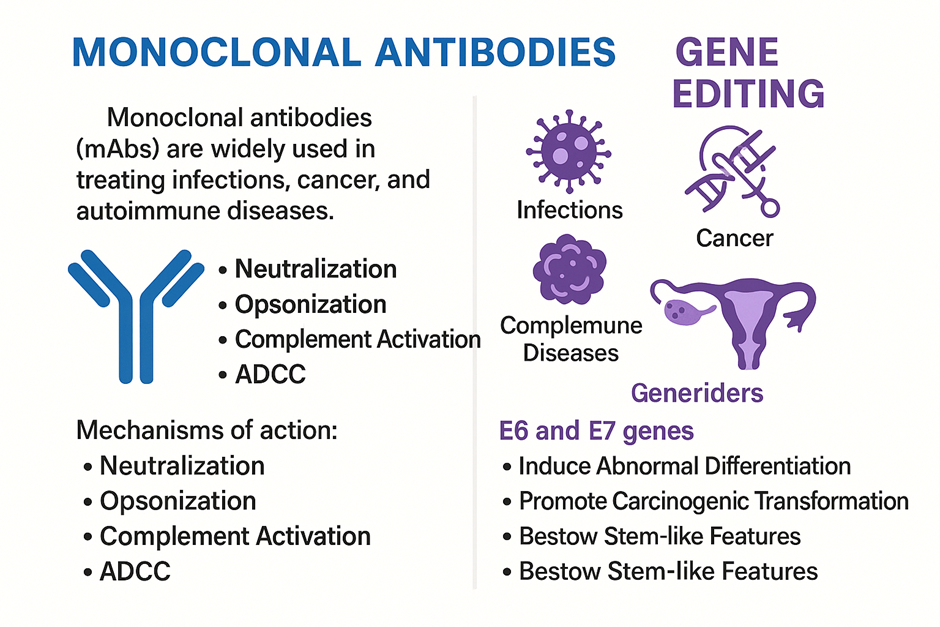
Figure 1 :-Monoclonal antibodies

The E6 protein helps cancer develop by breaking down p53, a key tumor-suppressing protein, and turning on telomerase, which allows cells to divide indefinitely. {24} Looking ahead, monoclonal antibodies are expected to evolve further, with bispecific and multispecific antibodies that can attack multiple disease targets at once. {25}

Nanobodies—tiny antibody fragments—may improve the ability to treat diseases that affect hard-to-reach tissues, including the brain. {26} New combinations of monoclonal antibodies with chemotherapy agents, toxins, or radiation (antibody-drug conjugates) are being developed for more selective cancer therapy. {27}

Gene therapy is also advancing, with refined tools like base editors and prime editing that can correct mutations without causing unintended damage to the genome. {28} Safer, non-viral delivery systems, such as lipid nanoparticles, are being explored to reduce immune reactions and improve targeting of gene therapies. {29}

Artificial intelligence is helping to design personalized gene-editing strategies that minimize risk and maximize benefit for individual patients. {30} Researchers are expanding gene therapy applications beyond rare genetic conditions to more widespread diseases like diabetes, cardiovascular disease, and neurodegenerative disorders. {31}

Improved manufacturing methods promise to make both monoclonal antibodies and gene therapies more affordable and widely available. {32} Off-the-shelf therapeutic products are being explored to allow faster treatment without the need for customization for each patient. {33}

Despite ongoing ethical, regulatory, and cost challenges, international collaborations are focused on ensuring that these therapies can reach patients globally. {34} Continuous innovation in biotechnology and bioengineering is likely to further accelerate these advances. {35} Monoclonal antibodies may increasingly be used in combination therapies to improve outcomes for resistant or complex diseases. {36}

In gene therapy, combining genome editing with cell therapies (such as CAR-T cells) could open up powerful new treatment strategies. {37} Long-term research is exploring how to make gene therapy effects permanent without needing repeat treatments. {38} Monoclonal antibodies are also being studied for use in infectious disease prevention beyond current targets, including emerging viruses. {39} Synthetic biology may enable entirely new forms of antibody-like molecules with novel functions. {40}

Gene therapy approaches are being investigated for organ regeneration and repair, not just disease correction. {41} The integration of wearable technologies and biosensors could allow real-time monitoring of antibody and gene therapy responses. {42}

Future delivery systems may combine antibodies and gene-editing tools into single therapeutic packages. {43} Advanced computational models are being developed to predict immune responses to monoclonal antibodies and gene therapies before use in patients. {44}

Microbiome interactions with these therapies are an emerging area of study, as gut bacteria may influence their effectiveness. {45} Stem cell technologies might be combined with gene editing to create replacement tissues for damaged organs. {46} Gene therapy and monoclonal antibody platforms are being adapted for rapid response to pandemics. {47} Cross-disciplinary work involving material science is improving delivery methods for both antibody-based and gene-based treatments. {48} Global health initiatives are focusing on equitable access to these advanced therapies in low- and middle-income countries. {49}

Finally, public engagement and education will be crucial to ensuring acceptance and ethical use of these powerful new medical tools. {50}

Table 2 :-Future Directions in Monoclonal Antibodies and Gene Therapy:

Area

Future Development

Potential Benefit

Remaining Challenge

Monoclonal Antibodies

Bispecific / multispecific antibodies

Target multiple disease pathways simultaneously

Complex design and manufacturing

Monoclonal Antibodies

Nanobody technology

Better tissue penetration; use in brain diseases

Stability and delivery optimization

Monoclonal Antibodies

Antibody-drug conjugates

More precise cancer therapy

Risk of off-target toxicity

Gene Therapy

Prime editing / base editing

High precision mutation correction

Off-target effects still under study

Gene Therapy

Non-viral delivery (e.g., lipid nanoparticles)

Safer delivery; reduced immune response

Efficiency of delivery

Gene Therapy

AI-assisted design

Personalized, optimized gene therapies

Requires advanced computational tools

Both Fields

Off-the-shelf therapies

Faster, more accessible treatment

Regulatory approval; cost

Both Fields

Integration with biosensors and wearables

Real-time monitoring of treatment response

Data privacy; technology integration

Both Fields

Global health initiatives

Wider access in low-resource settings

Funding; infrastructure

RESEARCH GAPS AND FUTURE DIRECTIONS :

There is a growing need to explore the combined effects of monoclonal antibodies (mAbs) with other therapeutic agents, aiming to identify the most effective antibody-drug combinations for treating diverse diseases.

Further research is essential to clarify the detailed mechanisms through which mAbs function, particularly within complex disease settings like cancer, autoimmune disorders, and infections. The development of advanced monoclonal antibodies remains expensive and time-intensive. It requires the optimization of scalable, affordable cell lines and improved systems for expression and purification to streamline production.

Innovative antibody delivery techniques—such as oral or inhalation routes—should be explored to widen the therapeutic applications of antibodies beyond current limitations. Future investigations must also prioritize understanding antibody-dependent enhancement (ADE) mechanisms to reduce associated risks during the development of therapeutic mAbs.

CONCLUSION:

Antibodies, particularly monoclonal antibodies (mAbs), have become indispensable in both diagnostics and therapeutic applications, representing one of the most rapidly expanding classes of biologics. The antigen-binding function is carried out by the Fab region through its variable domains, whereas the Fc region is responsible for immune effector activities such as opsonization, complement-mediated cytotoxicity (CDC), and antibody-dependent cellular cytotoxicity (ADCC). Modifying the Fc portion (Fc engineering) enables fine-tuning of immune responses—enhancing therapeutic outcomes while minimizing unwanted effects, such as antibody-dependent enhancement (ADE).

Antibody-drug conjugates (ADCs) allow for highly selective targeting of diseased cells, helping to reduce harm to healthy tissues.
Single-chain variable fragments (scFvs) are commonly used in both therapeutic and diagnostic settings due to their engineering flexibility, high stability, and ease of production.
Bispecific antibodies (bsAbs), which can bind to two different antigens or epitopes simultaneously, provide improved therapeutic versatility over traditional mAbs. Nanobodies (Nbs) stand out for their small size, high solubility, strong binding affinity, and capacity to access unique antigenic sites. Biosimilar antibodies and mimetics offer more affordable treatment options and help navigate around patent-related limitations.

Technological progress in mAb development—including electrofusion, B cell immortalization, transgenic models, nucleic acid delivery, and single B cell isolation—has enhanced antibody specificity while reducing potential immunogenicity.

Modern approaches like surface display platforms and advanced expression/purification systems have accelerated the discovery and mass production of high-affinity antibodies. Next-generation antibody formats offer several advantages such as dual targeting, extended circulation time, increased mutation resistance, lower risk of immune reaction, and easier administration routes.

Abbreviations:-

  • Abs - Antibodies
  • Nbs - Nanoantibodies
  • bsAbs - Bispecific antibodies
  • HPV -  Human Papillomavirus
  • mAbs - Monoclonal antibodies
  • ADCs - Antibody-drug conjugates
  • scFvs - single-chain variable fragments
  • HIV - Human Immunodeficiency Virus
  • ADE - antibody-dependent enhancement
  • CDC - complement dependent cytotoxicity
  • ADCC - antibody-dependent cellular cytotoxicity

REFERENCES

  1. Justiz-Vaillant A, Pandit BR, Unakal C, Vuma S, Akpaka PE. A Comprehensive Review About the Use of Monoclonal Antibodies in Cancer Therapy. Antibodies. 2025;14(2):35.
  2. Chen H, Lin Z, Arnst KE, Miller DD, Li W. Tubulin Inhibitor-Based Antibody-Drug Conjugates for Cancer Therapy. Molecules. 2017;22(8):1281.
  3. Peters C, Brown S. Antibody–drug conjugates as novel anti-cancer chemotherapeutics. Biosci Rep. 2015;35(5):e00225.
  4. Fu Z, Li S, Han S, Shi C, Zhang Y. Antibody drug conjugate: “biological missile” for targeted cancer therapy. Signal Transduct Target Ther. 2022;7:93.
  5. Ritchie M, Tchistiakova L, Scott N. Implications of receptor-mediated endocytosis in ADC development. mAbs. 2013;5(1):13–21.
  6. Zhao P, Zhang Y, Li W, Jeanty C, Xiang G, Dong Y. Recent advances of antibody-drug conjugates for clinical applications. Acta Pharm Sin B. 2020;10(9):1589–1600.
  7. Hock MB, Thudium KE, Carrasco-Triguero M, Schwabe NF. Immunogenicity of antibody-drug conjugates: Bioanalytical methods. AAPS J. 2015;17(1):35–46.
  8. Staudacher AH, Brown MP. ADCs and bystander killing: Is internalisation required? Br J Cancer. 2017;117(11):1736–1742.
  9. Lu J, Jiang F, Lu A, Zhang G. Linkers Having a Crucial Role in Antibody-Drug Conjugates. Int J Mol Sci. 2016;17(4):561.
  10. Purcell JW et al. LRRC15 is a novel stromal target for ADCs. Cancer Res. 2018;78(14):4059-4072.
  11. Muyldermans S. Nanobodies: natural single-domain antibodies. Annu Rev Biochem. 2013;82:775–797.
  12. Van Audenhove I, Gettemans J. Nanobodies as versatile tools in cancer research. Cancer Lett. 2016;370(2):107–116.
  13. Wesolowski J et al. Single-domain antibodies in tumor targeting: Nanobody-based CARs. Front Immunol. 2023;14:1012841.
  14. Huang L et al. Nanobodies and their derivatives: pioneering future cancer therapeutics. Cell Commun Signal. 2025;23:70.
  15. De Genst E et al. Nanobody inhibitors of GPCR signaling. Nat Commun. 2018;9:1096.
  16. Dong J et al. Chromobody biosensors based on nanobodies. Nature Methods. 2012;9:121–128.
  17. Stijlemans B et al. Nanobodies neutralize H5N1 virus in mice. J Infect Dis. 2011;203(5):567–576.
  18. Labrijn AF, Janmaat ML, Reichert JM, Parren PW. Bispecific antibodies: a mechanistic review. Nat Rev Drug Discov. 2019;18(8):585–608.
  19. Labrijn AF et al. An efficient route to human bispecific IgG. Nat Biotechnol. 1998;16(7):677–681.
  20. Min J et al. Bispecific antibodies and their applications. J Hematol Oncol. 2015;8:130.
  21. Abbaspour-Tehrani S et al. Unleashing the potential of bispecific antibodies for targeted treatment. Front Immunol. 2023;14:1291836.
  22. Dreier T et al. Engineering of scFv-based bispecific antibodies. Proc Natl Acad Sci USA. 1988;85(24):10018–10022.
  23. Zhang Q et al. BsAbs in Alzheimer’s therapy: targeting Aβ/tau pathways. Int J Mol Sci. 2023;24(13):6271.
  24. Wächter K et al. Bispecific monoclonal antibody development history. Nat Biotechnol. 2021;39(1):14-24.
  25. Jinek M et al. A programmable dual-RNA–guided DNA endonuclease in adaptive bacterial immunity. Science. 2012;337(6096):816–821.
  26. Cox DBT et al. Therapeutic genome editing: prospects for CRISPR/Cas9. Sci Transl Med. 2015;7(200):200ps17.
  27. Anzalone AV et al. Genome editing with CRISPR-Cas9 base editors. Nature. 2019;576(7785):149–157.
  28. Komor AC et al. Programmable editing of a target base in genomic DNA without double-stranded DNA cleavage. Nature. 2016;533(7603):420–424.
  29. Doudna JA, Charpentier E. The new frontier of genome engineering with CRISPR-Cas9. Science. 2014;346(6213):1258096.
  30. Wang D, Tai PWL, Gao G. Adeno-associated virus vector as a platform for gene therapy delivery. Nat Rev Drug Discov. 2019;18(5):358–378.
  31. Ylä-Herttuala S. Endgame: Glybera finally recommended for approval as the first gene therapy drug in the West. Mol Ther. 2012;20(10):1831–1832.
  32. Nayerossadat N et al. Viral and nonviral delivery systems for gene therapy. Biosci Rep. 2012;32(3):243–271.
  33. Zhang Y et al. Non-viral delivery systems in gene therapy: lipid nanoparticles. Nat Rev Drug Discov. 2021;20(5):317–332.
  34. Liu C et al. Lipid nanoparticle-mediated mRNA delivery in vaccines and gene therapy. Nat Rev Mater. 2022;7(12):989–1004.
  35. Gupta A, Cutting edge gene therapy for blood disorders: CRISPR/Cas9. Blood. 2020;136(19):2075–2086.
  36. Wossnig L et al. Best practices for machine learning in antibody discovery and development. arXiv. 2023.2312.08470.
  37. Silva BM et al. AI-driven B-cell immunotherapy design. arXiv. 2023.2309.01122.
  38. Evers A, Malhotra S, Sood VDS. In Silico Approaches to Better Antibody Design. arXiv. 2023.2305.07488.
  39. Chen L et al. ADCNet: predicting ADC activity with deep learning. arXiv. 2024.2401.09176.
  40. Larochelle C, Sheikhi M, Haddad S. Progress in novel delivery technologies to improve antibody efficacy. Curr Pharm Des. 2024;30(4):310–325.
  41. Bryant P et al. Surface display technologies for antibody selection. Trends Biotechnol. 2022;40(1):29–45.
  42. Kaplon H, Reichert JM. Antibodies to watch in 2023. mAbs. 2023;15(1):e2232654.
  43. Kaplon H, Reichert JM. Antibodies to watch in 2024. mAbs. 2024;16(1):2022341.
  44. Kaplon H, Reichert JM. Milestones in therapeutic antibodies—40?years. Nat Rev Drug Discov. 2019;18(7):485–508.
  45. Verdieck MT et al. Global gene therapy trials for inherited retinal disease. Genet Med. 2021;23(3):325–333.
  46. Frank P et al. Public acceptance of gene editing and biotechnology. Nat Med. 2018;24(3):283–287.
  47. Butler D. Pandemic preparedness: platforms and acceptance. Lancet. 2020;395(10234):2323–2325.
  48. Monahan JB. Equity in access to biologics in LMICs. Lancet Glob Health. 2022;10(11):e1625–e1631.
  49. Collins FS. NIH gene therapy advisory committee final report. Science. 2024;345(6202):124–125.
  50. Dowdy SF. Delivery systems for nucleic acid-based therapies. Nat Biotechnol. 2017;35(3):222–229.
  51. Sevigny J et al. The antibody aducanumab reduces Aβ in Alzheimer’s. Nature. 2016;537(7618):50–56.
  52. Tateishi Y et al. Trial of lecanemab in Aβ plaque reduction. N Engl J Med. 2023;388(4):373–385.
  53. Selkoe DJ, Hardy J. The amyloid hypothesis. Nat Neurosci. 2016;19(2):119–126.
  54. Nair AB, Jacob S. A guide to oncology biopharma pricing & patent challenges. Oncologist. 2022;27(5):381–387.
  55. Offner S et al. CAR-T versus BsAb in lymphoma: Comparative review. Front Oncol. 2023;13:1167809.
  56. Duell CD et al. Datopotamab deruxtecan internalization mechanism. Clin Cancer Res. 2016;22(20):5276–5285.
  57. Katsumata L et al. Ifinatamab deruxtecan in advanced solid tumors. Cancer Res. 2023;83(8 Suppl):4891.
  58. von Behring E, Kitasato S. On the development of immunity. Deutsche Medizinische Wochenschrift. 1890;16:1113–1115.
  59. Edelman GM et al. The structure of an antibody molecule. Proc Natl Acad Sci USA. 1961;50(2):396–402.
  60. Porter RR. The hydrolysis of rabbit γ-globulin and its fragments. Biochem J. 1959;72(2):426–436.

Reference

  1. Justiz-Vaillant A, Pandit BR, Unakal C, Vuma S, Akpaka PE. A Comprehensive Review About the Use of Monoclonal Antibodies in Cancer Therapy. Antibodies. 2025;14(2):35.
  2. Chen H, Lin Z, Arnst KE, Miller DD, Li W. Tubulin Inhibitor-Based Antibody-Drug Conjugates for Cancer Therapy. Molecules. 2017;22(8):1281.
  3. Peters C, Brown S. Antibody–drug conjugates as novel anti-cancer chemotherapeutics. Biosci Rep. 2015;35(5):e00225.
  4. Fu Z, Li S, Han S, Shi C, Zhang Y. Antibody drug conjugate: “biological missile” for targeted cancer therapy. Signal Transduct Target Ther. 2022;7:93.
  5. Ritchie M, Tchistiakova L, Scott N. Implications of receptor-mediated endocytosis in ADC development. mAbs. 2013;5(1):13–21.
  6. Zhao P, Zhang Y, Li W, Jeanty C, Xiang G, Dong Y. Recent advances of antibody-drug conjugates for clinical applications. Acta Pharm Sin B. 2020;10(9):1589–1600.
  7. Hock MB, Thudium KE, Carrasco-Triguero M, Schwabe NF. Immunogenicity of antibody-drug conjugates: Bioanalytical methods. AAPS J. 2015;17(1):35–46.
  8. Staudacher AH, Brown MP. ADCs and bystander killing: Is internalisation required? Br J Cancer. 2017;117(11):1736–1742.
  9. Lu J, Jiang F, Lu A, Zhang G. Linkers Having a Crucial Role in Antibody-Drug Conjugates. Int J Mol Sci. 2016;17(4):561.
  10. Purcell JW et al. LRRC15 is a novel stromal target for ADCs. Cancer Res. 2018;78(14):4059-4072.
  11. Muyldermans S. Nanobodies: natural single-domain antibodies. Annu Rev Biochem. 2013;82:775–797.
  12. Van Audenhove I, Gettemans J. Nanobodies as versatile tools in cancer research. Cancer Lett. 2016;370(2):107–116.
  13. Wesolowski J et al. Single-domain antibodies in tumor targeting: Nanobody-based CARs. Front Immunol. 2023;14:1012841.
  14. Huang L et al. Nanobodies and their derivatives: pioneering future cancer therapeutics. Cell Commun Signal. 2025;23:70.
  15. De Genst E et al. Nanobody inhibitors of GPCR signaling. Nat Commun. 2018;9:1096.
  16. Dong J et al. Chromobody biosensors based on nanobodies. Nature Methods. 2012;9:121–128.
  17. Stijlemans B et al. Nanobodies neutralize H5N1 virus in mice. J Infect Dis. 2011;203(5):567–576.
  18. Labrijn AF, Janmaat ML, Reichert JM, Parren PW. Bispecific antibodies: a mechanistic review. Nat Rev Drug Discov. 2019;18(8):585–608.
  19. Labrijn AF et al. An efficient route to human bispecific IgG. Nat Biotechnol. 1998;16(7):677–681.
  20. Min J et al. Bispecific antibodies and their applications. J Hematol Oncol. 2015;8:130.
  21. Abbaspour-Tehrani S et al. Unleashing the potential of bispecific antibodies for targeted treatment. Front Immunol. 2023;14:1291836.
  22. Dreier T et al. Engineering of scFv-based bispecific antibodies. Proc Natl Acad Sci USA. 1988;85(24):10018–10022.
  23. Zhang Q et al. BsAbs in Alzheimer’s therapy: targeting Aβ/tau pathways. Int J Mol Sci. 2023;24(13):6271.
  24. Wächter K et al. Bispecific monoclonal antibody development history. Nat Biotechnol. 2021;39(1):14-24.
  25. Jinek M et al. A programmable dual-RNA–guided DNA endonuclease in adaptive bacterial immunity. Science. 2012;337(6096):816–821.
  26. Cox DBT et al. Therapeutic genome editing: prospects for CRISPR/Cas9. Sci Transl Med. 2015;7(200):200ps17.
  27. Anzalone AV et al. Genome editing with CRISPR-Cas9 base editors. Nature. 2019;576(7785):149–157.
  28. Komor AC et al. Programmable editing of a target base in genomic DNA without double-stranded DNA cleavage. Nature. 2016;533(7603):420–424.
  29. Doudna JA, Charpentier E. The new frontier of genome engineering with CRISPR-Cas9. Science. 2014;346(6213):1258096.
  30. Wang D, Tai PWL, Gao G. Adeno-associated virus vector as a platform for gene therapy delivery. Nat Rev Drug Discov. 2019;18(5):358–378.
  31. Ylä-Herttuala S. Endgame: Glybera finally recommended for approval as the first gene therapy drug in the West. Mol Ther. 2012;20(10):1831–1832.
  32. Nayerossadat N et al. Viral and nonviral delivery systems for gene therapy. Biosci Rep. 2012;32(3):243–271.
  33. Zhang Y et al. Non-viral delivery systems in gene therapy: lipid nanoparticles. Nat Rev Drug Discov. 2021;20(5):317–332.
  34. Liu C et al. Lipid nanoparticle-mediated mRNA delivery in vaccines and gene therapy. Nat Rev Mater. 2022;7(12):989–1004.
  35. Gupta A, Cutting edge gene therapy for blood disorders: CRISPR/Cas9. Blood. 2020;136(19):2075–2086.
  36. Wossnig L et al. Best practices for machine learning in antibody discovery and development. arXiv. 2023.2312.08470.
  37. Silva BM et al. AI-driven B-cell immunotherapy design. arXiv. 2023.2309.01122.
  38. Evers A, Malhotra S, Sood VDS. In Silico Approaches to Better Antibody Design. arXiv. 2023.2305.07488.
  39. Chen L et al. ADCNet: predicting ADC activity with deep learning. arXiv. 2024.2401.09176.
  40. Larochelle C, Sheikhi M, Haddad S. Progress in novel delivery technologies to improve antibody efficacy. Curr Pharm Des. 2024;30(4):310–325.
  41. Bryant P et al. Surface display technologies for antibody selection. Trends Biotechnol. 2022;40(1):29–45.
  42. Kaplon H, Reichert JM. Antibodies to watch in 2023. mAbs. 2023;15(1):e2232654.
  43. Kaplon H, Reichert JM. Antibodies to watch in 2024. mAbs. 2024;16(1):2022341.
  44. Kaplon H, Reichert JM. Milestones in therapeutic antibodies—40?years. Nat Rev Drug Discov. 2019;18(7):485–508.
  45. Verdieck MT et al. Global gene therapy trials for inherited retinal disease. Genet Med. 2021;23(3):325–333.
  46. Frank P et al. Public acceptance of gene editing and biotechnology. Nat Med. 2018;24(3):283–287.
  47. Butler D. Pandemic preparedness: platforms and acceptance. Lancet. 2020;395(10234):2323–2325.
  48. Monahan JB. Equity in access to biologics in LMICs. Lancet Glob Health. 2022;10(11):e1625–e1631.
  49. Collins FS. NIH gene therapy advisory committee final report. Science. 2024;345(6202):124–125.
  50. Dowdy SF. Delivery systems for nucleic acid-based therapies. Nat Biotechnol. 2017;35(3):222–229.
  51. Sevigny J et al. The antibody aducanumab reduces Aβ in Alzheimer’s. Nature. 2016;537(7618):50–56.
  52. Tateishi Y et al. Trial of lecanemab in Aβ plaque reduction. N Engl J Med. 2023;388(4):373–385.
  53. Selkoe DJ, Hardy J. The amyloid hypothesis. Nat Neurosci. 2016;19(2):119–126.
  54. Nair AB, Jacob S. A guide to oncology biopharma pricing & patent challenges. Oncologist. 2022;27(5):381–387.
  55. Offner S et al. CAR-T versus BsAb in lymphoma: Comparative review. Front Oncol. 2023;13:1167809.
  56. Duell CD et al. Datopotamab deruxtecan internalization mechanism. Clin Cancer Res. 2016;22(20):5276–5285.
  57. Katsumata L et al. Ifinatamab deruxtecan in advanced solid tumors. Cancer Res. 2023;83(8 Suppl):4891.
  58. von Behring E, Kitasato S. On the development of immunity. Deutsche Medizinische Wochenschrift. 1890;16:1113–1115.
  59. Edelman GM et al. The structure of an antibody molecule. Proc Natl Acad Sci USA. 1961;50(2):396–402.
  60. Porter RR. The hydrolysis of rabbit γ-globulin and its fragments. Biochem J. 1959;72(2):426–436.

Photo
Siri Varma. M
Corresponding author

Malla Reddy College of Pharmacy (MRCP), Maisammaguda, Telangana, India 500100

Photo
Sridhar Siddiraju
Co-author

Malla Reddy College of Pharmacy (MRCP), Maisammaguda, Telangana, India 500100

Photo
Muvvala Sudhakar
Co-author

Malla Reddy College of Pharmacy (MRCP), Maisammaguda, Telangana, India 500100

Siri Varma. M, Sridhar Siddiraju, Muvvala Sudhakar, Emerging Biopharmaceuticals: The Future of Gene Therapy and Monoclonal Antibodies in Treating Chronic Diseases, Int. J. of Pharm. Sci., 2026, Vol 4, Issue 2, 510-517. https://doi.org/10.5281/zenodo.18482144

More related articles
Nitrosamine Impurities: Analytical Detection and R...
Gopal Gawhale, Dr. Shirish Jain, Dr. Ashish Gawai, Ganesh Gore...
Enhancement of Solubility and Dissolution Rate of ...
Ranjit Sakhare, Dr. Vishal Babar, Dr Sudarshan Nagrale...
Emerging Hydrogel-Based Topical Delivery Systems: ...
Ganesh Shinde, Kanchan Upadhye, Anup Thakre, Prachi Karadbhajane...
Formulation And Evaluation O Herbal Neem Face Wash Powder...
Bansode Disha, Hemant H.Gangurde, Hemant Gangurde, Somnath Davkhar, Bandgar Sakshi...
Herbal Extract- Based Peel-Off Face Mask Gels for Skin Rejuvenation and Anti-Age...
Dhanyashree K, Rakshith K J, Chaithra M P, Hemavathi N...
Nano Herbal Transferosomal Serum –A Dual Functional Approach For Anti-Aging An...
Rubicashree S, Anju K.P., Murali R, Srinidhi C, Chaya P...
Related Articles
Trimethoprim- Sulfamethoxazole (Bactrim Ds) Induced Stevens Johnson Syndrome: A ...
Renjitha M.S., Shaiju Dharan, Azeem Mohamed Basheer, Chintha Chandran, Vibisha Victor...
Post-Approval Regulatory Submissions and Variations Management of Pharmaceutical...
Aniket Jadhav, Dr. Anil Babar, Amit Pondkule, Dr. Sudarshan Nagrale...
Nitrosamine Impurities: Analytical Detection and Risk Assessment...
Gopal Gawhale, Dr. Shirish Jain, Dr. Ashish Gawai, Ganesh Gore...
More related articles
Nitrosamine Impurities: Analytical Detection and Risk Assessment...
Gopal Gawhale, Dr. Shirish Jain, Dr. Ashish Gawai, Ganesh Gore...
Enhancement of Solubility and Dissolution Rate of Poorly Water-Soluble Antifung...
Ranjit Sakhare, Dr. Vishal Babar, Dr Sudarshan Nagrale...
Emerging Hydrogel-Based Topical Delivery Systems: A Review of Salicylic Acid and...
Ganesh Shinde, Kanchan Upadhye, Anup Thakre, Prachi Karadbhajane...
Nitrosamine Impurities: Analytical Detection and Risk Assessment...
Gopal Gawhale, Dr. Shirish Jain, Dr. Ashish Gawai, Ganesh Gore...
Enhancement of Solubility and Dissolution Rate of Poorly Water-Soluble Antifung...
Ranjit Sakhare, Dr. Vishal Babar, Dr Sudarshan Nagrale...
Emerging Hydrogel-Based Topical Delivery Systems: A Review of Salicylic Acid and...
Ganesh Shinde, Kanchan Upadhye, Anup Thakre, Prachi Karadbhajane...