

We use cookies to ensure our website works properly and to personalise your experience. Cookies policy
1Research Scholar, Maharishi Arvind Institute of Pharmacy, Jaipur, Rajasthan
2Associate Professor, Maharishi Arvind Institute of Pharmacy, Jaipur, Rajasthan
3Principal, Maharishi Arvind Institute of Pharmacy, Jaipur, Rajasthan
Non-alcoholic fatty liver disease (NAFLD) is one of the most prevalent chronic liver disorders worldwide and is strongly associated with obesity, insulin resistance, dyslipidemia, and type 2 diabetes mellitus. The present study was designed to evaluate the therapeutic potential of methanolic extract of Bauhinia variegata (MBV) against high-fat diet (HFD)-induced NAFLD in experimental rats. Bauhinia variegata is presence of phytoconstituents such as alkaloids, flavonoids, tannins, saponins, glycosides, and phenolic compounds. The powdered plant material was extracted using methanol in a Soxhlet apparatus. NAFLD was induced in rats by administration of a high-fat diet for 35 days. Animals were divided into five groups: normal control, disease control, standard control (Atorvastatin 20 mg/kg), test group I (MBV 200 mg/kg), and test group II (MBV 400 mg/kg). Biochemical parameters including liver function tests (ALT, AST, ALP), lipid profile (HDL, LDL, total cholesterol, triglycerides), body weight, food intake, water intake, and histopathological analysis of liver tissue were evaluated. The findings suggest that Bauhinia variegata possesses significant hepatoprotective and antihyperlipidemic activity against HFD-induced NAFLD, possibly due to its antioxidant and anti-inflammatory properties. Thus, the plant extract may serve as a promising natural therapeutic agent for the management of NAFLD.
Non-alcoholic fatty liver disease (NAFLD) is a prevalent and increasingly significant liver disorder characterized by the accumulation of fat in the liver (steatosis) in individuals who consume little or no alcohol.1 Non-alcoholic fatty liver disease (NAFLD) has evolved from a relatively unknown disease to the most common cause of chronic liver disease worldwide.2 Currently, a consensus defines NAFLD as an umbrella term for a range of diseases in which steatosis is present in more than 5% of hepatocytes with metabolic risk factors (especially obesity and type 2 diabetes), excluding excessive alcohol consumption or other chronic liver disease.3 NAFLD is fast becoming one of the most common causes of chronic liver disease worldwide, and is now a major cause of liver-related morbidity and mortality. The symptoms are usually associated with features of metabolic syndrome, such as obesity, dyslipidemia, type 2 diabetes and hypertension. However, the pathogenesis of NAFLD is unknown, and this has become a hindrance to the treatment of NAFLD.4
Insulin resistance (in body and adipose tissue) increases the release of free fatty acids (FFA) from adipose tissue. These excess FFAs enter the liver, leading to triglyceride accumulation → this causes fatty liver (steatosis).5 Insulin resistance also increases SREBP-1c and ChREBP, which stimulate more fat synthesis in the liver, worsening fat accumulation. As fat builds up, the liver becomes insulin resistant, further increasing glucose and insulin levels → a vicious cycle.6 Excess liver fat generates inflammation and oxidative stress causing: Activation of hepatic stellate cells and Hepatocellular injury and NAFLD.7 Alkaloids present in Bauhinia variegate linn shows Wound healing, inflammation, Antioxidant, liver disorders, stomach disorders, Jaundice. Major constituents are Carbohydrates, glycosides, alkaloids, Saponins, Tannins, Flavonoids, Phenolic compounds and traditional uses8,9: Pharmacological actions: Hepatoprotective, Anti-diabetic, wound healing, anti-diarrhoeal, anti-ulcer activity.10 Therefore to investigate the therapeutic effects of Bauhinia variegate (Kachnar) extract in ameliorating non-alcoholic fatty liver disease (NAFLD) in high-fat diet- induced experimental rats. To explore the histopathological changes in liver tissue to determine the extent of liver damage and the potential hepatoprotective effects of bauhinia variegatea..
Material and Methods
Bauhinia variegata were collected and dried. The powdered plant material of Bauhinia variegatawas packed into a thimble and placed in the Soxhlet apparatus, after which methanol was used as the extracting solvent.
Experimental method:
All the animals used in the experiment were approved by the Institutional Animal Ethics Committee (IAEC).
Table 1: Experimental Design
|
Group n=6 |
Dose |
Duration |
|
Normal control |
Saline p.o. |
49 days |
|
Disease control |
High fat diet (HFD)10ml/kg orally |
49 days |
|
Standard control |
Atorvastatin 20mg/kg+HFD orally |
HFD-1-35 days, Atorvastatin-35- 49days |
|
Test- 1 |
MBV 200mg/kg |
HFD-1-35 days, MBV-35-49days |
|
Test -2 |
MBV 400mg/kg |
HFD-1-35 day MBV-35-49days |
The disease model wiere induced in animals by administering a high-fat diet. The diet were carefully prepared by combining specific ingredients, including corn oil (400 g), sucrose (150 g), total milk powder (80 g), lard (100 g), egg yolk (200 g), sodium deoxycholate (10 g), tween 80 (36.4 g), propylene glycol (31.1 g), vitamin mixture (2.5 g), cooking salt (10 g), mineral mixture (1.5 g), and distilled water (300 mL). All components were thoroughly mixed to ensure uniformity before being provided to the test animals.
Evaluation Parameter:
|
Sr.No. |
Evaluation Parameter |
|
1. |
Daily parameter- Food intake, water intake |
|
2. |
Weekly parameter- Body weight |
|
3. |
Biochemical parameter- Liver function test: ALT, AST, ALP Lipid profile test: HDL, LDL, TG, TC |
|
4. |
Histopathological analysis of liver tissue- H&E Staining |
Results And Discussion:
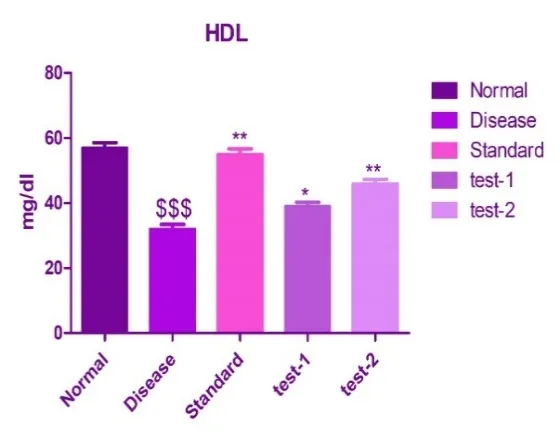
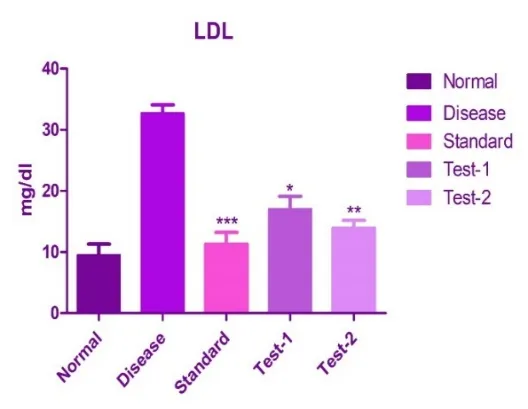
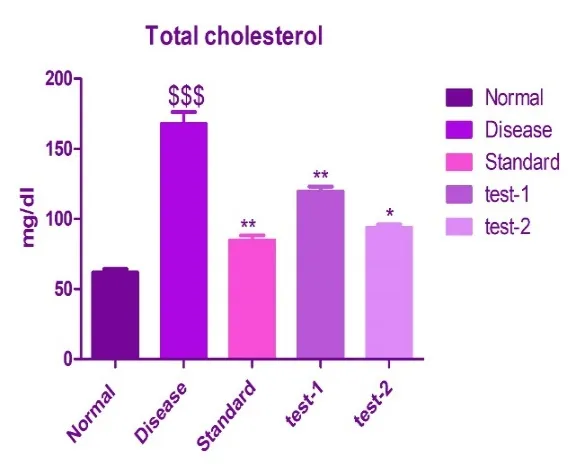
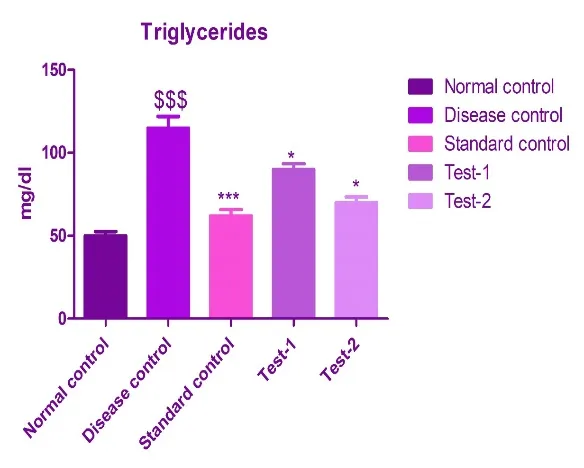
The levels of LDL was significantly increased in the disease group while HDL is decreased in disease group compared to the normal group. The levels of total cholesterol and truglycerides was significantly increased in the disease group compared to the normal group. Statistical significance denoted as (*-p< 0.05, **-p<0.01 and ***-p<0.001 compared to the disease control group.
2. EFFECT OF B.VARIEGATA ON LIVER ENZYME LEVEL OF ANIMALS:
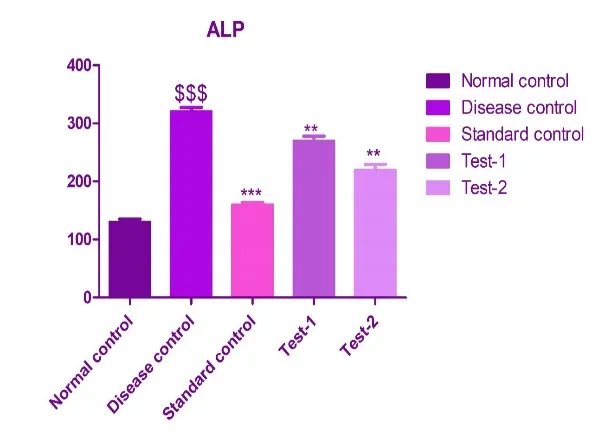
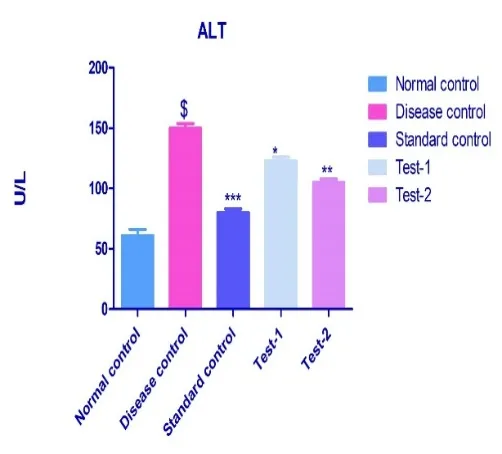
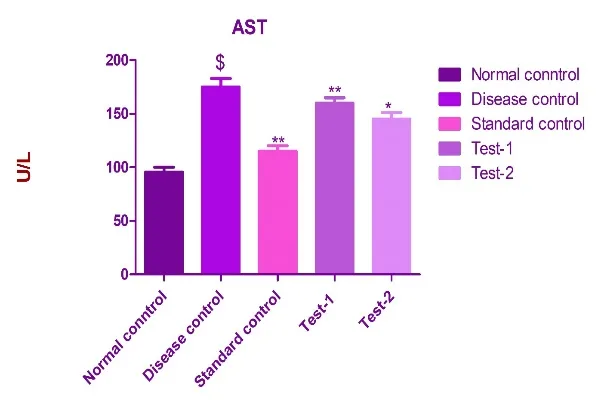
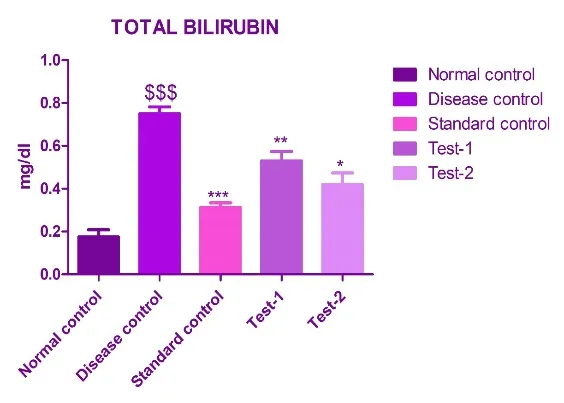
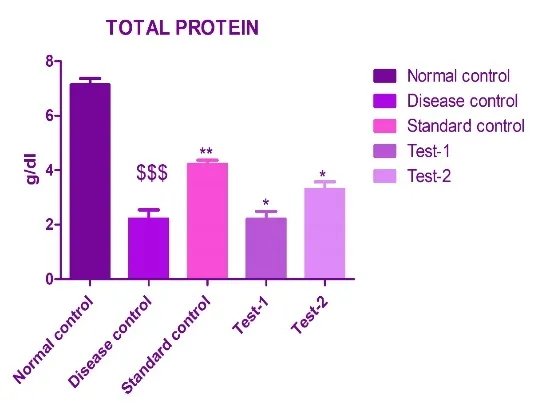
The levels of ALP and ALT was significantly increased in the disease group compared to the normal group. The levels of AST and total bilirubin was significantly increased in the disease group compared to the normal group while level of total protein was decersead in the disease group compared to the nnormal group. Statistical significance denoted as (*-p< 0.05, **-p<0.01 and ***-p<0.001 compared to the disease control group.
CONCLUSION
High-fat diet feeding resulted in metabolic disturbances such as increased body weight, altered lipid profile, elevated liver enzyme levels, and reduced antioxidant enzyme activity, indicating successful induction of NAFLD. However, treatment with the plant extract significantly improved these parameters. Therefore, the results of this study suggest that the plant extract has promising therapeutic potential in the prevention and management of NAFLD. However, further studies are required to elucidate the exact molecular mechanisms responsible for its protective effects and to evaluate its safety and efficacy in clinical settings. In conclusion, the plant extract may serve as a potential natural therapeutic agent for the management of non-alcoholic fatty liver disease.
REFERENCES

Muskan Jain, Richa Agarwal, Rajesh Asija, Evaluation of Pharmacological Effects of Bauhinia Vaeriegata Linn on Non Alcoholic Fatty Liver Disease in High-Fat Diet-Induced Experimental Rats, Int. J. of Pharm. Sci., 2026, Vol 4, Issue 5, 7421-7426. https://doi.org/10.5281/zenodo.20413747
 10.5281/zenodo.20413747