

We use cookies to ensure our website works properly and to personalise your experience. Cookies policy
Department of Pharmaceutics, Ashokrao Mane College of Pharmacy, Peth Vadgaon, Shivaji University, Maharashtra, India 416112
Tridax procumbens, commonly referred to as coat buttons or tridax daisy, is a widely distributed plant in the Asteraceae family with a rich history in traditional Ayurvedic medicine. Over the last two decades, extensive scientific research has proven its medicinal properties, particularly its strong antibacterial action, on phytochemical characterisation, in vitro antibacterial assays, cream formulation design, physicochemical criteria for assessment, stability testing, and improved nano-dispense methods. The evidence consistently shows that ethanolic, methanolic, and aqueous leaf extracts of T. procumbens have broad-spectrum antibacterial activity against clinically significant pathogens such as Staphylococcus aureus, Escherichia coli, Pseudomonas aeruginosa, Klebsiella pneumonia, Bacillus subtilis, and Bacillus cereus.
The worldwide propagation of antibiotic-resistant bacteria has produced an urgent demand for new antimicrobial medicines derived from natural sources. Medicinal plants have long been the core of conventional healthcare systems in Asia, Africa, and Latin America, and contemporary pharmacological research supports their therapeutic claims. Among these, Tridax procumbens (L.), a member of the family Asteraceae, stands out as a plant with outstanding medicinal value that is currently inadequately utilised in mainstream pharmaceutical development.
T. procumbens is a prostrate, branching annual herb that grows as a weed throughout tropical and subtropical climates such as India, West Africa, Southeast Asia, and the Americas. Despite its weed designation, it has been used in folk medicine studies as an anticoagulant, wound healer, antiseptic, antifungal agent, insect repellent, and hepatoprotective treatments. It has been prescribed by Indian Ayurvedic practitioners as an alternative for "Beringia," a well-known hair growth booster. The plant's leaves, stems, blossoms, and roots have all been studied for their therapeutic properties, with the leaves receiving the most scientific interest.

Fig No-1
The development of herbal antibacterial creams represents a tremendous opportunity to convert T. procumbens' raw antimicrobial potential into a standardised, patient-acceptable topical dose form. Creams, whether oil-in-water (O/W) or water-in-oil (W/O) emulsions, have several advantages, including ease of application, good skin penetration, cosmetic acceptability, and the potential to transport both hydrophilic and lipophilic active components. Such formulations are evaluated using a series of physicochemical tests to assure safety, stability, and medicinal efficacy.
This study critically examines 30 published research publications on the phytochemistry, pharmacology, formulation, and efficacy of T. procumbens-based herbal antibacterial creams and closely related topical treatments. The papers are organised thematically to produce a cohesive narrative that includes botanical background, phytochemical profiling, antibacterial mechanisms, formulation tactics, assessment parameters, and future directions.

Fig No-2: Relative Distribution of Major Phytochemical Classes in T. procumbens Leaf Extract
In the world, India is well-known for its indigenous valuable flora and fauna with excellent therapeutic potential. India is the world's largest source of luxuriant flora and vast variety of medicinally beneficial plants, which play an important role in people's health. Medicinal plant use is regarded a "living tradition" in many underdeveloped countries, including India. The reliance on plants is a significant component of Indian cultural heritage, which is represented in practices and lifestyles throughout the country.
India has a rich history of historically valued medicine. Ayurveda, Unani, Siddha, Amechi, and Homoeopathy are among the various medicinal systems practiced in India. Many people use a huge number of plants for disease therapy encompassing both human and animal ailments. The plants employed in treatments are referred to as "valuable" medicinal plants. It is no surprise that one-fourth of the world's population, i.e. 1.42 billion people, use medicinal plants as home remedies. According to World Health Organization (WHO) data, in nations with limited resources, approximately 80% of people consume traditional medicines to maintain mental health and vigour. According to one estimate throughout the entire world, 20,000 to 35,000 species have been used as medications, pharmaceuticals, cosmetics, and nutraceuticals. [1]
Botanical Profile and Ethnomedicinal Background
Taxonomy and Morphology
The plant is designated as Kingdom Plantae, Family Asteraceae, Genus Tridax, and Species procumbens. Morphologically, it is a prostrate herb with opposite, lanceolate leaves with serrated sides and little yellow ray flowers. The plant's geographical distribution includes India, West Africa, Australia, and tropical America, as well as its traditional usage in many cultures, such as use as a poultice for wounds, diarrhoea management, and skin infection treatment.
T. procumbens is a semi-prostrate and annual creeper herb with branching, sparsely hairy stems that root at nodes and reach heights of 30-50 cm. Leaf structures are single, opposite, serrate or dentate, sharp, fleshy, pubescent, exstipulate, lanceolate to ovate in shape with 3-7 cm long, irregularly serrated margin with wedge-shaped base, slightly petioles, and hairy on both surfaces. The leaves are dorsiventral, having a single layer of epidermis on both surfaces and a thick cuticle. The upper epidermis has a single layer of multicellular covering trichomes, whereas the lower epidermis has a single layer of elongated cells that are densely packed. The crystals of calcium can be seen in vessels in the xylem. Vascular bundles are concentric in form. Meristeel is composed of a single, centrally situated collateral vascular bundle surrounded by some parenchymatous cells.
Flowers are tubular in design, yellow in colour, and have hairs on the capitulum part of the inflorescence [4, 13, 14]. This plant produces two types of flowers: ray florets and disc florets with basal placental development [13].
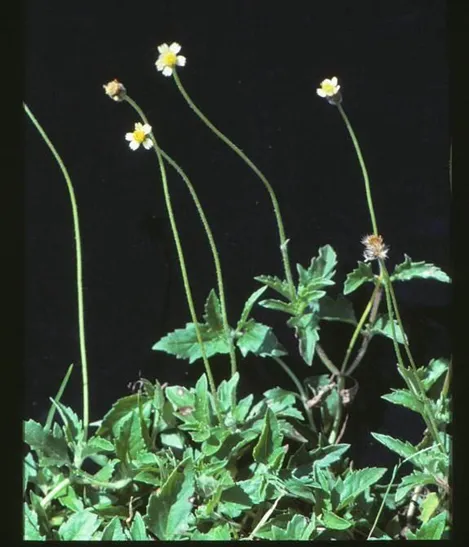
Fig No-3: Tridax procumbens plant
Fruit is a rigid achene with stiff hairs and a feathery, plume-like white pappus on one end that aids in aerial distribution. The heads are diverse, with long peduncles that can reach heights of up to 2 feet. The ray florets are female, with a ligulate corolla, trifid, and always pale-yellow in colour.
T. procumbens seeds germinate at warmer temperatures (35/25 and 30/20 °C) with 58-78% light. These are particularly susceptible to salt concentration and water stress [15]. Gametes have 36 (diploid) and 18 (haploid) chromosomes [8]. Propagation occurs through spreading stems and seed production [4].

Fig No-4: Botanical specimen
Botanical Description
Kingdom: Plantae | Sub-kingdom: Tracheobionta | Division: Magnoliophyta | Class: Magnoliopsida | Sub-class: Asteridae | Order: Asterales | Family: Asteraceae | Genus: Tridax | Species: procumbens
Vernacular Names
English: Coat Buttons and Tridax Daisy | Hindi: Ghamra | Sanskrit: Jayanti Veda | Marathi: Dagadi Pala | Telugu: Gaddi Chemanthi | Tamil: Thata poodu | Malayalam: Chiravanak | Spanish: Cadillp Chisaca | French: Herbe Caille | Chinese: Kotobukigiku (Satish et al., 2012)
Phytochemical Characterization
Qualitative and Quantitative Phytochemical Screening
Saponins, steroids, diterpenes, alkaloids, flavonoids, phenols, and tannins were found in the leaves of Tridax procumbens. The methodical use of conventional colour reactions and precipitation assays resulted in a credible phytochemical fingerprint for the plant. The study emphasised that the co-presence of flavonoids and tannins is especially relevant for antibacterial activity, as both chemical groups are known to damage bacterial cell membranes and precipitate proteins.
A quantitative phytochemical and antioxidant analysis revealed that T. procumbens ethanolic extracts had significantly higher total phenolic content (TPC) and total flavonoid content (TFC) than many other commonly used medicinal plants. High TPC values correlate with substantial DPPH radical scavenging activity, and because oxidative stress plays a role in bacterial pathogenesis, the extract's antioxidant and antibacterial dual action is clinically relevant.
HPLC analysis was used to isolate and identify quercetin and rutin from T. procumbens leaves. Quercetin, a flavonoid aglycone, has been extensively tested for antibacterial action via mechanisms such as DNA gyrase inhibition, cytoplasmic membrane disruption, and suppression of fatty acid production. Rutin, a glycoside derivative, enhances anti-inflammatory action. [7]
A systematic and extensive review, which included 101 references and screened 839 papers, identified over 138 chemical compounds isolated or characterised from T. procumbens. These include luteolin, quercetin, isquercetin, glucoluteolin, carotenoids, beta-sitosterol, oleanolic acid, lupeol, fumaric acid, radixin, betaine, pentacyclic triterpenes, alkyl esters, and fatty acids. [8]
Advanced Phytochemical Profiling
Cutting-edge work using ultrasonic-assisted extraction, ultra-performance liquid chromatography, and quadrupole time-of-flight mass spectrometry achieved remarkable phytochemical resolution. The study carefully assessed the impact of various solvent polarity on phytochemical yield and discovered a diverse matrix of tannins, flavonoids, phenolic acids, and terpenoids. This work presents a thorough, reproducible extraction procedure for industrial-scale cream formulation. [9]
Individual fractions of ethyl acetate extract were separated and evaluated for biological activity using column chromatography. The F4-5 fraction demonstrated the highest antibacterial inhibition against E. coli, S. aureus, B. subtilis, and Proteus mirabilis, whereas different fractions had the highest antioxidant or xanthine oxidase inhibitory activity. This bioactivity-guided fractionation approach is essential for determining the exact active fractions that are most suited for cream formulation. [10]
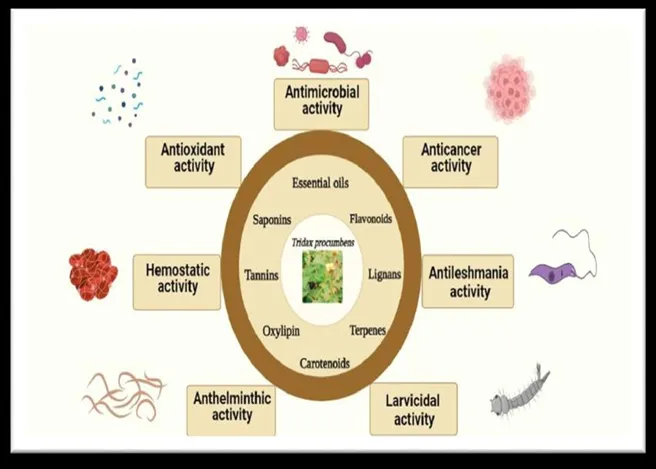
Fig No-5: Pharmacological activities of T. procumbens
In Vitro Antibacterial Studies
Agar Diffusion and Minimum Inhibitory Concentration Studies
The agar well diffusion method was used to determine the phytochemical content and antibacterial activity of T. procumbens leaf extracts against three gram-positive and three gram-negative bacterial species. The chloroform extract had the strongest antibacterial action, producing results comparable to the standard medication ampicillin. The MIC for ethanol and methanol extracts against examined species ranged from 1.96 to 19.5 mg/mL, with S. aureus being the most susceptible. [11]
A systematic examination of acetone and methanolic extracts of all plant parts (stem, root, leaf, flower, and whole plant) against E. coli, Klebsiella pneumoniae, Proteus vulgaris (gram-negative), and B. subtilis and S. aureus (gram-positive) revealed that ethanol and methanolic extracts had broad-spectrum efficacy against all test organisms. Root extracts in chloroform and petroleum ether exhibited no efficacy against Gram-negative bacteria. [12]
In a study aimed specifically at bovine mastitis-causing Staphylococcus aureus, both aqueous and methanolic leaf extracts of T. procumbens exhibited considerable in vitro antibacterial activity. This study is relevant since S. aureus is the most prevalent skin pathogen found in topical antibacterial cream applications, demonstrating the clinical utility of T. procumbens-based formulations for skin infections. [13]
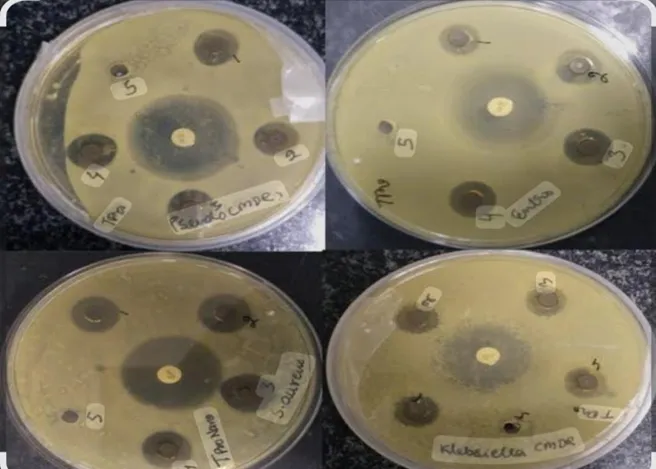
Fig No-6: Antibacterial assay results
Mechanisms of Antibacterial Action
T. procumbens' bactericidal action against clinically relevant infections such as S. aureus and P. aeruginosa has been attributed to mechanisms involving cell membrane rupture and bioactive chemical intercalation inside bacterial nucleic acids. The flavonoid-rich fractions appear to hinder DNA gyrase and topoisomerase IV, enzymes required for bacterial DNA replication. Tannins denature bacterial membrane proteins through protein precipitation, resulting in cytoplasmic leakage and cell death.
A novel study combined ethanolic T. procumbens extract and chitosan to produce a composite with improved antibacterial efficacy. The composite was tested for sensitivity against E. coli, S. aureus, P. aeruginosa, K. pneumoniae, A. niger, M. canis, and C. acremonium using agar well diffusion and double serial dilution (MIC/MBC determination). The chitosan-extract combination demonstrated substantially higher zones of inhibition than either drug alone, indicating synergistic interaction. [14]
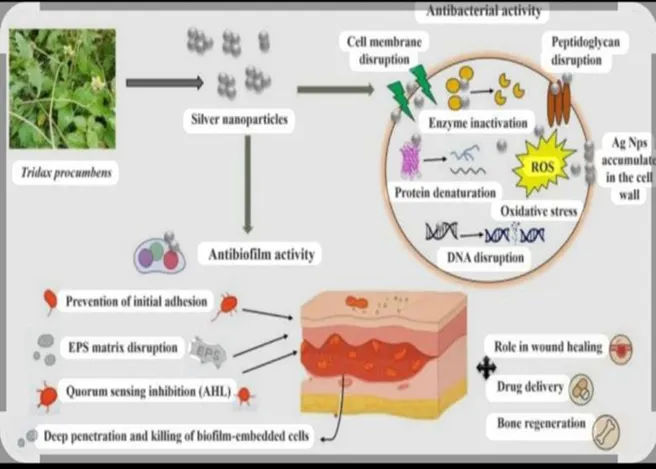
Fig No-7: Antibacterial mechanism of silver nanoparticles
Formulation of Herbal Antibacterial Creams
Formulation Design and Excipient Selection
Preparation of the cream followed a systematic procedure involving both oil and water phases (Table 1). Initially, the oil phase was prepared by combining 5 gm of Liquid Paraffin and 1.6 gm of White Beeswax, which were gently heated using a double boiler or microwave until the wax melted completely and a homogeneous mixture was obtained. The temperature during this step was maintained between 70 and 75 °C, and occasional stirring ensured complete melting and uniformity.
Concurrently, the water phase was prepared by dissolving 0.08 gm of Borax in 3.3 ml of Purified Water, also heated to approximately 70 °C, ensuring the borax dissolved completely. [18]
Once both phases reached the appropriate temperature, the heated water phase was slowly poured into the oil phase with continuous stirring to initiate emulsification. The mixture was stirred vigorously until a stable emulsion began to form. This blending step was crucial for achieving the proper consistency and stability of the final product.
After the emulsion was formed, the mixture was allowed to cool to less than 40 °C. During the cooling process, the cream began to thicken, developing the desired semi-solid texture. Once the temperature dropped sufficiently, preservatives and Rose Water were added to the cooled cream, followed by thorough stirring to ensure uniform distribution of all components. The result was a stable and homogeneous cream formulation ready for further evaluation and use. [19]
Table No. 1: Formula for Cream Base
|
Ingredients |
Quantity (for 10 gm) |
Role of Ingredients |
|
Liquid Paraffin |
5 gm |
Moisturizer |
|
White Beeswax |
1.6 gm |
Penetration Enhancer |
|
Borax |
0.08 gm |
Stabilizer |
|
Methyl Paraben |
0.018 gm |
Preservative |
|
Propyl Paraben |
0.002 gm |
Preservative |
|
Rose Water |
q.s |
Perfume |
|
Purified Water |
3.3 ml |
Vehicle |
Table No. 2: Cream Concentrations
|
Cream |
Concentration of Acacia catechu |
Concentration of Tridax procumbens |
|
1st |
1% |
1% |
|
2nd |
2% |
2% |
|
3rd |
3% |
3% |
|
4th |
3% |
- |
|
5th |
- |
3% |
Evaluation Parameters for Herbal Antibacterial Creams
Physicochemical Evaluation
The evaluation of a cream involves assessing its organoleptic properties, physical characteristics, and other attributes that determine its effectiveness and appeal to consumers. Further evaluation has been conducted on higher concentration of cream by incorporating 3% of Acacia catechu and Tridax procumbens.
Organoleptic evaluation is a crucial aspect of assessing the quality and acceptability of a cream formulation through sensory parameters such as appearance, colour, odour, and texture. The appearance of the cream is initially examined visually to ensure uniformity and the absence of any phase separation or irregularities; a well-formulated cream should appear smooth and consistent without visible separation of oil and water phases. The colour is also visually inspected to confirm consistency; it should typically be clear, white, or slightly off-white, depending on the ingredients used. The odour is assessed by smelling the cream to detect any unpleasant or undesirable scents. Finally, the texture is evaluated by applying a small quantity of the cream to the skin or rubbing it between the fingers.
pH Determination
The pH of the prepared formulation Tridax procumbens phospholipid complex (phytosome) gel was determined to be between 6 and 7.5, which falls within the typical pH range of the skin. Specifically, the pH was found to be 7.35. Hence, the formulated Tridax procumbens phospholipid complex (phytosome) gel is within the skin pH range.
Determination of Spreadability
Spreadability is a key factor in patient adherence, as it ensures even distribution of the Tridax procumbens phytosomal gel on the skin. The spreading coefficient values for the formulated gel indicate that it spreads easily on the skin's surface. The spreadability test reveals a value of 27.5, which indicates excellent spreading properties.
Determination of Viscosity
The viscosity of the Tridax procumbens phospholipid complex (phytosome) gel was found to be 7100 cps at 5 rpm, indicating that it has a semi-solid texture, which is appropriate for topical use. The high viscosity at low shear rates suggests shear-thinning behavior, which is essential for ease of application and better skin retention.
FTIR Analysis
FTIR analysis was performed using a Bruker-Alpha II. The range of wavenumbers used to capture the spectrum was 4000 to 500 cm−1. The FTIR spectra of the Tridax procumbens extract, Tridax procumbens phospholipid complex (phytosome) and Tridax procumbens phytosomal gel were analysed along with the values of their principal peaks.
Washability
The cream was easily removed by washing with water, indicating good washability. No oily residue or stickiness remained on the skin after washing. The formulation showed satisfactory cleansing properties.
Evaluation of Cream Antimicrobial Assay
Table No. 3: Evaluation Parameters
|
Evaluation Parameters |
Observation |
|
Appearance |
Clear |
|
Odour |
Characteristic |
|
pH |
5.5 |
|
State |
Semisolid |
|
Consistency |
Smooth |
|
Spreadability |
Spreadable |
|
Washability |
Washable |
|
Phase Separation |
No phase separation |
|
Homogenicity |
Homogeneous |

Fig 8 & 9: Antimicrobial assay against E. coli and Bacillus subtilis
DISCUSSION
The antibacterial, antifungal, anti-inflammatory, antioxidant, and wound healing properties of T. procumbens translate into a multi-target topical product that may outperform single-mechanism synthetic antibiotics, particularly against biofilm-forming and multi-drug-resistant pathogens. A significant strength of T. procumbens-based cream research is the consistency of findings across geographically diverse research groups operating in India, Nigeria, Indonesia, Thailand, and other countries. This geographical validation mitigates concerns about chemotype variability and suggests that the core antibacterial phytoconstituent profile is robustly maintained across growing conditions.
Several research gaps emerge from this review. First, while in vitro antibacterial activity is extensively documented, in vivo clinical studies on human subjects remain scarce. The transition from laboratory data to clinical proof-of-concept is essential for regulatory acceptance. Second, formal toxicological profiling — including acute oral toxicity, dermal sensitization, and repeated-dose toxicity — is incompletely documented. Third, pharmacokinetic data on skin penetration and percutaneous absorption of T. procumbens phytoconstituents from cream matrices is largely absent, making it difficult to correlate in vitro release with in vivo therapeutic outcomes. Fourth, standardization of raw material (leaf extract) in terms of marker compound content (e.g., quercetin percentage) is inconsistently applied, making cross-study comparisons challenging.
The integration of nanotechnology addresses several of these limitations. Silver nanoparticle formulations have demonstrated enhanced skin permeation, improved bioavailability, and superior antibacterial activity in animal wound models, providing a pathway toward rigorous in vivo validation. Phytosome complexation improves the oral bioavailability of polar phytoconstituents and is increasingly being applied to topical systems. From a regulatory perspective, the extensive traditional use history of T. procumbens across multiple cultures provides a safety precedent that can support Generally Recognized as Safe (GRAS) designation for cosmetic-grade preparations. [26]
CONCLUSIONS AND FUTURE DIRECTIONS
Tridax procumbens leaf extract possesses scientifically validated antibacterial properties attributable to a rich and synergistically active phytochemical profile. Herbal antibacterial creams formulated with T. procumbens leaf extract consistently exhibit acceptable physicochemical properties, satisfactory in vitro antibacterial activity, dermal safety, and promising in vivo wound healing efficacy. The plant therefore merits serious consideration as a lead candidate for commercial herbal antibacterial cream development.
Future research should prioritize the following directions:
1. Randomized controlled clinical trials comparing T. procumbens cream against standard topical antibiotics (mupirocin, fusidic acid) in patients with superficial skin infections to generate evidence-grade I clinical data.
2. Formal standardization protocols establishing minimum quercetin and luteolin content in leaf extracts to ensure batch-to-batch consistency in antibacterial activity.
3. Comprehensive dermal safety assessment including repeated insult patch test (RIPT), phototoxicity, and sensitization studies in human volunteers.
4. Pharmacokinetic skin penetration studies using Franz diffusion cells with pig skin or human cadaver skin to characterize percutaneous absorption of key phytoconstituents from O/W cream matrices.
5. Scale-up formulation development with industrial stability testing (12 months under ICH Q1A) to support regulatory dossier preparation.
6. Exploration of combination nanotechnology platforms — such as AgNP-loaded phytosomes in cream matrices — to achieve superior bioavailability, prolonged release, and enhanced antibacterial potency against MDR pathogens.
In conclusion, T. procumbens represents a compelling convergence of traditional wisdom and modern pharmacological evidence — a plant whose time for mainstream pharmaceutical development has arrived. With appropriate investment in clinical research and formulation standardization, T. procumbens-based antibacterial cream has the potential to become a significant addition to the global dermatological product portfolio. [29]
REFERENCES



Lina Nagpure, Prachi Dashwant, Shraddha Pisal, Avadhut Dukandar, Formulation and Evaluation of Herbal Antibacterial Cream using Tridax procumbens Leaf Extract, Int. J. of Pharm. Sci., 2026, Vol 4, Issue 5, 7108-7119. https://doi.org/10.5281/zenodo.20404726
 10.5281/zenodo.20404726