

We use cookies to ensure our website works properly and to personalise your experience. Cookies policy
Department of Pharmacognasy, Dnyanvilas College of Pharmacy, Pune, Maharashtra, India
Stress and anxiety disorders are increasing globally and significantly affect human health and quality of life. Conventional oral dosage forms of herbal medicines often suffer from poor bioavailability, degradation in the gastrointestinal tract, and hepatic first-pass metabolism. The present study aimed to formulate and evaluate a mucoadhesive buccal film containing Ashwagandha (Withania somnifera) using fenugreek mucilage as a natural mucoadhesive polymer for stress management. Buccal films were prepared by the solvent casting method using Ashwagandha extract, fenugreek mucilage, Hydroxypropyl Methylcellulose (HPMC), propylene glycol, and other excipients. The prepared films were evaluated for physicochemical and mechanical parameters including appearance, handling characteristics, weight variation, thickness, folding endurance, surface pH, and drug content uniformity. The optimized formulation showed satisfactory flexibility, smooth surface texture, uniform thickness, acceptable weight variation, and neutral surface pH suitable for buccal administration. Folding endurance results indicated good mechanical strength and flexibility of the films. Drug content studies demonstrated uniform distribution of Ashwagandha extract throughout the formulation. The developed mucoadhesive buccal film successfully combined the therapeutic potential of Ashwagandha with the advantages of buccal drug delivery. The study concludes that the formulated herbal buccal film may serve as a promising alternative delivery system for stress management with improved patient compliance and enhanced bioavailability.
Stress and anxiety disorders have become major health concerns worldwide due to increasing lifestyle changes, work pressure, psychological imbalance, and chronic illnesses. According to global health reports, millions of individuals suffer from stress-related disorders that negatively affect physical and mental well-being. Herbal medicines have gained considerable attention because of their safety, effectiveness, and reduced adverse effects compared to synthetic drugs. The oral route remains the most preferred route for drug administration because of its convenience and patient compliance. However, conventional oral dosage forms are associated with several limitations such as degradation in the gastrointestinal tract, delayed onset of action, and extensive hepatic first-pass metabolism, resulting in reduced bioavailability. Buccal drug delivery systems (BDDS) have emerged as an effective alternative for improving drug absorption and therapeutic efficacy. Buccal films are thin, flexible dosage forms designed to adhere to the buccal mucosa and release the drug in a controlled manner. The buccal route provides direct access to systemic circulation, thereby avoiding first-pass metabolism and improving bioavailability. Mucoadhesive buccal films also improve patient compliance, especially in pediatric and geriatric patients who experience difficulty swallowing conventional dosage forms. Ashwagandha (Withania somnifera), commonly known as Indian Ginseng, is a medicinal herb extensively used in Ayurveda for its adaptogenic, anxiolytic, antioxidant, and neuroprotective activities. The major phytoconstituents of Ashwagandha include withanolides, alkaloids, and steroidal lactones that contribute to its anti-stress effects. Fenugreek (Trigonella foenum-graecum) mucilage is a natural polysaccharide with excellent film-forming and mucoadhesive properties. It is biodegradable, biocompatible, economical, and suitable for pharmaceutical applications. The incorporation of fenugreek mucilage into buccal films can enhance adhesion, swelling behavior, and controlled drug release.
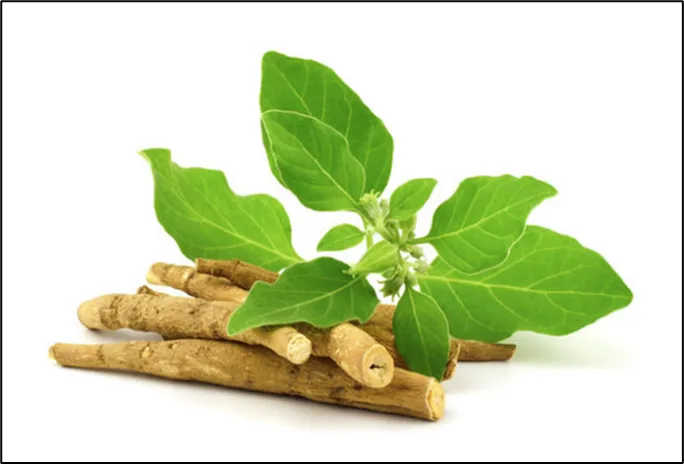
Figure 1 Withania Somnifer
LITERATURE REVIEW
Previous studies have demonstrated the therapeutic potential of Ashwagandha in stress management, neurological disorders, anti-inflammatory activity, and immune modulation. Mikulska et al. reported the health-promoting and adaptogenic effects of Ashwagandha and highlighted its neuroprotective and anti-stress activities. Ekor emphasized the growing use of herbal medicines and the importance of developing safe and effective herbal formulations for clinical applications. Adhikari and Panda formulated atenolol buccal patches using fenugreek seed mucilage and demonstrated satisfactory mucoadhesive properties and drug release behavior, indicating the pharmaceutical potential of fenugreek mucilage as a natural polymer. Pathak and Kumar reviewed buccal drug delivery systems and concluded that buccal films improve bioavailability by bypassing hepatic first-pass metabolism and enhancing mucosal absorption. Recent studies on mucoadhesive buccal films using HPMC and natural polymers have shown promising results in improving mechanical strength, controlled release, and patient compliance.
Research Gap
Although Ashwagandha possesses significant anti-stress and adaptogenic properties, limited research has been conducted on its formulation as a mucoadhesive buccal film using natural polymers such as fenugreek mucilage. Most available formulations are conventional oral dosage forms associated with reduced bioavailability and delayed therapeutic action.
Objective
Hypothesis
The formulation of Ashwagandha as a mucoadhesive buccal film using fenugreek mucilage will improve drug bioavailability, enhance mucoadhesion, and provide effective stress management with improved patient compliance.
Methodology
Study Design and Setting
The study was an experimental laboratory-based formulation and evaluation study carried out in the Pharmacognosy laboratory of SGMSPM’s Dnyanvilas College of Pharmacy, Pune.
Materials
The materials used included Ashwagandha extract, fenugreek mucilage, HPMC, propylene glycol, citric acid, Tween 80, saccharin sodium, peppermint oil, distilled water, and ethanol.
Extraction of Ashwagandha
Ashwagandha extract was prepared using maceration followed by acid treatment with methanolic sulfuric acid solution. The extract was filtered, concentrated using a rotary evaporator, and stored in airtight containers.
Extraction of Fenugreek Mucilage
Fenugreek mucilage was extracted by maceration using chloroform water. The soaked seeds released mucilage, which was filtered, precipitated, dried, and stored for further use.
Preparation of Buccal Film
Buccal films were prepared using the solvent casting method. HPMC and fenugreek mucilage were dispersed separately in distilled water. Ashwagandha extract was dissolved in ethanol containing Tween 80. Propylene glycol, citric acid, saccharin sodium, and peppermint oil were added to the formulation. The final casting solution was poured into petri plates and dried at 40–45°C. The dried films were peeled and cut into suitable dimensions.
Formulation Composition:
Table 1: Formulation Composition
|
Sr. No. |
Materials |
Quantity |
|
1. |
Ashwagandha extract |
1000 mg |
|
2. |
Fenugreek mucilage |
300 mg |
|
3. |
HPMC |
200 mg |
|
4. |
Propylene glycol |
1 ml |
|
5. |
Citric acid |
0.1 gm |
|
6. |
Tween 80 |
0.02 ml |
|
7. |
Saccharin sodium |
q.s |
|
8. |
Peppermint oil |
q.s |
|
9. |
Distil water |
28 ml |
|
10. |
Ethanol |
12 ml |
Evaluation of Mucoadhesive Buccal Films
The prepared mucoadhesive buccal films containing Ashwagandha extract were evaluated for various physicochemical and mechanical parameters to ensure their suitability for buccal drug delivery. The evaluation tests included physical appearance, weight variation, thickness, folding endurance, surface pH, and drug content uniformity.
1. Physical Appearance
The prepared films were visually inspected for colour, transparency, texture, brittleness, and presence of air bubbles or cracks.
2. Weight Variation
Weight variation was determined by individually weighing ten films from each batch using a digital balance.
Table 2: Weight of film
|
Film No. |
Weight of individual film |
|
1. |
72 mg |
|
2. |
73 mg |
|
3. |
75 mg |
|
4. |
72 mg |
|
5. |
79 mg |
|
6. |
76 mg |
|
7. |
71 mg |
|
8. |
72 mg |
|
9. |
70 mg |
|
10. |
76 mg |
Average Weight: 73.6 ± 2.80 mg
3. Thickness Measurement
Film thickness was measured at different points using a digital Vernier caliper.
Table 3: Thickness of film
|
Film No. |
Thickness of Individual Film |
|
1. |
0.14 mm |
|
2. |
0.14 mm |
|
3. |
0.14 mm |
|
4. |
0.15 mm |
|
5. |
0.16 mm |
|
6. |
0.16 mm |
|
7. |
0.16 mm |
|
8. |
0.17 mm |
|
9. |
0.17 mm |
|
10. |
0.19 mm |
Average Thickness: 0.15 ± 0.015 mm
4. Folding Endurance
Folding endurance was determined by repeatedly folding the film at the same position until it broke.
Table 4: Folding Endurance
|
Film No. |
Folding Endurance |
|
1. |
191 |
|
2. |
220 |
|
3. |
235 |
Mean Folding Endurance: 215.3 ± 22.4
5. Surface pH
The surface pH of the buccal films was measured using a pH meter after allowing the film surface to swell with distilled water.
Table 5: Surface pH
|
Film. No. |
Surface pH |
|
1. |
6.7 |
|
2. |
6.8 |
|
3. |
6.6 |
Average Surface pH: 6.7 ± 0.1
6. Drug Content Uniformity
Drug content uniformity was evaluated by dissolving individual films in suitable solvent and analyzing spectrophotometrically.
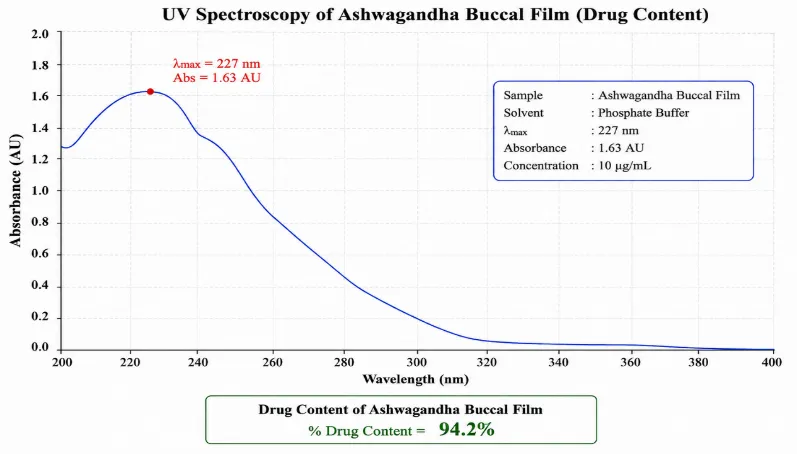
Image 2: Graph of drug content 1
The percentage drug content of the formulated Ashwagandha buccal film was found to be
94.2%.
DISCUSSION
The prepared Ashwagandha buccal films exhibited satisfactory physicochemical and mechanical properties suitable for buccal drug delivery applications. The solvent casting method produced smooth, flexible, and transparent films without cracks or air bubbles, indicating proper formulation compatibility. The average film weight and thickness demonstrated acceptable uniformity, confirming homogeneous distribution of polymers and drug throughout the matrix. The surface pH values were close to salivary pH, suggesting minimal risk of mucosal irritation during administration. Folding endurance studies indicated good mechanical strength and flexibility, which are important characteristics for patient handling and application. Similar findings were reported in previous studies involving mucoadhesive buccal films formulated using natural polymers and HPMC combinations. The use of fenugreek mucilage as a natural polymer contributed to improved mucoadhesive properties and film integrity. The formulated buccal films may enhance the bioavailability of Ashwagandha by bypassing hepatic first-pass metabolism and promoting prolonged mucosal contact.
Limitations And Implications
The study was limited to preliminary physicochemical evaluation and did not include in vivo pharmacokinetic studies, stability studies, or clinical evaluation. In vitro drug release and permeation studies were also limited. Despite these limitations, the study demonstrates the potential of herbal mucoadhesive buccal films as an alternative dosage form for stress management and improved patient compliance.
FUTURE RESEARCH DIRECTION
Future studies should focus on:
CONCLUSION
The present study successfully formulated and evaluated mucoadhesive buccal films containing Ashwagandha extract using fenugreek mucilage as a natural mucoadhesive polymer. The prepared films demonstrated satisfactory physical appearance, flexibility, surface pH, thickness uniformity, and mechanical strength suitable for buccal administration. The use of natural fenugreek mucilage improved the mucoadhesive characteristics and film-forming ability of the formulation. Buccal delivery of Ashwagandha may provide enhanced bioavailability, rapid onset of action, avoidance of first-pass metabolism, and improved patient compliance compared to conventional oral dosage forms. Therefore, the developed formulation represents a promising herbal drug delivery system for stress management and related conditions.
REFERENCES



Bindurani L.G.P Ram, Sana Khan*, Ritesh Bankar, Pramod Ingale, Formulation And Evaluation of Mucoadhesive Ashwagandha Buccal Film Using Fenugreek Mucilage as A Natural Polymer for Stress Management., Int. J. of Pharm. Sci., 2026, Vol 4, Issue 5, 7378-7384. https://doi.org/10.5281/zenodo.20411372
 10.5281/zenodo.20411372