

We use cookies to ensure our website works properly and to personalise your experience. Cookies policy
Department of Pharmaceutics, Sri Vijay Vidyalaya College of Pharmacy, Nallampalli, Dharmapuri
The purpose of this research was to develop and test soft gelatin capsules with the ethanolic extract of Terminalia chebula Retz, intended to treat nutritional deficiencies as well as overall dietary well-being. The main goal was to create a capsule that is compliant with pharmacopeial standards of stability, uniformity and quality.Preformulation activities of the active pharmaceutical ingredient (API) involved assessment of physical properties, solubility profile, loss on drying, and sulphated ash content. The capsules were formulated by the ethanolic extract of T. chebula in a gelatin shell made of gelatin, glycerin, purified water, and acceptable coloring agents. The fill formula contained the herbal extract, hydrogenated vegetable oil, soy lecithin, soybean oil, and yellow beeswax.Post-formulation analyses involved permeability and seal tests, potency, uniformity of dosage units and content, disintegration time, moisture level, and microbial limit test. Among all prepared batches, batch F4 of fill and batch F2 of shell had better quality at maintained storage conditions, keeping assay values within the limits. Uniform appearance, constant fill weight, appropriate hardness, and acceptable disintegration were also observed in the final capsules.Finally, stable and high-quality soft gelatin capsules of Terminalia chebula extract were successfully formulated. The formulation offered good protection of the active ingredient from degradation and guaranteed steady API delivery.
Oral administration remains the most commonly preferred route for delivering drugs due to its convenience, safety, and high patient compliance. Among oral dosage forms, solid tablets are frequently chosen because they are simple to manufacture, easy to consume, allow precise dosing, and are more stable than liquid formulations.1 Capsules, in contrast, are often the first choice for oral delivery of certain drugs, though they may also be administered via rectal or vaginal routes. Capsules have been widely applied in clinical research and pharmaceutical product development. From a patient perspective, capsules provide an odorless and tasteless delivery option that eliminates the need for additional coating, and many individuals find them easier to swallow than tablets. Typically, capsules enclose the active pharmaceutical ingredient (API) along with excipients within either a hard or soft gelatin shell. After oral administration, the gelatin shell dissolves in intestinal fluids, releasing the encapsulated therapeutic compounds.2 Soft gelatin capsules (SGCs) are single, sealed gelatin shells containing a liquid, suspension, or semi-solid material, collectively referred to as the fill. The shell is commonly composed of gelatin combined with water-soluble or water-dispersible plasticizers, which impart flexibility and elasticity. Additional ingredients, such as coloring agents and preservatives, may also be included to improve appearance and stability. When necessary, soft gelatin capsules can be coated to protect their contents from gastric acid or to achieve targeted release in the intestine. They are widely employed in both pharmaceutical and dietary supplement industries to deliver liquids, suspensions, pastes, and powders.3 Since their introduction in the 1930s, SGCs have gained considerable importance as a drug delivery system because they can safely encapsulate drugs that are sensitive to oxidation, light, heat, or moisture, maintaining their potency and stability over time. The production of SGCs requires skilled personnel, effective management, and facilities designed to comply with Good Manufacturing Practice (GMP) standards, including strict environmental control.4 SGCs are particularly useful for accurately delivering drugs that require very low doses, such as cardiac glycosides and vitamin D analogs. They are manufactured in diverse sizes, shapes (including spherical, elliptical, oblong, and custom tube designs with or without twist-off ends), and colors, providing visually appealing products for consumers. For oral administration, human SGCs should generally not exceed 20 mm for oblong, 16 mm for oval, and 9 mm for round capsules.5
SGC manufacturing is carried out under precisely controlled temperature and humidity conditions. The process typically involves preparing the gelatin mass, formulating the fill material (API or nutrients), encapsulation, drying, inspection of finished capsules, and final storage and packaging.6-8 Gelatin capsules are also widely used as carriers for vitamins, minerals, and pharmaceuticals due to gelatin’s digestibility, biocompatibility, and compatibility with a variety of active compounds.9
Currently, the market offers several plant-based soft gelatin capsules, including K-Berry capsules (Chaste berry extract), Cipzer capsules (Ginger oil), Neemcap (Neem extract), Ginron (Ginseng extract), and Volksvit-12G, which combines multiple components such as Omega-3 fatty acids, Green Tea extract, Ginseng extract, Ginkgo Biloba extract, Grape Seed extract, Ginger extract, Garlic extract, Guggul extract, Green Coffee Bean extract, Glycyrrhiza glabra extract, Giloy extract, as well as multivitamins, multiminerals, and antioxidants in a softgel formulation.
The present study aimed to develop a soft gelatin capsule containing a suspension of multivitamins and minerals. The formulation was designed to meet recommended nutritional requirements and provide an effective approach to correct dietary deficiencies in the population.
2. MATERIALS AND METHODS
2.1 COLLECTION AND AUTHENTIFICATION OF TERMINALIA CHEBULA RETZ
The dried fruit of Terminalia chebula Retz were collected on june from siddha medical clinic. The plant was recognized and authenticated
2.2 PREPARATION OF EXTRACT
The epicarp of Terminalia chebula Retz seeds was ground into a coarse powder after being shade-dried under typical circumstances. Using ethanol as the solvent and a Soxhlet equipment, the powdered medication was extracted using a hot continuous extraction procedure. To acquire the crude ethanolic extract, the extract was concentrated and the dried residue was gathered.
2.3 PRE-FORMULATION AND DRUG CHARACTERIZATION
The physical properties of the pure active pharmaceutical ingredients (APIs) were assessed through visual examination, with attention to parameters such as color, surface uniformity, and overall appearance. Qualitative solubility tests were performed using various solvents to evaluate the water solubility characteristics of the APIs. Moisture content was determined by measuring weight loss before and after drying under controlled conditions (loss on drying). The sulphated ash content was evaluated by incinerating the API samples in a silica crucible and heating until a constant weight was achieved. Also sample was further inspected visually to identify the presence of any foreign matter or impurities.
3. Formulation Development of Terminalia chebula Soft Gelatin Capsules
By encapsulating a suspension of the active pharmaceutical ingredient (API) and specific excipients in a gelatin shell, soft gelatin capsules containing Terminalia chebula extract have been developed. The preparation process involved two main stages: preparation of the fill material (medicament) and preparation of the gelatin capsule shell.
3.1 PREPARATION OF FILL MEDICAMENT
After transferring the necessary amount of soybean oil into a clean fill mixing tank, some amount was taken out to melt the wax. The leftover soybean oil was combined with soy lecithin and vigorously stirred for ten minutes. In a water-jacketed stainless steel pot, hydrogenated vegetable oil, yellow beeswax, and the remaining soybean oil were all heated until they melted completely. After ten minutes of mixing, this wax mixture was once again added to the lecithin-soybean oil blend. After adding Terminalia chebula extract to the fill mixture, it was agitated for fifteen minutes to ensure it was equally distributed. To eliminate air bubbles and create a stable, homogenous mixture, the suspension was homogenized and de-aerated under vacuum.
Table 1: Fill medicament composition
|
Component |
Formula 1 |
Formula 2 |
Formula 3 |
Formula 4 |
Formula 5 |
|
Terminalia chebula extract |
25% |
25% |
25% |
25% |
25% |
|
Hydrogenated vegetable oil |
10% |
10% |
5% |
5% |
6% |
|
Soya Lecithin |
6% |
8% |
5% |
6% |
10% |
|
Refined Soy oil |
52% |
45% |
58% |
63% |
39% |
|
Yellow bees wax |
7% |
12% |
4% |
3% |
10% |
|
Result |
Balanced; flows well, But low suspendability |
Stable but more viscous |
Settle faster, need more homogenization |
✅ Excellent flowability, low wax, and well-suspended extract. |
More viscous |
3.2 SHELL FORMULATION OF SOFT GELATIN CAPSULES
The main ingredients of soft gelatin capsules (SGCs) are gelatin, purified water, and plasticizers like sorbitol 70% and glycerin. To improve the gelatin shell's appearance, stability and functionality, optional components can be added, such as colorants (chlorophyllin-copper complex) and preservatives (sodium methyl paraben). In order to ensure efficient release of the active ingredient in the human body, an effective shell formulation must be compatible with the fill material and meet critical processing requirements. These include the ability to flow easily at moderate temperatures (~60°C) for encapsulation, set quickly into ribbons with sufficient mechanical strength, retain elasticity after drying and throughout shelf life, and exhibit appropriate swelling and dissolution behavior.
Table 2: Gelatin shell composition
|
Component |
Formula 1 |
Formula 2✅ |
Formula 3 |
Formula 4 |
Formula 5 |
|
Gelatin |
42.29% |
40.00% |
44.00% |
46.00% |
38.00% |
|
Glycerin |
8.78% |
10.00% |
9.00% |
7.00% |
12.00% |
|
Sorbitol 70% |
11.71% |
13.00% |
8.00% |
9.00% |
13.00% |
|
Chlorophyllin- copper complex |
0.06% |
0.06% |
0.05% |
0.05% |
0.06% |
|
Sodium Methyl Paraben |
0.15% |
0.14% |
0.15% |
0.15% |
0.14% |
|
Purified Water |
37.01% |
36.80% |
38.80% |
37.80% |
36.80% |
|
Result |
Good flexibility, but not ideal for long-term use |
Higher Flexibility ✅ Recommended |
Drier shell, less flexible, but good for humid climate |
Strong, but may crack while drying. |
Too soft, risk of leakage or poor handling |
3.3 ENCAPSULATION PROCESS
A rotary encapsulation machine was used to formulate soft gelatin capsules, and the die roll settings were changed according to the fill medicament property. Standard machine parts were used, and the amount of soybean oil was carefully adjusted to control the fill weight. The capsules were tumble dried for 30 minutes after encapsulation before being moved to a tunnel dryer for last-minute drying and stability.
3.4 DRYING PROCESS
The soft gelatin capsules that were encapsulated were dried at 28 ± 2 °C in a tunnel dryer. To get the required final moisture content and guarantee the stability of the capsules, the majority of the moisture was first removed by tumble drying, and then the mixture was carefully dried under the same conditions for up to 24 hours.
3.5 POST-ENCAPSULATION PROCESSES
After encapsulation, the soft gelatin capsules were cleaned for 30 to 45 minutes in a wiping pan to get rid of any leftover gelatin or surface residue. After that, the capsules were sent through a sizing machine to guarantee consistency and get rid of size variances. Only high-quality capsules were permitted to continue after a visual assessment was conducted to identify and eliminate any defective or misfilled capsules. After passing quality checks, the capsules were packaged in HDPE containers. To evaluate the long-term stability and integrity of the capsules, stability studies were subsequently carried out in accordance with ICH criteria under regulated temperature and humidity settings. This systematic process ensured the production of Terminalia chebula soft gelatin capsules with consistent quality and optimized performance.
4. EVALUATION OF OPTIMIZED SOFT GELATIN CAPSULES
DESCRIPTION:
The overall appearance of the capsules was assessed visually for color, shape, surface quality, and uniformity.
PERMEABILITY AND SEALING:: .
Physical integrity of the capsules was evaluated by visual inspection to confirm the absence of leakage, ensuring that the shell was properly sealed and intact to prevent loss or contamination of the contents.
POTENCY: .
Drug content in the capsules was determined and expressed as a percentage of the labeled claim. Capsules meeting the specified potency limits were considered pharmaceutically and chemically stable.
WEIGHT VARIATION TEST: .
Ten capsules were individually weighed to determine gross weight. Each capsule was then carefully opened, and the fill material was dissolved in a suitable solvent. After evaporation of the solvent, the shells were weighed, and net fill weight was calculated by subtracting shell weight from gross weight. Drug content in each capsule was calculated based on the formulation. Fill-weight variations were monitored using automated capsule sizing and weighing machines.
CONTENT UNIFORMITY TEST:
This test was conducted if required by pharmacopeial monographs or if capsules failed the weight variation test. Nine out of ten capsules were expected to contain 85–115% of the labeled drug content, with none outside 75–125%. Additional testing was performed if two or three capsules fell outside the ideal range.
DISINTEGRATION TIME:
Capsules were tested for disintegration using a basket-rack assembly in a thermostatically controlled water bath at 37 ± 2 °C. Capsules were observed for complete disintegration according to compendial specifications to ensure drug availability for dissolution and absorption.
MOISTURE CONTENT:
Water content of capsules or fill material was measured using Karl Fischer titration. Moisture levels were monitored to correlate with stability, degradation, and drug release.
MICROBIAL TESTING:
SAMPLE PREPARATION:
10 g of sample was dissolved in 100 mL of soya bean casein digest medium.
TOTAL AEROBIC MICROBIAL COUNT / YEAST AND MOLD COUNT:
0.1 mL of the sample was plated in duplicate on SCD agar for bacteria and SDA for fungi. Plates were incubated at 30–35 °C for 3 days (SCD) and 20–25 °C for 5 days (SDA). Colonies were counted, and CFU/g was calculated.
PATHOGEN TESTING:
Samples were tested for E. coli, Salmonella abony, Staphylococcus aureus, and Pseudomonas aeruginosa using standard enrichment, selective media, and biochemical confirmation tests.
E. coli: MacConkey broth and agar, confirmed by indole test.
Salmonella abony: Rappaport Vassiliadis enrichment, XLD agar, confirmed by TSI test.
Staphylococcus aureus: Mannitol salt agar, confirmed by plasma coagulation test.
Pseudomonas aeruginosa: Cetrimide agar, confirmed by oxidase test.
These evaluations ensured that the optimized soft gelatin capsules met pharmaceutical quality standards for appearance, content uniformity, stability, disintegration, moisture control, and microbial safety.
5. RESULTS
Pre-formulation studies were conducted on the Active Pharmaceutical Ingredients (APIs) to evaluate their physical and chemical properties, ensuring stability and suitability for capsule formulation. Various formulation parameters were tested to optimize product performance.
During the formulation development of Terminalia chebula Retz soft gelatin capsules, five fill medicament compositions (F1, F2, F3, F4, and F5) were prepared. Formulations F1, F2, F3, and F5, containing the API with selected excipients, failed to form stable suspensions due to insufficient levels of certain excipients, which resulted in low viscosity and poor consistency.
Composition F4, consisting of the API with optimized excipients, exhibited spontaneous dispersibility and demonstrated satisfactory viscosity and consistency, making it the most suitable fill formulation for encapsulation.
The gelatin shell was prepared from gel pastes and used in the encapsulation process (Table 1). Evaluation of the soft gelatin capsules showed that the gelatin solution viscosity was within the acceptable range of 20–40 mPa·s, indicating proper flow and handling during encapsulation. The bloom strength of gelatin was found to be within the normal range of 150–250, and the drying loss of the capsule shell, corresponding to residual moisture content, ranged from 6% to 13%, meeting standard specifications.
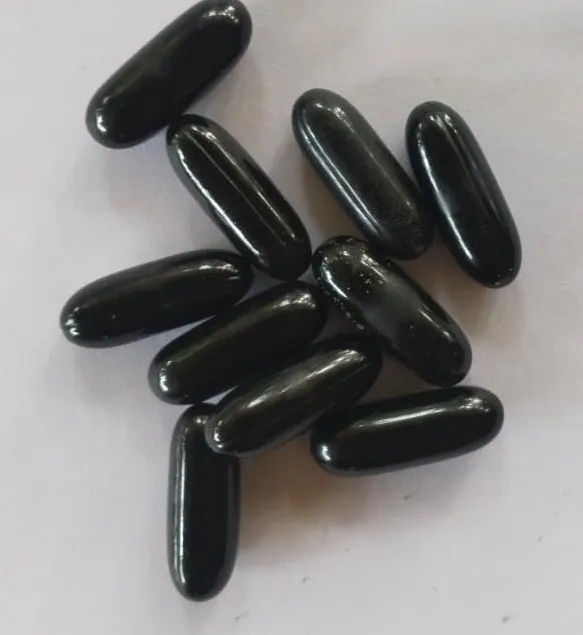
Fig.1: Appearance of softgel capsules
The soft gelatin capsules of Terminalia chebula Retz were evaluated for their physicochemical and microbiological properties. The capsules were black, opaque, oblong, and contained a brown oily liquid, indicating uniformity and successful incorporation of the extract into the HPMC oily base. Weight variation and fill weight assessments showed good uniformity, with capsule weights ranging from 1495.5 to 1521.2 mg and deviations within ±1.1%. Disintegration studies revealed that the capsules dissolved within 8.2–10.7 minutes, while the loss on drying of the gelatin shell was 9.5% w/w. HPLC analysis confirmed the presence of chebulagic acid and chebulinic acid, with a total hydrolyzable tannin content of 100.3% of the labeled claim, meeting system suitability criteria. Microbial limit tests indicated a total aerobic bacterial count of 45 CFU/g and yeast and mold count of 12 CFU/g, both well within pharmacopoeial limits, and no pathogenic microorganisms, including E. coli, Salmonella abony, Staphylococcus aureus, and Pseudomonas aeruginosa, were detected. Overall, the formulated capsules exhibited desirable morphological characteristics, consistent weight, appropriate disintegration, accurate tannin content, and microbiological safety, confirming their quality and suitability for pharmaceutical use.
These findings confirm that the optimized fill and shell formulations produced stable, uniform, and pharmaceutically acceptable soft gelatin capsules.
DISCUSSION
The present study was undertaken with the primary objective of formulating and evaluating soft gelatin capsules containing ethanolic extract of Terminalia chebula Retz. Herbal drug formulations, particularly those incorporating polyphenolic compounds such as hydrolyzable tannins, have been widely studied due to their pharmacological potential.
However, their therapeutic application is often limited by poor patient compliance, stability issues, and lack of standardization in dosage forms. In this context, the development of soft gelatin capsules provides a novel approach to improve the acceptability, stability, and effectiveness of Terminalia chebula extract.
The extraction process employed in this study involved Soxhlet extraction using ethanol as solvent. Ethanol was chosen due to its ability to effectively extract polyphenolic compounds while ensuring safety and acceptability in pharmaceutical preparations. The yield of the extract was found to be consistent, and the concentrated material demonstrated suitable stability for further formulation studies. The dried extract was stored in airtight containers to avoid degradation caused by environmental factors such as moisture and light, thereby ensuring the reproducibility and quality of subsequent formulations.
Formulation of the ethanolic extract into soft gelatin capsules was carried out under cGMP conditions to ensure quality and uniformity. Soft gelatin capsules were selected as the dosage form for several reasons: (i) they mask the unpleasant taste and odor of herbal extracts, (ii) they enhance patient compliance through ease of swallowing, (iii) they improve bioavailability by allowing faster disintegration and dissolution, and (iv) they provide superior stability for sensitive phytoconstituents compared to conventional solid dosage
forms. The formulation process involved preparation of the fill material, shell formulation, encapsulation, and drying steps, each of which contributed to the quality and reproducibility of the final product.
The formulated soft gelatin capsules were evaluated through a series of pharmacopeial tests.
CONCLUSION
The present study successfully developed and evaluated soft gelatin capsules containing ethanolic extract of Terminalia chebula Retz., thereby providing a modern, standardized dosage form for a traditionally used herbal medicine. The extraction process produced a stable, phytoconstituent-rich extract, and encapsulation under controlled conditions resulted in capsules that met pharmacopeial quality standards, including weight uniformity, integrity, disintegration, assay, moisture content, and microbial safety.
The formulation demonstrated several advantages over conventional herbal preparations such as powders, decoctions, and tablets. The soft gelatin capsules effectively masked the bitter taste of the extract, improved patient compliance, and provided enhanced
protection and stability for hydrolyzable tannins and other sensitive phytoconstituents. These
features ensure consistent dosing, better storage stability, and improved therapeutic reliability.
The findings confirm that encapsulation into soft gelatin capsules is a feasible strategy to overcome the limitations of traditional herbal formulations. The study provides a strong foundation for further in-vivo pharmacokinetic studies and clinical trials to validate bioavailability, therapeutic efficacy, and safety in human subjects.
In conclusion, the successful formulation of T. chebula into soft gelatin capsules represents a significant advancement in the modernization and standardization of herbal medicines. This approach not only improves acceptability and stability but also bridges the gap between traditional knowledge and contemporary pharmaceutical practices, supporting the integration of plant-based therapeutics into evidence-based global healthcare.
CONFLICT OF INTEREST STATEMENT
We declare that we have no conflict of interest.
REFERENCES
https://www.researchgate.net/publication/238772581_Formulation_and_physical_properties_of_soft_capsules.
https://www.researchgate.net/publication/238772581_Formulation_and_physical_properties_of_soft_capsules.


Manojkumar M, Vasanthan A, Senthil Kumar K L, Formulation and Evaluation of Terminalia Chebula Retz Soft Gelatin Capsules, Int. J. of Pharm. Sci., 2026, Vol 4, Issue 9, 3024-3032, https://doi.org/10.5281/zenodo.22938643
 10.5281/zenodo.22938643