

We use cookies to ensure our website works properly and to personalise your experience. Cookies policy
1,2,3 Shree Guru Gobind Singh Tricentenary University, Budhera, Gurugram, Haryana, India
4 K. R. Mangalam University, Gurugram, Sohna Rural, Haryana, India 122103
5 MVN University, NCR, Aurangabad, Haryana, India 121105
Green-synthesized zinc oxide nanoparticles (ZnO NPs) have attracted interest for topical and dermatological applications because of their multifunctional dermatological properties involving infection control, inflammatory regulation, oxidative stress modulation and tissue regeneration. Incorporating these nanoparticles into emulgels may improve topical spreadability, residence time, physical handling, and local delivery. This review critically examines recent evidence on biologically synthesized ZnO NPs in emulgels and related topical systems, including nanoemulgels, hydrogels, and nanogels. The review discusses plant- and microorganism-mediated synthesis, the influence of phytochemicals and process conditions on nanoparticle properties, characterization methods, formulation design, rheology, stability, release, skin deposition, biological mechanisms, therapeutic applications, toxicity, scale-up, and regulatory considerations. Available evidence suggests that green ZnO NPs can show useful antimicrobial and wound-healing activity, but the biological response depends strongly on particle size, morphology, surface chemistry, zinc-ion dissolution, phytochemical coating, concentration, and exposure duration. Direct evidence for green-synthesized ZnO NP-loaded emulgels remains limited, whereas much of the available literature concerns free nanoparticles, non-emulgel vehicles, chemically synthesized ZnO, or multifunctional composites. Green synthesis therefore should not be considered an automatic guarantee of safety, reproducibility, or clinical superiority. Future studies should use standardized botanical materials, phytochemical fingerprinting, validated nanoparticle characterization, appropriate formulation controls, repeated-dose dermal toxicology, ex vivo skin-retention studies, pilot-scale manufacturing, and controlled clinical trials. At present, green ZnO NP-loaded emulgels should be regarded as promising research-stage systems rather than clinically established therapies.
Topical drug delivery systems have evolved significantly over the past two decades, with emulgels emerging as one of the most versatile platforms. Emulgels combine the dual advantages of emulsions and gels, offering enhanced solubility for hydrophobic drugs, improved stability, and patient-friendly application properties. Their biphasic nature may support controlled release, improved spread ability, prolonged residence time, and enhanced local deposition of suitable active ingredients compared with some conventional creams or ointments. However, improved penetration is not universal and depends on the composition of the emulsion, droplet size, polymer network, drug properties, skin condition, and presence of permeation enhancers(1) Among the various nanomaterials incorporated into emulgel systems, zinc oxide nanoparticles have attracted considerable attention. ZnO NPs are widely recognized for their antimicrobial, antioxidant, and anti-inflammatory properties, making them suitable candidates for dermatological and wound-healing applications(2). Traditionally, ZnO NPs have been synthesized through chemical and physical methods; however, these approaches often involve toxic reagents, high energy consumption, and environmental concerns. To address these limitations, green synthesis methods have been developed, using extracts of plant, microorganisms, and biopolymers as reducing and stabilizing agents. Plant-mediated synthesis, in particular, has gained momentum due to its eco-friendliness, cost-effectiveness, and ability to produce biocompatible nanoparticles with functional surface groups(3,4). Recent studies have demonstrated that phytochemicals such as flavonoids, alkaloids, and terpenoids present in plant extracts not only reduce metal ions but also stabilize the nanoparticles, thereby enhancing their biomedical potential(5). The incorporation of green-synthesized ZnO NPs into emulgel formulations represents a promising frontier in sustainable nanomedicine. Such formulations combine the therapeutic benefits of ZnO NPs with the structural and functional advantages of emulgels, resulting in improved drug delivery, enhanced anti-inflammatory activity, and reduced cytotoxicity (6,7). Ex vivo diffusion and release studies using Franz diffusion cells have reported that ZnO-containing topical gels and green-synthesized ZnO-based nanocarriers can improve skin delivery and prolong the release of incorporated therapeutic agents. In particular, a biologically synthesized Ag/ZnO nanocomposite incorporated into a Carbopol nanoemulgel exhibited slow and sustained release of neomycin, silver, and zinc oxide ions for up to 12 h. Similarly, a plant-mediated ZnO formulation based on Rubia cordifolia extract showed enhanced ex vivo skin permeation compared with the corresponding plant-extract dispersion. These findings suggest that ZnO-based emulgel systems may be useful for prolonged topical treatment; however, their suitability for chronic inflammatory conditions requires confirmation through formulation-specific anti-inflammatory, skin-retention, irritation, and long-term safety studies(8). Despite these advances, important challenges remain before green-synthesized ZnO nanoparticles can be reliably translated into clinical products. Variations in plant species, geographic origin, harvesting conditions, extraction procedures, phytochemical composition, precursor concentration, pH, temperature, reaction time, and purification methods can produce substantial differences in nanoparticle size, morphology, crystallinity, surface chemistry, aggregation, and biological activity. Therefore, standardized synthesis protocols, detailed phytochemical profiling, validated characterization methods, and appropriate quality-control criteria are essential for improving batch-to-batch reproducibility. In addition, the clinical translation of ZnO nanoparticles is complicated by the need for scalable manufacturing, long-term stability studies, standardized toxicity testing, and regulatory evaluation of the nanoparticle core, surface-bound phytochemicals, impurities, and final dosage form. Importantly, green synthesis does not guarantee complete safety: ZnO nanoparticle toxicity may be dose- and time-dependent and is influenced by particle size, surface area, dissolution, reactive oxygen species generation, zinc-ion release, and cell type. Consequently, cytotoxicity, genotoxicity, hemocompatibility, irritation, sensitization, biodistribution, and repeated-dose in vivo studies should be performed before widespread clinical adoption (9,10). This review critically examines recent evidence on green-synthesized ZnO nanoparticles in topical formulations, with particular emphasis on emulgels, nanoemulgels, hydrogels, and related nanogels. It discusses biological synthesis strategies; the influence of phytochemicals and process variables on nanoparticle properties; characterization methods; formulation design; stability; rheology; release; skin deposition; antimicrobial, anti-inflammatory, antioxidant, and wound-healing mechanisms; therapeutic applications; safety; scale-up; quality control; and regulatory considerations. Particular attention is given to distinguishing direct evidence obtained from green-synthesized ZnO NP-loaded emulgels from indirect evidence derived from free nanoparticles, non-emulgel topical systems, chemically synthesized ZnO, or multifunctional composites. This distinction is important because evidence from a hydrogel, nanogel, wound dressing, or Ag/ZnO composite cannot automatically be extrapolated to a ZnO-only emulgel.
2. Review Scope and Evidence Classification
The literature discussed in this review was classified according to formulation relevance and synthesis route. Direct evidence refers to studies in which green-synthesized ZnO nanoparticles were incorporated into an emulgel or nanoemulgel. Related evidence includes green ZnO nanoparticles formulated in hydrogels, nanogels, wound dressings, films, or other topical systems. Indirect evidence includes studies of free green-synthesized ZnO nanoparticles or ZnO-containing composites that provide mechanistic or biological information but do not directly evaluate an emulgel. Studies using chemically synthesized ZnO nanoparticles, Ag/ZnO composites, or ZnO combined with antibiotics or herbal compounds were considered separately because their findings cannot be attributed solely to green-synthesized ZnO nanoparticles.
3: Green Synthesis of Zinc Oxide Nanoparticles
3.1 Overview of Green Synthesis
Environmentally oriented fabrication approaches provide an alternative pathway for producing ZnO nanomaterials while reducing dependence on aggressive reagents and energy-intensive processing. Conventional techniques, including sol–gel, hydrothermal, solvothermal, and chemical precipitation methods, may require hazardous reagents, organic solvents, elevated temperature or pressure, specialized equipment, and energy-intensive processing, potentially increasing chemical waste, production costs, and the risk of residual contaminants. Green synthesis uses biological resources, including plant extracts, fungi, bacteria, algae, proteins, polysaccharides, and other biopolymers, as sources of complexing, capping, and stabilizing molecules. In plant-mediated ZnO synthesis, phytochemicals may coordinate zinc ions, influence hydrolysis and precipitation, regulate nucleation and crystal growth, and remain associated with the nanoparticle surface. These surface-associated molecules may modify dispersion, dissolution, cellular interactions, and biological activity. Green synthesis may reduce the use of selected hazardous reagents and organic solvents; however, it does not guarantee universal biocompatibility. The safety of the final nanoparticles depends on particle size, morphology, surface chemistry, residual impurities, dose, exposure duration, dissolution, and the biological model(11). In contrast, green synthesis utilizes biological agents—primarily plant extracts, but also fungi, bacteria, and biopolymers—as reducing and stabilizing agents. This eco-friendly methodology not only minimizes hazardous by-products but also enhances the biocompatibility of the resulting nanoparticles
In contrast, green synthesis employs biological resources—including plant extracts, fungi, bacteria, algae, proteins, polysaccharides, and other biopolymers—as sources of reducing, complexing, capping, and stabilizing agents. Plant phytochemicals and microbial metabolites can participate in zinc-ion conversion and remain associated with the nanoparticle surface, thereby influencing particle nucleation, growth, dispersion, surface chemistry, and biological interactions. This approach may reduce the use of hazardous solvents and reagents and may generate fewer harmful by-products than some conventional synthesis routes. Furthermore, surface-associated biomolecules may contribute to the antioxidant, antimicrobial, and biological compatibility of the resulting ZnO nanoparticles. However, improved biocompatibility should be considered a potential advantage rather than a universal property, because it depends on nanoparticle size, morphology, surface coating, residual impurities, dose, exposure duration, and the target cell or tissue.(12).
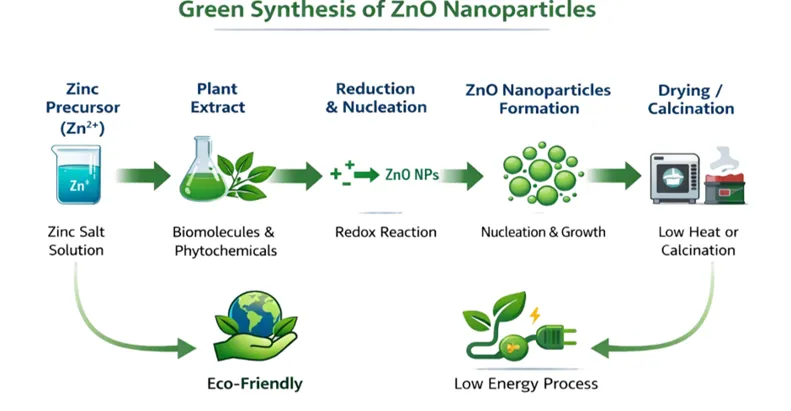
Figure No.1: Schematic representation of plant-assisted fabrication of zinc oxide nanoparticles.
3.2 Plant-Mediated Synthesis
Plant extracts are among the most widely investigated biological systems for green ZnO nanoparticle synthesis because they contain diverse phytochemicals, including flavonoids, phenolic acids, alkaloids, terpenoids, proteins, sugars, and organic acids. These compounds can interact with zinc precursors such as zinc acetate or zinc nitrate through hydroxyl, carbonyl, carboxyl, and amino groups. During synthesis, phytochemicals may chelate or coordinate Zn2+

3.3 Characterization Techniques
Characterization of green-synthesized ZnO nanoparticles
Comprehensive characterization of green-synthesized ZnO NPs is essential for confirming nanoparticle formation, assessing batch-to-batch reproducibility, understanding the contribution of plant-derived surface molecules, and predicting biomedical performance. No single analytical technique can adequately describe all relevant nanoparticle properties; therefore, optical, spectroscopic, structural, microscopic, and colloidal analyses should be interpreted together.
UV–visible spectroscopy
UV–Vis spectroscopy provides a rapid preliminary indication of ZnO NP formation through the characteristic ultraviolet absorption associated with the ZnO band-gap transition. Green-synthesized ZnO NPs commonly show an absorption maximum in the approximate range of 350–380 nm, although the exact wavelength may vary with particle size, morphology, crystallinity, aggregation, surface coating, and measurement conditions. For example, Euphorbia dracunculoides-mediated ZnO NPs showed an absorption maximum at 368 nm. UV–Vis analysis may also provide information about optical band-gap energy, but it should be supported by XRD and microscopic techniques for definitive confirmation.(16)
Fourier-transform infrared spectroscopy
Infrared spectral analysis is valuable for detecting biomolecular residues attached to nanoparticle surfaces and verifying the participation of phytochemicals during synthesis. Changes in bands assigned to hydroxyl, carbonyl, carboxyl, amine, and other functional groups can indicate their involvement in zinc-ion coordination, nucleation, growth regulation, and surface capping. FTIR therefore provides evidence of phytochemical participation in synthesis and stabilization, but it does not by itself prove the complete chemical mechanism.(17)
X-ray diffraction
Diffraction-based analysis is commonly employed to verify crystalline organization and structural integrity of biosynthesized nanomaterials. Green-synthesized ZnO commonly exhibits the hexagonal wurtzite phase, with characteristic reflections corresponding to planes such as (100), (002), and (101). The mean crystallite size may be estimated from peak broadening using the Scherrer equation:
D=Kλβcosθ
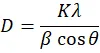
where D


Transmission electron microscopy
TEM provides direct information about primary particle morphology, size, shape, and aggregation. Green-synthesized ZnO NPs may appear spherical, quasi-spherical, rod-shaped, triangular, or hexagonal depending on the plant extract and synthesis conditions. TEM should preferably be reported with particle-size measurements based on numerous individual particles rather than a representative image alone. In the Euphorbia study, electron microscopy showed rod-shaped and triangular structures, illustrating that morphology is not universally spherical or hexagonal.
Dynamic light scattering and zeta potential
DLS measures the hydrodynamic diameter of particles dispersed in a liquid and provides the polydispersity index. The hydrodynamic diameter includes the nanoparticle core together with the associated phytochemical layer and solvent-solvation shell; therefore, it is often larger than the size measured by TEM or calculated from XRD. Zeta potential estimates the electrokinetic surface potential and helps assess the tendency of particles to remain dispersed. A high absolute zeta-potential value may indicate stronger electrostatic repulsion and a lower tendency toward aggregation under the conditions tested. However, zeta potential alone does not establish long-term stability because dispersion behavior is also influenced by pH, ionic strength, steric effects, phytochemical coating, polymer adsorption, and storage conditions. In one study, ZnO NPs showed a zeta potential of approximately −42.2 mV, which was consistent with electrostatic stabilization in that experimental system.(19)
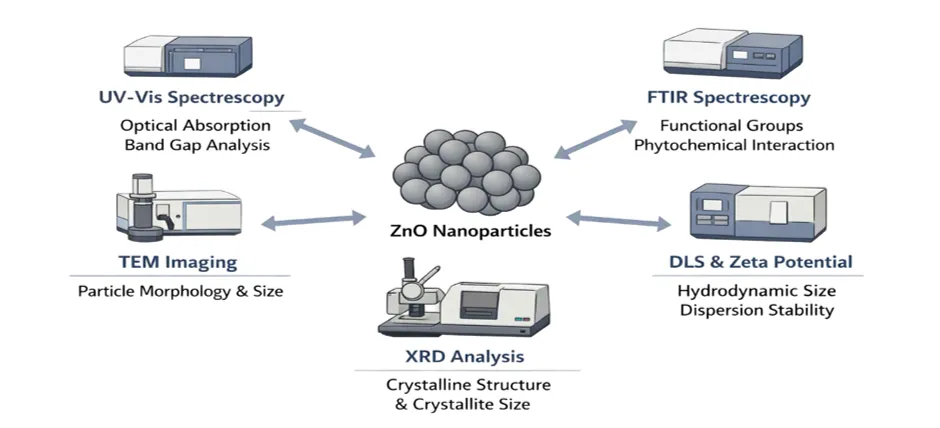
Figure No.2: Analytical tools employed for physicochemical evaluation of biosynthesized ZnO nanostructures.
3.4 Comparative Studies: Green vs. Chemical Synthesis
Comparative studies suggest that some green-synthesized ZnO nanoparticles may show higher cell viability or lower cytotoxicity than selected chemically synthesized counterparts under specific experimental conditions. However, this finding is not universal. Comparative safety depends on particle size, morphology, surface chemistry, residual precursors, phytochemical coating, dose, exposure duration, dissolution, and the biological model.. In a direct comparison using Vero cells, Musa acuminata-mediated ZnO nanoparticles produced significantly higher cell viability and lower apoptotic responses than chemically synthesized ZnO nanoparticles, although both materials showed concentration- and time-dependent cytotoxicity. Green-synthesized ZnO nanoparticles have also demonstrated substantial antimicrobial and anti-inflammatory activity, which may be influenced by phytochemical molecules retained on their surfaces. These surface-associated compounds can modify particle–cell interactions, oxidative-stress responses, and biological activity. However, the relative safety and efficacy of green and chemical ZnO nanoparticles depend on particle size, morphology, surface chemistry, residual precursors, phytochemical composition, dose, exposure duration, and the biological model; therefore, green synthesis should not be assumed to universally produce smaller, less toxic, or more effective nanoparticles (20,21).
3.5 Biomedical Potential of Green-Synthesized ZnO NPs
Overall, green-synthesized ZnO nanoparticles exhibit antimicrobial, anti-inflammatory, antioxidant, and wound-healing potential. Their biological effects may arise from the combined actions of ZnO-associated ROS generation, Zn2+

3.6 Limitations and Challenges
Despite their potential advantages, green-synthesized ZnO nanoparticles face important challenges related to standardization, scalability, mechanistic understanding, and regulatory acceptance. Variations in plant species, geographical origin, phytochemical composition, extraction procedure, precursor concentration, pH, temperature, and reaction time can produce batch-to-batch differences in nanoparticle size, morphology, crystallinity, surface chemistry, and biological activity. Furthermore, laboratory-scale protocols may not retain the same yield, colloidal stability, and physicochemical uniformity during scale-up. The precise roles of individual phytochemicals in zinc-ion complexation, nucleation, growth regulation, and surface stabilization also remain incompletely understood. Finally, the lack of harmonized regulatory criteria for biogenic nanoparticles complicates quality control, toxicological evaluation, and clinical translation. Standardized raw-material characterization, validated synthesis protocols, advanced physicochemical analysis, quality-by-design manufacturing, and comprehensive long-term safety assessment are therefore essential for advancing green ZnO nanoparticles toward pharmaceutical application. (24,25)
4: Emulgel Formulation Strategies
4.1 Fundamentals of Emulgel Systems
Emulgels are semisolid, biphasic drug-delivery systems prepared by incorporating an emulsion into a three-dimensional gel network. Depending on the formulation objective, the emulsion may be oil-in-water or water-in-oil, while the gel phase is generally formed using polymers such as Carbopol, hydroxypropyl methylcellulose, sodium carboxymethylcellulose, poloxamers, or other hydrophilic or organogel-forming materials. This hybrid architecture combines the solubilization and compartmentalization capacity of an emulsion with the viscosity, spreadability, and residence-time advantages of a gel.(26)
The emulsion phase is particularly useful for incorporating poorly water-soluble or lipophilic drugs, which can be dissolved or dispersed in the oil phase. Surfactants and co-surfactants help reduce interfacial tension and maintain dispersion of the two immiscible phases. The gel network increases the viscosity of the continuous phase, restricts droplet mobility, improves physical stability, and reduces runoff after topical application. Consequently, the drug may be released through a combined mechanism involving diffusion from the internal phase, partitioning across the oil–water interface, and transport through the hydrated polymeric gel matrix.
Emulgels may provide better spreadability, skin residence, cosmetic acceptability, and ease of removal than many conventional ointments and creams. They can also offer prolonged local contact and potentially controlled drug release. In nanoemulgels, the smaller emulsion droplets may further increase interfacial area and improve drug solubilization and dermal delivery. However, enhanced skin penetration is not universal and must be confirmed experimentally because it depends on droplet size, oil composition, surfactant concentration, drug partitioning, polymer structure, skin condition, and the presence of penetration enhancers.(27)
4.2 Components of Emulgel Formulations
Oil phase
The oil phase contains natural or synthetic oils such as liquid paraffin, isopropyl myristate, medium-chain triglycerides, oleic acid, mineral oil, or plant oils. It can dissolve or disperse hydrophobic drugs and phytoconstituents, influence droplet size, modify skin partitioning, and provide partial occlusion. The choice of oil affects emulsion type, viscosity, sensory properties, drug release, and skin permeation. For ZnO NP-loaded emulgels, the oil phase may indirectly influence nanoparticle distribution by modifying interfacial properties, viscosity, droplet size, and polymer–particle interactions. ZnO NPs are generally dispersed rather than molecularly solubilized in the formulation. Depending on their surface chemistry and preparation method, they may be present in the aqueous phase, associated with the oil–water interface, or distributed throughout the gel matrix. Their actual location should be confirmed experimentally rather than assumed from the formulation composition.(28)
Aqueous phase
The aqueous phase provides the continuous vehicle for water-soluble ingredients and hydrates the gelling polymer. It may contain purified water, buffers, humectants, preservatives, and hydrophilic drugs or plant extracts. The aqueous phase also affects pH, ionic strength, viscosity, nanoparticle dispersion, zinc-ion release, and skin compatibility.In a ZnO NP emulgel, pH should be controlled because it can influence polymer viscosity, nanoparticle aggregation, surface charge, ZnO dissolution, preservative performance, and potential skin irritation.
Emulsifiers
Emulsifiers reduce interfacial tension between the oil and aqueous phases and form an interfacial film around dispersed droplets. Common examples include polysorbates such as Tween 80 and Tween 20, sorbitan esters such as Span 20 and Span 80, lecithin, and selected nonionic surfactants. A suitable emulsifier or emulsifier mixture helps prevent coalescence and phase separation.(29) The surfactant system should be optimized rather than increased indiscriminately. Excess surfactant may cause irritation, alter nanoparticle surface chemistry, affect zinc-ion or drug release, change interfacial structure, or destabilize the emulsion through depletion or bridging flocculation. Surfactant selection should therefore consider hydrophilic–lipophilic balance, skin tolerability, nanoparticle compatibility, droplet size, physical stability, and the intended site of topical action.
Gelling agents
Gelling agents create the three-dimensional polymeric network that converts the liquid or semisolid emulsion into an emulgel. Common polymers include Carbopol 934, Carbopol 940, Carbopol 934P, HPMC, sodium carboxymethylcellulose, poloxamers, and xanthan gum. They control viscosity, spreadability, extrudability, droplet mobility, residence time, and drug-release rate.(29)
Carbopol generally produces clear, highly viscous gels after neutralization, whereas HPMC and xanthan gum may provide different rheological and sensory properties. Polymer concentration and type can substantially influence nanoparticle dispersion, emulsion stability, release kinetics, and skin adhesion.
Permeation enhancers and co-solvents
Permeation enhancers reversibly modify the barrier properties of the stratum corneum or improve drug partitioning into the skin. Examples include propylene glycol, ethanol, oleic acid, isopropyl myristate, terpenes, and selected essential oils. Propylene glycol can function as a humectant, co-solvent, and permeation enhancer, while ethanol can improve drug solubilization and increase stratum-corneum fluidity.(30)
Their concentration must be optimized because excessive ethanol or certain essential oils may cause dryness, irritation, erythema, or barrier disruption. An enhancer that increases drug flux may not always be desirable for ZnO NPs if the intended objective is local skin retention rather than systemic penetration.
Preservatives and pH modifiers
Preservatives may be needed because emulgels contain water and can support microbial growth. Common choices include sodium benzoate, phenoxyethanol, parabens, or other validated preservative systems. pH modifiers or neutralizing agents, such as triethanolamine or sodium hydroxide, may be used to develop Carbopol viscosity and adjust the formulation to a skin-compatible pH. The compatibility of preservatives and neutralizers with ZnO NPs and plant-derived phytochemicals should be verified experimentally.(31)
Green-synthesized ZnO nanoparticles
In the proposed formulation, green-synthesized ZnO NPs are the principal functional nanomaterial. Their dispersion should be optimized to prevent aggregation and ensure dose uniformity. Relevant tests include particle-size distribution, polydispersity index, zeta potential, microscopy, zinc content, crystallinity, sedimentation, redispersibility, and chemical compatibility with the polymer, surfactant, oil, preservative, and active drug.
4.3 Incorporation of Nanoparticles into Emulgels
Incorporation of green-synthesized ZnO nanoparticles into an emulgel may combine the biological activity of the nanomaterial with the topical delivery advantages of an emulsion–gel matrix. ZnO NPs may contribute antimicrobial, anti-inflammatory, antioxidant, and wound-healing effects, whereas the emulgel may improve spreadability, residence time, physical handling, and release control. ZnO NPs are commonly pre-dispersed in the aqueous phase or incorporated during gel preparation; however, the appropriate method depends on their surface chemistry, aggregation tendency, and compatibility with the formulation. Dispersion stability is influenced by particle size, surface charge, phytochemical coating, pH, ionic strength, surfactant concentration, mixing energy, and polymer–particle interactions. The final formulation should therefore be compared with a nanoparticle-free emulgel and should be evaluated for particle-size distribution, PDI, zeta potential, viscosity, yield stress, thixotropy, spreadability, zinc content, release, sedimentation, redispersibility, and storage stability. Direct evidence for formulations containing only green-synthesized ZnO NPs remains limited.(32)
4.4 Formulation Optimization
Optimization of ZnO NP-loaded emulgels requires balancing nanoparticle dispersion, skin compatibility, rheological performance, physical stability, release behavior, and biological activity. Particle size and polydispersity should be controlled because they may influence surface area, aggregation, dissolution, cellular interactions, and formulation uniformity. However, a particle size below 50 nm does not automatically guarantee enhanced skin penetration, improved therapeutic activity, or acceptable safety. The effect of particle size must be interpreted together with morphology, surface coating, dose, aggregation state, dissolution, formulation composition, and skin condition. The formulation pH should be selected within a skin-compatible range while maintaining polymer performance, nanoparticle stability, preservative activity, and drug stability. Adequate viscosity and pseudoplastic or thixotropic behavior are desirable to prevent leakage and sedimentation while permitting easy spreading and patient use. Release can be modulated by adjusting polymer concentration, oil-phase composition, droplet size, emulsifier level, nanoparticle loading, and drug–polymer interactions. Franz diffusion-cell studies of related topical nanoemulsion gels and plant-mediated ZnO nanocarriers have reported prolonged release over approximately 12–24 h in selected experimental systems. However, the measured substance may have been a co-loaded drug, zinc ions, dissolved zinc species, or total zinc rather than intact ZnO nanoparticles. Therefore, the release duration and mechanism must be confirmed in the final formulation using validated analyte-specific methods.(33) .
4.5 Stability and Rheological Studies
Stability and rheological studies are essential for evaluating the long-term quality and topical performance of ZnO NP-loaded emulgels. Physical stability should be assessed by monitoring phase separation, creaming, flocculation, coalescence, sedimentation, syneresis, color, odor, pH, particle-size distribution, zeta potential, drug content, and microbial quality under real-time and accelerated storage conditions. Rheological characterization should include viscosity, flow behavior, yield stress, spreadability, extrudability, and, where possible, thixotropic recovery and viscoelastic moduli. Pseudoplastic and thixotropic behavior is generally advantageous because it facilitates extrusion and spreading during application while maintaining formulation structure at rest. ZnO NPs may modify emulgel stability and gel strength through interactions with polymer chains, surfactants, phytochemical coatings, and oil–water interfaces; however, the effect depends on nanoparticle concentration, surface chemistry, degree of aggregation, and formulation composition. Therefore, any claim of improved stability should be supported by comparison with a nanoparticle-free control and by quantitative stability data.(34,35).
4.6 Case Studies and Recent Advances
Collectively, recent studies support the potential of green ZnO-containing topical nanocarriers for antimicrobial therapy, acne management, wound care, and controlled local drug delivery. However, direct clinical and ex vivo evidence for emulgels containing only green-synthesized ZnO nanoparticles remains limited. Future studies should compare ZnO NP-loaded emulgels with nanoparticle-free controls and evaluate antimicrobial efficacy, release kinetics, skin deposition, irritation, cytotoxicity, stability, and patient acceptability. (8,36)
5: Mechanistic Insights — Anti-Inflammatory and Antimicrobial Action
5.1 Introduction to Mechanistic Pathways
Zinc oxide nanoparticles, including those produced through biological routes, may exhibit biological effects through several overlapping mechanisms. These include reactive oxygen species generation, zinc-ion dissolution, direct nanoparticle–cell interactions, membrane perturbation, surface-associated phytochemical effects, and modulation of inflammatory signaling. The relative contribution of each mechanism depends on particle size, morphology, surface chemistry, aggregation, pH, light exposure, dissolution behavior, concentration, and the biological model. Consequently, proposed mechanisms should be supported by appropriate mechanistic assays rather than inferred only from a biological endpoint.
Green synthesis may add a second layer of biological activity to ZnO NPs. Phenolics, flavonoids, terpenoids, proteins, and other plant-derived molecules retained on the nanoparticle surface may influence particle dispersion, microbial adhesion, cellular uptake, oxidative stress, and inflammatory responses. However, the contribution of these surface molecules varies with the plant source and synthesis procedure; therefore, biological activity should not be attributed to ZnO alone without appropriate controls.
5.2 Antimicrobial mechanisms
ZnO NPs can inhibit Gram-positive and Gram-negative bacteria through several complementary pathways:

In an emulgel, the polymeric matrix may prolong local contact between ZnO NPs and microorganisms, while controlled release can reduce rapid depletion of the active material. However, the gel may also reduce nanoparticle mobility; therefore, antimicrobial activity must be measured in the final formulation rather than inferred from free nanoparticles.
5.3 Anti-inflammatory mechanisms
In selected animal wound models, ZnO-containing treatments have been associated with reduced expression of inflammatory markers, including CD68, IL-8, TNF-α, MCP-1, IL-6, and IL-1β. These findings suggest potential anti-inflammatory activity, but the magnitude of the response depends on the animal model, wound type, treatment concentration, treatment duration, and formulation composition. When the formulation contains additional components, such as polymers, antibiotics, silver, or plant extracts, the observed effect cannot be attributed exclusively to ZnO nanoparticles.(40)
The proposed anti-inflammatory mechanisms include:
These effects should be distinguished from nonspecific cytotoxicity. High concentrations of ZnO NPs may generate excessive ROS, release excessive Zn2+

5.4 Evidence from Recent Studies
Recent studies support the potential of ZnO-containing topical nanocarriers for infected wounds and inflammatory skin conditions, although direct evidence involving green-synthesized ZnO nanoparticles in conventional emulgels remains limited. A 2024 in situ-forming ZnO nanoparticle hydrogel demonstrated antibacterial activity against methicillin-resistant Staphylococcus aureus, producing inhibition zones of 18.40 mm after 24 h and 22.78 mm after 48 h. The formulation also showed biocompatibility and improved healing in an infected frostbite-wound model; however, it was a hydrogel rather than an emulgel.(41)
A separate 2024 study developed a Carbopol nanoemulgel containing a green-synthesized Ag/ZnO nanocomposite and neomycin. The formulation exhibited activity against multidrug-resistant wound bacteria, inhibited biofilm formation, and provided prolonged release of the incorporated antimicrobial components. Because the system included silver and neomycin in addition to ZnO, its antimicrobial and release effects should not be assigned solely to ZnO nanoparticles.(8)
Other recent research has demonstrated that ZnO-based nanocomposites can combine antimicrobial, antioxidant, and anti-inflammatory effects. For example, ZnO–cinnamic acid nanoparticles inhibited several wound-associated bacterial species and accelerated wound closure in a zebrafish model, achieving approximately 93% closure after 14 days at the higher tested concentration. Nevertheless, this evidence should be regarded as supportive rather than direct evidence for green ZnO NP-loaded emulgels.(42)
|
Table 1. Evidence from Recent Studies |
||
|
Evidence category |
Examples |
How it should be interpreted |
|
Direct evidence |
Green ZnO NPs incorporated into an emulgel |
Highest relevance to your review question |
|
Closely related evidence |
Green ZnO in nanoemulgel, hydrogel, or nanogel |
Supportive but not equivalent |
|
Indirect evidence |
Free green ZnO NPs or ZnO composites |
Mechanistic or preliminary support only |
|
Non-comparable evidence |
Chemical ZnO, Ag/ZnO, ZnO–drug composites |
Must be clearly separated |
|
Clinical evidence |
Human topical ZnO formulations |
Important for translation but may not involve green synthesis or emulgels |
5.5 Synergistic Effects in Emulgel Systems
The combination of green-synthesized ZnO nanoparticles with an emulgel matrix may provide complementary advantages. ZnO NPs contribute antimicrobial, anti-inflammatory, antioxidant, and wound-healing activity, whereas the emulgel controls the local environment in which the nanoparticles and any co-loaded drug are dispersed and released.
Sustained local exposure: The viscous polymeric network can reduce rapid runoff and restrict the mobility of dispersed droplets or nanoparticles. Drug release may therefore be prolonged through diffusion from the emulsion phase and transport through the hydrated gel matrix. A slower release profile may maintain local antimicrobial or anti-inflammatory activity, but the actual release duration depends on polymer concentration, oil composition, nanoparticle loading, surface coating, and drug–excipient interactions.(43)
Improved topical deposition: Nanoemulsion droplets, suitable oils, surfactants, co-solvents, and penetration enhancers can improve contact with the stratum corneum and increase the deposition of certain active ingredients. However, this should not be described as guaranteed “deep penetration” of ZnO NPs. Studies of topical ZnO commonly show that particles remain primarily within or on the outer skin barrier, and increased skin deposition does not necessarily mean systemic or deep epidermal penetration. Ex vivo permeation and skin-retention studies are therefore required.(44)
Improved physical stability: The gel network can increase the viscosity of the continuous phase and reduce droplet movement, sedimentation, and aggregation. In some systems, polymer–particle or particle–interface interactions may reinforce the formulation structure. However, ZnO NPs can also aggregate, alter polymer conformation, interact with surfactants, or destabilize the emulsion if the concentration, pH, ionic strength, or mixing procedure is unsuitable.(45)
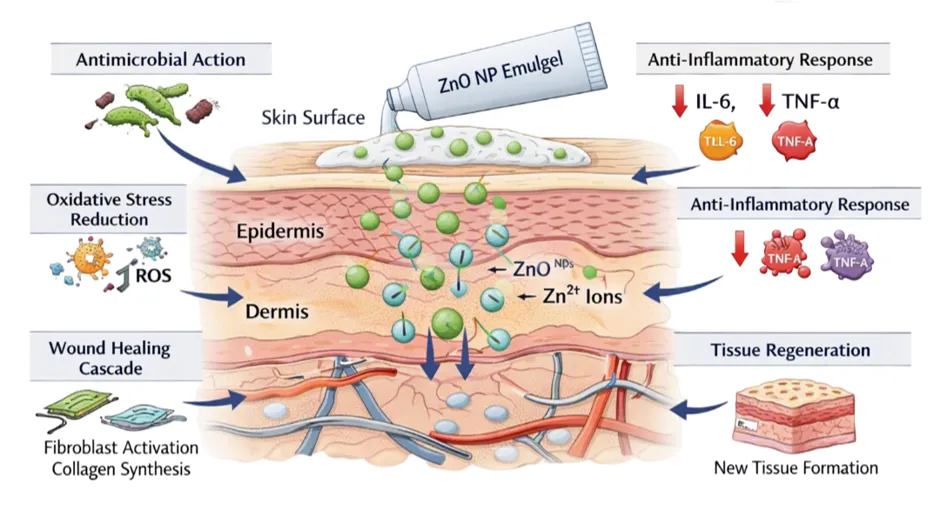
Figure No.3: Proposed biological mechanisms associated with ZnO nanoparticle-loaded topical emulgel systems.
5.6 Challenges in Mechanistic Understanding
Despite promising biological findings, the mechanisms and safety of green-synthesized ZnO nanoparticles require further clarification. ZnO NPs may exert antioxidant effects at lower or optimized concentrations through phytochemical-associated radical scavenging, whereas higher concentrations may generate excessive reactive oxygen species and release Zn2+

, resulting in pro-oxidant activity and cytotoxicity. The biological response is further influenced by plant-extract variability, because changes in phytochemical composition can alter nanoparticle size, morphology, surface chemistry, aggregation, dissolution, and cellular interactions. In addition, many studies describe biological outcomes without systematically mapping the contributions of ROS, zinc-ion release, membrane interaction, phytochemical capping, inflammatory signaling, and cellular uptake. Long-term safety following repeated topical application is also inadequately studied, particularly in damaged or inflamed skin. Future work should therefore combine standardized plant-extract profiling with mechanistic assays, dose–response analysis, repeated-dose dermal studies, skin-barrier evaluation, and comparisons with chemically synthesized ZnO NPs, free plant extract, and nanoparticle-free emulgels. (46,47)
6: Therapeutic Applications of ZnO NP-Loaded Emulgels
6.1 Dermatological Disorders
Topical formulations containing ZnO nanoparticles have potential applications in dermatology because ZnO combines antimicrobial, anti-inflammatory, barrier-supporting, and wound-healing properties. Incorporation into an emulgel may improve spreadability, residence time, physical handling, and local release of ZnO-associated active components. However, the clinical performance of a ZnO NP-loaded emulgel depends on particle size, dose, surface chemistry, polymer composition, skin condition, and the presence of co-loaded drugs or phytochemicals.
Acne
ZnO nanoparticles may be relevant to acne because they can inhibit Cutibacterium acnes—formerly known as Propionibacterium acnes—and may reduce inflammatory signaling, oxidative stress, and sebum-associated irritation. A recent clinical study of a 0.5% hyaluronic-acid-stabilized ZnO nanogel reported a 58% reduction in inflammatory lesions after four weeks, together with improvement in transepidermal water loss and no observed erythema. The formulation was a nanogel rather than an emulgel and was not necessarily green-synthesized, so it should be cited as supporting evidence rather than direct proof of green ZnO NP emulgel efficacy.(48)
The claim that ZnO NP emulgels improve patient compliance through reduced greasiness should be supported by a patient-reported outcome study. Spreadability, low tack, low residue, ease of washing, and cosmetic acceptability can improve adherence, but these properties must be measured rather than assumed.
Eczema and dermatitis
Zinc-containing topical products may support skin-barrier repair and provide anti-inflammatory or protective effects in selected dermatitis conditions. However, ZnO nanoparticles may also induce oxidative stress, inflammasome activation, and keratinocyte toxicity in inflamed or damaged skin at inappropriate concentrations. A 2024 study found that ZnO nanoparticles produced pronounced toxic effects in keratinocytes and psoriasis-like keratinocytes, including reduced viability, oxidative stress, and inflammasome activation.(49) Therefore, the role of ZnO NP emulgels in eczema should be described as potentially supportive, not established as a primary treatment. Safety studies using inflamed or barrier-disrupted skin models are particularly important because results obtained with healthy skin may not predict responses in eczema.
Psoriasis
The potential use of ZnO nanoparticles in psoriasis is mechanistically plausible because psoriasis involves oxidative stress, immune activation, abnormal keratinocyte proliferation, and excessive cytokine signaling. However, direct evidence for green ZnO NP emulgels in psoriasis is currently insufficient. Some experimental work indicates that ZnO nanoparticles can suppress inflammatory cytokine expression in immune-cell models, whereas other studies report toxicity and inflammasome activation in psoriasis-like keratinocytes. This apparent duality emphasizes the importance of dose, particle characteristics, exposure time, and the formulation vehicle.(50)
6.2 Wound Healing
ZnO NP-loaded topical systems may accelerate wound healing by combining antimicrobial, anti-inflammatory, antioxidant, and tissue-regenerative effects. Antimicrobial activity can reduce bacterial colonization and secondary infection, whereas modulation of inflammatory mediators may limit prolonged tissue damage. Zinc-ion release and interactions between ZnO nanoparticles and skin cells may further support keratinocyte migration, re-epithelialization, collagen deposition, granulation-tissue formation, and angiogenesis. In animal models, biosynthesized ZnO nanoparticles have been associated with faster wound contraction, mature epithelialization, restoration of skin architecture, reduced fibrosis, and lower inflammatory-marker expression. Incorporation into an emulgel may improve topical residence and formulation handling; however, direct evidence for green-synthesized ZnO NP-loaded emulgels remains limited, and the contribution of the emulgel matrix must be distinguished from the effects of the nanoparticles and plant-derived capping compounds.(51)
6.3 Antimicrobial Therapy
ZnO NP-loaded emulgels may provide broad-spectrum antimicrobial activity against clinically important bacteria and fungi. Biogenic ZnO nanoparticles have demonstrated activity against Gram-positive and Gram-negative organisms, including Staphylococcus aureus, Escherichia coli, and Pseudomonas aeruginosa, through combined effects involving reactive oxygen species generation, Zn2+

release, membrane disruption, protein damage, and interference with intracellular metabolism. Green-synthesized ZnO nanoparticles have also shown activity against Candida albicans, although evidence against dermatophytes remains less extensive and should be supported by organism-specific studies. In addition, ZnO nanoparticles may prevent biofilm formation and damage established biofilms by inhibiting bacterial adhesion, disrupting extracellular polymeric substances, and interfering with exopolysaccharide production. Incorporation into an emulgel may prolong local contact and improve topical handling, but antimicrobial activity must be confirmed in the final formulation because the gel matrix and excipients can influence nanoparticle dispersion and microbial exposure.(52,53)
6.4 Controlled Drug Delivery
Emulgel matrices may provide controlled local delivery of co-loaded drugs and ZnO-associated therapeutic components by increasing formulation viscosity, restricting molecular mobility, and creating a diffusion barrier. Release behavior depends on the polymeric network, oil-phase composition, droplet size, emulsifier concentration, nanoparticle loading, surface coating, and drug–excipient interactions. Franz diffusion-cell studies of related ZnO-containing hydrogels and topical nanoemulgel systems have demonstrated prolonged release over approximately 12–24 h; however, most studies measure the release or permeation of the co-loaded drug rather than intact ZnO nanoparticles. Therefore, controlled release should be confirmed in the final formulation using validated membrane-release and, where relevant, ex vivo skin-retention or permeation studies. A prolonged release profile may reduce the need for frequent application and improve adherence, but reduced dosing frequency should not be claimed unless supported by pharmacodynamic or clinical evidence.(54,55)
6.5 Synergistic Applications with Herbal Actives
Green-synthesized ZnO nanoparticles may be combined with herbal bioactives such as curcumin, Aloe vera, neem extract, and other phytochemical-rich materials to develop multifunctional emulgel systems. ZnO NPs can provide antimicrobial activity, zinc-ion release, and potential wound-healing effects, whereas herbal constituents may contribute antioxidant, anti-inflammatory, antimicrobial, and tissue-regenerative properties. Curcumin-assisted green synthesis of ZnO-based nanoparticles has produced improved antimicrobial activity compared with selected individual components, while ZnO–curcumin nanoconjugates prepared by chemical methods have shown enhanced antibacterial and antioxidant performance in comparative assays. Nevertheless, direct evidence for green-synthesized ZnO NPs combined with herbal actives in emulgel formulations remains limited. Therefore, claims of synergy and improved biocompatibility should be confirmed using combination-index analysis, checkerboard assays, time-kill studies, cytotoxicity testing, and comparisons with each individual component and the blank emulgel.(56,57)
6.6 Clinical Translation and Patient Outcomes
Clinical translation of green-synthesized ZnO nanoparticle formulations remains at an early stage. Most recent evidence comes from in vitro studies, animal wound models, ex vivo permeation experiments, and topical nanogels or wound dressings rather than randomized clinical trials of ZnO NP-loaded emulgels.
The strongest recent human evidence identified here involved a calcium-alginate dressing containing ZnO nanoparticles for diabetic foot ulcers. In that study, the ZnO nanoparticle dressing achieved approximately 75% wound closure, compared with 71% for the calcium-alginate control, and the mean healing time was 48 days versus 72 days. The dressing was reported to be well tolerated. However, this was a wound dressing rather than an emulgel, and the study does not establish the efficacy of green-synthesized ZnO NPs specifically.(58)
Preclinical evidence is stronger for wound-healing and antifungal applications. A naringenin–ZnO–chitosan gel showed synergistic antifungal activity against Candida albicans, with an FICI of 0.018. In a mouse model of cutaneous candidiasis, the fungal burden was 109 ± 25 CFU/mL in the combination-gel group, compared with 2260 ± 446 CFU/mL in the infected control group. Cytokine and histopathological findings also supported improved infection control and tissue recovery. This was an animal study involving a chitosan gel, not a clinical trial of a ZnO NP emulgel.(59)
Other topical nanocomposite systems have shown prolonged release and wound-healing effects in animal models. For example, ZnO- or Ag-containing vitamin-loaded films released active components for up to 24 h and demonstrated wound contraction, re-epithelialization, collagen deposition, and reduced inflammation in mice.(60)
6.7 Limitations in Therapeutic Applications
Despite encouraging antimicrobial, anti-inflammatory, and wound-healing findings, several barriers limit the therapeutic translation of green-synthesized ZnO NP-loaded emulgels.
Dose-dependent toxicity: ZnO NPs may cause oxidative stress, membrane injury, mitochondrial dysfunction, inflammatory signaling, and cell death at sufficiently high concentrations. Cytotoxicity is influenced by particle size, morphology, surface chemistry, aggregation, dissolution, zinc-ion release, exposure time, and cell type. A recent green ZnO study reported concentration-dependent inhibition of cancer-cell viability over a 48-hour exposure period across concentrations of 25–200 µg/mL. These results demonstrate that green synthesis does not eliminate dose-related toxicity.(61)
Importantly, safety should be evaluated using relevant skin models, including keratinocytes, fibroblasts, reconstructed human epidermis, and inflamed or barrier-disrupted skin. A dose that is antimicrobial against bacteria may also damage mammalian cells, so the therapeutic index should be determined rather than assuming that all green ZnO formulations are biocompatible.
Variability in plant-mediated synthesis: Plant-mediated synthesis is affected by plant species, plant part, geographical origin, season, cultivation conditions, harvesting, storage, extraction solvent, extract concentration, precursor salt, pH, temperature, reaction time, and calcination. These factors can alter particle size, morphology, crystallinity, surface capping, aggregation, dissolution, and biological activity. Standardized botanical authentication, controlled extraction, phytochemical fingerprinting, and predefined nanoparticle quality attributes are therefore essential for consistent therapeutic performance.
Regulatory and quality-control barriers: Regulatory assessment is complicated by the multifunctional nature of these formulations. Authorities must consider the ZnO core, particle-size distribution, crystal phase, surface-bound phytochemicals, residual plant components, impurities, microbial contamination, zinc-ion release, aggregation, stability, and the behavior of the final emulgel. Additional concerns include long-term dermal exposure, skin-barrier disruption, sensitization, immunogenicity, environmental release, and inconsistent nano-labeling. Recent dermatology-focused analysis identifies batch variability, surface-chemistry-related immunogenicity, long-term dermal penetration, and environmental effects as important regulatory gaps.(62)
7: Challenges and Future Perspectives
7.1 Standardization of Green Synthesis Protocols
Standardization of plant-mediated ZnO nanoparticle synthesis is essential for reproducible therapeutic performance and clinical translation. Plant-extract composition varies with species, cultivar, plant part, geographical origin, season, cultivation conditions, harvesting stage, storage, extraction solvent, and extraction parameters. These differences can alter the concentration of phenolics, flavonoids, terpenoids, proteins, sugars, and organic acids involved in zinc-ion coordination, nucleation, particle growth, and surface stabilization. Consequently, batch-to-batch variability may affect nanoparticle size, morphology, crystallinity, surface chemistry, aggregation, dissolution, biological activity, and toxicity. Reproducible production requires botanical authentication, controlled extraction procedures, phytochemical fingerprinting, defined zinc-precursor and reaction conditions, validated purification, and characterization of critical quality attributes. HPLC, LC–MS, and complementary spectroscopic methods should be used to monitor key phytochemical markers, while design-of-experiments and quality-by-design approaches can help establish robust synthesis conditions. The final ZnO NP-loaded emulgel must also be evaluated separately because excipients may alter nanoparticle dispersion, rheology, release, skin deposition, and stability.(63,64)
7.2 Toxicity and Dose-Dependent Effects
Although green-synthesized ZnO nanoparticles may reduce the use of hazardous reagents and may possess biologically active surface coatings, they are not inherently free from toxicity. At high or prolonged exposures, ZnO NPs may generate excessive reactive oxygen species, release Zn2+

, impair mitochondrial function, damage cellular membranes, activate inflammatory signaling, and induce apoptosis. Their toxicity is influenced by particle size, morphology, surface chemistry, aggregation, dissolution, dose, exposure duration, and cell type. Repeated topical application should therefore be evaluated carefully, particularly in inflamed, abraded, burned, or diseased skin. Current human evidence suggests that intact ZnO NPs show limited penetration through healthy skin, although surface accumulation and zinc-ion release may occur. Consequently, dose optimization and comprehensive assessment of cytotoxicity, irritation, sensitization, skin-barrier function, zinc-ion release, local retention, and systemic exposure are necessary before clinical use of green ZnO NP-loaded emulgels.(65,66)
7.3 Regulatory and Translational Barriers
Nanoparticle-based topical formulations face significant regulatory and translational barriers because their performance depends on nanoscale characteristics such as particle-size distribution, morphology, aggregation, surface charge, surface chemistry, dissolution, and interactions with skin and immune cells. Green-synthesized ZnO nanoparticles present additional challenges because variations in plant-extract composition may produce different phytochemical coatings, residual impurities, zinc-ion release profiles, and biological responses. Regulatory evaluation must therefore address the ZnO core, surface-associated biomolecules, residual plant constituents, microbial quality, manufacturing reproducibility, stability, dermal retention, irritation, sensitization, repeated-dose toxicity, and antimicrobial or anti-inflammatory efficacy of the final emulgel. Although regulatory agencies provide general guidance for drug products containing nanomaterials, requirements remain product-specific and internationally nonuniform. Progress toward clinical translation will require collaboration among formulation scientists, toxicologists, analytical laboratories, manufacturers, clinicians, and regulatory authorities to establish validated characterization methods, critical quality attributes, standardized toxicology protocols, scalable manufacturing processes, and clinically meaningful performance criteria.(67,68)
Essential translational requirements
7.4 Scalability and Manufacturing Challenges
Scaling green ZnO nanoparticle synthesis from laboratory to industrial production remains technically challenging. Changes in reaction volume, mixing, heat and mass transfer, precursor addition, viscosity, oxygen exposure, purification, drying, and calcination can alter nanoparticle size, morphology, crystallinity, aggregation, surface chemistry, and biological activity. In addition, variations in plant-extract composition caused by species, geographical origin, season, cultivation conditions, harvesting, extraction, and storage may compromise batch-to-batch reproducibility. Industrial development must therefore combine authenticated and standardized plant material with controlled extraction, phytochemical fingerprinting, automated synthesis, validated purification, microbial-quality control, and continuous monitoring of critical quality attributes. Bioreactor or continuous-flow technology may improve mixing and process control, but pilot-scale validation is still required to demonstrate that the resulting ZnO nanoparticles and final emulgel retain uniformity, stability, efficacy, safety, cost-effectiveness, and environmental advantages.(69,70)
7.5 Clinical Trials and Human Studies
Most current evidence for green-synthesized ZnO NP-loaded emulgels is derived from in vitro, ex vivo, and animal studies, while human clinical data remain limited. One early-phase human study of a 0.5% hyaluronic-acid-stabilized ZnO nanogel reported a reduction of approximately 58% in inflammatory acne lesions after four weeks, with a favorable short-term safety profile; however, the formulation was a nanogel rather than an emulgel and was not necessarily prepared using a green synthesis route. Consequently, clinical efficacy, long-term safety, patient adherence, and therapeutic superiority of green ZnO NP-loaded emulgels remain unconfirmed. Well-designed randomized controlled studies are needed to evaluate lesion reduction, wound-closure time, microbial burden, recurrence, irritation, sensitization, patient satisfaction, and repeated-dose safety. Such evidence will help inform regulatory assessment and determine whether these systems provide clinically meaningful advantages over established topical therapies.(36)
7.6 Future Perspectives
Despite current challenges, green-synthesized ZnO NP-loaded emulgels may provide a foundation for next-generation topical and wound-care systems. Future research could focus on personalized formulations tailored to disease type, wound stage, skin-barrier condition, microbial burden, and patient sensitivity. Combination systems incorporating ZnO NPs with herbal bioactives, antibiotics, antifungals, or anti-inflammatory agents may provide complementary or synergistic activity, provided that synergy and safety are demonstrated experimentally. Integration with smart hydrogels, electrospun nanofibers, microneedles, and stimuli-responsive carriers may further improve local retention, controlled release, and site-specific delivery. At the same time, sustainable manufacturing should prioritize standardized biological raw materials, bioreactor or continuous-flow processing, low-energy purification, waste minimization, and life-cycle assessment. These advances must proceed alongside rigorous characterization, repeated-dose toxicology, scale-up validation, and controlled clinical studies to ensure that technological innovation translates into safe, reproducible, and clinically meaningful products.
Practical research priorities
CONCLUSION
The incorporation of green-synthesized zinc oxide nanoparticles into emulgel systems represents a promising strategy at the intersection of sustainable nanotechnology and topical drug delivery. Emulgels combine an emulsion phase, which can support the dispersion or solubilization of suitable active ingredients, with a polymeric gel network that provides viscosity, spreadability, residence time, and potential release control. Green-synthesized ZnO nanoparticles may contribute antimicrobial, antioxidant, anti-inflammatory, and wound-healing activities through mechanisms involving reactive oxygen species, Zn2+

release, direct microbial interaction, and modulation of inflammatory responses. Together, these properties provide a rational basis for investigating ZnO NP-containing emulgels in dermatological, wound-care, and localized inflammatory applications.
Recent studies published from 2021 to 2026 have demonstrated promising activity for green or biogenic ZnO nanoparticles in antimicrobial, anti-inflammatory, antioxidant, and wound-healing models. Related ZnO-containing gels, hydrogels, nanoemulgels, and topical nanogels have also shown prolonged release, improved local delivery, antimicrobial activity, and favorable wound-healing outcomes. However, direct evidence for green-synthesized ZnO nanoparticles incorporated into conventional emulgels remains comparatively limited. Evidence for reduced acne lesions, improved patient satisfaction, antifungal lesion resolution, or superiority over established treatments should therefore be interpreted cautiously unless supported by formulation-specific controlled clinical studies.
The translational potential of these systems is constrained by several unresolved challenges. Variability in plant-extract composition can produce inconsistent nanoparticle size, morphology, surface chemistry, dissolution, and biological activity. Scale-up may alter mixing, heat transfer, purification, aggregation, and batch uniformity. In addition, green synthesis does not eliminate dose-dependent toxicity; excessive ROS generation, zinc-ion release, and nanoparticle–cell interactions may cause oxidative stress, irritation, or cytotoxicity. Regulatory evaluation must address the ZnO core, phytochemical coating, residual impurities, final emulgel, manufacturing reproducibility, stability, dermal disposition, repeated-dose safety, and clinical efficacy.
Future development should focus on authenticated and standardized plant materials, phytochemical fingerprinting, quality-by-design manufacturing, validated nanoparticle characterization, pilot-scale production, and comprehensive dermal toxicology. Combination systems involving ZnO NPs and herbal bioactives or conventional drugs may provide complementary effects, but claims of synergy and improved biocompatibility require direct comparative testing. Advanced platforms such as smart hydrogels, electrospun nanofibers, microneedles, and stimuli-responsive carriers may further improve local retention and release, although their safety, scalability, and clinical value remain to be established.
Overall, green ZnO NP-loaded emulgels should currently be regarded as promising research-stage topical delivery systems rather than clinically established therapies. Their successful translation will depend on demonstrating reproducible manufacturing, a favorable therapeutic index, formulation-specific stability, clinically meaningful efficacy, patient acceptability, and long-term dermal safety.
REFERENCES





Dheeraj, Yogender, Mansi Tyagi, Naman Parmar, Manisha Sharma, Green-Synthesized Zinc Oxide Nanoparticle-Loaded Emulgels for Topical and Dermatological Applications: Formulation Strategies, Biological Activity, Safety, and Translational Challenges, Int. J. of Pharm. Sci., 2026, Vol 4, Issue 10, 1595-1621. https://doi.org/10.5281/zenodo.23331022
 10.5281/zenodo.23331022