

We use cookies to ensure our website works properly and to personalise your experience. Cookies policy
Department of Pharmaceutics, Konkan Gyanpeeth Rahul Dharkar College of Pharmacy and Research Institute, Karjat, Maharashtra.
Orodispersible films (ODFs) represent an innovative approach to immediate-release delivery, overcoming the problem of noncompliance related with traditional tablets and capsules, specifically in the pediatric, geriatric, and dysphagic population. Such ultra-thin, flexible films undergo very rapid breakdown upon contact with saliva, allowing for rapid dissolution of the drug and absorption through the oral mucosa, with no first-pass metabolism needed to increase bioavailability. This review summarizes the advancement in ODF development and characterization based on the solvent casting techniques, followed by new developments such as hot-melt extrusion and 3D printing technologies. The materials include polymer (such as HPMC, PVA), plasticization for mechanical stability and minimizing weaknesses (e.g., low drug loading, humidity sensitivity). Fused deposition modeling (FDM), semi-solid extrusion (SSE), and other printing techniques provide personalization and multi-layer designs for incompatible APIs, although nozzle clogging and other challenges remain. Compared to orodispersible tablets (ODTs), ODFs are more portable with lower risk of choking. Theoretical advancements could provide for nanoparticle incorporation, taste-masking through cyclodextrin complexes, point-of-care 3D printing for precision medicine. In conclusion, market conditions indicate strong research, ODFs are potentially transformative therapeutics and currently, the patents have continued to reflect vigorous growth.
Orodispersible films (ODFs), also termed oral thin films or strips, are hydrophilic polymeric matrices designed to disintegrate or dissolve within seconds in the oral cavity without water, forming a solution or suspension for easy swallowing. Defined by the European Pharmacopoeia as single- or multi-layered sheets that rapidly disperse in saliva, ODFs target immediate drug release for local or systemic effects. Their rise stems from dysphagia prevalence—impacting ~8% of patients who skip doses due to swallowing difficulties—and appeal to paediatrics, geriatrics, and travellers.(1–3)
Evolution and Advantages: Pioneered post-1950s, commercial breakthroughs like Pfizer's Listerine PocketPaks (2001) spurred growth, with Rx products like Zuplenz (ondansetron) following. ODFs offer high surface area for rapid dissolution (<30 s per FDA), avoiding hepatic first-pass for enhanced bioavailability (e.g., BCS Class II/IV drugs), precise dosing, and taste-masking via flavours. Mechanical properties—tensile strength, flexibility—ensure handling durability. (1,4)
The formulation basis of orodispersible films (ODFs) focuses on hydrophilic polymeric matrices for ultra-rapid disintegration (<30 seconds) in 1-2 mL saliva, ensuring immediate drug release and bioavailability with mechanical stability. APIs (5-30% w/w) suit high-potency, water-soluble drugs (<50 mg/film, e.g., ondansetron 4-8 mg); hydrophobic BCS II/IV drugs (ibuprofen, itraconazole) need amorphous dispersions or cyclodextrins. Polymers (40-65% w/w)—HPMC E3/E5 (4-10%, low viscosity), PVA DA-8 (4-8%, strong tensile 20-40 MPa), pullulan (2-5%, fast hydration), maltodextrin (5-10%)—provide mucoadhesion (>5000 dyne/cm²) and neutral pH (6.5-7.2). Plasticizers (15-30% w/w; glycerol, PG, PEG 400 at 2:1-3:1 ratio) ensure flexibility (>150 folds, 25-50% elongation). Super disintegrants (3-10% w/w; CPVP 2-6%, CCS 3-5%, SSG 4-8%) enable wicking/swelling; surfactants (0.5-2%, Tween 80/SLS) reduce contact angle <30°; citric acid (1-3%) stimulates saliva; sweeteners (aspartame 1-3%, mannitol 5-10%), flavours (mint 0.5-1%) mask taste (>70%); xanthan gum (0.5-1%) controls viscosity (100-500 cP). Fillers (CaCO? /talc 5-15%) aid flow; BHT (0.01%) prevents oxidation. QbD targets DT, >85% dissolution at 5 min, 95-105% uniformity, >15 MPa strength, preventing phase separation(5,6). Common polymers for Orodispersible films (ODFs) include hydrophilic options that ensure rapid disintegration and film formation, such as hydroxypropyl methylcellulose (HPMC), polyvinyl alcohol (PVA), pullulan, and hydroxypropyl cellulose (HPC).
Table No. 01 Polymers for Orodispersible Films(2,4)
|
Category |
Examples |
Key Benefits for ODFs |
|
Synthetic |
PVA, PVP, PEO |
High flexibility, mechanical strength |
|
Cellulose |
HPMC, HPC, HEC, NaCMC |
Rapid swelling, content uniformity |
|
Natural |
Pullulan, starch, gelatin |
Biodegradable, patient-friendly mouthfeel |
Excipients are categorized by function, with film-forming polymers being essential for structure.
These provide the film's backbone, ensuring flexibility and quick dissolution. Common options include hydroxypropyl methylcellulose (HPMC, especially grades E5 and E15), pullulan, polyvinyl alcohol (PVA), hydroxypropyl cellulose (HPC), carboxymethyl cellulose (CMC), and polyvinyl pyrrolidone (PVP). Natural alternatives like maltodextrin, gelatin, chitosan, and sodium alginate are also used. Film-forming polymers form the structural matrix of Orodispersible films (ODFs), providing shape, flexibility, rapid disintegration and mechanical strength like tensile properties (>1-2 MPa).
Key Properties Required
These polymers must be hydrophilic for quick saliva dissolution, filmogenic for uniform thin films (50-200 µm thick), non-toxic/GRAS status, and compatible with drugs. They balance tensile strength (TS) vs. elongation (to avoid brittleness) and often blend for optimization—e.g., higher molecular weight increases TS but slows disintegration.(2)
Table No. 02 Common Film Forming Polymers (1,4).
|
Polymer |
Properties |
Typical Use/ Concentration |
Examples/Notes |
|
HPMC (E5/E15 grades) |
High TS (up to 33 MPa), moderate disintegration, good flexibility with plasticizers |
40-50% w/w, low-viscosity grades preferred |
Blends with starch/PEG improve folding endurance (>180 folds); E5 faster dissolving than E15 |
|
Pullulan |
Excellent mouthfeel, rapid disintegration (<20 s), brittle alone |
30-50%, often combined |
Natural polysaccharide; superior sensory profile |
|
PVA/PVP |
High solubility, TS >2 MPa, supersaturation stabilization |
20-40% |
PVP hydrogen-bonds for drug solubility; PVA for strength |
|
Maltodextrin/ Lycoat® |
Low viscosity, fast breakup, cost-effective |
40-60% |
Starch-derived; good for high-drug loads |
|
Chitosan |
Mucoadhesive, antimicrobial, pH-sensitive |
2-5% (low MW best) |
Biodegradable; higher conc slows disintegration |
|
Sodium Alginate |
High hydrophilicity, Ca²? cross-linkable for strength |
20-40%, blended |
<60 s disintegration; enhances bioavailability |
|
Gelatin/Starch (modified) |
Mucoadhesive, rapid DT, flexible with collagen |
30-50% |
Pregelatinized starch boosts swelling; outperforms synthetics in TS. |
Plasticizers are critical excipients in Orodispersible films (ODFs), added at 0-20% w/w (typically 10-20%) to reduce glass transition temperature (Tg), increase flexibility, prevent brittleness/cracking, and improve handling without compromising disintegration time (DT, ideally <30 s). They lower tensile strength (TS) while boosting elongation at break and folding endurance (>100-180 folds), enhancing peel ability and uniformity. Hydrophilic plasticizers (e.g., low MW like glycerol) increase water vapor permeability and drug release but may leach out, risking pore formation; lipophilic ones (e.g., triacetin) retain strength longer.
Table No. 03 Common Plasticizers(5)
|
Plasticizer |
Properties |
Typical Concentration |
Notes/Examples |
|
Glycerol (Glycerin) |
Highly hydrophilic, excellent flexibility, fast DT |
10-20% w/w |
Superior for pullulan/HPMC; outperforms sorbitol in DT (17-29 s vs. 24-32 s) ? |
|
Propylene Glycol (PG) |
Low MW, high solubility, better than PEG 400 for folding endurance |
5-15% |
Preferred for rapid DT; improves HPMC film removability formulation |
|
Polyethylene Glycol (PEG 400/600) |
Moderate hydrophilicity, tunable by MW (lower MW = faster permeability) |
10-20% |
Reduces TS in HPMC; blends with starch/HPMC optimize endurance pmc. |
|
Sorbitol/ Xylitol |
Sugar alcohols, sweetness bonus, good mouthfeel |
5-15% |
Xylitol faster DT than sorbitol; dual role as sweetener |
|
Triacetin |
Lipophilic, maintains mechanical resilience |
5-10% |
Low water absorption in Eudragit films; prevents cracking |
Disintegrants and super disintegrants are vital excipients in orodispersible films (ODFs), incorporated at 2-10% w/w to promote rapid swelling, wicking, or porosity upon saliva contact, achieving disintegration times (DT) under 30-180 seconds per pharmacopeial standards while maintaining film integrity. They outperform conventional starch by absorbing 10-40 g water per gram via mechanisms like swelling (particle expansion disrupts matrix), wicking (capillary action draws fluid), or deformation/recovery (stress relief on hydration), with higher concentrations (>9%, e.g., in 50-80 µm thick films) yielding DT <50 s and >80% drug release in 10 min.
Table no. 04: Common Types of Disintegrants and Super disintegrants(7)
|
Type |
Examples |
Properties/Concentration |
Notes |
|
Super disintegrants (Synthetic) |
Crospovidone (Polyplasdone), Croscarmellose sodium (Ac-Di-Sol), Sodium starch glycolate (SSG, Primellose) |
2-8%; Crospovidone: rapid swell w/o gel, high porosity; CCS: faster than SSG (DT 70-180 s at 90 µm); SSG: 6% yields 3.5 s DT in loperamide ODF |
Cross-linked polymers; blends (e.g., SSG+CCS 1:1) enhance release (99% in 10 min metolazone films) |
|
Natural Super disintegrants |
Fenugreek mucilage, Plantago ovata (psyllium) seed mucilage, Pregelatinized starch |
3-10%; Mucilages boost swelling/ solubility cheaply/ non-toxically |
Improve bioavailability; safer alternative to synthetics |
Sweeteners and taste-maskers are crucial in orodispersible films (ODFs) to improve palatability, especially for bitter drugs, while stimulating saliva for rapid disintegration (<30 s), typically at 1-5% w/w.
Table no. 05 Common types of Sweeteners(4,8)
|
Type |
Examples |
Properties/Concentration |
Notes |
|
Artificial |
Aspartame, Acesulfame K, Sodium saccharin, Sucralose |
High intensity (200-600x sucrose), heat stable; 0.1-1% |
Aspartame (synergistic with acesulfame); saccharin common in formulations (e.g., 10 mg/strip) |
|
Natural/ Sugar Alcohols |
Sucrose, Xylitol, Fructose, Isomalt, Mannitol, Sorbitol |
Cooling effect, non-cariogenic; 1-5% (e.g., xylitol influences DT) |
Xylitol/fructose reduce grittiness; sucrose/isomalt thicken films but extend DT slightly |
Table no. 06 Taste-Maskers(4,8)
|
Category |
Examples |
Mechanism/Concentration |
|
Cyclodextrins |
β-Cyclodextrin |
Complexation (1:1-1:5 drug:CD); 10-20% for bitterness [previous context] |
|
Ion-exchange Resins |
Amberlite |
Drug binding/release in saliva; 1-5% |
|
Flavors/Essences |
Mint, Strawberry, Citrus |
Sensory distraction; 0.5-2% with sweeteners |
Surfactants in orodispersible films (ODFs) are used at low levels (0.5-2% w/w) to reduce surface tension, enhance drug wettability and solubility (especially for hydrophobic APIs), improve film homogeneity, and prevent aggregation during solvent casting, with common examples including sodium lauryl sulfate (SLS), Tween 80 (polysorbate 80), benzalkonium chloride, sorbitan oleate, and glyceril monolinoleate that facilitate uniform drug dispersion and faster dissolution without foaming issues. (1,2)
Saliva stimulants, typically organic acids at 1-5% w/w like citric acid, malic acid, tartaric acid, or ascorbic acid, trigger rapid saliva secretion (up to 5-10-fold increase) upon contact to aid disintegration (<30 s) and dissolution while contributing sourness that masks bitterness, often combined with sweeteners for balanced mouthfeel. (1,2,4)
Solvents for casting, such as water (for hydrophilic polymers like HPMC), ethanol, ethyl acetate, or hydroalcoholic mixtures, dissolve polymers/plasticizers into a low-viscosity solution (5-20 cP) that's cast and dried at 40-80°C to form thin films (50-200 µm), with ethyl acetate preferred for poorly water-soluble drugs due to fast evaporation and minimal residues.
Solvent Casting (Primary Lab/Scale Method)- Involves dissolving/dispersing API, polymers (HPMC/PVA 4-10%), plasticizers (20-30% glycerol), and excipients in solvents (water/ethanol), casting on plates, and drying (oven/vacuum, 40-60°C). Pros: Simple, no heat for thermolabile drugs; yields uniform films. Cons: Solvent residues, bubbles, viscosity issues, batch variability, polymorphism risks. Ideal for small-scale; e.g., etoricoxib ODFs with PVA/SSG showed <50s disintegration. (8,9)
Hot-Melt Extrusion (HME)- Extrudes molten polymer-API mix (no solvents), cools to film. Polymers like PVA/PEO; temperatures 80-150°C. Advantages: Continuous, solvent-free, amorphization boosts solubility (e.g., olanzapine ASDs). Drawbacks: Heat degrades sensitives, high energy, brittleness if plasticizer uneven. Combined with casting for prolonged release. (10)
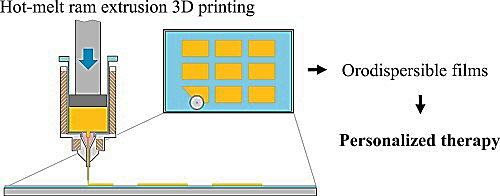
Figure No. 01 Hot- Melt Ram Extrusion 3d Printing
Electrospinning- Electrospinning is an emerging technique for preparing orodispersible films (ODFs) in which a polymer–drug solution is converted into a non?woven nanofiber mat under a high?voltage electric field, yielding highly porous, ultra?thin films that disintegrate rapidly (often within seconds) in the oral cavity. This method enhances dissolution and bioavailability of poorly water?soluble drugs (e.g., aripiprazole, sildenafil) by stabilizing the API in micro? or nanocrystalline form within the nanofibers, while still providing acceptable mechanical properties and good patient?reported mouthfeel. However, electrospinning faces challenges related to solvent use, process parameter control, and scalability, which currently limit its routine industrial application despite its promising performance in laboratory?scale ODF development.(11,12)
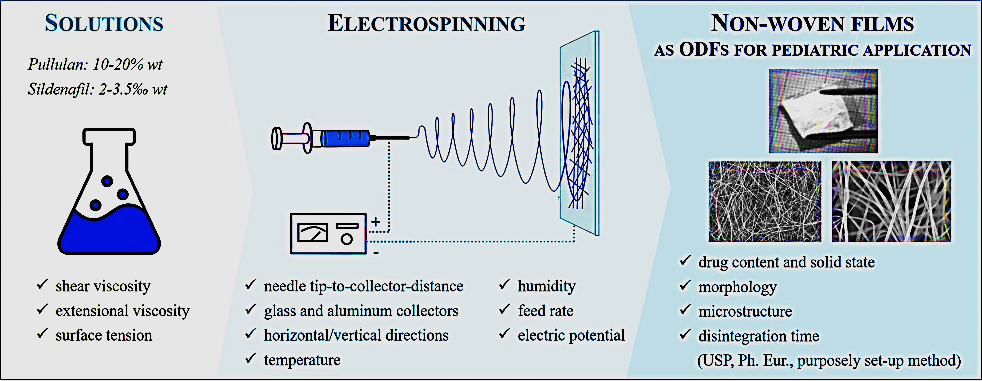
Figure No. 02 Electrospinning (13)
Rolling/ Semi-Solid Casting- Rolling or semi?solid casting is a solvent?based film?preparation method in which a viscous, semi?solid polymer–drug paste or gel is spread uniformly between rollers or over a substrate (e.g., PET liner) and then dried to form a thin orodispersible film. This approach avoids high?temperature processing and can be adapted to both simple lab?scale casting and larger?scale roll?to?roll systems, offering good thickness control and mechanical integrity when polymer blends and plasticizers are optimized. Compared with conventional solvent casting, semi?solid casting can reduce issues such as bubble formation and non?uniformity, while still enabling rapid disintegration and content uniformity suitable for low?dose, pediatric? and geriatric?friendly ODFs.(14,15)
3D Printing (Emerging Printing Technologies)-(16–18)
Overview- 2D/3D printing enables personalization, multilayers for incompatible APIs, precise dosing.
Inkjet Printing (2D)- Inkjet printing (2D) for orodispersible films (ODFs) is a non?contact, room?temperature technique in which a drug?loaded ink is precisely deposited onto a pre?formed ODF substrate (often cast or semi?solid extruded), enabling flexible, patient?specific dosing while preserving thermolabile APIs and flavours. The method supports high?resolution, customizable patterns and can encode data?matrix codes, but success depends on finely tuned inks with low viscosity, low surface tension, and sub?200 nm particles to avoid nozzle clogging and recrystallization?related dissolution changes. Inkjet?printed ODFs have been demonstrated for drugs such as enalapril and metoprolol, highlighting their potential for personalized, on?demand orodispersible films. Cons: Nozzle clogging (particles >200nm), ink limits, recrystallization. Used for metoprolol. (19–21)
Fused Deposition Modeling (FDM)- Fused Deposition Modeling (FDM) is an additive manufacturing technique used to fabricate orodispersible films (ODFs) by extruding a thermoplastic polymer–API filament through a heated nozzle, depositing the molten material layer?by?layer onto a build platform according to a 3D CAD design. The process involves first producing drug?loaded filaments (commonly using polyvinyl alcohol, PVA, or PVA?mannitol?sugar?alcohol blends) via hot?melt extrusion, then printing them at elevated temperatures (typically 140–190?°C) to create porous, multilayer films with controlled geometry and high surface area, which can enhance dissolution and enable taste?masking by separating drug and flavour layers. FDM?printed ODFs achieve good mechanical strength and reproducible dosing, and have demonstrated rapid disintegration and >80–85% drug release within minutes for APIs such as aripiprazole and other model drugs, making FDM a promising platform for personalized, fast?dissolving films, though thermolabile APIs remain challenging due to the high?temperature processing. Extrudes API-polymer filaments (PVA/APR). Advantages: Amorphization (e.g., APR dissolution > casted), porous structures, multilayers. Drawbacks: High temp (150-200°C) degrades thermolabile drugs, filament prep. (22,23,24)
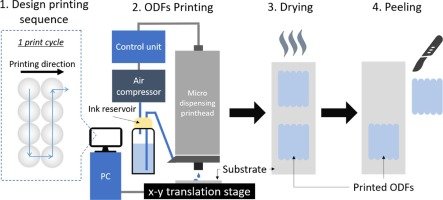
Figure No.- 03 Fused Deposition Modeling (FDM)
Semi-Solid Extrusion (SSE)- Semi?Solid Extrusion (SSE) is an extrusion?based 3D printing technique for orodispersible films (ODFs) in which a drug?loaded polymer gel or paste (e.g., HPC, PVA?PEG, maltodextrin, sodium alginate, or their blends) is extruded at or near ambient temperature from a syringe?type nozzle and deposited layer?by?layer to form a thin, rapidly?disintegrating film, bypassing the high?temperature processing of FDM and thus preserving thermosensitive APIs. The method avoids solvent?casting drawbacks such as bubble formation and uneven thickness, while enabling precise control over dose, geometry, and multilayer designs (e.g., separating API?rich and flavour?rich layers), and has demonstrated rapid disintegration and complete drug release for model compounds like caffeine, making SSE?printed ODFs a promising platform for personalized, pediatric?friendly, on?demand formulations. Prints pastes at ambient temp. Pros: Thermostable APIs (levocetirizine personalization), porosity control. Cons: Viscosity sensitivity, slower. (25–27)
Flexographic- Flexographic printing is a high?speed, roll?to?roll manufacturing method adapted for orodispersible films (ODFs) in which a drug?loaded ink is transferred from an engraved roller onto a pre?formed, blank ODF substrate (typically produced by solvent casting or semi?solid casting). The process operates at or near room temperature, allowing accurate, low?dose patterning of APIs such as rasagiline mesylate or tadalafil onto the film surface without significantly altering the film’s mechanical properties, disintegration time, or API crystallinity, and is particularly suitable for low?dose, high?potency drugs and personalized?dose products. By enabling multiple printing cycles on the same carrier film, flexographic printing offers a cost?effective and scalable alternative to conventional solvent casting, while minimizing material waste and providing good control over content uniformity and dose flexibility in ODF production.(28,29)
Overall pros: Customization (QR-coded ODFs), on-demand pharmacy production. Drawbacks: Scale-up barriers, regulatory hurdles, nozzle issues. Patents surge for hybrids.
Films prepared via solvent casting: Mix API/polymers/plasticizers in solvent, cast (50-200µm wet), dry (40-80°C), cut. HME: Extrude melt, calender. Printing: Design CAD, extrude/print, dry in-process. Uniformity key; e.g., HPMC/glycerol for HPMC-based ODFs yields <30s DT. (4,5)
Table No. 07 Comparison Between ODF vs ODT (2,3,30)
|
Aspect |
ODFs |
ODTs |
|
Form/Size |
Thin film (50-200 µm, 2-4 cm²) |
Tablet (2-8 mm thick) |
|
Disintegration |
5-60s (saliva wick effect) |
10s-180s (super-disintegrants) |
|
Choking Risk |
Minimal (no residue) |
Higher (fragments) |
|
Portability |
High (pouch-packed) |
Moderate (rigid) |
|
Drug Loading |
Low (<50 mg, potent APIs) |
Higher (up to 500 mg) |
|
Manufacturing |
Casting/3D printing |
Compression/lyophilization |
|
Cost/Scalability |
Lower production |
Established, cheaper at scale |
FUTURE ASPECTS
Future aspects of orodispersible films (ODFs) promise a paradigm shift toward personalized, patient-centric immediate-release drug delivery. 3D printing technologies like FDM and SSE will enable on-demand multilayer films at point-of-care, creating porous structures for 3-5x faster dissolution and incompatible API separation with >90% release in 30 seconds. Nanotechnology via HME amorphous dispersions and SEDDS/nanocrystals will overcome low drug loading, achieving >100 mg/film and 4x bioavailability for poorly soluble drugs. Smart pH-responsive Eudragit® films offer site-specific buccal retention up to 6 hours, while iontophoretic microneedles deliver peptides like semaglutide at 80% bioavailability; cyclodextrin taste-masking reduces bitterness 70%, and QR-NFC films ensure blockchain-tracked adherence. Biologics advance with stable probiotic/mRNA vaccine ODFs and mucoadhesive antibodies. Sustainable biodegradable polymers cut environmental impact 60%, with AI optimizing formulations for <20s disintegration at 95% accuracy, slashing development time. Regulatory support drives a $12.4B market by 2032; clinical frontiers include GLP-1/levodopa/fentanyl ODFs, with challenges like nozzle clogging and humidity resolved via self-healing filaments, SSE, MOFs, and silica coatings, positioning ODFs as precision therapy cornerstone. (2,31–33)
CONCLUSION (2,4,20,34)
ODFs revolutionize immediate-release delivery due to patient-centered design, superior performance and immediate user appeal, rapid onset of action, and innovation potential. Hurdles such as drug loading notwithstanding, these recent progresses in printing and nanotech herald new use cases for precision medicine. Orodispersible films (ODFs) are now considered a transformative technology in the field of pharmaceuticals for immediate drug delivery systems based on early application, and are being used to improve patient compliance and medicine treatment efficacy. This study has thoroughly investigated their development and characterization, from basic solvent casting techniques to emerging 3D printing technologies, and it has reiterated the advantages of ODFs compared to the conventional dosage forms, including those including tablets and orodispersible tablets (ODTs) where rapid disintegration (less than 30 seconds), can be portable, and lower choking potentials have led to a favorable performance for dysphagic, pediatric, and geriatric patients. For instance, hydrophilic polymers like HPMC and PVA will also be combined with plasticizers called glycerol to yield mechanical strength and rapid mucoadhesive dispersion. Limitations in drug loading (<50 mg/film, humidity sensitivity, scale-up variability, etc.), which could pose major challenges due to physicochemical challenges, have been met through strategically deployed solutions: nanocrystal suspensions to amorphize the microtissue, hot-melt extrusion, and printing to accommodate personalization. ODFs possess greater surface area than ODTs for quicker onset and better taste-masking by cyclodextrin complexes, making them suitable for high-potency APIs for antiemetics, analgesics and psychotropics. The future of ODFs is very bright, powered by 3D printing (FDM/SSE) for on-demand multilayer preparation, nanotechnology for improved bioavailability and smart pH-responsive features for site-specific delivery. AI-optimized formulations and sustainable biopolymers will hasten GMP adoption, with forecasts showing potential market growth of $12.4 billion by 2032 due to rising chronic disease burdens. To this end, regulatory approvals such as the FDA’s NIR uniformity guidelines, open the door for biologics and personalized medicine applications ranging from mRNA vaccines to pharmacogenomics-specific doses. Finally, ODFs represent the newest frontiers of paradigm shift in patient-specific drug development, bringing formulation science and clinical science to a single level of innovation in drug formulation and treatment. Evolving from niche strips to precision platforms, their development should broaden the therapeutic access, increase the adherence and minimize first-pass effects that can be seen in oral drug delivery will ultimately lead to an evolution in oral delivery. Future studies should follow to maximize their clinical translation and long-term efficacy for achieving full promise to make ODFs a central pillar to existing pharmacotherapy.
REFERENCES

Shraddha Patil, Dr. Sanket Dharashivkar, Dr. Swapnil Phalak, Dr. Mohan Kale, Innovative Advances in Orodispersible Films: Tailoring Immediate Drug Release for Enhanced Patient-Centric Therapy, Int. J. of Pharm. Sci., 2026, Vol 4, Issue 4, 727-738 https://doi.org/10.5281/zenodo.19415607
 10.5281/zenodo.19415607