

We use cookies to ensure our website works properly and to personalise your experience. Cookies policy
1Student, Sal Institute of Pharmacy, Ahmedabad.
2Associate professor, Sal Institute of Pharmacy, Ahmedabad.
3 Principal, Sal Institute of Pharmacy, Ahmedabad.
In topical drug delivery system, a gel can be defined as a soft, durable, or solid material composed of both solid and liquid components. The solid part (gelator) forms a mesh or network of aggregates that immobilizes portions of the liquid, preventing leakage or flow under local pressure. Depending on the liquid component, gels are classified as hydrogels (water-based) or organogels (organic solvent – based). Organogels have emerged as versatile tools in pharmaceuticals, particularly for topical and transdermal drug delivery. They are semisolid systems consisting of an apolar phase and a solid phase. The gel forms through entrapment of polar segments within the three-dimensional network of the solid phase. Common apolar solvents include isopropyl palmitate and isopropyl myristate, while organogelators such as sorbitan monostearate and lecithin constitute the solid phase. Organogels are non-crystalline, nonglossy, thermoreversible (thermoplastic) materials with viscoelastic properties, making them effective semi-solid preparations. Their structure arises from physical interactions among gelator molecules, creating a stable three-dimensional network. These systems are capable of transporting both hydrophilic and lipophilic therapeutic agents, broadening their pharmaceutical utility. The present review highlights the key properties of organogels, their classification based on organogelators, methods of preparation, and diverse applications in pharmaceutical formulations.
The gel is best applied, in drug delivery systems because they combine essential qualities such as smoothness, consistency, appealing appearance, rapid drug release, simplified quality testing, and excellent stability. Recently, specialized gel formulations known as orthanogels have been developed to enable early drug delivery. Lipid-based compositions have proven effective in enhancing penetration through the skin; however, they can alter hydration maintain the bioactive state of the skin while still achieving good penetration. Organogels represent a promising alternative, as incorporate both oil and liquid phases, offering balanced delivery properties. Lecithin-based organogels, for example, have been successfully used to delivery bioactive agents for the treatment of skin aging. Gels can be classified according to the types of bonds present in the gelator network: physical gels, formed by weak interactions such as van der waals forces and hydrogen bonds, and chemical gels, stabilized by strong covalent bonds. Based on the liquid component, gels are broadly into two categories: hydrogel(water-based) and organogel (organic solvent-based).
HYDROGELS: - Hydrogel is a 3-dimensional (3D) network of hydrophilic polymers that can be swollen in water and hold large amounts of water while maintaining structure due to the chemical or physical bonding of each polymer chain. Hydrogels were first reported by wichterle and Lim (1960). By definition, water must make at least 10% of the total weight (or volume) for an object to be a hydrogel.
Hydrogels also have a level of flexibility very similar to natural tissue due to their important water content. Network hydrophilicity is caused by the presence of hydrophilic groups such as -NH2, -OH, -CONH2, -CONH -, and -SO3H.
ORGANOGEL: - Organ gel is thermodynamically stable, clear, viscoelastic, biocompatible and isotropic gels composed of phospholipids, a suitable organic and polar solvent. The formation of three-dimensional network at organogel is the result of a change in the micellar level fluid in a low viscous network that includes a spam that causes micelles in natural fluids that are not cool.
These reversible circular structures of microcarbid lipid aggregates, the twins progressively from micelles long tubular with background addition, followed by interference to create a three-dimensional temporary network with multiple solutions.
However, the clarity and optical isotropy of the organogel remains to be maintained. Because of this, these systems are commonly referred to as polymers such as micelles and are also called living or equivalent polymers, such as worms or string like micelles.
ADVANTAGE OF ORGANOGELS: -
DISADVANTAGES: -
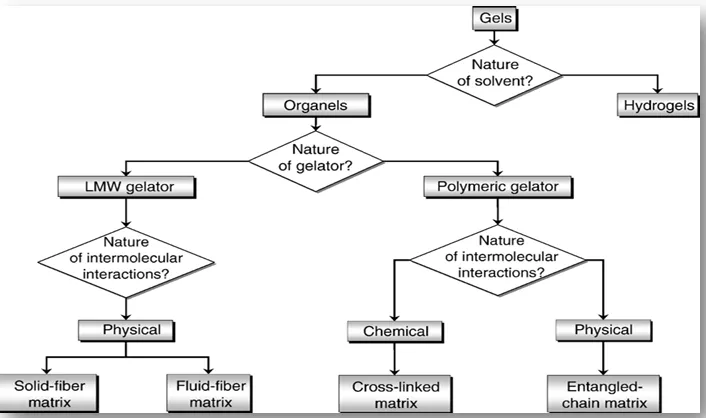
Fig .1 Organogel classification
TYPES OF ORGANOGELS: -
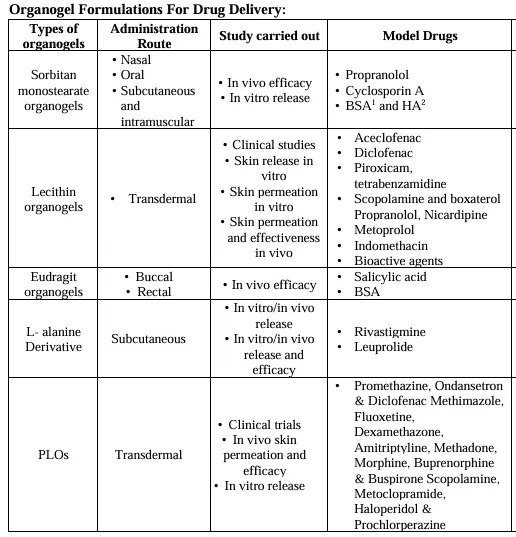
Lecithin organogels: -
Lecithin is a phospholipid, extracted from various plants and animal tissues, though not from the egg cell. Lecithin derived from natural sources can froms gelled structures and has been caused by the presence of iunsaturated fatty acids and specific chemicals
ithin its structure. Synthetic lecithin and hydrogenated soy lecithin fail to develop organogels. Apart from the chemical structure, the purity is excluded Lecithin also plays a key role in the formation of organogel. Experimental studies have shown that lecithin fails to initiate the gellification process of apolar solvent when lecithin contains <95% phosphatidyl content. Lecithin-based organogels are thermodynamically stable, thermoreversible (solto-gel transition temperature at 40`C), transparent, viscoelastic, biocompatible.Ex: pure soy lecithin.
Pluronic Lecithin organogel :-
PLO is an organogel formulation based on soy lecithin containing isopropyl palmitate or isopropyl myristate, water and pluronic F127 (also know as poloxamer 407). PLO may not contain sorbic acid, which acts as a preservative, in both stages. It occurs as a yellow, odorless and smooth consistency that is rapidly absorbed in the skin quickly. Ex: ketoprofen and progesterone.
Premium Lecithin organogels (PrLOs):-
PrLO is the second most common organogel of lecithin and valued for its smooth, and non-oily nature, which provides a cosmetically elegant and pleasant application. This gel does not have a pluronic derivative, thereby reducing the risk of skin irritation and intolerance rections. This gel has been used successfully to detoxify various bioactive agents, including, diclofenac, ibuprofen, ketoprofen and progesterone, and PrLO is considered the vehicle of choice for intradermal drug delivery.Ex: diclofenac, ibuprofen,ketoprofen,progesterone.
Limonene GP1 / PG Organogel :-
Limonene, a naturally occurring terpene, has been identified as an effective penetration enhancer for transdermal drug delivery. it has been incorporated into various types of transdermal formulations to improve the penetration of bioactive agents across the transdermal layer; its inclusion enhances the bioavailability of therapeutic compounds within skin tissues. Ex: terpene.
Gelatin-Stabilized Microemulsion-basd Organogel : -
Gelatin is a protein widely used as a structuring agent in foods system due to its strong phase. Build a gelled structure there a hot gelatin solution (above 40 ̊C) is cooled to below 35 ̊C. resulting in a stable gelled structure. Microemulsions are often preferred for gelatin-stabilized organogels because they are naturally thermostable and easy to prepare the same, Ex: Gelatin stabilized microemulsion.
Sorbitan Organogels derived from fatty acids:
Gelators in thin category include sorbitan monostearate and sorbitan monopalmitate, these hydrophobic, non-ionic molecules with strong activity and the ability to immobilize various apolar solvents. These gelators from a solid-fiber matrix when heated. The gelator solution in the apolar solvent cools down. The process of Jelly formation is mentioned in the formation of toroidal reverse micelles as temperature lowered, Ex: isopropyl myristate and vegetable oils.
Polyethylene organogels:-
Polyethylene organogels are typically colorless and are formed when low-molecular-weight (LMW) polyethylene is dissolved in mineral oil at a temperature above 130 ̊C and rapid cooling. These organogels are widely utilized as fuel bases due to thair stable structure. The gelation process is belived from the physical interaction of solid-fibers networks formed by precipitated polyethylene molecules,which provide the organogel with its characteristic stability and consistency. Ex: fuel bases
Eudragit organogel: -
Eudragit organogel are prepared using a mixture of polyhydric alcohol such as propylene glycol and glycerol, combined with high concentrations (30-40%) of eudragit (L or S) and liquid PEG. To formulate the gel, the drug is first dissolved in PEG, and this solution is then incorporated into Eudragit power. The resulting mixture is triturated with a mortar and pestle for approximately one minute. Both the concentration of eudragit and the amount of drug directly influence the consistency of the gel. Viscosity increases with higher eudragit concentration but decreases with increasing drug dosage.at low drug concentration, the gel exhibits greater rigidity and stability, its enhanced hardness and structural integrity. Ex: polyhydric alcohol.
Supramolecular organogel:
These gels are formed by gelators of low molecules mass, ranging from simple alkanes to complex structures such as phthalocyanine. The structural; diversity of these molecules provide wide scope for developing gels with advanced technological application. Their aggregation patterns provide valuable insights into molecular self-assembly and gel architecture. These systems exhibit remarkable thermoreversibility and mechanical strength due to controlled self-assembled structures. They’re enabling applications in sensing and processing. There is Used in catalysis, separation, controlled release. oil recovery, cryogenic fuel gelation, and functional materials. Anisotropic gels derived from liquid crystals serve as advanced functional materials. Example: cryogenic fuel gelation.
L-alanine derived organogels: -
LAM (N-lauroyl-L-alanine methylester) undergoes gelation with organic solvents such as; triglycerides, soya-bean oil. It is not as extensively used as other organogels. At room temperature, it remains in gel state. In biophasic mixture of water and an organic solvent, fatty acid derivative of L-alanine selectively gel the solvent phase without affecting the aqueous portion a property that enhance their supplicate for organogel application. This characteristic makes it considerably more supplicate to use in organogel. It can be suitable for sustain release system. Ex: leuprolide, rivastigmine.
PROPERTIES OF ORGANOGEL:
Viscoelasticity: Oeganogel behave as Viscoelastic materials, combining both viscous and elastic properties. at low shear rates, they remain flexible in a solid state, however increasing shear disrupts the physical interaction among the fiber networks, reducing elasticity.
Non-Birefringence: these systems are naturally isotropic, meaning they do not transmit bright light under polarized conditions. When examined microscopically, they appear as dark matrices due to their non-birefringent nature.
Thermo reversibility: organogels are more stable below their critical transition temperature. When heated above this threshold, the solid matrix is disrupted and the gel flows; upon cooling, the structure reforms, demonstrating reversible gelation.
Temperature: the thermal stability of organogels depends on the specific gelator Used. Gelation occurs when gelators self-assemble under favorable condition,reducing free energy and forming a stable network.
Visual clarity: organogel may appear opaque or transparent on their composition. for example, sorbitan monostearate gels are opaque and lecithin-based gels are naturally transparent.
Chirality: the presence of chiral centre in gelator molecules enables ordered packing,contributing to both thermodynamic and kinetic stability in gel system.
Biocompatibility: Early organogels was often prepared with non- biocompatible materials limiting their medical use. Advances in formulation have introduced biocompatible gelators, making organogel suitable for drug delivery and biomedical application.
ORGANOGELATORS: -
There are gelling agents capable of transforming a preparation into a semisolid mass, imparting the desired consistency in organogel. Their solublity in the solvent generates intermolecular forces that stabilize both the thermodynamic and kinetic characteristics of the gel. Organogelators is their temperature dependent phase behaviour they as a solid matrix at a room temperature but transition into liquid at lower temperatures. The structure of organogels is self-assembly ability of the organogelator, with the degree of cooperative assembly regulated by its molecular structure and solublity.
Organogelators are n-alkanes, which can gel proportionally short chined alkanes by precipitating into fibrous networks that form a three-dimensional structure. This network design is central to the architecture of organogels, as it promotes intermolecular bounding and increase the thickness of the preparation.organogelators are classified as hydrogen bond forming (e.g, amino acids, amides, carbohydrates)or non-hydrogen bound forming (e.g., anthraquinone, steroidal, moieties, anthracene).
Recent research has expanded the field to include novel categories such as sugar-based organogelators , Ex: glucosyl derivatives and green organogelators, Ex: plant derived fatty acid, biodegradable polymers, each introducing unique concepts and mechanisms.
TYPES OF ORGANOGELATORS: -
These are 4-tertiary butyl-1-aryl cyclohexanols derivatives. Function as low-molecular-mass gelators with properties that depend strongly on the nature of the nonpolar solvent involved in the organogel.due to their low solubility in such solvents, preparations may supplicate either cloudy or clear depending on the solvent involved. at room temperature.these compounds exits in a solid state and can induce gelation only when phenyl group occupies the axial configuration; derivatives with phenyl groups in the equatorial configuration fail to from gels. the desirable property of thermal reversibility. common example of this class is carbon tetrachloride (CCL4), benzene, cyclohexane, etc
These are long chain containing gelling agent. these are gelling substance containing long chains. These are gelling substances that have the ability to gel. Their molecular size is over 2 kilodaltons. They can form gels even when used in very low concentration. They can appear in different shapes. if you change their chemical formula slightly. You can change the effective of their gelation they can also be classified as organic or organogelants. They are considered physical organogel if they form antibodies in the organogel network, causing cross-linking; they are considered organogel if they from non- covalent bound that lead to cross -linking in the network. The transition temperature from the gel state to the sol state is also very low. They have a better gel than other LMOGs. These usually include L-lysine derivatives and polyethylene, polycarbonate polymethylmethacrylate, polyester etc. include another example such as.
“Gemini” mean “Twins”. This word comes from Latin. The first L-lysine Gemini organogelator was developed by Suzuki. It consists of two L- lysine chain of different lengths connected by amide bonds. The length of this chain is proportional to the gelling capacity of the gelling agent. They have good gelling properties. They can immobilize many non-polar solvents. A good example of this class is ketones, alcohol, etc.
These are gelling agents of small weight (≤3000 Daltons). the assembly is a support for gel forming ability they form thermoreversible transparent gels. Nonpolar solvent in which they can be immobilized include benzene. These are the most commonly used organogelators. They can weaken the water level even when used in low concentration
(<2%). The length of the alkyl chain in LMWO directly affects its gelling ability. Depending on the intermolecular interactions they make,they mostly from fibrous matrices or can from liquid fibrous matrices. A solid fiber matrix can be obtained if the organogelator is cold beyond the solubility of the gelator and then undergoes rapid, incomplete precipitation in the organic solvent, leading to physical disturbances. To form a liquid matrix, a polar solvent must be added to the surfactant, which causes the molecular to regroup, thereby immobilizing the aqueous phase. This also leads to a difference in the stability of the two matrices have improved mechanical properties compared to liquid fiber matrices have a similar molecular structure compared to liquid fiber matrices. According to its chemical structure, LMOG is divided into steroid organogelants, ALS organogelants, etc. are separated.
MECHANISM OF ORGANOGEL:
Organogeltion is typically initiated by the incorporation of a small amount of polar solvent into an organogel system. When lecithin is preset, it self-assembles into reverse spherical micelles at concentration around ~0.01 mM. The addition of critical amount of polar additives binds to the hydrophilic head groups of lecithin, triggering the formation of liner network. With further increase in polar additive concentration, these micelles transform into flexible, elongated tubular structures (2.0-2.5 nm radius, extending
hundreds to thousands of nanometers in length). As these tubular micelles overlap and entangle, they create a transient three-dimensional network, which imparts gel-like properties to the system.
In the case of phospholipid organogels, the gelling mechanism is more complex due to the synergistic interaction between phospholipids and polymeric co-surfactants in their hydrated states. Here, solvent molecules and lecithin phosphate groups organize into a hydrogen-bonded network, stabilizing the gel structure. This cooperative arrangement enhances the mechanical strength and stability of the organogel compared to systems relying solely on lecithin.
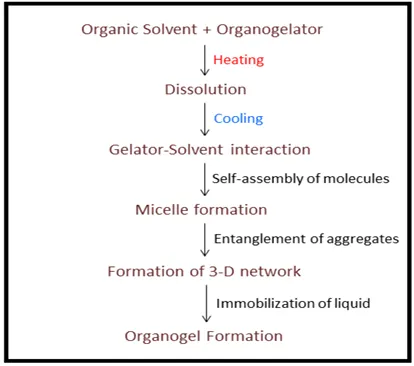
Fig .2 Mechanism Of Organogel
MECHANISM OF GEL PERMEATION INTO SKIN: -
Human skin is composed of multiple tissue layers, but the stratum corneum, the stratum corneum, the outermost layer, serves as the primary rate-limiting barrier for gel permeation. Traditional formulations show limitation: lipid- based systems enhance penetration but disrupt skin hydration, sometimes leading to dermatitis, while aqueous formulation preserve the bioactive state of the skin but suffer from poor penetration efficiency.Organogels overcome these drawbacks by combining both oil and aqueous phases, making them effective carriers for bioactive agents. In particular, Pleuronic lecithin organogels (PLOs) enhance penetration through the synergistic action of lecithin and co-surfactants. Lecithin interacts with skin lipids, transiently disorganizing the stratum corneum structure and opening pores. This interaction leads to the formation of a cylindrical network, expanding the lecithin polar region. Meanwhile, the non-polar solvent acts as a penetration enhancer, forming a thin film on the skin surface.
PATHWAY OF DRUG PERMEATION IN SKIN: -
The process begins with the dissolution of the drug in the carrier system, followed by its diffusion to the skin surface. Once at the drug undergoes partitioning across the epidermal layer, overcoming the barrier of the stratum corneum. It then continues its diffusion through the upper dermal layer, reaching deeper tissues. Finally, the drug is taken up by blood capillary cells, enabling it’s into systemic circulation where therapeutic action occurs.
This streamlined mechanism illustrates how organogels, particularly Pleuronic lecithin organogels (PLOs), facilitate efficient transdermal delivery by combining dissolution, diffusion, partitioning, and absorption into one continuous pathway.
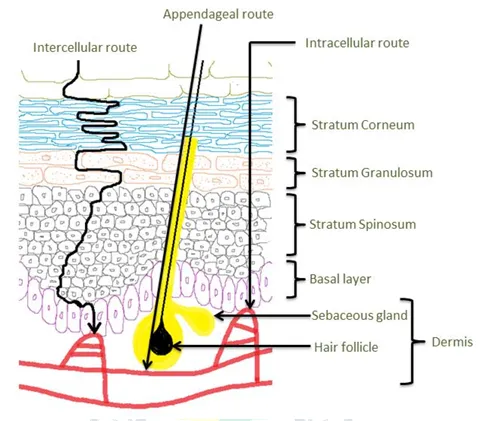
Fig .3 Skin Structure
KEY FACTORS INFLUENCING ORGANOGEL PROPERTIES AND SKIN INETERACTION: -
pH:-
A change in pH can stimulate a reversible transition between gel and sol states.
Thus, pH directly influences the physical of organogels.pH was determined by using digital pH meter standardized with standard buffer of pH 4 and 7.
Temperature: -
Temperature depends on the chemistry of the polymer and its mechanism of interaction with the medium. Increasing temperature destabilizes the 3D mesh network of organogels. Leads to fluctuations in viscosity- higher temperature ranges to maintain stability.Storage requires controlled temperature ranges to maintain stability.
Organogelators :-
The type of organogelator determines the mechanical strength and rheological
behavior of the gel.Drug release rete depends on the concentration of gelator used.
Adjuvants:
Surfactants: modify gel characterristics depending on type and concentration.Ex: tween 80, span 60.
Salts: can cause salting out, forming more secondary bounds among molecules. Ex: NaCl, CaCl2
Organic solvent: gel structure varies with solvent polarity (polar vs non-polar) Ex:hexane,ethanol
Organogelaotor: the rate of drug from organogel is directly connected by the concentration of the gelators. Higer concentration has stronger gel network,slower drug diffusion. lower concentration has weaker gel matrix, faster drug release.
Ex: lecithin based organogel and stearic acid.
Skin permeation enhancer: there are not only improve drug penetration through the skin
But also interact with the gel structure. Ex: Limonene and trepenes, Oleic acid, penetration enhancers and rheology modifiers, altering flow and deformation properties.
Moisture:
Organogels tend to swell when exposed to moisture, as they absorb water moleculer.
This absorption can disrupt the gel matrix, leading to instability in the structure.Ex:Gelatin Organogel
Purity: -
The constituents used in organogel prepration must be in their pure form.
Impurities interfere with the structural intergrity of the gel network.
Example: Lecithin fails induce gelation if not used in its pure state. Ex: Phospholipids,cholesterol.
APPLICATION OF ORGANOGELS:
This consist both dermal and transdermal systems, apply the skin as a route for effective drug administration.as the drug permeating through the skin enter circulation directly, they bypass first- pass metabolism, offering improved bioavailabilty.poloxamer lecithin organogeol(PLOs), which use isopropyl myristate or isopropyl palmitate as apolar organogels solvents, serve as vectors for the release of NSAIDs such as ketoprofen, flurbiprofen, and diclofenac sodium, providing analgesic effects. Reverse micellar microemulsion-based gels (MBGs), composed of soya lecithin, iso-octane, and water, have been explored for the delivery of propranolol. Organogels are increasingly recognized as promising matrices for controlled release of topical antimicrobials. For instance, piroxicam-loaded organogels have been applied in the treatment of rheumatoid arthritis, while in-situ forming L-alanine injectable organogels enable the release of labile macromolecular drugs. Several studies on transdermal organogels have demonstrated positive outcomes, including PLO formulations with mometasone furoate for psoriasis and fluconazole-loaded organogels based on olive oil for fungal infections. Collectively, highlight organogels as versatile and effective systems for controlled and targeted drug delivery.
To date, only two reports have described the use of organogels for oral delivery of bioactive agents. The first, published in 2005, demonstrated that cyclosporine A-a potent immunosuppressant- exhibited improved activity when administered orally to beagle dogs in a sorbitan monoleate – based organogel formulation. The second stud explored the use of 12-hydroxystearic acid, an organogelator, to develop organogels with soybean oil as the apolar phase. In this system, ibuprofen, a non-steroidal anti-inflammatory drug (NSAID), was incorporated into the gelled structure. Release studies revealed that increasing the concentration of the organogelator within the organogel led to a corresponding decrease in the drug release rate.
Ophthalmic solutions are commonly used for administering drugs to the eye; however, due to their low viscosity, frequent dosing is required as absorption at the target site is often limited. To overcome this, thicker preparation such as gels are preferred, as they increase contact time and enhance drug absorption. For example, methazolamide has been incorporated into carbomer and poloxamer geld for glaucoma treatment, showing efficacy where conventional ophthalmic solutions failed. Similarly, organogelators combined with polymers like Eudragit L and S have been employed to prepare ophthalmic formulations designed for sustained drug delivery.Organogels have also been explored for vaccine delivery. Microemulsion-based organogels serve as vehicles for hydrophilic vaccines, while noisome-containing organogels have been developed to entrap vaccines. When administered intramuscularly, immunological response.
Organogels are primarily employed in the food industry due to their ability to reduce oil mobility in multi- ingredient food products. They can serve as replacers for trans and saturated fats in processed foods, helping achieve specific textures while offering healthier alternatives. Wax-based organogels, in particular, provide excellent oxidative stability and influence properties such as firmness and spreadability, making them especially suitable for use in spreadable food products.
Low molecular weight organogelators (LMOGs) are used for preparation of lipsticks. For instance, LMOGs are employed in the preparation of lipsticks, while 12-HAS serves as an organogelator in sunscreens to effectively block UVB rays. the properties of organogels designed for cosmetic applications can be further enhanced by incorporating organic solvents like Amazonian oils (natural and plant oil), which naturally provide moisturizing and nourishing effects. A Various of dermatological cosmetics- including lip gels, skin and hair protectants- can be formulated as organogels. Beyond these, Other cosmetic preparations such as shampoos, dentifrices, and perfumes have also been successfully developed in organogels form, highlighting their versatility in the beauty industry.
CONCLUSION: -
Organogels are a viscoelastic substance formed by gelling an organic solvent with a bioactive agent. Their unique properties have sparked significant interest, as they offer the potential to replace or eliminate many conventional components, techniques, and limitation in diverse formulations. While organogels present a wide range of applications. Among the various drug delivery routes use on there. Looking ahead, the development of stable organogels composed entirely of biocompatible components could attract strong commercial interest, positioning them as a preferential choice of formulators and consumers alike.thus transforming drug molecular into novel formulations like organogel can help in cost effective and productive research. In future this carrier system can become a milestone.
REFERENCES


Mansi Chhanval, Harsh Chunara, Dr. Harsha Patel, Organogels: Preparation, Characterization, Pharmaceutical Applications and Recent Advances in Cannabidiol Delivery, Int. J. of Pharm. Sci., 2026, Vol 4, Issue 8, 341-354,.https://doi.org/10.5281/zenodo.21773631
 10.5281/zenodo.21773631