

We use cookies to ensure our website works properly and to personalise your experience. Cookies policy
Department of Quality Assurance, Shivajirao S. Jondhle College of Pharmacy, Asangaon, Thane 421601, Mumbai, Maharashtra, India.
Background Dysmenorrhea, or painful menstruation, is one of the most prevalent gynecological complaints among women of reproductive age, affecting between 45% and 95% of menstruating women worldwide. Conventional management with NSAIDs and hormonal contraceptives is limited by gastrointestinal, hormonal, and systemic adverse effects, prompting interest in safer topical alternatives. Objective To formulate and evaluate a polyherbal roll-on containing volatile essential oils for the safe and effective topical management of primary dysmenorrhoea.Methods A polyherbal roll-on was prepared by sequential blending of camphor, menthol, clove, thymol, and asafetida oils, extracted by Clevenger-apparatus hydrodistillation where applicable. The formulation was evaluated for organoleptic properties, pH, homogeneity, after-feel, removability, skin irritancy (Draize scoring), microbial growth (streak plate method), and stability under three storage conditions over four weeks. Clinical acceptability was assessed using patient feedback and Numerical Rating Scale (NRS) pain scoring. Resultsm The formulation was a pale-yellow, clear, non-viscous liquid with a pleasant aromatic odour and a skin-compatible pH of 6.0. It showed uniform homogeneity with no phase separation, no dermal irritation on patch testing, and no microbial growth on nutrient or Sabouraud dextrose agar. The roll-on was stable at room temperature over four weeks. Patient-reported efficacy was approximately 80%, with a mean NRS pain reduction of 56.8% at 30 minutes post-application. Conclusion The developed polyherbal roll-on represents a safe, self-preserving, and patient-friendly natural alternative to synthetic analgesics for primary dysmenorrhea, with a simple manufacturing process suited to community-level and resource-limited healthcare settings. Further randomised controlled trials and pharmacokinetic evaluation are warranted to confirm therapeutic validity.
1.1 Background and burden of dysmenorrhea
Menstruation is a normal physiological process in women of reproductive age, but for a substantial proportion it is accompanied by dysmenorrhea painful, cramping menstrual pain that is among the leading causes of short-term school and work absenteeism worldwide. Estimates indicate that 45–95% of menstruating women experience some degree of dysmenorrhea, with 10–20% reporting symptoms severe enough to interfere with daily activities.
Dysmenorrhea is classified as primary, occurring in the absence of identifiable pelvic pathology and typically beginning within 6–12 months of menarche, or secondary, attributable to an underlying pelvic condition such as endometriosis or fibroids. The present study is concerned with the topical management of primary dysmenorrhea.
1.2 Pathophysiology of primary dysmenorrhea
Primary dysmenorrhea arises predominantly from overproduction of prostaglandins F2α and E2 in the secretory endometrium following progesterone withdrawal, driving myometrial hypercontractility, uterine ischaemia, and sensitisation of peripheral nociceptors. Additional mediators such as leukotrienes, vasopressin, and nitric oxide contribute to the pain cascade (Figure 1), which explains why prostaglandin inhibition alone does not relieve symptoms in all patients.
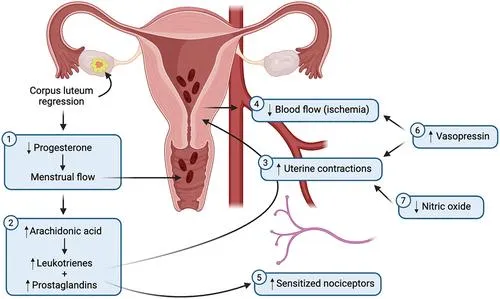
Figure 1. Pathophysiological cascade underlying primary dysmenorrhea, triggered by corpus luteum regression and progesterone withdrawal.
1.3 Limitations of conventional management
Conventional management relies on NSAIDs (e.g., ibuprofen, mefenamic acid, naproxen) and hormonal contraceptives, both of which carry recognised limitations: NSAIDs are associated with gastrointestinal irritation, ulceration, and bleeding with chronic use, and 20–25% of women do not respond adequately to them; hormonal contraceptives carry thromboembolic and mood-related risks and are contraindicated in some patients. These limitations have driven growing interest in herbal and topical alternatives.
1.4 Rationale for a topical polyherbal approach
Volatile essential oils from mentha, clove, camphor, thymol, and asafoetida possess documented analgesic, antispasmodic, anti-inflammatory, and carminative properties. Menthol activates the TRPM8 cold receptor and blocks calcium and sodium channels, producing cooling, antispasmodic, and mild local-anaesthetic effects. Eugenol, the principal constituent of clove oil, inhibits COX-1/COX-2 and platelet aggregation and has antispasmodic and antimicrobial activity. Asafoetida's ferulic acid and farnesiferol constituents relax uterine smooth muscle and inhibit prostaglandin synthesis, alongside carminative action that reduces menstrual bloating. A roll-on dosage form offers targeted lower-abdominal application, avoidance of gastrointestinal and hepatic first-pass metabolism, consistent dosing, and a hygienic, portable format suited to self-administration advantages that motivated the present formulation work.
1.5 Aim and objectives
Aim: To formulate and evaluate a polyherbal roll-on containing volatile essential oils for the safe and effective topical management of primary dysmenorrhea.
Objectives:
2. Literature Review
Roll-on preparations are liquid formulations packaged in containers fitted with a rolling-ball applicator that allows convenient, hygienic, and precise topical application. Several recent studies have explored polyherbal roll-ons for dysmenorrhea and general topical analgesia, summarised in Table 1.
Table 1. Comparative overview of published herbal roll-on formulations for dysmenorrhea.
|
Author (Year) |
Formulation |
Key finding |
|
Kota et al. (2022) |
Eucalyptus, peppermint, lavender and wintergreen roll-on |
Established the technical framework for herbal roll-ons; pain relief comparable to topical diclofenac. |
|
Patil et al. (2024) |
Herbal menstrual pain relief balm |
Wax-based balm requiring melting/solidification; more involved manufacture than a roll-on. |
|
Shelke et al. (2023) |
Menthol–clove–thymol–ajwain–asafoetida roll-on |
80% patient-reported efficacy over 5 days; pH 6, satisfactory homogeneity, no microbial contamination. |
|
Sudhakaran et al. (2025) |
Butterfly pea and fennel extract roll-on |
Multi-step aseptic botanical-extract preparation; satisfactory evaluation parameters and patient-reported efficacy. |
|
Shriode et al. (2024) |
Polyherbal roll-on to reduce dysmenorrhea |
Supports the polyherbal roll-on format as an effective delivery vehicle for menstrual pain relief. |
Taken together, this body of work establishes the roll-on as a validated, self-administrable vehicle for essential-oil-based menstrual pain relief, while also indicating an opportunity to simplify manufacture relative to balmand extract-based formats a gap the present study addresses through direct blending of pre-extracted volatile oils.
3. Materials and Methods
3.1 Materials and their role in the formulation
Camphor, menthol (mint) oil, clove oil, thymol (ajwain) oil, and asafoetida oil were used as the active essential-oil components of the formulation. Composition and functional role of each component are summarised in Table 2.
Table 2. Composition of the herbal roll-on formulation (final procedure used for evaluation).
|
Ingredient |
Approx. quantity |
Role in formulation |
|
Camphor oil |
1.02 mL |
Base / counter-irritant |
|
Menthol (mint) oil |
0.97 mL |
Cooling analgesic, antispasmodic, TRPM8 activator |
|
Clove oil |
1.06 mL |
COX inhibitor, analgesic, antispasmodic |
|
Thymol (ajwain) oil |
0.95 mL |
Antispasmodic, carminative |
|
Asafoetida oil |
1.00 mL |
Uterine smooth-muscle relaxant, antispasmodic, anti-inflammatory |
Note: An alternative carrier-oil-based composition (almond oil 80 mL as base with menthol, clove, eucalyptus, and fenugreek oils) was also recorded during formulation trials. The table above reflects the final procedure used for evaluation; the two batch records should be reconciled prior to journal submission (see Section 6, Limitations).
3.2 Extraction of essential oils
Clove oil was extracted from dried, coarsely powdered clove buds (Syzygium aromaticum) by hydrodistillation in a Clevenger apparatus for 4–5 hours; the distillate was dried over anhydrous sodium sulfate and stored in amber vials at 4 °C. Menthol was obtained from fresh field mint (Mentha arvensis) leaves by steam distillation for 3–4 hours, with the menthol fraction confirmed by its characteristic cooling odour and crystallisation on refrigeration. Thymol was extracted from ajwain seeds (Trachyspermum ammi) by steam distillation for 4–5 hours, dried over anhydrous sodium sulfate, and confirmed organoleptically by its characteristic pungent aroma.
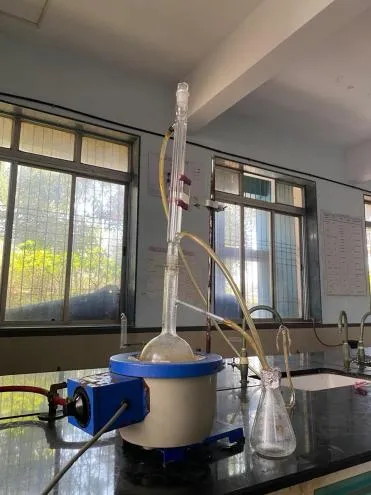
Figure 2. Clevenger apparatus set-up used for hydrodistillation of the volatile oils.
Figure 3. Representative extraction steps: (a) filtration of the distillate; (b) collected thymol (ajwain) oil extract.
3.3 Preparation of the herbal roll-on
All glassware and the roll-on container were autoclaved prior to use. Camphor oil was added first as the base, followed sequentially by menthol, clove, thymol, and asafoetida oils, with gentle mixing after each addition. The complete blend was mixed for 10–15 minutes to ensure uniform distribution, filled into the roll-on container, sealed with the ball applicator, and labelled.
3.4 Evaluation parameters
4. Results and Discussion
4.1 Organoleptic and physicochemical properties
Table 3. Organoleptic evaluation of the herbal roll-on.
|
Parameter |
Result |
Inference |
|
Colour |
Pale yellow |
Characteristic of essential-oil blend |
|
Odour |
Aromatic, minty, pleasant |
Presence of volatile oils |
|
Texture / clarity |
Clear, liquid, non-viscous |
Uniform blending achieved |
|
After-feel |
Cooling, counter-irritant, non-greasy |
Good user acceptability |
Table 4. Physicochemical, safety, and stability evaluation summary.
|
Parameter |
Result |
Inference |
|
pH |
6.0 |
Compatible with skin pH (4.5–6.5) |
|
Homogeneity |
Uniform, no separation |
Stable blend |
|
Skin irritancy |
No irritation observed |
Safe for topical use |
|
Removability |
Easily removed with water |
Non-greasy, good compliance |
|
Microbial growth |
No growth detected |
Self-preserving formulation |
|
Stability (room temp.) |
Stable over 4 weeks |
Adequate shelf stability |
The pale-yellow colour reflects the combined clove, camphor, and asafoetida oils, while the pleasant aromatic odour is dominated by eugenol and menthol. All ten volunteers rated the cooling after-feel as strongly positive, consistent with menthol-mediated TRPM8 activation. The measured pH of 6.0 falls within the physiologically compatible range for skin application and is consistent with values reported for comparable herbal roll-ons (pH 6, Kota et al.; pH 6.8, Patil et al.).
4.2 Homogeneity, irritancy, and microbial safety
The formulation showed uniform distribution of all oil components with no phase separation, turbidity, or sedimentation at 24, 48, and 72 hours across storage conditions. Minor, fully reversible viscosity changes were observed at 4 °C and 47 °C, consistent with the hydrophobic nature of the oil blend, which resists aqueous phase separation. No erythema, oedema, pruritus, or other dermatological reactions were observed during the 4-hour occluded patch test, and no microbial colonies developed on nutrient or Sabouraud dextrose agar consistent with the well-documented broad-spectrum antimicrobial activity of eugenol, menthol, and thymol, which appear to confer self-preservation without added synthetic preservatives.
4.3 Clinical acceptability
Patient feedback indicated approximately 80% reported efficacy in reducing menstrual pain, with a mean NRS pain-score reduction of 56.8% at 30 minutes post-application. These findings are broadly consistent with prior polyherbal roll-on formulations for dysmenorrhea, such as the menthol–clove–thymol–ajwain–asafoetida blend of Shelke et al., which reported 80% patient-reported efficacy over a 5-day application period with a comparable pH and safety profile, and the eucalyptus–peppermint–lavender–wintergreen roll-on of Kota et al., which reported pain relief comparable to topical diclofenac. A full description of the clinical evaluation cohort (sample size, inclusion/exclusion criteria, ethics approval, and follow-up duration) should be appended for journal submission, as this is not detailed in the underlying study records.
4.4 Comparison with published formulations
Compared with balm-based herbal formulations that require melting and solidification, the present roll-on is simpler to manufacture, avoids heating of thermolabile essential oils, and eliminates the texture variability of wax-based vehicles. Relative to botanical-extract roll-ons requiring multi-step aseptic preparation, such as the butterfly pea and fennel formulation of Sudhakaran et al., the present two-step oil-blending process reduces manufacturing complexity while retaining a synergistic polyherbal mechanism of action spanning COX inhibition, calcium-channel antagonism, TRPM8 activation, and uterine smooth-muscle relaxation.
5. Novelty of the Study
6. Limitations
7. Future Scope
Randomised controlled trials with larger, well-characterised patient cohorts and standardised pain-assessment protocols are recommended to confirm therapeutic validity. Pharmacokinetic studies evaluating the transdermal absorption and dermal bioavailability of key actives (eugenol, menthol, thymol) would strengthen the evidence base, alongside extended stability studies to establish a validated shelf life and, ultimately, feasibility for larger-scale, community-level manufacture.
8. CONCLUSION
A polyherbal roll-on combining camphor, menthol, clove, thymol, and asafoetida essential oils was successfully formulated and evaluated for the topical management of primary dysmenorrhea. The formulation demonstrated a skin-compatible pH, uniform homogeneity, absence of irritancy, self-preserving antimicrobial activity, pleasant organoleptic properties, and stability at room temperature, alongside favourable patient-reported efficacy. These findings support the polyherbal roll-on as a safe, cost-efficient, and patient-friendly alternative to conventional synthetic analgesics for dysmenorrhea, particularly suited to community-level and resource-limited healthcare settings.
9. Acknowledgements
The authors thank the Department of Quality Assurance, Shivajirao S. Jondhle College of Pharmacy, Asangaon, Thane, for providing laboratory facilities for this study.
10. Conflict of Interest
The authors declare no conflict of interest.
11. Author Contributions
S. Salve, P. Sawant, A. Shaikh, and T. Shaikh contributed to formulation development, laboratory evaluation, and data collection. P. Surve supervised the study, contributed to its conception and design, and critically reviewed the manuscript. All authors read and approved the final manuscript.
REFERENCES

Suyash Salve, Pranay Sawant, Afsana Shaikh, Taskin Shaikh, Pooja Surve, Formulation And Evaluation Of A Polyherbal Roll-On For The Topical Management Of Primary Dysmenorrhea, Int. J. of Pharm. Sci., 2026, Vol 4, Issue 8, 3700-3708. https://doi.org/10.5281/zenodo.22062062
 10.5281/zenodo.22062062