

We use cookies to ensure our website works properly and to personalise your experience. Cookies policy
Pachamuthu College of Pharmacy, Dharmapuri. Affiliated to The Tamil Nadu Dr. M. G. R. Medical University, Chennai, Tamil Nadu, India
Medicinal herbs are the local heritage with global importance. Medicinal herbs have curative properties due to presence of various complex chemical substance of different composition, which are found as secondary plant metabolites in one or more parts of these plants. These plant metabolites according to their composition are grouped as alkaloids, glycosides, corticosteroids, essential oils etc. Euphorbia hirta, (family Euphorbiaceae) is an herb found in many parts of the world. In Sanskrit it means “Dugadhika” According to the Doctrine of Signatures, the plant has a reputation for increasing milk flow in women, because of its milky latex, and is used for other female complaints as well as diseases of the respiratory tract. The plant has been reported as increase in urine output, antidiarrheal, antispasmodic, antiinflammatory etc.
The plant Euphorbia hirta, a small annual hairy plant of family Euphorbiaceae is popularly known by the name Dudhe Jhar in Nepal. The plant is erect or ascending herb growing up to the height of 50 cm, stem is slender and often reddish or purplish in colour, covered with yellowish bristly hairs especially in younger parts. The plant hears small numerous clustered flowers on leaf nodes. From each leaf node there protrudes out a pair of opposite, elliptical, oblong or oblong-lanceolate leaf having serrated edge. Fruits are yellow, three celled, hairy and keeled capsules having the diameter of 1-2 mm that contain three brown, four sided. angular wrinkled seed. The plant is distributed throughout the hotter part of Nepal, India and most of the tropical and sub-tropical countries mostly grow in open grasslands. Euphorbia hirta is a well-known herb amongst the users of conventional medicines. It is used as the folk medicine against several skin disease, wounds, warts, gonorrhoea, migraines and intestinal parasites throughout the world. The plant is popularly known as asthma plant because it provides a good cure for asthma disease and other respiratory problems. The plant is also widely used against diarrhoea, and dysentery. There are many testimonies that prove the effectiveness of E. hirta against dengue too, traditionally it is also used in the treatment of kidney stone, diabetes, and in conjunctivitis. It also exhibit anxiolytic and sedative (4), analgesic, antipyretic, antiinflammatory, antimicrobial 16), anti-allergy (7), anti-oxidant (1, anti-tumour 19, anthelminthic 1001, anti-cancer and diuretic activities 2 The current study was purposed to determine the bioactive compounds from the methanol extract of E. hirta plant, evaluate the pharmacological potential and characterize them by GC-MS chromatographic technique.
DESCRIPTION
Euphorbia Hirta L
Family: (Euphorbiaceae)
Vernacular names: dudhani, dudhi
English name: snake weed Morphology:
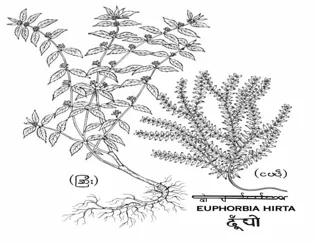
1) Selection of Herbal Drugs
Herbal drug was selected based on its long history of traditional use. The plant is widely available and has been commonly used in medicine to treat various health problems. Selection of herbal drug involves choosing the correct plant with proper botanical identification. The medicinally active part of the plant should be collected at the appropriate stage of growth. The selected herbal drug must contain the required phytochemical constituents and be free from adulteration and contamination. The selection of plant material is essential to ensure the safety, effectiveness, and quality of herbal formulation.
The plant is used in the treatment of asthma, cough, diarrhoea, dysentery, wounds, skin infections, inflammation, and warts. Euphorbia hirta is rich in bioactive phytoconstituents such as flavonoids, phenolic compounds, tannins, alkaloids, saponins, and terpenoids. It possesses antioxidant, antimicrobial, anti-inflammatory, antidiabetic, and anti-asthmatic activities.
Botanical Identity
Kingdom : Plantae
Division : Spermatophyta
Class : Dicotyledonae
Order : Euphorbiales
Family : Euphorbiaceae
Genus : Euphorbia
Species : Hirta
2) Literature Review of Euphorbia hirta
Medicinal plants have been widely used since ancient times for the treatment and prevention of various diseases. According to the World Health Organization (WHO), about 80% of the world’s population depends on traditional medicine for primary healthcare. Among the various medicinal plants, Euphorbia hirta L. has gained considerable attention due to its diverse pharmacological activities. Euphorbia hirta belongs to the family Euphorbiaceae and is commonly known as asthma weed, garden spurge, or tawa-tawa. The plant is widely distributed in tropical and subtropical regions including India, Africa, Australia, and Southeast Asia. Traditionally, it has been used in herbal medicine for the treatment of asthma, diarrhoea, dysentery, cough, bronchitis, and skin infections. Recent scientific studies have focused on the phytochemical composition and biological activities of Euphorbia hirta. Various research reports have confirmed that the plant possesses antimicrobial, antioxidant, anti-inflammatory, antidiarrheal, and anticancer properties. Because of these therapeutic potentials, the plant has become an important subject of pharmacological and phytochemical research.
3) Collection and Authentication of Plant Material
The whole plant of Euphorbia hirta was collected from Chautara, Sangachowkgadhi, Nepal, in the month of June 2016. The plant was collected from natural habitats where it grows abundantly in open fields and roadside areas. The collection was carried out carefully to ensure that healthy and disease-free plant samples were obtained for the study. After collection, the plant material was thoroughly washed with clean water to remove soil, dust, and other impurities. The washed plant material was then subjected to shade drying at room temperature for about 15 days. Shade drying was preferred to preserve the phytochemical constituents present in the plant and to avoid degradation caused by direct sunlight. Once the plant material was completely dried, it was crushed and ground into a fine powder using a mechanical grinder. The powdered plant material was then stored in a clean, airtight container to protect it from moisture, contamination, and microbial growth. The container was kept in a cool and dry place until further analysis and experimental procedures were carried out. The collected plant material was authenticated by examining its morphological and physical characteristics. The identification process involved comparing the observed features of the plant with standard botanical references and herbarium records. Important morphological characteristics such as the structure of the leaves, stem, flowers, and fruits were carefully observed during the identification process. Euphorbia hirta is characterized by small yellow flowers that appear in clusters at the leaf axils. The plant produces hairy, three-lobed capsules that contain wrinkled and triangular seeds. The leaves are opposite, elliptical in shape, and possess serrated margins, while the stem is covered with fine hairs. Based on these morphological characteristics and comparison with standard botanical descriptions, the plant material was confirmed to be Euphorbia hirta. These features verified and authenticated the identity of the collected plant sample used in the present study.
4) Preparation of Extract (Detailed)
The collected plant materials such as leaves and flowers of Euphorbia hirta were thoroughly washed with distilled water to remove dust and other contaminants. The cleaned plant materials were then shade-dried at room temperature for about 7–10 days to prevent the degradation of thermolabile phytoconstituents. After complete drying, the plant materials were cut into small pieces and ground using a mortar and pestle or mechanical grinder to obtain a coarse powder. The powdered material was passed through a sieve (40–60 mesh size) to obtain uniform particle size. The powdered plant material was then stored in airtight containers in a cool and dry place until further use. For extraction, the powdered plant material was subjected to Soxhlet extraction method. Approximately 50–100 g of the powdered plant material was placed in a thimble made of filter paper and loaded into the Soxhlet extractor. The extraction was carried out using solvents of increasing polarity, such as hexane, chloroform, and methanol. Initially, hexane was used to remove non-polar compounds such as fats and oils. After completion of hexane extraction, the same plant material was dried and further extracted with chloroform to obtain moderately polar compounds. Finally, extraction was carried out using methanol, which can extract highly polar phytochemical constituents. The extraction process was continued for 6–8 hours until the solvent in the siphon tube of the Soxhlet apparatus became colourless, indicating complete extraction of phytoconstituents. After extraction, the solvents were removed by evaporation using a rotary evaporator under reduced pressure at controlled temperature (40–50°C). This resulted in the formation of semi-solid crude extracts. The extracts obtained from each solvent were carefully collected, weighed, and the percentage yield of the extract was calculated using the following formula:
Percentage Yield = (Weight of Dried Extract) / (Weight of Powdered Plant Material)×100
The dried extracts were then stored in sterile airtight containers and kept in a refrigerator at 4°C until further use. These extracts were subsequently used for phytochemical screening, biological activity studies, and other analytical evaluations to identify the presence of active constituents such as alkaloids, flavonoids, tannins, phenolic compounds, saponins, steroids, and glycosides.
5) Preliminary Phytochemical Tests:
Preliminary test for alkaloids, saponins, tannins, steroids, flavonoids, anthraquinones, cardiac glycosides and reducing sugar.
|
EXPERIMENT |
OBSERVATION |
INFERENCE |
|
i)Test for Alkaloids One ml of the extract solution was taken and a few drops of Dragendorff’s reagent were added. |
Orange-coloured precipitate formed |
Presence of alkaloids. |
|
ii) Test for Coumarins One ml of extract was mixed with 10% NaOH solution. |
Yellow colour developed |
Presence of coumarins |
|
iii) Test for Tannins A small amount of powdered sample was treated with 10% alcoholic ferric chloride solution. |
Appearance of dark blue or greenish-black colour |
Presence of tannins |
|
iv) Test for Flavonoids Few drops of NaOH solution were added to the extract |
Formation of intense yellow colour which becomes colourless on addition of dilute acid. |
Presence of flavonoids |
|
v) Test for Phenols The extract solution was treated with 3–4 drops of ferric chloride solution. |
Bluish-black coloration |
Presence of phenolic compounds |
|
vi) Test for Volatile Oils Two ml of extract solution was mixed with dilute HCl |
Formation of white precipitate |
Presence of volatile oil |
|
vii) Test for Quinones 1 ml of extract and few drops of concentrated HCl were added |
Development of red colour |
Presence of quinones |
|
viii) Test for Sugars One ml of extract was treated with Fehling’s solution |
Formation of red coloured precipitate |
Presence of sugar |
|
ix)Test for Carbohydrates a) Molisch’s Test Sample was treated with two drops of alcoholic αnaphthol solution b) Benedict’s Test Sample was mixed with Benedict’s reagent and gently heated c) Fehling’s Test Sample was hydrolysed using dilute H₂SO₄, neutralized with alkali and heated with Fehling’s A and B solutions |
Formation of a violet ring at the junction of the two layers
Formation of orange-red precipitate
Formation of a red precipitate |
Presence of carbohydrates
Presence of reducing sugar
Presence of reducing sugar |
6) Physiochemical Evaluation
Physicochemical Evaluation of Euphorbia hirta is an important step in pharmacognosy to determine the purity, quality, and identity of the crude drug. These parameters help in detecting adulteration, contamination, and standardization of the herbal drug.
6.1 Moisture Content (Loss on Drying)
Procedure:
Importance:
6.2 Ash Values
a) Total Ash
Procedure:
Procedure:
c) Water Soluble Ash
Procedure:
6.3 Extractive Values
a) Alcohol Soluble Extractive Value
b) Water Soluble Extractive Value
Importance:
6.4 pH Determination
Procedure:
6.5 Foreign Organic Matter
Procedure:
6.6 Fluorescence Analysis
Procedure:
1. NaOH
2. HCl
3. H₂SO₄
4. Methanol
Importance:
7) Chromatographic Analysis
7.1 FTIR Analysis
Fourier Transform Infrared (FTIR) analysis was carried out to identify the functional groups present in the different fractions of Euphorbia hirta. The chloroform, butanol, ethyl acetate fractions, and methanol extract were analysed using an FTIR spectrophotometer (Shimadzu IR Prestige). The samples were scanned in the infrared region of 5000–400 cm⁻¹. The obtained spectra were used to identify the characteristic functional groups present in the extracts based on their absorption peaks. FTIR analysis helps in determining the presence of important phytochemical constituents such as alcohols, phenols, alkanes, aldehydes, ketones, and carboxylic acids.
7.2 GC–MS Analysis
Gas Chromatography–Mass Spectrometry (GC–MS) analysis was performed to identify the chemical constituents present in the methanol extract of Euphorbia hirta.The analysis was carried out using a GC–MS QP 2010 Ultra instrument equipped with an RTX-5MS capillary column (30 m × 0.25 mm × 0.25 µm).
Operating Conditions:
During the analysis, the sample components were separated based on their volatility and interaction with the stationary phase of the column. The separated compounds were then detected by the mass spectrometer, which produced characteristic mass spectra for each compound. The identification of compounds was carried out by comparing the obtained mass spectra with the standard spectra available in the NIST (National Institute of Standards and Technology) library database. This analysis helps in identifying bioactive compounds present in the plant extract, which may be responsible for the pharmacological activities of Euphorbia hirta.
8) Quantitative Analysis of Euphorbia hirta
Quantitative phytochemical analysis is carried out to determine the amount of major bioactive compounds present in the plant extract. These compounds are responsible for the medicinal properties of the plant. In Euphorbia hirta, important phytochemicals such as alkaloids, flavonoids, phenols, tannins, and saponins are quantitatively estimated.
8.1 Determination of Total Alkaloid Content
Procedure:
Calculation:
Total Alkaloid (%) =
𝒘𝒆𝒊𝒈𝒉𝒕 𝒐𝒇 𝒂𝒍𝒌𝒂𝒍𝒐𝒊𝒅 𝒓𝒆𝒔𝒊𝒅𝒖𝒆 × 𝟏𝟎𝟎
𝒘𝒆𝒊𝒈𝒉𝒕 𝒐𝒇 𝒔𝒂𝒎𝒑𝒍𝒆
8.2 Determination of Total Flavonoid Content
Procedure:
Calculation:
Flavonoid Content (%) =
𝑾𝒆𝒊𝒈𝒉𝒕 𝒐𝒇 𝒇𝒍𝒂𝒗𝒐𝒏𝒐𝒊𝒅 𝒆𝒙𝒕𝒓𝒂𝒄𝒕 × 𝟏𝟎𝟎
𝑾𝒆𝒊𝒈𝒉𝒕 𝒐𝒇 𝒔𝒂𝒎𝒑𝒍𝒆
8.3 Determination of Total Phenolic Content
Procedure:
8.4 Determination of Tannin Content
Procedure:
8.5 Determination of Saponin Content
Procedure:
Calculation:
Saponin content (%) =
𝑾𝒆𝒊𝒈𝒉𝒕 𝒐𝒇 𝒔𝒂𝒑𝒐𝒏𝒊𝒏 𝒓𝒆𝒔𝒊𝒅𝒖𝒆 × 𝟏𝟎𝟎
𝑾𝒆𝒊𝒈𝒉𝒕 𝒐𝒇 𝒔𝒂𝒎𝒑𝒍𝒆
9) Biological Activities of Euphorbia hirta
Euphorbia hirta (commonly called Asthma weed or Snake weed) is a medicinal plant widely used in traditional medicine. Different parts of the plant such as leaves, stems, flowers, and roots contain phytochemicals like flavonoids, tannins, alkaloids, phenols, and terpenoids which are responsible for its various biological activities.
1. Antimicrobial Activity
Euphorbia hirta shows strong antimicrobial activity against several bacteria and fungi. Extracts of the plant inhibit the growth of microorganisms such as Staphylococcus aureus, Escherichia coli, Pseudomonas aeruginosa, and Candida albicans. This activity is mainly due to the presence of flavonoids, tannins, and phenolic compounds.
2. Anti-inflammatory Activity
The plant possesses significant anti-inflammatory properties. The extracts reduce inflammation by inhibiting inflammatory mediators such as prostaglandins and cytokines. Because of this property, it is traditionally used to treat asthma, bronchitis, and skin inflammation.
3. Antioxidant Activity
Euphorbia hirta contains natural antioxidants such as quercetin, gallic acid, and other phenolic compounds. These compounds help neutralize free radicals, protecting cells from oxidative stress and preventing damage to tissues.
4. Antidiarrheal Activity
The plant is widely used in traditional medicine for treating diarrhoea and dysentery. Studies have shown that extracts of Euphorbia hirta can reduce intestinal motility and fluid secretion, helping control diarrhoea.
5. Antidiabetic Activity
Research has indicated that Euphorbia hirta may help in reducing blood glucose levels. The plant extracts improve glucose metabolism and may enhance insulin activity, making it useful in managing diabetes.
6. Anticancer Activity
Some studies suggest that the plant exhibits cytotoxic effects against certain cancer cell lines. The presence of flavonoids and triterpenoids contributes to its potential anticancer properties by inhibiting tumour cell growth.
7. Antimalarial Activity
Extracts of Euphorbia hirta have shown activity against Plasmodium species, the parasite responsible for malaria. This supports its traditional use in treating fever and malaria.
8. Respiratory Activity
The plant is popularly known as Asthma plant because it helps in relieving asthma, cough, and bronchial disorders. It acts as a bronchodilator and expectorant, helping clear mucus from the respiratory tract.
10) Formulation of Euphorbia hirta
Euphorbia hirta is widely used in herbal medicine and can be formulated into different dosage forms such as tablets, capsules, syrups, ointments, and herbal teas. The formulation depends on the intended therapeutic use such as antidiarrheal, antimicrobial, anti-inflammatory, or respiratory treatment.
1. Herbal Syrup Formulation
Ingredients:
Procedure:
2. Herbal Capsule Formulation
Ingredients:
Procedure:
3. Topical Ointment Formulation
Ingredients:
Procedure:
4. Herbal Tea / Decoction
Preparation:
11) Data Analysis of Euphorbia hirta
Data analysis in the study of Euphorbia hirta is performed to interpret the results obtained from physicochemical evaluation, phytochemical screening, extraction yield, and biological activity tests. The collected experimental data are analysed statistically to determine the significance and reliability of the results.
1. Physicochemical Data Analysis
Physicochemical parameters such as moisture content, ash values, and extractive values are analysed to determine the quality and purity of the plant material.
Parameters commonly analysed:
The results are expressed as mean ± standard deviation (SD) after performing experiments in triplicate.
2. Phytochemical Screening Analysis
Qualitative phytochemical tests are conducted to detect the presence of bioactive compounds.
Compounds analysed:
The results are usually represented in tabular form showing presence (+) or absence (−) of phytochemicals in different solvent extracts (hexane, chloroform, methanol, etc.).
Example table:
|
Phytochemical |
Hexane Extract |
Chloroform Extract |
Methanol Extract |
|
Alkaloids |
- |
+ |
+ |
|
Flavonoids |
- |
+ |
+ |
|
Tannins |
- |
- |
+ |
|
Saponins |
- |
- |
+ |
3. Extraction Yield Analysis
The percentage yield of extracts obtained from different solvents is calculated using the formula:
Percentage Yield =
𝑾𝒆𝒊𝒈𝒉𝒕 𝒐𝒇 𝑬𝒙𝒕𝒓𝒂𝒄𝒕 × 𝟏𝟎𝟎
𝑾𝒆𝒊𝒈𝒉𝒕 𝒐𝒇 𝑷𝒍𝒂𝒏𝒕 𝑴𝒂𝒕𝒆𝒓𝒊𝒂𝒍
This helps determine which solvent provides the maximum extraction of phytochemicals.
4. Biological Activity Data Analysis
Biological activities such as antimicrobial, antioxidant, and antidiarrheal activities are analysed by comparing experimental results with control samples.
For example:
Antimicrobial activity:
Measured by zone of inhibition (mm) against microorganisms.
|
Microorganism |
Extract |
Zone of Inhibition (mm) |
|
E. coli |
Methanol extract |
15mm |
|
S. aureus |
Methanol extract |
18mm |
5. Statistical Analysis
Statistical methods are used to validate the experimental results.
Common methods include:
These analyses help determine whether the results are statistically significant (p < 0.05).
RESULT & DISCUSSION
The results obtained from the study of Euphorbia hirta include physicochemical evaluation, phytochemical screening, extraction yield, and biological activity tests. These results help to confirm the medicinal value and pharmacological potential of the plant.
1. Physicochemical Evaluation Results
The physicochemical parameters were determined to assess the quality and purity of the plant material.
Parameter Result (%) Moisture content 6.5 %
Total ash 8.2 %
Acid insoluble ash 2.1 %
Water soluble ash 3.8 %
Alcohol soluble extractive value 12.4 %
Water soluble extractive value 15.6 %
Discussion:
The moisture content was within acceptable limits, indicating proper drying of the plant material. The ash values reflect the presence of inorganic substances and confirm the purity of the sample. Higher water-soluble extractive value indicates the presence of polar phytoconstituents such as flavonoids and tannins.
2. Phytochemical Screening Results
Preliminary phytochemical analysis revealed the presence of various bioactive compounds.
Phytochemical Result
Alkaloids Present (+)
Flavonoids Present (+)
Tannin Present (+)
Saponins Present (+)
Glycosides Present (+)
Phenols Present (+)
Terpenoids Present (+)
Discussion:
The presence of these phytochemicals suggests that Euphorbia hirta has significant medicinal properties. Flavonoids and phenols contribute to antioxidant activity, while tannins and saponins may be responsible for antimicrobial and anti-inflammatory effects.
3. Extraction Yield Results
Solvent Yield (%)
Hexane 4.5 %
Chloroform 6.8 %
Methanol 12.3 %
CONCLUSION
The present study on Euphorbia hirta demonstrates that the plant possesses significant medicinal and pharmacological properties. The physicochemical evaluation confirmed the purity and quality of the plant material. Preliminary phytochemical screening revealed the presence of important bioactive constituents such as alkaloids, flavonoids, tannins, saponins, phenols, glycosides, and terpenoids.
The extraction process showed that methanol extract produced a higher yield, indicating that polar solvents are more effective in extracting phytochemicals from the plant. The biological activity studies, particularly antimicrobial tests, indicated that Euphorbia hirta exhibits effective inhibitory activity against various bacterial and fungal strains. These results support the traditional use of Euphorbia hirta in the treatment of respiratory disorders, diarrhoea, inflammation, and infections. The presence of various bioactive compounds suggests that the plant can serve as a potential source for the development of herbal medicines and pharmaceutical formulations. Therefore, Euphorbia hirta can be considered a valuable medicinal plant with promising therapeutic potential, and further studies such as isolation of active compounds, toxicity studies, and clinical trials are recommended to explore its full medicinal benefits.
REFERENCES


Lokesh M, K S Babyshalini, R Keerthika, Overview of Euphoria Hita, Int. J. of Pharm. Sci., 2026, Vol 4, Issue 7, 927-940. https://doi.org/10.5281/zenodo.21193845
 10.5281/zenodo.21193845