

We use cookies to ensure our website works properly and to personalise your experience. Cookies policy
Department of Pharmaceutical Chemistry, Channabasweshwar Pharmacy College (Degree), Latur-413512, Affiliated to SRTMU, Nanded, Maharashtra, India
Polycystic ovary syndrome (PCOS) is a common endocrine and metabolic disorder affecting women of reproductive age. It is mainly characterized by hormonal imbalance, irregular menstrual cycles, hyperandrogenism, insulin resistance, obesity, and infertility. PCOS is also associated with long-term complications such as type 2 diabetes, cardiovascular disorders, and psychological disturbances. The exact cause of PCOS is not completely understood, but genetic, environmental, and lifestyle factors are considered important in its development. This review focuses on the pathophysiology, clinical manifestations, diagnosis, and management of PCOS. Various treatment approaches including lifestyle modification and pharmacological therapy are discussed. Early diagnosis and proper management can help reduce complications and improve the overall quality of life in affected women
Polycystic ovary syndrome (PCOS) is one of the most common endocrine and metabolic disorders affecting women of reproductive age worldwide. The disorder is mainly characterized by hyperandrogenism, chronic anovulation, menstrual irregularities, and polycystic ovarian morphology. PCOS is considered a heterogeneous condition because its clinical presentation may vary among individuals depending on genetic, hormonal, metabolic, and environmental factors. In recent years, the prevalence of PCOS has increased considerably due to changes in lifestyle patterns, unhealthy dietary habits, obesity, stress, and reduced physical activity1,2.
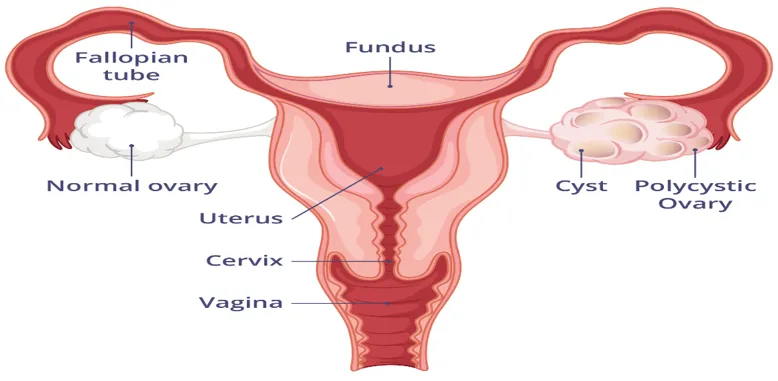
Figure 1: Normal and Polycystic Ovaries
PCOS not only affects reproductive health but is also associated with several metabolic and psychological complications. Women suffering from PCOS commonly experience symptoms such as irregular menstruation, acne, hirsutism, weight gain, alopecia, and infertility. In addition to reproductive dysfunction, the syndrome is strongly associated with insulin resistance, obesity, dyslipidemia, type 2 diabetes mellitus, metabolic syndrome, and cardiovascular disorders. Psychological disturbances including anxiety, depression, stress, and reduced self-esteem are also frequently observed in affected individuals, significantly impacting their quality of life1,3,4.
Although the exact etiology of PCOS remains unclear, several interrelated mechanisms are believed to contribute to its development. Insulin resistance and hyperandrogenism are considered major factors involved in disease progression. Hyperinsulinemia stimulates ovarian androgen production and decreases the synthesis of sex hormone-binding globulin (SHBG), resulting in elevated levels of circulating androgens. Increased androgen levels interfere with normal follicular maturation and ovulation, leading to ovarian dysfunction and infertility. Hormonal imbalance involving altered secretion of luteinizing hormone (LH) and follicle-stimulating hormone (FSH) further contributes to abnormal follicular development and menstrual irregularities. Genetic susceptibility, chronic low-grade inflammation, oxidative stress, obesity, and environmental factors are also believed to play significant roles in the pathogenesis of the disorder3,7.
Diagnosis of PCOS is generally based on clinical features, biochemical investigations, and ultrasonographic findings. The Rotterdam criteria are the most commonly used diagnostic guidelines for identifying the disorder. Early diagnosis and appropriate management are important to prevent long-term reproductive, metabolic, and cardiovascular complications associated with PCOS. Current treatment strategies mainly focus on lifestyle modification, dietary regulation, physical activity, weight management, hormonal therapy, insulin sensitizers, and ovulation induction therapies according to patient symptoms and reproductive goals2,16.
The present review aims to provide a comprehensive overview of PCOS with emphasis on its etiology, pathophysiology, clinical manifestations, diagnosis, complications, and current management strategies. The review also highlights natural management approaches and recent advances that may improve therapeutic outcomes and overall quality of life in affected women.
Table No. 1: DIFFERENCE BETWEEN PCOD AND PCOS
|
Feature |
PCOD (Polycystic Ovarian Disease) |
PCOS (Polycystic Ovary Syndrome) |
|
Definition |
Ovarian disorder involving immature follicle formation |
Complex endocrine and metabolic syndrome |
|
Severity |
Comparatively less severe |
More severe and chronic |
|
Hormonal Imbalance |
Mild hormonal disturbance |
Significant hormonal imbalance |
|
Ovulation |
Ovulation may occur occasionally |
Ovulation is commonly impaired |
|
Insulin Resistance |
Less common |
Frequently present |
|
Androgen Levels |
Mildly elevated |
Markedly elevated |
|
Menstrual Irregularities |
Mild to moderate |
More severe and persistent |
|
Fertility Impact |
Mild fertility disturbances |
Frequently associated with infertility |
|
Metabolic Complications |
Usually less prominent |
Increased risk of diabetes and cardiovascular disease |
|
Management |
Mainly lifestyle modification |
Lifestyle modification with medical treatment |
|
Nature of Disorder |
Primarily ovarian condition |
Systemic endocrine disorder |
ETIOLOGY AND RISK FACTORS OF PCOS
Polycystic ovary syndrome (PCOS) is a multifactorial disorder caused by the interaction of genetic, hormonal, metabolic, environmental, and lifestyle-related factors. Although the exact cause is not fully understood, insulin resistance and hyperandrogenism are considered major contributors to disease development. Elevated insulin levels increase androgen production, which disrupts normal ovulation and follicular maturation1,7.
Genetic predisposition also plays an important role, as women with a family history of PCOS, obesity, or type 2 diabetes mellitus are at higher risk of developing the disorder3,18. Lifestyle factors such as obesity, unhealthy diet, physical inactivity, and stress may further worsen hormonal imbalance and metabolic abnormalities associated with PCOS2,20.
Hormonal disturbances involving increased luteinizing hormone (LH) and altered follicle-stimulating hormone (FSH) levels contribute to ovarian dysfunction and formation of multiple immature follicles17,18. In addition, chronic low-grade inflammation and oxidative stress are believed to participate in disease progression. Overall, PCOS develops through a complex interaction between endocrine dysfunction and environmental influences6,24.
PATHOPHYSIOLOGY OF PCOS
Polycystic ovary syndrome (PCOS) is a complex endocrine and metabolic disorder involving multiple interconnected mechanisms. Insulin resistance and hyperandrogenism are considered the major factors responsible for the development and progression of the syndrome. In insulin resistance, body tissues become less sensitive to insulin, resulting in compensatory hyperinsulinemia. Increased insulin levels stimulate ovarian theca cells to produce excess androgens and reduce the production of sex hormone-binding globulin (SHBG), thereby increasing free androgen levels in circulation1,7.
Hyperandrogenism interferes with normal follicular development and ovulation, leading to accumulation of immature follicles within the ovaries. Hormonal imbalance involving increased luteinizing hormone (LH) and relatively decreased follicle-stimulating hormone (FSH) further contributes to ovarian dysfunction and chronic anovulation3,18. These abnormalities result in menstrual irregularities, infertility, acne, hirsutism, and polycystic ovarian morphology.
Chronic low-grade inflammation, oxidative stress, obesity, and genetic predisposition also play important roles in the pathogenesis of PCOS. Inflammatory mediators and excess adipose tissue may worsen insulin resistance and endocrine dysfunction, thereby aggravating disease severity. Overall, the interaction between metabolic abnormalities, hormonal imbalance, and environmental factors contributes to the clinical manifestations of PCOS6,24,29.
CLINICAL MANIFESTATIONS OF PCOS
The clinical manifestations of polycystic ovary syndrome (PCOS) vary among individuals due to differences in hormonal imbalance and metabolic abnormalities. The disorder mainly affects reproductive, metabolic, dermatological, and psychological health. Menstrual irregularities such as oligomenorrhea, amenorrhea, and anovulation are among the most common clinical features observed in women with PCOS. Chronic anovulation may further lead to infertility and difficulty in conception1,2.
Hyperandrogenism is another major characteristic of PCOS and is responsible for symptoms such as hirsutism, acne, oily skin, and androgenic alopecia. Many women with PCOS also experience weight gain and central obesity, which may worsen insulin resistance and metabolic complications. Acanthosis nigricans, characterized by darkened skin folds, may also be present due to hyperinsulinemia3,20.
Metabolic manifestations associated with PCOS include insulin resistance, dyslipidemia, impaired glucose tolerance, and increased risk of type 2 diabetes mellitus and cardiovascular disorders4,25. In addition to physical symptoms, psychological disturbances such as anxiety, depression, mood swings, stress, and reduced self-esteem are frequently observed in affected individuals. Sleep disturbances and fatigue may also occur in some patients. Overall, the clinical presentation of PCOS significantly affects the quality of life and reproductive health of women21.
DIAGNOSIS OF PCOS
Diagnosis of polycystic ovary syndrome (PCOS) is based on clinical features, biochemical investigations, and ultrasonographic findings. The Rotterdam criteria are the most widely accepted diagnostic guidelines for PCOS. According to these criteria, the presence of any two of the following three features confirms the diagnosis after exclusion of other related disorders: hyperandrogenism, ovulatory dysfunction, and polycystic ovarian morphology2,16.
Clinical evaluation includes assessment of menstrual irregularities, hirsutism, acne, obesity, and infertility. Biochemical investigations are performed to measure hormone levels such as testosterone, luteinizing hormone (LH), follicle-stimulating hormone (FSH), prolactin, and insulin5. Blood glucose levels and lipid profile are also evaluated to identify associated metabolic abnormalities.
Pelvic ultrasonography is commonly used to identify enlarged ovaries with multiple immature follicles arranged peripherally, giving a characteristic “string of pearls” appearance28. Additional investigations may be performed to exclude other endocrine disorders such as thyroid dysfunction, congenital adrenal hyperplasia, Cushing’s syndrome, and hyperprolactinemia. Early and accurate diagnosis is important for effective management and prevention of long-term complications associated with PCOS.
COMPLICATIONS OF PCOS
Polycystic ovary syndrome (PCOS) is associated with several reproductive, metabolic, cardiovascular, and psychological complications that may affect long-term health and quality of life. One of the major complications of PCOS is infertility, which mainly occurs due to chronic anovulation and hormonal imbalance. Women with PCOS commonly experience irregular ovulation, making conception difficult27.
Metabolic complications such as insulin resistance, impaired glucose tolerance, obesity, and type 2 diabetes mellitus are frequently observed in affected individuals4,19. Dyslipidemia and hypertension may further increase the risk of cardiovascular diseases25. Prolonged menstrual irregularities and unopposed estrogen exposure may also increase the risk of endometrial hyperplasia and endometrial cancer.
Psychological complications including anxiety, depression, stress, mood disorders, and reduced self-esteem are common among women with PCOS due to physical symptoms such as obesity, acne, hirsutism, and infertility21. Sleep disturbances and obstructive sleep apnea may additionally occur in some patients. Overall, untreated PCOS may lead to serious reproductive and metabolic complications, highlighting the importance of early diagnosis and proper management.
NON-PHARMACOLOGICAL/NATURAL MANAGEMENT OF PCOS
Lifestyle modification is considered the first-line approach in the management of polycystic ovary syndrome (PCOS), especially in overweight and obese individuals. Non-pharmacological management mainly focuses on improving insulin sensitivity, regulating hormonal imbalance, reducing body weight, and improving reproductive and metabolic health. Proper lifestyle changes may significantly reduce symptoms and lower the risk of long-term complications associated with PCOS8.
Dietary management plays an important role in controlling PCOS symptoms. A balanced diet rich in whole grains, fruits, vegetables, lean proteins, and high-fiber foods may help regulate blood glucose levels and improve insulin sensitivity [2]. Reduction in intake of processed foods, sugary beverages, and saturated fats is also beneficial. Low glycemic index diets are commonly recommended for weight management and metabolic control in women with PCOS.
Regular physical activity and exercise help improve insulin resistance, promote weight loss, and enhance ovulatory function. Aerobic exercise, resistance training, yoga, and moderate-intensity workouts performed consistently may help reduce androgen levels and improve menstrual regularity. Even moderate weight reduction can positively affect fertility and hormonal balance 9.
Stress management is another important aspect of natural management because psychological stress may worsen hormonal disturbances. Techniques such as meditation, yoga, breathing exercises, proper sleep, and mindfulness practices may help improve mental well-being and endocrine function.
Several herbal and natural therapies including cinnamon, fenugreek, flaxseed, aloe vera, spearmint tea, and ashwagandha have also shown potential benefits in improving insulin sensitivity and hormonal balance in women with PCOS. However, further clinical studies are still required to confirm their long-term safety and effectiveness. Overall, lifestyle and behavioral modifications remain essential components in the long-term management of PCOS10.
PHARMACOLOGICAL MANAGEMENT OF PCOS
Pharmacological management of polycystic ovary syndrome (PCOS) mainly aims to control symptoms, improve hormonal imbalance, regulate menstrual cycles, reduce insulin resistance, and manage infertility. The choice of therapy depends on the patient’s symptoms, metabolic condition, and reproductive goals.
Insulin sensitizers such as metformin are commonly used in women with PCOS to improve insulin sensitivity and reduce hyperinsulinemia. Metformin helps regulate menstrual cycles, improve ovulation, and reduce androgen levels. Thiazolidinediones such as pioglitazone may also improve insulin resistance, although their use is limited due to adverse effects.11,12 Hormonal therapy is frequently used to manage menstrual irregularities and hyperandrogenic symptoms. Combined oral contraceptive pills help regulate menstrual cycles and decrease androgen production, thereby improving acne and hirsutism2 Anti-androgenic drugs such as spironolactone may additionally be used to reduce excessive hair growth and androgen-related symptoms.
For women experiencing infertility, ovulation induction agents such as clomiphene citrate and letrozole are commonly prescribed to stimulate ovulation. Letrozole is often preferred because of its better ovulation and pregnancy outcomes in many patients. In severe or treatment-resistant cases, assisted reproductive techniques such as in vitro fertilization (IVF) and laparoscopic ovarian drilling may be considered.
Recent therapeutic approaches including glucagon-like peptide-1 (GLP-1) receptor agonists and combination therapies are also being investigated for improving metabolic and reproductive outcomes in women with PCOS. Overall, pharmacological treatment is usually combined with lifestyle modification for effective long-term management of the disorder23.
RECENT ADVANCES IN PCOS MANAGEMENT
Recent advances in the understanding of polycystic ovary syndrome (PCOS) have improved the diagnosis and management of the disorder. Current research mainly focuses on targeted therapies, metabolic regulation, gut microbiota, molecular biomarkers, and personalized treatment approaches. These advancements aim to improve reproductive, hormonal, and metabolic outcomes in women with PCOS13,14.
One of the major recent developments in PCOS management is the use of glucagon-like peptide-1 (GLP-1) receptor agonists such as liraglutide and semaglutide. These agents have shown promising effects in reducing body weight, improving insulin sensitivity, regulating menstrual cycles, and decreasing androgen levels in women with PCOS. Recent studies suggest that GLP-1 receptor agonists may provide better metabolic outcomes when combined with lifestyle modification and conventional therapies.
Another emerging area of research is the role of gut microbiota in the pathogenesis of PCOS. Alteration in gut microbial composition has been associated with insulin resistance, inflammation, and hormonal imbalance in affected individuals. Recent studies indicate that modulation of gut microbiota through probiotics, prebiotics, dietary intervention, and microbiome-targeted therapies may help improve metabolic and reproductive health in women with PCOS. 13,15
Advances in molecular biology have also led to the identification of novel biomarkers involved in PCOS progression. Inflammatory markers, adipokines, oxidative stress markers, and genetic factors are being investigated for early diagnosis and individualized treatment strategies. Personalized medicine approaches based on hormonal profile, metabolic status, and genetic susceptibility are gaining importance in improving therapeutic outcomes.14
In addition, recent research has explored the use of combination therapies, anti-obesity agents, vitamin supplementation, and digital health technologies for long-term PCOS management. Artificial intelligence-based diagnostic systems and advanced imaging techniques are also being investigated for improving early diagnosis and monitoring of disease progression. Overall, these recent advances may contribute to more effective and personalized management strategies for women with PCOS in the future.
FUTURE PERSPECTIVES
The future management of polycystic ovary syndrome (PCOS) is expected to advance through better understanding of its underlying molecular and metabolic mechanisms. Since PCOS is a multifactorial disorder with reproductive, endocrine, and metabolic involvement, future research should focus on developing more precise and effective therapeutic strategies. Identification of novel genetic markers and biochemical biomarkers may improve early diagnosis and help predict disease severity and treatment response.
Emerging therapies targeting insulin resistance, inflammation, oxidative stress, and hormonal imbalance may provide improved outcomes with reduced adverse effects. Research related to gut microbiota, anti-obesity agents, and newer insulin-sensitizing drugs is also gaining importance in PCOS management. Personalized treatment approaches based on individual hormonal and metabolic profiles may further enhance therapeutic effectiveness and reproductive outcomes.
In addition, increasing awareness regarding healthy lifestyle practices, dietary modification, exercise, stress management, and early screening programs may help reduce the prevalence and long-term complications associated with PCOS. Modern technologies such as artificial intelligence, digital health monitoring, and telemedicine may also contribute to improved diagnosis, patient follow-up, and disease management. Therefore, continuous clinical research and multidisciplinary healthcare approaches are essential for improving the overall quality of life in women affected by PCOS.
CONCLUSION
Polycystic ovary syndrome (PCOS) is a common endocrine and metabolic disorder that affects the reproductive, metabolic, and psychological health of women. The condition is mainly associated with hormonal imbalance, insulin resistance, irregular menstruation, infertility, obesity, and hyperandrogenism. In addition to reproductive complications, PCOS may also increase the risk of type 2 diabetes mellitus, cardiovascular diseases, and mental health disorders.
Early diagnosis and appropriate management are important to reduce long-term complications and improve the quality of life in affected women. Lifestyle modification including healthy diet, regular exercise, weight management, and stress reduction remains the cornerstone of PCOS management. Pharmacological therapies also play an important role in controlling symptoms and improving reproductive outcomes. Continued research and advanced therapeutic approaches may further improve the diagnosis and management of PCOS in the future.
REFERENCES

Kalyani Atkare, Dr. Vivek Panchabhai, Aarti Kalshetti, Namrata Shivankar, Shraddha Belkunde, Vaishnavi Chepat, Polycystic Ovary Syndrome: Pathophysiological Mechanisms, Diagnostic Challenges, and Emerging Therapeutic Strategies, Int. J. of Pharm. Sci., 2026, Vol 4, Issue 7, 941-949. https://doi.org/10.5281/zenodo.21193977
 10.5281/zenodo.21193977