

We use cookies to ensure our website works properly and to personalise your experience. Cookies policy
Institute of Pharmacy, Oriental University, Indore, MP
Allergic disorders such as allergic rhinitis and chronic urticaria affect a large portion of the population and often require long-term antihistamine therapy. Levocetirizine, a third-generation H1 receptor antagonist, is widely used due to its efficacy and lower sedative effects. However, conventional immediate-release formulations may lead to fluctuations in plasma drug concentration and require repeated dosing, which can reduce patient compliance and therapeutic consistency. Sustained release (SR) oral drug delivery systems offer a promising strategy to overcome these limitations by providing controlled and prolonged drug release. Such systems help maintain steady plasma levels, reduce dosing frequency, and potentially minimize side effects, thereby improving overall treatment outcomes in chronic allergic conditions. Quality by Design (QbD) has become an important approach in modern pharmaceutical development. It focuses on predefined product objectives, identification of critical quality attributes, risk assessment, and systematic optimization using design of experiments. By applying QbD principles to the development of levocetirizine sustained release tablets, a robust and reliable formulation can be achieved with consistent performance and regulatory compliance. This review highlights the need for sustained release levocetirizine formulations and discusses the application of QbD principles in their development and optimization.
1.1 Allergic Disorders and Their Global Burden
Allergic disorders are among the most common chronic conditions worldwide, affecting individuals across all age groups. Rapid urbanization, environmental pollution, changing lifestyles, and genetic predisposition have contributed to the rising prevalence of allergic diseases. These disorders not only reduce quality of life but also impose a considerable economic burden due to healthcare costs and loss of productivity.[1]
Allergic rhinitis is a chronic inflammatory condition of the nasal mucosa triggered by exposure to allergens such as pollen, dust mites, animal dander, or mold. It is clinically characterized by sneezing, nasal congestion, rhinorrhea, itching, and watery eyes. Although not life-threatening, persistent symptoms can interfere with sleep, concentration, work efficiency, and daily activities. In many patients, allergic rhinitis is associated with other atopic conditions such as asthma, further complicating disease management. [2]
Chronic urticaria is another common allergic disorder marked by recurrent wheals (hives), itching, and sometimes angioedema lasting for more than six weeks. The condition may significantly affect psychological well-being due to visible skin lesions and persistent discomfort. Management often requires long-term antihistamine therapy to control symptoms and prevent recurrence. [3]

Figure no 1. Allergic Disorders and types
1.2 Levocetirizine
Levocetirizine is a third-generation, non-sedating antihistamine widely prescribed for the treatment of allergic rhinitis and chronic urticaria. Chemically, it is the active enantiomer of cetirizine and belongs to the piperazine derivative class of antihistamines. [4]Its selective activity contributes to improved efficacy and reduced central nervous system side effects compared to earlier antihistamines. [5] The primary mechanism of action of levocetirizine involves selective antagonism of peripheral histamine H1 receptors. By blocking these receptors, it prevents histamine-mediated allergic responses such as vasodilation, increased vascular permeability, itching, and mucosal edema. As a result, it effectively alleviates symptoms associated with allergic conditions. [6]
Pharmacokinetically, levocetirizine is rapidly absorbed after oral administration, with high bioavailability and minimal hepatic metabolism. It is primarily excreted unchanged through the kidneys. [7] Despite these advantages, the drug has a relatively moderate elimination half-life, which may necessitate regular dosing to maintain therapeutic plasma levels. Although generally well tolerated, mild adverse effects such as drowsiness, dry mouth, and fatigue may occur in some patients. [8]
1.3 Need for Sustained Release Formulation
Conventional immediate-release formulations of levocetirizine are effective but may present certain limitations in long-term therapy. One of the primary concerns is the need for repeated dosing to maintain consistent therapeutic levels in the bloodstream. Even with once-daily dosing, plasma drug concentration may fluctuate, leading to variations in symptom control. [9]
Fluctuations in plasma levels can result in periods of sub-therapeutic exposure or higher peak concentrations, potentially affecting efficacy and tolerability. For chronic conditions such as allergic rhinitis and urticaria, maintaining stable drug concentrations is crucial for sustained symptom relief. Sustained release (SR) formulations offer a promising solution to these challenges. By controlling the rate of drug release over an extended period, SR systems help maintain steady plasma concentrations, reduce dosing frequency, and enhance patient adherence. Improved compliance is particularly important in chronic allergic disorders where long-term treatment is required. Therefore, the development of a sustained release formulation of levocetirizine represents a rational and clinically relevant approach to optimizing therapy and improving patient outcomes. [10]
2. Levocetirizine: Drug Profile
2.1 Chemical Structure
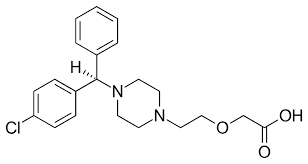
Figure no. 2 Levocetirizine structure
Levocetirizine is the pharmacologically active R-enantiomer of cetirizine and belongs to the piperazine derivative class of antihistamines. Chemically, it is designated as (R)-[2-[4-[(4-chlorophenyl)phenylmethyl]-1-piperazinyl]ethoxy]acetic acid dihydrochloride. The presence of a piperazine ring, aromatic rings, and a carboxylic acid functional group plays a crucial role in its antihistaminic activity and physicochemical behavior. [11]
The molecular formula of levocetirizine dihydrochloride is C??H??ClN?O?·2HCl, and it has a molecular weight of approximately 461.8 g/mol (dihydrochloride salt). The molecule exhibits chirality, and the R-enantiomer demonstrates higher affinity and selectivity toward peripheral H1 receptors compared to the S-enantiomer. This stereochemical specificity contributes to its enhanced therapeutic profile and reduced adverse effects.
2.2 Physicochemical Properties
Understanding the physicochemical characteristics of levocetirizine is essential for designing an effective sustained release formulation.
2.3 Biopharmaceutical Classification System (BCS) Classification
According to the Biopharmaceutical Classification System (BCS), levocetirizine is generally categorized under BCS Class III (high solubility and low permeability). Drugs in this class dissolve readily in gastrointestinal fluids but may have limited membrane permeability.
For sustained release formulation development, BCS Class III drugs require careful consideration of factors affecting gastrointestinal transit time and absorption window. Since levocetirizine is highly soluble, controlling its release rate through polymeric matrices becomes essential to prevent rapid drug diffusion and ensure prolonged therapeutic action.
2.4 Pharmacokinetics [13]
Absorption
Levocetirizine is rapidly and extensively absorbed following oral administration. It demonstrates high oral bioavailability, indicating minimal first-pass metabolism. Peak plasma concentrations are typically achieved within a short period after dosing.
Distribution
The drug exhibits moderate plasma protein binding and distributes primarily within extracellular fluids. Due to its relatively low penetration across the blood–brain barrier, central nervous system side effects such as sedation are minimal compared to first-generation antihistamines.
Metabolism
Levocetirizine undergoes minimal hepatic metabolism. A small fraction of the administered dose is metabolized via oxidation and conjugation pathways, which reduces the risk of significant drug–drug interactions.
Elimination
The drug is predominantly excreted unchanged through renal pathways. Its elimination half-life supports once-daily dosing; however, plasma concentration may gradually decline, which justifies exploring sustained release formulations for prolonged therapeutic coverage.
2.5 Stability Considerations [14]
Stability plays a critical role in formulation development and shelf-life determination. Levocetirizine dihydrochloride is generally stable under normal storage conditions but may be sensitive to:
In sustained release matrix formulations, compatibility with polymers and excipients must be evaluated through preformulation studies such as FT-IR, DSC, and accelerated stability testing. Understanding degradation pathways and environmental sensitivities ensures the development of a stable and robust dosage form.
Table 1: Drug Profile of Levocetirizine
|
Parameter |
Value |
Significance in SR Formulation |
|
Chemical class |
Third-generation antihistamine |
Selective H1 antagonist |
|
BCS Class |
III |
High solubility, low permeability |
|
pKa |
Amphoteric |
pH-dependent solubility |
|
Solubility |
High |
Needs release retardation |
|
Half-life |
~8–10 hrs |
Suitable for SR |
3. Sustained Release Oral Drug Delivery Systems
3.1 Concept and Principles
Sustained release (SR) oral drug delivery systems are designed to release a drug at a predetermined rate for an extended period of time in order to maintain therapeutic drug levels in the bloodstream. The primary objective of sustained release formulations is to reduce dosing frequency, improve patient adherence, and minimize fluctuations in plasma drug concentration. [11]
Although the terms controlled release and sustained release are often used interchangeably, there is a subtle distinction between them. Sustained release systems prolong drug release over time but may not maintain a constant release rate. In contrast, controlled release systems are specifically designed to deliver the drug at a nearly constant rate, ideally following zero-order kinetics. Controlled release is therefore considered a more precise and advanced form of sustained release. [15]
Table 2: Comparison – Conventional vs Sustained Release Tablets
|
Parameter |
Immediate Release |
Sustained Release |
|
Drug release |
Rapid |
Prolonged |
|
Plasma fluctuation |
High |
Minimal |
|
Dosing frequency |
Higher |
Reduced |
|
Patient compliance |
Moderate |
Improved |
Mechanisms of Drug Release [16]
Drug release from sustained release tablets can occur through one or more of the following mechanisms:
In practice, many sustained release systems operate through a combination of these mechanisms.
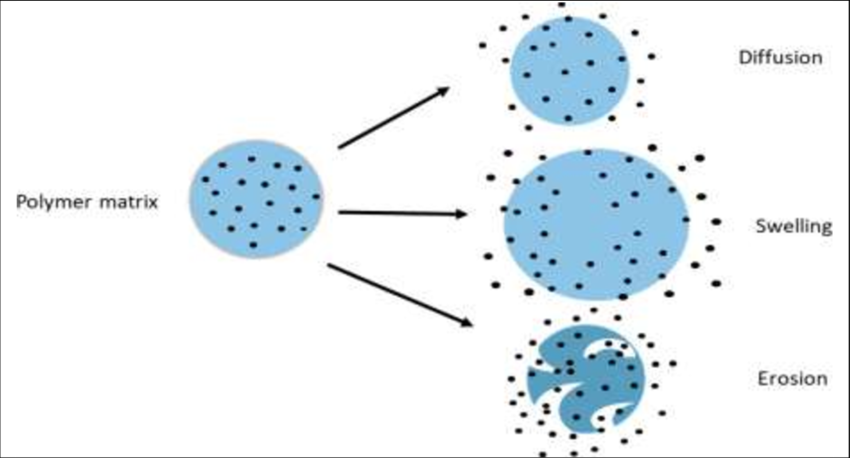
Figure no. 3 Mechanisms of Drug Release
3.2 Types of Sustained Release Systems
1. Matrix Systems [17]
Matrix systems are among the most widely used sustained release formulations due to their simplicity and cost-effectiveness. In these systems, the drug is uniformly dispersed within a polymer matrix.
Matrix systems are particularly suitable for highly soluble drugs, as polymer concentration can be adjusted to modulate release rate.
2. Reservoir Systems
In reservoir systems, the drug core is surrounded by a polymeric membrane that controls drug release. The membrane acts as a barrier regulating diffusion of the drug into the external environment. While reservoir systems can provide more precise release control, they require more complex manufacturing processes.
3. Osmotic Pump Systems [18]
Osmotic systems utilize osmotic pressure as the driving force for drug release. These tablets contain an osmotic agent and are coated with a semipermeable membrane having a small delivery orifice. Water influx generates pressure, which pushes the drug solution out at a controlled rate. Osmotic systems are capable of achieving near zero-order release kinetics.
4.3 Polymers Used in Sustained Release Tablets [19]
Polymers play a crucial role in determining the release behavior and performance of SR tablets.
Hydroxypropyl Methylcellulose (HPMC)
HPMC is one of the most commonly used hydrophilic matrix-forming polymers. Different viscosity grades such as K4M, K15M, and K100M are selected depending on the desired release rate. Higher viscosity grades provide stronger gel formation and slower drug release.
Ethyl Cellulose
Ethyl cellulose is a hydrophobic polymer widely used in matrix and coating systems. It controls drug release primarily through diffusion and is particularly useful for highly water-soluble drugs.
Carbopol
Carbopol is a cross-linked polyacrylic acid polymer known for its high swelling capacity. It forms a viscous gel upon hydration and can effectively retard drug release.
Natural Polymers [20]
Natural polymers such as guar gum, xanthan gum, chitosan, and alginate are increasingly explored due to their biodegradability, biocompatibility, and cost-effectiveness. They can provide controlled release through swelling and gel formation mechanisms.
Table 6: Polymers Used in SR Tablets
|
Polymer |
Type |
Mechanism |
Advantage |
|
HPMC K4M |
Hydrophilic |
Swelling & diffusion |
Cost-effective |
|
Ethyl cellulose |
Hydrophobic |
Diffusion |
Good retardation |
|
Carbopol |
Cross-linked polymer |
Swelling |
Strong gel formation |
|
Guar gum |
Natural |
Swelling |
Biocompatible |
3.4 Advantages and Limitations of Sustained Release Tablets [21]
Advantages
Limitations
In summary, sustained release oral drug delivery systems provide significant therapeutic and patient-centered benefits, particularly for chronic conditions requiring long-term medication. However, careful formulation design and optimization are essential to ensure safety, efficacy, and consistent performance.
4. Quality by Design (QbD) in Pharmaceutical Development
4.1 Concept of Quality by Design (QbD)
Quality by Design (QbD) is a systematic, science-based, and risk-oriented approach to pharmaceutical product development. It emphasizes building quality into the product from the initial stages of formulation and process design rather than relying solely on end-product testing. According to the International Council for Harmonisation of Technical Requirements for Pharmaceuticals for Human Use, QbD is defined as “a systematic approach to development that begins with predefined objectives and emphasizes product and process understanding and process control, based on sound science and quality risk management.” [22]
Comparison with the Traditional Approach
In the traditional pharmaceutical development approach, product quality is often evaluated primarily through finished product testing. This method relies heavily on trial-and-error experimentation and fixed process parameters. If the final product fails to meet specifications, reformulation or process adjustments are required. [23] In contrast, QbD focuses on understanding the relationship between formulation variables, process parameters, and product performance. It integrates risk assessment, statistical tools, and process control strategies to ensure consistent quality. Rather than testing quality into the product, QbD builds quality into the product during development.
4.2 ICH Guidelines Related to QbD [24]
Several guidelines developed by the International Council for Harmonisation of Technical Requirements for Pharmaceuticals for Human Use provide the regulatory framework for implementing QbD in pharmaceutical development:
Together, these guidelines form the foundation for modern, regulatory-compliant pharmaceutical development.
4.3 Key Elements of QbD[25]
Quality Target Product Profile (QTPP)
QTPP defines the intended characteristics of the final product, including dosage form, route of administration, strength, release profile, stability, and safety attributes.
Critical Quality Attributes (CQAs)
CQAs are physical, chemical, biological, or microbiological properties that must be controlled within specific limits to ensure product quality.
Critical Material Attributes (CMAs)
CMAs refer to the properties of raw materials (e.g., particle size, polymer viscosity, moisture content) that can impact product quality.
Critical Process Parameters (CPPs)
CPPs are process variables such as mixing time, compression force, and granulation temperature that significantly influence CQAs.
Risk Assessment Tools
Common tools include:
Control Strategy
A planned set of controls derived from process understanding that ensures consistent product quality throughout manufacturing. [26]
Design Space
Design space is the multidimensional combination of CMAs and CPPs that has been demonstrated to assure quality. Operating within this space ensures regulatory flexibility and consistent performance.
Table 3: Key Elements of QbD
|
QbD Element |
Description |
Relevance |
|
QTPP |
Target product profile |
Defines development goals |
|
CQAs |
Critical quality attributes |
Ensures safety & efficacy |
|
CMAs |
Material properties |
Affect release behavior |
|
CPPs |
Process variables |
Affect final product quality |
|
Design Space |
Multivariate region |
Regulatory flexibility |
5. Application of QbD in Sustained Release Tablet Development [27]
5.1 Defining QTPP for Levocetirizine Sustained Release Tablets
For levocetirizine SR tablets, the QTPP should include:
5.2 Identification of Critical Quality Attributes (CQAs) [28]
For sustained release tablets, important CQAs include:
5.3 Risk Assessment Methodologies[29]
Failure Mode and Effects Analysis (FMEA)
FMEA systematically evaluates potential failure modes, their causes, and their impact on product quality. A risk priority number (RPN) is calculated to rank variables.
Fishbone (Ishikawa) Diagram
This graphical tool identifies potential sources of variability related to materials, methods, machinery, environment, and personnel.
These tools help prioritize formulation and process variables for further optimization.
5.4 Design of Experiments (DoE) [30]
Design of Experiments is a statistical approach used to study the effect of multiple variables simultaneously.
Common designs include:
DoE helps establish mathematical models linking CMAs and CPPs to CQAs.
5.5 Establishment of Design Space
Design space is developed through multivariate statistical modeling using DoE data. It represents the combination of formulation and process parameters that consistently produce tablets meeting predefined quality criteria.
Optimization is commonly performed using a desirability function, which simultaneously considers multiple responses (e.g., dissolution, hardness, friability). The optimized formulation is validated by preparing confirmatory batches.
6. Challenges and Future Perspectives
Although Quality by Design (QbD) offers a systematic and scientific approach to sustained release (SR) tablet development, several practical challenges remain.
Scale-up is a major concern, as formulation and process parameters optimized at laboratory scale may not perform identically at pilot or commercial scale. Variations in equipment size, mixing efficiency, and compression force can affect dissolution profiles and product consistency.
Polymer variability also poses challenges. Differences in viscosity, particle size, and moisture content between batches can significantly influence drug release behavior. Strict raw material control and supplier qualification are therefore essential under the QbD framework.
Regulatory flexibility may vary across regions. Although regulatory authorities support QbD, establishing a justified design space requires extensive data and statistical validation, making submissions complex and resource-intensive.
Looking ahead, the integration of artificial intelligence (AI) and machine learning (ML) can enhance data analysis, predict formulation performance, and reduce experimental workload. Additionally, continuous manufacturing combined with QbD and Process Analytical Technology (PAT) offers improved process control, real-time monitoring, and better scalability.
CONCLUSION
The development of sustained release oral tablets represents a strategic approach to improving therapeutic outcomes in chronic conditions requiring long-term medication. By controlling drug release over an extended period, sustained release systems reduce dosing frequency, minimize plasma concentration fluctuations, and enhance patient compliance.
The implementation of Quality by Design (QbD) provides a systematic and scientific framework for the development and optimization of such formulations. Through the identification of Quality Target Product Profile (QTPP), Critical Quality Attributes (CQAs), Critical Material Attributes (CMAs), and Critical Process Parameters (CPPs), QbD ensures a comprehensive understanding of formulation and manufacturing processes. The application of risk assessment tools and statistical optimization techniques enables the establishment of a robust design space, ensuring consistent product quality and regulatory compliance.
Overall, QbD significantly enhances the reliability, reproducibility, and scalability of sustained release formulations. Future research should focus on advanced predictive modeling, integration of AI-driven tools, real-time monitoring technologies, and expansion of continuous manufacturing systems. Such innovations will further strengthen pharmaceutical development, ensuring safe,
REFERENCES


Ajay Lohare, Dr. Priyanka Nagar, Quality by Design (QbD) Based Development and Optimization of Levocetirizine Sustained Release Oral Tablets, Int. J. of Pharm. Sci., 2026, Vol 4, Issue 3, 1799-1810. https://doi.org/10.5281/zenodo.19064168
 10.5281/zenodo.19064168