

We use cookies to ensure our website works properly and to personalise your experience. Cookies policy
Godavari institute of pharmacy kolpa
Approximately 40% of marketed drugs and up to 90% of molecules in the discovery pipeline exhibit poor aqueous solubility, and a substantial proportion of these additionally face pre-systemic barriers — P-glycoprotein-mediated efflux, extensive cytochrome P450 3A4 metabolism, and limited membrane permeability — that further constrain oral bioavailability beyond solubility alone. Lipid-based nanocarriers, encompassing liposomes, solid lipid nanoparticles (SLN), nanostructured lipid carriers (NLC), self-(micro/nano)emulsifying drug delivery systems (SMEDDS/SNEDDS), and nanoemulsions, address these compounded barriers through a combination of solubilization, intestinal lymphatic transport (partially bypassing hepatic first-pass metabolism), P-glycoprotein efflux inhibition, and enhanced membrane permeability. This review synthesizes the comparative and mechanistic literature on lipid-based nanocarrier performance, presents two original schematic figures — a classification of the major lipid nanocarrier classes and their shared biopharmaceutical roles, and a mechanistic pathway diagram linking nanocarrier encapsulation to improved oral bioavailability — and highlights a quantitative in vivo case example (fenofibrate) in which NLC and SMEDDS formulations achieved 705% and 809% relative bioavailability increases over a marketed micronized reference product. Gaps in scale-up reproducibility, long-term physical stability, and drug-loading capacity limitations are identified as the principal translational challenges for this technology class.
Poor aqueous solubility is the most frequently cited formulation barrier in modern drug development, but for many BCS Class II and IV compounds, solubility is only part of the bioavailability problem: extensive intestinal and hepatic first-pass metabolism, active efflux by P-glycoprotein transporters at the enterocyte membrane, and limited passive membrane permeability further reduce the fraction of dissolved drug that ultimately reaches systemic circulation intact. Addressing solubility alone — via nanocrystals, amorphous solid dispersions, or simple micronization — therefore does not guarantee proportional bioavailability improvement when these additional pre-systemic barriers are significant.
Lipid-based nanocarrier systems are distinguished from other nanotechnology-based solubility-enhancement strategies by their capacity to simultaneously address multiple barriers within a single formulation platform: the lipidic matrix or vehicle solubilizes the drug, promotes association with the intestinal lymphatic (chylomicron) transport pathway that partially bypasses hepatic first-pass metabolism, and — depending on the specific lipids and surfactants used — can inhibit P-glycoprotein-mediated efflux and reduce cytochrome P450 3A4-mediated pre-systemic metabolism. This multi-mechanism action is the basis for describing lipid nanocarriers as playing a 'significant role' in biopharmaceutical performance improvement, rather than a purely solubility-focused role.
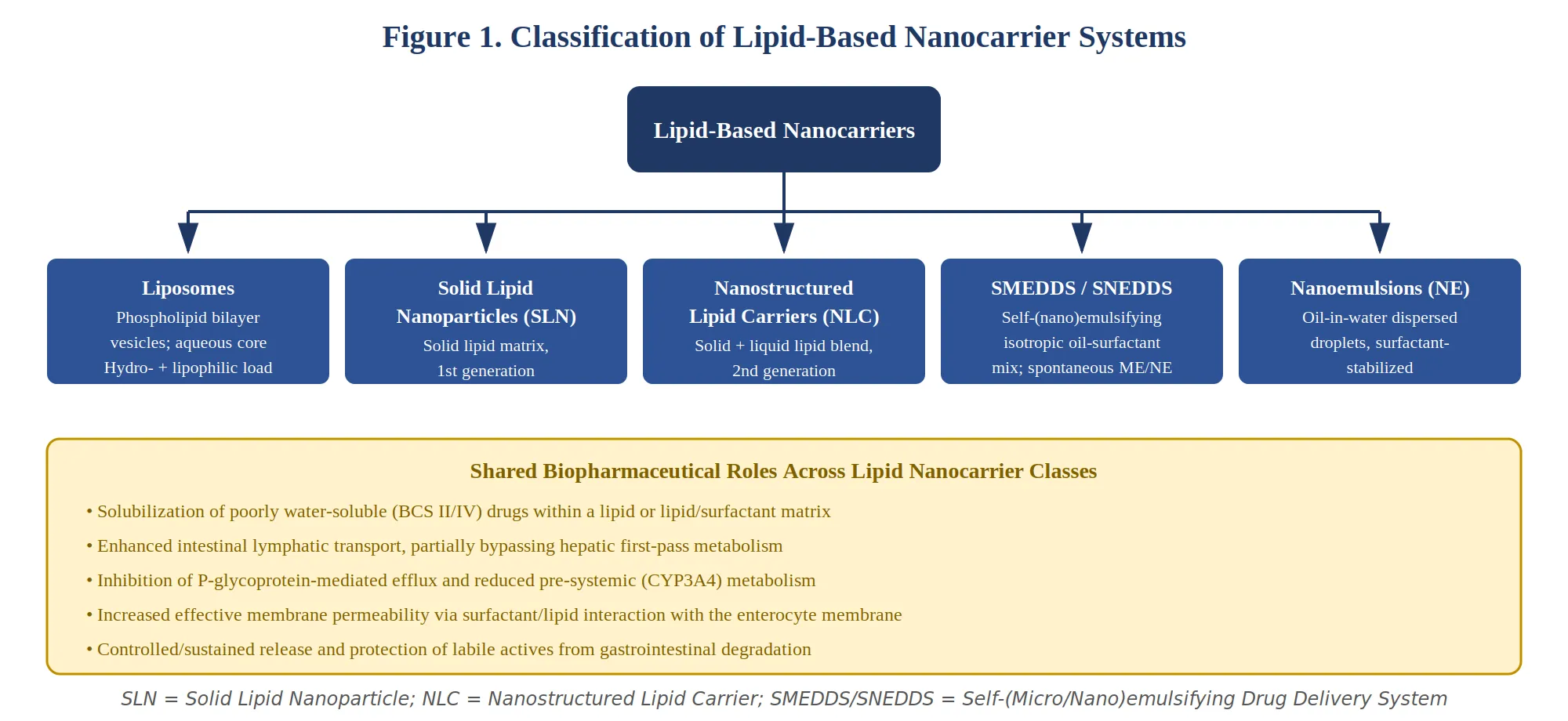
Figure 1. Classification of the principal lipid-based nanocarrier systems and their shared biopharmaceutical roles. (Original diagram prepared for this review.)
2. Mechanistic Basis for Improved Biopharmaceutical Performance
Figure 2 summarizes the principal mechanistic pathways by which lipid nanocarrier encapsulation is understood to improve oral bioavailability of a poorly soluble drug: increased apparent solubility and dissolution within gastrointestinal fluid; intestinal lymphatic uptake via the chylomicron pathway, which delivers absorbed drug directly to systemic circulation via the thoracic duct rather than the hepatic portal vein, reducing first-pass hepatic metabolism for highly lipophilic actives; inhibition of P-glycoprotein-mediated intestinal efflux and reduced cytochrome P450 3A4 pre-systemic metabolism, particularly by surfactants such as certain polyethoxylated excipients used in SMEDDS/SNEDDS formulations; and enhanced membrane permeability arising from lipid/surfactant interaction with the enterocyte membrane. These mechanisms are not mutually exclusive and are frequently invoked in combination to explain the bioavailability improvements reported for specific lipid nanocarrier formulations.
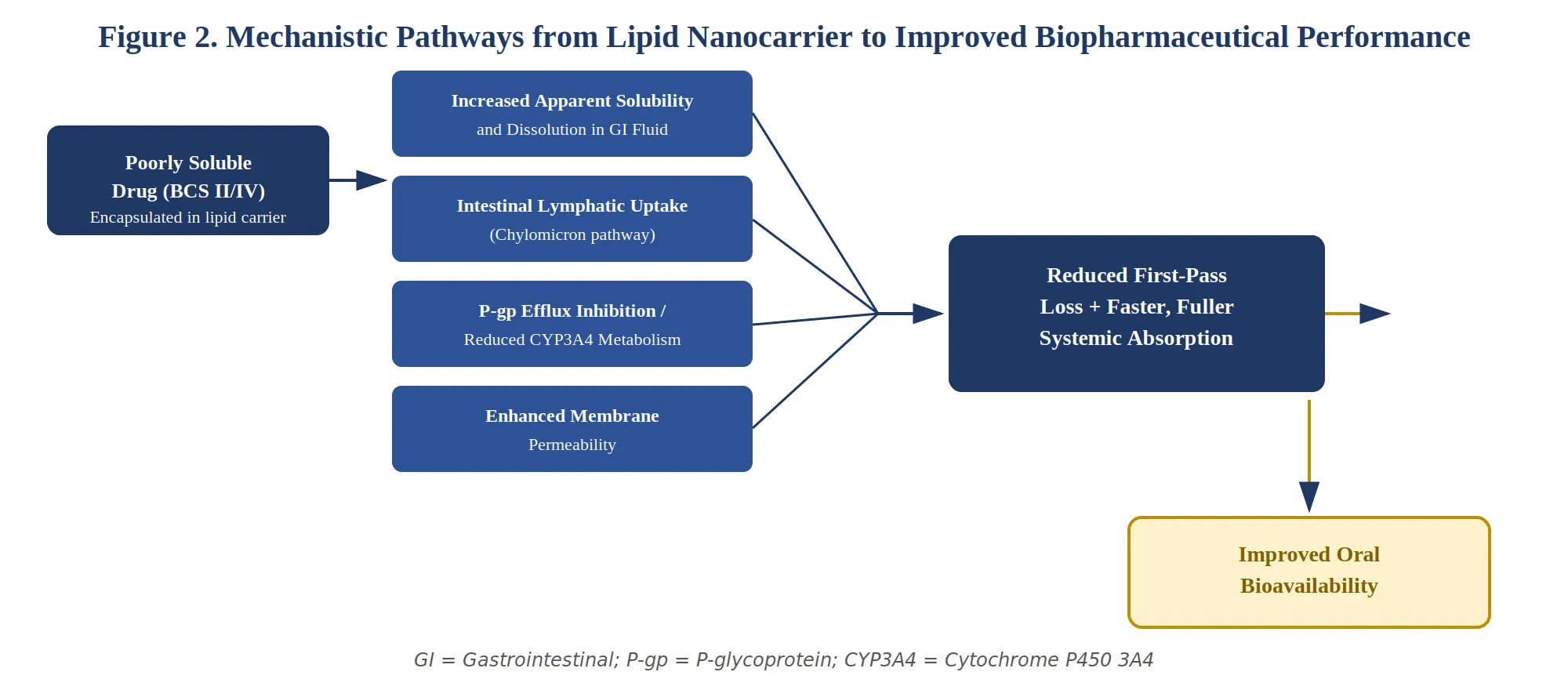
Figure 2. Mechanistic pathways from lipid nanocarrier encapsulation to improved oral bioavailability. (Original diagram prepared for this review.)
3. Literature Review and Comparative Performance
A direct in vivo comparative study in beagle dogs evaluated fenofibrate — a BCS Class II lipid-regulating drug — formulated as solid dispersion pellets (SDP), nanostructured lipid carriers (NLC), and a self-microemulsifying drug delivery system (SMEDDS), benchmarked against the marketed micronized reference product Lipanthyl. While SDP showed the fastest in vitro release in lipase-free medium, NLC and SMEDDS release increased substantially after pancreatic lipase addition, and — critically — the in vivo relative oral bioavailability of NLC and SMEDDS reached 705.11% and 809.10% respectively relative to Lipanthyl, compared with only 366.05% for the SDP formulation, directly demonstrating that lipid-based nanocarrier systems can outperform even a fast-releasing solid dispersion for a BCS II drug once in vivo absorption barriers are accounted for (PMC4180958).
A review of nanostructured lipid carriers as an oral bioavailability platform for lipophilic drugs catalogued the specific absorption barriers addressed by NLCs — including P-glycoprotein efflux and cytochrome P450-mediated metabolism — and discussed backlogs of earlier lipid-based formulations such as physical instability, limited drug loading, and drug expulsion during storage that NLC's solid/liquid lipid blend structure is intended to overcome relative to first-generation SLNs (PMC4674999).
Cyclodextrin-modified SLNs and NLCs were reviewed as a hybrid strategy to further improve encapsulation efficiency and release-rate control for poorly soluble drugs, combining pre-complexation, co-encapsulation, or surface-adsorption approaches to integrate cyclodextrin inclusion-complex chemistry with the lipid nanocarrier matrix (Alloush & Demiralp, 2025. doi:10.3390/ijms26136509).
A comprehensive review of nanostructured lipid carriers detailed composition, scalable production methods, and characterization techniques, emphasizing biodegradable, solvent-free manufacturing approaches consistent with green-chemistry principles, and citing formulation examples including an HDAC-inhibitor NLC (ITF3756) developed specifically to address poor aqueous solubility (J Drug Deliv Ther, 2025).
Lipid nanocarriers were also reviewed as a delivery platform for anticancer phytochemicals (curcumin, quercetin, resveratrol, silymarin, naringenin), where SLN/NLC encapsulation improved solubility, stability, cellular uptake, and tumor-specific release, with additional reported improvement in brain permeability relevant to central nervous system-targeted delivery (MDPI Pharmaceutics, 2025;17(8):1079).
A systematic review of lipid-based nanocarriers for nose-to-brain delivery in central nervous system disorders, searching PubMed, Ovid MEDLINE, and Scopus through January 2024, confirmed that SLN and NLC nanoscale size and tailored lipid composition facilitate efficient drug loading and optimal release for chronic neuro-oncological and neurodegenerative disease applications via the intranasal route (PMC10975610).
4. Identified Gaps and Novelty Statement
Three gaps recur across the lipid nanocarrier literature surveyed. First, despite consistent in vitro solubility and release-rate improvements, direct in vivo bioavailability comparisons across multiple lipid nanocarrier classes for the same drug — of the type performed for fenofibrate — remain uncommon, limiting the evidence base for choosing between SLN, NLC, and SMEDDS platforms for a given molecule. Second, drug-loading capacity and long-term physical stability (drug expulsion from the lipid matrix during storage, particularly for SLNs) remain recognized limitations that hybrid approaches such as cyclodextrin-modified formulations only partially address. Third, scale-up reproducibility from laboratory-scale high-pressure homogenization or microemulsification to commercial manufacture is inconsistently reported relative to the volume of laboratory-scale proof-of-concept literature.
5. CONCLUSION
Lipid-based nanocarriers play a significant and mechanistically distinct role in improving the biopharmaceutical performance of poorly soluble and poorly permeable drugs, addressing not only aqueous solubility but also intestinal lymphatic transport, P-glycoprotein efflux, and pre-systemic metabolism within a single formulation platform. The quantitative fenofibrate case example reviewed here — where NLC and SMEDDS formulations achieved 705% and 809% relative bioavailability improvement over a marketed reference product — illustrates the magnitude of benefit achievable when these mechanisms are engaged in combination. Addressing remaining gaps in drug-loading capacity, long-term physical stability, and scale-up reproducibility represents the principal translational opportunity for advancing lipid nanocarrier technology from laboratory proof-of-concept toward broader clinical and commercial application.
Conflict of Interest
The authors declare no conflict of interest.
REFERENCES

Rahul Solunke, Jyotiraditya More, Amrata Suryawanshi,Sumedh Sonkamble, Saurabh Tapade,Significant Role Of Lipid-Based Nanocarriers For Improved Biopharmaceutical Performance Of Drugs: A Critical Review, Int. J. of Pharm. Sci., 2026, Vol 4, Issue 7, 4829-4833. https://doi.org/10.5281/zenodo.21554166
 10.5281/zenodo.21554166