
View Article

  • Superdisintegrant-Mediated Disintegration of Rapidly Disintegrating Tablets: Mechanisms, Factors, Testing and Recent Advances

  • M.Pharm Student, Department of Pharmaceutics, College of Pharmacy, PGIMS, Rohtak, Haryana, India.

Abstract

Rapidly disintegrating tablets (RDTs) are an important oral drug delivery system designed to disintegrate rapidly in the oral cavity without water, improving medication convenience and patient compliance, particularly among paediatric and geriatric populations. Superdisintegrants play a crucial role by promoting liquid penetration, swelling, and disruption of the tablet matrix. This review provides a comprehensive overview of the mechanisms, formulation variables, evaluation methods, and recent advances associated with superdisintegrant-mediated disintegration. The principal mechanisms discussed include swelling, capillary wicking, strain recovery, particle repulsion, and heat of wetting. The review examines commonly used synthetic superdisintegrants, including croscarmellose sodium, sodium starch glycolate, and crospovidone, alongside natural polysaccharides, plant-derived mucilages, and co-processed excipients. The review highlights the influence of superdisintegrant concentration, compression force, tablet porosity, excipient properties, incorporation method, moisture content, and storage conditions on hydration and disintegration kinetics. Excessive swelling, gel formation, hydrophobic excipient interactions, and reduced pore connectivity may impede liquid penetration and delay tablet breakdown. Conventional pharmacopoeial disintegration tests are discussed alongside advanced analytical techniques, including X-ray computed tomography, terahertz pulsed imaging, high-speed imaging, and non-contact sensor-based systems for real-time monitoring of swelling, erosion, and structural changes. Recent developments in porous tablet engineering, three-dimensional printing, and sustainable excipient design offer promising opportunities to improve disintegration performance while maintaining mechanical strength and storage stability. Furthermore, food-induced increases in gastrointestinal fluid viscosity may delay disintegration, emphasising the need for physiologically relevant testing conditions.

Keywords

Rapidly disintegrating tablets, superdisintegrants, croscarmellose sodium, sodium starch glycolate, crospovidone, swelling, wicking, tablet disintegration, non-contact sensing

Introduction

× Popup Image

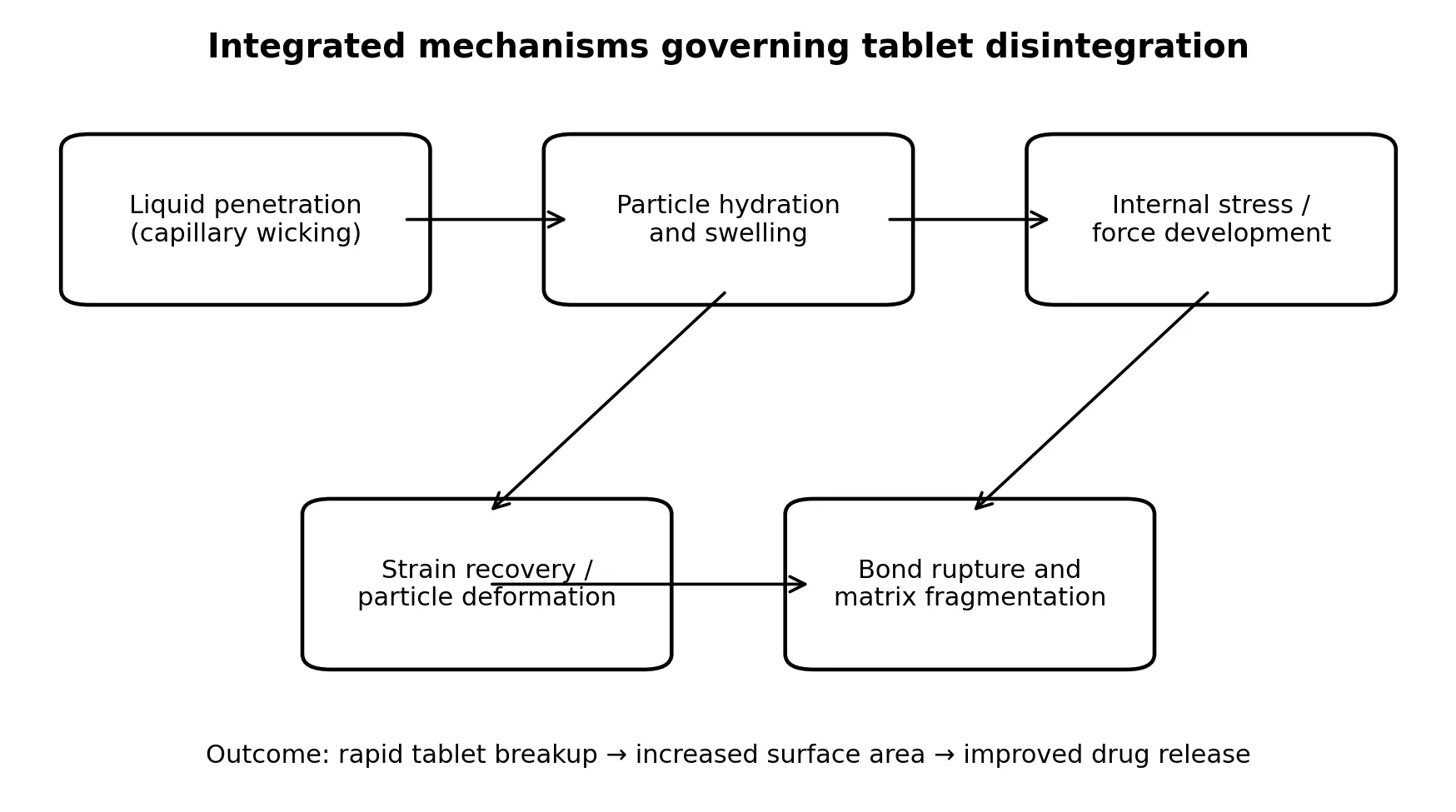
Rapidly disintegrating tablets (RDTs) represent a significant advancement in oral drug delivery and are specifically designed to undergo rapid structural disintegration upon contact with saliva, allowing administration without the need for water. (Fig 1) Traditionally, this fast disintegration has been achieved through the incorporation of hydrophilic superdisintegrants, which enhance water uptake, swelling, and matrix disruption within the tablet. However, rapid disintegration is not governed by superdisintegrants alone; it also depends on the interplay between formulation composition and tablet architecture. The selection of an appropriate superdisintegrant is critical, as its concentration and physical interaction with the active pharmaceutical ingredient dictate the overall porosity and kinetic disintegration behaviour of the final dosage form. Consequently, current review aims to elucidate the synergistic effects of multicomponent disintegrant systems that balance rapid hydration rates with the structural integrity necessary for industrial tabletting processes. Beyond these foundational characteristics, modern investigations are increasingly focusing on the optimisation of particle size distribution and ionic charge density to mitigate potential compatibility issues between excipients and moisture-sensitive therapeutic agents. In this context, the integration of super-porous hydrogels and modified cellulose derivatives has emerged as a promising strategy to sustain rapid disintegration even when formulated with hydrophobic drug candidates. Moreover, the strategic application of co-processed excipients has further refined this process by minimising segregation tendencies while simultaneously enhancing the compactability of the tablet blend. Furthermore, the incorporation of cross-linked polymers is being evaluated for their ability to exert high swelling pressures without compromising the tablet's friability or storage stability. Ultimately, these multifaceted approaches enable formulators to navigate the trade-off between accelerated wetting kinetics and the mandatory requirements for long-term shelf life in humid conditions. While the wicking effect facilitates rapid solvent penetration into the tablet matrix, the swelling capacity of superdisintegrants is a key determinant of tablet disintegration, as rapid water uptake and volumetric expansion generate internal stresses that break the tablet into smaller fragments. This physical disintegration increases the available surface area for drug release and subsequently enhances the dissolution rate, particularly for immediate-release and rapidly disintegrating tablet formulations. The swelling capacity of these agents remains a primary determinant of the overall dissolution rate (Zhao & Augsburger, 2005a). However, recent evidence suggests that the disintegration force development rate serves as a more reliable predictor of tablet breakdown speed than the extent of swelling alone (Agiba & Ahmed, 2019). Furthermore, alternative disintegration mechanisms—including particle repulsive forces, heat of wetting, strain recovery, particle deformation, and capillary wicking—may contribute alongside swelling in highly compressed tablets, indicating that tablet disintegration is governed by multiple complementary mechanisms rather than swelling alone (Kumar & Kumari, 2019). Moreover, the interplay between excipient moisture content, granule density, and the specific mode of disintegrant incorporation requires rigorous control, as these factors fundamentally modulate the rate of liquid imbibition and subsequent structural collapse (Maclean et al., 2021). Specifically, for superdisintegrants like sodium starch glycolate and croscarmellose sodium, the degree of molecular crosslinking and substitution represents a critical functional attribute, as these parameters directly regulate the viscosity of the surrounding medium and the resultant polymer swelling capacity (Zarmpi et al., 2020). In particular, crospovidone demonstrates superior efficacy in this regard due to its porous morphology and high crosslink density, which enable rapid liquid penetration and swelling without the formation of a viscous gel layer (Agrawal et al., 2016). Additional functional-related characteristics, such as particle size distribution, also dictate the hydration capacity and powder flow ability of these crospovidone grades, thereby influencing the overall disintegration performance of the final tablet (Berardi et al., 2021). Indeed, the variation in functional-related characteristics among different crospovidone grades underscores the necessity of decoupling particle size from hydration capacity to accurately predict the disintegration outcomes of orally disintegrating tablets (El-Saleh et al., 2025). Furthermore, while croscarmellose sodium relies on a complex combination of swelling, wicking, and deformation, its fibrous structure necessitates careful optimisation of tablet porosity to avoid sub-optimal transport kinetics (Prabhat et al., 2021). Conversely, studies have indicated that crospovidone may achieve disintegration times under 30 seconds due to its sponge-like porous structure, which promotes superior capillary action compared to other superdisintegrants (Amelian, 2012). Current analytical methodologies, such as high-resolution X-ray computed tomography and terahertz pulsed imaging, are now employed to non-destructively quantify the internal pore architecture evolution during the hydration phase. Current analytical techniques have greatly improved the understanding of tablet disintegration by enabling non-destructive evaluation of structural changes during hydration. Advanced imaging methods, including high-resolution X-ray computed tomography (X-ray CT) and terahertz pulsed imaging (TPI), are increasingly used in research to visualise internal pore architecture, liquid penetration, and matrix evolution without damaging the tablet. However, because these techniques require specialised instrumentation, more accessible approaches are gaining wider adoption. In particular, non-contact sensor systems integrated with conventional USP disintegration or dissolution apparatus provide real-time kinetic measurements of tablet swelling, liquid uptake, and disintegration behaviour. These methods offer a practical and cost-effective alternative for continuous monitoring, making them valuable tools for both pharmaceutical research and routine formulation development.
figure

Figure 1: Integrated Sequence of Liquid Uptake, Swelling, Stress Development and Tablet Fragmentation.
figure

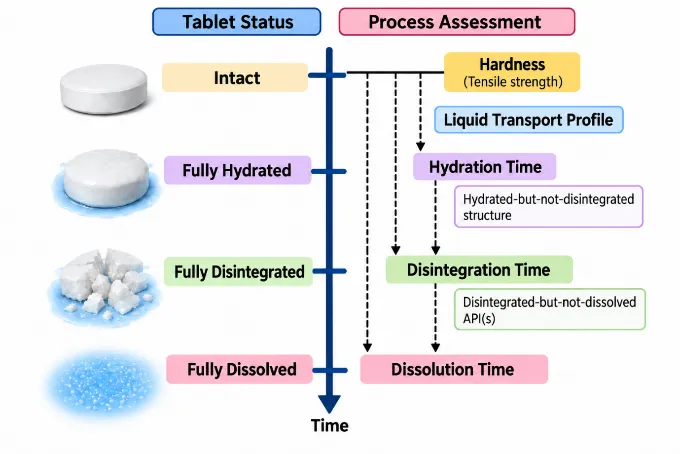
Figure 2: Systematic Representation of Tablet Hydration, Disintegration, and Dissolution Stages with Corresponding Process Assessment Parameters.

2. Superdisintegrants in Oral Drug Delivery Systems

Within this therapeutic landscape, sodium starch glycolate is frequently prioritised for its ability to achieve significant multi-dimensional swelling, often expanding 7–12 times its volume within 30 seconds (Elhabal et al., 2023). Similarly, crospovidone functions through capillary-mediated liquid uptake, maintaining its characteristic swelling capacity and porosity even in acidic media, which preserves disintegration kinetics across varying physiological pH levels (Mohite et al., 2024). Furthermore, scanning electron microscopy reveals that crospovidone particles possess a highly porous morphology that optimizes the wicking of fluids into the tablet matrix, facilitating rapid breakdown without the gelation often encountered with lower crosslink density agents (Sharma, 2019). In contrast, tablets containing crospovidone demonstrate significantly higher hardness values compared to those formulated with croscarmellose sodium, highlighting a unique balance between mechanical robustness and rapid disintegration (Gohel et al., 2007). Beyond these traditional disintegrants, the chemical modification of starches to produce sodium starch glycolate involves a distinct crosslinking process that significantly enhances volume expansion compared to unmodified counterparts, typically increasing particle volume by 200–300% upon hydration (Shobana et al., 2020). Such substantial expansion is notably higher than that of poly (acrylate) derivatives, which have been observed to exhibit lower swelling capacities of approximately 59% in comparative assessments (Pabari & Ramtoola, 2012). While synthetic polymers like crospovidone maintain high performance in aqueous or acidic environments without hindering dissolution through gel formation, other materials such as microcrystalline cellulose provide auxiliary swelling that supports the overall structural disintegration (Sharma & Sonawane, 2017). Additionally, the incorporation of cross-linked alginic acid offers a distinct advantage, as it facilitates rapid disintegration through both wicking and swelling mechanisms in either wet or dry granulation processes (Roshan & Keerthy, 2021). Furthermore, studies indicate that croscarmellose sodium often facilitates superior disintegration rates compared to other synthetic alternatives, primarily due to its exceptional swelling capacity (Nzekwe et al., 2025). However, this agent may also increase local viscosity upon contact with aqueous media, potentially delaying fluid penetration into the tablet core if the swelling is accompanied by excessive gelling (Teran, 2016). Moreover, the functional efficacy of croscarmellose sodium can be significantly influenced by the surrounding media, as acidic conditions often negatively impact its water uptake and swelling capacity due to the specific nature of its carboxymethyl sodium substituents.

3. Tablet Disintegration Mechanisms

The fundamental disintegration behaviour is governed by a tripartite interplay of liquid wicking, particle deformation recovery, and hygroscopic swelling (Hanif et al., 2018). While individual disintegrants are often evaluated by their bulk water uptake capacity, research indicates that the force generated during this process is highly dependent on the particle's specific interaction with the solvent medium (Rudnic et al., 1982). For instance, wet granulation processes can significantly alter the tensile strength and subsequent disintegratability of these agents, demonstrating that their performance in a poorly water-soluble matrix is not solely an intrinsic property (Veronica et al., 2024). Rather, the physical state and flowability of the disintegrant, such as the superior flow properties exhibited by sodium starch glycolate, play a decisive role in the final compact's structural integrity and breakdown kinetics (Chauhan et al., 2018). Furthermore, while compendial assays provide necessary data regarding chemical quality, they often fail to capture the nuances of surface area and porosity that govern the functional equivalence of different superdisintegrant sources (Shah & Augsburger, 2002). Consequently, selecting an appropriate addition method—whether intergranular, extra-granular, or a split-part approach—is essential to optimise these functional attributes, as the timing of incorporation directly dictates the rate of medium penetration and the subsequent replacement of adsorbed air (Iswariya et al., 2021). Conversely, the selection of the incorporation method can significantly influence the wetting time, where higher concentrations of superdisintegrants often correlate with accelerated soaking and reduced disintegration times, as evidenced by studies identifying crospovidone as achieving the fastest breakdown (Apeji et al., 2019). This rapid disintegration is further supported by the agent's ability to act as hydrophilic channels that facilitate deep water transfer into the tablet core, thereby enhancing the solubilization of internal constituents (Makar et al., 2017). In addition, emerging research highlights carboxymethyl starch as a versatile alternative, which functions through the dual mechanisms of rapid swelling and electrostatic repulsion to effectively overcome tablet-matrix cohesion (Desai et al., 2026).

3.1 Swelling and Wicking Processes

The liquid absorption behaviour of a formulation is significantly influenced by the interplay between the tablet's internal pore structure and the specific hydration kinetics of the disintegrant. Studies indicate that while swelling-based disintegrants show minimal sensitivity to variations in relative tablet density, storage conditions significantly impact the kinetics of water uptake and force development, particularly for agents like sodium starch glycolate (SSG) (Quodbach & Kleinebudde, 2014). Conversely, compaction pressure significantly modulates the sensitivity of these disintegration mechanisms, as higher forces can restrict the available porosity required for efficient wicking and structural expansion (Zheng et al., 2022). This negative correlation between compaction-induced density and disintegration performance arises because reduced porosity limits the rate of liquid penetration necessary to trigger the internal swelling forces (Maclean et al., 2021). Furthermore, the integration of co-processed excipients has emerged as a strategic approach to mitigate these compaction-related challenges, as these engineered materials often maintain high porosity and enhanced flowability even under increased compression forces (Malode et al., 2025). Ultimately, the total disintegration process is governed by a series of four interconnected sequences, including liquid uptake, particle swelling, dissolution of interparticle bonds, and final matrix break-up (Markl et al., 2021).

3.2 Strain recovery

During hydration, the polymer molecules transition from a constrained, glassy state to a flexible, rubbery configuration, facilitating the release of stored elastic energy (Markl & Zeitler, 2017). This rapid physical reconfiguration effectively ruptures interparticulate bonds, a process that is highly dependent on the number and strength of contacts formed during the initial compression phase (Markl et al., 2017). The dynamic evolution of these interparticulate contacts, driven by the swelling of particles, significantly alters the available pore space and consequently dictates the overall disintegration timescale (Soundaranathan et al., 2023). Furthermore, recent calorimetric investigations indicate that this exothermic transition generates measurable heat changes, providing a quantifiable link between the energy released during hydration and the total disintegration kinetics of the tablet matrix. Beyond these chemical and structural factors, the internal pore network serves as a critical conduit, as its architecture dictates the capillary and viscous forces that govern the ingress of gastrointestinal fluids to the site of particle bonds (Markl et al., 2017). The efficacy of this fluid transport is inherently linked to the available pore volume, which influences the hydration rate and the subsequent mechanical rupture of interparticular sinter bridges (Yassin et al., 2015).

4. Superdisintegrant Classification

Superdisintegrants are categorized based on their primary physical mechanism of action (Fig.2) including swelling, water wicking, and the mechanical recovery of deformed particles (Garg & Gupta, 2013). Specifically, strain recovery involves the reversible viscoelastic deformation of particles, where the mechanical activation upon fluid contact forces the polymer chains back to their original, energetically favourable shape (Silva et al., 2018). This phenomenon, often associated with microcrystalline cellulose or specific croscarmellose sodium grades, provides a distinct disruptive force that complements traditional osmotic swelling (Soundaranathan et al., 2020). Additionally, the mechanism of wicking—the rapid capillary transport of fluid through the tablet pores—often functions in tandem with these swelling properties, particularly in formulations utilizing crospovidone to ensure rapid matrix fragmentation (Yeom et al., 2017). Furthermore, low-substituted hydroxyl propyl cellulose variants utilize rapid swelling to provide effective disintegration without forming gels, proving especially beneficial in high-porosity systems (Nyol & Gupta, 2013). Despite these mechanical advantages, the selection process remains complex because the efficacy of each superdisintegrant is highly dependent on formulation-specific variables such as tablet compaction force and potential interactions with the active pharmaceutical ingredient (Rydhög, 2020). For instance, a disintegrant must ideally possess a small particle size to avoid a gritty mouthfeel, ensuring patient compliance for orally disintegrating delivery systems (Devi et al., 2022). Moreover, synthetic superdisintegrants like crospovidone are frequently preferred in such applications because their highly porous structure avoids complexation with drug molecules, thereby maintaining compatibility while ensuring efficient performance at low concentrations (Tafere et al., 2021).

Strain/shape recovery

Table 1: Principal Mechanisms of Superdisintegrants and Key Formulation Considerations.

Mechanism Representative agents Principal action Main formulation consideration
Swelling Sodium starch glycolate; croscarmellose sodium Rapid water uptake and volumetric expansion Excessive swelling/gel formation may retard liquid penetration
Wicking/Capillary action Crospovidone; microcrystalline cellulose Capillary transport of liquid through tablet pores Requires adequate pore connectivity and hydrophilic pathways
Strain recovery/deformation Cross-linked polymers; selected cellulose derivatives Recovery of deformed particles generates disruptive stress Strongly influenced by compaction pressure and particle deformation
Repulsion/heat of wetting/gas release Mechanism-dependent systems Additional forces assist bond rupture and matrix breakup Usually acts synergistically with swelling and wicking

4.1 Synthetic Disintegrant

These agents are engineered through precise chemical cross-linking or polymerization processes to achieve high-efficiency disintegration by maximizing osmotic pressure and swelling capacity (Sharma & Chauhan, 2021). For example, croscarmellose sodium functions through a synergistic combination of capillary-driven wicking and rapid particle expansion, which remains effective even at low concentrations (Parfati & Rani, 2018). Similarly, sodium starch glycolate is frequently utilized due to its exceptional ability to undergo rapid volumetric expansion, which significantly reduces the disintegration time of drug matrices (Gangane et al., 2020). Furthermore, crospovidone is widely utilized for its unique wicking capabilities and rapid dispersion in aqueous environments, providing instantaneous tablet breakup in the gastrointestinal tract (Kute et al., 2023). Although effective, these synthetic materials are frequently associated with higher manufacturing costs and limited biodegradability, driving ongoing research toward sustainable, plant-derived alternatives (Aswini et al., 2026). The emerging field of co-processed excipients further bridges this gap, combining the structural reliability of synthetic polymers with the functional advantages of natural modifiers to achieve tailored disintegration kinetics (Kaur & Kaur, 2017). These systems, including specialized products like Ludiflash and F-melt, enhance the physical properties of the blend to provide superior tableting performance and a pleasant mouthfeel without the need for additional water (Nimbalkar et al., 2022).

Table 2: Comparative Functional Profile of Selected Synthetic and Cross-Linked Superdisintegrants.

Superdisintegrant Dominant mechanism(s) Strengths highlighted in the review Potential limitation
Crospovidone Wicking; porous capillary channels Rapid liquid penetration; minimal gel formation; useful at low levels Performance depends on grade, particle size and tablet porosity
Croscarmellose sodium Swelling + wicking + deformation High swelling capacity; effective in direct compression and wet granulation Excessive viscosity and pH-dependent hydration may delay penetration
Sodium starch glycolate Extensive swelling Very high volumetric expansion; strong disintegration force Overuse or unsuitable conditions may cause gelling and delayed breakup
Cross-linked alginic acid / related polymers Wicking + swelling Can support rapid disintegration across processing routes Requires optimization of concentration and matrix structure

The efficacy of these agents is primarily driven by the ability to generate internal pressure that overcomes the cohesive forces of the tablet binder (Metta & Sahoo, 2024). This pressure is largely generated through capillary-driven liquid penetration, which accelerates the dispersion of the tablet matrix to increase the effective surface area available for dissolution (Kesare et al., 2023). Beyond these mechanical pathways, recent advancements have focused on co-processed excipients that combine multiple functionalities to overcome the limitations of single-component systems (Nabila & Karo-Karo, 2024). These synergistic blends effectively bridge the gap between processability and performance, enabling the creation of compacts with superior mechanical strength and rapid fragmentation characteristics (Dhiman et al., 2022). By incorporating these materials, formulators can effectively optimize the bioavailability of poorly soluble drugs while simultaneously improving patient compliance in sensitive populations such as the elderly and paediatric patients (Prakash et al., 2023) However, formulators must remain cognizant that while these agents demonstrate peak performance at low concentrations, exceeding optimal levels can hinder tablet breakdown by creating a viscous gel layer that impedes liquid penetration (Vv et al., 2013)

4.2 Natural disintegrant

Beyond synthetic options, natural superdisintegrants such as plant-derived mucilages, gums, and polysaccharides offer a sustainable and biologically compatible alternative for fast-disintegrating formulations (Fahmansyah et al., 2024). These bio-sourced materials often exhibit high swelling indices that rival synthetic analogs, providing an economical and environmentally benign approach to modulating tablet porosity (Shokri & Adibki, 2013). Investigations into natural polymers like guar gum have demonstrated that specific formulations can achieve rapid dissolution profiles, reaching nearly 100% drug release within minutes while maintaining structural integrity during processing (Pradhan et al., 2021). The integration of these natural polymers also offers significant advantages in paediatric and geriatric applications, as they are generally recognized as non-toxic, non-irritant, and biodegradable. These natural excipients are particularly advantageous in addressing the medication administration burdens encountered by paediatric and geriatric patient populations (Sharma, 2021). Natural polysaccharides such as Plant ago ovata and Osmiummucilage basilica mucilage’s have demonstrated particular utility in this regard, offering multifunctional benefits as binders and release modifiers that effectively reduce the incidence of dysphagia-related non-compliance (Mehta et al., 2025). Similarly, the application of Hibiscus Rosa sinensis leaf mucilage has emerged as a promising strategy for enhancing the bioavailability of poorly soluble drugs like metoprolol tartrate, effectively optimizing the disintegration profile of or dispersible systems (Bagchi et al., 2026). Building upon this, other botanical derivatives such as Aegle marmelos mucilage are increasingly evaluated for their superior swelling and binding properties, providing a cost-effective, non-toxic alternative to synthetic counterparts like sodium starch glycolate (Patil et al., 2026). Furthermore, materials such as Mangifera indica gum and locust bean gum are gaining prominence for their ability to significantly decrease disintegration time while simultaneously acting as stabilizers for poorly water-soluble active pharmaceutical ingredients (Alam et al., 2014; Sunitha et al., 2014). These natural polymers demonstrate enhanced biocompatibility and reduced toxicity compared to traditional synthetic excipients, facilitating broader utilization in pediatric and geriatric drug delivery systems (Naliyadhara et al., 2025). Recent comparative studies indicate that natural mucilages, such as those derived from Fenugreek, may even outperform widely used synthetic disintegrants like sodium starch glycolate in optimizing the wetting and water absorption characteristics of fast-dissolving tablets (Malviya et al., 2020). Beyond their functional efficacy, these bio-sourced polymers offer significant economic advantages, as they are often derived from renewable, cost-effective agricultural byproducts (Saini & Sharma, 2012). Moreover, their inherent biodegradability and biocompatibility align with modern green chemistry initiatives, ensuring that pharmaceutical manufacturing remains both sustainable and patient-centric (Thakare et al., 2026).

5. Formulation Variables affecting disintegration

Compression pressure stands out as a critical determinant, as elevated force often results in increased tablet density and reduced pore space, which restricts the liquid penetration essential for structural disruption (Adeleye, 2019). Furthermore, the solid fraction of the compact serves as a primary predictor of dissolution and disintegration behaviour, as it accounts for the mechanisms governing fluid mass transport within the tablet core. Additionally, the degree of bond deformation during compaction further dictates the final matrix structure, where excessive plastic deformation may impede the expansion necessary for effective disintegration (Rawas‐Qalaji et al., 2006). Beyond these compression-related constraints, material-specific phenomena such as strain recovery play a critical role, wherein particles revert to their original shape upon contact with moisture, exerting outward axial pressure against the compact matrix (Markl & Zeitler, 2017). This shape recovery mechanism facilitates disintegration by generating localized stress that exceeds the cohesive forces within the matrix, particularly when materials exhibit unidirectional expansion following their prior deformation during compaction (Maclean et al., 2021). Concurrent with these structural dynamics, the rupture of interparticulate bonds remains a prerequisite for effective matrix breakdown, necessitating a delicate balance between mechanical integrity and the requirement for rapid dissolution (Markl et al., 2020). Advanced diagnostic methods, such as high-speed imaging and magnetic resonance imaging, have proven essential in mapping these internal stress distributions and quantifying liquid transport kinetics (Ma et al., 2024). Furthermore, recent developments in computational modelling and terahertz pulsed imaging provide a non-invasive, mechanistically grounded framework for monitoring these real-time internal liquid transport kinetics. These innovative technologies help elucidate how specific pore evolution and capillary structures contribute to the macroscopic disintegration response (Lee et al., 2025). Beyond these analytical advancements, it is essential to recognize that filler characteristics often exert a synergistic influence on the disintegrating agent, significantly modulating the overall tablet hydration profile (Gupta et al., 2009). For instance, the interplay between excipient morphology and particle-based mechanics highlights that optimizing the internal connectivity of the tablet is as critical as the selection of the superdisintegrant itself (Martins, 2021). Moreover, empirical models based on Darcy’s law and modified swelling equations have confirmed that the evolution of pore size and local permeability during hydration are primary determinants of the overall disintegration success (Markl et al., 2017).

5.1 Excipient Interaction

The synergy between superdisintegrants and co-processed fillers often dictates the formation of critical capillary networks that dictate the overall hydration rate of the matrix (Bawuah et al., 2020). For instance, formulations incorporating croscarmellose sodium leverage localized fragmentation to maximize pore expansion, which drastically accelerates fluid ingress compared to monolithic excipient systems (Kalugin et al., 2026). However, these benefits must be balanced against the presence of lubricants like magnesium stearate, which can create hydrophobic barriers that retard liquid penetration and counteract the expansion forces generated by the superdisintegrant (Lee et al., 2025). In particular, research utilizing terahertz pulsed imaging has demonstrated that modulating formulation porosity and superdisintegrant concentrations significantly alters the moisture transport kinetics and internal swelling rates required for effective tablet disruption (Yassin et al., 2015). Furthermore, understanding the localization of the advancing liquid front within the compact matrix is essential for refining the empirical models that predict tablet disintegration times in variable production environments (Lee et al., 2023). Moreover, the physicochemical nature of the active pharmaceutical ingredient further influences these dynamics, as higher solubility compounds often exhibit improved dissolution rates through enhanced excipient hydration, whereas poorly soluble drugs may suffer from surface swelling that impedes mass transport (Brown et al., 2021). In addition, the inherent variability in excipient quality and material attributes significantly impacts these wetting processes, often necessitating a nuanced biopharmaceutical approach to formulation design (Zarmpi et al., 2020). Integrating mathematical models based on Darcy’s law with empirical hydration kinetics allows for a more predictive assessment of how porosity and pore permeability evolve during the disintegration process (Markl et al., 2017).

5.2 Compression Force

While higher breaking force and tablet density generally correlate with slower dissolution profiles, lower initial compression settings are often required to maintain efficient moisture uptake and rapid disintegration (Zaborenko et al., 2019). This relationship is further complicated by the interaction between fillers and lubricants, where hydrophilic additives may compete with disintegrants for moisture, thereby restricting the fluid availability required for effective matrix rupture (Backere et al., 2022). Specifically, higher concentrations of lubricants like magnesium stearate can exacerbate this effect by forming hydrophobic films that block water ingress, whereas alternate choices such as sodium stearyl fumarate may show varying impacts on disintegration due to their distinct hydrophilic properties (Kota et al., 2024). Moreover, studies indicate that the retention of viscous environmental media, such as xanthan gum, on the tablet surface can lead to significant disintegration delays, even when disintegrants with high water mobility, like crospovidones, are utilized (Sugiura et al., 2020). Beyond these compositional factors, the target load itself serves as a dominant variable, as increased compaction force typically lowers porosity and restricts water penetration, thereby significantly lengthening the disintegration timeframe (Iurian, 2020). Furthermore, the solubility profile of the incorporated active pharmaceutical ingredient acts as a modifier for these compression effects, as higher drug loadings can either facilitate or impede fluid pathways depending on the specific solute-matrix affinity (Al-Dujaili & Roberts, 2026). Additionally, the disintegration force development rate has been identified as a superior predictor of performance compared to the mere magnitude of swelling capacity, highlighting the importance of kinetic factors in tablet matrix breakdown (Agiba & Ahmed, 2019). Consequently, researchers have increasingly prioritized the optimization of internal pore structures, such as connectivity and size distribution, to ensure that liquid transport remains unobstructed even under high-density compaction (Al‐Sharabi et al., 2020).

5.3 Deformation and Porosity Effects

High-pressure compression often induces plastic deformation in disintegrant particles, which can neutralise their expansive potential by collapsing the internal capillary network required for rapid liquid transport. This structural collapse limits the surface area available for fluid contact, ultimately hindering the rapid dissolution essential for efficient drug release (Miljković et al., 2024). Recent research underscores that tablet disintegration relies on a complex, interdependent sequence of events where dynamic pore structure changes play a pivotal role in regulating fluid transport (Soundaranathan et al., 2023). Specifically, the distribution and relative void space within the tablet matrix dictate the capillary and viscous forces that facilitate fluid ingress and the subsequent disruption of interparticulate solid bridges (Markl et al., 2017)

5.4 Superdisintegrant Conc.

Superdisintegrant as a Key Formulation Variable ion is a central determinant of disintegration capacity and dissolution performance, since increasing the level of these excipients accelerates water uptake and tablet breakup in immediate-release systems (Yeom et al., 2017). Nevertheless, the relationship between superdisintegrant concentration and performance is not strictly linear, because the swelling capacity, fiber-like morphology, and sorption behaviour of each excipient determine how efficiently water is drawn into the tablet matrix (Zhao & Augsburger, 2005a, 2005b). Differences in particle size distribution further modulate this behaviour, since larger particles of croscarmellose sodium and sodium starch glycolate swell more extensively than smaller ones, whereas crospovidone, with its more porous structure, relies on capillary wicking rather than volumetric swelling (Zarmpi et al., 2020). Because crospovidone's high crosslink density allows it to swell rapidly in water without gelling, its disintegration action depends less on volume expansion and more on the rapid penetration of liquid through its porous particle network (Agrawal et al., 2016). Because this capillary-driven mechanism is largely independent of pH, crospovidone retains its wicking efficiency in acidic media, where its liquid uptake and swelling capacity remain comparable to those observed in aqueous medium (Gohel et al., 2007). Consequently, formulators working with crospovidone-based systems can expect comparable disintegration times across a range of gastric and intestinal conditions, which simplifies the selection of this excipient when the drug's solubility varies with pH (Tafere et al., 2021).

5.5 Effect of addition method

Superdisintegrants are commonly incorporated into rapidly disintegrating tablet formulations either before granulation (intragranularly), after granulation (extragranularly), or through a combination of both approaches, and the choice of addition method alters how the disintegrant is distributed within the compact and therefore how it interacts with water penetration, swelling, and tablet microstructure. Intragranular addition places the superdisintegrant within the granule matrix, where it is exposed to the binder and other excipients during wet massing, which can reduce its swelling capacity and disintegration efficiency relative to the same quantity added externally (Iswariya et al., 2021; Veronica et al., 2024). Extragranular addition, by contrast, keeps the disintegrant largely outside the granule core, so that it can hydrate and swell directly at the particle surfaces and within the interparticulate pore network once the tablet contacts the aqueous medium (Apeji et al., 2019). Because the granulation step can physically entrap the disintegrant within denser, larger particles, the efficiency of an intragranularly added superdisintegrant is strongly influenced by granule density and the extent of water competition from soluble or hygroscopic excipients (Maclean et al., 2021; Quodbach & Kleinebudde, 2014). In contrast, extragranular addition largely avoids this entrapment, which is why the disintegrant retains its intrinsic swelling and wicking behaviour when the tablet is exposed to the disintegration medium, as the intragranular route tends to preserve good disintegration activity only when the compaction process does not expose the disintegrant to repeated wetting and drying (Makar et al., 2017). Granulation-related losses of efficiency have been directly documented: wet granulation with a binder reduced the disintegration performance of crospovidone, croscarmellose sodium and sodium starch glycolate in a poorly water-soluble matrix, and the sensitivity of each disintegrant differed (Veronica et al., 2024), while the rate of water uptake into the matrix was significantly altered (Al‐Sharabi et al., 2020).

5.6 Effect of Moisture and Storage Conditions on Disintegration of Rapid Disintegrating Tablets

Residual moisture within the compacted matrix and moisture gained during storage are both capable of altering the hydration state, swelling capacity and pore architecture of superdisintegrant-containing tablets, which in turn governs how rapidly water penetrates the dosage form and how quickly it disintegrates. Because superdisintegrants such as croscarmellose sodium, sodium starch glycolate and crospovidone differ in their hygroscopicity, swelling kinetics and water-uptake pathways, the same moisture burden does not affect them uniformly, and premature swelling during storage can convert a formulation designed for rapid disintegration into one that disintegrates slowly or not at all (Maclean et al., 2022) Storage-induced changes in disintegration are therefore not simply a matter of moisture quantity, but of how each disintegrant's water-uptake behaviour interacts with the humidity and temperature profile it experiences over time, as demonstrated for sodium starch glycolate, whose disintegration times are affected most strongly by storage conditions through reduced water uptake and force development kinetics (Quodbach & Kleinebudde, 2014). Conversely, crospovidone, which lacks the ionizable carboxylate groups of croscarmellose sodium and sodium starch glycolate, appears to tolerate moisture exposure more gracefully in several reported storage studies, although this apparent robustness has not been resolved mechanistically and remains a hypothesis requiring confirmation through humidity-controlled imaging of liquid penetration. Such a study would need to track water uptake, swelling force and disintegration time under controlled relative humidity, since storage studies conducted to date have generally reported only end-point disintegration times and have not isolated the kinetic contribution of moisture acquired before compression from that acquired during storage (Markl et al., 2021). Wet granulation and drying steps add a further, distinct source of moisture, since residual water retained after drying can be redistributed within the compact during blending and compression, so that the initial hydration state of each disintegrant particle varies with the thermal history of the granulate rather than with the nominal moisture specification alone. Because disintegrants such as croscarmellose sodium and sodium starch glycolate act largely through swelling, even modest differences in pre-compression hydration can alter the swelling force they generate once water reaches the compact, a relationship that has been linked to specific disintegration mechanisms in which swelling dominates for these two materials (Zhao & Augsburger, 2005a). Conversely, the wicking and water-penetration pathway that is thought to predominate for crospovidone implies that its performance depends more on the availability of open capillary pores than on the swelling capacity of individual particles, so that moisture-induced densification or pore closure during storage could be expected to impair it through a different route, a possibility that has not yet been tested directly (Lee et al., 2025; Soundaranathan et al., 2023).

6. Performance Evaluation and optimization

Traditional compendial testing, such as the USP〈701〉 method, provides a binary pass/fail assessment that, while crucial for quality control, often fails to elucidate the underlying thermodynamics of the disintegration process (Lee et al., 2024). To address these limitations, researchers are increasingly employing mechanistic particle-based models that analyse the coupled dynamics of imbibition and swelling to better predict how specific granular configurations influence the rate of matrix breakdown (Martins, 2021). These refined analytical approaches reveal that tablets formulated without disintegrating agents often require substantially longer durations for complete fragmentation, highlighting that relying solely on tablet components without targeted superdisintegrants is frequently insufficient for rapid release kinetics (Gupta et al., 2009). Consequently, when binders or fillers demonstrate poor inherent wetting, the integration of superdisintegrants becomes mandatory to overcome the kinetic barriers to fluid penetration (Backere et al., 2021). Indeed, optimizing the concentration of these agents is critical, as studies have shown that increasing the level of superdisintegrants can significantly reduce wetting time and improve overall disintegration performance (Dash et al., 2022). However, researchers note that relying exclusively on simulated wetting tests to quantify these effects may introduce biases, as simple wetting measurements do not always correspond linearly with formal in vitro disintegration outcomes (Sutthapitaksakul et al., 2022).

Table 3: Overview of Methods Used to Characterize Disintegration Performance and Hydration Kinetics.

Evaluation approach Information obtained Main advantage Main limitation
USP disintegration test Endpoint disintegration time Standardized and suitable for routine QC Limited mechanistic and in vivo predictive information
Wetting-time / water-uptake tests Initial hydration and wetting behavior Simple and accessible screening method May not correlate linearly with complete disintegration
Swelling-pressure / force measurements Force development during hydration Mechanistically informative predictor of breakdown Requires specialized apparatus and careful calibration
X-ray CT / terahertz imaging Internal pore structure and liquid-front evolution Non-destructive, spatially resolved analysis High instrumentation and expertise requirements
Non-contact sensing / real-time tracking Dynamic swelling, erosion and gap-height changes Continuous kinetic monitoring with practical implementation potential Still requires method standardization

6.1 In Vitro Testing Protocols

Standardised USP procedures, while serving as regulatory benchmarks, often lack the agitation precision required to accurately correlate measured disintegration times with actual in vivo performance (Zhao & Augsburger, 2005b). Consequently, investigators are adopting flow-through cell systems and refined hydrodynamic models that better simulate the peristaltic forces and gastric shear encountered in the human gastrointestinal tract (Agiba & Ahmed, 2019). These advanced systems facilitate a deeper examination of multiple disintegration mechanisms, including particle repulsion and the heat of wetting, which are often overlooked in conventional testing (Hemalatha & Ramu, 2023). For instance, the implementation of non-contact distance sensors now allows for the generation of mechanical fingerprints that quantify the dynamic erosion interface, offering a more nuanced view than traditional endpoint-based metrics. This high-resolution tracking of gap height evolution reveals that the disintegration behaviour is highly dependent on formulation-specific structural breakdown (Lee & Zeitler, 2026). Furthermore, imaging studies indicate that physiological factors, such as gastric transit and the presence of food-induced viscosity, can impose constraints that standardised in vitro conditions often fail to replicate (Seoane‐Viaño et al., 2023). To bridge this gap, investigators increasingly utilize biorelevant dissolution media containing surfactants or phospholipids, which more accurately reflect the surface tension and wetting characteristics found in the human gastric environment (Azarbayjani et al., 2009). Moreover, researchers are exploring the use of high-viscosity media that mimic postprandial conditions to assess the robustness of superdisintegrants against the slowed fluid transport induced by food ingestion (Stahl et al., 2026). These advancements in testing methodology are essential, as current standardized apparatuses often provide limited insights into the complex hydrodynamics of the gastrointestinal tract, necessitating the development of novel testers that allow for adjustable flow and shear conditions (Abrahamson et al., 2020). Furthermore, regulatory frameworks acknowledge the inherent limitations of these compendial setups, as the volumes used in standard dissolution testing significantly exceed the limited quantities of fluid available in the human buccal cavity (Cilurzo et al., 2017).

6.2 Optimization Study Designs

Effective experimental designs currently utilize factorial approaches to evaluate the synergistic interactions between superdisintegrant concentrations and compression pressures, ensuring that formulations maintain consistent disintegration rates across varying physiological conditions. Advanced methodologies, such as high-speed video imaging and magnetic resonance imaging, are now routinely incorporated into these designs to quantify liquid transport and swelling kinetics within porous compacts (Al‐Sharabi et al., 2020). Additionally, the application of three-dimensional tomographic imaging allows for the precise measurement of particle size distribution near the tablet surface under low-velocity flow, overcoming the limitations imposed by the high hydrodynamic forces of standard pharmacopoeia apparatus (Lenz et al., 2022). Beyond these visualization techniques, recent developments in biorelevant media now incorporate specific additives like sodium taurocholate and lecithin to better mimic the surfactants present in the proximal gastrointestinal tract (Hashem et al., 2020). These specialized media are instrumental in predicting how superdisintegrants interact with complex surfactant environments, ultimately guiding the selection of optimal formulations for maximizing drug bioavailability. Moreover, recent investigations underscore the necessity of evaluating superdisintegrant performance under simulated fed-state conditions, as food-induced viscosity can substantially delay disintegration and impair the bioavailability of specific drug compounds. Furthermore, implementing an Analytical Quality by Design (aQbD) approach allows researchers to systematically assess how variables such as disintegrant levels, particle size distribution, and compression forces interact to influence the overall dissolution profile.

Table 4: Summary of Key Formulation Variables, Expected Effects and Optimization Concerns.

Design variable Expected influence Useful response Optimization concern
Superdisintegrant concentration Changes hydration and force development Disintegration time; wetting time Excessive level may reduce tablet strength
Compression force Changes porosity and pore connectivity Tensile strength; disintegration time Over-compression may slow liquid penetration
Addition method Controls intra-/extra-granular distribution Water uptake; robustness Split addition may balance strength and rapid breakup
Moisture and storage May alter swelling and premature activation Stability; friability Humidity control is essential
Excipient interaction Excipient interactions can affect liquid penetration, swelling, tablet porosity, and disintegration time. Disintegration time, swelling ratio, water absorption, and tablet mechanical strength Optimize excipient compatibility and concentration to minimize adverse interactions, avoid excessive swelling or gel-layer formation, maintain tablet strength, and achieve rapid, reproducible disintegration.
Deformation & Porosity Influence tablet pore structure, liquid penetration, mechanical strength, and disintegration time. Porosity, tensile strength, and disintegration time. Optimize compression force to achieve sufficient porosity and mechanical strength while ensuring rapid disintegration.

7. Recent advances & Future Perspectives

Future studies must prioritise the development of dynamic, two-phase lipolysis models to accurately determine how lipid-based drug delivery systems interact with superdisintegrants under realistic digestive conditions (Joyce et al., 2018). Furthermore, investigating the influence of food-induced viscosity on the disintegration force development rate remains a critical area, as postprandial conditions can significantly delay API release for BCS class III compounds (Zaheer & Langguth, 2017). Beyond these physiological considerations, there is a pressing need to bridge the gap between excipient variability and final product quality by identifying critical material attributes (CMA) under a QbD framework (Zarmpi et al., 2020). Standardising these testing methodologies is essential for establishing robust correlations between laboratory-scale assessments and clinical in vivo behaviour (Soulairol et al., 2017). Technological innovations such as lyophilisation, melt granulation, and spray drying have optimised the internal porous structure of these dosage forms to ensure complete disintegration in the oral cavity within 60 seconds (Joshi et al., 2014; Kalugin et al., 2026). Furthermore, the integration of advanced superdisintegrants and taste-masking agents addresses common challenges associated with palatability and the mechanical fragility inherent in highly porous matrices (Sharma et al., 2026a, 2026b). These innovations are further supported by the application of patented manufacturing processes, such as sublimation and moulding, which balance high dissolution rates with the necessary structural integrity for stable packaging and storage (Sharma et al., 2026a). Beyond conventional manufacturing methods, the incorporation of nanotechnology has recently enabled the development of tablets with even higher drug loading capacities and more precise control over dissolution kinetics (Sharma & Chauhan, 2021). These developments facilitate direct absorption through the buccal mucosa, potentially bypassing first-pass hepatic metabolism and ensuring a rapid onset of therapeutic action (Mohite et al., 2024). Recent explorations into 3D printing technologies further refine the precision of these delivery systems, allowing for the customised architecture of porous structures tailored to specific drug-release requirements (Patil et al., 2026).

CONCLUSION

RDT have significantly improved patient compliance by enabling drug administration without water, particularly for geriatric and paediatric populations (Sharma et al., 2026a). Current research is increasingly focused on mitigating the trade-offs between rapid disintegration and moisture sensitivity, employing moisture-barrier packaging and advanced excipient engineering to enhance shelf-life stability (Patil et al., 2026; Thakare et al., 2026). Moreover, the integration of personalized pharmaceutical manufacturing is enabling the creation of patient-specific dosages that address unique bioavailability profiles (Naliyadhara et al., 2025).

REFERENCES

  1. Abrahamson, B., McAllister, M., Augustijns, P., Zane, P., Butler, J., Holm, R., Langguth, P., Lindahl, A., Müllertz, A., Pépin, X., Rostami-Hodjegan, A., Sjögren, E., Berntsson, M., & Lennernäs, H. (2020). Six years of progress in the oral biopharmaceutics area – A summary from the IMI OrBiTo project. European Journal of Pharmaceutics and Biopharmaceutics, 152, 236–247. https://doi.org/10.1016/j.ejpb.2020.05.008
  2. Adeleye, O. A. (2019). Relationship between compression pressure, mechanical strength and release properties of tablets. Polymers in Medicine, 49 (1), 27–33. https://doi.org/10.17219/pim/111888
  3. Agiba, A. M., & Ahmed, M. A. (2019). INSIGHTS INTO FORMULATION TECHNOLOGIES AND NOVEL STRATEGIES FOR THE DESIGN OF ORALLY DISINTEGRATING DOSAGE FORMS: A COMPREHENSIVE INDUSTRIAL REVIEW. International Journal of Pharmacy and Pharmaceutical Sciences, 8–20. https://doi.org/10.22159/ijpps.2019v119.34828
  4. Agrawal, A., Dudhedia, M. S., Deng, W., Shepard, K., Li, Z., Povilaitis, E., & Zimny, E. (2016). Development of Tablet Formulation of Amorphous Solid Dispersions Prepared by Hot Melt Extrusion Using Quality by Design Approach. AAPS PharmSciTech, 17 (1), 214–232. https://doi.org/10.1208/s12249-015-0472-0
  5. Al-Dujaili, Z., & Roberts, M. (2026). Towards Rational Excipient Selection: Assessing Lactose-Based Co-Processed Excipients with APIs of Differing Solubilities. Journal of Pharmaceutical Innovation, 21 (3). https://doi.org/10.1007/s12247-026-10467-4
  6. Al-Sharabi, M., Markl, D., Mudley, T., Bawuah, P., Karttunen, A.-P., Ridgway, C. J., Gane, P., Ketolainen, J., Peiponen, K.-E., Rades, T., & Zeitler, J. A. (2020). Simultaneous investigation of the liquid transport and swelling performance during tablet disintegration. Research at the University of Copenhagen (University of Copenhagen), 584, 119380–119380. https://doi.org/10.1016/j.ijpharm.2020.119380
  7. Alam, M. T., Parvez, N., & Sharma, P. K. (2014). FDA-Approved Natural Polymers for Fast Dissolving Tablets. Journal of Pharmaceutics, 2014, 1–6. https://doi.org/10.1155/2014/952970
  8. Amelian, A. (2012). Effect of the type of disintegrant on the characteristics of orally disintegrating tablets manufactured using new ready-to-use excipients. African Journal of Pharmacy and Pharmacology, 6 (31). https://doi.org/10.5897/ajpp12.459
  9. Anand, N., Singh, L., & Sharma, V. (2013). EMERGENCE OF NATURAL SUPER-DISINTEGRNATS IN ORO-DISPERSIBLE TABLETS: AN OVERVIEW. International Research Journal of Pharmacy, 4 (8), 33–37. https://doi.org/10.7897/2230-8407.04805
  10. Apeji, Y. E., Olayemi, O., Anyebe, S. N., Oparaeche, C., Orugun, O. A., Olowosulu, A. K., & Oyi, A. R. (2019). Impact of binder as a formulation variable on the material and tableting properties of developed co-processed excipients. SN Applied Sciences, 1 (6). https://doi.org/10.1007/s42452-019-0585-2
  11. Aswini, V., Sharmiladevi, K., & E, L. (2026). Natural Superdisintegrants in Fast Dissolving Tablet Emphasis on Banana Peel Powder as a Sustainable Pharmaceutical Excipient - A Review. International Journal of Science and Research (IJSR), 551–555. https://doi.org/10.21275/sr26306093537
  12. Azarbayjani, A. F., Jouyban, A., & Chan, S. Y. (2009). Impact of Surface Tension in Pharmaceutical Sciences. Journal of Pharmacy & Pharmaceutical Sciences, 12 (2), 218–218. https://doi.org/10.18433/j32p40
  13. Backere, C. de, Beer, T. D., Vervaet, C., & Vanhoorne, V. (2021). Effect of binder type and lubrication method on the binder efficacy for direct compression. International Journal of Pharmaceutics, 607, 120968–120968. https://doi.org/10.1016/j.ijpharm.2021.120968
  14. Backere, C. de, Quodbach, J., Beer, T. D., Vervaet, C., & Vanhoorne, V. (2022). Impact of alternative lubricants on process and tablet quality for direct compression. International Journal of Pharmaceutics, 624, 122012–122012. https://doi.org/10.1016/j.ijpharm.2022.122012
  15. Bagchi, A., Alam, M. P., & Rai, W. (2026). Advances and Perspectives in Orodispersible Tablets: Natural and Synthetic Superdisintegrants for Enhanced Drug Delivery. Zenodo (CERN European Organization for Nuclear Research). https://doi.org/10.5281/zenodo.19045660
  16. Bawuah, P., Markl, D., Turner, A., Evans, M., Portieri, A., Farrell, D., Lucas, R., Anderson, A., Goodwin, D., & Zeitler, J. A. (2020). A Fast and Non-destructive Terahertz Dissolution Assay for Immediate Release Tablets. Journal of Pharmaceutical Sciences, 110 (5), 2083–2092. https://doi.org/10.1016/j.xphs.2020.11.041
  17. Berardi, A., Bisharat, L., Quodbach, J., Rahim, S. A., Perinelli, D. R., & Cespi, M. (2021). Advancing the understanding of the tablet disintegration phenomenon – An update on recent studies. International Journal of Pharmaceutics, 598, 120390–120390. https://doi.org/10.1016/j.ijpharm.2021.120390
  18. Berardi, A., Janssen, P. H. M., & Dickhoff, B. H. J. (2022). Technical insight into potential functional-related characteristics (FRCs) of sodium starch glycolate, croscarmellose sodium and crospovidone. Journal of Drug Delivery Science and Technology, 70, 103261–103261. https://doi.org/10.1016/j.jddst.2022.103261
  19. Bhowmik, D. (2013). RECENT TRENDS OF POLYMER USAGE IN THE FORMULATION OF ORODISPERSIBLE TABLETS. http://ijrpb.com/current issues/1/v1_is2/ijrpb 1 (2) 4 page 169-174.pdf
  20. Biswas, R., Ghosh, A., Kapat, P., Mondal, S., Ansari, M. A., & Sarkhel, S. (2025). Superdisintegrant: The Prerequisite for the development of Orodispersible Tablets. Research Journal of Pharmacy and Technology, 3945–3952. https://doi.org/10.52711/0974-360x.2025.00567
  21. Brown, B., Ward, A., Fazili, Z., Østergaard, J., & Asare-Addo, K. (2021). Application of UV dissolution imaging to pharmaceutical systems. Advanced Drug Delivery Reviews, 177, 113949–113949. https://doi.org/10.1016/j.addr.2021.113949
  22. Chauhan, K., Solanki, R., & Sharma, S. (2018). A REVIEW ON FAST DISSOLVING TABLET. International Journal of Applied Pharmaceutics, 10 (6), 1–1. https://doi.org/10.22159/ijap.2018v10i6.28134
  23. Cilurzo, F., Musazzi, U. M., Franzè, S., Selmin, F., & Minghetti, P. (2017). Orodispersible dosage forms: biopharmaceutical improvements and regulatory requirements. Drug Discovery Today, 23 (2), 251–259. https://doi.org/10.1016/j.drudis.2017.10.003
  24. Dash, G. S., Murthy, P. N., & Chowdary, K. A. (2022). SELECTION AND OPTIMIZATION OF MOST EFFICIENT SUPERDISINTEGRANT FOR THE FORMULATION OF DISPERSIBLE TABLETS OF TRAMADOL HYDROCHLORIDE. International Journal of Pharmacy and Pharmaceutical Sciences, 21–26. https://doi.org/10.22159/ijpps.2022v14i7.43638
  25. Desai, H., Zore, A., Khania, P., & Vora, V. (2026). Carboxymethyl Starch as a Pharmaceutical Excipient: A Comprehensive Review of its Synthesis, Properties, and Multifunctional Applications in Drug Delivery. Zenodo (CERN European Organization for Nuclear Research). https://doi.org/10.5281/zenodo.18156107
  26. Devi, K. D., Kumar, D. V., & Reddy, K. S. (2022). A Review on Fast Dissolving Tablets. International Journal of Pharmaceutical Sciences Review and Research, 71–78. https://doi.org/10.47583/ijpsrr.2022.v76i02.014
  27. Dhiman, J., Dev, D., & Prasad, D. N. (2022). Superdisintegrants: Brief Review. Journal of Drug Delivery and Therapeutics, 12 (1), 170–175. https://doi.org/10.22270/jddt.v12i1.5155
  28. El-Saleh, F., Hübscher, H., Trofimov, S., & Muehlenfeld, C. (2025). Impact of functional-related characteristics (FRCs) of crospovidone on tablet disintegration performance. Pharmaceutical Development and Technology, 30 (6), 759–771. https://doi.org/10.1080/10837450.2025.2518568
  29. Elhabal, S. F., Teaima, M. H., ALI, Y. S., El-Nabarawi, M. A., Abdelmonem, R., & Elfar, N. (2023). TASTE MASKED CLOPERASTINE HYDROCHLORIDE AND RUPATADINE ORAL DISPERSIBLE TABLETS: FORMULATION DESIGN, DEVELOPMENT, CHARACTERIZATION AND PHARMACOKINETICS STUDY ON WISTAR RATS. International Journal of Applied Pharmaceutics, 191–200. https://doi.org/10.22159/ijap.2023v15i4.47824
  30. Fahmansyah, L. P., Agus, S., & Suparman. (2024). REVIEW : OF SUPERDISINTEGRANT INGREDIENTS IN FAST DISINTEGRANT TABLET TABLET PREPARATIONS. Medical Sains Jurnal Ilmiah Kefarmasian, 9 (3), 857–876. https://doi.org/10.37874/ms.v9i3.1292
  31. Gandhi, L., & Akhtar, S. (2019). Comparative study on effect of natural and synthetic superdisintegrants in the formulation of orodispersible tablets. Journal of Drug Delivery and Therapeutics, 9 (2), 507–513. https://doi.org/10.22270/jddt.v9i2.2404
  32. Gangane, P., Ghughuskar, S. H., Mahapatra, D. K., & Mahajan, N. (2020). Evaluating the Role of Celosia argentea Powder and Fenugreek Seed Mucilage as Natural Super-Disintegrating Agents in Gliclazide Fast Disintegrating Tablets. International Journal of Current Research and Review, 12 (17), 101–108. https://doi.org/10.31782/ijcrr.2020.12173
  33. Garg, A., & Gupta, M. M. (2013). MOUTH DISSOLVING TABLETS: A REVIEW. Journal of Drug Delivery and Therapeutics, 3 (2). https://doi.org/10.22270/jddt.v3i2.458
  34. Gohel, M., Parikh, R. K., Brahmbhatt, B. K., & Shah, A. R. (2007). Improving the tablet characteristics and dissolution profile of ibuprofen by using a novel coprocessed superdisintegrant: A technical note. AAPS PharmSciTech, 8 (1). https://doi.org/10.1208/pt0801013
  35. Gupta, A., Hunt, R. L., Shah, R. B., Sayeed, V. A., & Khan, M. A. (2009). Disintegration of Highly Soluble Immediate Release Tablets: A Surrogate for Dissolution. AAPS PharmSciTech, 10 (2), 495–499. https://doi.org/10.1208/s12249-009-9227-0
  36. Hanif, M., Abbas, G., Rasul, A., Khan, S. M., & Amir, M. F. (2018). BOX BEHNKEN DESIGN: A STATISTICAL APPROACH TO EVALUATE THE EFFECT OF CROSSLINKED CARBOXYMETHYL CELLULOSE AND SODIUM STARCH GLYCOLATE ON RELEASE KINETICS OF DRUG. Acta Poloniae Pharmaceutica - Drug Research, 75 (4), 965–975. https://doi.org/10.32383/appdr/79424
  37. Hashem, H., Abdou, A. R., Taha, N. F., Mursi, N., & Emara, L. H. (2020). Formulation and stability studies of metformin hydrochloride in a controlled porosity osmotic pump system. Journal of Applied Pharmaceutical Science, 10 (4), 100–112. https://doi.org/10.7324/japs.2020.104013
  38. Hemalatha, B., & Ramu, A. (2023). Pegylated Conjugates Of Microcrystalline Cellulose For Use As Tablet Super-Disintegrants: Development And Evaluation. Journal of Survey in Fisheries Sciences. https://doi.org/10.53555/sfs.v10i1.2114
  39. Iswariya, V. T., Nambaaru, S., Krishna, Ch. V. M., & Annammadevi, G. S. (2021). Natural Super-Disintegrant Agents Used in Various Oral Solid Dosage Forms. Journal of Drug Delivery and Therapeutics, 11 (1), 110–113. https://doi.org/10.22270/jddt.v11i1.4681
  40. Iurian, S. (2020). THE EVALUATION OF DYNAMIC COMPACTION ANALYSIS AS A QBD TOOL FOR PAEDIATRIC ORODISPERSIBLE MINITABLET FORMULATION. FARMACIA, 68 (6), 999–1010. https://doi.org/10.31925/farmacia.2020.6.6
  41. Joshi, Y., Mastropietro, D. J., Muppalaneni, S., & Omidian, H. (2014). A new approach to determining the performance of superdisintegrants. Journal of Bioactive and Compatible Polymers, 30 (1), 3–16. https://doi.org/10.1177/0883911514558370
  42. Joyce, P., Dening, T. J., Meola, T. R., Schultz, H. B., Holm, R., Thomas, N., & Prestidge, C. A. (2018). Solidification to improve the biopharmaceutical performance of SEDDS: Opportunities and challenges. Advanced Drug Delivery Reviews, 142, 102–117. https://doi.org/10.1016/j.addr.2018.11.006
  43. Kalugin, D., Thool, P., Blocka, C., Zhu, N., Mao, C., & Zhang, L. (2026). Understanding real-time water penetration dynamics in tablets using synchrotron X-ray micro-computed tomography. Journal of Pharmaceutical Sciences, 115 (5), 104226–104226. https://doi.org/10.1016/j.xphs.2026.104226
  44. Kanaujiya, S., & Kumar, S. (2022). Comparative study of natural disintegrants, selection criteria for superdisintegrants. World Journal of Pharmaceutical Sciences, 10 (5), 56–63. https://doi.org/10.54037/wjps.2022.100503
  45. Kaur, A., & Kaur, L. (2017). SUPERDISINTEGRANTS: AN ARISING EXEMPLAR IN ORODISPERSIBLE TABLETS. 5 (1), 11.
  46. Kesare, K. P., Rasala, T. M., Ittadwar, A., & Sahare, D. (2023). Natural Disintegrating Agents in Pharmaceutical Formulation and Development: Review. International Journal of Pharmaceutical Sciences Review and Research, 80 (1). https://doi.org/10.47583/ijpsrr.2023.v80i01.005
  47. Kota, N., Kamaraj, R., Murugaanandam, S., Bharathi, M., & Bhunia, A. K. (2024). A data-driven approach utilizing a raw material database and machine learning tools to predict the disintegration time of orally fast-disintegrating tablet formulations. Pharmacia, 71, 1–12. https://doi.org/10.3897/pharmacia.71.e122507
  48. Kumar, G. P. (2016). Fundamental Aspects of Superdisintegrants: A Concise Review. Journal of Global Pharma Technology, 4 (2), 1–12. https://doi.org/10.1234/jgpt.v4i2.468
  49. Kumar, R. S., & Kumari, A. (2019). Superdisintegrant: crucial elements for mouth dissolving tablets. Journal of Drug Delivery and Therapeutics, 9 (2), 461–468. https://doi.org/10.22270/jddt.v9i2.2480
  50. Kute, V. G., Patil, R. S., Kute, V. G., & Kaluse, P. D. (2023). Immediate-release dosage form; focus on disintegrants use as a promising excipient. Journal of Drug Delivery and Therapeutics, 13 (9), 170–180. https://doi.org/10.22270/jddt.v13i9.6217
  51. Lee, J., Goodwin, D., Dhenge, R. M., Nassar, J., Bano, G., & Zeitler, J. A. (2023). Enhanced in-situ liquid transport investigation setup for pharmaceutical tablet disintegration analysis using terahertz radiation. International Journal of Pharmaceutics, 635, 122726–122726. https://doi.org/10.1016/j.ijpharm.2023.122726
  52. Lee, J., Goodwin, D., Dhenge, R. M., Nassar, J., & Zeitler, J. A. (2024). Calorimetric investigation on heat release during the disintegration process of pharmaceutical tablets. Apollo (University of Cambridge), 660, 124315–124315. https://doi.org/10.1016/j.ijpharm.2024.124315
  53. Lee, J., Hancock, J. L., Goodwin, D., Dhenge, R. M., Nassar, J., & Zeitler, J. A. (2025). A mechanistic framework for predicting tablet disintegration: Integrating the Representative Capillary Evolution Model (RCEM) and the Dynamic Void Fraction Evolution Model (DVFEM). International Journal of Pharmaceutics, 685, 126275–126275. https://doi.org/10.1016/j.ijpharm.2025.126275
  54. Lee, J. H., & Zeitler, J. A. (2026). Quantitative disintegration profiling using real-time erosion tracking during the standard USP 〈 701 〉 test. International Journal of Pharmaceutics, 693, 126712–126712. https://doi.org/10.1016/j.ijpharm.2026.126712
  55. Lenz, J., Fuest, F., Finke, J. H., Bunjes, H., Kwade, A., & Juhnke, M. (2022). Tablet Disintegration and Dispersion under In Vivo-like Hydrodynamic Conditions. Pharmaceutics, 14 (1), 208–208. https://doi.org/10.3390/pharmaceutics14010208
  56. Ma, M., Powell, D., Nassar, M., Teckoe, J., Markl, D., & Zeitler, J. A. (2024). Impact of immediate release film coating on the disintegration process of tablets. Journal of Controlled Release, 373, 533–546. https://doi.org/10.1016/j.jconrel.2024.07.037
  57. Maclean, N., Khadra, I., Mann, J., Williams, H. E., Abbott, A., Mead, H., & Markl, D. (2021). Investigating the role of excipients on the physical stability of directly compressed tablets. International Journal of Pharmaceutics X, 4, 100106–100106. https://doi.org/10.1016/j.ijpx.2021.100106
  58. Maclean, N., Walsh, E., Soundaranathan, M., Khadra, I., Mann, J., Williams, H. E., & Markl, D. (2021). Exploring the performance-controlling tablet disintegration mechanisms for direct compression formulations. International Journal of Pharmaceutics, 599, 120221–120221. https://doi.org/10.1016/j.ijpharm.2021.120221
  59. Maclean, N., Khadra, I., Mann, J., Abbott, A., Mead, H., & Markl, D. (2022). Formulation-dependent stability mechanisms affecting dissolution performance of directly compressed griseofulvin tablets. International Journal of Pharmaceutics, 631, 122473–122473. https://doi.org/10.1016/j.ijpharm.2022.122473
  60. Makar, R. R., Latif, R., Hosni, E. A., & El-Gazayerly, O. N. (2017). The Impact of Amorphisation and Spheronization Techniques on the Improved in Vitro & in Vivo Performance of Glimepiride Tablets. Advanced Pharmaceutical Bulletin, 7 (4), 557–567. https://doi.org/10.15171/apb.2017.067
  61. Malode, G. P., Yawale, D. V., Chainani, Y. D., Meshram, A. S., Badukale, N. A., & Sarwan, D. N. (2025). A Reveiw: Development on Co-Processed Excipients used in Current and Future Trend of Excipient Technology. Asian Journal of Pharmacy and Technology, 405–411. https://doi.org/10.52711/2231-5713.2025.00058
  62. Malviya, V., Thakur, Y., Shrikhande, S., Gudadhe, K., & Tawar, M. (2020). Formulation and evaluation of natural gum based fast dissolving tablet of Meclizine hydrochloride by using 32 factorial design. Asian Journal of Pharmacy and Pharmacology, 6 (2), 94–100. https://doi.org/10.31024/ajpp.2020.6.2.7
  63. Markl, D., & Zeitler, J. A. (2017). A Review of Disintegration Mechanisms and Measurement Techniques. Pharmaceutical Research, 34 (5), 890–917. https://doi.org/10.1007/s11095-017-2129-z
  64. Markl, D., Sauerwein, J., Goodwin, D., Ban, S. van den, & Zeitler, J. A. (2017). Non-destructive Determination of Disintegration Time and Dissolution in Immediate Release Tablets by Terahertz Transmission Measurements. Pharmaceutical Research, 34 (5), 1012–1022. https://doi.org/10.1007/s11095-017-2108-4
  65. Markl, D., Yassin, S., Wilson, D. I., Goodwin, D., Anderson, A., & Zeitler, J. A. (2017). Mathematical modelling of liquid transport in swelling pharmaceutical immediate release tablets. International Journal of Pharmaceutics, 526, 1–10. https://doi.org/10.1016/j.ijpharm.2017.04.015
  66. Markl, D., Warman, M., Dumarey, M., Bergman, E.-L., Folestad, S., Shi, Z., Manley, L. F., Goodwin, D., & Zeitler, J. A. (2020). Review of real-time release testing of pharmaceutical tablets: State-of-the art, challenges and future perspective. International Journal of Pharmaceutics, 582, 119353–119353. https://doi.org/10.1016/j.ijpharm.2020.119353
  67. Markl, D., Maclean, N., Mann, J., Williams, H. E., Abbott, A., Mead, H., & Khadra, I. (2021). Tablet disintegration performance: Effect of compression pressure and storage conditions on surface liquid absorption and swelling kinetics. International Journal of Pharmaceutics, 601, 120382–120382. https://doi.org/10.1016/j.ijpharm.2021.120382
  68. Martins, P. H. C. (2021). PARTICLE MECHANICS APPROACH TO MODELING DISINTEGRATION OF CONFINED GRANULAR SYSTEMS DUE TO HYDRATION AND SWELLING [Figshare (United Kingdom)]. In Figshare. https://doi.org/10.25394/pgs.14501709.v1
  69. Masih, A., Kumar, A., Singh, S., & Tiwari, A. K. (2017). FAST DISSOLVING TABLETS: A REVIEW. International Journal of Current Pharmaceutical Research, 9 (2), 8–8. https://doi.org/10.22159/ijcpr.2017v9i2.17382
  70. Mehta, P., Jagwani, Dr. A., Gehalot, Mr. N., & Jain, Dr. V. (2025). Review on use of Natural Disintegrants for formulation of Metoclopramide Oral Disintegrating Tablet. African Journal of Biomedical Research, 28. https://doi.org/10.53555/ajbr.v28i2s.8686
  71. Metta, S., & Sahoo, S. K. (2024). Green Alternatives in Drug Delivery: Harnessing the Potential of Natural Superdisintegrants for Enhanced Pharmaceutical Performance. African Journal of Pharmaceutical Sciences, 4 (2), 1–20. https://doi.org/10.51483/afjps.4.2.2024.1-20
  72. Miljković, V., Nikolić, L., & Miljković, M. (2024). MICROCRYSTALLINE CELLULOSE: A BIOPOLYMER WITH DIVERSIFORM APPLICATIONS. Cellulose Chemistry and Technology, 58, 683–698. https://doi.org/10.35812/cellulosechemtechnol.2024.58.62
  73. Mohite, S. S., Munde, A. B., Lagad, J. A., & Shaha, T. (2024). A Review on Mouth Dissolving Tablets. International Journal of Scientific Research in Science and Technology, 11 (2), 427–435. https://doi.org/10.32628/ijsrst52411276
  74. Nabila, N., & Karo-Karo, S. U. (2024). Exploring natural disintegrant as alternative excipients sources for tablet formulation: A systematic review. International Journal of Science and Research Archive, 13 (2), 3296–3305. https://doi.org/10.30574/ijsra.2024.13.2.2530
  75. Naliyadhara, M. V., Chovatiya, R. B., Vekariya, S. R., Undhad, D. D., & Buddhadev, S. S. (2025). Innovative Drug Delivery Systems: The Comprehensive Role of Natural Polymers in Fast-Dissolving Tablets. 40–40. https://doi.org/10.3390/engproc2025087040
  76. Nimbalkar, P. B., & Rathod, A. V. (2022). Disintegrating agents: The backbone of mouth dissolving tablets. Zenodo. https://doi.org/10.5281/zenodo.6412558
  77. Nyol, S., & Gupta, M. M. (2013). IMMEDIATE DRUG RELEASE DOSAGE FORM: A REVIEW. Journal of Drug Delivery and Therapeutics, 3 (2). https://doi.org/10.22270/jddt.v3i2.457
  78. Nzekwe, M. U., Olowosulu, A. K., Apeji, Y. E., & Olurishe, T. O. (2025). EVALUATION OF THE EFFECT OF VARIOUS SUPERDISINTEGRANTS ON THE DRUG RELEASE PROFILE OF OMEPRAZOLE CORE TABLETS. Archives of Pharmaceutical Sciences and Biotechnology Journal, 4 (2), 48–57. https://doi.org/10.47514/apsbj.2024.4.2.005
  79. Pabari, R. M., & Ramtoola, Z. (2012). Effect of a Disintegration Mechanism on Wetting, Water Absorption, and Disintegration Time of Orodispersible Tablets. Journal of Young Pharmacists, 4 (3), 157–163. https://doi.org/10.4103/0975-1483.100021
  80. Parfati, N., & Rani, K. C. (2018). The effects of croscarmellose sodium concentration on the physicochemical characteristics of orodispersible tablets of atenolol. Pharmaciana, 8 (1), 87–87. https://doi.org/10.12928/pharmaciana.v8i1.7619
  81. Patil, D., Shelke, S., Bhangare, D. H., Shinde, P., Gavit, Dr. M., & Wankhede, R. (2026). Formulation and Evaluation of FDTs using Aegle Marmelos as a Natural Super-Disintegrants. International Journal of Science Strategic Management and Technology, 2 (3), 1–9. https://doi.org/10.55041/ijsmt.v2i3.293
  82. Prabhat, S., Shrestha, R., & Sahana, S. (2021). Formulation and evaluation of orally disintegrating tablet containing taste masked mirtazapine. Journal of Analytical & Pharmaceutical Research, 10 (2), 71–80. https://doi.org/10.15406/japlr.2021.10.00368
  83. Pradhan, D., Chakraborty, P., Halder, S., & Bagchi, A. (2021). An overview on FDA-approved natural super disintegrants efficacy in a fast dissolving drug delivery system. Journal of Applied Pharmaceutical Research, 9 (3), 1–7. https://doi.org/10.18231/j.joapr.2021.v9.i3.1-7
  84. PRAKASH, D., Arora, V., & Dewangan, H. K. (2023). A SYSTEMATIC REVIEW OF THE APPLICATION OF NATURAL POLYMERS IN THE FORMULATION OF ORO-DISPERSIBLE TABLET. International Journal of Applied Pharmaceutics, 27–36. https://doi.org/10.22159/ijap.2023v15i5.48183
  85. Quodbach, J., & Kleinebudde, P. (2014). Performance of tablet disintegrants: impact of storage conditions and relative tablet density. Pharmaceutical Development and Technology, 20 (6), 762–768. https://doi.org/10.3109/10837450.2014.920357
  86. Ratnaparkhi, M., G.R., K., & R.S., A. (2021). Natural Polymers in Fast Dissolving Tablets. Research Journal of Pharmacy and Technology, 2859–2866. https://doi.org/10.52711/0974-360x.2021.00503
  87. Rawas-Qalaji, M., Estelle, F., Simons, R., & Simons, K. J. (2006). Fast-disintegrating sublingual tablets: Effect of epinephrine load on tablet characteristics. AAPS PharmSciTech, 7 (2). https://doi.org/10.1208/pt070241
  88. Roshan, K., & Keerthy, H. S. (2021). Orodispersible Tablets: A Compendious Review. Asian Journal of Pharmaceutical Research and Development, 9 (3), 66–75. https://doi.org/10.22270/ajprd.v9i3.947
  89. Rudnic, E. M., Rhodes, C. T., Welch, S. P., & Bernardo, P. (1982). Evaluations of the Mechanism of Disintegrant Action. Drug Development and Industrial Pharmacy, 8 (1), 87–109. https://doi.org/10.3109/03639048209052562
  90. Rydhög, J. (2020). A Guide to Choose the Most Suited Superdisintegrant - General considerations and watchout when optimizing ODT-formulations. https://lup.lub.lu.se/student-papers/search/publication/9028301
  91. S., A. S., Saudagar, R. B., & S., S. M. (2018). REVIEW: FAST DISSOLVING TABLET. International Journal of Current Pharmaceutical Research, 10 (2), 5–5. https://doi.org/10.22159/ijcpr.2018v10i2.25876
  92. Saini, P., & Sharma, N. (2012). 3. Natural Polymers used in Fast Disintegrating Tablets: A Review. International Journal of Drug Development and Research, 4 (4). https://www.ijddr.in/abstract/3-natural-polymers-used-in-fast-disintegrating-tablets-a-review-5076.html
  93. Sandeep, D. S., Charyulu, R. N., & Nayak, P. (2015). COMPARATIVE STUDY OF SUPERDISINTEGRANTS USING ANTIEMETIC DRUG AS A MODEL. Journal of Health and Allied Sciences NU, 5 (1), 40–44. https://doi.org/10.1055/s-0040-1703861
  94. Seoane-Viaño, I., Pérez-Ramos, T., Liu, J., Januskaite, P., Guerra-Baamonde, E., González-Ramírez, J., Vázquez-Caruncho, M., Basit, A. W., & Goyanes, Á. (2023). Visualizing disintegration of 3D printed tablets in humans using MRI and comparison with in vitro data. Journal of Controlled Release, 365, 348–357. https://doi.org/10.1016/j.jconrel.2023.11.022
  95. Shah, U., & Augsburger, L. L. (2002). Multiple Sources of Sodium Starch Glycolate, NF: Evaluation of Functional Equivalence and Development of Standard Performance Tests. Pharmaceutical Development and Technology, 7 (3), 345–359. https://doi.org/10.1081/pdt-120005731
  96. Sharma, S. N., & Sonawane, R. S. (2017). Role of superdisintegrants in immediate release tablets: A review. Journal of Pharmaceutical and BioSciences, 5 (1), 1–1. https://doi.org/10.31555/jpbs/2017/5/1/1-5
  97. Sharma, H. K. (2019). The Effect of Geosynthetic Content on Soil Behaviour. International Journal of Scientific Research in Science and Technology, 304–307. https://doi.org/10.32628/ijsrst196141
  98. Sharma, S. (2021). An overview of Natural Superdisintegrants. Research Journal of Topical and Cosmetic Sciences, 113–124. https://doi.org/10.52711/2321-5844.2021.00016
  99. Sharma, S., & Chauhan, S. (2021). A review: An overview of Natural Superdisintegrants. Research Journal of Topical and Cosmetic Sciences, 13–24. https://doi.org/10.52711/2321-5844.2021.00003
  100. Sharma, S. K. D., Behera, T. K., Khan, A. S., Ranbir, R., Sahu, K., Kalsai, P., & Priyanka. (2026a). Natural Gums as Superdisintegrant in Fast Dissolving Tablets: Mechanistic Insights, Comparative Evaluation and Future Perspectives. Zenodo (CERN European Organization for Nuclear Research). https://doi.org/10.5281/zenodo.18871401
  101. Shen, Y. C., Taday, P. F., & Pepper, M. (2008). Terahertz pulsed imaging for pharmaceutical applications. Journal of Pharmaceutical Sciences, 97 (11), 4784–4792. https://doi.org/10.1002/jps.21344
  102. Shobana, K., Subramanian, L., Rajesh, M., & Sivaranjani, K. (2020). A Review on Superdisintegrants. International Journal of Pharmaceutical Sciences Review and Research, 65 (2), 149–154. https://doi.org/10.47583/ijpsrr.2020.v65i02.023
  103. Shokri, J., & Adibki, K. (2013). Application of Cellulose and Cellulose Derivatives in Pharmaceutical Industries. In InTech eBooks. https://doi.org/10.5772/55178
  104. Silva, D. A., Webster, G. K., Bou-Chacra, N. A., & Löbenberg, R. (2018). The Significance of Disintegration Testing in Pharmaceutical Development. Dissolution Technologies, 25 (3), 30–38. https://doi.org/10.14227/dt250318p30
  105. Soulairol, I., Chaheen, M., Tarlier, N., Aubert, A., Bataille, B., & Sharkawi, T. (2017). Evaluation of disintegrants functionality for orodispersible mini tablets. Drug Development and Industrial Pharmacy, 43 (11), 1770–1779. https://doi.org/10.1080/03639045.2017.1339081
  106. Soundaranathan, M., Vivattanaseth, P., Walsh, E., Pitt, K., Johnston, B. F., & Markl, D. (2020). Quantification of swelling characteristics of pharmaceutical particles. International Journal of Pharmaceutics, 590, 119903–119903. https://doi.org/10.1016/j.ijpharm.2020.119903
  107. Soundaranathan, M., Al-Sharabi, M., Sweijen, T., Bawuah, P., Zeitler, J. A., Hassanizadeh, S. M., Pitt, K., Johnston, B. F., & Markl, D. (2023). Modelling the Evolution of Pore Structure during the Disintegration of Pharmaceutical Tablets. Pharmaceutics, 15 (2), 489–489. https://doi.org/10.3390/pharmaceutics15020489
  108. Stahl, V., Umer, M. F., Al-Gousous, J., Nawroth, T., Sun, W.-J., Wu, F., Jiang, W., Gao, Z., & Langguth, P. (2026). Overcoming the Challenges of Viscous Simulated Fed State Media with a Computerized Numerical Control Tablet Disintegration and Dissolution Tester. AAPS PharmSciTech, 27 (3). https://doi.org/10.1208/s12249-026-03363-0
  109. Sugiura, D., Onuki, Y., Fujita, Y., Nakamura, A., & Harada, T. (2020). Effect of Disintegrants on Prolongation of Tablet Disintegration Induced by Immersion in Xanthan Gum-Containing Thickening Solution: Contribution of Disintegrant Interactions with Disintegration Fluids. Chemical and Pharmaceutical Bulletin, 68 (11), 1055–1060. https://doi.org/10.1248/cpb.c20-00480
  110. Sun, C. C., Markl, D., & Zeitler, J. A. (2023). Real-time monitoring of tablet disintegration using non-contact sensing techniques. International Journal of Pharmaceutics, 638, 122905. https://doi.org/10.1016/j.ijpharm.2023.122905
  111. Sunitha, H. S., Parthiban, S., Kumar, G. P. S., & Mani, T. (2014). A RECENT REVIEW ON TECHNOLOGICAL ADVANCEMENT AND TH E USE OF NATURAL SUPERDISINTEGRANT IN THE FORMULATION OF FAST DISINTEGRATING TABLET. http://www.ajrpsb.com/article/A%20RECENT%20REVIEW%20ON%20TECHNOLOGICAL%20ADVANCEMENT%20AND%20THE%20USE%20OF%20NATURAL%20SUPERDISINTEGRANT%20IN%20THE%20FORMULATION%20OF%20FAST%20DISINTEGRATING%20TABLET.pdf
  112. Sutthapitaksakul, L., Thanawuth, K., Huanbutta, K., & Sriamornsak, P. (2022). Effect of a superdisintegrant on disintegration of orally disintegrating tablets determined by simulated wetting test and in vitrodisintegration test. PubMed, 77 (10), 287–290. https://doi.org/10.1691/ph.2022.2015
  113. Tafere, C., Yilma, Z., Abrha, S., & Yehualaw, A. (2021). Formulation, in vitro characterization and optimization of taste-masked orally disintegrating co-trimoxazole tablet by direct compression. PLoS ONE, 16 (3). https://doi.org/10.1371/journal.pone.0246648
  114. Teran, M. E. M. (2016). Development and evaluation of controlled release pellets in orodispersible tablets for pediatric use. In HAL (Le Centre pour la Communication Scientifique Directe). Centre National de la Recherche Scientifique. https://theses.hal.science/tel-01585698
  115. Thakare, M. P., Hatwar, P. R., Bakal, R. L., & Rathod, P. P. (2026). A review of herbal excipients used in pharmaceutical formulations. GSC Biological and Pharmaceutical Sciences, 34 (3), 209–216. https://doi.org/10.30574/gscbps.2026.34.3.0115
  116. Tyagia, L., & Priyanshub. (2024). A COMPREHENSIVE REVIEW ON SUPERDISINTEGRANTS: ACCELERATING DISSOLUTION FOR ENHANCED DRUG PERFORMANCE. International Journal of Medical Science, 4 (1), 34–49. https://doi.org/10.56815/ijmsci.v4i1.2024.34-49
  117. Ubaidulla, U., Reddy, M. V., Ruckmani, K., Ahmad, F. J., & Khar, R. (2007). Transdermal therapeutic system of carvedilol: Effect of hydrophilic and hydrophobic matrix on in vitro and in vivo characteristics. AAPS PharmSciTech, 8 (1). https://doi.org/10.1208/pt0801002
  118. Veronica, N., Lee, E. S. M., Heng, P. W. S., & Liew, C. V. (2024). Functionality of wet-granulated disintegrant in comparison to directly incorporated disintegrant in a poorly water-soluble tablet matrix. International Journal of Pharmaceutics, 661, 124467–124467. https://doi.org/10.1016/j.ijpharm.2024.124467
  119. Vv, V., Ts, A., Anuja, & John, S. B. (2013). SUPERDISINTEGRANTS IN FAST DISINTEGRATING DRUG DELIVERY SYSTEMS: A BRIEF REVIEW. International Journal of Pharmacy, 3 (8), 380–386. https://www.pharmascholars.com/abstractview/superdisintegrants-in-fast-disintegrating-drug-delivery-systems-a-brief-review
  120. Yassin, S., Goodwin, D., Anderson, A., Šibík, J., Wilson, D. I., Gladden, L. F., & Zeitler, J. A. (2015). The Disintegration Process in Microcrystalline Cellulose Based Tablets, Part 1: Influence of Temperature, Porosity and Superdisintegrants. Journal of Pharmaceutical Sciences, 104 (10), 3440–3450. https://doi.org/10.1002/jps.24544
  121. Yeom, D. W., Chae, B. R., Kim, J. H., Chae, J. S., Shin, D. J., Kim, C., Kim, S. R., Choi, J. H., Song, S. H., Oh, D.-H., Sohn, S. I., & Choi, Y. W. (2017). Solid formulation of a supersaturable self-microemulsifying drug delivery system for valsartan with improved dissolution and bioavailability. Oncotarget, 8 (55), 94297–94316. https://doi.org/10.18632/oncotarget.21691
  122. Yousaf, A. M., Naheed, F., Shahzad, Y., Hussain, T., & Mahmood, T. (2019). Influence of sodium starch glycolate, croscarmellose sodium and crospovidone on disintegration and dissolution of stevia-loaded tablets. Polymers in Medicine, 49 (1), 19–26. https://doi.org/10.17219/pim/111516
  123. Zaborenko, N., Shi, Z., Corredor, C. C., Smith-Goettler, B., Zhang, L., Hermans, A., Neu, C. M., Alam, M. A., Cohen, M. R., Lu, X., Xiong, L., & Zacour, B. M. (2019). First-Principles and Empirical Approaches to Predicting In Vitro Dissolution for Pharmaceutical Formulation and Process Development and for Product Release Testing. The AAPS Journal, 21 (3), 32–32. https://doi.org/10.1208/s12248-019-0297-y
  124. Zaheer, K., & Langguth, P. (2017). Formulation strategy towards minimizing viscosity mediated negative food effect on disintegration and dissolution of immediate release tablets. Drug Development and Industrial Pharmacy, 44 (3), 444–451. https://doi.org/10.1080/03639045.2017.1397685
  125. Zarmpi, P., Flanagan, T., Meehan, E. J., Mann, J., & Fotaki, N. (2020). Biopharmaceutical Understanding of Excipient Variability on Drug Apparent Solubility Based on Drug Physicochemical Properties. Case Study: Superdisintegrants. The AAPS Journal, 22 (2), 46–46. https://doi.org/10.1208/s12248-019-0406-y
  126. Zarmpi, P., Flanagan, T., Meehan, E. J., Mann, J., Østergaard, J., & Fotaki, N. (2020). Biopharmaceutical implications of excipient variability on drug dissolution from immediate release products. European Journal of Pharmaceutics and Biopharmaceutics, 154, 195–209. https://doi.org/10.1016/j.ejpb.2020.07.014
  127. Zhao, N., & Augsburger, L. L. (2005a). The influence of swelling capacity of superdisintegrants in different pH media on the dissolution of hydrochlorothiazide from directly compressed tablets. AAPS PharmSciTech, 6 (1). https://doi.org/10.1208/pt060119
  128. Zhao, N., & Augsburger, L. L. (2005b). Functionality comparison of 3 classes of superdisintegrants in promoting aspirin tablet disintegration and dissolution. AAPS PharmSciTech, 6 (4). https://doi.org/10.1208/pt060479
  129. Zheng, A. Y., Heng, P. W. S., & Chan, L. W. (2022). Tablet Disintegratability: Sensitivity of Superdisintegrants to Temperature and Compaction Pressure. Pharmaceutics, 14 (12), 2725–2725. https://doi.org/10.3390/pharmaceutics14122725

Reference

  1. Abrahamson, B., McAllister, M., Augustijns, P., Zane, P., Butler, J., Holm, R., Langguth, P., Lindahl, A., Müllertz, A., Pépin, X., Rostami-Hodjegan, A., Sjögren, E., Berntsson, M., & Lennernäs, H. (2020). Six years of progress in the oral biopharmaceutics area – A summary from the IMI OrBiTo project. European Journal of Pharmaceutics and Biopharmaceutics, 152, 236–247. https://doi.org/10.1016/j.ejpb.2020.05.008
  2. Adeleye, O. A. (2019). Relationship between compression pressure, mechanical strength and release properties of tablets. Polymers in Medicine, 49 (1), 27–33. https://doi.org/10.17219/pim/111888
  3. Agiba, A. M., & Ahmed, M. A. (2019). INSIGHTS INTO FORMULATION TECHNOLOGIES AND NOVEL STRATEGIES FOR THE DESIGN OF ORALLY DISINTEGRATING DOSAGE FORMS: A COMPREHENSIVE INDUSTRIAL REVIEW. International Journal of Pharmacy and Pharmaceutical Sciences, 8–20. https://doi.org/10.22159/ijpps.2019v119.34828
  4. Agrawal, A., Dudhedia, M. S., Deng, W., Shepard, K., Li, Z., Povilaitis, E., & Zimny, E. (2016). Development of Tablet Formulation of Amorphous Solid Dispersions Prepared by Hot Melt Extrusion Using Quality by Design Approach. AAPS PharmSciTech, 17 (1), 214–232. https://doi.org/10.1208/s12249-015-0472-0
  5. Al-Dujaili, Z., & Roberts, M. (2026). Towards Rational Excipient Selection: Assessing Lactose-Based Co-Processed Excipients with APIs of Differing Solubilities. Journal of Pharmaceutical Innovation, 21 (3). https://doi.org/10.1007/s12247-026-10467-4
  6. Al-Sharabi, M., Markl, D., Mudley, T., Bawuah, P., Karttunen, A.-P., Ridgway, C. J., Gane, P., Ketolainen, J., Peiponen, K.-E., Rades, T., & Zeitler, J. A. (2020). Simultaneous investigation of the liquid transport and swelling performance during tablet disintegration. Research at the University of Copenhagen (University of Copenhagen), 584, 119380–119380. https://doi.org/10.1016/j.ijpharm.2020.119380
  7. Alam, M. T., Parvez, N., & Sharma, P. K. (2014). FDA-Approved Natural Polymers for Fast Dissolving Tablets. Journal of Pharmaceutics, 2014, 1–6. https://doi.org/10.1155/2014/952970
  8. Amelian, A. (2012). Effect of the type of disintegrant on the characteristics of orally disintegrating tablets manufactured using new ready-to-use excipients. African Journal of Pharmacy and Pharmacology, 6 (31). https://doi.org/10.5897/ajpp12.459
  9. Anand, N., Singh, L., & Sharma, V. (2013). EMERGENCE OF NATURAL SUPER-DISINTEGRNATS IN ORO-DISPERSIBLE TABLETS: AN OVERVIEW. International Research Journal of Pharmacy, 4 (8), 33–37. https://doi.org/10.7897/2230-8407.04805
  10. Apeji, Y. E., Olayemi, O., Anyebe, S. N., Oparaeche, C., Orugun, O. A., Olowosulu, A. K., & Oyi, A. R. (2019). Impact of binder as a formulation variable on the material and tableting properties of developed co-processed excipients. SN Applied Sciences, 1 (6). https://doi.org/10.1007/s42452-019-0585-2
  11. Aswini, V., Sharmiladevi, K., & E, L. (2026). Natural Superdisintegrants in Fast Dissolving Tablet Emphasis on Banana Peel Powder as a Sustainable Pharmaceutical Excipient - A Review. International Journal of Science and Research (IJSR), 551–555. https://doi.org/10.21275/sr26306093537
  12. Azarbayjani, A. F., Jouyban, A., & Chan, S. Y. (2009). Impact of Surface Tension in Pharmaceutical Sciences. Journal of Pharmacy & Pharmaceutical Sciences, 12 (2), 218–218. https://doi.org/10.18433/j32p40
  13. Backere, C. de, Beer, T. D., Vervaet, C., & Vanhoorne, V. (2021). Effect of binder type and lubrication method on the binder efficacy for direct compression. International Journal of Pharmaceutics, 607, 120968–120968. https://doi.org/10.1016/j.ijpharm.2021.120968
  14. Backere, C. de, Quodbach, J., Beer, T. D., Vervaet, C., & Vanhoorne, V. (2022). Impact of alternative lubricants on process and tablet quality for direct compression. International Journal of Pharmaceutics, 624, 122012–122012. https://doi.org/10.1016/j.ijpharm.2022.122012
  15. Bagchi, A., Alam, M. P., & Rai, W. (2026). Advances and Perspectives in Orodispersible Tablets: Natural and Synthetic Superdisintegrants for Enhanced Drug Delivery. Zenodo (CERN European Organization for Nuclear Research). https://doi.org/10.5281/zenodo.19045660
  16. Bawuah, P., Markl, D., Turner, A., Evans, M., Portieri, A., Farrell, D., Lucas, R., Anderson, A., Goodwin, D., & Zeitler, J. A. (2020). A Fast and Non-destructive Terahertz Dissolution Assay for Immediate Release Tablets. Journal of Pharmaceutical Sciences, 110 (5), 2083–2092. https://doi.org/10.1016/j.xphs.2020.11.041
  17. Berardi, A., Bisharat, L., Quodbach, J., Rahim, S. A., Perinelli, D. R., & Cespi, M. (2021). Advancing the understanding of the tablet disintegration phenomenon – An update on recent studies. International Journal of Pharmaceutics, 598, 120390–120390. https://doi.org/10.1016/j.ijpharm.2021.120390
  18. Berardi, A., Janssen, P. H. M., & Dickhoff, B. H. J. (2022). Technical insight into potential functional-related characteristics (FRCs) of sodium starch glycolate, croscarmellose sodium and crospovidone. Journal of Drug Delivery Science and Technology, 70, 103261–103261. https://doi.org/10.1016/j.jddst.2022.103261
  19. Bhowmik, D. (2013). RECENT TRENDS OF POLYMER USAGE IN THE FORMULATION OF ORODISPERSIBLE TABLETS. http://ijrpb.com/current issues/1/v1_is2/ijrpb 1 (2) 4 page 169-174.pdf
  20. Biswas, R., Ghosh, A., Kapat, P., Mondal, S., Ansari, M. A., & Sarkhel, S. (2025). Superdisintegrant: The Prerequisite for the development of Orodispersible Tablets. Research Journal of Pharmacy and Technology, 3945–3952. https://doi.org/10.52711/0974-360x.2025.00567
  21. Brown, B., Ward, A., Fazili, Z., Østergaard, J., & Asare-Addo, K. (2021). Application of UV dissolution imaging to pharmaceutical systems. Advanced Drug Delivery Reviews, 177, 113949–113949. https://doi.org/10.1016/j.addr.2021.113949
  22. Chauhan, K., Solanki, R., & Sharma, S. (2018). A REVIEW ON FAST DISSOLVING TABLET. International Journal of Applied Pharmaceutics, 10 (6), 1–1. https://doi.org/10.22159/ijap.2018v10i6.28134
  23. Cilurzo, F., Musazzi, U. M., Franzè, S., Selmin, F., & Minghetti, P. (2017). Orodispersible dosage forms: biopharmaceutical improvements and regulatory requirements. Drug Discovery Today, 23 (2), 251–259. https://doi.org/10.1016/j.drudis.2017.10.003
  24. Dash, G. S., Murthy, P. N., & Chowdary, K. A. (2022). SELECTION AND OPTIMIZATION OF MOST EFFICIENT SUPERDISINTEGRANT FOR THE FORMULATION OF DISPERSIBLE TABLETS OF TRAMADOL HYDROCHLORIDE. International Journal of Pharmacy and Pharmaceutical Sciences, 21–26. https://doi.org/10.22159/ijpps.2022v14i7.43638
  25. Desai, H., Zore, A., Khania, P., & Vora, V. (2026). Carboxymethyl Starch as a Pharmaceutical Excipient: A Comprehensive Review of its Synthesis, Properties, and Multifunctional Applications in Drug Delivery. Zenodo (CERN European Organization for Nuclear Research). https://doi.org/10.5281/zenodo.18156107
  26. Devi, K. D., Kumar, D. V., & Reddy, K. S. (2022). A Review on Fast Dissolving Tablets. International Journal of Pharmaceutical Sciences Review and Research, 71–78. https://doi.org/10.47583/ijpsrr.2022.v76i02.014
  27. Dhiman, J., Dev, D., & Prasad, D. N. (2022). Superdisintegrants: Brief Review. Journal of Drug Delivery and Therapeutics, 12 (1), 170–175. https://doi.org/10.22270/jddt.v12i1.5155
  28. El-Saleh, F., Hübscher, H., Trofimov, S., & Muehlenfeld, C. (2025). Impact of functional-related characteristics (FRCs) of crospovidone on tablet disintegration performance. Pharmaceutical Development and Technology, 30 (6), 759–771. https://doi.org/10.1080/10837450.2025.2518568
  29. Elhabal, S. F., Teaima, M. H., ALI, Y. S., El-Nabarawi, M. A., Abdelmonem, R., & Elfar, N. (2023). TASTE MASKED CLOPERASTINE HYDROCHLORIDE AND RUPATADINE ORAL DISPERSIBLE TABLETS: FORMULATION DESIGN, DEVELOPMENT, CHARACTERIZATION AND PHARMACOKINETICS STUDY ON WISTAR RATS. International Journal of Applied Pharmaceutics, 191–200. https://doi.org/10.22159/ijap.2023v15i4.47824
  30. Fahmansyah, L. P., Agus, S., & Suparman. (2024). REVIEW?: OF SUPERDISINTEGRANT INGREDIENTS IN FAST DISINTEGRANT TABLET TABLET PREPARATIONS. Medical Sains Jurnal Ilmiah Kefarmasian, 9 (3), 857–876. https://doi.org/10.37874/ms.v9i3.1292
  31. Gandhi, L., & Akhtar, S. (2019). Comparative study on effect of natural and synthetic superdisintegrants in the formulation of orodispersible tablets. Journal of Drug Delivery and Therapeutics, 9 (2), 507–513. https://doi.org/10.22270/jddt.v9i2.2404
  32. Gangane, P., Ghughuskar, S. H., Mahapatra, D. K., & Mahajan, N. (2020). Evaluating the Role of Celosia argentea Powder and Fenugreek Seed Mucilage as Natural Super-Disintegrating Agents in Gliclazide Fast Disintegrating Tablets. International Journal of Current Research and Review, 12 (17), 101–108. https://doi.org/10.31782/ijcrr.2020.12173
  33. Garg, A., & Gupta, M. M. (2013). MOUTH DISSOLVING TABLETS: A REVIEW. Journal of Drug Delivery and Therapeutics, 3 (2). https://doi.org/10.22270/jddt.v3i2.458
  34. Gohel, M., Parikh, R. K., Brahmbhatt, B. K., & Shah, A. R. (2007). Improving the tablet characteristics and dissolution profile of ibuprofen by using a novel coprocessed superdisintegrant: A technical note. AAPS PharmSciTech, 8 (1). https://doi.org/10.1208/pt0801013
  35. Gupta, A., Hunt, R. L., Shah, R. B., Sayeed, V. A., & Khan, M. A. (2009). Disintegration of Highly Soluble Immediate Release Tablets: A Surrogate for Dissolution. AAPS PharmSciTech, 10 (2), 495–499. https://doi.org/10.1208/s12249-009-9227-0
  36. Hanif, M., Abbas, G., Rasul, A., Khan, S. M., & Amir, M. F. (2018). BOX BEHNKEN DESIGN: A STATISTICAL APPROACH TO EVALUATE THE EFFECT OF CROSSLINKED CARBOXYMETHYL CELLULOSE AND SODIUM STARCH GLYCOLATE ON RELEASE KINETICS OF DRUG. Acta Poloniae Pharmaceutica - Drug Research, 75 (4), 965–975. https://doi.org/10.32383/appdr/79424
  37. Hashem, H., Abdou, A. R., Taha, N. F., Mursi, N., & Emara, L. H. (2020). Formulation and stability studies of metformin hydrochloride in a controlled porosity osmotic pump system. Journal of Applied Pharmaceutical Science, 10 (4), 100–112. https://doi.org/10.7324/japs.2020.104013
  38. Hemalatha, B., & Ramu, A. (2023). Pegylated Conjugates Of Microcrystalline Cellulose For Use As Tablet Super-Disintegrants: Development And Evaluation. Journal of Survey in Fisheries Sciences. https://doi.org/10.53555/sfs.v10i1.2114
  39. Iswariya, V. T., Nambaaru, S., Krishna, Ch. V. M., & Annammadevi, G. S. (2021). Natural Super-Disintegrant Agents Used in Various Oral Solid Dosage Forms. Journal of Drug Delivery and Therapeutics, 11 (1), 110–113. https://doi.org/10.22270/jddt.v11i1.4681
  40. Iurian, S. (2020). THE EVALUATION OF DYNAMIC COMPACTION ANALYSIS AS A QBD TOOL FOR PAEDIATRIC ORODISPERSIBLE MINITABLET FORMULATION. FARMACIA, 68 (6), 999–1010. https://doi.org/10.31925/farmacia.2020.6.6
  41. Joshi, Y., Mastropietro, D. J., Muppalaneni, S., & Omidian, H. (2014). A new approach to determining the performance of superdisintegrants. Journal of Bioactive and Compatible Polymers, 30 (1), 3–16. https://doi.org/10.1177/0883911514558370
  42. Joyce, P., Dening, T. J., Meola, T. R., Schultz, H. B., Holm, R., Thomas, N., & Prestidge, C. A. (2018). Solidification to improve the biopharmaceutical performance of SEDDS: Opportunities and challenges. Advanced Drug Delivery Reviews, 142, 102–117. https://doi.org/10.1016/j.addr.2018.11.006
  43. Kalugin, D., Thool, P., Blocka, C., Zhu, N., Mao, C., & Zhang, L. (2026). Understanding real-time water penetration dynamics in tablets using synchrotron X-ray micro-computed tomography. Journal of Pharmaceutical Sciences, 115 (5), 104226–104226. https://doi.org/10.1016/j.xphs.2026.104226
  44. Kanaujiya, S., & Kumar, S. (2022). Comparative study of natural disintegrants, selection criteria for superdisintegrants. World Journal of Pharmaceutical Sciences, 10 (5), 56–63. https://doi.org/10.54037/wjps.2022.100503
  45. Kaur, A., & Kaur, L. (2017). SUPERDISINTEGRANTS: AN ARISING EXEMPLAR IN ORODISPERSIBLE TABLETS. 5 (1), 11.
  46. Kesare, K. P., Rasala, T. M., Ittadwar, A., & Sahare, D. (2023). Natural Disintegrating Agents in Pharmaceutical Formulation and Development: Review. International Journal of Pharmaceutical Sciences Review and Research, 80 (1). https://doi.org/10.47583/ijpsrr.2023.v80i01.005
  47. Kota, N., Kamaraj, R., Murugaanandam, S., Bharathi, M., & Bhunia, A. K. (2024). A data-driven approach utilizing a raw material database and machine learning tools to predict the disintegration time of orally fast-disintegrating tablet formulations. Pharmacia, 71, 1–12. https://doi.org/10.3897/pharmacia.71.e122507
  48. Kumar, G. P. (2016). Fundamental Aspects of Superdisintegrants: A Concise Review. Journal of Global Pharma Technology, 4 (2), 1–12. https://doi.org/10.1234/jgpt.v4i2.468
  49. Kumar, R. S., & Kumari, A. (2019). Superdisintegrant: crucial elements for mouth dissolving tablets. Journal of Drug Delivery and Therapeutics, 9 (2), 461–468. https://doi.org/10.22270/jddt.v9i2.2480
  50. Kute, V. G., Patil, R. S., Kute, V. G., & Kaluse, P. D. (2023). Immediate-release dosage form; focus on disintegrants use as a promising excipient. Journal of Drug Delivery and Therapeutics, 13 (9), 170–180. https://doi.org/10.22270/jddt.v13i9.6217
  51. Lee, J., Goodwin, D., Dhenge, R. M., Nassar, J., Bano, G., & Zeitler, J. A. (2023). Enhanced in-situ liquid transport investigation setup for pharmaceutical tablet disintegration analysis using terahertz radiation. International Journal of Pharmaceutics, 635, 122726–122726. https://doi.org/10.1016/j.ijpharm.2023.122726
  52. Lee, J., Goodwin, D., Dhenge, R. M., Nassar, J., & Zeitler, J. A. (2024). Calorimetric investigation on heat release during the disintegration process of pharmaceutical tablets. Apollo (University of Cambridge), 660, 124315–124315. https://doi.org/10.1016/j.ijpharm.2024.124315
  53. Lee, J., Hancock, J. L., Goodwin, D., Dhenge, R. M., Nassar, J., & Zeitler, J. A. (2025). A mechanistic framework for predicting tablet disintegration: Integrating the Representative Capillary Evolution Model (RCEM) and the Dynamic Void Fraction Evolution Model (DVFEM). International Journal of Pharmaceutics, 685, 126275–126275. https://doi.org/10.1016/j.ijpharm.2025.126275
  54. Lee, J. H., & Zeitler, J. A. (2026). Quantitative disintegration profiling using real-time erosion tracking during the standard USP ? 701 ? test. International Journal of Pharmaceutics, 693, 126712–126712. https://doi.org/10.1016/j.ijpharm.2026.126712
  55. Lenz, J., Fuest, F., Finke, J. H., Bunjes, H., Kwade, A., & Juhnke, M. (2022). Tablet Disintegration and Dispersion under In Vivo-like Hydrodynamic Conditions. Pharmaceutics, 14 (1), 208–208. https://doi.org/10.3390/pharmaceutics14010208
  56. Ma, M., Powell, D., Nassar, M., Teckoe, J., Markl, D., & Zeitler, J. A. (2024). Impact of immediate release film coating on the disintegration process of tablets. Journal of Controlled Release, 373, 533–546. https://doi.org/10.1016/j.jconrel.2024.07.037
  57. Maclean, N., Khadra, I., Mann, J., Williams, H. E., Abbott, A., Mead, H., & Markl, D. (2021). Investigating the role of excipients on the physical stability of directly compressed tablets. International Journal of Pharmaceutics X, 4, 100106–100106. https://doi.org/10.1016/j.ijpx.2021.100106
  58. Maclean, N., Walsh, E., Soundaranathan, M., Khadra, I., Mann, J., Williams, H. E., & Markl, D. (2021). Exploring the performance-controlling tablet disintegration mechanisms for direct compression formulations. International Journal of Pharmaceutics, 599, 120221–120221. https://doi.org/10.1016/j.ijpharm.2021.120221
  59. Maclean, N., Khadra, I., Mann, J., Abbott, A., Mead, H., & Markl, D. (2022). Formulation-dependent stability mechanisms affecting dissolution performance of directly compressed griseofulvin tablets. International Journal of Pharmaceutics, 631, 122473–122473. https://doi.org/10.1016/j.ijpharm.2022.122473
  60. Makar, R. R., Latif, R., Hosni, E. A., & El-Gazayerly, O. N. (2017). The Impact of Amorphisation and Spheronization Techniques on the Improved in Vitro & in Vivo Performance of Glimepiride Tablets. Advanced Pharmaceutical Bulletin, 7 (4), 557–567. https://doi.org/10.15171/apb.2017.067
  61. Malode, G. P., Yawale, D. V., Chainani, Y. D., Meshram, A. S., Badukale, N. A., & Sarwan, D. N. (2025). A Reveiw: Development on Co-Processed Excipients used in Current and Future Trend of Excipient Technology. Asian Journal of Pharmacy and Technology, 405–411. https://doi.org/10.52711/2231-5713.2025.00058
  62. Malviya, V., Thakur, Y., Shrikhande, S., Gudadhe, K., & Tawar, M. (2020). Formulation and evaluation of natural gum based fast dissolving tablet of Meclizine hydrochloride by using 32 factorial design. Asian Journal of Pharmacy and Pharmacology, 6 (2), 94–100. https://doi.org/10.31024/ajpp.2020.6.2.7
  63. Markl, D., & Zeitler, J. A. (2017). A Review of Disintegration Mechanisms and Measurement Techniques. Pharmaceutical Research, 34 (5), 890–917. https://doi.org/10.1007/s11095-017-2129-z
  64. Markl, D., Sauerwein, J., Goodwin, D., Ban, S. van den, & Zeitler, J. A. (2017). Non-destructive Determination of Disintegration Time and Dissolution in Immediate Release Tablets by Terahertz Transmission Measurements. Pharmaceutical Research, 34 (5), 1012–1022. https://doi.org/10.1007/s11095-017-2108-4
  65. Markl, D., Yassin, S., Wilson, D. I., Goodwin, D., Anderson, A., & Zeitler, J. A. (2017). Mathematical modelling of liquid transport in swelling pharmaceutical immediate release tablets. International Journal of Pharmaceutics, 526, 1–10. https://doi.org/10.1016/j.ijpharm.2017.04.015
  66. Markl, D., Warman, M., Dumarey, M., Bergman, E.-L., Folestad, S., Shi, Z., Manley, L. F., Goodwin, D., & Zeitler, J. A. (2020). Review of real-time release testing of pharmaceutical tablets: State-of-the art, challenges and future perspective. International Journal of Pharmaceutics, 582, 119353–119353. https://doi.org/10.1016/j.ijpharm.2020.119353
  67. Markl, D., Maclean, N., Mann, J., Williams, H. E., Abbott, A., Mead, H., & Khadra, I. (2021). Tablet disintegration performance: Effect of compression pressure and storage conditions on surface liquid absorption and swelling kinetics. International Journal of Pharmaceutics, 601, 120382–120382. https://doi.org/10.1016/j.ijpharm.2021.120382
  68. Martins, P. H. C. (2021). PARTICLE MECHANICS APPROACH TO MODELING DISINTEGRATION OF CONFINED GRANULAR SYSTEMS DUE TO HYDRATION AND SWELLING [Figshare (United Kingdom)]. In Figshare. https://doi.org/10.25394/pgs.14501709.v1
  69. Masih, A., Kumar, A., Singh, S., & Tiwari, A. K. (2017). FAST DISSOLVING TABLETS: A REVIEW. International Journal of Current Pharmaceutical Research, 9 (2), 8–8. https://doi.org/10.22159/ijcpr.2017v9i2.17382
  70. Mehta, P., Jagwani, Dr. A., Gehalot, Mr. N., & Jain, Dr. V. (2025). Review on use of Natural Disintegrants for formulation of Metoclopramide Oral Disintegrating Tablet. African Journal of Biomedical Research, 28. https://doi.org/10.53555/ajbr.v28i2s.8686
  71. Metta, S., & Sahoo, S. K. (2024). Green Alternatives in Drug Delivery: Harnessing the Potential of Natural Superdisintegrants for Enhanced Pharmaceutical Performance. African Journal of Pharmaceutical Sciences, 4 (2), 1–20. https://doi.org/10.51483/afjps.4.2.2024.1-20
  72. Miljkovi?, V., Nikoli?, L., & Miljkovi?, M. (2024). MICROCRYSTALLINE CELLULOSE: A BIOPOLYMER WITH DIVERSIFORM APPLICATIONS. Cellulose Chemistry and Technology, 58, 683–698. https://doi.org/10.35812/cellulosechemtechnol.2024.58.62
  73. Mohite, S. S., Munde, A. B., Lagad, J. A., & Shaha, T. (2024). A Review on Mouth Dissolving Tablets. International Journal of Scientific Research in Science and Technology, 11 (2), 427–435. https://doi.org/10.32628/ijsrst52411276
  74. Nabila, N., & Karo-Karo, S. U. (2024). Exploring natural disintegrant as alternative excipients sources for tablet formulation: A systematic review. International Journal of Science and Research Archive, 13 (2), 3296–3305. https://doi.org/10.30574/ijsra.2024.13.2.2530
  75. Naliyadhara, M. V., Chovatiya, R. B., Vekariya, S. R., Undhad, D. D., & Buddhadev, S. S. (2025). Innovative Drug Delivery Systems: The Comprehensive Role of Natural Polymers in Fast-Dissolving Tablets. 40–40. https://doi.org/10.3390/engproc2025087040
  76. Nimbalkar, P. B., & Rathod, A. V. (2022). Disintegrating agents: The backbone of mouth dissolving tablets. Zenodo. https://doi.org/10.5281/zenodo.6412558
  77. Nyol, S., & Gupta, M. M. (2013). IMMEDIATE DRUG RELEASE DOSAGE FORM: A REVIEW. Journal of Drug Delivery and Therapeutics, 3 (2). https://doi.org/10.22270/jddt.v3i2.457
  78. Nzekwe, M. U., Olowosulu, A. K., Apeji, Y. E., & Olurishe, T. O. (2025). EVALUATION OF THE EFFECT OF VARIOUS SUPERDISINTEGRANTS ON THE DRUG RELEASE PROFILE OF OMEPRAZOLE CORE TABLETS. Archives of Pharmaceutical Sciences and Biotechnology Journal, 4 (2), 48–57. https://doi.org/10.47514/apsbj.2024.4.2.005
  79. Pabari, R. M., & Ramtoola, Z. (2012). Effect of a Disintegration Mechanism on Wetting, Water Absorption, and Disintegration Time of Orodispersible Tablets. Journal of Young Pharmacists, 4 (3), 157–163. https://doi.org/10.4103/0975-1483.100021
  80. Parfati, N., & Rani, K. C. (2018). The effects of croscarmellose sodium concentration on the physicochemical characteristics of orodispersible tablets of atenolol. Pharmaciana, 8 (1), 87–87. https://doi.org/10.12928/pharmaciana.v8i1.7619
  81. Patil, D., Shelke, S., Bhangare, D. H., Shinde, P., Gavit, Dr. M., & Wankhede, R. (2026). Formulation and Evaluation of FDTs using Aegle Marmelos as a Natural Super-Disintegrants. International Journal of Science Strategic Management and Technology, 2 (3), 1–9. https://doi.org/10.55041/ijsmt.v2i3.293
  82. Prabhat, S., Shrestha, R., & Sahana, S. (2021). Formulation and evaluation of orally disintegrating tablet containing taste masked mirtazapine. Journal of Analytical & Pharmaceutical Research, 10 (2), 71–80. https://doi.org/10.15406/japlr.2021.10.00368
  83. Pradhan, D., Chakraborty, P., Halder, S., & Bagchi, A. (2021). An overview on FDA-approved natural super disintegrants efficacy in a fast dissolving drug delivery system. Journal of Applied Pharmaceutical Research, 9 (3), 1–7. https://doi.org/10.18231/j.joapr.2021.v9.i3.1-7
  84. PRAKASH, D., Arora, V., & Dewangan, H. K. (2023). A SYSTEMATIC REVIEW OF THE APPLICATION OF NATURAL POLYMERS IN THE FORMULATION OF ORO-DISPERSIBLE TABLET. International Journal of Applied Pharmaceutics, 27–36. https://doi.org/10.22159/ijap.2023v15i5.48183
  85. Quodbach, J., & Kleinebudde, P. (2014). Performance of tablet disintegrants: impact of storage conditions and relative tablet density. Pharmaceutical Development and Technology, 20 (6), 762–768. https://doi.org/10.3109/10837450.2014.920357
  86. Ratnaparkhi, M., G.R., K., & R.S., A. (2021). Natural Polymers in Fast Dissolving Tablets. Research Journal of Pharmacy and Technology, 2859–2866. https://doi.org/10.52711/0974-360x.2021.00503
  87. Rawas-Qalaji, M., Estelle, F., Simons, R., & Simons, K. J. (2006). Fast-disintegrating sublingual tablets: Effect of epinephrine load on tablet characteristics. AAPS PharmSciTech, 7 (2). https://doi.org/10.1208/pt070241
  88. Roshan, K., & Keerthy, H. S. (2021). Orodispersible Tablets: A Compendious Review. Asian Journal of Pharmaceutical Research and Development, 9 (3), 66–75. https://doi.org/10.22270/ajprd.v9i3.947
  89. Rudnic, E. M., Rhodes, C. T., Welch, S. P., & Bernardo, P. (1982). Evaluations of the Mechanism of Disintegrant Action. Drug Development and Industrial Pharmacy, 8 (1), 87–109. https://doi.org/10.3109/03639048209052562
  90. Rydhög, J. (2020). A Guide to Choose the Most Suited Superdisintegrant - General considerations and watchout when optimizing ODT-formulations. https://lup.lub.lu.se/student-papers/search/publication/9028301
  91. S., A. S., Saudagar, R. B., & S., S. M. (2018). REVIEW: FAST DISSOLVING TABLET. International Journal of Current Pharmaceutical Research, 10 (2), 5–5. https://doi.org/10.22159/ijcpr.2018v10i2.25876
  92. Saini, P., & Sharma, N. (2012). 3. Natural Polymers used in Fast Disintegrating Tablets: A Review. International Journal of Drug Development and Research, 4 (4). https://www.ijddr.in/abstract/3-natural-polymers-used-in-fast-disintegrating-tablets-a-review-5076.html
  93. Sandeep, D. S., Charyulu, R. N., & Nayak, P. (2015). COMPARATIVE STUDY OF SUPERDISINTEGRANTS USING ANTIEMETIC DRUG AS A MODEL. Journal of Health and Allied Sciences NU, 5 (1), 40–44. https://doi.org/10.1055/s-0040-1703861
  94. Seoane-Viaño, I., Pérez-Ramos, T., Liu, J., Januskaite, P., Guerra-Baamonde, E., González-Ramírez, J., Vázquez-Caruncho, M., Basit, A. W., & Goyanes, Á. (2023). Visualizing disintegration of 3D printed tablets in humans using MRI and comparison with in vitro data. Journal of Controlled Release, 365, 348–357. https://doi.org/10.1016/j.jconrel.2023.11.022
  95. Shah, U., & Augsburger, L. L. (2002). Multiple Sources of Sodium Starch Glycolate, NF: Evaluation of Functional Equivalence and Development of Standard Performance Tests. Pharmaceutical Development and Technology, 7 (3), 345–359. https://doi.org/10.1081/pdt-120005731
  96. Sharma, S. N., & Sonawane, R. S. (2017). Role of superdisintegrants in immediate release tablets: A review. Journal of Pharmaceutical and BioSciences, 5 (1), 1–1. https://doi.org/10.31555/jpbs/2017/5/1/1-5
  97. Sharma, H. K. (2019). The Effect of Geosynthetic Content on Soil Behaviour. International Journal of Scientific Research in Science and Technology, 304–307. https://doi.org/10.32628/ijsrst196141
  98. Sharma, S. (2021). An overview of Natural Superdisintegrants. Research Journal of Topical and Cosmetic Sciences, 113–124. https://doi.org/10.52711/2321-5844.2021.00016
  99. Sharma, S., & Chauhan, S. (2021). A review: An overview of Natural Superdisintegrants. Research Journal of Topical and Cosmetic Sciences, 13–24. https://doi.org/10.52711/2321-5844.2021.00003
  100. Sharma, S. K. D., Behera, T. K., Khan, A. S., Ranbir, R., Sahu, K., Kalsai, P., & Priyanka. (2026a). Natural Gums as Superdisintegrant in Fast Dissolving Tablets: Mechanistic Insights, Comparative Evaluation and Future Perspectives. Zenodo (CERN European Organization for Nuclear Research). https://doi.org/10.5281/zenodo.18871401
  101. Shen, Y. C., Taday, P. F., & Pepper, M. (2008). Terahertz pulsed imaging for pharmaceutical applications. Journal of Pharmaceutical Sciences, 97 (11), 4784–4792. https://doi.org/10.1002/jps.21344
  102. Shobana, K., Subramanian, L., Rajesh, M., & Sivaranjani, K. (2020). A Review on Superdisintegrants. International Journal of Pharmaceutical Sciences Review and Research, 65 (2), 149–154. https://doi.org/10.47583/ijpsrr.2020.v65i02.023
  103. Shokri, J., & Adibki, K. (2013). Application of Cellulose and Cellulose Derivatives in Pharmaceutical Industries. In InTech eBooks. https://doi.org/10.5772/55178
  104. Silva, D. A., Webster, G. K., Bou-Chacra, N. A., & Löbenberg, R. (2018). The Significance of Disintegration Testing in Pharmaceutical Development. Dissolution Technologies, 25 (3), 30–38. https://doi.org/10.14227/dt250318p30
  105. Soulairol, I., Chaheen, M., Tarlier, N., Aubert, A., Bataille, B., & Sharkawi, T. (2017). Evaluation of disintegrants functionality for orodispersible mini tablets. Drug Development and Industrial Pharmacy, 43 (11), 1770–1779. https://doi.org/10.1080/03639045.2017.1339081
  106. Soundaranathan, M., Vivattanaseth, P., Walsh, E., Pitt, K., Johnston, B. F., & Markl, D. (2020). Quantification of swelling characteristics of pharmaceutical particles. International Journal of Pharmaceutics, 590, 119903–119903. https://doi.org/10.1016/j.ijpharm.2020.119903
  107. Soundaranathan, M., Al-Sharabi, M., Sweijen, T., Bawuah, P., Zeitler, J. A., Hassanizadeh, S. M., Pitt, K., Johnston, B. F., & Markl, D. (2023). Modelling the Evolution of Pore Structure during the Disintegration of Pharmaceutical Tablets. Pharmaceutics, 15 (2), 489–489. https://doi.org/10.3390/pharmaceutics15020489
  108. Stahl, V., Umer, M. F., Al-Gousous, J., Nawroth, T., Sun, W.-J., Wu, F., Jiang, W., Gao, Z., & Langguth, P. (2026). Overcoming the Challenges of Viscous Simulated Fed State Media with a Computerized Numerical Control Tablet Disintegration and Dissolution Tester. AAPS PharmSciTech, 27 (3). https://doi.org/10.1208/s12249-026-03363-0
  109. Sugiura, D., Onuki, Y., Fujita, Y., Nakamura, A., & Harada, T. (2020). Effect of Disintegrants on Prolongation of Tablet Disintegration Induced by Immersion in Xanthan Gum-Containing Thickening Solution: Contribution of Disintegrant Interactions with Disintegration Fluids. Chemical and Pharmaceutical Bulletin, 68 (11), 1055–1060. https://doi.org/10.1248/cpb.c20-00480
  110. Sun, C. C., Markl, D., & Zeitler, J. A. (2023). Real-time monitoring of tablet disintegration using non-contact sensing techniques. International Journal of Pharmaceutics, 638, 122905. https://doi.org/10.1016/j.ijpharm.2023.122905
  111. Sunitha, H. S., Parthiban, S., Kumar, G. P. S., & Mani, T. (2014). A RECENT REVIEW ON TECHNOLOGICAL ADVANCEMENT AND TH E USE OF NATURAL SUPERDISINTEGRANT IN THE FORMULATION OF FAST DISINTEGRATING TABLET. http://www.ajrpsb.com/article/A%20RECENT%20REVIEW%20ON%20TECHNOLOGICAL%20ADVANCEMENT%20AND%20THE%20USE%20OF%20NATURAL%20SUPERDISINTEGRANT%20IN%20THE%20FORMULATION%20OF%20FAST%20DISINTEGRATING%20TABLET.pdf
  112. Sutthapitaksakul, L., Thanawuth, K., Huanbutta, K., & Sriamornsak, P. (2022). Effect of a superdisintegrant on disintegration of orally disintegrating tablets determined by simulated wetting test and in vitrodisintegration test. PubMed, 77 (10), 287–290. https://doi.org/10.1691/ph.2022.2015
  113. Tafere, C., Yilma, Z., Abrha, S., & Yehualaw, A. (2021). Formulation, in vitro characterization and optimization of taste-masked orally disintegrating co-trimoxazole tablet by direct compression. PLoS ONE, 16 (3). https://doi.org/10.1371/journal.pone.0246648
  114. Teran, M. E. M. (2016). Development and evaluation of controlled release pellets in orodispersible tablets for pediatric use. In HAL (Le Centre pour la Communication Scientifique Directe). Centre National de la Recherche Scientifique. https://theses.hal.science/tel-01585698
  115. Thakare, M. P., Hatwar, P. R., Bakal, R. L., & Rathod, P. P. (2026). A review of herbal excipients used in pharmaceutical formulations. GSC Biological and Pharmaceutical Sciences, 34 (3), 209–216. https://doi.org/10.30574/gscbps.2026.34.3.0115
  116. Tyagia, L., & Priyanshub. (2024). A COMPREHENSIVE REVIEW ON SUPERDISINTEGRANTS: ACCELERATING DISSOLUTION FOR ENHANCED DRUG PERFORMANCE. International Journal of Medical Science, 4 (1), 34–49. https://doi.org/10.56815/ijmsci.v4i1.2024.34-49
  117. Ubaidulla, U., Reddy, M. V., Ruckmani, K., Ahmad, F. J., & Khar, R. (2007). Transdermal therapeutic system of carvedilol: Effect of hydrophilic and hydrophobic matrix on in vitro and in vivo characteristics. AAPS PharmSciTech, 8 (1). https://doi.org/10.1208/pt0801002
  118. Veronica, N., Lee, E. S. M., Heng, P. W. S., & Liew, C. V. (2024). Functionality of wet-granulated disintegrant in comparison to directly incorporated disintegrant in a poorly water-soluble tablet matrix. International Journal of Pharmaceutics, 661, 124467–124467. https://doi.org/10.1016/j.ijpharm.2024.124467
  119. Vv, V., Ts, A., Anuja, & John, S. B. (2013). SUPERDISINTEGRANTS IN FAST DISINTEGRATING DRUG DELIVERY SYSTEMS: A BRIEF REVIEW. International Journal of Pharmacy, 3 (8), 380–386. https://www.pharmascholars.com/abstractview/superdisintegrants-in-fast-disintegrating-drug-delivery-systems-a-brief-review
  120. Yassin, S., Goodwin, D., Anderson, A., Šibík, J., Wilson, D. I., Gladden, L. F., & Zeitler, J. A. (2015). The Disintegration Process in Microcrystalline Cellulose Based Tablets, Part 1: Influence of Temperature, Porosity and Superdisintegrants. Journal of Pharmaceutical Sciences, 104 (10), 3440–3450. https://doi.org/10.1002/jps.24544
  121. Yeom, D. W., Chae, B. R., Kim, J. H., Chae, J. S., Shin, D. J., Kim, C., Kim, S. R., Choi, J. H., Song, S. H., Oh, D.-H., Sohn, S. I., & Choi, Y. W. (2017). Solid formulation of a supersaturable self-microemulsifying drug delivery system for valsartan with improved dissolution and bioavailability. Oncotarget, 8 (55), 94297–94316. https://doi.org/10.18632/oncotarget.21691
  122. Yousaf, A. M., Naheed, F., Shahzad, Y., Hussain, T., & Mahmood, T. (2019). Influence of sodium starch glycolate, croscarmellose sodium and crospovidone on disintegration and dissolution of stevia-loaded tablets. Polymers in Medicine, 49 (1), 19–26. https://doi.org/10.17219/pim/111516
  123. Zaborenko, N., Shi, Z., Corredor, C. C., Smith-Goettler, B., Zhang, L., Hermans, A., Neu, C. M., Alam, M. A., Cohen, M. R., Lu, X., Xiong, L., & Zacour, B. M. (2019). First-Principles and Empirical Approaches to Predicting In Vitro Dissolution for Pharmaceutical Formulation and Process Development and for Product Release Testing. The AAPS Journal, 21 (3), 32–32. https://doi.org/10.1208/s12248-019-0297-y
  124. Zaheer, K., & Langguth, P. (2017). Formulation strategy towards minimizing viscosity mediated negative food effect on disintegration and dissolution of immediate release tablets. Drug Development and Industrial Pharmacy, 44 (3), 444–451. https://doi.org/10.1080/03639045.2017.1397685
  125. Zarmpi, P., Flanagan, T., Meehan, E. J., Mann, J., & Fotaki, N. (2020). Biopharmaceutical Understanding of Excipient Variability on Drug Apparent Solubility Based on Drug Physicochemical Properties. Case Study: Superdisintegrants. The AAPS Journal, 22 (2), 46–46. https://doi.org/10.1208/s12248-019-0406-y
  126. Zarmpi, P., Flanagan, T., Meehan, E. J., Mann, J., Østergaard, J., & Fotaki, N. (2020). Biopharmaceutical implications of excipient variability on drug dissolution from immediate release products. European Journal of Pharmaceutics and Biopharmaceutics, 154, 195–209. https://doi.org/10.1016/j.ejpb.2020.07.014
  127. Zhao, N., & Augsburger, L. L. (2005a). The influence of swelling capacity of superdisintegrants in different pH media on the dissolution of hydrochlorothiazide from directly compressed tablets. AAPS PharmSciTech, 6 (1). https://doi.org/10.1208/pt060119
  128. Zhao, N., & Augsburger, L. L. (2005b). Functionality comparison of 3 classes of superdisintegrants in promoting aspirin tablet disintegration and dissolution. AAPS PharmSciTech, 6 (4). https://doi.org/10.1208/pt060479
  129. Zheng, A. Y., Heng, P. W. S., & Chan, L. W. (2022). Tablet Disintegratability: Sensitivity of Superdisintegrants to Temperature and Compaction Pressure. Pharmaceutics, 14 (12), 2725–2725. https://doi.org/10.3390/pharmaceutics14122725

Photo
Anshul
Corresponding author

M.Pharm Student, Department of Pharmaceutics, College of Pharmacy, PGIMS, Rohtak, Haryana, India.

Anshul, Superdisintegrant-Mediated Disintegration of Rapidly Disintegrating Tablets: Mechanisms, Factors, Testing and Recent Advances, Int. J. of Pharm. Sci., 2026, Vol 4, Issue 11, 3614-3637. https://doi.org/10.5281/zenodo.24394463

More related articles
Phytochemical Profiling and Therapeutic Potential ...
D. K. Wagh, S. P. Pawars, N. P. Patil, M. D. Pendharkar, J. K. Ch...
Bioadhesive Drug Delivery Systems for Prolonged Re...
Aditi Tarmale, Vinaya Vekhande, Namrata Sabale, Manasi Padwal, Go...
Digital Solutions for Drug Recall and Banned Drug ...
Vinay Kamnani, Abhijeet Welankiwar...
Eye Flue Conjuctivities: A Review...
Anurag Jangam, Vinay Janrav, Mahajan Rohit, Krushna Jethe, Kalyani Gosavi...
Regulatory Landscape of E-Cigarettes Across the World: A Review...
Rucha Jani, Vishva Dhotre, Shwet Patel, Shreya Rathod, Misari Patel, Krima Patel...
Phytochemical Diversity and Combined Therapeutic Potential of Cucumis sativus L....
Saloni Talekar, Sakshi Pise, Harshada Wadile, Dr. Vinod Pawar, Dr. Pravin Utekar...
Related Articles
Drug-Induced Oxidative Stress: Mechanisms, Major Drugs, and Antioxidant Therapy...
P. V. Valvi, Dr. S. P. Pawar, M. D. Pendharkar, N. P. Patil, J. K. Chavan...
Topical Phytotherapy for Musculoskeletal Pain: A Comprehensive Review of Formula...
D. R. Vasave, S. P. Pawar, s. Neha P. Patil, s. Mrunal D. Pendharkar, s. Jayshri k. Chavan...
Phytochemical Profiling and Therapeutic Potential of Curcumin Yielding Plants...
D. K. Wagh, S. P. Pawars, N. P. Patil, M. D. Pendharkar, J. K. Chavan...
More related articles
Phytochemical Profiling and Therapeutic Potential of Curcumin Yielding Plants...
D. K. Wagh, S. P. Pawars, N. P. Patil, M. D. Pendharkar, J. K. Chavan...
Bioadhesive Drug Delivery Systems for Prolonged Residence Time: Emerging Polymer...
Aditi Tarmale, Vinaya Vekhande, Namrata Sabale, Manasi Padwal, Gouri Gavhane, Dhanashree Chandgir...