

We use cookies to ensure our website works properly and to personalise your experience. Cookies policy
Department of pharmaceutical chemistry, Jawaharlal Nehru Technological University Hyderabad, Kukatpally, Hyderabad -500085, Telangana, India
Number nitrogen-containing heterocyclic derivatives have been employed as adaptable scaffolds in medication development. One of the heterocyclic substances with notable pharmacological properties is oxadiazole. Biological functions such as anti -convulsant, anti alzimer, anti-hypertensive, anti- cancer, anti- HIV, an ti-inflammatory, and anthelmintic propertie’s were discovered to be processed by oxadiazole derivatives. The synthesis of this molecule is of tremendous interest because of its powerful and significant biological actions, which make it of enormous medicinal value. The goal is to manufacture and recrystallize N-substituted 5-phenyl 2-amino Oxadiazole derivatives and describe them using m.p., Rf, FTIR, 1H NMR, and MASS data. Lipinski's rule of five, PASS, OSIRIS molecular property explorer, Molsoft, and docking tools were used to predict the molecular properties of every synthesized molecule. Every chemical was created using a traditional technique. Inhibition of albumin denaturation was used to assess the anti-inflammatory efficacy of the produced compounds. Every chemical exhibits a high % yield. When compared to the usual medication (diclofenac), all of the compounds exhibited good binding affinities, were non-toxic, more active, and complied with Lipinski's criterion. When compared to the common medication, Diclofenac, the molecules IVa, IVc, IVd, and IVe were more effective. In summary, the molecules IVa, IVc, IVd, and IVe exhibit favorable outcomes in both biological evaluation and molecular property prediction.
Medicinal or pharmaceutical chemistry is a scientific subject at the intersection of chemistry and pharmacology that focuses on designing, manufacturing, and developing pharmaceutical drugs. Medicinal chemistry is concerned with the organic, analytical, and biological aspects of new pharmaceuticals and includes the identification, synthesis, and development of novel chemical entities suitable for therapeutic application. Included are studies of contemporary drugs, their biological prosperities, and their quantitative structure activity correlations (QSAR). The synthesis of heterocyclic compounds has undergone significant restructuring in recent years, especially for those featuring several heterocyclic rings inside a single molecule. This information prompted us to broaden our research efforts to synthesis 1,3,4-oxadiazole derivatives connected to quinazolin-4-one to increase the pool of physiologically active compounds and to improve pharmacological effects, such as synergistic action. The oxadiazole and quinazolin-4-one moieties have demonstrated appealing properties such as analgesic, anti-inflammatory, antibacterial, anti fungal, anti tuberculosis, anti cancer, anti candidal, anti oxidant, antidepressant, sedative, hypnotic, hypoglycemic agents, light screening agents, dyes, and x-ray contrast substances. 2-amino-1,3,4--oxadiazole functions as a muscle relaxant and has demonstrated anti-mitotic properties. The incorporation of a 1,3,4--oxadiazole ring is utilized to create heat-resistant polymers due to the thermal stability of the 1,3,4--oxadiazole structure.1,3,4--oxadiazole is utilized as a dye, fluorescent agent, whitening compound, and scintillator. Consequently, it was deemed advantageous to integrate two, five, and six-membered heterocyclic rings into a molecular structure to evaluate their cumulative effect on pharmacological activity.
EXPERIMENTAL SECTION
Insilico screening
Lipinski's filtration based on the rule of five:
The documents were incorporated in *pdb, *mol, *mol2, *xyz, *sdf, or smile formats. Precautions were included to eliminate white space in the input file name. The window was activated and the documents were uploaded in the previously specified formats. The pH was modified within the range of 0 to 14 as necessary. Results were acquired upon submission.
OSIRIS real estate investigator (version 2)
The current investigation utilized OSIRIS property explore version 2, which necessitates the JAVA platform for operation. The configuration of the constructed molecule, when illustrated or inserted in SMIL ES format, will display the outcomes on the right side with color differentiation. A green hue signifies non-toxicity, whereas red denostes toxicity.
Forecasting activity spectra for compounds (PASS)
Compounds that have passed the Lipinsffki criteria were analyzed using the online PASS software to forecast their biological functions. The Pa and Pi values range from 0.000 to 1.000. To establish the criterion for determining the category ofvcd activity to be forecasted.
Molsoft Property Explorer (version 3.7-2)
The current study utilized Molsssoft Property Explorer versiocvcn v.3.7-2. The configuration, when depicted dssirectly on the window or incorporated in mol, In vch, smiles formats, will compute properties such as MlogP and MlogvcvS. [Lalitha anzzad Sivakamasundari 2010].
Dockings (version 4.0)
AutoDock is a software application for molecular modeling simulations. It is particularly efficacious for protein-ligand docking. There are two iterations: Auto Dock 4.0 and Vina. Vina represents a sophisticated itesration. [Rarey 1996].
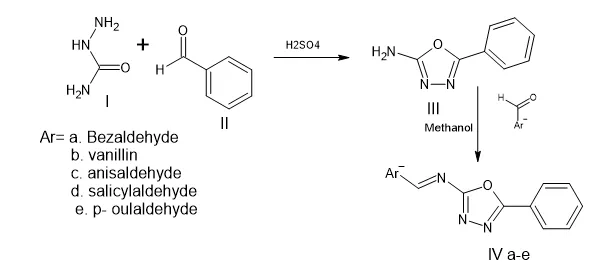
Synthesis of 5-phenyl-1,3,4-Oxadiazol-2-amine:
An equimolar amount of benzoic acid (0.1 mol) and thiosemicarbazide (0.1 mol) was combined in 30 mL of concentrated sulfuric acid and heated act a temperature of 80-90°C in a water bath for 7-8 hours. The reaction mixture was chilled, transferred onto crushed ice, and neutralized with ammonia. The crude product that formed was subjected to filtration, rinsed with distilled water, dried, then recrystallized using hot water. The reaction's completion was observed via TLC employing Chloroform: Benzene: Glacial acetic acid (3: 1: 1) as the solvent mixture.
Synthesis of N-(substituted benzylidene)- 5-phenyl-1,3,4-oxadiazol-2-amine:
An equimolar amount of 2-c-5-phenyl-1,3,4-oxadiazole (0.02 mol) and aromatic aldehydes (0.02 mol) was placed in a round-bottom flask. Thirty milliliters of methanol were incorporated, and the amalgamation was subjected to heating at 60-70°C in a water bath for four hours. A small quantity of glacial acetic acid was introduced to facilitate the process. The reaction's completion was seen by TLC utilizing Chloroform: Benzene: Glacial acetic acid (3: 1: 1) as the solvent mixture. The surplus methanol was eliminated under reduced pressure with a rotary vacuum evaporator, and the resultant crude product was recrystallized from methanol.
Evaluation of in vitro anti inflammatory activity:
Inhibition of albumin denaturation:
% Denaturation inhibition = (1−D/C) × 100%
Where is the absorbance reading of the text sample, and C is the absorbance reading without test sample(negative control).
Results and Discussion:
4.1 Insilico screening:
4.1.1 Lipinski rule of 5 filtration:
Table no 1: Results of Lipinski’s Filtration:
|
Compound |
Molecular weight |
Hydrogen bond donors |
Hydrogen bond acceptors |
Log p |
Molar refractivity |
|
IV a |
277.09 |
0 |
5 |
2.70 |
53.44 |
|
IV b |
323.09 |
1 |
7 |
2.12 |
77.62 |
|
IV c |
307.10 |
0 |
6 |
2.78 |
60.98 |
|
IV d |
293.08 |
1 |
6 |
3.00 |
69.99 |
|
IV e |
291.10 |
0 |
5 |
3.26 |
53.44 |
By the above values, the synthesized oxadiazole derivatives are obeys the Lipinski rule of5.
4.1.2 Prediction of activity spectra for substances (PASS):
Table no 2: Results of PASS prediction:
|
Compound |
Anti Inflammatory activity |
|
|
|
Pa |
Pi |
|
IV a |
0.396 |
0.031 |
|
IV b |
0.486 |
0.018 |
|
IV c |
0.774 |
0.004 |
|
IV d |
0.406 |
0.041 |
|
IV e |
0.538 |
0.012 |
|
Standard |
0.791 |
0.003 |
According to the aforementioned results, all synthesized compounds adhere to the PASS criteria with Pa values over 0.3, whereas the standard medication exhibits a Pa value of 0.791. The specifically produced compounds IV c and IV e exhibit greater activity in comparison to the other target molecules.
4.1.3 Osiris molecular property explorer:
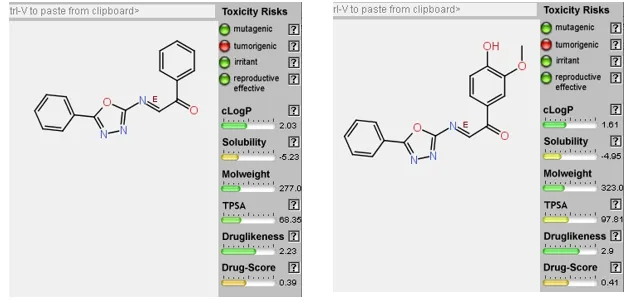
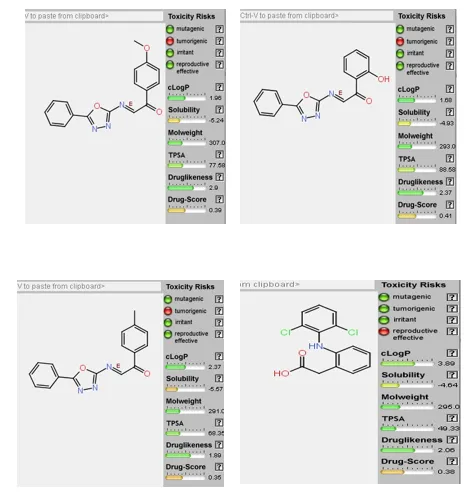
Fig no 1: OSIRIS molecular property explorer of compounds4a-4e
According to the findings of the OSIRIS Molecular Property Explorer, all produced compounds exhibit superior drug-likeness compared to the standard and mitigate reproductive toxicity.
4.1.4 Molsoft property explorer:
Table no 3: Results of Molsoft Molecular property explorer:
|
Compound |
Molecular formula |
Molecular weight |
HBA |
HBD |
Mlogp |
Mlogs |
Mol PSA |
Molecular volume |
|
IV a |
C16H11N3O2 |
277.09 |
5 |
0 |
2.70 |
-2.86 |
53.44 |
261.57 |
|
IV b |
C17H13N3O4 |
323.09 |
7 |
1 |
2.12 |
-2.44 |
77.62 |
304.84 |
|
IV c |
C17H13N3O3 |
307.10 |
6 |
0 |
2.78 |
-2.95 |
60.98 |
293.42 |
|
IV d |
C16H11N3O3 |
293.08 |
6 |
1 |
3.00 |
-3.29 |
69.99 |
272.75 |
|
IV e |
C17H13N3O2 |
291.10 |
5 |
0 |
3.26 |
-3.32 |
53.44 |
282.51 |
4.1.5 Docking Analysis:
protein ID: 5KIR
Docking is employed to ascertain the precise binding shape and orientation of the ligand molecule within the protein's active site. The four produced Oxadiazole compounds and the standard (Diclofenac) were subjected to docking against COX-2 utilizing Auat-Dock Tool 4.0, an automated docking software.
The docking process involves four main steps,
(i) Protein preparation
(ii) Ligand preparation
(iii) Grid preparation
(4) Docking.
The Lamarckian genetic algorithm has been employed as the search mechanism to identify the optimal conformers. The starting population was arbitrarily established at 150 individuals, with ten generations designated for each execution of the genetic algorithm, and the upper limit for energy evaluations was fixed at 2,500,000. The dimensions of the grid box were configured to encompass all the act4e site residues found within stiff macromolecules. The grid box was positioned at 8.671 Å x -8.036 Å x 0.67 Å, with dimensions established at 40, 40, 40 (X, Y, Z coordinates) to encompass all active site residues.
Docking investigations revealed that every ligand selected for examination had a minimum binding affinity with the target protein structure of Vioxx complexed with human COX-2. The interactions between protein and ligand were analyzed for minimum binding energy (Kcal/mol) and the quantity of hydrogen bonds established with active site residues. The docking interactions between the five ligands and the protein structure of Vioxx bound to human COX-2 were depicted using the Chimera 1.13.1 viewer, as illustrated in Fig. 2. The ultimate docked validation acquired for the various ligands, predicated on binding energy, quantity of hydrogen bonds established, bond distance, and interacting residues, is presented in Table 4. All the synthesized compounds exhibit minimum binding energy with the docking score in comparison to the reference medication Diclofenac docked against the structure of Vioxx bound to human CaOX-2.
The extent of hydrogen bonds established with interacting residues for all ligands indicates that the bonding was favorable. The majority of the essential residues depicted in Table 4 are the active site residues of the target protein as forecasted by PDB total. According on the docking score, all ligands exhibit docking interactions with the protein structure of Vioxx bound to human COX-2. The chemicals exhibiting cell inhibitory activity selected as ligands in this research had several mechanisms of action.
Table no 4: Docking results of all synthesized compounds & standard:
|
Compound |
Key Residues |
Distance (Ao) |
No.of hydrogens |
Docking Score (Kcal/Mol) |
|
IVa |
O-Tyr Arg Tyr Arg |
2.927 2.239 2.068 2.111 |
4 |
-7.03 |
|
IVb |
Arg Gly Glu O-Thr Lys |
2.001 2.333 2.141 2.758 1.982 |
5 |
-6.76 |
|
IVc |
O-Tyr Ser |
2.561 2.081 |
2 |
-8.81 |
|
IVd |
Arg Tyr |
1.752 2.148 |
2 |
-7.76 |
|
IVe |
Arg Arg Tyr O-Tyr |
2.130 2.685 2..338 3.276 |
4 |
-7.59 |
|
Standard (Diclofenac) |
Gln Asn Lys Lys |
1.996 2.045 2.441 1.682 |
4 |
-4.55 |
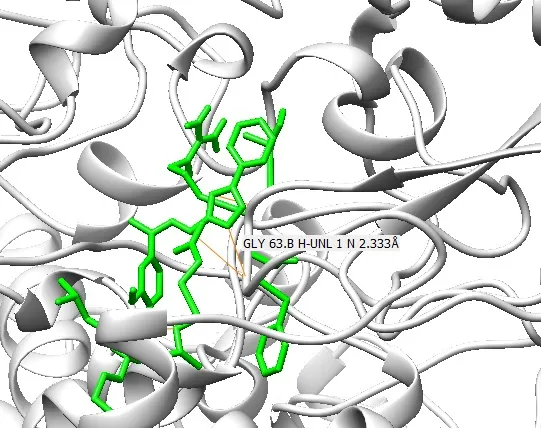
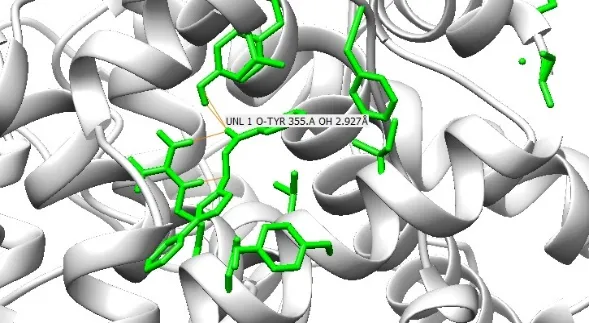
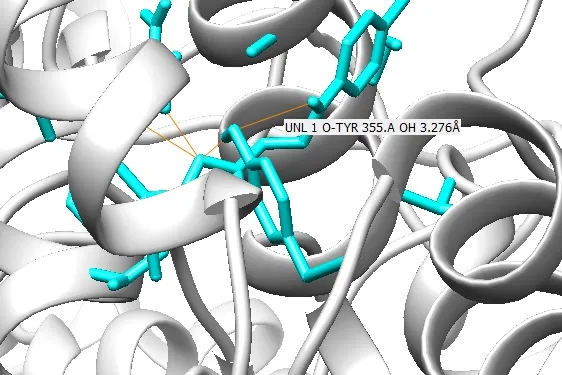
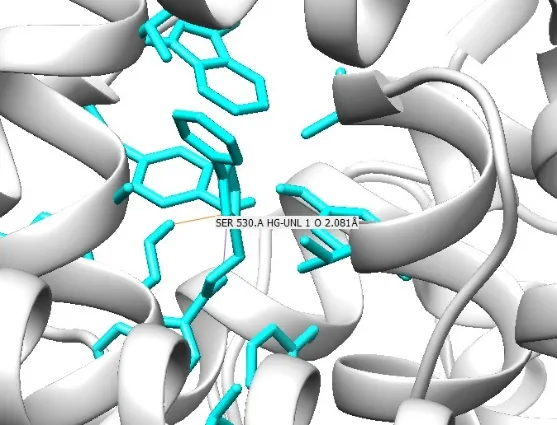
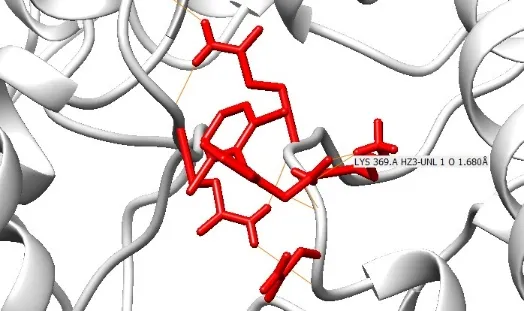
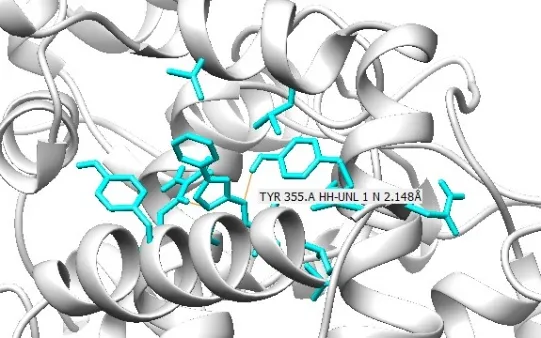
Fig no 2: Dockingresult ofSynthesized compoundsandstandard
4.2 Physical data for synthesized compounds:
Table -5
|
Compound |
Mol. Formula |
Mol. Weight |
% yield |
mp (oC) |
Rf Value |
|
Iva |
C16H11N3O2 |
277 g |
65% |
269-271oC |
0.48 |
|
IVb |
C17H13N3O4 |
323.09 |
75% |
352-356oC |
0.75 |
|
IVc |
C17H13N3O3 |
307.10 |
45% |
238-242oC |
0.55 |
|
IVd |
C16H11N3O3 |
293.08 |
85% |
218-222 oC |
0.89 |
|
IVe |
C17H13N3O2 |
291.10 |
39% |
212-216 oC |
0.62 |
All the recent oxadiazole derivatives were produced using various chemical agents. The presence of two derivatives results in increased yields. These are IVb (a derivative of Vanillin) and IVd (a derivative of Salicylaldehyde). The remaining three derivatives provide lower returns. All the generated compounds exhibited variations in melting point and TLC profiling when juxtaposed with the second stage of the created molecule. All produced compounds underwent recrystallization from methanol, and a specific compound was purified via column chromatography, thereafter characterized using several spectroscopic methods such as FTIR, 1H NMR, and mass spectrometry.
4.3 Spectral data for the synthesized compound 4a:
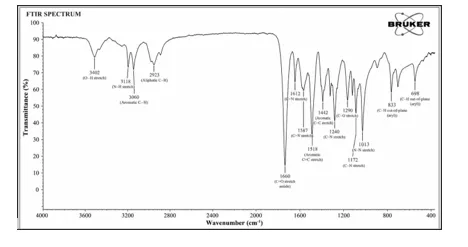
FTIR spectrum: The FTIR spectra of the produced product displayed a wide absorption band at 3402 cm⁻¹, linked to the phenolic hydroxyl (O–H) group. A distinctive absorption at 3118 cm⁻¹ validated the existence of the amide N–Ha group. The fragrant C–H stretching vibration was observed at 3060 cm⁻¹, whereas the faint band at 2923 cm⁻¹ was associated with aliphatic C–H stretching.
A prominent absorption band detected at 1660 cm⁻¹ was attributed to the stretching vibration of the amide carbonyl (C=O). The notable peaks at 161a2 cm⁻¹ and 1587 cm⁻¹ were ascribed to the azomethine (C=N) moiety and the C=N stretching of the heterocyclic ring, respectively, validating the production of thea Schiff base. The peak at 1518 cm⁻¹ is attributed to the stretching vibrations of aromatic C=C bonds.
The absorptions at 1290 cm⁻¹ and 1172 cm⁻¹ were attribuaed to C–N stretching vibrations, while the band at 1240 cm⁻¹ signifiead phenolic C–O stretching. The signal seen at 1013 cm⁻¹ was indicative of N–N stretching in the heterocyclic ring structure. Moreover, the absorption peaks at 833 cm⁻¹ and 698 cm⁻¹ were ascribed to the out-of-plane bending vibrations of aromatic C–H bonds, corroborating the existence of substituted aromatic rings.
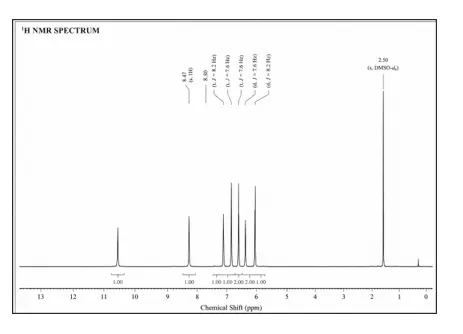
1H NMR spectrum: 10.57 (s, 1H, OH), 8.a47 (s, 1H, CH=N), 8.23 (d, J = 8.2 Hz, 1H, Ar–H), 7.95 (t, J = 7.6 Hz, 1H, Ar–H), 7.80 (t, J = 7.6 Hz, 2H, Ar–H), 7.64 (d, J = 7.6 Hz, 2H, Ar–H), 7.53 (d, J = 8.2 Hz, 1H, Ar–H).
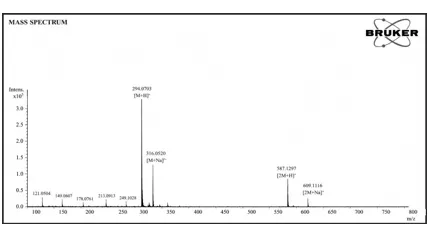
Mass spectrum: 294.07 [M+H]⁺, consistent with the molecular formulaC16H11N3O3 (MW = 293.30). Major fragment ions were observed at m/z 249, 213, 178, 149 and 121 corresponding to sequential cleavage of the salicylaldehyde – oxadiazaole linked aromatic portions of the molecule.
By these spectral values conform the compound as (2E)-1-(2-hydroxyphenyl)-2-[(5-phenyl-1,3,4-oxadiazol-2-yl)imino]ethan-1-one
4.4 Evaluation of Anti Inflammatory activity:
Inhibition of albumin denaturation:
The outcome of the anti-inflammatory action assessed using the egg albumin denaturation method is presented in Table 5. Diclofenac sodium was utilized as a reference standard. All the synthesized compounds exhibited concentration-dependent suppression of egg albumin denaturation. The IVc demonstrated relatively superior outcomes compared to other drugs. The highest percentage of protein denaturation inhibition was recorded at 300µg/ml. The highest percentage of inhibition achieved by the synthesized compounds and the conventional medication (Diclofenac) was 70.53%, 62.31%, 75.30%, 71.68%, 71.68%, and 57.97%, respectively. The minimum percentage inhibition of protein denaturation was recorded as 15.45%, 10.38%, 16.26%, 13.25%, 14.45%, and 6.76% for the synthesized compounds and the standard medication (Diclofenac) at a concentration of 50µg/ml.
Table -6
|
|
Concentration (µg/ml) |
|||||
|
Sample |
50 |
100 |
150 |
200 |
250 |
300 |
|
IVa |
15.45±0.241 |
26.08±0.418 |
37.92±0.241 |
50.72±0.418 |
62.56±0.241 |
70.53±0.241 |
|
IVb |
10.38±0.241 |
18.35±0.241 |
26.81±0.418 |
41.30±0.418 |
51.20±0.241 |
62.31±0.418 |
|
IVc |
16.26±0.347 |
25.90±0.347 |
40.16±0.200 |
50.60±0.347 |
66.86±0.347 |
75.30±0.347 |
|
IVd |
13.25±0.347 |
21.08±0.347 |
34.93±0.347 |
43.37±0.347 |
62.65±0.347 |
71.68±0.347 |
|
IVe |
14.45±0.347 |
23.49±0.347 |
39.75±0.347 |
44.37±0.200 |
61.24±0.200 |
71.68±0.347 |
|
Standard (Diclofenac) |
6.76±0.241 |
13.04±0.418 |
21.25±0.241 |
37.68±0.418 |
45.65±0.418 |
57.97±0.418 |
CONCLUSION:
Acknowledgement: The authors are grateful to the Guide, Head and staff of Centre for Pharmaceutical Sciences, UCESTH, JNTUH, Kukatpally, Hyderabad, Telangana, India for providing the necessary research facilities.
REFERENCES



T.Anusha, Dr. M. Ajitha*, Guduru Sai Krishna, Synthesis Of Some Novel 1, 3, 4- Oxadiazole Deriva Tives And Assessm Ent Of Their Inhib Itory Ac Tion On Al Bumin Denaturation, Int. J. of Pharm. Sci., 2026, Vol 4, Issue 10, 1193-1205. https://doi.org/10.5281/zenodo.23236457
 10.5281/zenodo.23236457