

We use cookies to ensure our website works properly and to personalise your experience. Cookies policy
College of Pharmaceutical Sciences, Puri
Cleaning validation is a critical element of pharmaceutical manufacturing, ensuring equipment cleanliness, product quality, and patient safety. It has progressed from compliance?based practices with arbitrary residue limits to a science?driven, risk?based discipline integrating toxicology, analytical chemistry, and advanced technologies. This review outlines global regulatory frameworks, analytical methods, and emerging trends, emphasizing the shift toward patient?centric strategies. Regulatory bodies such as the FDA, EMA, and PIC/S promote health?based exposure limits, lifecycle management, and harmonized GMP standards, while ICH Q9 and Q10 embed risk management and continuous improvement into quality systems. Advances in chromatographic and spectroscopic techniques, alongside tools like high?resolution mass spectrometry, rapid microbiological methods, and digital monitoring, have enhanced residue detection and efficiency. Sustainability initiatives and regulatory harmonization further shape modern practices. Cleaning validation has become a dynamic, science?based discipline essential for pharmaceutical quality, requiring continued innovation and collaboration to address regulatory variability, sampling limitations, and evolving manufacturing technologies
Cleaning validation is a critical component of pharmaceutical manufacturing that ensures equipment cleaning procedures consistently remove residues to predetermined acceptable levels, thereby preventing cross-contamination and maintaining product quality, safety, and efficacy in compliance with Good Manufacturing Practices (GMP) [1]. Over the past three decades, its importance has increased due to stricter regulatory oversight and the need to prevent product recalls, regulatory sanctions, and reputational damage [2]. Historically, cleaning validation relied on compliance-driven and arbitrary acceptance criteria such as fixed limits of 10 ppm or 0.1% of the therapeutic dose of the previous product, which often lacked scientific justification and did not adequately address patient safety risks, particularly for highly potent drugs [3]. This limitation led to the adoption of more science-based approaches, including toxicological risk assessment and health-based exposure limits (HBELs), which are derived from parameters such as the No-Observed-Adverse-Effect Level (NOAEL) and Permitted Daily Exposure (PDE) to establish patient-safety-driven acceptance criteria [4]. The evolution of cleaning validation has also been influenced by international regulatory frameworks such as ICH Q9 (Quality Risk Management) and ICH Q10 (Pharmaceutical Quality System), which promote risk-based decision-making, lifecycle management, and continuous improvement [5-6]. Failures in cleaning validation can lead to serious consequences including cross-contamination, adverse patient outcomes, product recalls, and financial losses, emphasizing the need for scientifically justified and risk-based validation programs aligned with global regulatory expectations [2]. Furthermore, effective cleaning validation enhances operational efficiency by reducing downtime, minimizing batch failures, and optimizing manufacturing processes through the integration of toxicological science, advanced analytical techniques, and modern risk-management approaches [3].
2. Regulatory frame work
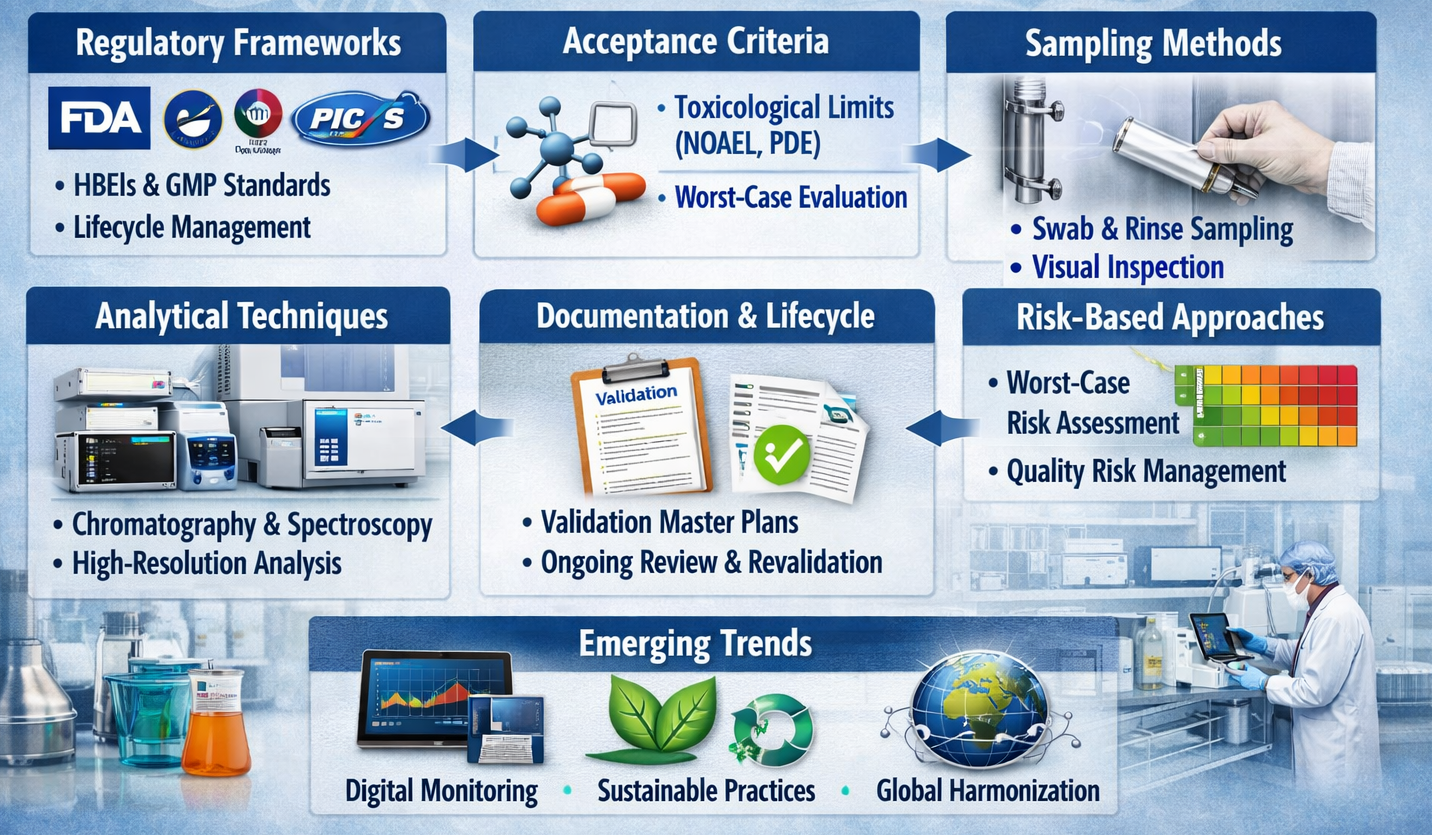
The key components of cleaning validation in pharmaceutical manufacturing are shown in figure 1.
|
|
|
Figure 1: Key Components of Cleaning Validation in Pharmaceutical Manufacturing |
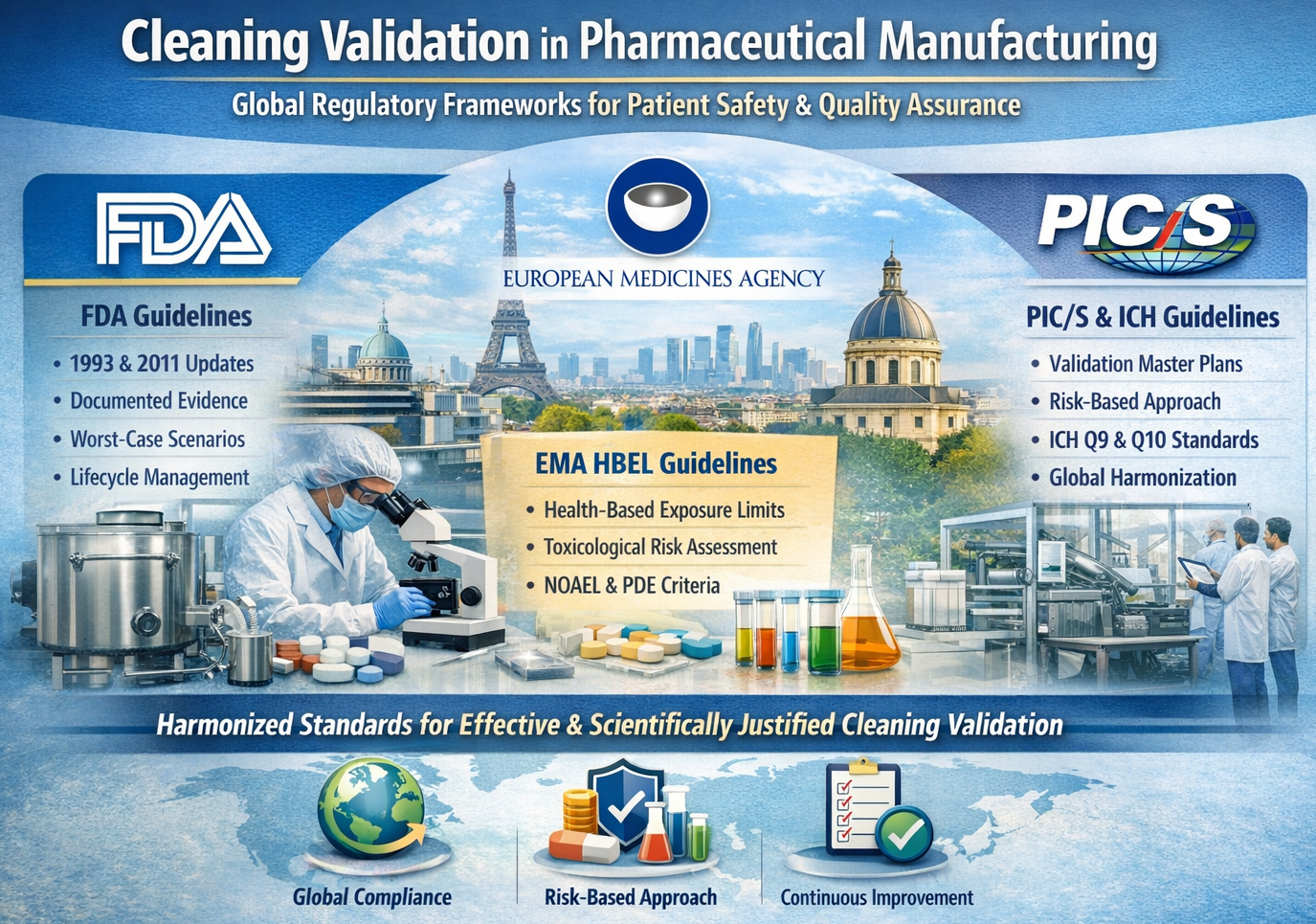
The Figure 2 summarizes the global regulatory landscape guiding cleaning validation in pharmaceutical manufacturing, highlighting how agencies like the FDA, EMA, PIC/S, and ICH have evolved from prescriptive, compliance-based requirements to risk-based, science-driven frameworks focused on patient safety and lifecycle management. It visually contrasts key regulatory contributions: the FDA’s emphasis on documented evidence and worst-case scenario validation, the EMA’s adoption of health-based exposure limits (HBELs) grounded in toxicological assessments like NOAEL and PDE, and PIC/S’s practical guidance on validation master plans and harmonization. Together, these frameworks promote consistent, scientifically justified cleaning validation practices across regions, enabling multinational pharmaceutical companies to maintain high standards of quality and regulatory compliance [1,2,5-8].
|
|
|
Figure 1: Illustrates how global regulatory frameworks (FDA, EMA, PIC/S, ICH) guide cleaning validation in pharmaceutical manufacturing, showing the evolution from compliance-based requirements to risk-based, science-oriented approaches focused on patient safety and lifecycle management |
3. Analytical Methods
Analytical methods form the backbone of cleaning validation, providing the scientific evidence required to demonstrate that residues have been effectively removed from manufacturing equipment. The choice of analytical technique depends on the nature of the residue, the sensitivity required, and the practicality of implementation in a manufacturing environment. Over the years, analytical methods have evolved from simple, non-specific tests to highly sensitive, sophisticated techniques capable of detecting trace levels of contaminants [1,2].
Chromatographic Techniques
Chromatographic methods, particularly High-Performance Liquid Chromatography (HPLC), remain the gold standard in cleaning validation. HPLC offers high sensitivity and specificity, making it suitable for detecting active pharmaceutical ingredients (APIs) at trace levels [9]. It is widely used because it can quantify residues with precision, providing robust data for regulatory submissions. Liquid Chromatography-Mass Spectrometry (LC-MS) represents an advancement over HPLC, offering enhanced sensitivity and specificity, particularly for complex molecules and low-dose drugs. LC-MS can detect residues at parts-per-billion levels, making it invaluable for validating cleaning processes involving highly potent compounds. Gas Chromatography (GC) is also employed, particularly for volatile compounds, although its use is less common in pharmaceutical cleaning validation compared to HPLC and LC-MS [7].
Spectroscopic Methods
Spectroscopic techniques provide rapid and often non-destructive analysis of residues. Total Organic Carbon (TOC) analysis is one of the most widely used methods, offering a quick and non-specific measure of organic residues. TOC is particularly useful for detecting cleaning agents and excipients, although it lacks the specificity required for APIs. Ultraviolet (UV) spectroscopy is effective for compounds with strong chromophores, providing a simple and cost-effective method for residue detection [11]. Fourier Transform Infrared (FTIR) spectroscopy is valuable for identifying functional groups in residues, offering qualitative insights into the nature of contaminants [8]. While spectroscopic methods may not always provide the sensitivity or specificity of chromatographic techniques, they are often used as complementary tools, particularly for routine monitoring and rapid assessments.
Sampling Techniques
Sampling is a critical component of cleaning validation, as the accuracy of analytical results depends on the representativeness of the samples collected. Swab sampling is the most common method, involving direct collection of residues from equipment surfaces [12]. It is simple and widely accepted by regulatory agencies, but it is operator-dependent and may not capture residues in inaccessible areas. Rinse sampling involves collecting wash solutions from equipment, providing information on residues in hard-to-reach areas. A combination of swab and rinse sampling is often recommended to ensure comprehensive residue detection. Advances in sampling techniques, such as automated swabbing devices and improved swab materials, are enhancing reproducibility and reliability.
Emerging Analytical Tools
Recent years have seen the emergence of advanced analytical tools that offer greater sensitivity, specificity, and speed. High-Resolution Mass Spectrometry (HRMS) enables ultra-trace detection of residues, supporting stringent health-based exposure limits (HBELs) [13]. Rapid Microbiological Methods (RMMs) are gaining traction for detecting microbial contamination, reducing turnaround times compared to traditional culture-based methods [14]. Portable spectroscopy devices, such as handheld Raman and near-infrared (NIR) spectrometers, facilitate real-time, on-site analysis, enhancing flexibility and responsiveness [15]. These emerging tools reflect the broader trend toward digitalization and real-time monitoring in pharmaceutical manufacturing.
4. Acceptance Criteria
Acceptance criteria are central to cleaning validation, as they define the maximum allowable residue levels that can remain on manufacturing equipment after cleaning. These criteria provide the benchmark against which analytical results are compared, ensuring that cleaning processes are effective and that patient safety is protected. Over time, acceptance criteria have evolved from arbitrary, compliance-driven thresholds to scientifically justified, risk-based limits derived from toxicological data [1,2].
Traditional Approaches
Historically, acceptance criteria were based on simple, arbitrary limits such as 10 parts per million (ppm) of the previous product or 0.1% of the therapeutic dose carried over into the next product [16]. These thresholds were easy to apply and provided a straightforward framework for regulatory compliance. However, they lacked scientific justification and did not adequately account for differences in potency, toxicity, or therapeutic dose among different drugs. For example, a highly potent oncology drug could pose significant risks even at trace levels, whereas a relatively benign excipient might not require such stringent limits. This discrepancy highlighted the limitations of traditional approaches and the need for more scientifically robust criteria [7].
Health-Based Exposure Limits (HBELs)
The introduction of health-based exposure limits (HBELs) marked a significant advancement in cleaning validation. HBELs are derived from toxicological assessments, such as the No-Observed-Adverse-Effect Level (NOAEL) and Permitted Daily Exposure (PDE), ensuring that acceptance criteria are directly linked to patient safety. By considering factors such as pharmacological activity, therapeutic dose, and toxicological profile, HBELs provide a more accurate and patient-centric framework for cleaning validation. The European Medicines Agency (EMA) has been a leader in promoting HBELs, publishing guidelines that require manufacturers to adopt toxicological risk assessments when setting acceptance criteria. This approach aligns cleaning validation with toxicological science, ensuring that residue limits are scientifically justified and protective of patient health [17].
Risk-Based Approaches
Risk-based approaches integrate HBELs with manufacturing realities, balancing patient safety with operational feasibility [5]. They prioritize worst-case scenarios, such as the most potent drug manufactured in a facility or the hardest-to-clean equipment, ensuring that cleaning processes are validated under the most challenging conditions. Risk-based approaches also consider factors such as batch size, equipment design, and cleaning method, providing a holistic framework for setting acceptance criteria. By adopting risk-based approaches, manufacturers can allocate resources more efficiently, focusing on high-risk areas while maintaining robust patient safety standards [2]. This approach reflects the broader principles of ICH Q9 (Quality Risk Management), which emphasize science-based decision-making and continuous improvement [5].
Practical Considerations
In practice, acceptance criteria must be both scientifically justified and operationally feasible. Analytical methods must be capable of detecting residues at the specified limits, and sampling strategies must provide representative data. For example, if HBELs require detection of residues at parts-per-billion levels, analytical methods such as LC-MS or HRMS may be necessary [15]. Similarly, sampling strategies must ensure that residues in inaccessible areas are captured, requiring a combination of swab and rinse sampling [10]. Practical considerations also include the reproducibility of analytical methods, the reliability of sampling techniques, and the cost-effectiveness of implementing stringent acceptance criteria [18].
5. Emerging Trends
The following table 1 summarizes the key emerging trends and technological advancements shaping modern pharmaceutical cleaning validation practices.
|
Emerging Trend |
Description |
References |
|
Risk-Based Validation |
Regulators encourage the use of risk-based approaches instead of arbitrary acceptance limits. Cleaning validation focuses on worst-case conditions such as highly potent drugs and difficult-to-clean equipment. This approach follows the principles of quality risk management described in ICH Q9 and helps allocate resources toward high-risk areas while maintaining patient safety. |
[2,5,7] |
|
Continuous Manufacturing Integration |
Continuous manufacturing systems operate without interruption and require innovative cleaning validation strategies. Approaches such as clean-in-place (CIP) systems, real-time monitoring, and flexible cleaning protocols are used to control residues while supporting uninterrupted production processes. |
[4, 19] |
|
Automation and Digitalization |
Digital technologies such as Electronic Batch Records (EBRs), artificial intelligence (AI), and machine learning are being implemented to improve traceability, predict residue behavior, and optimize cleaning processes. Real-time sensors and portable spectroscopy enable continuous verification of cleaning effectiveness, supporting Industry 4.0 initiatives. |
[20-21] |
|
Sustainability and Green Chemistry |
Pharmaceutical manufacturers are adopting eco-friendly cleaning agents, biodegradable detergents, enzymatic cleaners, and water-saving technologies to reduce the environmental impact of cleaning processes. These approaches align with green chemistry principles and corporate sustainability goals while maintaining regulatory compliance. |
[22-23] |
|
Global Harmonization |
Regulatory authorities such as FDA, EMA, PIC/S, and WHO are working toward harmonized cleaning validation expectations. This alignment simplifies multinational compliance, reduces regulatory duplication, and ensures consistent patient safety standards across global pharmaceutical manufacturing operations. |
[2], [4] |
6. Challenges and Future Directions
Cleaning validation continues to face challenges despite advancements in regulatory frameworks and analytical technologies. Variability in regulatory expectations across agencies such as the FDA, EMA, and PIC/S complicates global compliance for multinational pharmaceutical companies. Limitations in sampling methods, including operator-dependent swab sampling and dilution issues in rinse sampling, affect the accuracy and representativeness of residue detection. Analytical techniques must balance sensitivity and practicality, as highly sensitive methods like LC-MS are costly, while simpler methods such as TOC lack specificity. Additionally, integrating cleaning validation into modern systems such as continuous manufacturing requires new validation strategies. Future directions emphasize HBEL-based risk assessment, real-time monitoring technologies, predictive modeling, improved global harmonization, and sustainable cleaning practices [1,2,9,15].
CONCLUSION
Cleaning validation has progressed from compliance?driven practices with arbitrary residue limits to a science?based, risk?oriented discipline integrating toxicology, advanced analytics, and modern technologies. Regulatory agencies such as the FDA, EMA, and PIC/S have promoted health?based exposure limits and lifecycle management, linking cleaning standards directly to patient safety. Advances in chromatographic and spectroscopic methods, along with digital monitoring and sustainable approaches, are reshaping validation strategies. Despite challenges in regulatory variability, sampling limitations, and integration with continuous manufacturing, ongoing innovation and collaboration will be essential to ensure robust, harmonized, and patient?centric cleaning validation in pharmaceutical production.
REFERENCES






Basanta Kumar Behera, Anup Kumar Patra, Satyabrata Sahoo, Soumyashree Subhasmita Sahoo, Bhagyashree Sahoo, Amiyakanta Mishra, The Future of Cleaning Validation: Integrating Regulatory Standards, Analytical Innovation, and Green Practices in Pharma, Int. J. of Pharm. Sci., 2026, Vol 4, Issue 3, 2513-2520. https://doi.org/10.5281/zenodo.19148151
 10.5281/zenodo.19148151