

We use cookies to ensure our website works properly and to personalise your experience. Cookies policy
Department of Pharmaceutics, The Oxford College of Pharmacy, 1st cross, Hongasandra, Bengaluru, Karnataka-560068, India.
Heart disease has traditionally been considered a condition affecting older adults; however, recent evidence indicates a growing incidence of myocardial infarction among younger populations. The present study explores the rising prevalence of heart attacks in young adults and the lifestyle and health-related factors contributing to this trend. A survey conducted among 51 participants with an average age of 38 years assessed awareness, lifestyle behaviors, and existing cardiovascular risk factors. The findings revealed that although most participants were aware of cardiopulmonary resuscitation (CPR) and recognized the increasing prevalence of cardiac diseases in youth, several modifiable risk factors were common. Irregular dietary habits, inadequate physical activity, stress, and high caffeine intake were frequently observed. Additionally, a notable proportion reported hypertension, family history of cardiac disease, or existing heart-related conditions. Modern lifestyle changes including sedentary behavior, unhealthy dietary patterns, smoking, alcohol consumption, and psychological stress appear to play a significant role in the increasing incidence of cardiovascular disease among young individuals. Preventive strategies such as promoting balanced nutrition, encouraging regular physical activity, reducing tobacco and alcohol use, and improving awareness about cardiovascular health are essential. Early screening and public health interventions may help reduce the burden of cardiovascular disease and prevent premature cardiac events among younger populations
People who are elderly or have underlying medical issues are more likely to have heart attacks. However, this notion might lead to younger people missing symptoms or not seeing the need for a cardiac checkup in the first place. Among young people, the risk of heart attacks has increased in recent years. It is not a well-known fact, but regrettably, young, sudden cardiac death claims the lives of many healthy young individuals. Not too long ago, older individuals were the main group affected by heart attacks. A heart attack was uncommon in people under 40 years old. Nowadays, one in five people who have a heart attack are under 40. Here's another alarming fact to emphasize the issue: A heart attack is more likely to occur in your 20s or early 30s. In this young age group, the heart attack rate rose by 2% annually between 2000 and 2016. Young folks are experiencing heart attacks more frequently. Heart attacks were always a problem for people over 65, but today 1 in 5 patients are under 40, and attacks are increasingly occurring in people in their 20s and 30s more frequently 1. Youth, however, do not lessen the effects of such an attack. Younger patients are nevertheless susceptible to the same dangers and side effects. For instance, you may suffer a second big heart attack that could be fatal following your first, regardless of your age. A second cardiac event can still happen even if you're becoming older. Over the previous ten years, the American Heart Association stated that the number of heart attacks among people under 40 had increased by 2% annually. According to other studies, the number of heart attacks among persons aged 35 to 54 years has increased by 30% to 45%. According to the European Society of Cardiology, heart attacks in adults under 45 have increased by 74% in the last ten years. Hospitalizations for heart attacks among adults aged 18 to 34 increased by 32% between 2006 and 2016, according to the CDC. According to the Indian Council of Medical Research's (ICMR) 2017 India State-Level Disease Burden Initiative, "India: Health of the Nation's States," the percentage of deaths in India attributed to non-communicable diseases (NCDs) rose from 37.9% in 1990 to 61.8% in 2016. Chronic respiratory diseases (CRDs), diabetes, cancer, and cardiovascular diseases (CVDs) are the four main NCDs. These conditions are all associated with four behavioral risk factors: poor diet, inactivity, and alcohol and cigarette use. According to data on "Accidental Deaths & Suicides in India" (ADSI) compiled by the National Crime Records Bureau (NCRB), the number of heart attack-related deaths in India has continuously stayed over 25,000 over the past four years and over 28,000 over the last three 1,2.
2.THE SURVEY AND REPORT
This survey gathered responses from 51 individuals, averaging about 38 years of age, with 31 women and 18 men. Around 18% reported a history of high blood pressure, 12% had been diagnosed with a heart-related condition, and 22% had a family history of cardiac arrest. Most respondents (80%) know how to perform CPR, and a striking 90% believe cardiac problems are on the rise among younger people. Sleep patterns varied, with most getting 6–8 hours of rest, while 21% consumed alcohol, 10% smoked, and tea/coffee intake ranged from none to as many as 10 cups daily, with 2 cups being most common. In terms of exercise, 16 exercised rarely, 10 exercised 3–5 times a week, 9 exercised 1–2 times a week, 8 exercised daily, and 6 never exercised. Diet habits showed 23 people describing their diet as healthy, 21 having irregular meals, 3 skipping meals regularly, and 2 consuming a diet high in junk food2. From the data, it can be concluded that while a majority of respondents are aware of CPR and recognize the growing risk of cardiac issues among younger people, their lifestyle habits show several potential risk factors. A significant proportion report irregular meals, low to moderate exercise levels, and in some cases, high tea/coffee consumption. Although smoking and alcohol use are relatively low, the presence of high blood pressure, heart conditions, and family history of cardiac arrest in a notable segment of participants indicates a need for improved preventive health measures. Overall, greater emphasis on regular exercise, balanced nutrition, and consistent sleep patterns could help reduce long-term cardiac risks in this group. Comprehending the rising incidence of heart attacks among youth is essential for public health. By identifying the root causes, we can create focused interventions, increase public awareness, and encourage preventative actions to lessen the negative effects on public health and safeguard the welfare of coming generations3.
3. FACTORS CONTRIBUTING TO THE RISE IN HEART ATTACKS AND HEART DISEASES
1. LIFESTYLE FACTORS
The increasing incidence of heart attacks in youth is mostly due to lifestyle factors. In today's world, leading a sedentary lifestyle and not exercising are all too frequent. Young people are spending more time sitting and doing less physical activity due to the rise of technology and sedentary jobs. Weight gain, obesity, high blood pressure, and raised cholesterol are all risk factors for heart disease that are exacerbated by this lack of activity. In order to tackle this issue and lower the incidence of heart attacks among the younger population, it is imperative to promote active lives, encourage regular physical activity, and create opportunities for exercise 4.
All of the body's cell membranes depend on cholesterol, a lipid that is vital to numerous metabolic processes. It is created in the liver by the body from the food we ingest. Low-density lipoprotein (LDL) and high-density lipoprotein (HDL) are blood lipids (fats) that include cholesterol. While HDL (or "good") cholesterol aids in the body's cholesterol removal and prevents plaque from forming in the arteries, LDL (or "bad") cholesterol can cause plaque to form in the arteries. Saturated fats, sometimes referred to as "bad fats," have a tendency to raise blood levels of LDL (or "bad") cholesterol. Animal products (butter, coconut oil, pork fat (including lard and dripping), beef, lamb, chicken skin, and palm oil), as well as processed meals like biscuits and pastries, are common sources of saturated fats. Your arteries (blood vessels) become clogged with cholesterol when you eat a lot of saturated and trans fats. You run the danger of having a heart attack, stroke, and other serious health issues because of this. Foods high in these fats should be avoided or consumed in moderation. Vegetable sources of monounsaturated and polyunsaturated fats offer numerous health advantages5.
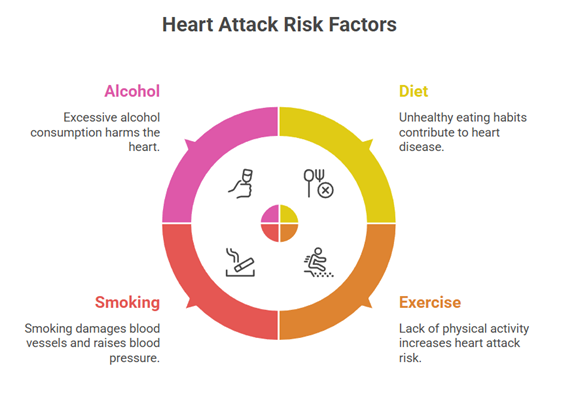
Fig. No 1: various risk factors for heart attack
Like every other muscle, the heart requires exercise. While muscles that aren't used deteriorate and atrophy, muscles that are consistently used get stronger and healthier. The heart can pump more blood throughout the body and maintain its peak performance with minimal strain when it is exercised. It will probably remain healthier for longer as a result. Frequent exercise also maintains the flexibility of arteries and other blood vessels, which promotes healthy blood flow and regular blood pressure. Lack of regular exercise may be the cause of up to 250,000 deaths annually in the United States, according to the American Heart Association journal Circulation. One of the top five risk factors for heart disease has continuously been leading a sedentary, or inactive, lifestyle. Smoking, obesity, high blood pressure, and high cholesterol are other risk factors. Low physical fitness also increases the risk of cardiovascular events, such as heart attacks and fatalities6.
Cigarette smoking and consuming three or more drinks of alcohol per day have comparable, and likely synergistic, effects on certain types of cardiovascular disease. However, there isn't much proof that the combined effects of drinking and smoking are worse than what would be predicted from their separate impacts. Most of the time, moderate drinking does not carry these concerns, and on some risk variables, it even has the opposite effect of cigarette smoking. The nation's cardiovascular health should clearly and significantly improve as a result of ongoing public health initiatives to reduce tobacco use and dangerous drinking. Approximately one out of every five deaths in the US is caused by cigarette smoking. Smoking exposes you to chemicals that harm your heart and blood vessels, increasing your risk of atherosclerosis, or plaque accumulation in the arteries. Additionally, smoking raises your chance of developing peripheral artery disease (PAD). Plaque accumulation in the arteries that provide blood to your head, organs, arms, and legs is known as PAD. Heart attacks, strokes, and coronary heart disease are all more likely to occur in people with PAD. The smoke exhaled by someone who smokes or from the burning end of a cigarette, cigar, pipe, or other tobacco product is known as secondhand smoke. Those who do not smoke may have the same kinds of harm to their heart and blood vessels as those who smoke6. On the other side, excessive drinking is associated with certain negative health consequences, such as heart problems. Heart failure, stroke, and elevated blood pressure can result from excessive alcohol use. Cardiomyopathy, a condition that affects the heart muscle, can also be exacerbated by excessive drinking. A somewhat rare illness, alcohol-induced cardiomyopathy affects 1% to 2% of individuals who drink more alcohol than is advised. A form of dilated cardiomyopathy, which occurs when the heart's muscles stretch excessively, is alcohol-related cardiomyopathy. The muscles weaken as they are stretched further. The impact is similar to how excessive stretching weakens a spring or rubber band. This type of stretching is particularly common in the muscles that regulate the left and right ventricles, the bottom chambers of your heart. With the left ventricle pumping blood to your entire body and the right ventricle pumping blood to your lungs, these chambers are crucial since they perform the majority of your heart's function. Your entire body suffers when the muscles surrounding your ventricles weaken because they are unable to pump as forcefully. The electrical system of your heart may also be affected by changes in its form. With each beating, an electrical current flows across your entire heart, causing each component to contract in a particular order. This timing is influenced by the form of your heart, and it can be thrown off if certain areas of it extend. Your heart may beat out of rhythm if it takes too long, even by minuscule fractions of a second. This condition is known as desynchrony. In a similar vein, alcohol can poison your heart and lead to the formation of scar tissue. Arrhythmias, or abnormal heart rhythms, are another potentially fatal condition that can be brought on by that scar tissue 6,7.
2. STRESS AND MENTAL HEALTH
Stress can cause heart disease through a number of different methods. Chronic or long-term stress can raise the body's inflammatory levels, which can lead to an increase in plaque accumulation in the arteries and issues like coronary heart disease. Additionally, catecholamines, which are hormones produced by the adrenal glands, rise in response to stress. Adrenaline, the "fight or flight" hormone, is one catecholamine that raises mental alertness in stressful circumstances. However, adrenaline also increases blood pressure and quickens the heartbeat. Over time, an excessive amount of that can harm the heart. Long-term increases in cortisol, another stress hormone, raise blood pressure, blood sugar, cholesterol, and triglycerides. About 2 in 3 employees say work is a significant source of stress, according to a recent report from the American Heart Association Center for Workplace Health Research & Evaluation. Job stress can stem from long hours, physical strain, high demand or job insecurity7.
3. DISEASE STATE
a. Hypertension
Long-term high blood pressure can harm blood vessel walls, leading to the development of microscopic rips. The body sends specialized cells that adhere to the injured area to repair it. Plaque may eventually form at these damaged areas as a result of the accumulation of chemicals like lipids and cholesterol. Atherosclerosis, the gradual accumulation of plaque, can restrict the arteries' interiors and obstruct blood flow to the heart. If the plaque ruptures or breaks off and produces a clot, blood flow may also be obstructed. A clot or plaque accumulation can obstruct blood flow, depriving that area of the heart of the oxygen and nutrition it requires. This is referred to as a heart attack8.
b. Diabetic mellitus
People with diabetes are more likely to have other conditions that raise the risk for heart disease Your blood vessels may begin to suffer damage if your blood sugar levels remain elevated for an extended length of time, even if they are only slightly elevated. Serious heart problems may result from this. Because your body cannot adequately consume all of the sugar when your blood sugar levels are high, more of it adheres to your red blood cells and accumulates in your blood. The arteries that carry blood to and from your heart may get damaged as a result of this accumulation. This indicates that the heart is unable to receive the necessary oxygen and nourishment9.
C. Abdominal obesity
A recent study found that even if a person's body mass index is within a healthy level, they are more likely to develop heart disease if they have excess fat around their midsections and important organs. Research on the effects of belly fat and other indicators of obesity on heart health is compiled in the American Heart Association statement, which was released Thursday in its journal Circulation. Abdominal fat and visceral adipose tissue, or VAT, are other names for belly fat. Experts advise that both BMI and abdominal measurements be taken into account at routine checkups because they may indicate a higher risk of heart disease, even in those of normal weight. Fat buildup around the liver is also associated with abdominal obesity. Non-alcoholic fatty liver disease is frequently the result, raising the risk of cardiovascular disease. Approximately 3 billion individuals worldwide suffer from obesity or overweight. According to Powell-Wiley, the "obesity epidemic contributes significantly" to a number of chronic illnesses and incidences of cardiovascular disease worldwide. Obesity is specifically linked to an increased risk of coronary artery disease and cardiovascular disease-related mortality. excessive blood pressure, Type 2 diabetes, excessive cholesterol, and sleep disturbances are all exacerbated by it10.
4.SYMTOMPS11,12
Common heart attack symptoms include:
Fig. No.2: Various symptoms of Heart attack
5.PREVENTIONS
CONCLUSION
The rise in myocardial infarction and sudden cardiac events among young adults is a clear and worrying public?heath signal. Once considered a disease of older age, acute coronary events are increasingly affecting people in their 20s, 30s and 40s: population studies and registries report that roughly one in five heart?attacks patients is now younger than 40, hospitalizations for ages 18–34 increased substantially over recent decades. Survey also reflects growing awareness: 90% of respondents perceive an increase in cardiac problems among younger people, and measurable risk factors (hypertension, family history, suboptimal diet, low activity, irregular sleep) are common. Epidemiology and local statistics suggest a complex and preventable tendency. Modern lifestyle changes (sedentary behavior, unhealthy diets high in refined carbohydrates and processed foods, rising obesity and abdominal adiposity), metabolic disease (diabetes, dyslipidemia, hypertension), behavioral risks (tobacco, harmful alcohol use), and psychosocial stress are all significant contributors. Environmental factors such as air pollution, as well as broader socioeconomic determinants (urbanization, work stress, food systems), play a vital influence. Early myocardial infarction increases the likelihood of repeated episodes, long-term impairment, and premature mortality, even if the patient is young.
7. SUMMARY
The study highlights the increasing incidence of heart attacks among young adults, a trend that has become a significant public health concern worldwide. Traditionally considered a disease of older individuals, cardiovascular events are now increasingly reported in people under 40 years of age. Several lifestyle factors such as sedentary habits, unhealthy diet, smoking, alcohol consumption, stress, and obesity contribute to this rise. Survey findings indicate that while many individuals are aware of cardiac health risks, unhealthy lifestyle behaviors remain common. Medical conditions including hypertension, diabetes, and abdominal obesity further increase the risk of myocardial infarction. The study emphasizes the importance of preventive strategies, including regular exercise, healthy dietary habits, stress management, adequate sleep, and avoidance of tobacco and alcohol. Increasing public awareness, promoting early health screenings, and strengthening healthcare and government initiatives can help reduce cardiovascular risk among young populations and improve long-term public health outcomes.
8. ACKNOWLEDGEMENTS
I sincerely express my heartfelt gratitude to Dr. Gururaj S Kulkarni Sir, for his unwavering guidance, encouragement, and invaluable support throughout the development of this review. I would also like to extend special thanks to All the Faculty Members of Department of Pharmaceutics, The Oxford College of Pharmacy, Bengaluru.
Author contributions
All authors contributed equally to this work. The authors have contributed significantly in the conception, writing, and revision of the manuscript.
Funding
None to declare.
Conflict of interest
None to declare.
Ethics approval
None to declare.
REFERENCES


Lis Maria Joseph, Hari kishor R, Giresha Naidu M., Growing Heart Attack Crisis in The Young: Understanding the Causes and Safeguarding the Future, Int. J. of Pharm. Sci., 2026, Vol 4, Issue 3, 1382-1291. https://doi.org/10.5281/zenodo.19000299
 10.5281/zenodo.19000299