

We use cookies to ensure our website works properly and to personalise your experience. Cookies policy
Pharm D, Rajiv Gandhi University.
Depression is a prevalent psychiatric disorder with significant global health impact, and current Background: Rickettsial infections are zoonotic diseases caused by obligate intracellular bacteria, presenting with fever, rash, and eschar, and can pose diagnostic challenges when overlapping with pre-existing autoimmune or connective tissue conditions. Primary biliary cholangitis (PBC), a chronic autoimmune cholestatic liver disease, is frequently associated with other autoimmune phenomena, including Raynaud's phenomenon, due to shared immune dysregulation. pharmacological treatments are limited by delayed onset and adverse effects. The present study evaluated the antidepressant potential of hydroalcoholic root extract
Rickettsial fever encompasses a group of acute febrile illnesses caused by obligate intracellular, gram-negative bacteria of the genus Rickettsia, transmitted to humans through the bite of infected arthropod vectors such as ticks, mites, lice, or fleas. Clinically, it commonly presents with sudden-onset high-grade fever, severe headache, myalgia, lymphadenopathy, and in some cases a characteristic eschar or rash, and if left untreated can progress to multi-organ involvement. Diagnosis in resource-limited settings often relies on the Weil-Felix test, a heterophile agglutination assay that exploits antigenic cross-reactivity between certain Proteus strains (OX-19, OX-2, and OX-K) and rickettsial antibodies; despite its known limitations in sensitivity and specificity, it remains a practical presumptive screening tool where indirect immunofluorescence assays are not readily accessible.
Primary biliary cholangitis (PBC) is a chronic, progressive autoimmune cholestatic liver disease characterized by immune-mediated destruction of the small intrahepatic bile ducts, leading to cholestasis, portal inflammation, and, if untreated, progression to fibrosis and cirrhosis. It predominantly affects women, most commonly those between 40 and 60 years of age, and its serological hallmark is the presence of anti-mitochondrial antibody (AMA), detected in the majority of affected patients. Common clinical features include fatigue, pruritus, jaundice, and hepatomegaly, though a substantial proportion of patients are asymptomatic at the time of diagnosis and are identified incidentally through biochemical or serological screening.
Raynaud's phenomenon is a vasospastic disorder characterized by episodic, reversible digital ischemia triggered by cold exposure or emotional stress, manifesting as sequential color changes in the fingers and toes — typically white, followed by blue, and then red — as vasospasm resolves and reperfusion occurs. It may occur as a primary, idiopathic condition or secondary to an underlying autoimmune or connective tissue disorder, and its presence often prompts a broader workup for such associated conditions.
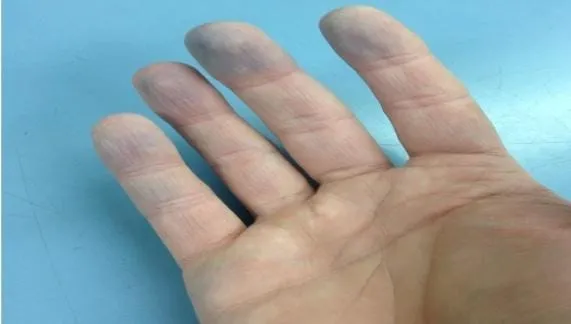
The co-occurrence of an acute infectious illness with two distinct chronic conditions one autoimmune-hepatic and one vasospastic in a single patient presents a unique diagnostic challenge, since the symptoms of fever, fatigue, and vascular changes can overlap considerably across all three processes.
Case Presentation
A 42-year-old female presented with a 2-day history of headache, fever with chills, and bluish discoloration of the fingers precipitated by cold exposure. Initial workup was negative for dengue (NS1, IgM, IgG), while the Weil-Felix test showed elevated titers (OX19 1:160, OX2 1:160, OXK 1:80), confirming rickettsial infection. Elevated CRP (5.0 mg/L) supported an active inflammatory process. Further evaluation for the finger discoloration revealed a positive anti-mitochondrial antibody (AMA), establishing a diagnosis of primary biliary cholangitis, with the cold-induced digital color changes attributed to concurrent Raynaud's phenomenon. The patient was managed with intravenous ceftriaxone and oral doxycycline for rickettsial fever, alongside supportive therapy (pantoprazole, paracetamol, vitamin B-complex) and atorvastatin. Clinical improvement was noted by day 3–4, with resolution of fever and presenting complaints, and the patient was discharged in stable condition.
DISCUSSION
This case is clinically notable for the simultaneous presentation of three distinct pathological processes — an acute vector-borne infection, a chronic autoimmune liver disease, and a vasospastic disorder — each of which can independently produce overlapping systemic symptoms such as fatigue, joint discomfort, and vascular changes, making initial diagnostic triage genuinely difficult.
Diagnostic challenge and the role of serology: The patient's initial provisional diagnosis of "Raynaud's phenomenon with dengue" reflects a reasonable but incomplete first-pass assessment, since dengue is a common febrile illness in this region presenting with similar constitutional symptoms. However, the negative dengue panel prompted further serological workup, ultimately identifying rickettsial infection via the Weil-Felix reaction. It is worth noting that the Weil-Felix test suffers from poor sensitivity and specificity, with a recent study showing an overall sensitivity as low as 33% and specificity of 46%, and the current gold standard in diagnosing rickettsial infections is indirect immunofluorescence, which was not performed in this case. Despite this limitation, the pattern seen — reactivity across OX-19 and OX-2 pointing toward the spotted fever or typhus group, with the pattern of reactivity rather than a single titer being what points toward a diagnosis — combined with the clinical picture of acute fever and headache, supported a presumptive diagnosis and justified empirical doxycycline therapy, which remains standard practice in resource-limited settings where IFA is not readily available.
Autoimmune overlap — PBC and Raynaud's phenomenon: The incidental finding of a positive AMA in a patient presenting primarily with an infectious syndrome is clinically significant. AMA is the serologic hallmark of PBC and is positive in 90–95% of patients with the disease, and PBC is the most prevalent autoimmune disease in females, with most cases occurring in those aged 40 to 60 years — consistent with this patient's demographic profile. Vasospastic phenomena such as Raynaud's are recognized to cluster with autoimmune and connective tissue disorders, and multiple case reports demonstrate that MS patients have a higher risk of developing additional autoimmune disorders compared to the general population, likely due to shared genetic, humoral, or environmental factors — a mechanism plausibly extendable to the PBC-Raynaud's association seen here, even though the two conditions are not classically described as a defined overlap syndrome in the way PBC-autoimmune hepatitis overlap is. (Primary Biliary Cholangitis With Incomplete Response to Conventional Therapies But Had Complete Response to Baricitin
Clinical pharmacist's role
From a pharmacy practice standpoint, this case underscores the value of active chart review and prescription auditing in a multi-morbid patient. The identification of dosing omissions and lack of generic nomenclature on the chart, along with vigilant monitoring of hepatic and renal parameters, was particularly important given that several agents used (doxycycline, azithromycin, statins) require hepatic consideration in a patient with underlying cholestatic liver disease. Monitoring LFTs served a dual purpose here — tracking both antibiotic-related hepatotoxicity risk and the natural history of PBC.
Limitations
The diagnosis of rickettsial fever in this patient relied on a single Weil-Felix titer rather than a confirmatory paired (acute/convalescent) sample or IFA/PCR, which are more specific; similarly, PBC diagnosis relied on AMA positivity alone without liver biopsy or imaging, which — while consistent with standard diagnostic criteria — leaves less definitive confirmation than a multi-modal workup would provide.
CONCLUSION
Timely serological confirmation and doxycycline-based therapy led to favorable outcomes in this patient with rickettsial fever superimposed on pre-existing PBC and Raynaud's phenomenon, underscoring the need for a high index of suspicion when infectious and autoimmune presentations overlap.
REFERENCES



Meeran khan,Syed Hamdan Maaz, Sumaiya Begum, A Case Report on Rickettsial Fever in A Patient with Primary Biliary Cholangitis and Raynauds Phenomenon, Int. J. of Pharm. Sci., 2026, Vol 4, Issue 10, 131-134, https://doi.org/10.5281/zenodo.23074556
 10.5281/zenodo.23074556