

We use cookies to ensure our website works properly and to personalise your experience. Cookies policy
*1,2,3K.R. College of Pharmacy, Bengaluru, Karnataka, India Corresponding Author- Annan Ghosh
This study is about the making of a new chocolate based delivery system, which comes with digestive herbs and adaptogenic compounds. The idea is to boost gastrointestinal wellness and also improve the patient’s willingness to take it regularly. Usual dosage formats like syrups and powders can be kind a tricky, because they often show weak palatability and lower acceptance. So to handle those limits, an adaptogenic digestive chocolate was prepared using a cocoa base together with plant ingredients such as Ginger, Ajwain, Cumin, Tulsi, Brahmi, and Mint. After preparation, the formulation was checked for sensory features and physicochemical properties. What came out showed decent appearance , taste, texture , and overall stability. The melting point stayed around 33–35°C , and the pH was 6 ± 0.1 . Then in-silico work was carried out, and the molecular docking results suggested moderate to strong binding between thymol, menthol, and bacoside with digestive as well as neurological targets. ADME findings also pointed toward good absorption and bioavailability for thymol, menthol, and eugenol, whereas the toxicity prediction suggested very low safety worries.Overall, the work concludes that the developed product is a promising nutraceutical, it feels patient-friendly, and it is kind of innovative in nature. It also may offer digestive plus adaptogenic support. The final formulation was named “CogniGut Chocolate”, meaning it aims at both digestive comfort and gut-brain axis support, using a mix of digestive herbs and adaptogenic botanicals.
Digestive health, and stress management are kind a linked sides of human wellness that people have paid a lot more attention to lately. These days lifestyles tend to be a bit messy, with irregular meal timing, more processed food, lots of sitting, and a steady background of psychological pressure. Because of that, we’re seeing more GI troubles like indigestion, bloating, and irritable bowel syndrome showing up. Meanwhile, long term stress is also known to mess with the gut–brain axis, so digestion gets weaker and overall wellbeing dips down, kind a fast. Fixing both issues really needs new style solutions that mix digestive support with adaptogenic stress relief—so not just one thing at a time.
In traditional herbal medicine there’s this broad shelf of plants with digestive and adaptogenic strengths. For example, Ajwain (Trachyspermum ammi), Ginger (Zingiber officinale), Cumin (Cuminum cyminum), and Mint (Mentha arvensis) have been used for ages in Ayurveda and related practices, mainly for carminative effects and for acting like a digestive stimulant. Then you have adaptogens such as Brahmi (Bacopa monnieri) and Tulsi (Ocimum sanctum), which are often described as helping to tune stress responses, boosting resilience, and also supporting brain-related and immune functions. Still, even when herbal ingredients sound promising, herbal formulations can stumble due to issues like bad taste, bitterness, and low willingness by patients to actually stick with the product.
Chocolate, made from Theobroma cacao, gives a pretty interesting path around some of that. Cocoa is liked by most people and it also brings flavanols along with theobromine, both of which are tied to antioxidant activity and mood related benefits. If you blend herbal actives into a chocolate base, the unpleasant notes of the herbs can be better hidden, and consumer acceptance tends to improve. Plus, cocoa butter melts slowly, so the release of bioactive compounds is more gradual. So this kind of dosage form ends up combining digestive herbs and adaptogens, but with the fun sensory side of chocolate, becoming a functional nutraceutical that is claimed to be both useful and enjoyable at the same time.
In this work, the focus is on developing, checking, and doing in silico validation of Adaptogenic Digestive Chocolate. The main aims are pretty clear but they overlap a bit, such as:
• Designing a synergistic formulation that includes digestive herbs , adaptogens, and supportive excipients.
• Setting up a complete preparation method to keep stability and reproducibility consistent.
• Doing sensory plus physicochemical evaluation so product quality and acceptance can be assessed.
• Running in silico docking studies to confirm molecular interactions between herbal actives and enzymes that relate to digestion and stress control.
• Looking at safety and ADME (Absorption, Distribution, Metabolism, Excretion) patterns to judge whether it can fit regular consumption.
So overall, by connecting traditional herbal knowledge with modern formulation science and computational checking, this project tries to bring a new kind of patient friendly nutraceutical that targets digestive discomfort along with stress at the same time. CogniGut Chocolate, as a concept, is meant to be more than just another formulation idea, but also part of pushing functional foods into mainstream healthcare.
The developed product was named CogniGut Chocolate, where “Cogni” points toward adaptogenic and cognitive-supportive characteristics of items like Brahmi and Tulsi. “Gut”, on the other hand, shows the digestive support from ginger, ajwain, cumin, mint, and cardamom. The naming is basically built around this integrated gut–brain wellness concept for the formulation, even though it feels simple it tries to cover the full story.
2. Ingredients and Their Function
Table -1
|
Ingredient |
Function |
|
Cocoa mass |
Base, slow-release carrier |
|
Cocoa butter |
Texture and melting |
|
Milk powder |
Creaminess |
|
Ginger |
Digestive stimulant |
|
Ajwain (Thymol) |
Anti-gas, carminative |
|
Cumin |
Enhances enzyme secretion |
|
Tulsi (Eugenol) |
Adaptogenic, anti-stress |
|
Brahmi (Bacoside) |
Cognitive support, gut-brain axis |
|
Mint (Menthol) |
Cooling, antispasmodic |
|
Cardamom |
Aroma and digestive |
|
Gum acacia |
Emulsifier |
3. Plant Profile of Ingredients
A. Ajwain (Trachyspermum ammi)
B. Mint (Mentha arvensis)
C. Brahmi (Bacopa monnieri)
D. Tulsi (Ocimum sanctum)
E. Ginger (Zingiber officinale)
F. Cumin (Cuminum cyminum)
G. Cardamom (Elettaria cardamomum)
H. Cocoa (Theobroma cacao)
I. Gum Acacia (Acacia senegal)
J. Cocoa Butter (Theobroma cacao)
4. Formulation Table
Table -2
|
Ingredient |
F1 |
|
Cocoa mass |
45 g |
|
Cocoa butter |
6.66 g |
|
Ginger powder |
1.5 g |
|
Ajwain powder |
1 g |
|
Cumin powder |
1.2 g |
|
Brahmi powder |
1.67 g |
|
Tulsi extract |
1 g |
|
Mint powder |
1 g |
|
Cardamom powder |
0.8 g |
|
Gum acacia |
0.4 g |
4. Method of Preparation
The final “optimized” formulation that came out of this study was called CogniGut Chocolate and, basically, it was picked for more evaluation studies later on .
This chocolate batch was made through a few sequential steps like this :
1. Melting
First, cocoa mass and cocoa butter were melted around 45–50?°C using a water bath, until a fairly smooth molten base formed.
2. Herbal part getting in
Then the pre weighed herbal powders (Ginger, Ajwain, Cumin, Mint, Tulsi, Brahmi , Cardamom ) were added little by little. Throughout this stage the temperature was kept below 50?°C, so the actives don’t get degraded.
3. Making it more stable
Gum acacia was incorporated as an emulsifier in order to stabilize the mixture and help achieve a consistent, even dispersion of the herbal components.
4. Moulding and cooling
Finally, the mixture was transferred into moulds and cooled at 10–15?°C for about 30 minutes, until it solidified. Afterward the chocolates were demoulded and stored in aluminium foil at room temperature.
Table-3
|
-1 Nutritional Parameter |
Per 10 g Chocolate |
|
Energy |
58–62 kcal |
|
Carbohydrates |
3.8–4.5 g |
|
Total Sugars |
0.8–1.2 g |
|
Protein |
0.8–1.1 g |
|
Total Fat |
4.5–5.2 g |
|
Saturated Fat |
2.8–3.2 g |
|
Dietary Fibre |
1.2–1.6 g |
The estimated nutritional composition of CogniGut Chocolate was worked out to figure, in a rough way, the likely amount of the big nutrients in a single 10 g serving. This was done by using the amounts of each ingredient that went into the final mix, and then matching those amounts with their known nutritional values. Each ingredient’s share was considered, then the numbers were tuned proportionally, based on the final chocolate total weight.
For a 10 g serving, the formulation was estimated to supply about 58–62 kcal, along with 3.8–4.5 g carbohydrates, 0.8–1.1 g proteins, 4.5–5.2 g fats, 1.2–1.6 g dietary fibre and 0.8–1.2 g sugar. The fat amount seems relatively higher mainly because the cocoa based chocolate structure holds more lipids, while the carbohydrates come from the chocolate base plus the herbal additions. As for the dietary fibre, that part is largely linked to the plant derived herbal powders that were blended in.
Overall these figures should be seen as estimated nutritional values that came from the formulation plan and ingredient composition, not from laboratory proximate testing. So they’re meant to give a nearby nutritional snapshot for one 10 g serving of CogniGut Chocolate, not an exact laboratory result.
6. Evaluation Parameters
A. Sensory Evaluation
1. Appearance (Surface, Shape, Gloss)
2. Colour
• Why important: Visual cue for product identity and quality, people judge it fast.
• Expected: Uniform rich brown typical of chocolate
• Deviations indicate: Overheating (darkening), fat bloom (whitish film), or ingredient dispersion issues, like uneven blending
3. Odour/Aroma
• Why important: Strongly influences perceived taste and acceptance.
• Expected: Cocoa-forward aroma with mild herbal notes (balanced, not pungent).
• Reflects: Stability of volatile compounds and absence of rancidity or off-odours
4. Taste (Sweetness & Aftertaste)
• Why important: Main driver for compliance, it’s the part that matters most.
• Expected: Pleasant sweetness with controlled herbal aftertaste (effectively masked by cocoa + honey/stevia).
• Reflects: Proper ratio of sweeteners and herbs; absence of bitterness or harshness
5. Texture (Mouthfeel)
• Why important: Key to the premium chocolate experience.
• Expected: Smooth, creamy, non-gritty, melts cleanly without waxiness.
• Reflects: Particle size distribution, emulsification, and fat phase behavior
B. Physicochemical Evaluation
1. Weight Variation
• Why important: makes sure the dose is even, like per unit when someone actually uses it.
• Method: analytical balance, with quick repeats now and then .
• Acceptance: a tight band (for example 10 ±0.5 g per piece set)
• Implication: if this passes, it usually means mixing was decent, moulding was precise, and the whole workflow stays repeatable.
2. Melting Point (°C)
• Why important: it basically controls both how it keeps over storage and how it melts in the mouth.
• Method: capillary method.
• Expected: around 33–35°C, roughly near body heat.
• Implication: suggests cocoa butter crystallization is doing the right thing, and it can melt orally without getting deformed just sitting at room temperature.
3. pH (1% Solution/Dispersion)
• Why important: shows chemical steadiness and also how compatible it is with the oral environment.
• Method: pH paper.
• Expected: close to neutral, say ~6–7.
• Implication: helps reduce irritation risk, and supports stability of any actives, even if the formulation is a bit sensitive.
4. Texture Uniformity
• Why important : gives consistency from one unit to the next, so the mouthfeel and release are more predictable.
• Method: visual inspection / manual check.
• Implication: points toward effective mixing, and good dispersion of powders or extracts, not clumping and not “patchy” spots.
5. Surface Stability (Bloom/Cracking)
• Why important : tells you how physically stable it is during storage, not only chemically.
• Method: just visual observation across time, again and again.
• Expected: no fat bloom, no sugar bloom , and no cracking.
• Implication: indicates tempering was correct, formulation stays steady, and packaging is doing its part.
7. Results of Evaluation
Sensory Results
Table -4
|
Parameter |
Result |
|
Appearance |
Smooth, Shiny surface with uniform shape |
|
Colour |
Dark brown, attractive and uniform |
|
Aroma |
Pleasant herbal chocolate aroma |
|
Taste |
Good balance of sweetness and herbal notes |
|
Texture |
Smooth texture, melts easily without grittiness |
Table - 5
|
Parameter |
Result |
|
Weight variation |
10 ± 0.5 g |
|
Melting point |
33–35°C |
|
pH |
6 ± 0.1 |
|
Stability |
No cracking/bloom |
The formulation, demonstrated acceptable up to excellent sensory properties. The smooth glossy look kinda confirms that tempering was on point and that the fat crystals stayed stable , like a nice formation. A uniform colour also points to an even dispersion of cocoa solids along with the herbal components, nothing weird or patchy. The pleasant cocoa aroma, with mild herbal hints, suggests that volatile herbal odours were masked properly . The taste—sweet with a mild herbal aftertaste—seems to show good balancing between sweeteners (stevia + honey) and the botanicals. Texture was described as smooth and creamy, which supports adequate particle size reduction and proper emulsification , overall.
Physiochemically, the weight variation (10 ± 0.5 g) indicates consistent dosing and decent process control. The melting point (33–35°C) is well suited for an oral melt, stable at room temperature yet it melts close to body temperature for fast release. The pH (6 ± 0.1) sits in a near neutral range, so it looks compatible with oral conditions and it also helps ingredient stability. Moisture content (1.5 ± 0.2%) is low, which supports a longer shelf life, while also limiting microbial growth and reducing bloom formation. No surface cracking or bloom showed up, so the physical stability seems good and storage behaviour was appropriate.
All things considered, the evaluation results kind of validate that the formulation is organoleptically acceptable and physiochemically stable, suitable as a chocolate-based delivery system.

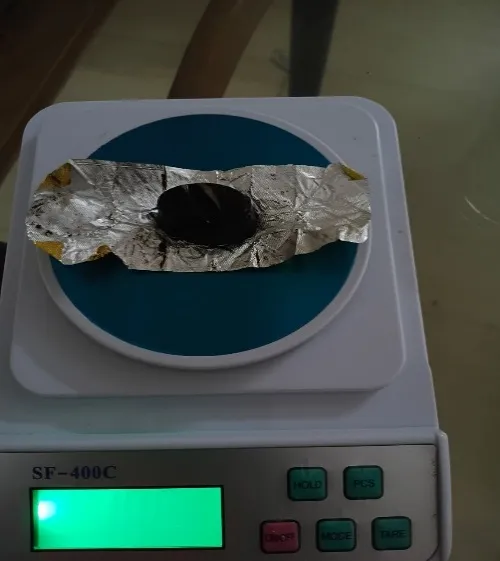
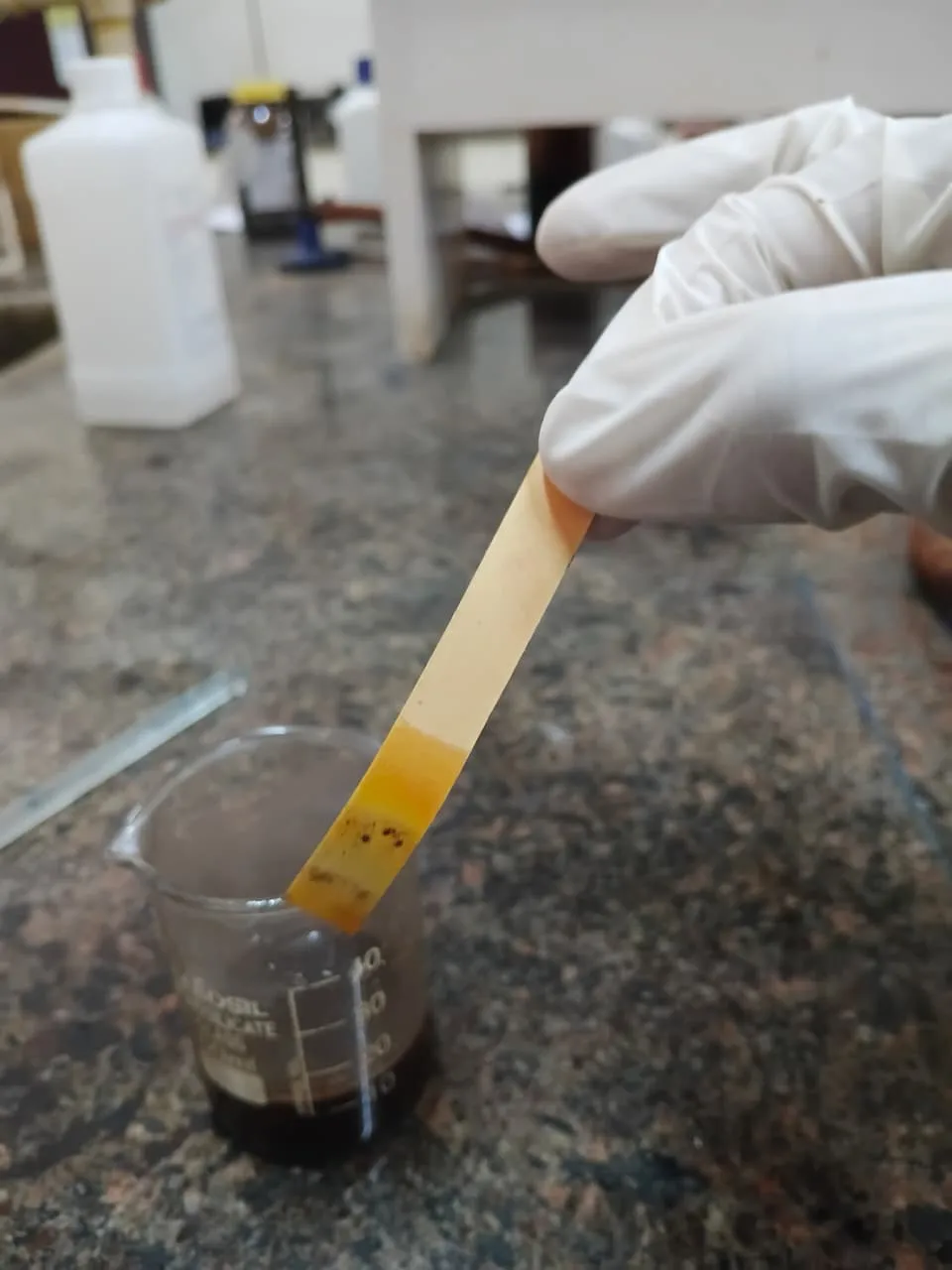
Figure 1: Evaluation tests
8. In Silico Study
Table -6
Docking Results
|
Ligand |
Target |
PDB ID |
Resolution |
Best Vina score |
|
Thymol |
α-Amylase |
1PPI |
2.20 Å |
−5.9 kcal/mol |
|
Menthol |
Pancreatic lipase |
1LPB |
2.46 Å |
−6.7 kcal/mol |
|
Bacoside |
Acetylcholinesterase |
1EVE |
2.50 Å |
−9.1 kcal/mol |
|
Eugenol |
GABA(_A) receptor α1β2γ2 |
6D6U |
3.92 Å |
−6.7 kcal/mol |
ADME Interpretation
Toxicity Prediction
Molecular docking was used to look at the possible interactions among four chosen phytoconstituents from CogniGut Chocolate, like thymol, menthol, bacoside and eugenol, with molecular targets that relate to digestive activity and the gut–brain axis kind of mechanisms. The ligand–target pairs we picked were thymol–α-amylase, menthol–pancreatic lipase, bacoside–acetylcholinesterase (AChE), and eugenol–GABA receptor, A
Docking itself was carried out with AutoDock Vina v1.2.7, using its scoring function plus a randomised, stochastic search strategy.
Protein Preparation
The target protein structures were fetched from the Protein Data Bank (PDB) and then prepped a bit prior to docking. Basically , non essential crystallographic waters and other unnecessary hetero bits were taken out, but cofactors plus key structural pieces were kept, when it actually made sense. After that, polar hydrogens were added, and the receptors got transformed into the specific docking format that was required. The targets chosen were porcine pancreatic α-amylase (PDB: 1PPI; 2.20 Å), the pancreatic lipase–colipase complex (PDB: 1LPB; 2.46 Å), acetylcholinesterase from Tetronarce californica (PDB: 1EVE; 2.50 Å), and a human α1β2γ2 GABA receptor (PDB: 6D6U; 3.92 Å).
Ligand Preparation
The three dimesional structures of thymol, menthol, bacoside, and eugenol were prepared by generating some molecular geometries , then adding hydrogen atoms, and finally assigning the right protonation states, you know. The ligands were converted into the docking-ready format, keeping rotatable bonds so there is this conformational freedom during the docking process, even if it may not look like much at first.
Docking Procedure
The prepared receptors were considered like rigid structures, while the ligand flexibility stayed there. Grid boxes were placed around the selected predicted binding regions of each target , and then the docking poses were ranked via the AutoDock Vina scoring function. After that, the top ranked poses were picked for further analysis , basically.
For the grid-center coordinates grid dimensions, exhaustiveness, the number of generated poses and the number of docking replicates , those were set using whatever options were already in the original AutoDock Vina configuration files. So these values should be reported exactly as they appear , from the saved docking configuration /output .
Thymol–α-Amylase:
Thymol turned out to have a predicted docking score of −5.9 kcal/mol, so that looks like a favorable kind of interaction with the chosen α-amylase binding place.
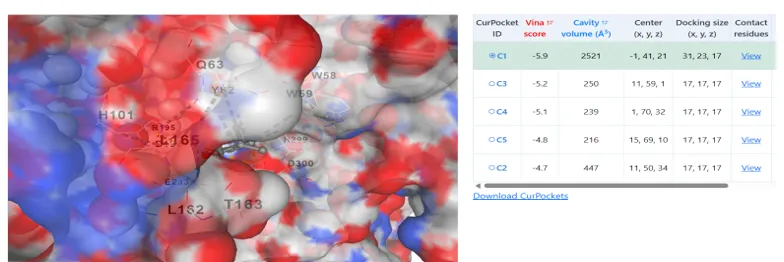
Figure 2: Thymol Docking Result
Menthol–Pancreatic Lipase:
Menthol had this predicted docking score of −6.7 kcal/mol, so it looked like there was a favourable kind of interaction around the pancreatic lipase binding area , in general.
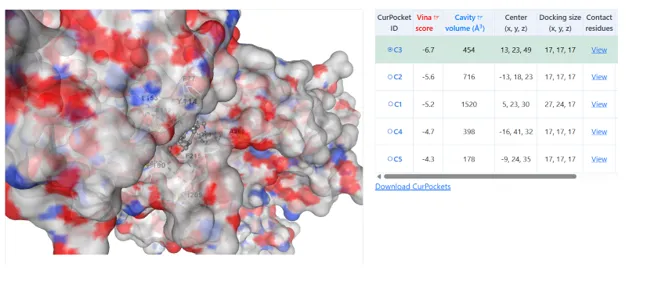
Figure 3: Menthol Docking Result
Bacoside–AChE:
Bacoside shows the most favorable predicted docking score across the evaluated combinations, it landed at −9.1 kcal/mol against AChE. For the dataset we have right now, that is the best computational score, but it still does not, on its own, really confirm experimentally strong binding.
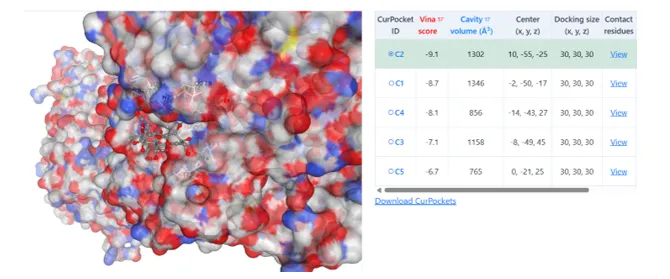
Figure 4: Bacoside Docking Result
Eugenol–GABA receptor:
Eugenol showed a predicted docking score of −6.7 kcal/mol, against the human α1β2γ2 GABA receptor. The +7.6 kcal/mol value that appeared in the docking output corresponded to the reference/template entry, so it was not the eugenol score. Because of that, −6.7 kcal/mol was kept for interpretation.
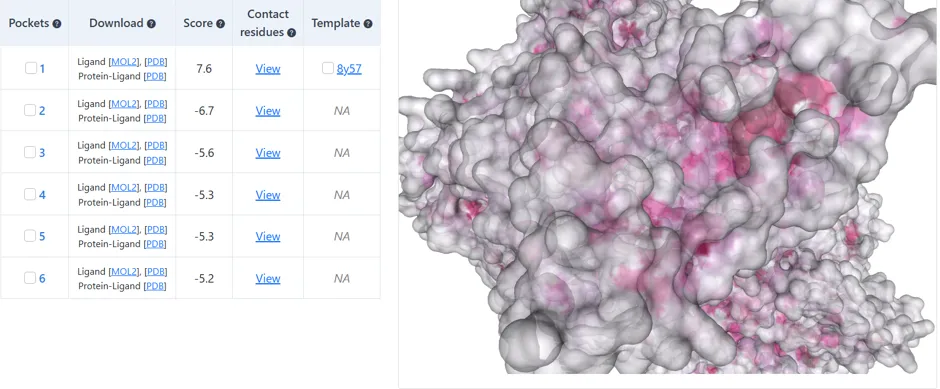
Figure 5: Eugenol Docking Result
Docking Score Interpretation:
The docking scores were treated mostly like relative, computational estimates using the same kind of docking protocol. General labels like “weak”, “moderate”, “strong” or “very strong” were not given, because AutoDock Vina scores depend on the scoring model and the search settings, so it’s kind of indirect. In that context bacoside showed the best predicted docking score, menthol and eugenol basically looked similar in their predicted scores , and thymol ended up with the less favorable score for the set that was tested. Also these numbers shouldn’t be viewed as experimentally determined binding affinities or anything like that.
Docking Protocol Validation
The docking protocol was kind of evaluated, using the crystallographic benzamidine- containing complex PDB ID 4COF as reference system. Redocking of the crystallographic ligand and the comparison of experimental vs predicted poses ,were done by looking at RMSD. In general, an RMSD around ≤2.0 Å is usually treated as acceptable for reproducing a crystallographic binding pose, that’s the idea. Still, the real RMSD you got from the redocking experiment needs to be reported, not just a guess. And you should only claim successful validation if the redocking and the RMSD calculation were genuinely carried out.
Overall Docking Finding
Overall, the docking study kind of gave computational backup for the proposed multi-target way of action of CogniGut Chocolate. Thymol looked like it could interact with α-amylase (−5.9 kcal/mol), menthol with pancreatic lipase (−6.7 kcal/mol), bacoside with AChE (−9.1 kcal/mol) and eugenol with the GABA A receptor (−6.7 kcal/mol). Among the combinations that were tested, bacoside turned out to have the most favorable predicted docking score. These results are computational and more like idea-generating steps , so they still need experimental validation, before any firm conclusions about pharmacological effects can really be stated.
The physicochemical as well as pharmacokinetic properties of thymol menthol bacoside, and eugenol were estimated with the SwissADME web server which was made by the Swiss Institute of Bioinformatics. This platform gives computational forecasts for physicochemical traits, stomach and intestinal uptake, blood brain barrier (BBB) permeability, overall drug-likeness, and medicinal chemistry parameters. The delivered outputs are basically in silico predictions and should be seen as early signs, not as things confirmed in actual bench experiments
Comparative SwissADME profile of selected compounds
Table 7
|
Parameter |
Thymol |
Menthol |
Bacoside |
Eugenol |
|
Molecular Weight (g/mol) |
150.22 |
156.27 |
768.97 |
164.20 |
|
Consensus Log P |
2.80 |
2.58 |
2.19 |
2.22 |
|
GI Absorption |
High |
High |
Low |
High |
|
BBB Permeation |
Yes |
Yes |
No |
Yes |
|
P-gp Substrate |
No |
No |
Yes |
No |
|
Lipinski Violations |
0 |
0 |
3 |
0 |
|
Bioavailability Score |
0.55 |
0.55 |
0.17 |
0.55 |
|
PAINS Alerts |
0 |
0 |
0 |
0 |
|
Brenk Alerts |
0 |
0 |
2 |
1 |
The SwissADME prediction suggested that thymol, menthol and eugenol had high predicted gastrointestinal absorption, while bacoside looked like low predicted GI absorption. It also looked like BBB permeability was supported for thymol, menthol and eugenol , so in the computational model there’s a possibility of central nervous system exposure. On the other hand bacoside showed several drug likeness rule violations, because it has a bigger molecular size and higher polarity. So, overall it seems the predicted pharmacokinetic profile might be rather different. Of course, these are in-silico observations, not experimentally validated pharmacokinetic outcomes, and they should not be treated as confirmed results.
We predicted the toxicity profile of the chosen bioactive compounds by using the pkCSM platform, it uses graph based machine learning models to approximate different toxicity related endpoints. The numbers you see here should be taken as computational toxicity predictions, not as experimentally confirmed toxicity outcomes, so keep in mind they are only an estimate, not real bench results.
Comparative pkCSM toxicity prediction
Tabl
Table -8
|
Toxicity Endpoint |
Thymol |
Menthol |
Bacoside |
Eugenol |
|
AMES Toxicity |
No |
No |
No |
Yes |
|
hERG I Inhibition |
No |
No |
No |
No |
|
hERG II Inhibition |
No |
No |
Yes |
No |
|
Hepatotoxicity |
Yes |
No |
No |
No |
|
Skin Sensitization |
Yes |
Yes |
No |
Yes |
|
Human MTD (log mg/kg/day) |
1.007 |
0.940 |
-1.566 |
1.024 |
|
Oral Rat LD50 (log mol/kg) |
2.074 |
1.946 |
2.707 |
2.118 |
|
Chronic LOAEL (log mg/kg/day) |
2.212 |
2.017 |
3.101 |
2.049 |
The pkCSM analysis suggested that the predicted toxicity profiles among the chosen compounds were kinda different. Thymol had predicted hepatotoxicity and also skin sensitisation signals, while menthol showed only a predicted skin sensitisation signal. Bacoside demonstrated a predicted hERG II inhibition liability, on the other hand eugenol showed a predicted AMES mutagenicity signal, together with skin sensitisation. Overall these results kinda work as computational toxicity alerts that should be followed up experimentally, not really as proof of actual toxicological effects.
9. Discussion
The study shows that a chocolate matrix can fairly well integrate digestive botanicals and adaptogens without messing up the sensory quality too much. The organoleptic success—taste, aroma, texture—kind of tackles the main issue with most traditional herbal dosage forms, which is basically poor compliance .
From a formulation view , the cocoa butter phase helps with controlled melt and release, and it also boosts the solubility of lipophilic actives like thymol menthol, and eugenol. Adding honey plus stevia does taste masking in a way that avoids an excessive caloric burden , while gum acacia supports dispersion and overall stability.
The evaluation results confirm dose uniformity, good melting behaviour, low moisture, and surface stability , so the product looks suitable for storage and routine use. Also, the in-silico part gives some mechanistic backing: enzyme interactions (amylase , lipase) relate to digestion, and the AChE interaction seems tied to gut–brain modulation.
ADME predictions generally match real-world expectations—good GI absorption and moderate bioavailability especially for lipophilic compounds, aided by the lipid matrix . Toxicity predictions suggest no big red flags at functional doses, though they still underline the need for strict dose control and proper safety assessments.
All together, these findings support the idea that an adaptogenic digestive chocolate can deliver multiple benefits with good acceptability, basically bridging nutraceutical efficacy with day-to-day user experience.
10. Future Scope
The developed CogniGut Chocolate, may be further enhanceed via the use of smart packaging technologies, or at least that’s how it goes in practice. A QR code based information system could be stitched directly into the product packaging to give consumers immediate access to product information , ingredient details nutritional facts, mechanism of action, scientific evidence,and clear usage instructions. In this way, the approach might boost consumer awareness, increase product transparency, and keep people more involved, while also supporting the commercialization of the formulation as a modern nutraceutical type of product.
11. CONCLUSION
A new adaptogenic digestive chocolate, kinda successfully developed using a cocoa based delivery system, and it included digestive herbs like ginger, ajwain, cumin, mint, cardamom, as well as adaptogens such as Tulsi and Brahmi. The final blend showed excellent sensory acceptance, plus sturdy physicochemical stability—especially in terms of melting behavior that was on point, low moisture content and a weight that stayed consistent over time
The in silico work suggested multiple target interactions, where there was moderate to strong binding with digestive enzymes, and also a quite strong interaction with a neurological target, specifically AChE. So overall it kinda backs both digestive support and adaptogenic action at the same time. ADME assessment pointed towards favourable oral uptake and bioavailability, whereas toxicity predictions leaned toward an acceptable safety profile, though only when dosing is controlled properly
Taken together, this formulation feels like a patient friendly, innovative nutraceutical—because it tries to balance efficacy, safety, and compliance. After additional validation through in-vitro and in-vivo experiments, it could have a strong chance for commercial scale as a functional digestive option aimed at gut well being and stress related GI discomfort too.
REFERENCES


Annan Ghosh*, Dr. Aysha Siddika, Dr. Kavita P.N., Development, Evaluation and In Silico Study of QR-Enabled CogniGut Chocolate for Gut-Brain Axis Support and Digestive Wellness, Int. J. of Pharm. Sci., 2026, Vol 4, Issue 9, 4251-4264. https://doi.org/10.5281/zenodo.23062111
 10.5281/zenodo.23062111