

We use cookies to ensure our website works properly and to personalise your experience. Cookies policy
R. G. Sapkal College of Pharmacy, Anjaneri, Nashik.
The present study was carried out to prepare and evaluate a herbal formulation containing parthenium hysterophorus extract and turmeric for potential anticancer activity. The ethanolic extract of the plant material was prepared using suitable extraction method and further incorporated into the formulation. Various evaluation parameters such as description study, solubility study, pH determination, assay, percentage yield, foreign particle test, microbiological test, environmental condition test, stability study, and diffusion study were performed.UV spectrophotometric analysis was carried out for quantitative estimation of the formulation and the calibration curve showed good linearity with satisfactory correlation coefficient value. The formulation exhibited acceptable physical appearance, good stability, suitable pH, and satisfactory drug content. No forging particle and microbial contamination were observed during the study. The formulation also shows satisfactory stability under different environmental and storage condition The overall results indicated that the prepared herbal formulation passed good pharmaceutical characteristics and may be useful for further studies related to anticancer activity and drug delivery application.
Traditional phytomedicines are widely used as a primary health care option for nearly 75% to 80% of the world’s population because they are affordable and usually have fewer side effects. Herbal medicines have been used for many years to treat different diseases and also help in strengthening the immune system against various health problems. The beneficial effects of medicinal plants mainly come from the presence of different bioactive compounds produced through their natural metabolic processes. Cancer is a leading cause of mortality worldwide. Modern chemotherapeutics often cause severe toxicity. The parthenium hysterophorus and turmeric are show Anti-cancer activity and anti-Inflammatory activity.[1]
Parthenium hysterophorus is herbaceous flowering species belonging to family Asteraceae. It contains so many chemical constituents such as Sesquiterpene lactones, Flavonoids and Phenolic acids and etc. Parthenium hysterophorus also known as Congress weed, Carrot grass, wild fever, bitter weed, star weed, white top and some peoples as called “Scourge of India”. It is agricultural weed rapidly spreading through out Asia and other areas beyond its native range in the central region. In parthenium hysterophorus Parthenin (Sesquiterpene lactones) are the main chemical compound that show Anti-cancer activity. This compound is quire some type of cancer treatment such as Breast cancer (MCF-7), Liver cancer (HepG2), Colon cancer (HT-29), acute leukemia cancer (HL-60) and Promyelocytic leukemia cancer (THP-1). [1,2,3]
Table No.1: Parthenium hysterophorus (parthenin) Discerption
|
Property |
Description |
|
Plant Name |
Parthenium Hysterophorus |
|
Drug Name |
Parthenin |
|
Chemical Structure |
Sesquiterpene lactone |
|
Molecular Formula |
C15H18O4 |
|
Molecular Weight |
262.3 g/mol |
|
Solubility |
Soluble in Water And ethanol |
|
Melting point |
163 -166 0C |
|
Appearance |
Dark Green Color |
|
Identification |
UV Spectroscopy IR Spectroscopy |
|
Category |
Anticancer Activity |
Turmeric, a rhizomatous herbaceous eternal plant (Curcuma longa) it’s belonging to family Zingiberaceae it has been received attention due to its immense anti-oxidant, anti-inflammatory, anti-mutagenic, anti-microbial, anti-cancer and analgesic activity. These medicinal values of turmeric are mainly ascribed to curcumin. Curcumin known chemically as 1,7-bis-(4-hydroxy-3- methoxyphenyl)-hepta-1,6-diene-3,5-dione, is a lipophilic polyphenol believed to exhibit anticancer, antibiotic, anti-inflammatory, and anti-aging properties, as indicated by various in vitro, in vivo studies, and clinical trials. Despite its potential, the therapeutic application of curcumin is hindered by challenges such as poor aqueous solubility, limited bioavailability, and unfavourable pharmacokinetic profiles. To overcome these issues, numerous formulations of curcumin have been developed. [4,5,23]
Table No. 2: Turmeric (curcumin) Description
|
Property |
Discerption |
|
Plant Name |
Turmeric |
|
Drug Name |
Curcumin |
|
Chemical Structure |
Curcuminoids |
|
Molecular Formula |
C21H20O6 |
|
Molecular Weight |
368.39 g/mol |
|
Solubility |
Poorly Soluble in water and sparingly soluble in Lipophilic Solutions |
|
Melting Point |
1830C |
|
Appearance |
Yellow And Orange Colour |
|
Identification |
UV Spectroscopy IR Spectroscopy |
|
Category |
Anti-inflammatory Anti-cancer Anti-oxidant |
Parenteral dosage forms are sterile pharmaceutical preparations that are administered directly into the body through injections, bypassing the gastrointestinal tract. The term “parenteral” refers to the administration of drugs outside the intestine. These dosage forms are particularly useful when a rapid therapeutic effect is required, when the drug is unstable in the digestive system, or when the patient is unable to take medicines orally. Common routes of parenteral administration include intravenous, intramuscular, subcutaneous, and intradermal injections. Parenteral preparations must be carefully manufactured to ensure sterility, absence of pyrogens, and freedom from particulate matter in order to maintain patient safety. Since the drug is delivered directly into the bloodstream or body tissues, parenteral dosage forms provide faster action and better bioavailability compared to oral medications. Although they offer several advantages such as accurate dosing and rapid drug action, these formulations require strict sterile conditions during preparation and administration to prevent infection and ensure drug stability.
Breast cancer is heterogeneous and one of the most common cancers affecting women worldwide. Breast cancer is not a single disease but includes different subtypes, and each behaves differently in the body. These subtypes are mainly identified based on hormone receptors (ER, PR) and HER2 status, which help doctors decide the most suitable treatment and predict the outcome. For example, Luminal A type usually has a good prognosis because it is ER and PR positive with low growth rate (low Ki-67), and it responds well to hormonal therapy. Luminal B type is slightly more aggressive, showing higher cell growth, so patients often need both chemotherapy and hormonal treatment. In the case of HER2-enriched subtype, the cancer cells produce excess HER2 protein, but targeted drugs specifically designed for HER2 have significantly improved patient outcomes. On the other hand, triple-negative breast cancer does not have ER, PR, or HER2 receptors, making it more aggressive and difficult to treat, although newer treatments like immunotherapy are now being explored. Overall, understanding these subtypes is very important, as it helps in selecting the right treatment and improving patient care. [25,26,27,28]
The younger parthenium hysterophorus are collected from well maintain agriculture and Turmeric rhizome are collected from college medicinal garden. The Parthenium & Turmeric are wash with water and remove the impurity form plant and then dry at the Room 250C. and also for extraction process Soxhlet apparatus are used. Identification and authentication of theses leaves were done at Analytical lab. Also, Ethanol as a solvent and Tween 80 as a Surfactant are used provided form College chemical storeroom. We use some instrument for analysis purposed we used UV spectrophotometer, pH meter, Weighing Balance, and some other instrument form college instrumental room & machine room. And IV formulation conformation test are performed in Analytical Lab.
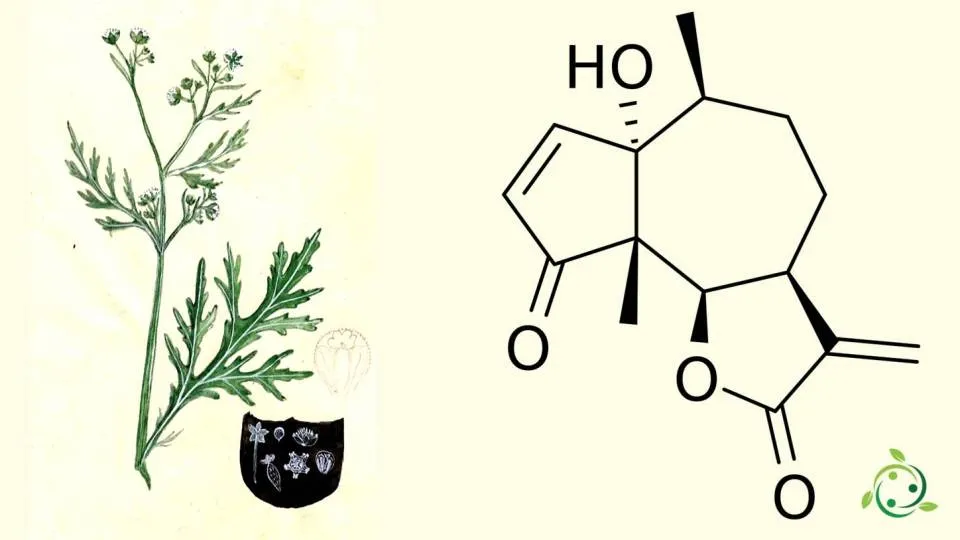
Figure 1. Parthenium hysterophorus (Parthenin)
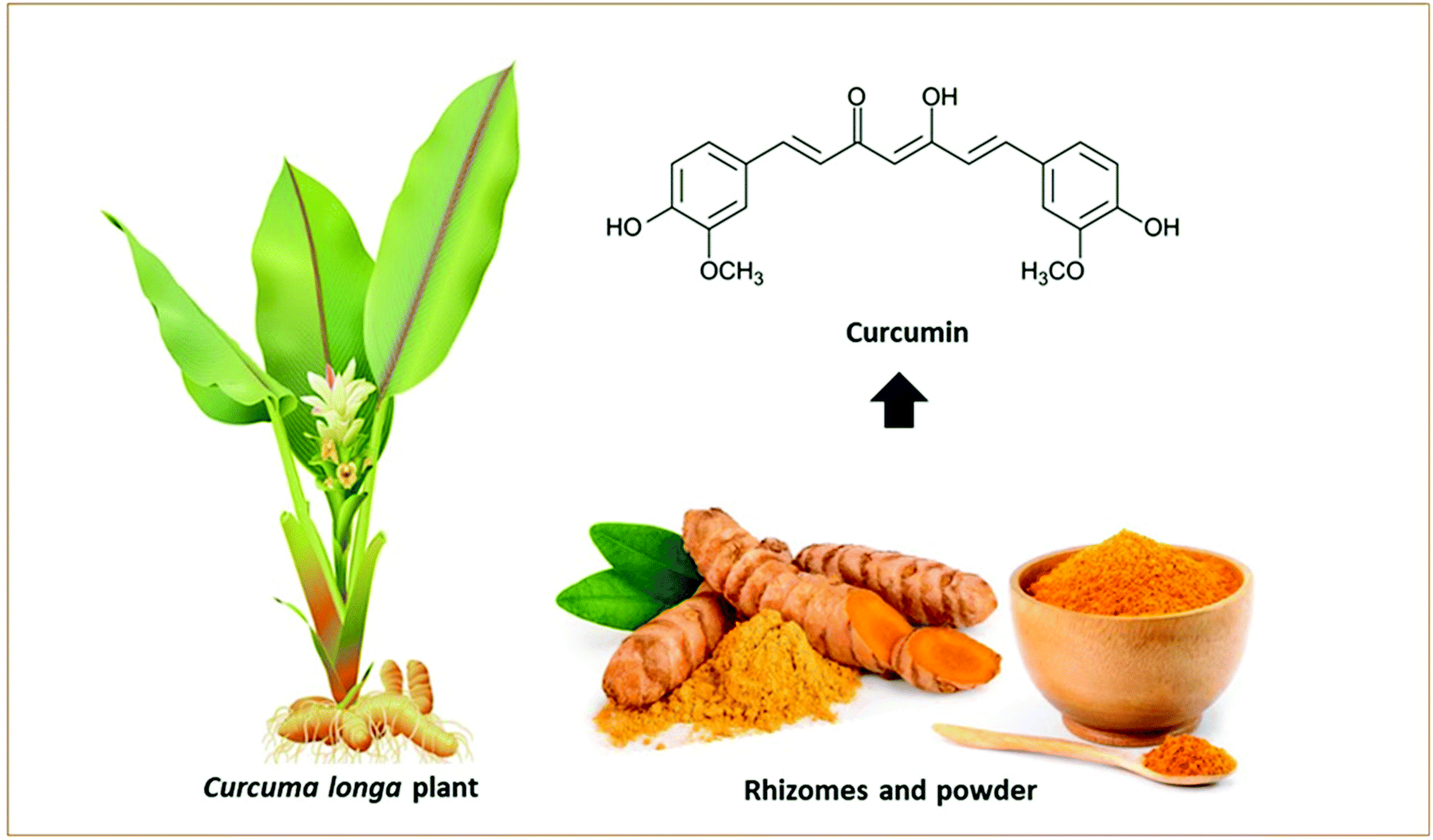
Figure 2. Turmeric (curcumin)
Preparation of Ethanolic Extract of Parthenium hysterophorus (PH):
The shed dried plant of parthenium hysterophorus were crumbled by a mechanical grinder and after grinding dry the powder in shed and then the grind powder passed to sieve to remove unwanted particles. We have used Soxhlet apparatus for the extraction of parthenin with the help of ethanol as a solvent, for that we have maintained the temperature at 75 to 800 C, this process is kept for 6 – 8 hours till the extract gets, after completing the extraction process evaporate the ethanol by using the simple distillation process or rotary evaporator method.[6,8,10,14]
Preparation of Ethanolic Extract of Turmeric:
The shed dried turmeric rhizomes were pulverized into fine powder in a mechanical grinder and then passed the powder into sieve for proper fine powder obtain. We are used Soxhlet apparatus for the extraction of curcumin with help of ethanol as a solvent, for provide a 70 0C. than competed the extraction process evaporate the ethanol by using the simple distillation process or rotary evaporator method.[23]
Preparation of Parthenium hysterophorus-Turmeric IV:
First offal we prepare Turmeric (Curcumin) solution, in this take some amount of turmeric extract powder Dissolve in Ethanol than add some amount of tween 80 for turmeric powder properly soluble in ethanol than heat this solution for 2 to 3 min. at 500C to remove small amount of ethanol and then Add Parthenium hysterophorus ethanolic extract (Parthenin) at continues stirring after adding than filter the Solution than add water for injection for volume make up.
This prepared IV solution fill into the stirred injection vial after filling this vial is sterilized into autoclaved.
In experimental work we prepared and evaluated the anticancer IV of parthenium hysterophorus and turmeric are show combine effect. They both treat the cancer cell to prevent abnormal cancer cell growth. In this we first prepared parthenium hysterophorus and turmeric ethanolic extract than we prepare the IV formulation they show combine effect on breast cancer (MCF-07). After preparation we perform some analytical study on the prepared formulation. In analytical study we performed some stability testing like Description, Solubility, pH, Identification test, foreign particle test, etc.
Stability Study:
Observation Table:
Table No.3: pH Observation table
|
Parameter |
Observation |
|
pH of Formulation |
6.8 – 7.8 |
Observation Table:
Table No.4: Foreign particle test Observation table
|
Parameter |
Observation |
|
Method Used |
Visual Inspection |
|
Foreign Particle |
Not observed |
|
Appearance |
Clear And Homogenous |
Observation Table:
Table No. 5: Environmental condition Observation table
|
Storage Condition |
Observation |
|
Room Temperature |
Stable, no phase separation |
|
Refrigerated Condition |
Stable, no visible change |
% Yield = Weight of the Sample extract *100
Initial wight of sample
Table No. 6: Organoleptic Study
|
Sr No. |
Description |
Observation |
|
|
Colour |
Yellowish Brown |
|
|
Odor |
Characteristic |
|
|
Texture |
Liquid |
Table No. 7: UV Spectrophotometer Absorbance
|
Sr. No. |
Concentration |
Absorbance |
|
|
2 |
0.029 |
|
|
4 |
0.073 |
|
|
6 |
0.101 |
|
|
8 |
0.132 |
|
|
10 |
0.164 |
|
|
16 |
0.27 |
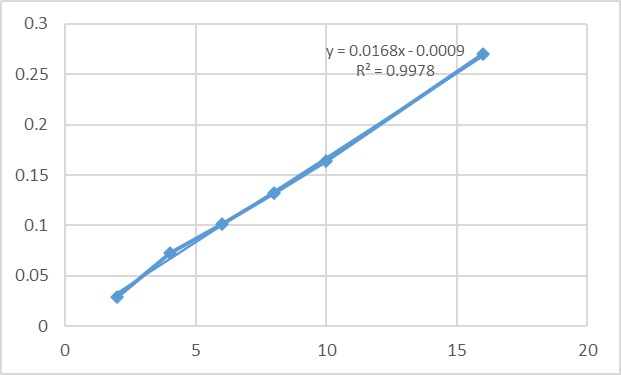
Figure 3:UV Spectrophotometer
Table No.8: All Sample Absorbance
|
Time |
Absorbance |
||
|
B1 |
B2 |
B3 |
|
|
0 |
0 |
0 |
0 |
|
30 |
0.087 |
0.119 |
0.111 |
|
60 |
0.112 |
0.134 |
0.237 |
|
120 |
0.162 |
0.147 |
0.363 |
|
180 |
0.212 |
0.161 |
0.422 |
|
240 |
0.522 |
0.175 |
0.48 |
|
300 |
0.543 |
0.203 |
0.489 |
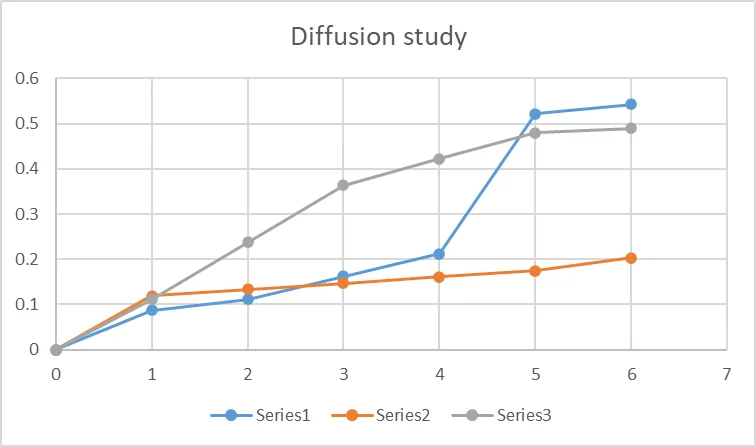
Figure 4: All Sample Drug release
Based on the diffusion study, Batch B3 showed a comparatively better and more consistent drug-release profile than B1 and B2. B3 exhibited a progressive increase in absorbance from 0.111 at 30 minutes to 0.489 at 300 minutes, indicating sustained drug diffusion over the study period. Therefore, Batch B3 (Serie s3) was selected as the optimized batch for further studies due to its desirable and sustained drug-release characteristics.
Table No.9: Batch no. 3 Drug release study
|
Time (Min.) |
Absorbance |
Concentration |
Dilution factor |
Concentration in 5ml (in mg) |
Cumulative amount (mg) |
Cumulative amount permeated per cm2 |
|
0 |
0 |
0 |
0 |
0 |
0 |
0 |
|
30 |
0.111 |
6.607142857 |
66.07142857 |
0.330357143 |
0.33 |
0.1875 |
|
60 |
0.237 |
14.10714286 |
141.0714286 |
0.705357143 |
1.035357143 |
0.588271104 |
|
120 |
0.363 |
21.60714286 |
216.0714286 |
1.080357143 |
2.115714286 |
1.20211039 |
|
180 |
0.422 |
25.11904762 |
251.1904762 |
1.255952381 |
3.371666667 |
1.915719697 |
|
240 |
0.48 |
28.57142857 |
285.7142857 |
1.428571429 |
4.800238095 |
2.727408009 |
|
300 |
0.489 |
29.10714286 |
291.0714286 |
1.455357143 |
6.255595238 |
3.554315476 |
Table No.10: Diffusion Study
|
Time (Min.) |
% Drug Release |
|
0 |
0 |
|
30 |
5.27 |
|
60 |
16.55 |
|
120 |
33.82 |
|
180 |
53.9 |
|
240 |
76.74 |
|
300 |
100 |
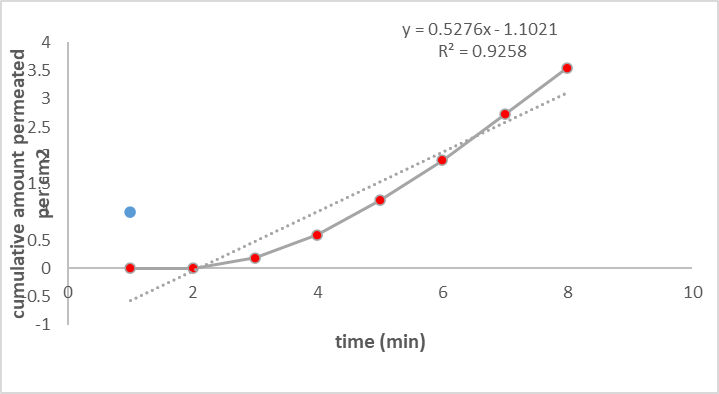
Figure 5: Batch 3 Drug release
Table No. 11: Zero Order
|
Sr. No. |
Time |
Zero order |
|
|
0 |
0 |
|
|
30 |
6.607142857 |
|
|
60 |
14.10714286 |
|
|
120 |
21.60714286 |
|
|
180 |
25.11904762 |
|
|
240 |
28.57142857 |
|
|
300 |
29.10714286 |
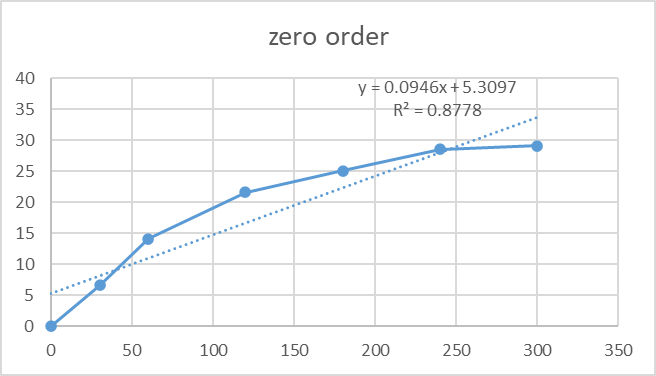
Figure 6: Zero Order
Table No. 12: First Order
|
Sr. No. |
Time |
First order |
|
|
0 |
0 |
|
|
30 |
0.82001 |
|
|
60 |
1.14944 |
|
|
120 |
1.3346 |
|
|
180 |
1.4 |
|
|
240 |
1.45593 |
|
|
300 |
1.464 |
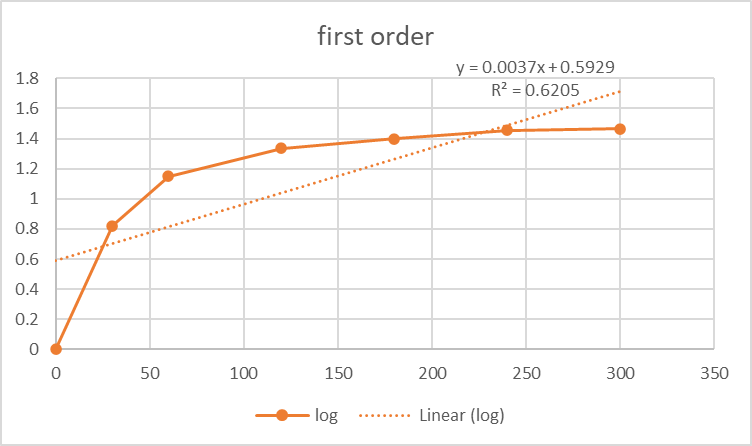
Figure 7: First order
Table No.13: Second Order
|
Sr. No. |
Time |
Second order |
|
|
0 |
0 |
|
|
30 |
0.15135 |
|
|
60 |
0.07089 |
|
|
120 |
0.04628 |
|
|
180 |
0.03981 |
|
|
240 |
0.035 |
|
|
300 |
0.03436 |
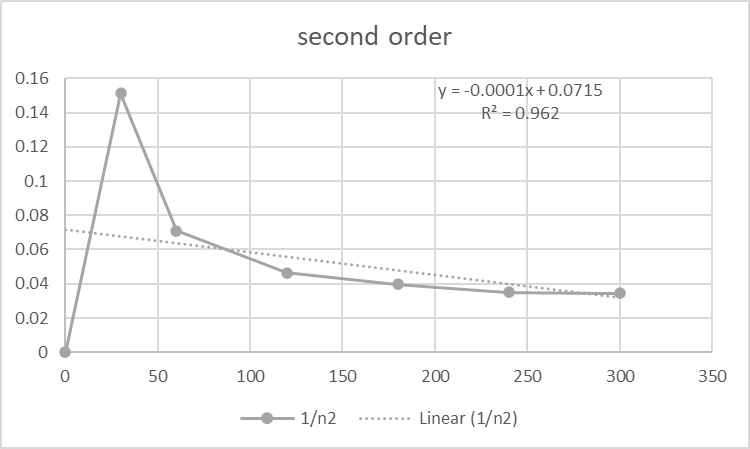
Figure 8:Second order
Table No.14: Higuchi Model
|
Time |
SQRT |
% Drug release |
|
0 |
0 |
0 |
|
30 |
5.477226 |
5.27 |
|
60 |
7.745967 |
16.55 |
|
120 |
10.95445 |
33.82 |
|
180 |
13.41641 |
53.9 |
|
240 |
15.49193 |
76.74 |
|
300 |
17.32051 |
100 |
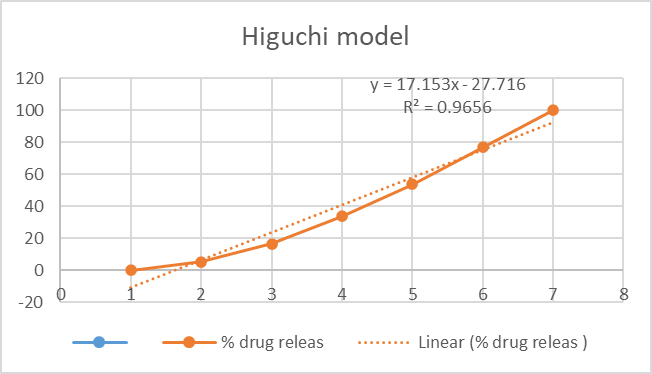
Figure 9: Higuchi model
Table No. 15: Korsmeyer Peppas
|
Time (min) |
concentration(microgram/ml) |
Fit |
SD |
|
0 |
0 |
0 |
0 |
|
30 |
6.607142857 |
9.575194436 |
8.809330177 |
|
60 |
14.10714286 |
13.66554382 |
0.195009713 |
|
120 |
21.60714286 |
19.50321627 |
4.426507112 |
|
180 |
25.11904762 |
24.01435046 |
1.220355805 |
|
240 |
28.57142857 |
27.8346365 |
0.542862561 |
|
300 |
29.10714286 |
31.21165418 |
4.428967914 |
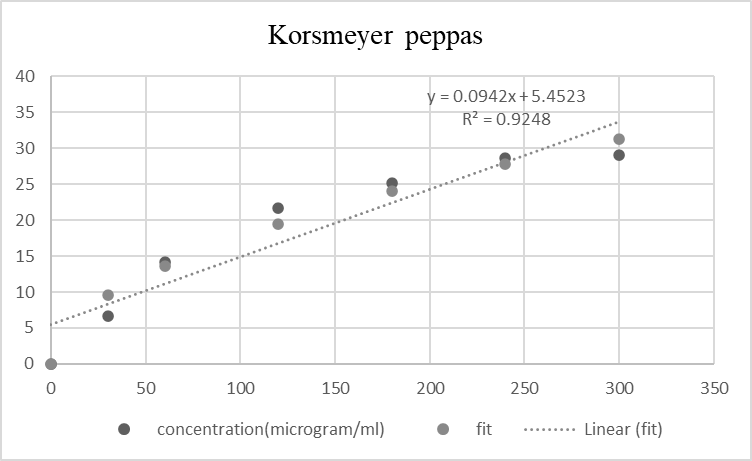
Figure 10: Korsmeyer Peppas
To determine the mechanism of drug, release the diffusion data was fitted into different kinetic model such as zero order, first order, second order, Higuchi model and Korsmeyer Peppas. The regression coefficient (R2) values obtained from the kinetic study indicated that the formulation followed Higuchi model drug release kinetic with good linearity compared to other kinetic models.
Table No.16: Model fitting of the release profile of optimized formulation
|
Batch |
Kinetic Model R2 |
||||
|
B3 |
Zero Order 0.8778 |
First Order 0.6205 |
Second Order 0.962 |
Higuchi 0.9656 |
Best Fit Model Higuchi |
|
Korsmeyer Peppas Equation |
|||||
|
B3 |
R2 0.9248 |
K Value 1.67161 |
n Value 0.513117 |
Mechanism Non Fickian Super Case II |
|
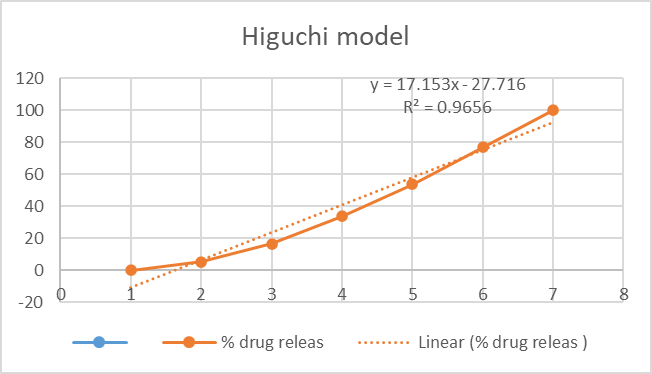
Figure 11: Higuchi Model
The obtained results confirmed that the prepared formulation passed satisfactory diffusion characteristics and controlled drug release behavior suitable for further pharmaceutical and anticancer application.
SUMMARY AND CONCLUSION:
The present study successfully prepared and evaluated an herbal formulation containing Parthenium hysterophorus extract and turmeric. The ethanolic extract showed satisfactory percentage yield and was effectively incorporated into the formulation. Various evaluation parameters including description study, solubility study, pH determination, assay, foreign particle test, microbiological test, environmental condition test, stability study, and diffusion study were carried out successfully. The formulation showed good physical appearance, acceptable pH, satisfactory drug content, and excellent stability under different storage conditions. No microbial contamination or foreign particles were observed during the evaluation studies. The UV spectrophotometric method showed good linearity and accuracy for quantitative estimation of the formulation. Based on the obtained results, the prepared formulation was found to possess satisfactory pharmaceutical properties and may be considered suitable for further research related to anticancer activity and advanced drug delivery applications
REFERENCES



Ashutosh Wagh, Shruti Vaze, Jagruti Patil, To Develop and Characterize a Novel Herbal Extract Formulation for enhanced Anticancer efficacy, Int. J. of Pharm. Sci., 2026, Vol 4, Issue 10, 102-119, https://doi.org/10.5281/zenodo.23074475
 10.5281/zenodo.23074475